MISSION

We are here to encourage the development of gifted young singers and to stimulate the growth of New York City's invaluable chamber opera companies. But we will not neglect the Metropolitan Opera either. Get ready for bouquets and brickbats.

Saturday, February 26, 2022

PAST, PRESENT, AND FUTURE

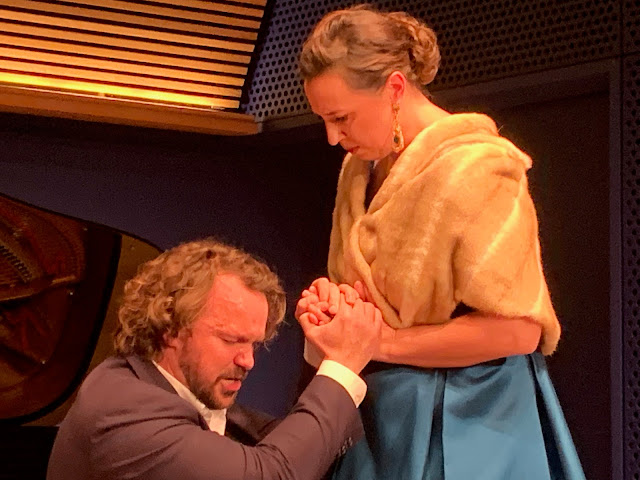
Donata D'Annunzio Lombardi and John Viscardi


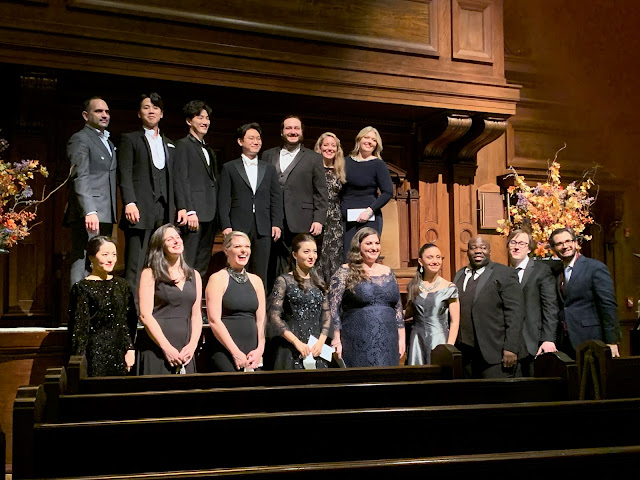
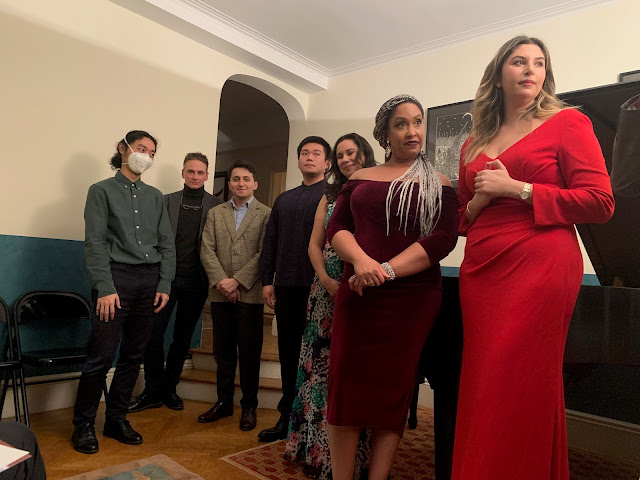
On Wednesday evening we were privileged to attend Classic Lyric Arts' "Concert at the Castle" along with a crowd of CLA Supporters, all of whom were delighted to witness the past, present, and future of this estimable program. A warm welcome from Founder and Artistic Director Glenn Morton, well known in operatic circles for his astute coaching and pedagogy in all three NYC music conservatories, introduced us to the myriad achievements of CLA--not only the immersive programs in Italy and France but the newly initiated program in the Berkshires which began last summer, focusing on the operas of Mozart.

Representing the past of CLA was tenor John Viscardi, a major light on American opera stages, who serves as Executive Director of CLA. Mr. Viscardi is an alumnus of both CLA's French program and Italian program; his linguistic facility gives evidence.  He opened the concert program with the tender "Chanson Triste" by Duparc. The performance was marked by perfect French diction (of course) and consummate expressiveness, alternating tender moments with expansive ones. He also closed the program performing a stunning duet with a surprise guest artist; we are going to keep you guessing her identity until the end of the review.

Another alumna of CLA is the lovely Daniela Magura, a beautiful mezzo-soprano with a luscious tone. She showed off her fine French in "Tristes apprêts", an aria from Rameau's Castor et Pollux that was new to our ears.  Her "Habanera" from Bizet's Carmen, on the other hand, is almost overly familiar but we always enjoy hearing a singer whose take on the character is a bit different.  Ms. Magura's Carmen is more subtle than most, so confident in her ability to seduce that she can underplay it, thereby avoiding all the encrusted clichés. What an advantage to hear her diversity in two such different arias and to hear French sung so authentically in Gallic style.  More credit to CLA's French program which she attended twice.

Baritone Jared Werlein is new to us and we are always happy to hear a singer with comedic flair.  He is a student of Mr. Morton at Juilliard and his fluency in Italian surely comes from his prior attendance at CLA's Italian program. We were able to appreciate his ability to go from the well-known classic ("Madamina, il catalogo è questo" from Mozart's Don Giovanni) to a delightful 20th c British song, "The green-eyed dragon" by Wolseley Charles. The lyrics were so clever in their rhymes and the music so tuneful that we plan to search out more of Mr. Charles' music. Mr. Werlein did justice to both styles, more evidence of the versatility that we admire. 

Tenor Michael McDermott, another student of Mr. Morton at Juilliard,  also chose two very different pieces. His Italian selection was the well known and beloved Tosti song "Non t'amo piu" which he sang with Italianate passion and the multiplicity of emotions that the librettist intended. His use of pacing and dynamic variation brought intensity to the performance. Quite different was his more delicate delivery of "Ah, lève-toi soleil" from Gounod's Roméo et Juliette in which he showed an easily produced upper register and pleasing French which will be fine tuned this coming summer at CLA's French program.

New to CLA and representing its future is the beautiful soprano Julianne Casey who also alternated a French selection with an Italian one. "Il est doux, il est bon" from Massenet's Hérodiade was sung with youthful rapture and some lovely resonance in the upper register. We liked the expansive top in "Se come voi piccina" from Le Villi, an early opera by Puccini with which we are unfamiliar. We cannot wait to hear her after her attendance at CLA's Italian program next summer.

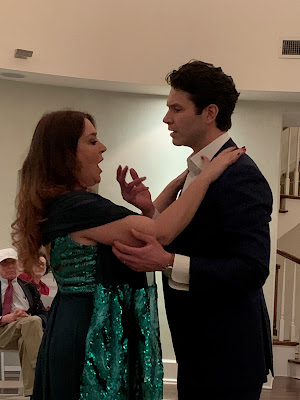
And now we will tell you dear reader, as promised, about the stunning surprise climax to the program. One of Europe's most sought after sopranos, Donata D'Annunzio Lombardi, performed the role of Tosca in the first act duet, with Mr. Viscardi as her Mario. We found ourselves captivated not only by the vocal excellence but by the characterization given by Ms. D'Annunzio. We felt as if we really understood Tosca, not only her devotion to Mario but the insecurity that underlay her display of jealousy and the good will that allowed her to turn the jealousy into a little tease.

Ms. D'Annunzio Lombardi is on the faculty of CLA and brings to their programs a very unusual method of teaching, the likes of which we have never seen. Suffice it to say that the changes wrought by her tutelage have been astonishing. We have the greatest respect for results and for those master teachers that add value. Students can consider themselves extremely fortunate to fall into her hands.

The collaborative pianist for the evening was the gifted Xu Cheng who never fails to keep pace with the singers and permits all of them to shine in their own fashion.

We advise keeping an eye on Classic Lyric Arts.  Their history is significantly worthwhile, their present shows the flexibility demanded by the Covid pandemic, and they have a brilliant future as they expand in new ways, some of which are in the works and some of which we foresee in our crystal ball.

If you, dear reader, care to see photos of the event, they will be on our FB page--Voce di Meche.

© meche kroop

Saturday, December 18, 2021

IF THE SHOE FITS


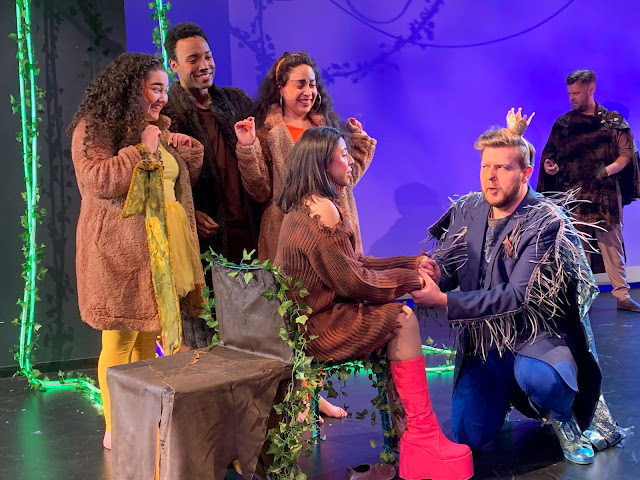
 Allie Altieri, Joseph Parrish, Linda Collazo, Shaina Martinez, and Nicholas Huff

Not 5 minutes past the curtain call we wanted to see Pauline Viardot's Cendrillon over again.  Where was the repeat button? We relished every moment of this charming work brought to the stage by City Lyric Opera, a most worthy company with high ideals. Helmed by Megan Gillis, CLO aims to provide quality art at affordable prices, providing opportunities for young artists with the aim of diversity and inclusivity.

Career advancement is not easy for female conductors and we were thrilled to see the young rapidly rising Maestro Michelle Rofrano on the podium leading an energetic and light-hearted reading of Pauline Viardot's telling of the Cinderella tale. The chamber orchestra was with her every step of the way. There were the requisite strings augmented by one each of flute, oboe, clarinet, bassoon, and horn. The plangent sound of the harp wove it all together. The melodic score has the flavor of French music hall, which we see as a good thing. Mo. Rofrano played the score as a light-hearted and enchanting bauble.

Onstage, in the role of Marie (Cendrillon) we had the rising star soprano Shaina Martinez who never fails to deliver a carefully thought out performance that somehow manages to appear spontaneous. Her rich voice lends itself to a variety of roles that we have heard her sing and this is just one more feather in her cap. Her Marie was no scullery maid but rather an overlooked member of a detestable family. Her voice conveyed more hope than despair with some winning coloration that made her relatable.

Her two Karens (oops, I meant step-sisters) demanded her help and services. Soprano Allie Altieri as Maguellone and mezzo-soprano Linda Collazo as Armelinde were as fine together as they were separately. Their  vocal coloration was exactly the opposite of Ms. Martinez'. Their facial expressions and body language were perfectly emblematic of their characters and absolutely hilarious.

In the role of La Fée we heard the extraordinary crystalline coloratura of Yejin Lee, singing in delightful bel canto style involving stunning fioritura.  Le Prince Charmant was sung by Nicholas Huff whose warmth of tone and ardent demeanor had him rise above some staged goofiness. The love duet with Cendrillon was beautifully realized by both artists. As his chamberlain Le Comte Barigoule, we heard tenor Corey Don whose fine voice and figure made it easy to believe the role reversals.

Cendrillon's father is usually portrayed as a henpecked husband who dares to show sympathy for his daughter only behind his wife's back; but in this case he is portrayed as a former dishonest merchant who has risen in status to that of Baron Pictordu. We did not quite catch how that was accomplished but there was a reference in the libretto that must have been a secret joke in Ms. Viardot's circle. The superb bass-baritone Joseph Parrish gave him the attitude of un parvenu  and filled out the character with a full rich sound. 

This one hour opera was written for Viardot's  students when she was rather advanced in years. It was likely performed at one of her salons. None of the sadistic parts of the Perrault fairytale were in evidence, nor any of the Disneyfied padding. This was a simple story of a neglected young woman whose good heart wins the affection of a prince, even though she doesn't know his identity. And it's also the story of a grasping family that has scapegoated her. Her kindness wins out in the end.

Let us not neglect the excellent chorus comprising Luxana Zepedas, Mithuna Sivaraman, Erin Rosales, Brian Jeffers, Ramon Gabriel Tenefrancia, and Nathaniel Mattingly.

The direction by Rose Freeman was right on point, giving everyone a chance to develop a unique character. There were a number of clever devices to enjoy as when La Fée asks Cendrillon to fetch a pumpkin and then to throw it out the window where it becomes a coach--projected on the upstage screen.  Similar devices were used for the horses and coachman. 

Rhea D'Souza is credited as Projection Designer and we found her projections to be a fine replacement for elaborate sets. We have been annoyed as of late by artsy-fartsy projections that distracted from the singing and staging.  Not so here. Every projection set the stage, so to speak, and contributed to the storytelling. 

Lina Younes was credited as Scenographer and Lighting Designer was Charlotte McPherson. No one is credited for the costumes but they evinced creativity and wit that exceeded what appeared to have been a modest budget. We were particularly taken with Cendrillon's "slippers"--shocking pink platform boots!

Although there was minimal dialogue in English, the opera was sung in beautiful French, translated by Quentin Bruno and projected onstage so that every member of the audience had a good view. 

The only information we are missing is the identity of the orchestrator. The work was written for piano accompaniment; perhaps Ms. Viardot did the orchestration herself. In any case it surely gave Mo. Rofrano some beautiful lines to work with.

In these trying times, light-hearted fun is just what we need. That being said, we would still want to hear this enchanting bauble even in the best of times. What an excellent choice for this company to have made!

© meche kroop

Friday, December 17, 2021

FUN(D) RAISING


 John Taylor Ward, Elliott Paige, Alissa Anderson, and Samarie Alicea

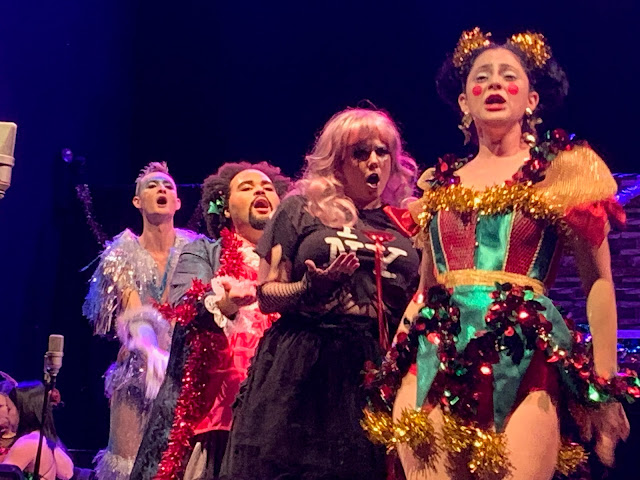
Last night marked a major event on the New York music scene. It was the opening night gala of Heartbeat Opera's annual extravaganza; it was extraordinary and extravagant--over the top in terms of concept and execution. With his customary wit and originality, Director Ethan Heard created an evening of satire and camp that left the audience exhilarated. The evening scored high marks even for the fundraising which was actually fun. One would have to be a Scrooge not to make a financial contribution to a company that actually pays its members.

The concept for the show Messy Messiah was having fun with Händel's masterpiece.  Methinks that singers love the piece because they get paid; but perhaps it is overplayed at this time of year and a worthy object for poking, prodding, twisting, and toppling. We adore satire and particularly the LGBTQ version. We want you to go to one of the two shows tonight (if there are seats available) and hesitate to spoil the fun so...if you are going, read no further. Here come the spoilers.

Cast members and musicians come down through Elliott Paige's chimney as this tenorrific artist relaxes by the fire. Lengthy-limbed bass-baritone John Taylor Ward sweeps around the stage with stature exaggerated by what must be platform shoes, fingers elongated into icicle-like appendages. Soprano Samarie Alicea, cute as a button, prances about in harlequinish attire. Adele's "laughing song" from Johann Strauss' Die Fledermaus was given quite the twist. Contralto Alissa Anderson, wrapped in a voluminous black cloak and carrying a lantern, gave us a novel interpretation of "Must the Winter Come So Soon" from Barber's Vanessa. Ballet dancer Jourdan Epstein left us gasping by balancing on point on the top of a wine bottle--on one foot!

We are posting multiple photos on Facebook for those who will not have the privilege of attending. Even those fortunate enough to attend one of tonight's performances will miss one of the highlights of the evening.  A mystery guest arrived wrapped in gold fabric like a gift. Hearing an ethereal voice singing "Vedrò con mio diletto", we instantly recognized the brilliant voice of counter-tenor Anthony Ross Costanzo. How appropriate to portray this guest artist as a gift! 

There were gags both subtle and obvious, including a photo of the late drag persona Divine showing up in the middle of "Oh night divine".

The chamber orchestra was completely in the mood with Music Director and violinist Jacob Ashworth conducting Daniel Schlosberg's inventive arrangements of the Händel, Tchaikovsky, Barber, and Strauss selections. Trumpeter Evan Honse had a fine solo onstage. In the "pit" he played alongside Mr. Schlosberg on the piano, violist Hannah Levinson, oboist Hsuan-Fong Chen, and Mr. Ashworth.

The lavish and witty costumes were designed by Fabian Aguilar and  makeup, by Maiko Ando. Choreography was realized by Eamon Foley.

The energy never let up nor did the dazzlements cease. Heartbeat Opera never heard of the "Irish goodbye".  Just when you thought there could be no further entertainment, on came yet another solo. The evening was capped by a role-reversed onstage proposal. We are keeping that a secret!

© meche kroop

Thursday, December 16, 2021

RUSSIAN PASSION

Daniel Scofield and Zoya Gramagin in the final scene of Tchaikovsky's Eugene Onegin

We got even more than we expected last night when the Russian Opera Society and Spotlight Artist Management presented a night of mostly Russian music.  Following a warm welcome from Natalie Burlutskaya, Tchaikovsky's masterpiece Eugene Onegin--with a libretto adapted from Pushkin's verse novel--took us to another time and place, one in which morals and social expectations were completely different from our own--an era of courtship, advantageous marriage, loyalty, and dutiful self-sacrifice.

To convey all that in a fully costumed lengthy opera with scenery  and orchestra is to be expected, but to achieve all that in a one-hour piano reduction with only the highlights presented is nothing short of miraculous.  This miracle rested on the shoulders of some excellent artists, including pianist Alexander Chaplinsky who likely made his own reduction of the score, allowing all the instrumental lines to be heard and all of Tchaikovsky's emotional content to be felt. The piano became a condensed orchestra.

Zoya Gramagin has the Russian soul and ease with the language to allow her to focus totally on dramatic interpretation. Her lush soprano was perfect for the role.  Like Violetta in La Traviata, her character has to experience growth from the beginning of the opera to the end. After a deeply felt introduction on the piano which introduced the themes, Ms. Gramagin showed us a shy and introverted country girl who contrasted well with mezzo-soprano Vita Koreneva's ebullient and flirtatious Olga. Their duet was stunning in its harmonies and the difference in the two sisters' personalities was made clear in the music.

In Olga's ariosa Ms. Koreneva painted a picture of the flighty younger sister. The centerpiece of the evening was Tatiana's "Letter Scene" in which she demonstrated a panoply of emotions, taking us right back to our youth.  Oh, the agony of first love!  The anxiety, the desperation, the hopefulness--all there and going right to our heart. We have heard this scene often in competitions but rarely have we heard it performed this poignantly.

We have strong feelings about Onegin that may not be shared by everyone. We do not see him as shallow and careless of Tatiana's feelings.  He is only 26 and is trying to be a "Dutch Uncle" to a 13-year-old girl who is infatuated with him. If he were a "bad dude" he could have taken advantage of her but he didn't. He is just immature and not a good sport about visiting in the provinces. Baritone Daniel Scofield did a fine job of illuminating the sophisticated youth with a disdain for the provincial.

In the final scene of the opera he is bereft at finding this child all grown up (at 17 years of age!), sophisticated and alluring, but wed and unavailable. The change of her hairstyle and the addition of a fur cape were not even necessary; Tatiana's maturation was present in the voice and gesture. Ms. Gramagin's fine acting let us see the conflict between love and duty tearing her apart.  But, being a loyal young woman, she must reject him, even whilst admitting her love.

We were moved by her growth which could only be conveyed in such a brief period of time and in such an episodic nature by a major talent.  That is our opinion of Ms. Gramagin! We felt empathy for both characters and the sense of loss. No happy Hollywood ending and no operatic suicide. Just ineffable sadness.

The continuity was broken by the insertion of Lensky's aria which, in the context of the opera, is instrumental to the story.  Somehow in this very abbreviated version, it interrupted the flow of Tatiana's character development. Lucas Levy's Lensky needed more variety of emotion and dynamics. Mr. Levy's delivery was forceful and missing the bewilderment a 17-year-old might feel when he has acted rashly and gotten himself in over his head. In spite of a beautiful decrescendo at the end, we were not moved. We were already uninvolved.

After the intermission, we were treated to some fine piano solos by Mr. Chaplinsky and some upbeat music by an interesting duo called Musalliance, comprising Anna Kusner playing the guitar, supporting the treble line performed on the domra by the impish Peter Omelchenko. The domra is an interesting string instrument that sounds at time like a mandolin and at other times like a balalaika. Mr. Omelchenko is fleet with his fingering and made old standards sound completely new. We particularly enjoyed Schubert's  "Ave Maria" and Rimsky Korsakov's "Flight of the Bumblebee", as well as some Neapolitan songs. Ms. Kusner excelled in Agustín Lara's "Granada" in which she took the lead. We noticed some finely wrought rasqueados. The audience went wild.

It was a lovely evening brought to a fine finale by the entire cast singing the "Carol of the Bells", each artist taking a phrase in succession.

© meche kroop


Monday, December 13, 2021

PREMIERE OPERA FOUNDATION FINALS


 Finalists in Premiere Opera Foundation's 2021 Competition

Sunday found us at the Finals of Premiere Opera Foundation's 2021 competition where we heard 16 singers, each one of whom had something great to offer. There was also a virtual competition which we did not hear, comprising competitors who were unable to travel. . All competitors were judged by a distinguished group of judges. Generous prize money was awarded and competitors also had the opportunity to be heard by prominent figures in the operatic community.  We are sure that the casting directors in attendance were able to fill many positions since the level was very high. One unique feature of this international competition is the lack of age limits.

The audience was welcomed by Eric Margiore, President and Artistic Director, who founded the competition in 2017.  The piano accompaniment was provided by marvelous Michael Fennelly who can play just about anything-- with each piece having the correct style.

As is our wont, we will not report the ranks of the "winners".  Making the finals is a "win"! That being said, for once we agreed with the judges. We have decided to present the singers in order and say just one thing about each performance.

Greer Lyle, a big girl with a big voice, pleased us with an emotional performance of Kuma's arioso by Tchaikovsky. We liked the pure vowels and the fine vibrato.

Erin Duane Brooks has a promising and powerful voice that has been improving since the first time we heard him sing.  His "Vesti la giubba" from Leoncavallo's Pagliacci was delivered with big round Italianate vowels, lacking only some variety of color. Yes, Canio has reason to be this bitter but we want to also see his vulnerability so we can feel some sympathy.

Yoseph Park demonstrated a beautiful tonal quality in Wagner's "O du, mein holder Abenstern". There was strength in the lower register and we would like to see him loosen up and use his body as well as his voice.

Shanley Horvitz employed her powerful voice to good effect in "Acerba voluttà" from Cilea's Andrea Chenier. She demonstrated good control and knew when to rein in the power.

Seonho Yu has a lovely tonal quality just right for Tchaikovsky's "Ya vas lyublu" and produced a lovely diminuendo at the conclusion. What we wanted from him was more tenderness and some gestures beyond the stock ones.

Yulan Piao painted a beautiful picture in Leoncavallo's "Stridono lassù", using her bright focused tone and apposite gestures to create a most sympathetic character.

Alex DeSocio portrayed the tormented Starbuck from Heggie's Moby Dick, drawing us in with free body movement that matched the lyrics. Furthermore, his diction enabled us to understand the text which is not always the case with the English language.

Allegra De Vita performed Händel's "Dopo notte" with clean fioritura. She surely knew what she was singing about and made the repetitions interesting.

Tatev Baroyan created the character of Liu in Puccini's "Tu che di gel sei cinta" in a most believable way showing the firmness of her character as she defies Turandot. We also enjoyed her soaring top notes.

Kathleen Reveille performed Händel's "Iris, hence away" with dramatic intent and fine pacing. We liked the strength in her lower register and the variety from one section of the aria to the next.

Maria Natale's bright soprano showed us Cio-cio San's naïveté in a most appealing fashion. We searched the horizon along with her in "Un bel di", seeing the sea through her eyes.

Jonghyun Park brought Tamino to convincing life in Mozart's "Dies Bildnis ist bezaubernd schön". He has a sweet tenor tone and tenderness shone through his lovely legato phrasing.

Joseph Lodato was absolutely chilling in "Pari siamo" from Verdi's Rigoletto. He captured the complexity of Rigoletto's character--the bitterness was there as well as the fear.

Katherine Whyte impressed us with her understanding of Marguerite's character in "Ah, je ris de me voir".  Her lovely fioritura illuminated the character of an innocent young woman bewitched by extravagant jewels

Thomas Cilluffo made our blood run cold with his delivery of the nasty "Aria of the Worm" from Corigliano's The Ghosts of Versailles.  He has a full and powerful voice and an interesting and unusual tonal quality which he employed to create a character. We shivered with his biting enunciation of final consonants.

Meigui Zhang gave us a different kind of shiver in her portrayal of Lucia in "Regnava nel silenzio". There was a successful foreshadowing of her character's ultimate breakdown by the suggestion of fragility. Her bright well-focused soprano tackled the fioritura in the service of the character, contributing to the believability that we so cherish.

It was a thrilling afternoon that demonstrated the scope of the operatic voice in all its glory!  All of the finalists deserve great careers and we wish them well.

© meche kroop

GROWING WITHOUT GROWING PAINS


 Meet Classic Lyric Arts superstars--pianist Xu Cheng, director Daniel Isengart, tenor Scott La Marca, baritone Chen Xi, soprano Laura Soto-Bayomi, and mezzo sopranos Briana Hunter and Shannon Delijani!

Classic Lyric Arts, helmed by renowned professor, coach, and collaborative pianist Glenn Morton, is well known for its intensive summer programs in both Italy and France. They are now expanding into The Berkshires for yet a third program--this one focusing on the operas of Mozart. Staying that close to home this past summer because of Covid has made this new addition seamless. Growth is good! Students will have the opportunity to enroll in any or all of the programs.

We felt privileged to attend their soirée last week to hear some of our favorite artists, some of whom have sung at Voce di Meche's House of Music and others who were new to us. The evening was coached by Daniel Isengart who has added great performance value to CLA's intensive programs and is now an esteemed faculty member.

To avoid deciding which artist to mention first, let us go according to fach with pride of place given to Laura Soto-Bayoni who has a sizable soprano and a personality to match. Because of our focus on emerging artists, we rarely get to hear big voices and hearing Verdi was a special treat. An arresting account was given of "Non so le tetre imagine" from Il Corsaro. This aria is filled with emotion which colored her delivery of the text. The melodies are gorgeous and Ms. Soto-Bayoni leaned into them with effective phrasing and an affecting vibrato.

She was no less impressive in "Stridono lassu" from Leoncavallo's Pagliacci , showing a real flair for verismo. We are pleased to report that the birdsong so beautifully created on the piano by Xu Cheng entered our consciousness doubly as her stunning soprano convinced us that we could also see the birds in our mind's eye.  Now that's artistry!

More flexibility was demonstrated in a duet with Mr. La Marca--"Tornami a dir che m'ami" from Donizetti's Don Pasquale in which both young lovers expressed their affection by means of some lovely phrasing of Donizetti's charming vocal line. We do love duets and the two voices blended perfectly in happy harmony.

Shannon Delijani was heretofore unknown to us but we are glad to have this lack remedied. Ms. Delijani has a striking presence that seemed to announce the striking voice we heard. Our favorite piece was "O mon Fernand" from Donizetti's La Favorite. We have loved this aria so much in Italian and we didn't expect to enjoy the French version but, thanks to some perfect French diction we were similarly enthralled. We have a great enthusiasm for bel canto and it strikes us as more difficult to perform on French vowels but Ms. Delijani was undaunted. The handling of the lower register had just the right mix of chest and head voice. The cabaletta was powerful.

Her facility with French served her well in Chabrier's chanson "Les cigales" which requires rich coloration and good dynamic control.  Ravel's "Kaddisch" was performed in Hebrew which was made to sound as beautiful as French. We felt a sincere commitment, made doubly impactful by the spare and haunting piano accompaniment.

Mezzo-soprano Briana Hunter possesses an amazing repertoire of expressions and gestures, all of which were brought to bear on the Habanera from Bizet's Carmen. We forgot every time we had heard it before and experienced it as if brand new. Her Carmen is a mercurial one and each gesture and expression seemed to emerge from the text.

Ms. Hunter's complete comfort in the French language was heard in "Elle est la pres de lui" from Thomas' Mignon. It was emotional; it was believable; each gesture supported the voice. There is so much strength in the lower register!

Tenor Scott La Marca did his best work in Turina's "Los dos miedos" which he had  performed in our House of Music. Regular readers may recall how much we love Spanish music and this is one of our favorites; we have not heard it sung better. The text is psychologically valid; the musical line is apposite; the performance was stellar. As we said before, the romantic duet with Ms. Soto-Bayomi was a big hit in which Mr. La Marca paced his tenor part to perfectly match her soprano line. Beautiful blending!

As if that weren't enough, we had a surprise guest who wasn't on the program. Guest artist Chen Xi sang Tosti's "Ideale" with the same commitment we heard in the rest of the program--a feature which made it seem as new as the Habanera. We loved the resonance in his lower register.  This was the icing on the delicious cake served up by Classic Lyric Arts! 

Xu Cheng's collaborative piano served each piece, each style, each composer, and each singer. This versatility should serve him well in his future career.

© meche kroop


Saturday, November 20, 2021

A RUSSIAN NIGHT


 Eugenia Forteza, Zoya Gramagin, Mikhail Urusov, and Pavel Suliandziga

The charming theatre of St. Nicholas Cathedral was filled last night with lovers of Russian music. The varied program included operatic arias, art songs, and piano solos and duets. There was something for everyone! We were welcomed by Natalie Burlutskaya of Spotlight Artists Management as well as a pair of Patriarchs, one of whom welcomed us in Russian and the other in English. 

The Chamber Chorus of the Cathedral both opened and closed the program. Sadly, we do not know what they were singing about but the harmonies were exquisite and delivered with commitment and sincerity.

Tchaikovsky got a great deal of attention with several selections from his opera Queen of Spades and Lensky's aria "Kuda, kuda" from Eugene Onegin, sensitively rendered by tenor Pavel Suliandziga. This must be his signature piece since we have heard him sing it several times. The young Lensky, in a trap of his own making, faces the upcoming duel with his friend Onegin and muses upon life and death.  What was a bit new this time (or maybe we hadn't observed it before) was the intensity with which Mr. Suliandziga sustained the feeling in the postlude, emphasizing the sorrow. There was also a diminuendo toward the end that was gracefully rendered. The performance elicited great sympathy for Lensky. "How misguided are the young" we thought, "making foolish and impetuous choices". 

The selections from Queen of Spades were performed by sopranos Zoya Gramagin as Lisa and Eugenia Forteza as Polina and tenor Mikhail Urusov. The two women have very different voices and our favorite piece was their duet. We do believe that the role of Polina was written for a contralto but I heard no evidence of strain; it was just two voices of two friends in emotional concert. This worked in spite of the fact that Ms. Gramagin has a huge dramatic soprano and Ms. Forteza a gentle lyric soprano. We admired Ms. Gramagin's ability to reign in some of the power allowing Ms. Forteza's gentle spirit to shine. Ms. Forteza's solo aria could not have been better.

Ms. Gramagin certainly did have the opportunity to let out all the stops in Lisa's Arioso which was powerful and affecting. Similarly, in her duet with Mr. Urosov later in the program, she scaled her voice to match his huge sound and did not allow herself to be eclipsed.

Mr. Urosov made a powerful and frantic Hermann in both his solos. At times we found ourself wishing he would scale his voice to the room and allow other softer colors into his voice. Some contrast would have been welcome.

The art song portion of the program gave him and Ms. Gramagin another opportunity to perform a duet in Glinka's "Oh, do not tempt me without reason".

Mr. Suliandziga gave a lovely sweet performance of Tchaikovky's "Serenade" and Ms. Gramagin lent her impressive artistry to Rachmaninoff's "I am no prophet" and Tchaikovsky's "Whether day dawns" which, coincidentally, Mr. Suliandziga performed about 2 years ago at Around the World in Song.

As if all that gorgeous music wasn't enough, we also heard some wonderful piano pieces--a four-handed version of "Waltz of the Flowers" from Tchaikovsky's The Nutcracker, reminding us of our youthful passion for ballet. This was performed by Raina Wang in the treble position and Nikita  Stepanenko in the bass position. Mr. Stepanenko also performed Rachmaninoff's "Etude-Tableau Op.33 #6".

Rachmaninoff's "Prelude Op.23 No. 2" was offered by Alexander Chaplinskiy. It is always a pleasure to hear a collaborative pianist show off their solo skills. If only the piano had been of better quality, we would have enjoyed it even more.

Although we have always loved Russian instrumental music, we confess we didn't appreciate Russian vocal music until we started writing about it.  Now, we cannot get enough of it!

© meche kroop