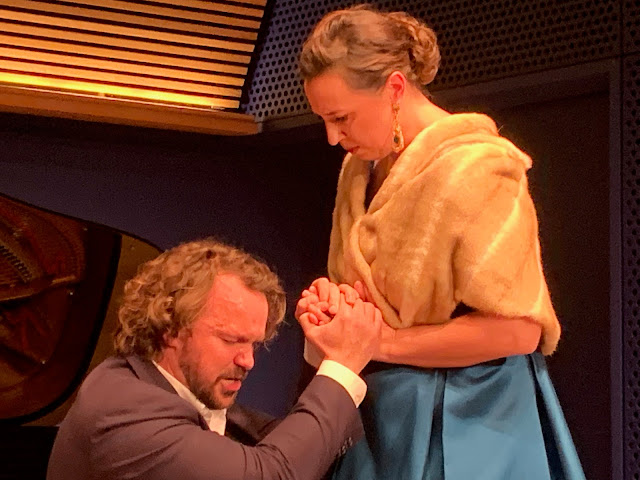
Markos Simopoulos, Andrew Allan Hiers, Lucas Levy, Santiago Ballerini, Chelsea Lehnea, and Ricardo José Rivera
A newly unearthed bel canto opera would have been sufficient cause for celebration. Preceding such a worthwhile offering with a thrilling recital of art songs by the composer of said opera, and a highly illuminating lecture/demonstration by Will Crutchfield made for a night of entertainment and education that has left us dizzy with excitement.
Let us begin with the final offering, the opera Anna di Resburgo by early 19th c. composer Carolina Uccelli, whose name seems to have been lost to operatic history because of journalistic errors in the spelling of her name and the date of her premature demise. (We will be extra careful not to make any journalistic errors here.) Although there were women writing art songs at that time, a woman daring to write an opera was unheard of and roundly criticized; its acceptance was largely due to the support she received from Rossini and Mayr.
Her first opera, Saul, has been lost (although, who knows, Crutchfield might someday find it) but her second and last, Anna di Resburgo, premiered in Naples in 1835, unfortunately right on the heels of Donizetti's Lucia di Lammermoor, with which it shared a Scottish location and a mystical graveyard scene.
The story, based on clan rivalry, involves the unjust conviction of a nobleman for the death of his beloved father. The actual murderer was a rival nobleman whose son reaped the benefits of said murder and who was obliged to live with the knowledge of his father's crime, revealed at the father's deathbed. This role gives the baritone, Ricardo José Rivera, the role of a lifetime, that of a man who is forced to confront his conscience and alter fate. Mr. Rivera seized the role by the throat (keeping his own throat relaxed and open) and created a character for whom we could feel compassion. That his singing filled the Rose Theater with glorious sound seemed an added bonus.
Also fulfilling her role as the loyal wife of the fugitive accused murderer, soprano Chelsea Lehnea aroused our sympathy. With a huge and polished instrument, she fought for her husband and for her son, a boy she had left with a landowner (the fine tenor Lucas Levy) and his daughter (excellent soprano Elisse Albian, well remembered from Opera Lafayette). As a clever ruse to remain close to her son, she had herself hired by the landowner as his nursemaid. We might add that the child actor, Olivia Trinchera Citterio, performed excellently and, unlike so many child actors, did nothing to steal the show and everything to portray a good child who loved his caretakers.
In the role of the runaway nobleman we had tenor Santiago Ballerini. whose short physical stature was overcome by his large vocal stature. We particularly enjoyed the pianissimo passages that had us leaning forward in our seat.
Led by Primo Violino Elisa Citterio (Olivia's mother?) and by Maestro al Cembalo Lucy Tucker Yates, The Teatro Nuovo Orchestra was a pleasure to hear, as usual. The Teatro Nuovo Chorus, led by Derrick Goff, served admirably. Stage Direction by Marco Nisticò was basic and rather challenging since Ms. Lehnea is a full head taller than Mr. Ballerini which made for some awkwardness that may have had no creative solution. We realize that one is meant to ignore such issues but we cannot tell a lie. It looked uncomfortable for Ms. Lehnea.
And now let us move onto the first part of the evening, a recital of songs composed by Uccelli, songs of great musicality, charming melody, and textual variety, accompanied and narrated by pianist Timothy Cheung. Singers were all Resident and Studio Artists of Teatro Nuovo. Soprano Francesca Federico opened with "Non invan su questa sponda" which she sang with clear pure tone and perfect vibrato.
In "Si tu m'aimais", mezzo-soprano Liz Culpepper handled upward and downward leaps with aplomb and had a killer trill. Tenor Jeremy Brauner created quite a character in "Il menestrello" as a charming wandering minstrel, employing expressive and dynamic variety. In "Frena le belle lacrime" soprano Laura Nielsen was remarkable for some lovely melismatic passages and moved easily from legato scale passages to staccato passages with excellent accompaniment by Mr. Cheung.
In "La preghiera" tenor Juan Hernández evinced a sweet Italianate tone and got our admiration for the tender "money note", avoiding the temptation to force the sound. We do love duets and there was a very cute one for two women admiring a handsome young boatman. It was charmingly performed, and not just sung, by soprano Francesca Lionetta and mezzo-soprano Sedona Libero.
Tenor Ai Chaim Ra has an unusual instrument well suited to the lovelorn poet of "Il rimprovero". and used dynamic variation well. Mr. Cheung's accompaniment augmented the sorrowful mood. Baritone Robert Garner, whom we have long admired, ended the program with a drinking song entitled "Orgia", letting loose with unrestrained expansiveness.
Following this superb song recital, Mr. Crutchfield enlightened the huge audience with his account of the composer, drawing attention to a number of her unusual musical inventions. We utilized his teachings to listen for the unusual patter song in Act II, and the flute solo accompanying the graveyard scene. We were able to identify the unusual walking bass line in the funeral march, as well as the manner in which the duet utilized the form of a canon to increase anxiety. These are details we might have overlooked since we tend to get wrapped up in the drama.
The audience was ecstatic, hearing gorgeous and inventive music so well performed and we left wondering why The Metropolitan Opera wastes so much money and risks losing their audience by producing non-musical polemic operas when what people want is "blood and guts". Give us romance, betrayal, loyalty, murder, assassination! And, above all, give us melody!
© meche kroop