MISSION

We are here to encourage the development of gifted young singers and to stimulate the growth of New York City's invaluable chamber opera companies. But we will not neglect the Metropolitan Opera either. Get ready for bouquets and brickbats.
Showing posts with label Vita Koreneva. Show all posts

Friday, February 27, 2026

AN AUTHENTIC SUOR ANGELICA


 Vita Koreneva and Rachel Hippert

Perhaps the most accurate phrase to express our opinion of Regina Opera's production of Puccini's Suor Angelica would be "well worth the trip". Admittedly it is a long way from Manhattan but where else can a hard core opera lover go to see a production that makes sense by virtue of faithfulness to time and place. We are sick and tired of productions that are shoehorned into some narcissistic director's "concept"!

Suor Angelica is imbued with the values of late 19th - early 20th century Italy. Girls who got pregnant were considered a shame upon their families' reputation and were consigned to the convent as punishment for their sins. Nowadays in the United States, single women who want a child barely think twice about deliberately achieving the state of motherhood. The opera does not translate well. 

Here we have Director Helen Van Tine not only giving us the real McCoy but also appending an original moment that touched us deeply, even though we are of a pagan nature. We hesitate to tell you about it because we would like you, Dear Reader, to attend one of the several upcoming performances and experience the moment for yourself. It must be said that singers make the best directors and in a perfect world we would banish all the self-important directors and send them back to Europe or Hollywood or wherever they came from.

So now that you know how highly we regard Regina Opera, let us tell you some specifics. The opera has been cast with a rotating cast of talented young singers, all of whom threw themselves into their roles with enthusiastic intent. The cast we saw at the dress rehearsal included soprano Rachel Hippert as the eponymous Suor Angelica and mezzo-soprano Vita Koreneva as La Principessa. The latter was of particular interest because, by subtle gestures, she permitted us to see a more well rounded character than we have previously seen.

We have been primed by prior productions to hate this woman who has banished her niece to a convent and only visited her after years of neglect. But what Ms. Koroneva showed us was a woman who was obliged to hide her sorrow out of duty to her aristocratic family and society. As she leaves the convent with the legal papers she brought for Angelica's signature, you could see her ambivalence in her glance and posture. We felt sorry for the character who must ensure the successful marriage of her other niece. This evoked the same feelings in us as when Germont Père in Verdi's La Traviata is well portrayed so that we can experience his softer side.  Now that's artistry!

Ms. Hippert also demonstrated the anguish of her character in "Senza Mamma" --the conflict between wanting to join her son in heaven and the guilt experienced by wanting to take her own life. We were allowed to experience her ambivalence without judging. This made the ending very satisfying. We confess that we were so taken with the storytelling aspect that we focused less on the voices, only remembering that all of the voices were better than adequate for their roles. This is an ensemble opera with a large cast all of whom were fine.. Due to the costuming it was difficult to tell the roles apart except for Sister Genovieffa who sang of missing the lambs that she used to tend; Margaux Frohlich made an impression with a very sweetly colored soprano.

There wasn't much opportunity for originality in the costuming but Marcia C. Kresge did well by La Principessa, giving the character a very believable regal Italianate appearance.

An English language translation of Giovacchino Forzano's libretto was projected very legibly and without glitch so we would like to commend Linda Cantoni.

Maestro Scott Jackson Wiley conducted his fine orchestra with sensitivity and subtlety, never overpowering the voices. In an unusual move, instead of filling out the evening with one or both of the other operas in Puccini's Il Trittico, Mo. Wiley programmed two concerti, each featuring a member of the orchestra. We enjoyed Nathan McKinstry's trumpet in a Haydn Concerto and. Anna Lien in a Harp concerto by Händel.  This programming decision allowed the full impact of the opera to sink in without the distraction of the violent Il Tabarro or the humorous Gianni Schicchi.

Before ending, we would like to share a bit of information that we never knew until we researched it. One of the earliest performances of Suor Angelica took place in the Tuscan convent to which Puccini's sister belonged. He played the score on the piano and sang all the roles himself; it was reported that all the nuns wept. Perhaps you will weep too when you see it...and we truly hope that you do. All subsequent performances will take place at 3:00PM this weekend and next.  Don't miss it!

© meche kroop


Thursday, December 16, 2021

RUSSIAN PASSION

Daniel Scofield and Zoya Gramagin in the final scene of Tchaikovsky's Eugene Onegin

We got even more than we expected last night when the Russian Opera Society and Spotlight Artist Management presented a night of mostly Russian music.  Following a warm welcome from Natalie Burlutskaya, Tchaikovsky's masterpiece Eugene Onegin--with a libretto adapted from Pushkin's verse novel--took us to another time and place, one in which morals and social expectations were completely different from our own--an era of courtship, advantageous marriage, loyalty, and dutiful self-sacrifice.

To convey all that in a fully costumed lengthy opera with scenery  and orchestra is to be expected, but to achieve all that in a one-hour piano reduction with only the highlights presented is nothing short of miraculous.  This miracle rested on the shoulders of some excellent artists, including pianist Alexander Chaplinsky who likely made his own reduction of the score, allowing all the instrumental lines to be heard and all of Tchaikovsky's emotional content to be felt. The piano became a condensed orchestra.

Zoya Gramagin has the Russian soul and ease with the language to allow her to focus totally on dramatic interpretation. Her lush soprano was perfect for the role.  Like Violetta in La Traviata, her character has to experience growth from the beginning of the opera to the end. After a deeply felt introduction on the piano which introduced the themes, Ms. Gramagin showed us a shy and introverted country girl who contrasted well with mezzo-soprano Vita Koreneva's ebullient and flirtatious Olga. Their duet was stunning in its harmonies and the difference in the two sisters' personalities was made clear in the music.

In Olga's ariosa Ms. Koreneva painted a picture of the flighty younger sister. The centerpiece of the evening was Tatiana's "Letter Scene" in which she demonstrated a panoply of emotions, taking us right back to our youth.  Oh, the agony of first love!  The anxiety, the desperation, the hopefulness--all there and going right to our heart. We have heard this scene often in competitions but rarely have we heard it performed this poignantly.

We have strong feelings about Onegin that may not be shared by everyone. We do not see him as shallow and careless of Tatiana's feelings.  He is only 26 and is trying to be a "Dutch Uncle" to a 13-year-old girl who is infatuated with him. If he were a "bad dude" he could have taken advantage of her but he didn't. He is just immature and not a good sport about visiting in the provinces. Baritone Daniel Scofield did a fine job of illuminating the sophisticated youth with a disdain for the provincial.

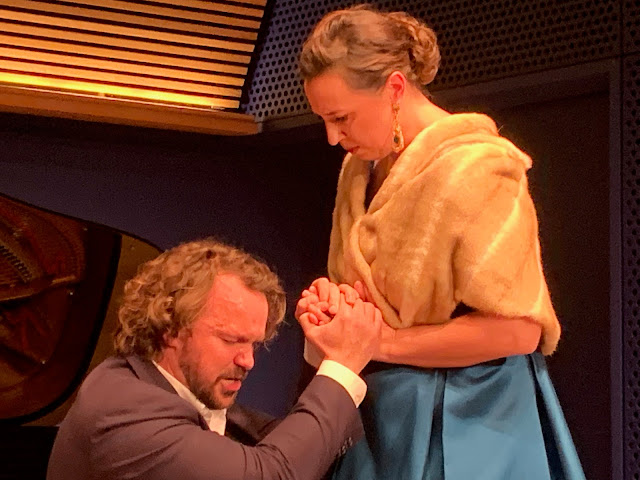
In the final scene of the opera he is bereft at finding this child all grown up (at 17 years of age!), sophisticated and alluring, but wed and unavailable. The change of her hairstyle and the addition of a fur cape were not even necessary; Tatiana's maturation was present in the voice and gesture. Ms. Gramagin's fine acting let us see the conflict between love and duty tearing her apart.  But, being a loyal young woman, she must reject him, even whilst admitting her love.

We were moved by her growth which could only be conveyed in such a brief period of time and in such an episodic nature by a major talent.  That is our opinion of Ms. Gramagin! We felt empathy for both characters and the sense of loss. No happy Hollywood ending and no operatic suicide. Just ineffable sadness.

The continuity was broken by the insertion of Lensky's aria which, in the context of the opera, is instrumental to the story.  Somehow in this very abbreviated version, it interrupted the flow of Tatiana's character development. Lucas Levy's Lensky needed more variety of emotion and dynamics. Mr. Levy's delivery was forceful and missing the bewilderment a 17-year-old might feel when he has acted rashly and gotten himself in over his head. In spite of a beautiful decrescendo at the end, we were not moved. We were already uninvolved.

After the intermission, we were treated to some fine piano solos by Mr. Chaplinsky and some upbeat music by an interesting duo called Musalliance, comprising Anna Kusner playing the guitar, supporting the treble line performed on the domra by the impish Peter Omelchenko. The domra is an interesting string instrument that sounds at time like a mandolin and at other times like a balalaika. Mr. Omelchenko is fleet with his fingering and made old standards sound completely new. We particularly enjoyed Schubert's  "Ave Maria" and Rimsky Korsakov's "Flight of the Bumblebee", as well as some Neapolitan songs. Ms. Kusner excelled in Agustín Lara's "Granada" in which she took the lead. We noticed some finely wrought rasqueados. The audience went wild.

It was a lovely evening brought to a fine finale by the entire cast singing the "Carol of the Bells", each artist taking a phrase in succession.

© meche kroop