MISSION

We are here to encourage the development of gifted young singers and to stimulate the growth of New York City's invaluable chamber opera companies. But we will not neglect the Metropolitan Opera either. Get ready for bouquets and brickbats.
Showing posts with label Michael McDermott. Show all posts

Saturday, February 26, 2022

PAST, PRESENT, AND FUTURE

Donata D'Annunzio Lombardi and John Viscardi


On Wednesday evening we were privileged to attend Classic Lyric Arts' "Concert at the Castle" along with a crowd of CLA Supporters, all of whom were delighted to witness the past, present, and future of this estimable program. A warm welcome from Founder and Artistic Director Glenn Morton, well known in operatic circles for his astute coaching and pedagogy in all three NYC music conservatories, introduced us to the myriad achievements of CLA--not only the immersive programs in Italy and France but the newly initiated program in the Berkshires which began last summer, focusing on the operas of Mozart.

Representing the past of CLA was tenor John Viscardi, a major light on American opera stages, who serves as Executive Director of CLA. Mr. Viscardi is an alumnus of both CLA's French program and Italian program; his linguistic facility gives evidence.  He opened the concert program with the tender "Chanson Triste" by Duparc. The performance was marked by perfect French diction (of course) and consummate expressiveness, alternating tender moments with expansive ones. He also closed the program performing a stunning duet with a surprise guest artist; we are going to keep you guessing her identity until the end of the review.

Another alumna of CLA is the lovely Daniela Magura, a beautiful mezzo-soprano with a luscious tone. She showed off her fine French in "Tristes apprêts", an aria from Rameau's Castor et Pollux that was new to our ears.  Her "Habanera" from Bizet's Carmen, on the other hand, is almost overly familiar but we always enjoy hearing a singer whose take on the character is a bit different.  Ms. Magura's Carmen is more subtle than most, so confident in her ability to seduce that she can underplay it, thereby avoiding all the encrusted clichés. What an advantage to hear her diversity in two such different arias and to hear French sung so authentically in Gallic style.  More credit to CLA's French program which she attended twice.

Baritone Jared Werlein is new to us and we are always happy to hear a singer with comedic flair.  He is a student of Mr. Morton at Juilliard and his fluency in Italian surely comes from his prior attendance at CLA's Italian program. We were able to appreciate his ability to go from the well-known classic ("Madamina, il catalogo è questo" from Mozart's Don Giovanni) to a delightful 20th c British song, "The green-eyed dragon" by Wolseley Charles. The lyrics were so clever in their rhymes and the music so tuneful that we plan to search out more of Mr. Charles' music. Mr. Werlein did justice to both styles, more evidence of the versatility that we admire. 

Tenor Michael McDermott, another student of Mr. Morton at Juilliard also chose two very different pieces. His Italian selection was the well known and beloved Tosti song "Non t'amo piu" which he sang with Italianate passion and the multiplicity of emotions that the librettist intended. His use of pacing and dynamic variation brought intensity to the performance. Quite different was his more delicate delivery of "Ah, lève-toi soleil" from Gounod's Roméo et Juliette in which he showed an easily produced upper register and pleasing French which will be fine tuned this coming summer at CLA's French program.

New to CLA and representing its future is the beautiful soprano Julianne Casey who also alternated a French selection with an Italian one. "Il est doux, il est bon" from Massenet's Hérodiade was sung with youthful rapture and some lovely resonance in the upper register. We liked the expansive top in "Se come voi piccina" from Le Villi, an early opera by Puccini with which we are unfamiliar. We cannot wait to hear her after her attendance at CLA's Italian program next summer.

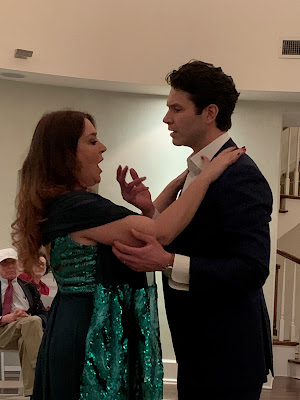
And now we will tell you dear reader, as promised, about the stunning surprise climax to the program. One of Europe's most sought after sopranos, Donata D'Annunzio Lombardi, performed the role of Tosca in the first act duet, with Mr. Viscardi as her Mario. We found ourselves captivated not only by the vocal excellence but by the characterization given by Ms. D'Annunzio. We felt as if we really understood Tosca, not only her devotion to Mario but the insecurity that underlay her display of jealousy and the good will that allowed her to turn the jealousy into a little tease.

Ms. D'Annunzio Lombardi is on the faculty of CLA and brings to their programs a very unusual method of teaching, the likes of which we have never seen. Suffice it to say that the changes wrought by her tutelage have been astonishing. We have the greatest respect for results and for those master teachers that add value. Students can consider themselves extremely fortunate to fall into her hands.

The collaborative pianist for the evening was the gifted Xu Cheng who never fails to keep pace with the singers and permits all of them to shine in their own fashion.

We advise keeping an eye on Classic Lyric Arts.  Their history is significantly worthwhile, their present shows the flexibility demanded by the Covid pandemic, and they have a brilliant future as they expand in new ways, some of which are in the works and some of which we foresee in our crystal ball.

If you, dear reader, care to see photos of the event, they will be on our FB page--Voce di Meche.

© meche kroop

Wednesday, April 3, 2019

ORA BELLISSIMA

Kenneth Merrill, Bénédicte Jourdois, Junseok Hwang, Jared Werlein, Michael McDermott, Katherine Herbert, Libby Sokolowski, and Song Hee Lee

We love reviewing students! The "students" we hear at Juilliard are generally not what one would think of as students since they are already performing around the country, and sometimes even abroad.  But last night we reviewed six first year students. We weren't expecting much but we were astonished at the high caliber of singing we heard. Apparently, a young singers needs to be quite advanced to get accepted at Juilliard.

Each singer had stage presence and a good command of Italian. Each one seemed to know what he/she was singing about and lent appropriate expression to the delivery. The raw material was all there and we hope we will be able to review them as they progress through the impressive training provided by the Juilliard Vocal Arts Department.

As soon as we saw the beautiful harpsichord onstage and saw Kenneth Merrill's name on the program we knew we would be delighted by some Baroque songs which are so suitable to young voices. Mr. Merrill provided the lovely harpsichord accompaniment for the first part of the program.

The excellent Bénédicte Jourdois was the collaborative pianist for the second half of the program which took us into the 19th and 20th c. The two were responsible for preparing and coaching the program. That's just an example of the fine training offered by Juilliard.

The appropriately named soprano Song Hee Lee opened the program with Claudio Monteverdi's "Quel sguardo sdegnosetto" the tempo of which was so fast that we could not understand the words. What we did understand is that this young lady has a voice of crystalline clarity most beautiful at the very top of the register. We liked the way she leaned into the appoggiatura at the end.

She closed the program with "Good Morning Midnight", André Previn's setting of a text by Emily Dickinson. The tempo here was slow enough for us to appreciate her excellent English diction and her ability to make sense of the text.

Soprano Katherine Herbert's bright instrument pleased the ear in "Ah! crudel, il pianto mio" from Händel's Rinaldo. In the fast section, her fioritura was crisp and clean. The ritornello offered some fine embellishments. We particularly enjoyed the trill. It was quite a treat to hear Mr. Merrill's accompaniment augmented by Ana Kim's mellow cello, also heard in several other selections.

Ms. Herbert was also fine in Britten's "The Last Rose of Summer" in which we enjoyed the vocal line, a familiar tune. We like the way she sustained the feeling during the silences; the spaces between the notes are also important!

Soprano Libby Sokolowski evinced an appealing vibrato and a pretty trill in "Credete al mio dolore" from Händel's Alcina. The sound is an exciting one with lots of resonance. Händel's arias do go on but Ms. Sokolowski provided plenty of variety of coloration and dynamics to keep the ear engaged.

Libby Larsen set Elizabeth Barrett Browning's "How do I love thee?" and Ms. Sokolowski made excellent sense of the text, showing another side of her artistry.

Jared Werlein has a pleasing lyrical baritone and gave evidence that he truly understood what he was singing about in Giulio Caccini's "Non ha'l ciel cotanti lumi", a lovely song of deep sentiment that he colored beautifully. 

He also made sense of the text "Youth and Love' by Ralph Vaughan Williams which he brought to a quiet conclusion.

Vivaldi's "La tiranna avversa sorte" from Arsilda, regina di Ponto, is a strange aria in which the harpsichord and cello play staccato with the vocal line written in legato.  Tenor Michael McDermott met that challenge neatly and demonstrated some impressive melismatic singing in a forceful tone suited to the determination of the character. We liked what he did with the dotted rhythm.

Mr. McDermott achieved a different mood, one of quietude, in Charles Ives' "Berceuse". We liked the clarity of enunciation and the expressiveness.

Baritone Junseok Hwang's first number was Purcell's "Music for a While" which we generally associate with a voice belonging to a fach of higher register. Once he let go his grip on the harpsichord and stepped forward toward the audience, his hands were free to gesture which added significantly to his performance. He successfully lightened the weight of his voice for the embellishments and brought the piece to a beautiful end. 

He also sang our favorite Bellini song "Vaga luna che inargenti" which has been running through our head all night long. The texture of his voice was well suited to the song and his gestures were appropriate, once he let go of the piano and stepped forward. It's a small point and once Mr. Hwang realizes how much more he connects when he steps forward, he will have made a giant step forward, so to speak. We are sure his teacher must nag him about it!

We enjoyed the program and the singers and Ms. Kim's cello, which made such a fine addition to the program. We look forward to hearing these singers again and watching them grow.

(c) meche kroop