MISSION

We are here to encourage the development of gifted young singers and to stimulate the growth of New York City's invaluable chamber opera companies. But we will not neglect the Metropolitan Opera either. Get ready for bouquets and brickbats.
Showing posts with label Donata D'Annunzio Lombardi. Show all posts

Saturday, February 26, 2022

PAST, PRESENT, AND FUTURE

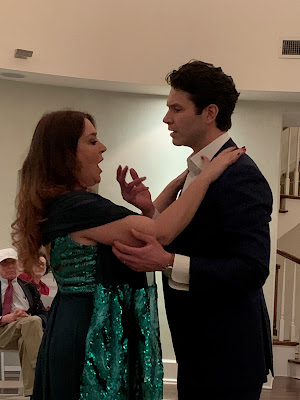
Donata D'Annunzio Lombardi and John Viscardi


On Wednesday evening we were privileged to attend Classic Lyric Arts' "Concert at the Castle" along with a crowd of CLA Supporters, all of whom were delighted to witness the past, present, and future of this estimable program. A warm welcome from Founder and Artistic Director Glenn Morton, well known in operatic circles for his astute coaching and pedagogy in all three NYC music conservatories, introduced us to the myriad achievements of CLA--not only the immersive programs in Italy and France but the newly initiated program in the Berkshires which began last summer, focusing on the operas of Mozart.

Representing the past of CLA was tenor John Viscardi, a major light on American opera stages, who serves as Executive Director of CLA. Mr. Viscardi is an alumnus of both CLA's French program and Italian program; his linguistic facility gives evidence.  He opened the concert program with the tender "Chanson Triste" by Duparc. The performance was marked by perfect French diction (of course) and consummate expressiveness, alternating tender moments with expansive ones. He also closed the program performing a stunning duet with a surprise guest artist; we are going to keep you guessing her identity until the end of the review.

Another alumna of CLA is the lovely Daniela Magura, a beautiful mezzo-soprano with a luscious tone. She showed off her fine French in "Tristes apprêts", an aria from Rameau's Castor et Pollux that was new to our ears.  Her "Habanera" from Bizet's Carmen, on the other hand, is almost overly familiar but we always enjoy hearing a singer whose take on the character is a bit different.  Ms. Magura's Carmen is more subtle than most, so confident in her ability to seduce that she can underplay it, thereby avoiding all the encrusted clichés. What an advantage to hear her diversity in two such different arias and to hear French sung so authentically in Gallic style.  More credit to CLA's French program which she attended twice.

Baritone Jared Werlein is new to us and we are always happy to hear a singer with comedic flair.  He is a student of Mr. Morton at Juilliard and his fluency in Italian surely comes from his prior attendance at CLA's Italian program. We were able to appreciate his ability to go from the well-known classic ("Madamina, il catalogo è questo" from Mozart's Don Giovanni) to a delightful 20th c British song, "The green-eyed dragon" by Wolseley Charles. The lyrics were so clever in their rhymes and the music so tuneful that we plan to search out more of Mr. Charles' music. Mr. Werlein did justice to both styles, more evidence of the versatility that we admire. 

Tenor Michael McDermott, another student of Mr. Morton at Juilliard also chose two very different pieces. His Italian selection was the well known and beloved Tosti song "Non t'amo piu" which he sang with Italianate passion and the multiplicity of emotions that the librettist intended. His use of pacing and dynamic variation brought intensity to the performance. Quite different was his more delicate delivery of "Ah, lève-toi soleil" from Gounod's Roméo et Juliette in which he showed an easily produced upper register and pleasing French which will be fine tuned this coming summer at CLA's French program.

New to CLA and representing its future is the beautiful soprano Julianne Casey who also alternated a French selection with an Italian one. "Il est doux, il est bon" from Massenet's Hérodiade was sung with youthful rapture and some lovely resonance in the upper register. We liked the expansive top in "Se come voi piccina" from Le Villi, an early opera by Puccini with which we are unfamiliar. We cannot wait to hear her after her attendance at CLA's Italian program next summer.

And now we will tell you dear reader, as promised, about the stunning surprise climax to the program. One of Europe's most sought after sopranos, Donata D'Annunzio Lombardi, performed the role of Tosca in the first act duet, with Mr. Viscardi as her Mario. We found ourselves captivated not only by the vocal excellence but by the characterization given by Ms. D'Annunzio. We felt as if we really understood Tosca, not only her devotion to Mario but the insecurity that underlay her display of jealousy and the good will that allowed her to turn the jealousy into a little tease.

Ms. D'Annunzio Lombardi is on the faculty of CLA and brings to their programs a very unusual method of teaching, the likes of which we have never seen. Suffice it to say that the changes wrought by her tutelage have been astonishing. We have the greatest respect for results and for those master teachers that add value. Students can consider themselves extremely fortunate to fall into her hands.

The collaborative pianist for the evening was the gifted Xu Cheng who never fails to keep pace with the singers and permits all of them to shine in their own fashion.

We advise keeping an eye on Classic Lyric Arts.  Their history is significantly worthwhile, their present shows the flexibility demanded by the Covid pandemic, and they have a brilliant future as they expand in new ways, some of which are in the works and some of which we foresee in our crystal ball.

If you, dear reader, care to see photos of the event, they will be on our FB page--Voce di Meche.

© meche kroop

Thursday, May 17, 2018

MAGICAL MASTER CLASS

Fabio Bezuti, Zachary Goldman, Xiaotong Cao, Glenn Morton, Oleksii Kuznietzov, Donata D'Annunzio Lombardi, Yvette Keong, and Tal Heller

How does it feel when a master teacher comes along and contradicts everything a singer has learned about her voice and vocal production?  We guess it feels pretty good when the results seem magical. We just attended such a class taught by famed Italian soprano Donata D'Annunzio Lombardi. This is our third or fourth opportunity to observe her working with young singers and the results have left a huge impression on us.

Her teachings are based on extensive experience with anatomy, bioenergetics, and osteopathy. She has assembled valuable advice from several famous singers. She can immediately diagnose exactly where tight muscles are blocking sound production and provide strange seeming exercises and postures to ease the blockage. We have heard dramatic changes in the students' voices within minutes!

Her focus is very much on accessing the back of the body and the several diaphragms that are apparently as important as the familiar one. The commonly taught posture and method of breathing into the belly seems to be all wrong.

Students got down on their hands and knees.  They lay on their belly and swam on the floor. They pinched their lips. They showed off their uvulas. They bent over the piano. Wow!

Participating students were sopranos Xiaotong Cao and Yvette Keong, mezzo-soprano Tal Heller, tenors Zachary Goldman and Oleksii Kuznietzov, and baritone Sunyeop Hwang. They all sounded just fine initially but after a half hour work with Ms. Lombardi they each sounded glorious with enhanced resonance. Accompanist was Fabio Bezuti.

We found ourself wishing that we had begun our vocal studies with Ms. Lombardi.  The bad news is that it is too late for us but the good news is that it isn't too late for you. This remarkable teacher, brought to us by Glenn Morton of Classic Lyric Arts, will be returning in October.

If you are a singer you absolutely must attend.  And if you are not, you can come and enjoy witnessing some miracles.

(c) meche kroop

Monday, November 7, 2016

TOASTING TOSTI WITH DONATA D'ANNUNZIO LOMBARDI

Seok Jong Baek and Donata D'Annunzio Lombardi

This was a master class like no other. Italian soprano Donata D'Annunzio Lombardi spent three hours coaching nine young singers in a class devoted to songs by Francesco Paolo Tosti to commemorate the centennial year of his death. Each singer prepared a song (some familiar and some lesser known) and Ms. Lombardi proceeded to use her unique knowledge of anatomy to transform each singer.  Had you been there you would not scoff at this extravagant assertion.

She uses various stances and poses to bypass the throat tension that she observes in American singers (although she admits that American singers are far more expressive than their Italian counterparts). This made us wonder whether the English language itself produces this throat tension; we must ask Ms. Lombardi!

The wildest claim she made is that tenors come in two varieties--"the hitchhiker" and "the communist".  The former holds the fingers down with the thumb sticking out, like Carreras; the latter holds his hands in a fist like Pavarotti. She avers that the thumb is connected with the intellect and the index finger with the front of the body. She wants the singer to use the back of the body--the rear attachment of the diaphragm, the musculature of the spine, and the tentorium of the brain at the back of the skull.

To our great surprise, we noticed an amazing difference when the singer touched his thumb to the pinkie, which is connected to the back of the body!

She stressed the importance of flexibility and spring and had many of the students stand on a bent leg while flexing and extending the other leg.  This too made a difference!  So did leaning over to one side. The spine provides an anchor for the sound. 

The bent over posture mimics that of Early Man--a natural sound emerges in these positions.  And we always believed that singers must stand erect with shoulders down and back to open the chest.  Now we know there is a better but counter-intuitive way. Rounding the shoulders like Maria Callas opens the length of the spine. Breathing must come through the back! 

There were also various exercises to free up the vocal chords and spaces in the head. Students were instructed to hold their lips or bite down on one side, lest the orbicular muscles block the larynx.

So much of this advice goes against the way American singers have been taught but if you had been there, you would have heard the evidence with your own ears!

The singers comprised sopranos Angela Candela, Elizabeth Perez, and Vivian Yau (the latter two heard at the CLA Gala), tenors Ganson Salmon, Chul Young Kim, Michael St. Peter, and HyunHo Cho, and baritones Sunyeop Hwang and Seok Jong Baek. Each one made a major leap forward.

Glenn Morton (Founder of Classic Lyric Arts, teacher, and coach) was the accompanist for the class which was held at Mannes School of Music.

(c) meche kroop


Thursday, March 12, 2015

SYNERGY

Students at Classic Lyric Arts


We have spilled plenty of (electronic) ink touting the glories of the total immersion summer programs of Classic Lyric Arts.  Ten lucky emerging artists get the chance to study in a small town in France for nearly a month under the tutelage of master teacher Michel Sénéchal.  They are immersed in the language and culture and return home transformed by the experience, having reached a new level of proficiency. They are not just singing in French; they are making the French language sing.

Twenty equally fortunate young artists receive similar training in Italy in the Emilia-Romagna region, imbibing pasta and wine along with the grand historical tradition conveyed by master teacher Ubaldo Fabbri.

We have heard and thrilled to the results but never had a clear picture of what this intense training looked and sounded like.  Last night's program at Opera America remedied that lack.  The result of an inspired collaboration between Artistic Director Glenn Morton and film maker August Ventura (two endlessly positive and creative men whom we are privileged to call friends) we were finally able to appreciate not just the outcome but the process of learning.

Mr. Ventura gave an inspired talk about Mr. Morton's vision, comparing it to that of the Roman god Janus in that he is able to relate to opera's glorious past and also to project into the future what is necessary to protect that patrimony.  He showed the three short films he created in which the audience could glimpse snatches of lessons from the great masters and coaches.  Mr. Ventura's point about the importance of preservation of a nation's past from apathy and from the danger of destruction by outside forces was very well taken.

But the proof of the pudding, so to speak, is in the singing and several former and present students delighted the audience by demonstrating the facility they gained during their residencies abroad.

Accompanied by the lyrical arpeggios of alumna Laetitia Ruccolo, soprano Dorothy Gal sang Antonia's aria "Elle a fui, la tourterelle" from Offenbach's Contes d'Hoffman in fine French style with the long lyric lines that we so love.  Yes indeed, she "made the French sing" with some lovely word coloring.

Soprano Nadia Petrella knocked our proverbial socks off with the eerie first act aria "Regnava nel silenzio" from Donizetti's Lucia di Lammermoor.  The feelings seemed to come from deep within and anticipated Lucia's instability of character. She fearlessly  attacked the high notes. This was exactly the way we want this aria to be sung. Michael Stewart was her able accompanist and they worked beautifully together.

Jia-Jun Hong gave a passionate and spot-on performance of the Marcello song "Il mio bel foco", accompanied by Fabio Bezuti. Mr. Hong was seen in the film as one of a group of Chinese singers who attended the Italian program.  How pleased we were to learn that Italian opera is held in high regard in China!  The students were incredibly enthusiastic about the training they received.

The fine tenor Vincent Festa delivered "É serbato a questo acciaro" from Bellini's I Capuleti ei Montecchi.  The performance was filled with "garlic" and we loved the way he handled the upward skips.  The cantabile and the cabaletta were equally impressive, as was Ms. Ruccolo's piano.

From Verdi's Ernani, baritone Baejoon Lee sang "Oh de' verd'anni miei", accompanied by Mr. Bezuti.  It is a fine sturdy sound and we will look forward to hearing more of Mr. Lee after his summer in Italy. A good Verdi baritone is always welcome.

As a special treat, Mr. Morton took to the piano bench to accompany two international stars, romantic tenor Leonardo Caimi and soprano Donata D'Annunzio Lombardi, on the CLA staff in a coaching capacity.

Mr. Caimi employed his marvelous sound with its generous amplitude and passionate spirit for Cardillo's "Core 'ngrato".  His style and fine legato phrasing made us feel as if we were Italian for those few minutes.

Ms. Lombardi achieved the same effect in Tosti's "Amour, amour" but in this case we were seeing France through Italian eyes.  It is easy to see why she is famous as an interpreter of Tosti's songs.  We have also witnessed her coaching at a prior event and her skills are remarkable.

We refer you to www.classiclyricarts.org where you too may see film clips of this outstanding program.

(c) meche kroop


Friday, April 11, 2014

CLASSIC LYRIC ARTS GALA

Briana Hunter, Elizabeth Chang, Stella Papatheodorou (photo by Leslie M. Ritch)
 Classic Lyric Arts is an organization that shares our goal of advancing the careers of young singers.  President and Artistic Director Glenn Morton hosted a Spring Benefit Gala last night at the Kosciuszko Foundation which was supported by the Gerda Lissner Foundation.  This was a wonderful opportunity for guests to hear some promising young singers and an equally wonderful opportunity for the young singers to show off what they have learned at the two European training programs.  Most of the singers have attended both La Lingua della Lirica in Emilia-Romagna and L'Art du Chant Français in the Périgord region.

We not only heard the singers but had plenty of time to speak with them about their experiences in the programs.  On both accounts one can consider the programs of CLA a huge success. Students are trained in diction, style, repertoire, stagecraft and career development.  They learn this from native speakers who teach in their own language.  It sounds like a total immersion experience.

The recital portion of the evening was led by Briana Hunter whose portrayal of Carmen in Bizet's "Gypsy Song" was as spirited as it was richly sung.  She will be performing the role at the Music Academy of the West.  She was joined by Stella Papatheodorou and Elizabeth Chang.


Madison Marie McIntosh and Terence Stone (photo by Leslie M. Ritch) 
"C'est le dieu de la jeunesse", a thrilling duet from Leo Delibes' Lakme was performed by sparkling soprano Madison Marie McIntosh and Terence Stone, whose voices harmonized so beautifully.


 A fun Rossini trio from Il Barbiere di Siviglia "Ah! Qual colpo/Zitti zitti" was sung by Maya Yahav Gour (who has a fine rich mezzo) along with tenor Vincent Festa and Xiaomeng Zhang.  Embellishments were handled in admirable bel canto style.
Sean Christensen and John Viscardi (Leslie M. Ritch)

Tenor Sean Christensen and baritone (yes, he is now a baritone and a fine one) John Viscardi did a fine duet from Puccini's La Bohème--"O Mimi tu più non torni".


Xiaoming Tian and Tamara Rusque (Leslie M. Ritch)

 Tamara Rusque gave Nedda a great big sound and some intense drama in her duet with Silvio from Leoncavallo's I Pagliacci.  Her Silvio was guest artist Xiaoming Tian.


Donata D'Annunzio Lombardi and Leonardo Caimi (Leslie M. Ritch)
Guest artists from Italy Donata D'Annunzio Lombardi and Leonardo Caimi thrilled the audience with their star-quality delivery of the duet "Parigi, o cara" from Verdi's La Traviata.  Ms. Lombardi also gave a moving account of "Un bel di" from Puccini's Madama Butterfly in which she floated the high notes and sustained the tone beautifully from pp to ff.  Mr. Caimi gave an equally moving performance of "E lucevan le stelle" from Puccini's Tosca.  This heartbreaking aria was sung with gorgeous phrasing and dynamic control.  What a pleasure to hear familiar arias sung so well by native-born Italian artists.  The air fairly oozed garlic.

The trio from the finale of Gounod's Faust --"Anges purs, anges radieux" was sung by Adriana Velinova with a full and resonant soprano that filled the room.  Her Faust was Michael Papincak with Fan Jia as the Devil--both guest artists.

Mr. Morton accompanied Ms. Lombardi and Mr. Caimi.  Other accompanists were Eri Nakamura, Laetitia Ruccolo, Michael Sheetz and David Mamedov.

Closing the program was "Make our garden grow" from Leonard Bernstein's Candide, conducted by Michael Sheetz.  May CLA grow like Candide's garden!

© meche kroop


Saturday, October 26, 2013

LA MAESTRA ITALIANA

Donata D'Annunzio Lombardi and Sean Christensen
Most master classes are both instructive and educational; they usually focus on interpretation, diction, phrasing--rarely on voice production, leaving such matters to the participants' own voice teachers.  Yesterday's master class was an exception--and it was exceptional.  Sponsored by Classic Lyric Arts which hosts programs of advanced studies in language, culture and classical repertoire in Italy and France, the class was taught by Donata D'Annunzio Lombardi, Director of Daltro Canto, dedicated to R&D of new approaches to vocal pedagogy.  The emphasis is described as "spontaneous vocal production through an understanding of energy flow and increased mind/body awareness".  Doug Han accompanied the artists.

As an observer and auditor, we noticed impressive changes in all four participants, sopranos Tamara Rusque, Elizabeth Novella and Dorothy Gal and tenor Sean Christensen.  We had never heard any of them sing beforehand but were able to compare their performance before working with Maestra Lombardi and after a half-hour of coaching.  The methods were new to us and seemed to involve a profound knowledge of anatomy and bio-energetics.  The guidance was given in Italian and translated by Glenn Morton, Artistic Director of Classic Lyric Arts.

There was some overlap but each participant was handled differently.  Signora Lombardi seemed to know exactly where each singer's tension was located and how to release it.  The entire body was brought into play, from the feet up.  There was a lot of emphasis on the spine and the hip joint.  Singing on one leg with the other swinging back and forth seemed to work wonders, as did wiggling the spine in serpentine fashion.

Much work was also done with the face.  Holding the lower lip between the fingers produced quite a difference as did wiggling the upper lip.  Who knew before today that showing the lower teeth could change the voice?  Or that the diaphragm was connected to the cervical vertebrae?  One singer was given a Ricola to hold between her back teeth.  Another interesting strategy was to bite the lower lip and vocalize.  Lacking the knowledge to understand how these strategies work we are nonetheless sure that the participants who are taking her weekend workshop will come away with a great deal of valuable knowledge.  The maestra is not only an amazing teacher but is a gifted artist herself--well known in all the famous opera houses of Italy as well as Paris, Zurich and Stuttgart.  How admirable that she is sharing her unique discoveries with the next generation.  Bravissima!

© meche kroop