MISSION

We are here to encourage the development of gifted young singers and to stimulate the growth of New York City's invaluable chamber opera companies. But we will not neglect the Metropolitan Opera either. Get ready for bouquets and brickbats.
Showing posts with label Laura Soto-Bayomi. Show all posts

Monday, May 18, 2026

A DIVINE COMEDY


Enes Pektas as Gianni Schicchi

Having succeeded so admirably in last year's production of Il Tabarro, Classic Lyric Art Vocal Academy has continued with their production this year of another part of Puccini's Il Trittico--Gianni Schicchi. And what a great choice it was, making full use of CLAVA's ability to collaborate as an artistic community to create a work that was greater than the sum of its parts.

These "parts" comprise an astute director (Daniel Isengart) who knows how to come up with original ideas and then to trust the cast members to take these ideas and run with them; a musically gifted conductor (Mo. Michelle Rofrano); a superlative pianist who created an entire orchestra with ten fingers (Luc Xu Cheng) and a gifted group of singers, members and graduates of CLAVA. These singers, having spent so much time with their colleagues, are imbued with ensemble spirit. There is no individual grandstanding, each singer served the telling of the tale.  And tell it they did!

Like Verdi, Puccini tackled comedy rather late in his career at the age of 60. Both of these Italian titans avoided the slapstick humor of Rossini (which we also love) and used their comedic gifts to shed light on human foibles. Verdi's Falstaff invites us to laugh at the pomposity of a Shakespearean knight of centuries earlier, whereas Puccini used humor to shed light on one of the less attractive features of Italian culture as exemplified by Dante in his Divine Comedy, also written centuries earlier. One might conclude that the temporal distance from the butt of humor makes it easier to laugh at.

No doubt there are still grasping families who can't wait for an elderly progenitor to leave this world so they can enjoy the benefits of his wealth. It is all in the telling of the tale and  Mr. Isengart told it well, making ample use of choreography that varied from chaos-- as the Donati family ransacks their dead relative's home for his will-- to elements of swirling unity as they agree on a common plan.  The character of the eponymous Schicchi is based on a real person, someone related to Dante's wife. As usual, the dramatist heightens and amplifies reality to make a dramatic point.

Puccini's librettist Giovacchino Forzano took Dante's story and embellished it, much as Mr. Isengart put his own stamp on it. What we most appreciated about the storytelling was that each character differentiated him/herself. As many times as we have seen this opera we could never tell one member of the family from another. Perhaps it was the clarity of direction and the dramatic skill of the singers, or perhaps the fact that we were sitting on the front row, we had no problem differentiating one from another.

The adorable Gherardino (Iris Whelen) was the first onstage, totally convincing as a little boy. His father Gherardo (Samuel Ng) and mother Nella (Estelina Syla) left no doubt about their annoyance with the child. Tia Zita (Miastasha Gonzales-Colon) convinced us that she was matriarch of this squabbling family and totally in control of her nephew Rinuccio (Fernando Silva-Gorbea) and his hoped for marriage to the lower-classed Lauretta (Laura Soto-Bayomi). Rinuccio's idea to bring Lauretta's father Gianni Schicchi (Enes Pektas) on board to help the family will be his ticket to romantic fulfillment.

And there's impoverished  Cousin Betto di Signa (Christopher Lau) and the wise patriarch Simone (George Baolin) with his son Marco (Henry Horstmann) and Marco's wife La Ciesca (Sofia Durante). All of them grasping, all of them furious that the dead Donato has left his wealth to the monastery, all of them willing to have Schicchi perjure himself to make themselves wealthy.

Alejandro De los Santos portrayed both doctor and notary with Quinlan Sellars portraying Pinellino the cobbler, both adding to the comedy.

And oh, how Puccini's musical ideas heighten the drama. The opening rhythmic motif that stirs our funny bone, the dirge that accompanies the phony grief of the Donati family, the lyrical love song that stirs our heart "Lauretta mia, staremo sempre qui!", the ladies' trio "Spogliati, bambolino!", and Rinuccio's philosophical paean to Florence "Firenze è come un albero fiorito". What about the most famous aria of the opera? "O mio babbino caro" was given an original interpretation that made perfect sense. Lauretta is just as devious as her father and is manipulating him into securing her future. Mr. Cheng was masterful in capturing both lyricism and humor, confusion and despair whilst Mo. Rofrano's firm conductorial hand kept it all together.

Missing were the lavish Florentine set and costumes and we can only say that the fine musical and dramatic values made them superfluous. The grieving family all wore black and the set comprised nothing but a four-poster bed for the dying Donato. Nothing more was needed.

Regular readers know that we are sick and tired of directorial conceits that must be elaborately explained in the "Director's Notes". This production managed to tell this story of comeuppance in a most relatable way with the most meager of resources. Mr. Isengart's notes were strictly academic and intellectual backstory for those who find such background information worthy of reading. Thankfully, there were no narcissistic ramblings and justifications.

It is thrilling to watch Classic Lyric Arts develop their performing arm. Although the selection of operas is probably designed to show off the talent that is available on any given year, as an audience member we felt as if the work had been chosen for our delight. The enormous space that held the performance and audience members was absolutely packed and very deserving of a proper theater with raked seating. From the front row we had no complaint but we wondered how the people in the rear fared. We cannot help but wonder why the best city in the United States has no suitable small theater. Any ideas, Dear Reader, will be welcome and passed along.

As you may know from our prior writings on the topic, New York City badly needs a small opera company to present the best of the canon in authentic productions. With our three music conservatories producing strange operas that no student needs in their repertory (I'm looking at you, Mannes) or putting weird spins on familiar works (I'm looking at you, Juilliard and Manhattan School of Music), we support CLAVA's gradual expansion and are pleased to note that next season may bring us two productions.  Stay tuned!

© meche kroop


Sunday, December 14, 2025

CLASSIC LYRIC ARTS GALA


CLASSIC LYRIC ARTS SINGERS


Although we enjoy Classic Lyric Arts students in small private concerts, it is at the yearly gala that one can see and hear a larger group of vocal and collaborative piano students of their three summer programs and also more advanced students of Classic Lyric Art Vocal Academy (CLAVA), a year round venture. It seems odd calling them students when their performances rival those with well-established careers. Many of them have been cast in operas and fortunate are the companies that hire them. The word "students" is somewhat misleading, but if you are familiar with the world of opera, you know that singers are always studying, even the most famous ones.

It is always such a treat to spend an evening seeing the results of their training. The students don't just sing, they present operatic scenes, staged and directed by faculty member Daniel Isengart. Attendees are treated to a sumptuous buffet before and after the performance and have an opportunity to mingle with the artists and to get to know them.  But the important thing is the singing so let us move on.

We will not be able to mention everyone who sang but we would like to share some of the highlights. One of our very favorite duets for tenor and baritone is the famous "Dio che nell'alma infondere" from Verdi's Don Carlo. Tenor David Freides, whom we recently heard as Rodolfo in Puccini's La Bohême, showed a heavier part of his voice as Don Carlo  and baritone Enes Pektas, recently starring as Michele in Puccini's Il Tabarro did the same for his role as  the Marquis de Posa. It is so gratifying to see young singers stretching their voices. They gave us intense dramatics as well as fine singing. Excellent accompaniment was by Marianna Vartikian.

Ms. Vartikian somehow managed to create a fine simulation of a Strauss orchestra as Laura Soto-Bayomi, Estelina Syla, and Sophia Durante enacted the heart-breaking scene from Der Rosenkavalier in which The Marschallin (LSB) steps back and watches her lover Octavian (SD) falling in love with Sophie (ES).

Soprano Sofia Gotch, a recent prizewinner of the Gloria Gari Competition (as was Mr. Pektas) performed Juliette's "Poison Aria" ("Amour, ranime mon courage") accompanied by Giancarlo Llerena. The voice soared to the ceiling of the concert room of The Kosciuszko Foundation and the overtones bounced all over the room. Furthermore, the acting was most convincing.

Particularly well directed was the scene from Donizetti's L'elisir d'amore in which the naïve Nemorino enlists in the army to get money to buy more love potion. Danny Farah accompanied tenor Wonjin Choi as the gullible Nemorino and baritone Brendon Rapushaj took the role of Sergeant Belcore. 

Accompanied by Mr. Llerena, Kimberly Alexandra Adam and Daisy Dalit Sigal each performed a poem by Tonino Guerra, set by Giovanni Fusco. The works were surprisingly composed in the 20th century, surprising because they were singable. It would seem that anything written in Italian is singable! Both singers shone.

Creating staging for scenes involving a large cast is challenging but Mr. Isengart rose to the challenge and made perfect sense of scenes from Mozart's Cosi fan tutte, Donizetti's Lucia de Lammermoor, and Rossini's Guglielmo Tell. Proof of "making sense" is when one can tell what's going on even without speaking the language.

There were two people in attendance who made perfect sense to us. One is Artistic Director Glenn Morton who introduced the evening by emphasizing the importance of language as taught in countries where the language is spoken with native teachers, and Executive Director John Viscardi who just so happens to be a superfine singer himself, one we reviewed a decade ago! Along with CLA France, CLA Italy, and CLA Vocal Academy, CLA is expanding again, moving CLA Mozart to an exceptional new location in Italy. Bravissimo!

©meche kroop


Thursday, May 4, 2023

POVERA DONNA


 Cast of City Lyric Opera's La Traviata

Opening nights at the opera are usually exciting and last night's opening of Verdi's tragedy La Traviata was particularly so for several reasons. An important one for us is that we have watched City Lyric Opera grow from its inception, back when it was called A.R.E. Opera. We love the idea that it is gynocentric, giving opportunities to female conductors and directors. What is important for the company is that they have outgrown church basements and black box theaters, presently performing in the charming theater at The Sheen Center which has a real proscenium arch with curtains, comfortable raked seating, a reception area, and room for a chamber orchestra.

This chamber orchestra, led by rising star Maestro Michelle Rofrano (no relation to the young Count Rofrano in Strauss' Der Rosenkavalier), comprised a dozen strings, augmented by flute, clarinet, bassoon, horn, trumpet, and timpani. They responded with agility to Mo. Rofrano's expressive hands in which no baton was needed.

Verdi's highly evocative music was given a fine reading with no radical departures but with subtle shadings and excellent balance. The dynamics were successful with the volume kept down during the arias but heightened for emotional moments. It is easy to see why Mo. Rofrano's star is on the ascendance.

We can say the same thing about the singers. How satisfying it felt for us to see and hear singers known to us from varied other performances with other companies--all together on the same stage, creating an effective ensemble feel. We credit Director R. Lee Kratzer for eliciting dramatically meaningful performances from the singers.

As the conflicted tragic heroine, we heard soprano Laura Soto-Bayomi who ably demonstrated Violetta's emotional growth from party girl to a woman in love and finally to a woman facing her death with fortitude. Her instrument is a powerful one with a brilliant upper register, as we noted recently when she performed in the zarzuela Luisa Fernanda for Opera Hispanica. It's a pleasure to witness a major talent with the versatility to perform such divergent roles.

As her ardent and impetuous young lover, we heard tenor Colin Aikins who was convincing in his portrayal. In Act I, he was shy and awkward, finally, with a big push from his copain Gastone, getting to meet the woman he has worshipped from afar for an entire year. In Act II, having gotten Violetta out of Paris and into the countryside, he has gained a measure of self confidence, delivering "Dei miei bollenti spiriti" with panache. Watching his spirits collapse when he reads Violetta's "dear John" letter was heartbreaking. The peak of his performance came in Act III when his anger exploded and his voice expanded to fit the emotion. Casting a young man in this role made the entire situation far more believable. We heard Mr. Aikins recently portraying a father in Puccini's Gianni Schicchi at Juilliard where he is a master's degree student. 

As Père Germont, we heard baritone Sejin Park who impressed us with his portrayal of a bourgeois paterfamilias, anxious to protect the good name of his family. He entered sternly but softened as he realized that his son's mistress was honorable and dignified. His rich round baritone was employed with admirable phrasing and dynamics. It was a memorable performance. We first heard Mr. Park at Santa Fe Opera where he portrayed the desperate Enrico in Donizetti's Lucia de Lammermoor. Again, we were impressed by the artist's versatility.

A character that usually fades into the background is Flora, Violetta' friend and party-giver.  Not this time! Mezzo-soprano Rosario Armas has a huge instrument that, along with some clever stage business and eye-catching costuming, filled the theater whilst tickling the ear. We loved the part in Act III in which she attacks her lover for his philandering.  We have heard Ms. Armas more times than we can count and she has always given 110%.

Another artist we have heard before is baritone Lucas Bouk who made a grand entrance in Act III as Baron Douphol, Violetta's wealthy "protector", striding in with an air of possessiveness and a massive fur coat.

Tenor Morgan Mastrangelo gave a fine portrayal of Gastone who sets the plot in motion by bringing his friend Alfredo to the party and literally pushing him toward Violetta, then spying on the two of them-- stage business that set him apart from the crowd of partygoers.

The role of the modest Annina was performed by soprano Alexandra Martinez-Turano who was not given any stage business to make her stand out, which was appropriate to the role.

Flora's unfaithful "protector" , the Marchese was played by bass-baritone Jonathan Harris whose reaction to Flora's accusation injected a note of humor. The chorus did a fine job in Act III singing the matador song and the staging was well done.

There were many other imaginative touches like the bird sounds heard before Act II and the howling wind before Act IV. However, we found other directorial decisions less than enchanting. We attended with two friends and none of us could understand the "concept".  We once saw a film version starring Teresa Stratas in which the overture was accompanied by a scene of the dying Violetta witnessing "removal men" carting off her belongings with the opera itself performed as flashbacks. It was cinematic and it worked.

In Ms. Kratzer's version, there appeared to be a coffin covered with camellias, in a room filled with people. Was this meant to be a funeral?  Violetta rises from what might be a bier and it seems as if her spirit reminisces about her life. In the final scene, which was awkwardly staged with Violetta getting in and out of bed several times, her "spirit" rises up and walks offstage. It just didn't work for us and interfered with the tragic ending.

In Act II, the silvery ribbons which were so effective in Act I fought with the countryside setting which was weakly established by a few green carpets on the ground, looking like putting greens, and a line of laundry which Alfredo proceeded to dump into a basket. There is something in the libretto about "washing away the shame" and we wondered whether this was meant to be symbolic. There were puffy white things scattered constantly in almost every scene; were they meant to be camellias or bloody tissues?  Or both? And the valise filled with the white things? None of this worked.

We don't mind if a director has something new to say about a masterpiece but all this nonsense struck us as attempts to call attention to the director's "originality". It certainly didn't serve to make the work any more relevant. There was no sense of time or place. Colorful costumes (by Camilla Dely) suggested modernity but we all know that the story is very much of the past. We no longer have "courtesans" and a young woman's marriage would not be affected by her brother having an affair. The woman would have been invited to her sister-in-law's wedding! And when the libretto speaks of Violetta leaving in a coach, we think horses.

Ms. Kratzer is certainly not alone in falling victim to this Eurotrash sensibility. The Metropolitan Opera has set a very poor example. Their La Traviata with the huge clock and Dr. Death was even worse. We feel very strongly that opera does NOT NEED TO BE MADE RELEVANT. It only has to be made musical and beautiful. We in the audience should feel free to draw analogies on our own and to appreciate differences in contemporary mores.  We don't see anyone running around the Metropolitan Museum of Art, painting over the Rembrandts trying to make them relevant.

We shall now step off our soapbox and praise City Lyric Opera for their fine casting and to congratulate them on their new home. We invite your comments below, especially if you disagree.

© meche kroop

Monday, April 24, 2023

FERNANDA

César Delgado and Laura Soto-Bayomi

Kelly Guerra and Marcelo Guzzo


Things have a way of coming full circle.  It was Maestro Jorge Parodi who taught us everything we know about the art of zarzuela and launched our deep interest in this art form. And now several years have elapsed and it is Mo. Parodi who, having taken over the reins of Opera Hispanica as General and Artistic Director, brought one of our favorite zarzuelas to the stage!  He has done so in an accessible fashion, emphasizing the gorgeous melodies of Federico Moreno Torroba's 1932 masterpiece Luisa Fernanda and omitting the confusing Republican versus Royalist politics of 1868 during the reign of Isabel II.

Although some day we would love to see the work produced in toto, for the time being we were more than satisfied to hear the memorable melodies sung by an excellent Panamerican cast, accompanied by Mo. Parodi himself at the piano, joined by violinist Mia Nardi-Huffman. We were delighted but not at all surprised that Mo. Parodi accomplished the excellent reduction of the lavish orchestral score.

Like many zarzuelas, the story of Luisa Fernanda is a combination of romantic issues and political ones. Poor Luisa, sensitively sung by Peruvian mezzo-soprano Kelly Guerra, is enamored of the dashing military man Javier, (dashingly performed by tenorific Mexican  César Delgado) who happens to be a "player". He surprises everyone by falling for the Duchess Carolina (seductively sung by Puerto Rican soprano Laura Soto-Bayomi) and switching political affiliations. Meanwhile Luisa is being courted by the wealthy landowner Vidal (authoritatively performed by Uruguayan baritone Marcelo Guzzo) who switches his political affiliations to win Luisa's affection. What political turmoil there was in 1862 Spain, matched only by the characters' romantic turmoil! We are not going to tell you the romantic outcome.

By eliminating the dialogue and extraneous characters, Mo. Parodi allowed the audience at the Instituto Cervantes (a most appreciative audience, we might add) to focus on each character's emotional shifts, which are so well delineated by Torroba's music. No doubt, the melodies may sound as familiar to your ears as they did to ours and, be warned, may lead to an infestation of "ear worms". We have been humming the themes all day!

The work was performed with minimal set but authentic period costumes by Eric Lamp, lending an air of verisimilitude.

Mo. Parodi, himself an Argentinian, succeeded on so many levels, from adapting the score to finding an attractive quartet of gifted singers who had the right style and the acting chops to make us care about the characters.

Fortunately, the opera world has not seen the end of this gem, since it will be performed at Opera in Williamsburg on May 13th. We left with our appetite appeased but somehow a hunger for more. Let us hope that this project will be developed further.

© meche kroop

Friday, May 27, 2022

A WONDERLAND FOR OUR TIME


Robert Feng, Nathaniel Mattingly, Laura Soto-Bayomi, Maestro Danielle Jageleski, and Mary Rice

City Lyric Opera put The Blue Gallery to good use in their staging of Elizabeth Raum's "opera" The Garden of Alice, seen last week and still recalled as a remarkable piece of theater. It was a wild idea of Ms. Raum to create a work of music theater based upon Lewis Carroll's Alice's Adventures in Wonderland. We put opera in quotes because it is difficult for us to recognize it as such, save for the excellence of the voices we heard, which is why we have headed our review with a photo of the cast. 

We urge our dear readers to look at one of our Facebook pages (Voce di Meche or Meche Kroop) to see photos of the unusual setting and wildly inventive costumes.

We have seen theatrical performances before that had been adapted from Carroll's surreal story and concluded that the book is basically a psychedelic trip with its concurrent hallucinations and surreal images and transformations.  Director Attilio Rigotti had other ideas. In the program, which we did not read until after the experience, his concept was about the Wild West nature of the electronic world, a world without truth where everything is a construction. 

The concept is an interesting one with which we have no quarrel; it enabled and justified the use of all manner of electronic devices and projections including comments on the action filtered through the lens of twitter comments.

The staging was immersive and the audience and singers occupied the same room at the same time in a gallery that provides a number of spaces. There was quite a bit of moving around and each space had interesting features. The excellent six piece chamber orchestra remained in one place and when Maestro Danielle Jageleski needed to be conducting the singers in a different space, her image was presumably transmitted to the orchestra. The one flaw this created was that the sound of the orchestra as broadcast to another room was not the natural sound that we so enjoyed in the final scene of the work. This would seem to have been a necessary compromise.

The storytelling was of course episodic but the characters of the book which we recall were all present with the White Rabbit (a nattily dressed bass-baritone by the name of Nathaniel Mattingly) assuming an increasingly larger role in the story. He is the guide, so to speak, of Alice's adventures.  Soprano Laura Soto-Bayomi made a winsome Alice, keeping her cool in this strange environment.

Mezzo-soprano Mary Rice made a fine arrogant showing as both the Duchess and The Red Queen, wearing equally outstanding costumes for each role.  The most traditional operatic aria was delivered by soprano Gileann Tan in the role of the Dormouse.

We liked Ryan Lustgarten's performance as the falsely accused Knave of Hearts as well as Robert Feng's growly Mad Hatter. Baritone Steve Valenzuela was fine as the Caterpillar and the Cheshire Cat and Ramon Tenefrancia's tenor suited the March Hare.

The work is admittedly difficult to describe and must have been quite a challenge to stage with such "imagenuity", to coin a phrase. The female-centric City Lyric Opera has never shrunk from a challenge and the results were worthwhile. Contemporary opera seems to be fragmenting in all directions and who knows which pathway it will follow, but for the moment we enjoyed this production far more than the political diatribes that we avoid.  This work managed to be both entertaining and stimulating.

That being said, we still maintain that the major feature of the operatic art form is the unamplified sound of the human voice. The presence of electronics is, for us, a distraction.  We hope to hear each and every member of the cast in settings more conducive to vocal appreciation.

© meche kroop


Saturday, April 23, 2022

CITY LYRIC OPERA GALA


 Maestro Michelle Rofrano, pianist Dura Jun, Nate Mattingly, Mary Rice, 
Laura Soto-Bayomi, Kelly Guerra, and Scott La Marca

 Last night, City Lyric Opera celebrated in high style with their Spring Gala, an auditory feast that was as bubbly as the bubbly that was served. We have been a fan of CLO for all six seasons and well recall when their name referred to their mission--opera that was accessible, relatable, and enjoyable. The name has changed but the mission has thankfully been preserved.

We don't know of any other opera company that is helmed and staffed by women and focuses on a female point of view. This past year, female composers have been celebrated.  Pauline Viardot's Cendrillon was a huge hit. Music Director Maestro Michelle Rofrano is now also the Artistic Director.

We were warmly welcomed by Megan Gillis, Co-Founder and Artistic Director, who announced the final offering of the season--Elizabeth Raum's The Garden of Alice. We had a sneak preview by means of an aria charmingly sung by soprano Laura Soto-Bayomi. To our astonishment, the aria was melodic which is a quality we rarely see in contemporary works. We are actually looking forward to seeing it! Watch our Facebook page for announcements.

Another major treat of the evening was that we got to hear THREE arias from zarzuelas! Zarzuelas are so full of passion and melody that we never fail to feel drawn into the story, even when there is only a solitary aria presented. Mezzo-soprano Mary Rice performed "Carceleras" from Chapi's Las hijas del Zebedeo with Latin flair and a fine Castilian accent. We loved the tongue-twisting rapid fire delivery, the intense rhythmicity, the word coloring, the gestures, and the polished vocalism.

Mezzo-soprano Kelly Guerra filled out "La Petenera" from Torroba's La marchenera with a rich tone and such brightness in the upper register that a soprano might envy. We particularly enjoyed the mercurial changes of mood.

From Vives' Doña Francisquita, tenor Scott La Marca performed "Por el humo se sabe dónde está el fuego" with intensity and passion.  The many "turns" on the vocal line were clean and precise. Mr. La Marca is gifted in conveying a mood as we heard in "Lonely House" from Kurt Weill's Street Scene which felt as lonely as an Edward Hopper painting. Furthermore, he created a very winning Nemorino in "Una furtiva lagrima" from Donizetti's L'elisir d'amore. By means of word coloration, he made each verse different from the others.  There was a very lengthy drawn out pianissimo on "morir" that had us holding our breath.

There were more Italian pieces on the generous program. Baritone Nate Mattingly seems to have a real flair for nasty characters, although he seems to be very pleasant in person. His mobile face and lengthy limbs serve him well in creating a character.  We wouldn't call Figaro a nasty character but he does have a nasty moment plotting against his employer Count Almaviva in "Se vuol ballare" from Mozart's Le nozze di Figaro. There are some rather colorful jokes for those who speak Italian that let us know just how nasty he is feeling. Don Basilio, on the other hand, is a truly nasty character always plotting to rain on someone's parade. Mr. Mattingly's delivery of "La calunnia" from Rossini's Il barbiere di Siviglia started with a whisper and built to a climax--the sound of the cannon. The way he rolled his "r"s had us laughing out loud.

From the same opera, Ms. Guerra did great justice to Rosina's "Una voce poco fa" in which the young heroine is also plotting--but not to hurt anyone else, just to get out from under the thumb of Don Bartolo. We enjoyed the steps she went through to come up with a plan.  There was not a bit of cliché in her performance,

Ms. Guerra is excellent at comedy. We are completely unfamiliar with Derrick Wang's opera Scalia/Ginsburg which has been around since 2015 but never produced in New York City (tant pis). We have been so fed up with boring contemporary operas that we began to tar them all with the same brush.  What a joy to hear excerpts from two that we enjoyed, one of which CLO will produce next month.  Perhaps they could be persuaded to do the Wang opera in the near future. The aria performed by Ms. Guerra, "You, Sir, are wrong here" was marked by clever rhymes and rhythms. We enjoyed every phrase.

Ms. Soto-Bayomi delighted us with "Stridono lassu" from Leoncavallo's  realismo opera I pagliacci. We have heard her perform it before and consider it her signature piece. For the opera to work we have to feel sympathy for a cheating wife and it is not only Leoncaallo's music that works on us but the artistry of the singer. In this case we saw the birds overhead and felt her longing for freedom.

Another side of her was shown in "Klänge Der Heimat" from Johann Strauss' Die Fledermaus.  There is our heroine disguised as a Hungarian countess and playing it to the hilt--a delightful performance.

There were also some ensembles on the program, well-directed by Mo. 
Rofrano. The trio "Soave sia el vento" from Mozart's Cosi fan tutte allowed her to show her skill at balancing the three voices. In the quartet "Bella figlia dell'amore" from Verdi's Rigoletto each vocal line was given clarity and the whole exceeded the sum of the four parts.

Pianist for the evening was the talented Dura Jun who seems to be able to play handsomely in any style.

What a splendid evening! New York is fortunate indeed to have a company that can entertain us opera lovers so well; and young singers are fortunate to be valued and paid for their artistry.

© meche kroop

Monday, December 13, 2021

GROWING WITHOUT GROWING PAINS


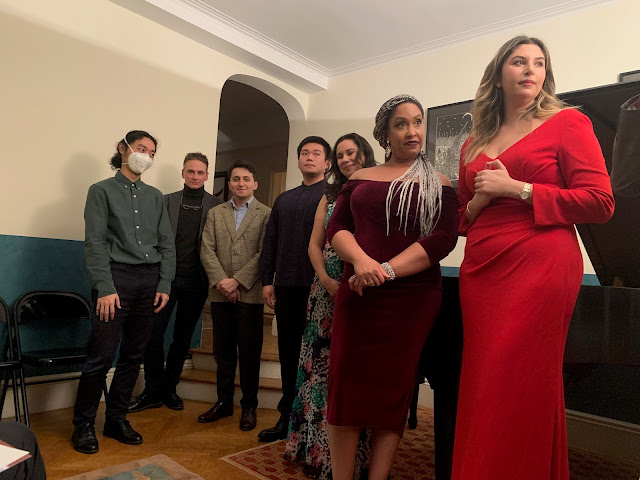
 Meet Classic Lyric Arts superstars--pianist Xu Cheng, director Daniel Isengart, tenor Scott La Marca, baritone Chen Xi, soprano Laura Soto-Bayomi, and mezzo sopranos Briana Hunter and Shannon Delijani!

Classic Lyric Arts, helmed by renowned professor, coach, and collaborative pianist Glenn Morton, is well known for its intensive summer programs in both Italy and France. They are now expanding into The Berkshires for yet a third program--this one focusing on the operas of Mozart. Staying that close to home this past summer because of Covid has made this new addition seamless. Growth is good! Students will have the opportunity to enroll in any or all of the programs.

We felt privileged to attend their soirée last week to hear some of our favorite artists, some of whom have sung at Voce di Meche's House of Music and others who were new to us. The evening was coached by Daniel Isengart who has added great performance value to CLA's intensive programs and is now an esteemed faculty member.

To avoid deciding which artist to mention first, let us go according to fach with pride of place given to Laura Soto-Bayoni who has a sizable soprano and a personality to match. Because of our focus on emerging artists, we rarely get to hear big voices and hearing Verdi was a special treat. An arresting account was given of "Non so le tetre imagine" from Il Corsaro. This aria is filled with emotion which colored her delivery of the text. The melodies are gorgeous and Ms. Soto-Bayoni leaned into them with effective phrasing and an affecting vibrato.

She was no less impressive in "Stridono lassu" from Leoncavallo's Pagliacci , showing a real flair for verismo. We are pleased to report that the birdsong so beautifully created on the piano by Xu Cheng entered our consciousness doubly as her stunning soprano convinced us that we could also see the birds in our mind's eye.  Now that's artistry!

More flexibility was demonstrated in a duet with Mr. La Marca--"Tornami a dir che m'ami" from Donizetti's Don Pasquale in which both young lovers expressed their affection by means of some lovely phrasing of Donizetti's charming vocal line. We do love duets and the two voices blended perfectly in happy harmony.

Shannon Delijani was heretofore unknown to us but we are glad to have this lack remedied. Ms. Delijani has a striking presence that seemed to announce the striking voice we heard. Our favorite piece was "O mon Fernand" from Donizetti's La Favorite. We have loved this aria so much in Italian and we didn't expect to enjoy the French version but, thanks to some perfect French diction we were similarly enthralled. We have a great enthusiasm for bel canto and it strikes us as more difficult to perform on French vowels but Ms. Delijani was undaunted. The handling of the lower register had just the right mix of chest and head voice. The cabaletta was powerful.

Her facility with French served her well in Chabrier's chanson "Les cigales" which requires rich coloration and good dynamic control.  Ravel's "Kaddisch" was performed in Hebrew which was made to sound as beautiful as French. We felt a sincere commitment, made doubly impactful by the spare and haunting piano accompaniment.

Mezzo-soprano Briana Hunter possesses an amazing repertoire of expressions and gestures, all of which were brought to bear on the Habanera from Bizet's Carmen. We forgot every time we had heard it before and experienced it as if brand new. Her Carmen is a mercurial one and each gesture and expression seemed to emerge from the text.

Ms. Hunter's complete comfort in the French language was heard in "Elle est la pres de lui" from Thomas' Mignon. It was emotional; it was believable; each gesture supported the voice. There is so much strength in the lower register!

Tenor Scott La Marca did his best work in Turina's "Los dos miedos" which he had  performed in our House of Music. Regular readers may recall how much we love Spanish music and this is one of our favorites; we have not heard it sung better. The text is psychologically valid; the musical line is apposite; the performance was stellar. As we said before, the romantic duet with Ms. Soto-Bayomi was a big hit in which Mr. La Marca paced his tenor part to perfectly match her soprano line. Beautiful blending!

As if that weren't enough, we had a surprise guest who wasn't on the program. Guest artist Chen Xi sang Tosti's "Ideale" with the same commitment we heard in the rest of the program--a feature which made it seem as new as the Habanera. We loved the resonance in his lower register.  This was the icing on the delicious cake served up by Classic Lyric Arts

Xu Cheng's collaborative piano served each piece, each style, each composer, and each singer. This versatility should serve him well in his future career.

© meche kroop