MISSION

We are here to encourage the development of gifted young singers and to stimulate the growth of New York City's invaluable chamber opera companies. But we will not neglect the Metropolitan Opera either. Get ready for bouquets and brickbats.
Showing posts with label City Lyric Opera. Show all posts

Thursday, May 4, 2023

POVERA DONNA


 Cast of City Lyric Opera's La Traviata

Opening nights at the opera are usually exciting and last night's opening of Verdi's tragedy La Traviata was particularly so for several reasons. An important one for us is that we have watched City Lyric Opera grow from its inception, back when it was called A.R.E. Opera. We love the idea that it is gynocentric, giving opportunities to female conductors and directors. What is important for the company is that they have outgrown church basements and black box theaters, presently performing in the charming theater at The Sheen Center which has a real proscenium arch with curtains, comfortable raked seating, a reception area, and room for a chamber orchestra.

This chamber orchestra, led by rising star Maestro Michelle Rofrano (no relation to the young Count Rofrano in Strauss' Der Rosenkavalier), comprised a dozen strings, augmented by flute, clarinet, bassoon, horn, trumpet, and timpani. They responded with agility to Mo. Rofrano's expressive hands in which no baton was needed.

Verdi's highly evocative music was given a fine reading with no radical departures but with subtle shadings and excellent balance. The dynamics were successful with the volume kept down during the arias but heightened for emotional moments. It is easy to see why Mo. Rofrano's star is on the ascendance.

We can say the same thing about the singers. How satisfying it felt for us to see and hear singers known to us from varied other performances with other companies--all together on the same stage, creating an effective ensemble feel. We credit Director R. Lee Kratzer for eliciting dramatically meaningful performances from the singers.

As the conflicted tragic heroine, we heard soprano Laura Soto-Bayomi who ably demonstrated Violetta's emotional growth from party girl to a woman in love and finally to a woman facing her death with fortitude. Her instrument is a powerful one with a brilliant upper register, as we noted recently when she performed in the zarzuela Luisa Fernanda for Opera Hispanica. It's a pleasure to witness a major talent with the versatility to perform such divergent roles.

As her ardent and impetuous young lover, we heard tenor Colin Aikins who was convincing in his portrayal. In Act I, he was shy and awkward, finally, with a big push from his copain Gastone, getting to meet the woman he has worshipped from afar for an entire year. In Act II, having gotten Violetta out of Paris and into the countryside, he has gained a measure of self confidence, delivering "Dei miei bollenti spiriti" with panache. Watching his spirits collapse when he reads Violetta's "dear John" letter was heartbreaking. The peak of his performance came in Act III when his anger exploded and his voice expanded to fit the emotion. Casting a young man in this role made the entire situation far more believable. We heard Mr. Aikins recently portraying a father in Puccini's Gianni Schicchi at Juilliard where he is a master's degree student. 

As Père Germont, we heard baritone Sejin Park who impressed us with his portrayal of a bourgeois paterfamilias, anxious to protect the good name of his family. He entered sternly but softened as he realized that his son's mistress was honorable and dignified. His rich round baritone was employed with admirable phrasing and dynamics. It was a memorable performance. We first heard Mr. Park at Santa Fe Opera where he portrayed the desperate Enrico in Donizetti's Lucia de Lammermoor. Again, we were impressed by the artist's versatility.

A character that usually fades into the background is Flora, Violetta' friend and party-giver.  Not this time! Mezzo-soprano Rosario Armas has a huge instrument that, along with some clever stage business and eye-catching costuming, filled the theater whilst tickling the ear. We loved the part in Act III in which she attacks her lover for his philandering.  We have heard Ms. Armas more times than we can count and she has always given 110%.

Another artist we have heard before is baritone Lucas Bouk who made a grand entrance in Act III as Baron Douphol, Violetta's wealthy "protector", striding in with an air of possessiveness and a massive fur coat.

Tenor Morgan Mastrangelo gave a fine portrayal of Gastone who sets the plot in motion by bringing his friend Alfredo to the party and literally pushing him toward Violetta, then spying on the two of them-- stage business that set him apart from the crowd of partygoers.

The role of the modest Annina was performed by soprano Alexandra Martinez-Turano who was not given any stage business to make her stand out, which was appropriate to the role.

Flora's unfaithful "protector" , the Marchese was played by bass-baritone Jonathan Harris whose reaction to Flora's accusation injected a note of humor. The chorus did a fine job in Act III singing the matador song and the staging was well done.

There were many other imaginative touches like the bird sounds heard before Act II and the howling wind before Act IV. However, we found other directorial decisions less than enchanting. We attended with two friends and none of us could understand the "concept".  We once saw a film version starring Teresa Stratas in which the overture was accompanied by a scene of the dying Violetta witnessing "removal men" carting off her belongings with the opera itself performed as flashbacks. It was cinematic and it worked.

In Ms. Kratzer's version, there appeared to be a coffin covered with camellias, in a room filled with people. Was this meant to be a funeral?  Violetta rises from what might be a bier and it seems as if her spirit reminisces about her life. In the final scene, which was awkwardly staged with Violetta getting in and out of bed several times, her "spirit" rises up and walks offstage. It just didn't work for us and interfered with the tragic ending.

In Act II, the silvery ribbons which were so effective in Act I fought with the countryside setting which was weakly established by a few green carpets on the ground, looking like putting greens, and a line of laundry which Alfredo proceeded to dump into a basket. There is something in the libretto about "washing away the shame" and we wondered whether this was meant to be symbolic. There were puffy white things scattered constantly in almost every scene; were they meant to be camellias or bloody tissues?  Or both? And the valise filled with the white things? None of this worked.

We don't mind if a director has something new to say about a masterpiece but all this nonsense struck us as attempts to call attention to the director's "originality". It certainly didn't serve to make the work any more relevant. There was no sense of time or place. Colorful costumes (by Camilla Dely) suggested modernity but we all know that the story is very much of the past. We no longer have "courtesans" and a young woman's marriage would not be affected by her brother having an affair. The woman would have been invited to her sister-in-law's wedding! And when the libretto speaks of Violetta leaving in a coach, we think horses.

Ms. Kratzer is certainly not alone in falling victim to this Eurotrash sensibility. The Metropolitan Opera has set a very poor example. Their La Traviata with the huge clock and Dr. Death was even worse. We feel very strongly that opera does NOT NEED TO BE MADE RELEVANT. It only has to be made musical and beautiful. We in the audience should feel free to draw analogies on our own and to appreciate differences in contemporary mores.  We don't see anyone running around the Metropolitan Museum of Art, painting over the Rembrandts trying to make them relevant.

We shall now step off our soapbox and praise City Lyric Opera for their fine casting and to congratulate them on their new home. We invite your comments below, especially if you disagree.

© meche kroop

Friday, May 27, 2022

A WONDERLAND FOR OUR TIME


Robert Feng, Nathaniel Mattingly, Laura Soto-Bayomi, Maestro Danielle Jageleski, and Mary Rice

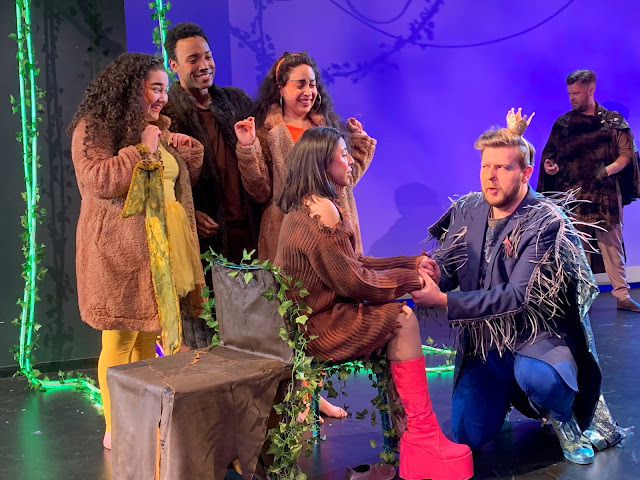
City Lyric Opera put The Blue Gallery to good use in their staging of Elizabeth Raum's "opera" The Garden of Alice, seen last week and still recalled as a remarkable piece of theater. It was a wild idea of Ms. Raum to create a work of music theater based upon Lewis Carroll's Alice's Adventures in Wonderland. We put opera in quotes because it is difficult for us to recognize it as such, save for the excellence of the voices we heard, which is why we have headed our review with a photo of the cast. 

We urge our dear readers to look at one of our Facebook pages (Voce di Meche or Meche Kroop) to see photos of the unusual setting and wildly inventive costumes.

We have seen theatrical performances before that had been adapted from Carroll's surreal story and concluded that the book is basically a psychedelic trip with its concurrent hallucinations and surreal images and transformations.  Director Attilio Rigotti had other ideas. In the program, which we did not read until after the experience, his concept was about the Wild West nature of the electronic world, a world without truth where everything is a construction. 

The concept is an interesting one with which we have no quarrel; it enabled and justified the use of all manner of electronic devices and projections including comments on the action filtered through the lens of twitter comments.

The staging was immersive and the audience and singers occupied the same room at the same time in a gallery that provides a number of spaces. There was quite a bit of moving around and each space had interesting features. The excellent six piece chamber orchestra remained in one place and when Maestro Danielle Jageleski needed to be conducting the singers in a different space, her image was presumably transmitted to the orchestra. The one flaw this created was that the sound of the orchestra as broadcast to another room was not the natural sound that we so enjoyed in the final scene of the work. This would seem to have been a necessary compromise.

The storytelling was of course episodic but the characters of the book which we recall were all present with the White Rabbit (a nattily dressed bass-baritone by the name of Nathaniel Mattingly) assuming an increasingly larger role in the story. He is the guide, so to speak, of Alice's adventures.  Soprano Laura Soto-Bayomi made a winsome Alice, keeping her cool in this strange environment.

Mezzo-soprano Mary Rice made a fine arrogant showing as both the Duchess and The Red Queen, wearing equally outstanding costumes for each role.  The most traditional operatic aria was delivered by soprano Gileann Tan in the role of the Dormouse.

We liked Ryan Lustgarten's performance as the falsely accused Knave of Hearts as well as Robert Feng's growly Mad Hatter. Baritone Steve Valenzuela was fine as the Caterpillar and the Cheshire Cat and Ramon Tenefrancia's tenor suited the March Hare.

The work is admittedly difficult to describe and must have been quite a challenge to stage with such "imagenuity", to coin a phrase. The female-centric City Lyric Opera has never shrunk from a challenge and the results were worthwhile. Contemporary opera seems to be fragmenting in all directions and who knows which pathway it will follow, but for the moment we enjoyed this production far more than the political diatribes that we avoid.  This work managed to be both entertaining and stimulating.

That being said, we still maintain that the major feature of the operatic art form is the unamplified sound of the human voice. The presence of electronics is, for us, a distraction.  We hope to hear each and every member of the cast in settings more conducive to vocal appreciation.

© meche kroop


Saturday, April 23, 2022

CITY LYRIC OPERA GALA


 Maestro Michelle Rofrano, pianist Dura Jun, Nate Mattingly, Mary Rice, 
Laura Soto-Bayomi, Kelly Guerra, and Scott La Marca

 Last night, City Lyric Opera celebrated in high style with their Spring Gala, an auditory feast that was as bubbly as the bubbly that was served. We have been a fan of CLO for all six seasons and well recall when their name referred to their mission--opera that was accessible, relatable, and enjoyable. The name has changed but the mission has thankfully been preserved.

We don't know of any other opera company that is helmed and staffed by women and focuses on a female point of view. This past year, female composers have been celebrated.  Pauline Viardot's Cendrillon was a huge hit. Music Director Maestro Michelle Rofrano is now also the Artistic Director.

We were warmly welcomed by Megan Gillis, Co-Founder and Artistic Director, who announced the final offering of the season--Elizabeth Raum's The Garden of Alice. We had a sneak preview by means of an aria charmingly sung by soprano Laura Soto-Bayomi. To our astonishment, the aria was melodic which is a quality we rarely see in contemporary works. We are actually looking forward to seeing it! Watch our Facebook page for announcements.

Another major treat of the evening was that we got to hear THREE arias from zarzuelas! Zarzuelas are so full of passion and melody that we never fail to feel drawn into the story, even when there is only a solitary aria presented. Mezzo-soprano Mary Rice performed "Carceleras" from Chapi's Las hijas del Zebedeo with Latin flair and a fine Castilian accent. We loved the tongue-twisting rapid fire delivery, the intense rhythmicity, the word coloring, the gestures, and the polished vocalism.

Mezzo-soprano Kelly Guerra filled out "La Petenera" from Torroba's La marchenera with a rich tone and such brightness in the upper register that a soprano might envy. We particularly enjoyed the mercurial changes of mood.

From Vives' Doña Francisquita, tenor Scott La Marca performed "Por el humo se sabe dónde está el fuego" with intensity and passion.  The many "turns" on the vocal line were clean and precise. Mr. La Marca is gifted in conveying a mood as we heard in "Lonely House" from Kurt Weill's Street Scene which felt as lonely as an Edward Hopper painting. Furthermore, he created a very winning Nemorino in "Una furtiva lagrima" from Donizetti's L'elisir d'amore. By means of word coloration, he made each verse different from the others.  There was a very lengthy drawn out pianissimo on "morir" that had us holding our breath.

There were more Italian pieces on the generous program. Baritone Nate Mattingly seems to have a real flair for nasty characters, although he seems to be very pleasant in person. His mobile face and lengthy limbs serve him well in creating a character.  We wouldn't call Figaro a nasty character but he does have a nasty moment plotting against his employer Count Almaviva in "Se vuol ballare" from Mozart's Le nozze di Figaro. There are some rather colorful jokes for those who speak Italian that let us know just how nasty he is feeling. Don Basilio, on the other hand, is a truly nasty character always plotting to rain on someone's parade. Mr. Mattingly's delivery of "La calunnia" from Rossini's Il barbiere di Siviglia started with a whisper and built to a climax--the sound of the cannon. The way he rolled his "r"s had us laughing out loud.

From the same opera, Ms. Guerra did great justice to Rosina's "Una voce poco fa" in which the young heroine is also plotting--but not to hurt anyone else, just to get out from under the thumb of Don Bartolo. We enjoyed the steps she went through to come up with a plan.  There was not a bit of cliché in her performance,

Ms. Guerra is excellent at comedy. We are completely unfamiliar with Derrick Wang's opera Scalia/Ginsburg which has been around since 2015 but never produced in New York City (tant pis). We have been so fed up with boring contemporary operas that we began to tar them all with the same brush.  What a joy to hear excerpts from two that we enjoyed, one of which CLO will produce next month.  Perhaps they could be persuaded to do the Wang opera in the near future. The aria performed by Ms. Guerra, "You, Sir, are wrong here" was marked by clever rhymes and rhythms. We enjoyed every phrase.

Ms. Soto-Bayomi delighted us with "Stridono lassu" from Leoncavallo's  realismo opera I pagliacci. We have heard her perform it before and consider it her signature piece. For the opera to work we have to feel sympathy for a cheating wife and it is not only Leoncaallo's music that works on us but the artistry of the singer. In this case we saw the birds overhead and felt her longing for freedom.

Another side of her was shown in "Klänge Der Heimat" from Johann Strauss' Die Fledermaus.  There is our heroine disguised as a Hungarian countess and playing it to the hilt--a delightful performance.

There were also some ensembles on the program, well-directed by Mo. 
Rofrano. The trio "Soave sia el vento" from Mozart's Cosi fan tutte allowed her to show her skill at balancing the three voices. In the quartet "Bella figlia dell'amore" from Verdi's Rigoletto each vocal line was given clarity and the whole exceeded the sum of the four parts.

Pianist for the evening was the talented Dura Jun who seems to be able to play handsomely in any style.

What a splendid evening! New York is fortunate indeed to have a company that can entertain us opera lovers so well; and young singers are fortunate to be valued and paid for their artistry.

© meche kroop

Saturday, December 18, 2021

IF THE SHOE FITS


 Allie Altieri, Joseph Parrish, Linda Collazo, Shaina Martinez, and Nicholas Huff

Not 5 minutes past the curtain call we wanted to see Pauline Viardot's Cendrillon over again.  Where was the repeat button? We relished every moment of this charming work brought to the stage by City Lyric Opera, a most worthy company with high ideals. Helmed by Megan Gillis, CLO aims to provide quality art at affordable prices, providing opportunities for young artists with the aim of diversity and inclusivity.

Career advancement is not easy for female conductors and we were thrilled to see the young rapidly rising Maestro Michelle Rofrano on the podium leading an energetic and light-hearted reading of Pauline Viardot's telling of the Cinderella tale. The chamber orchestra was with her every step of the way. There were the requisite strings augmented by one each of flute, oboe, clarinet, bassoon, and horn. The plangent sound of the harp wove it all together. The melodic score has the flavor of French music hall, which we see as a good thing. Mo. Rofrano played the score as a light-hearted and enchanting bauble.

Onstage, in the role of Marie (Cendrillon) we had the rising star soprano Shaina Martinez who never fails to deliver a carefully thought out performance that somehow manages to appear spontaneous. Her rich voice lends itself to a variety of roles that we have heard her sing and this is just one more feather in her cap. Her Marie was no scullery maid but rather an overlooked member of a detestable family. Her voice conveyed more hope than despair with some winning coloration that made her relatable.

Her two Karens (oops, I meant step-sisters) demanded her help and services. Soprano Allie Altieri as Maguellone and mezzo-soprano Linda Collazo as Armelinde were as fine together as they were separately. Their  vocal coloration was exactly the opposite of Ms. Martinez'. Their facial expressions and body language were perfectly emblematic of their characters and absolutely hilarious.

In the role of La Fée we heard the extraordinary crystalline coloratura of Yejin Lee, singing in delightful bel canto style involving stunning fioritura.  Le Prince Charmant was sung by Nicholas Huff whose warmth of tone and ardent demeanor had him rise above some staged goofiness. The love duet with Cendrillon was beautifully realized by both artists. As his chamberlain Le Comte Barigoule, we heard tenor Corey Don whose fine voice and figure made it easy to believe the role reversals.

Cendrillon's father is usually portrayed as a henpecked husband who dares to show sympathy for his daughter only behind his wife's back; but in this case he is portrayed as a former dishonest merchant who has risen in status to that of Baron Pictordu. We did not quite catch how that was accomplished but there was a reference in the libretto that must have been a secret joke in Ms. Viardot's circle. The superb bass-baritone Joseph Parrish gave him the attitude of un parvenu  and filled out the character with a full rich sound. 

This one hour opera was written for Viardot's  students when she was rather advanced in years. It was likely performed at one of her salons. None of the sadistic parts of the Perrault fairytale were in evidence, nor any of the Disneyfied padding. This was a simple story of a neglected young woman whose good heart wins the affection of a prince, even though she doesn't know his identity. And it's also the story of a grasping family that has scapegoated her. Her kindness wins out in the end.

Let us not neglect the excellent chorus comprising Luxana Zepedas, Mithuna Sivaraman, Erin Rosales, Brian Jeffers, Ramon Gabriel Tenefrancia, and Nathaniel Mattingly.

The direction by Rose Freeman was right on point, giving everyone a chance to develop a unique character. There were a number of clever devices to enjoy as when La Fée asks Cendrillon to fetch a pumpkin and then to throw it out the window where it becomes a coach--projected on the upstage screen.  Similar devices were used for the horses and coachman. 

Rhea D'Souza is credited as Projection Designer and we found her projections to be a fine replacement for elaborate sets. We have been annoyed as of late by artsy-fartsy projections that distracted from the singing and staging.  Not so here. Every projection set the stage, so to speak, and contributed to the storytelling. 

Lina Younes was credited as Scenographer and Lighting Designer was Charlotte McPherson. No one is credited for the costumes but they evinced creativity and wit that exceeded what appeared to have been a modest budget. We were particularly taken with Cendrillon's "slippers"--shocking pink platform boots!

Although there was minimal dialogue in English, the opera was sung in beautiful French, translated by Quentin Bruno and projected onstage so that every member of the audience had a good view. 

The only information we are missing is the identity of the orchestrator. The work was written for piano accompaniment; perhaps Ms. Viardot did the orchestration herself. In any case it surely gave Mo. Rofrano some beautiful lines to work with.

In these trying times, light-hearted fun is just what we need. That being said, we would still want to hear this enchanting bauble even in the best of times. What an excellent choice for this company to have made!

© meche kroop

Saturday, September 18, 2021

CITY LYRIC OPERA KICKS IT UP A NOTCH!

"

A RAPT AUDIENCE THRILLS TO SEASON KICK-OFF

A frisson of anticipation filled the theater of The Mansion at Murray Hill. A sizable group of opera lovers, thirsting for live vocal artistry, filled the theater to capacity and rewarded the four splendid singers with enthusiastic applause after every offering. The accomplished artists deserved this wild applause, made even wilder by Covid-related deprivation. We felt like a starving person encountering a buffet table loaded with goodies.

The artists were known to us and have sung either for Around the World in Song or for Voce di Meche's House of Music (Manhattan's tiniest venue-- our living room to be exact)--both situations for which we thought it unfair to review. Thus, it is our greatest pleasure to finally get to tell you what great choices City Lyric Opera has made for their upcoming season.

Beautifully accompanied by the lovely pianist Dura Jun, the singers took turns showing off their versatility.  We, however, will focus on the singers individually. As is customary, we will start with our soprano Shaina Martinez. Ms. Martinez has been on our radar screen since her days at Manhattan School of Music. We were there reviewing her dazzling performances when she won the Ades Competition 3 years ago and when she astonished the huge audience at Riverside Church with a song cycle by Turina. We have thrilled to her Fiordiligi and her Violetta. We never tire of her richly textured sizable soprano.  We love that she will tackle anything and make it her own.

Last night she sang "Glück, das mir verblieb" otherwise known as "Marietta's Lied" from Korngold's Die Tote Stadt, which we never heard her sing before. As in everything else she sings, the flawless vocalism was matched by depth of feeling and understanding of the character.

As far as the Puccini canon, we have enjoyed her Liu and last night found equal pleasure in "Chi il bel sogno di Doretta" from La Rondine, perhaps Puccini's most frivolous opera. Ms. Martinez showed herself to be a superb storyteller. There was one held note that took our breath away as it progressed through an entire rainbow of feelings.

As a prelude to CLO's first offering of the season--Pauline Viardot's  Cendrillon--Ms. Martinez performed "Si je n'y venais" which we had never heard before. The artist portrayed her as a gentle soul but not a victim. We were entranced and, no matter what variant Covid throws at us in December, nothing will keep us away from this production. We advise you to jump on it as soon as the dates are announced.

 Linda Collazo has delighted New York audiences with her richly toned mezzo-soprano and wide range. Indeed, she was the first artist we went to hear just as soon as we got vaccinated when she performed a program of arias and songs about strong women. This reminds us to tell you, dear reader, that CLO is a company founded by two strong women--the lovely Megan Gillis and the equally lovely Kathleen Spencer-- both participating in announcing the season with their winning enthusiasm. To add to the gynocentric orientation, CLO's new Music Director is Maestro Michele Rofrano (no relation to Octavian).

We have mostly heard Ms. Collazo singing zarzuela arias which we love. Last night we were pleased to hear her take on Bizet's Carmen in the "Seguidilla", thankfully sung without the clichés that leave us rolling our eyes. Her Carmen is more subtle and relies more on her voice than posing and strutting. 

"Smanie implacabili" from Mozart's Cosi fan tutte allowed Ms. Collazo to get emotional--even hysterical--which showed off her strengths throughout the register.

But it was "Una voce poco fa" from Rossini's Il barbiere di Siviglia that delighted us the most. We loved the way she gave Rosina a unique personality, using her phrasing most effectively. Readers will recall how much we lean toward bel canto. We enjoyed the very delicate vibrato, the notable decoration of the vocal line, and the fiery cabaletta. The descending scale passages were finely wrought.

Our tenor Cesar Andres Parreño is as gifted dramatically as he is vocally. We first heard him just before Covid struck when, as a student at Juilliard, he participated in a NYFOS program entitled "Cubans in Paris". We were so delighted by his talent that we recruited him to sing in our Around the World in Song.  He is not Cuban but rather Ecuadorian and represented his country magnificently with a selection of folk songs. 

What a pleasure it was to hear him again! He opened the program with an aria from Torroba's Maria Fernanda entitled "De este apacible rincón de Madrid" which suited his plangent lyric tenor perfectly. The timbre is just right for zarzuela and we were thrilled to witness his performance as he varied his emotional tone from tender to powerful.

We were over the moon when he performed yet another zarzuela aria, this one the famous "No puede ser" from Sorozábal's La taberna del Puerto. There is no way to fail to grasp the pain of deception and the delusional quality of one who cannot believe that a woman he loves does not share his moral compass.

In "Una furtiva lagrima" from Donizetti's L'elisir d'amore, the hero Nemorino has the great fortune of winning the woman he loves and Mr. Parreño captured the youthful innocence of his character with his sweet tone and effective acting. It takes courage to tackle an aria that has been performed by all the greats and to make it your own!

Baritone Andres Cascante is less well known to us than the others but we recall that he was one of Opera Index' prize winners about 4 years ago and had pleased us by performing a zarzuela aria.  Maybe he is less known to us but certainly not less appreciated! He made a wonderful Count Almaviva in "Hai già vinta la causa!" from Mozart's Le nozze di Figaro. He used voice, facial expression, and bodily gesture to bring the clueless Count to vivid life. He sang with full tone and total awareness of the text.

In Puccini's Gianni Schicchi, the main character is as arrogant as the Count but a lot smarter.  In "Si corre dal Notaio" he devises a plot to fool the greedy relatives of a dying old man. Mr. Cascante showed himself to be a most effective storyteller.

We must call Mr. Cascante's performance last night "3 shades of arrogance". The Count is arrogant by birth; Schicchi by wiliness; and Escamillo by public adoration. As our artist delivered "Votre toast" from Bizet's Carmen, he created a character enamored of his skill and fame. We just loved the subtleties that limned three very different characters with the same characterological feature.

We recall CLO's initial venture a few years ago when they called the company A.R.E.-- accessible, relatable, and enjoyable.  Although the name was changed, we are happy to report that their aim is the same and their aim is true.

© meche kroop
 

Friday, December 13, 2019

HOLIDAY PARTY WITH CITY LYRIC OPERA

Megan Gillis and Kathleen Spencer

What a pleasure it is to watch City Lyric Opera thrive! Co-Founders and Artistic Directors Kathleen Spencer and Megan Gillis, singers themselves, know exactly what singers need and have established an artist-centric company, a niche of which we heartily approve.

Last night, a gracious Upper West Side lady (and we do mean "lady") hosted a salon in celebration of the holiday season. With Amir Farid at the piano, there was plenty of singing, both professional and audience participation. Sets were well paced with plenty to eat and drink during the intermission.

We love being introduced to new singers so we had a field day, as they say. Mezzo-soprano Taylor-Alexis Dupont who sang in Porgy and Bess at The Metropolitan Opera appeared in a total wow of a red dress to deliver as passionate a delivery of Richard Strauss' "Zueignung" as we have ever heard. Clarion tone and fine German diction added up to a stellar performance.

It was a good night for mezzo-sopranos. Stephanie Feigenbaum was not new to us. We enjoyed her performance as Nancy in Britten's Albert Herring with Utopia Opera and also as the good witch Melissa in a Caccini opera with Dell'Arte Opera Ensemble. Last night she showed us two different aspects of her talent.

"What a Movie" from Leonard Bernstein's Trouble in Tahiti was delivered with perfect English diction, generous use of gesture, and just the right degree of irony. We were reminded of our own guilty pleasures and how we sometimes knock the things we enjoy because they are thought to be "beneath us"--like James Bond movies, for example.

Later, she sang "Make Someone Happy" from the forgotten musical Do Re Mi for which Comden and Green wrote the lyrics and Jules Styne composed the music. What a change from irony and histrionics to a quiet sincerity!

Baritone Joshua Miller sang a Charles Ives song called "Down East" that reminded him of his Maine roots. His mellow instrument and clarity of phrasing were joyful to hear.

Sadly, an unavoidably late arrival prevented us from hearing tenor Kameron Ghanavati sing a song by Ben Moore and soprano Celeste Morales singing Hugh Martin's "Have Yourself a Merry Little Christmas" and "I'll Be Seeing You". We were told they were both excellent and we are sure to catch up with them some other time.

Special Programs Manager Nehemiah Rolle led a discussion among the artists on the topic of what the holidays meant to them. It was an interesting idea and allowed those of us in the audience to see them as people, not just performers. We got to hear some charming stories.

There was group singing of "Winter Wonderland" and "Auld Lang Syne" (endless verses of it) but your faithful writer just moved her lips lest she send the entire group fleeing from the room!

At this time of year, think generously of the boutique opera companies that fill out the cultural landscape of our fair city with such beauty. City Lyric Opera deserves your support!

© meche kroop


Friday, November 1, 2019

A SEASONAL SEANCE FOR HALLOWEEN

Philip Stoddard, Cristina Marie Castro, Chantelle Grant, Jackson McKinnon, Kathleen Shelton, JoAnna Geffert,
and Joshua Miller

In 1946, commissioned by Columbia University, Gian Carlo Menotti composed the music and wrote the lyrics for a work entitled The Medium. Within a period of five years, it achieved a Broadway run, a television production, and a film.

It has been called an opera but, in our opinion, it comes across as a play with music. In its one hour duration, it has a great deal to say about deceit, gullibility, and abuse. As far as the "music" it is non-melodic, although there are three fine arias, two of which are for Monica and one for Madame Flora, her mother.

Although we have seen it before, the production we saw by City Lyric Opera hit all the right notes dramatically, thanks to Stage Director Mikhaela Mahoney who apparently included contributions from her excellent cast. Subtexts were revealed which were completely relevant to today's world.

The cast was uniformly excellent with Philip Stoddard portraying the mute Toby as a gangly adolescent whose mental faculties have not kept pace with his physical maturation. He conveyed so much with his face and gesture that speech would have been redundant.

As Monica, soprano Cristina Marie Castro invested her role with pathos and ambivalence. Clearly her abusive mother (Madame Flora) has brought her up with poor morality. She is obliged to serve her mother by fraudulently convincing Madame Flora's clients that she is the spirit of their departed children.

The one joy of her life is the presence of Toby whose backstory is only hinted at; he was rescued from the streets of Budapest and is mistreated by Madame Flora. The two youngsters are playmates but Monica cannot resist physicalizing their relationship in a way that confuses poor Toby.

Ms. Castro's shining soprano was lovely in "Monica's Waltz" and in the soothing song she sings to calm her anxious mother--"The Black Swan".

Chantelle Grant has an interesting texture to her mezzo-soprano instrument and was completely convincing as the duplicitous medium. Tampering with the world of spirits has its risks and Madame Flora becomes frightened when she hallucinates (or did she?) hands around her throat. She blames Toby for this, just as she blames him for everything.

She begins to decompensate and when her clients arrive for the next seance, she returns their money and tells them everything was a hoax. But they won't believe her and insist that their children actually contacted them! We see the same human flaw today in people who won't face the truth and clutch desperately to wishful thinking.

Ms. Grant takes to the bottle and sings a heart rending aria "Afraid? Am I afraid?" The three arias are in English and therefore less indicative of the quality of the voices than arias sung in Italian; but to our ears all the singers sounded just fine.

Aside from the three arias, all the other dialogue could be considered sprechstimme. No one would mind if the lines were spoken. As a matter of fact, since Music Director Jackson McKinnon played the piano with such an excess of volume, we would have preferred that, since many of the lines were drowned out. In all fairness, we were sitting very close to the piano, so if you attend one of the next four performances (and we hope you will) we advise sitting as far from the piano as possible.

The smaller roles were finely enacted. Kathleen Shelton portrayed Mrs. Nolan who wanted to communicate with her sixteen year old daughter. As the Gobineau's, JoAnna Geffert and Joshua Miller were convincing as a couple who had lost their two year old son and were satisfied just to hear him giggle. Of course it was Monica in both cases.

There were several small touches, which we will not reveal here, that made the production far more effective than it usually is. It was genuinely spooky and upsetting, which speaks well for the director and the performers. The casting was spot on. The roles of Monica and Madame Flora are double cast so you, dear reader, may see a performance that is slightly different from the one we saw. Still, we recognized the names of the second cast and can assure you that you won't be disappointed.

No one was credited for the set; it was simple but effective--a table, some chairs, a period lamp or two, and a neon sign advertising "Psychic". Dallas Estes' eerie lighting added to the experience. The uncredited costumes seemed period appropriate and fortunately did not call attention to themselves.

If you are unfamiliar with City Lyric Opera, let us fill you in. In a couple short years, Co-Founders and Co-Artistic Directors Kathleen Spencer and Megan Gillis have created a valuable niche for themselves with an artist-centric company that relies on an original vision to bring people into the world of opera with very modest ticket prices. Aside from their Mainstage Productions, they present Salons and WorkshOperas. These events must be experienced to be appreciated.

© meche kroop

Wednesday, September 11, 2019

CITY LYRIC OPERA SEASON OPENER

Jessica Niles, Eliza Bonet, Jessica Fishenfeld, Cory Battey, Scott Bradley Joiner, and Trevor Martin

In their fourth season, City Lyric Opera has everything going for itself. Helmed by two lovely ladies (incidentally, both possessors of lovely voices), this young company has garnered a highly invested young audience by virtue of their conviction and dedication to their mission. If you, dear reader, recall their origin as A.R.E. Opera, you will probably also recall what the initials stood for--opera that is Accessible, Relatable, and Enjoyable. Trust us when we tell you that these goals are still on the table, although there is a lot more to consider.

The idea of creating an artistic community in New York City is not a new one but it is rather new to the field of opera. Keeping ticket prices affordable--a price point of about $15-20 is eminently affordable--is also not new; but creating works of quality at that price point is a challenge they have met. Superb singers are attracted to the company and are treated as the artists they are, with generous fees paid.

This quality, combined with adventuresome programming relevant to our times, is responsible for their meteoric rise. Productions of operas are augmented by stimulating salon evenings and an annual WorkshOpera, one of which we attended last year; it was an eye-opening experience to learn about the creation of an opera!

We are not sure how the founders, Kathleen Spencer and Megan Gillis, have managed to accomplish this so rapidly but we suspect it has much to do with commitment, conviction, dedication, and hard work.

Last night the season opener was a gala event held at Steinway Hall involving some glorious singing, free-flowing champagne, and delicious passed hors d'oeuvres. These gals sure know how to throw a party! This is a family worth joining!

The major joy of our work is watching the developing careers of young artists. Take for example the sublime soprano Jessica Niles whom we first heard at a liederabend at Juilliard a couple years ago, singing Russian songs which she had translated herself. We were impressed and subsequently caught her performances in Juilliard's opera performances --Zerlina in Don Giovanni and Anna in Nikolai's Merry Wives of Windsor--perfect ingenue roles. 

Last night she performed Adina's aria "Prendi, per me sei libero" from Donizetti's L'elisir d'Amore, showing a deep understanding of the character and exhibiting a nice clean fioritura in the cabaletta. Later, she sang Emily's aria from Ned Rorem's Our Town. Her dramatic interpretation was moving; however we'd be lying if we said we liked the music. We didn't think Thornton Wilder would have wanted his story to be set to music, especially music without a memorable vocal line. Just sayin'!

We were delighted by the performances of mezzo-soprano Eliza Bonet whom we haven't seen since she portrayed a dominatrix (!) in the clever Three Ways by Robert Paterson (libretto by David Cote), a couple years ago. It really takes some Italian singing to appreciate the quality of a singer's voice and last night her choice of "Cruda sorte" from Rossini's L'Italiana in Algeri was just right to show off the terrific texture of her instrument and the spunkiness of her personality.

She delved deeper into her capacity for humor in Ben Moore's "Sexy Lady", written for Susan Graham--just one more funny song about the mezzo's dilemma. In this case, the words were more important than the music.

The meteoric rise of soprano Jessica Fishenfeld is another story that delights us. We first heard her as the Sandman in Humperdinck's Hansel und Gretel at Manhattan School of Music about six years ago. Then we saw her with Gramercy Opera in something called Big Jim and the Small-time Investors, a cute story with forgettable music. What we remember best was her duet with tenor Scott Bradley Joiner who joined her last night for the highly convincing love duet "Tornami a dir" from Donizetti's Don Pasquale. Hmmmm. Interesting. We wondered if they met during the production of Big Jim.

Absolutely dazzling was Ms. Fishenfeld's portrayal of Cunegonde from Bernstein's Candide, which opened the program last night. In "Glitter and be Gay" the word "revel" was never given such dramatic realization and the contrast between that and the crocodile tears of the slow section was impressive. Adding to the fun was a huge garment which Ms. Fishenfeld used well in the phrase "spread my wings".

She also performed a duet with baritone Trevor Martin (the only singer last night who was new to us)--"Make Believe" from the Jerome Kern/Oscar Hammerstein musical Showboat, which is sounding more and more like opera.

(We might add that Ms. Fishenfeld appeared with New York City Opera the previous night at their 75th Anniversary Concert in Bryant Park. That was understandably amplified so we didn't appreciate the artist's development until the City Lyric Opera event last night.)

Mr. Martin made a convincing Escamillo in the "Toreador Song" from Bizet's Carmen, as well as a fine romantic partner in the Showboat number. He also sang "Joey, Joey" from Frank Loesser's Most Happy Fella, showing us again how operatic a Broadway musical can be when sung unamplified by an operatically trained voice. It was at this point in the program that we realized just how excellent was the accompanist Cory Battey. When the wind whispered to Joey, we actually heard it in the piano!

Similarly, Mr. Joiner got his solo number as well, the well-loved "Questa o Quella" from Verdi's Rigoletto, which was sung in garlic-scented Italian of which every word was clear.

Just as one might expect in this bubbly evening, the encore was a group sing of "Libiamo" from Verdi's La Traviata!

This was a marvelous introduction to City Lyric Opera's fourth season and presented many reasons for us opera lovers to give our support, both financially and otherwise.  The next Mainstage event will be Gian Carlo Menotti's The Medium which opens appropriately on Halloween. This will be preceded by a Salon Evening on Oct. 15th which should provide some interesting insights into truth and reality.

(c) meche kroop

Wednesday, May 8, 2019

CARMEN GETS WET

Theodore Sarge, Young-Kwang Yoo, Lara Secord-Haid, Matthew Pearce, Tahanee Aluwihare, Quentin Bruno,
and Geddy Warner

If you love revolution in opera, read no further.  Just try to snag a ticket to City Lyric Opera's current production of La Tragédie de Carmen at the West End Theater (at The Church of St. Paul and St. Andrew) before word-of-mouth books up the remaining performances. We promise you an entertaining evening. Our attention was captured for an hour and a half and we left filled with conflicting thoughts and feelings.

This production has one foot in Bizet's 1875 masterpiece and the other in Part III of Prosper Mérimée's novella (which masqueraded as a non-fiction travelogue). But it has both feet in the water upon which we will shortly elaborate. And it is up to its neck in directorial narcissism.

It is our opinion that a work of art should stand on its own merit and should not require exegesis. Imagine explaining the Mona Lisa! For that reason we do not read the program until after an opera ends. We prefer to allow it to affect us. Or not.

The 1981 work La Tragédie de Carmen is an adaptation of Bizet's masterpiece; and it is not a masterpiece. It is a condensed, telescoped version, preserving our favorite arias, but ditching the chorus, the local color, and many of the characters and scenes that tell the story. The emphasis is shifted to the four main characters and their intense interaction. 

Arias have been reshuffled like the cards that the titular Carmen uses to foretell her future. Jean-Claude Carrière wrote dialogue to knit the vignettes together and Marius Constant composed music to weave the arias together. Peter Brook directed it, reminding us how we wish the era of regietheater would end. Opera began as a composer's medium and put the singer center stage. In our opinion this is how it should be. Directors should stick to film!

That being said, it was a canny choice for the relatively young and daring City Lyric Opera. Their mission is to provide one-of-a-kind opera going experiences without expectation or financial burden. This they have achieved. They have managed to keep us well entertained and to find excellent singers to feature in their productions.

For example, we had the marvelous mezzo-soprano Tahanee Aluwihare whose dusky instrument and seductive presentation gave us a believable free-spirited Carmen. As Micaëla, soprano Lara Secord-Haid sang beautifully but had the unenviable task of making the shy but brave character into a nasty jealous shrew who attacks Carmen.

Our Don Jose was superbly portrayed by tenor Matthew Pearce who was strangely "promoted" to the rank of General, which made his subjection to the will of Zuniga (Geddy Warner) rather peculiar. Men of lesser rank cannot demote a General! Forgetting all that, he sang with beautiful tone and lovely phrasing--and no down-time to rest his voice.

As Escamillo, Young-Kwang Yoo used his fine baritone to advantage without any costume choices to aid in his characterization.

Considering musical values aside from voices, Maestro Rebecca Tong led a chamber orchestra of 15, emphasizing the suitability of this production for a boutique opera company. We cannot claim to be completely satisfied with the balance; the piano sounded particularly odd when contrasting the cheerful theme of the bullfight with the tragic theme of Carmen's death. A recording by a full orchestra was used for the bullring music and this was poorly integrated with the live music.

Addressing the production values, some ideas were valid and some struck us as bizarre. The program notes would have the audience believe that the reflections on the water are meant to make us reflect upon our emotional gaps and how we fill them. Not for one moment during the show nor afterward has this entered our introspective mind. We cannot say that mirrors would have served better but we can say that making singers perform in several inches of water seems a form of artist abuse.

When Don Jose and Escamillo fight with water pistols (we kid you not) the audience laughed out loud, as they did at other points in the performance. We are not saying that comic moments don't belong in a tragedy; the Bard himself had humorous scenes in his tragedies. But this was just weird.

It also seemed inapposite for Micaëla and Carmen to have a cuddle session toward the end. There was not a shred of evidence to motivate that scene. As a matter of fact the condensation of the plot did not provide much motivation for a lot of the action. The wedding scene came at a point when Carmen was through with Don Jose and we thought it was a fantasy of his.

In the Mérimée novella, Micaëla does not even exist-- but Garcia, Carmen's husband (Quentin Bruno) does. His presence in this version seemed to serve to illustrate Don Jose's violent nature.

The rape/death scene seemed particularly badly directed since Carmen just lay down in the water as if she wanted to be raped. If this was supposed to make some kind of psychological point, it didn't float.

The production team comprised Victoria Collado as Director, Anna Driftmier as Scenographer/Costume Designer, and Charlotte McPhearson as Lighting Designer. We are not sure but surmise that directorial decisions were made jointly. 

In any case, Ms. McPhearson's lighting was suitably dramatic. An ensemble of three men wore headbands with bright lights which added to the eerie quality. They were Theodore Sarge (who had a brief moment as Lillas Pastia making a speech), Quentin Bruno (who had his brief moment as Garcia), and Geddy Warner (who had his brief moment as Zuniga).
We were wondering whether opera newbies would be the right audience for this piece. It is short. It is dramatic. It has sex and violence. We tried to approach it with the openness of a newbie and still found fault. What about diehard opera fans? We think they would find it a travesty with all that cut-and-paste of the music. Of course, it could be fun to identify where in the Bizet the music was taken from. "Oh wait!  Isn't that the music from where Micaëla is looking for Don Jose in the mountains?"

Perhaps if someone want to retell the Carmen story, he/she might consider writing their own music!

Photos from the production can be seen on our Facebook page--Voce di Meche.

(c) meche kroop

Thursday, March 7, 2019

HERstory by CITY LYRIC OPERA

Kanae Matsumoto, Cristina Maria Castro, and Kathleen Spencer


We have come to count on City Lyric Opera to sate our voracious artistic appetite. Co-founders and Artistic Directors Kathleen Spencer and Megan Gillis have managed to create a viable artist-centered company that not only serves the artists and entertains the audience but also provides some very appealing opportunities for supporters and donors. What a thrill it can be to sponsor a singer or the orchestra, the venue or the artistic staff. Here, one can truly feel a part of the production. Opera is expensive but these two lovely ladies appear to have a great business sense and have attracted a loyal following in just three years. Viva les femmes!

Last night's salon evening was held in a glamorous apartment overlooking Lincoln Center and was generously hosted by a charming couple newly making their home in the Big Apple. A crowd of beautiful people gathered to make new friends, partake of a particularly generous buffet accompanied by fine wines, and--most importantly--to welcome several young singers who gave their all to the music.

Regular readers will recall how disdainful we are of contemporary American song that utilizes boring text and cannot seem to come up with a pleasing melody. We were delighted to have our prejudice exploded, at least for one contemporary American composer by the name of Lori Laitman who was present at the salon and received all the accolades that her work merits.

With scintillating soprano Cristina Maria Castro taking the soprano part and the vivacious Ms. Spencer herself taking the mezzo-soprano part, we thoroughly enjoyed "I am in need of music" with text by Elizabeth Bishop from the poem "Sonnet" written in 1929. The text flowed and so did the music. The two voices intertwined in gorgeous overlapping phrases; we were enthralled.

We wish we could say the same about the two Sheila Silver songs which were settings of text by Edna St. Vincent Millay from "Beauty intolerable". We thought that soprano Rachael Braunstein gave them a lovely performance but that the poems did not seem to need music and the music they were given was rather jazzy and overwhelmed the vocal line.

On the other hand, Heinrich Heine's "Die Lorelei" seemed made to be sung and apparently, several composers agreed with me including the underrated Clara Schumann. Soprano Alaysha Fox, a young lady full of personality and warmth, gave an impressive performance of this story-telling song. Ms. Fox is a Metropolitan Opera National Council finalist and we simply cannot wait to hear her on March 31st.

We also enjoyed her performance of Amy Beach's "Ah, love, but a day" with text by Elizabeth Barrett Browning. The piano writing is quite lovely and never overshadowed the vocal line, although we think it would be difficult for anything to overshadow Ms. Fox! She invested this lovely song with varying vocal colors and brought it to a powerful climax.

Ms. Castro was particularly elegant with her French in three songs by Lili Boulanger who died tragically at the age of 24. (Lili was the younger sister of the famous composer and teacher Nadia Boulanger.) Not only did Ms. Castro honor the long Gallic vocal line but exhibited beautiful overtones. The three songs, as she explained, addressed three stages of romance, reminding us a bit of the three different moods of Debussy's Songs of Bilitis with their three different colors.

The superb soprano Maria Brea performed two songs from Ms. Laitman's Five Lovers, settings of autobiographical poems by Jäma Jandroković. The text referred to various lovers the poet enjoyed after her divorce.  Judging by the text, she did enjoy them! "On meeting again" was delicate and wistful, whereas "Lovely in his bones" was lively and enjoyed a feeling akin to Jobim's "The girl from Ipanema".

Ms. Brea's generous soprano brought the evening to a brilliant close with Maria Grever's romantic "Te quiero, dijiste", the words of which will make any woman weak in the knees. The song was delivered with full-throated passion but ended on an exquisitely floated final note.

It was a perfect way to end a female-centric program. Among the female singers, composers, and poets, only Heinrich Heine stood out as the lone male. But his poem was about a woman so we will admit him to the sisterhood!

(c) meche kroop

Wednesday, February 27, 2019

WORKSHOPERA?

Director Justin Griffith Brown coaching the role of Frasquita (photo by Kathleen Spencer for City Lyric Opera)


WorkshOpera? A very clever neologism to describe one of the initiatives of City Lyric Opera. We will first quote from their website and then we will describe our personal experience of the event.

"Too often in professional companies, artists are rushed through musical and physical role preparation. Often companies are on a tight rehearsal schedule and performers aren't allowed the time to explore their characters and the music together as a collaborative group. Here at City Lyric Opera, we believe that so much knowledge can be gained from taking the time to work together as a group to put a piece of music on its feet in a safe environment. WorkshOpera is process-based, not performance based so it is not open to the public and does not culminate in a performance. All artists are encouraged to play, experiment, and to make mistakes in order to better inform their own sense of artistry and musicianship. In the 4-hour workshop, singers will work directly with a conductor and stage director to explore their characters and musical style in the context of an operatic scene. Singers are expected to coach the repertoire ahead of time with our rehearsal pianist and arrive to the workshop memorized and ready to work."

We arrived ready to be a "fly on the wall", to learn how this process worked. We audience members go to a performance, sit in our seats and either we feel entertained and enlightened, or we don't. Most of us have no idea what goes on leading up to this performance. To know is to appreciate!

If you have been fortunate enough to have studied voice, you know the countless hours of study the participants in the WorkshOpera had put in beforehand. They probably read their part aloud, sang their part on a neutral vowel, then learned to sing the words on the melody. They likely put in a lot of time and effort just learning French.

So now, all five participants, chosen early in the season by audition, were ready to delve into the Act II quintet from Bizet's Carmen "Nous avons en tête une affaire". The four hour WorkshOpera comprised two sessions with Director Justin Griffith Brown (well remembered from his innovative direction of Mozart's Die Zauberflöte for Bare Opera) and two sessions with Maestro Thomas Muraco (whose Opera Repertoire Ensemble at Manhattan School of Music has delighted us for years).

Mr. Brown began by asking the five singers to introduce themselves. We always thought directors worked by telling the singers what he wanted them to do but this was an entirely different experience. He listened to each one tell how he/she felt about their character and asked interesting questions. Which one was older? How did they know each other? What was motivating them?

He said a bit about what was going on in Seville during that period and told about the racial tension existing between the gypsies and the Spaniards. This would surely color the performances.

There were physical exercises designed to promote group cohesion and focus. The singers walked around in a circle, maintaining equal distances. At a certain point, one person would change direction causing the others to follow suit.

Another exercise seemed designed to keep the conversational scene alive. It involved tossing an imaginary ball toward another member in the circle who would then toss it to someone else. The words used to toss were "Zip, Zap, and Zop". The exercise was then complicated by performing the same action while moving in a circle. Then the exercise was performed with singers mingling around the room without boundaries. 

We observed the singers meeting the challenge of focusing on the physical representation of a conversation whilst being in different positions vis-a-vis one another.

In this tag team type of situation, it was now Maestro Muraco's turn to impart his vocal coaching. The participants sat facing him and were instructed to run through the text of the scene, reading their lines slowly. This gave him an opportunity to evaluate their French and where they put the stresses. He made sure that they carried each phrase through to the end.

Pronunciation was given a fine tuning, especially regarding the "schwa".  In a fast paced scene like this, consonants must be incisively articulated and rhythms must be accurate. All this must be accomplished while maintaining a legato line. Singers, as they move around the stage, must keep the conductor within their peripheral vision and be on top of the beat.

After reciting the lines, the scene was sung through with piano accompaniment and further corrections given.

If the singer knows the music well then the staging would not throw them off.

And staging was just what Mr. Brown did during his second session with the participants. Tables and chairs were set up to create Lillas Pastia's tavern. Every line that was sung created its own movement. It did indeed seem a safe space for the singers to experiment. 

It made perfect sense for Carmen to get up and move away from the others as she declines to join their latest "affaire". Similarly, it made sense for Dancairo and El Remendado to enlist the help of Frasquita and Mercedes in persuading Carmen to join them. The flirtatious aspect between the characters was explored as well as the manipulation of the women by the two men. It seemed very organic to us, as if the singers were creating the scene spontaneously.

We learned that changes in the music's tonality or rhythm can inspire a character to move. We observed the five singers coming together as a unit and we doubt that we can ever watch this scene again without being cognizant of these shifts and motivations!

Mr. Muraco took over once again for a run through with the participants, now at a more advanced level. Before adjourning, we were treated to a staged "performance" of the scene. We found it engaging and involving, even more than actual performances with sets and costumes. Voices took on new colors as the characters had become more developed.

We might repeat that this was not a rehearsal for a performance. The five singers will leave with enhanced security in their characterization and singing. One might say they have the role "under their belt". We would like to further point out that City Lyric Opera does not charge singers anything for this priceless experience. It is funded by donations from opera lovers who support the art form. In our opinion, it is a very worthy investment.

A big loud "BRAVO" for City Lyric Opera and their singer-centric approach. Singers themselves, Co-Founders and Co-Artistic Directors Kathleen Spencer and Megan Gillis have created something remarkable in three years.

(c) meche kroop