MISSION

We are here to encourage the development of gifted young singers and to stimulate the growth of New York City's invaluable chamber opera companies. But we will not neglect the Metropolitan Opera either. Get ready for bouquets and brickbats.
Showing posts with label Yejin Lee. Show all posts

Saturday, December 18, 2021

IF THE SHOE FITS


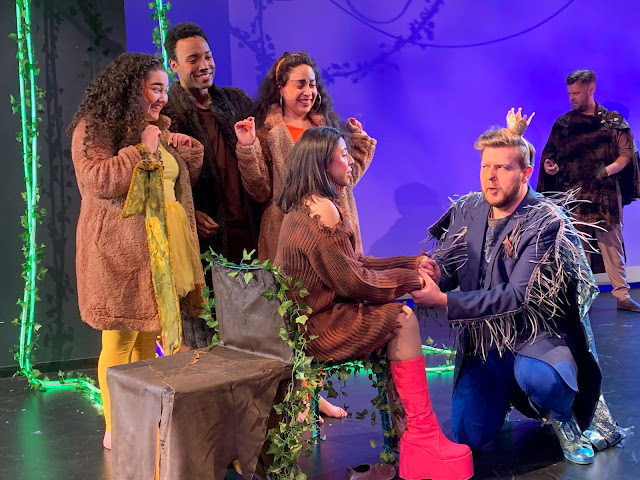
 Allie Altieri, Joseph Parrish, Linda Collazo, Shaina Martinez, and Nicholas Huff

Not 5 minutes past the curtain call we wanted to see Pauline Viardot's Cendrillon over again.  Where was the repeat button? We relished every moment of this charming work brought to the stage by City Lyric Opera, a most worthy company with high ideals. Helmed by Megan Gillis, CLO aims to provide quality art at affordable prices, providing opportunities for young artists with the aim of diversity and inclusivity.

Career advancement is not easy for female conductors and we were thrilled to see the young rapidly rising Maestro Michelle Rofrano on the podium leading an energetic and light-hearted reading of Pauline Viardot's telling of the Cinderella tale. The chamber orchestra was with her every step of the way. There were the requisite strings augmented by one each of flute, oboe, clarinet, bassoon, and horn. The plangent sound of the harp wove it all together. The melodic score has the flavor of French music hall, which we see as a good thing. Mo. Rofrano played the score as a light-hearted and enchanting bauble.

Onstage, in the role of Marie (Cendrillon) we had the rising star soprano Shaina Martinez who never fails to deliver a carefully thought out performance that somehow manages to appear spontaneous. Her rich voice lends itself to a variety of roles that we have heard her sing and this is just one more feather in her cap. Her Marie was no scullery maid but rather an overlooked member of a detestable family. Her voice conveyed more hope than despair with some winning coloration that made her relatable.

Her two Karens (oops, I meant step-sisters) demanded her help and services. Soprano Allie Altieri as Maguellone and mezzo-soprano Linda Collazo as Armelinde were as fine together as they were separately. Their  vocal coloration was exactly the opposite of Ms. Martinez'. Their facial expressions and body language were perfectly emblematic of their characters and absolutely hilarious.

In the role of La Fée we heard the extraordinary crystalline coloratura of Yejin Lee, singing in delightful bel canto style involving stunning fioritura.  Le Prince Charmant was sung by Nicholas Huff whose warmth of tone and ardent demeanor had him rise above some staged goofiness. The love duet with Cendrillon was beautifully realized by both artists. As his chamberlain Le Comte Barigoule, we heard tenor Corey Don whose fine voice and figure made it easy to believe the role reversals.

Cendrillon's father is usually portrayed as a henpecked husband who dares to show sympathy for his daughter only behind his wife's back; but in this case he is portrayed as a former dishonest merchant who has risen in status to that of Baron Pictordu. We did not quite catch how that was accomplished but there was a reference in the libretto that must have been a secret joke in Ms. Viardot's circle. The superb bass-baritone Joseph Parrish gave him the attitude of un parvenu  and filled out the character with a full rich sound. 

This one hour opera was written for Viardot's  students when she was rather advanced in years. It was likely performed at one of her salons. None of the sadistic parts of the Perrault fairytale were in evidence, nor any of the Disneyfied padding. This was a simple story of a neglected young woman whose good heart wins the affection of a prince, even though she doesn't know his identity. And it's also the story of a grasping family that has scapegoated her. Her kindness wins out in the end.

Let us not neglect the excellent chorus comprising Luxana Zepedas, Mithuna Sivaraman, Erin Rosales, Brian Jeffers, Ramon Gabriel Tenefrancia, and Nathaniel Mattingly.

The direction by Rose Freeman was right on point, giving everyone a chance to develop a unique character. There were a number of clever devices to enjoy as when La Fée asks Cendrillon to fetch a pumpkin and then to throw it out the window where it becomes a coach--projected on the upstage screen.  Similar devices were used for the horses and coachman. 

Rhea D'Souza is credited as Projection Designer and we found her projections to be a fine replacement for elaborate sets. We have been annoyed as of late by artsy-fartsy projections that distracted from the singing and staging.  Not so here. Every projection set the stage, so to speak, and contributed to the storytelling. 

Lina Younes was credited as Scenographer and Lighting Designer was Charlotte McPherson. No one is credited for the costumes but they evinced creativity and wit that exceeded what appeared to have been a modest budget. We were particularly taken with Cendrillon's "slippers"--shocking pink platform boots!

Although there was minimal dialogue in English, the opera was sung in beautiful French, translated by Quentin Bruno and projected onstage so that every member of the audience had a good view. 

The only information we are missing is the identity of the orchestrator. The work was written for piano accompaniment; perhaps Ms. Viardot did the orchestration herself. In any case it surely gave Mo. Rofrano some beautiful lines to work with.

In these trying times, light-hearted fun is just what we need. That being said, we would still want to hear this enchanting bauble even in the best of times. What an excellent choice for this company to have made!

© meche kroop

Sunday, July 14, 2019

BUBBLY CHAMPAGNE!

Elisabeth Harris as Prince Orlofsky and Chorus in Act II of Die Fledermaus

We never tire of Johann Strauss II's comic operetta Die Fledermaus. The witty libretto by Karl Haffner and Richarde Genée pokes a finger in the eye of late 19th c. Vienna with all its hypocrisy, class consciousness, and upper-class frivolity. The composer's music is equally witty and the score is well knit from overture to finale with glorious melodies tumbling out one after another--danceable waltzes and duple meter ones as well. Conductor Valéry Ryvkin and his excellent orchestra didn't miss a beat or a bubble in this champagne score.

Last night's production by Prelude to Performance was somewhat simplified as compared with the lavish one of 2016 with evening dress substituted for period costumes and projections standing in for elaborate sets. Nonetheless, the evening glittered by virtue of some outstanding performances.

If you don't know the story, dear reader, please enter Die Fledermaus in the search bar; we have told the story too many times to repeat it--once for Prelude to Performance and once for Amore Opera (both outstanding iterations.)

We have written every summer about Prelude to Performance which is celebrating 15 years of training young artists in many areas of performance, most notably that of character interpretation. We have never seen/heard anyone in one of their performances that failed to fully inhabit their character and bring it to vivid life. That is thanks to input from Artistic Director Martina Arroyo, the legendary soprano who has devoted her post-performance years to developing the talents of the up and coming young singers in her program.

Take, for example, soprano Lisa Faieta who gave us a complex and believable Rosalinde. Whether fighting off the attentions of Alfred (the aptly named Congju Song whose prodigious talent is new to us), soothing her about-to-be-jailed husband, rejecting the pleas of her maid Adele, or affecting the identity of an Hungarian Countess. As a matter of fact, it is in the latter guise that we were best able to appreciate her skills. Voice and gesture joined in this convincing portrayal and we were dazzled by a stunning messa di voce in "Klänge der Heimat". Two years have passed since we heard Ms. Faieta  with IVAI; her voice has developed wondrously.

Soprano Yejin Lee took the role of Adele and impressed us with her sprightly portrayal and dazzling coloratura. We had only seen her briefly before as one of the nymphs (Echo, we believe) in Ariadne auf Naxos; it was great to see more of her. As Rosalinde's maid she went over the top in her wheedling efforts to get the night off. In Act II, wearing Rosalinde's gown, she pretended to be the actress "Olga" and audaciously confronted Eisenstein when he recognized her. She absolutely scored in her "Adele's laughing aria". In Act III as she tried to convince Frank of her acting potential, we thought she could have been more convincing. That's the right place for some over-acting.

Mezzo-soprano Elizabeth Harris made an excellent Prince Orlofsky, emphasizing his bizarre personality and his ennui. Her arias were marvelously delivered. We always love "Chac'un a son goût" and the "Champagne song" in which the excellent chorus joins in. We could scarcely believe Ms. Harris' versatility, having reviewed her in several roles at Manhattan School of Music. What a contrast between Orlofsky and the cold-hearted Aunt Hannah in Tobias Picker's Emmeline!

As Eisenstein, baritone Jimin Park was lovable even when cheating on his wife (or so he thought). On his way to a brief jail sentence, he was lured to attend Prince Orlofsky's party. His dissembling with his wife Rosalinde and again at the party where he pretended to be Marquis Renard, established his character. His embarrassment when he sees Adele there was hilarious, as was his pidgin French with Frank the jailor who was posing as Chevalier Chagrin (neither man knew a word of French beyond "merci"), not to mention his flirtation with his own wife. All this comedy was accompanied by some fine singing that exhibited a tenorial quality in the upper register. We want to hear more of this young artist.

In the role of the jailer Frank, we heard baritone Yichen Xue, whom we heard two years ago singing "Scintille diamant" at Manhattan School of Music. We noted his excellent performance then and were glad to hear how his instrument has expanded. The scene in Act I in which he arrives to take Eisenstein to jail and finds Albert instead was a very funny one, as Rosalinde must pretend that Albert is her husband to preserve her reputation. He was quite funny again in Act II, pretending to be French.

The mastermind of this elaborate plot is Falke, so well sung by baritone Michael Parham, possessor of a fine instrument and elegant stage bearing--so elegant that we can just imagine the humiliation Falke must have experienced from Eisenstein's prior prank (the backstory) and his delight in the revenge.

Tenor Esteban Jose Zuniga, had a fine time and a funny one in the role of Dr. Blind, confirming everyone's worst expectations of the legal profession. 

Stage Director Alan Fischer did a fine job of keeping the action moving along at a galloping clip. We could not find credit for the direction of the chorus but they were excellent. Vera Junkers as language coach made sure that everyone's German was crisp and clear.

One measure of the success of this production is that the opera "newbie" we brought had a fine time. Wasn't this operetta the perfect introduction?

We should also mention that during Act II, the action was suspended for performances by some famous singers who appeared as guests introduced by WQXR's Robert Sherman. We particularly enjoyed the performance of soprano Nicole Haslett in Nanetta's aria, a role she performed with Prelude to Performance in 2012 and reprised last night! She got our attention then and we reviewed her 4 years ago as a George London competition winner. But what really stood out for us was her performance as Chloe in Offenbach's Daphnis and Chloe. 

That was the night we fell in love with Heartbeat Opera. Both Ms. Haslett and Heartbeat Opera are thriving, and to bring things full circle, she will be performing with them again next season in Der Freischutz. Nothing could keep us away!

Also on hand were soprano Mariana Zvetkova who sang "Io son l'umile ancella" from Cilea's Adriana Lecouvreur, soprano Harolyn Blackwell who sang "O mio babbino caro" from Puccini's Gianni Schicchi, and tenor Noah Stewart who performed "Donna non vidi mai" from Puccini's Manon Lescaut.

We could not imagine a more entertaining evening!

(c) meche kroop