MISSION

We are here to encourage the development of gifted young singers and to stimulate the growth of New York City's invaluable chamber opera companies. But we will not neglect the Metropolitan Opera either. Get ready for bouquets and brickbats.
Showing posts with label Linda Collazo. Show all posts

Monday, April 6, 2026

BUT IS IT OPERA?


Pablo Zinger, Linda Collazo, Maria Brea, and Juan Hernandez

We just spent a delightful evening enjoying one of our favorite art forms with a group of the finest interpreters of this art form at Fiesta de la Zarzuela. Regular readers have heard me write most enthusiastically about zarzuela and have read a bit about its origins; for those who are new to this blog, the short form of its history is that it originated in 17th century Spain, performed for the aristocracy, and ended up in the mid 20th century in the New World, enjoyed by the common folk. Not so different from the story of opera, right?

In what category shall we place zarzuela? We have our own ideas on this issue. In our opinion, a piece of musical theater that is sung by operatically trained singers without amplification qualifies as opera when the music tells the story. By this measure, we could count works by Rogers and Hammerstein, Sondheim, and Bernstein, as operas under the aforementioned circumstance. Zarzuela has incorporated its original nationalistic stamp into the genre, much as the best of American musicals have done. We see these included under the operatic umbrella whereas some contemporary works, prosy an unmelodic, seem left out in the rain.

This is, of course, only one opinion--more experiential than academic.  Some people would say that if The Metropolitan Opera produces it, it is an opera. Some people would say that spoken dialogue is a disqualification which would eliminate Carmen (as Bizet first composed it). This is obviously a moot point and we are willing to hear other people's opinions.

What we heard last night at Teatro Circulo comprised excerpts from a number of zarzuelas from the 19th and 20th century in predominantly chronological order. Three very talented Latin American singers made up the cast and we were treated to some engaging narration by Maestro Pablo Zinger who accompanied the singers on an electronic keyboard and (surprise!) led the audience in a singing lesson after the performance. We have never attended a performance in which the entire audience exited with such wide smiles.

We are hoping that Mo. Zinger will find a way to produce an entire zarzuela in the near future since we have only had that pleasure twice. Once before Covid when we enjoyed Maria Brea as the lead in the delightful comedy El Barbero de Sevilla and a post Covid production by Mo. Jorge Parodi of the more serious Luisa Fernanda. Let us hope! Meanwhile we have contented ourself with the occasional appearance of an aria or duet on a concert program.

Last night' production was a complete delight and created quite an impression with modest resources--a black box theater with thankfully raked seating, a minimal set comprising a pair of wrought iron benches, and singers dressed in black, accessorized with colorful mantónes de Manila.  A screen upstage projected slides illustrating famed zarzuela singers and composers of yore. We would have preferred English translations!

All three singers were superb. We usually write about singers at very early stages of their careers and love watching their careers flourish. We have fond recollections of the superb soprano Ms. Brea singing the role of Marie in  Martina Arroyo's Prelude to Performance over a dozen years ago. How rewarding it is to witness her as she fulfills her potential. We especially enjoyed the closing number "Salida de Cecilia" from Gonzalo Roig's Cecilia Valdes. We love the bright open top of her voice and the way she created a few different characters.

We have also written about mezzo-soprano Linda Collazo a number of times, many of them in recitals with Ms. Brea. Her facility with Latin American music and the Spanish language has always impressed us. Last night we particularly appreciated her performance of "Chancletera soy yo" from Ernesto Lecuona's Maria la O. Everything she sang was filled with passion and intention. And let us not forget to mention her pleasing resonance and apt phrasing.

Unlike our lengthy experience with the two female singers, our experience with tenor Juan Hernandez was limited to one occasion prior to Covid and please bear with us Dear Reader as we quote from our own review, which we feel is important to let you know how impressed we were even then. 

"We were also introduced to a very young tenor who showed a great deal of promise with a sweet unforced sound and amplitude of feeling. Juan Hernandez is his name and he is someone to watch. With the correct embouchure he produced a lovely Italianate sound in "Una furtiva lagrima" from Donizetti's comedy L'Elisir d'Amore. There was a lovely downward glissando, some admirable melismatic singing, and a finely drawn out decrescendo at the end. We thought of a fine silken thread suspended in the air."

Last night we made note of his lively personality and open-throated delivery in "Caballero de Gracia" from Chueca y Valverde's La Gran Via.  He exhibited all the right moves in the duets and trios as well. Come to think of it, we have heard Ms. Brea and Ms. Collazo in duets countless times and Mr. Hernandez melded perfectly into the scenes, providing some delightful trios.

We have only touched the surface of this excellent program, most of which was entirely new to us. Mo. Zinger can be credited with wearing many hats beside conceiving, directing, narrating and accompanying. Although the project of producing a zarzuela seems impractical considering dancers, an orchestra, a costumer, chorus, set designer, and lighting designer--if it could be accomplished we would turn to Mo. Zinger. Let us hope!

© meche kroop


Saturday, December 18, 2021

IF THE SHOE FITS


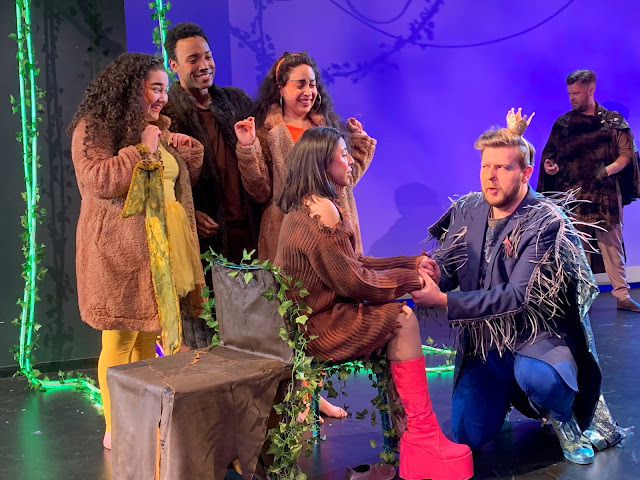
 Allie Altieri, Joseph Parrish, Linda Collazo, Shaina Martinez, and Nicholas Huff

Not 5 minutes past the curtain call we wanted to see Pauline Viardot's Cendrillon over again.  Where was the repeat button? We relished every moment of this charming work brought to the stage by City Lyric Opera, a most worthy company with high ideals. Helmed by Megan Gillis, CLO aims to provide quality art at affordable prices, providing opportunities for young artists with the aim of diversity and inclusivity.

Career advancement is not easy for female conductors and we were thrilled to see the young rapidly rising Maestro Michelle Rofrano on the podium leading an energetic and light-hearted reading of Pauline Viardot's telling of the Cinderella tale. The chamber orchestra was with her every step of the way. There were the requisite strings augmented by one each of flute, oboe, clarinet, bassoon, and horn. The plangent sound of the harp wove it all together. The melodic score has the flavor of French music hall, which we see as a good thing. Mo. Rofrano played the score as a light-hearted and enchanting bauble.

Onstage, in the role of Marie (Cendrillon) we had the rising star soprano Shaina Martinez who never fails to deliver a carefully thought out performance that somehow manages to appear spontaneous. Her rich voice lends itself to a variety of roles that we have heard her sing and this is just one more feather in her cap. Her Marie was no scullery maid but rather an overlooked member of a detestable family. Her voice conveyed more hope than despair with some winning coloration that made her relatable.

Her two Karens (oops, I meant step-sisters) demanded her help and services. Soprano Allie Altieri as Maguellone and mezzo-soprano Linda Collazo as Armelinde were as fine together as they were separately. Their  vocal coloration was exactly the opposite of Ms. Martinez'. Their facial expressions and body language were perfectly emblematic of their characters and absolutely hilarious.

In the role of La Fée we heard the extraordinary crystalline coloratura of Yejin Lee, singing in delightful bel canto style involving stunning fioritura.  Le Prince Charmant was sung by Nicholas Huff whose warmth of tone and ardent demeanor had him rise above some staged goofiness. The love duet with Cendrillon was beautifully realized by both artists. As his chamberlain Le Comte Barigoule, we heard tenor Corey Don whose fine voice and figure made it easy to believe the role reversals.

Cendrillon's father is usually portrayed as a henpecked husband who dares to show sympathy for his daughter only behind his wife's back; but in this case he is portrayed as a former dishonest merchant who has risen in status to that of Baron Pictordu. We did not quite catch how that was accomplished but there was a reference in the libretto that must have been a secret joke in Ms. Viardot's circle. The superb bass-baritone Joseph Parrish gave him the attitude of un parvenu  and filled out the character with a full rich sound. 

This one hour opera was written for Viardot's  students when she was rather advanced in years. It was likely performed at one of her salons. None of the sadistic parts of the Perrault fairytale were in evidence, nor any of the Disneyfied padding. This was a simple story of a neglected young woman whose good heart wins the affection of a prince, even though she doesn't know his identity. And it's also the story of a grasping family that has scapegoated her. Her kindness wins out in the end.

Let us not neglect the excellent chorus comprising Luxana Zepedas, Mithuna Sivaraman, Erin Rosales, Brian Jeffers, Ramon Gabriel Tenefrancia, and Nathaniel Mattingly.

The direction by Rose Freeman was right on point, giving everyone a chance to develop a unique character. There were a number of clever devices to enjoy as when La Fée asks Cendrillon to fetch a pumpkin and then to throw it out the window where it becomes a coach--projected on the upstage screen.  Similar devices were used for the horses and coachman. 

Rhea D'Souza is credited as Projection Designer and we found her projections to be a fine replacement for elaborate sets. We have been annoyed as of late by artsy-fartsy projections that distracted from the singing and staging.  Not so here. Every projection set the stage, so to speak, and contributed to the storytelling. 

Lina Younes was credited as Scenographer and Lighting Designer was Charlotte McPherson. No one is credited for the costumes but they evinced creativity and wit that exceeded what appeared to have been a modest budget. We were particularly taken with Cendrillon's "slippers"--shocking pink platform boots!

Although there was minimal dialogue in English, the opera was sung in beautiful French, translated by Quentin Bruno and projected onstage so that every member of the audience had a good view. 

The only information we are missing is the identity of the orchestrator. The work was written for piano accompaniment; perhaps Ms. Viardot did the orchestration herself. In any case it surely gave Mo. Rofrano some beautiful lines to work with.

In these trying times, light-hearted fun is just what we need. That being said, we would still want to hear this enchanting bauble even in the best of times. What an excellent choice for this company to have made!

© meche kroop

Saturday, September 18, 2021

CITY LYRIC OPERA KICKS IT UP A NOTCH!

"

A RAPT AUDIENCE THRILLS TO SEASON KICK-OFF

A frisson of anticipation filled the theater of The Mansion at Murray Hill. A sizable group of opera lovers, thirsting for live vocal artistry, filled the theater to capacity and rewarded the four splendid singers with enthusiastic applause after every offering. The accomplished artists deserved this wild applause, made even wilder by Covid-related deprivation. We felt like a starving person encountering a buffet table loaded with goodies.

The artists were known to us and have sung either for Around the World in Song or for Voce di Meche's House of Music (Manhattan's tiniest venue-- our living room to be exact)--both situations for which we thought it unfair to review. Thus, it is our greatest pleasure to finally get to tell you what great choices City Lyric Opera has made for their upcoming season.

Beautifully accompanied by the lovely pianist Dura Jun, the singers took turns showing off their versatility.  We, however, will focus on the singers individually. As is customary, we will start with our soprano Shaina Martinez. Ms. Martinez has been on our radar screen since her days at Manhattan School of Music. We were there reviewing her dazzling performances when she won the Ades Competition 3 years ago and when she astonished the huge audience at Riverside Church with a song cycle by Turina. We have thrilled to her Fiordiligi and her Violetta. We never tire of her richly textured sizable soprano.  We love that she will tackle anything and make it her own.

Last night she sang "Glück, das mir verblieb" otherwise known as "Marietta's Lied" from Korngold's Die Tote Stadt, which we never heard her sing before. As in everything else she sings, the flawless vocalism was matched by depth of feeling and understanding of the character.

As far as the Puccini canon, we have enjoyed her Liu and last night found equal pleasure in "Chi il bel sogno di Doretta" from La Rondine, perhaps Puccini's most frivolous opera. Ms. Martinez showed herself to be a superb storyteller. There was one held note that took our breath away as it progressed through an entire rainbow of feelings.

As a prelude to CLO's first offering of the season--Pauline Viardot's  Cendrillon--Ms. Martinez performed "Si je n'y venais" which we had never heard before. The artist portrayed her as a gentle soul but not a victim. We were entranced and, no matter what variant Covid throws at us in December, nothing will keep us away from this production. We advise you to jump on it as soon as the dates are announced.

 Linda Collazo has delighted New York audiences with her richly toned mezzo-soprano and wide range. Indeed, she was the first artist we went to hear just as soon as we got vaccinated when she performed a program of arias and songs about strong women. This reminds us to tell you, dear reader, that CLO is a company founded by two strong women--the lovely Megan Gillis and the equally lovely Kathleen Spencer-- both participating in announcing the season with their winning enthusiasm. To add to the gynocentric orientation, CLO's new Music Director is Maestro Michele Rofrano (no relation to Octavian).

We have mostly heard Ms. Collazo singing zarzuela arias which we love. Last night we were pleased to hear her take on Bizet's Carmen in the "Seguidilla", thankfully sung without the clichés that leave us rolling our eyes. Her Carmen is more subtle and relies more on her voice than posing and strutting. 

"Smanie implacabili" from Mozart's Cosi fan tutte allowed Ms. Collazo to get emotional--even hysterical--which showed off her strengths throughout the register.

But it was "Una voce poco fa" from Rossini's Il barbiere di Siviglia that delighted us the most. We loved the way she gave Rosina a unique personality, using her phrasing most effectively. Readers will recall how much we lean toward bel canto. We enjoyed the very delicate vibrato, the notable decoration of the vocal line, and the fiery cabaletta. The descending scale passages were finely wrought.

Our tenor Cesar Andres Parreño is as gifted dramatically as he is vocally. We first heard him just before Covid struck when, as a student at Juilliard, he participated in a NYFOS program entitled "Cubans in Paris". We were so delighted by his talent that we recruited him to sing in our Around the World in Song.  He is not Cuban but rather Ecuadorian and represented his country magnificently with a selection of folk songs. 

What a pleasure it was to hear him again! He opened the program with an aria from Torroba's Maria Fernanda entitled "De este apacible rincón de Madrid" which suited his plangent lyric tenor perfectly. The timbre is just right for zarzuela and we were thrilled to witness his performance as he varied his emotional tone from tender to powerful.

We were over the moon when he performed yet another zarzuela aria, this one the famous "No puede ser" from Sorozábal's La taberna del Puerto. There is no way to fail to grasp the pain of deception and the delusional quality of one who cannot believe that a woman he loves does not share his moral compass.

In "Una furtiva lagrima" from Donizetti's L'elisir d'amore, the hero Nemorino has the great fortune of winning the woman he loves and Mr. Parreño captured the youthful innocence of his character with his sweet tone and effective acting. It takes courage to tackle an aria that has been performed by all the greats and to make it your own!

Baritone Andres Cascante is less well known to us than the others but we recall that he was one of Opera Index' prize winners about 4 years ago and had pleased us by performing a zarzuela aria.  Maybe he is less known to us but certainly not less appreciated! He made a wonderful Count Almaviva in "Hai già vinta la causa!" from Mozart's Le nozze di Figaro. He used voice, facial expression, and bodily gesture to bring the clueless Count to vivid life. He sang with full tone and total awareness of the text.

In Puccini's Gianni Schicchi, the main character is as arrogant as the Count but a lot smarter.  In "Si corre dal Notaio" he devises a plot to fool the greedy relatives of a dying old man. Mr. Cascante showed himself to be a most effective storyteller.

We must call Mr. Cascante's performance last night "3 shades of arrogance". The Count is arrogant by birth; Schicchi by wiliness; and Escamillo by public adoration. As our artist delivered "Votre toast" from Bizet's Carmen, he created a character enamored of his skill and fame. We just loved the subtleties that limned three very different characters with the same characterological feature.

We recall CLO's initial venture a few years ago when they called the company A.R.E.-- accessible, relatable, and enjoyable.  Although the name was changed, we are happy to report that their aim is the same and their aim is true.

© meche kroop
 

Monday, May 24, 2021

WE ARE BACK IN ACTION


Our voce has been silent for these past 15 months due to- you know-Covid. We actually had forgotten how to access our blog and required assistance from Google! To celebrate the return of live music we have chosen a new typeface which we hope will be as easy on the eyes as Saturday night's concert was easy on the ears.

Eurasia Foundation's Aza Sydykov found a lovely and comfortable venue with adequate spacing between chairs and was wise enough to start the new "live season" with the magnificent mezzo-soprano Linda Collazo who, incidentally, has been singing for us at our musicales, garnering wild applause and many new fans from among the guests.

Saturday's recital focused on arias and songs by strong women and about powerful women in all their glory, among whom we count Ms. Collazo who is advancing her career with great care and dedication. A friend of ours, not easily impressed, who always compares young talent to the greats of ages long gone, was similarly dazzled by this gifted young artist. There is an admirable evenness of tone throughout her range, which is a wide one. All of our chakras were vibrating in turn.

Her Carmen brought new roundness to the character that had us visualizing each scene in our mind's eye. Collaborative pianist (and expert on Spanish music) Pablo Zinger let loose with his own jazzy accompaniment to the second verse of the Habanera, a work that we would have enjoyed more as a solo, the better to focus on its inventiveness. Ms. Collazo's seductive Seguidilla was no less exciting. No Don Jose could have resisted!

Bizet is surely not the only composer limning the characters of powerful women. Rossini loved not only mezzo-sopranos but also strong female characters like Isabella in L'Italiana in Algeri.  "Cruda sorte" bemoans the character's unhappy fate as she has been shipwrecked, separated from her lover, and threatened with being in a harem. Just listening to the artist's interpretation, you would realize that Isabella is not going to accept her fate and that she would triumph in the end. The contrast between the aria and the cabaletta was stunning and such a show of vocal fireworks!

The same could be said for "Una voce poco fa" from the master's Il barbiere di Siviglia. Ms. Collazo's skills with fioritura were matched by the vivacity of her acting. This was one spunky Rosina who would be sure to get her way. Those of you who love zarzuela as much as we do would have been as enchanted as we were by the lively presto of "Carceleras" from Las hijas de Zebedeo. Oh how we would love to see onstage the entire work, of which this is the hit song.

Is there anyone out there unfamiliar with the songs of the early 20th c. composer Maria Greve? Of course you have heard "Jurame" and "Te quiero dijiste" before but probably not as stirringly sung as by Ms. Collazo, who is just as adept at romantic ballads as she is with vocal fireworks.

"Bésame mucho" is another familiar Mexican song, this one by a young 20th c. composer named Consuelo Velásquez. There is so much wonderful music coming out of Mexico that we wondered what they put in their tortillas.

Not to shortchange North American composers, the program was rounded out by "Can't Help Lovin' Dat Man of Mine"  from  Jerome Kern and Oscar Hammerstein's Showboat, the United States' first serious musical. What brought that under the umbrella of powerful women is that it was adapted from a novel by Edna Ferber.

The evening was narrated by Mr. Zinger who is a fount of information about Spanish music, providing anecdotes about the works and the composers. This added a great deal to the evening, especially if you love learning new things as much as we do.

The recital ended far too soon. We had been starved for live music and this was like an exquisite "amuse bouche" whetting our appetite for more.  Shall we call it an "amuse oreille"?


© meche kroop

Wednesday, May 1, 2019

A NEW SPANISH LANGUAGE ORATORIO LOOMED LARGE OVER WEST VILLAGE AUDIENCE

El Caminante de Nazaret at United Methodist Church of the Village
Guest Review by Cullen Gandy:


I wish I could say that I enjoyed the new Spanish Easter “Opera in 5 acts” El Caminante de Nazaret, yesterday, but there were a few things that were just too imposing which prevented me from doing so. The evening spanned around three hours, and covered the same type of territory that one would expect to hear in any large scale oratorio; such as Bach St. Matthäus Passion, Mendelssohn Elijah, or Handel's Messiah. It was, in effect, a full rendering of the passion story. Start to finish. In Spanish, composed by Rafael Grullón.

The issues I had with the piece/production weren’t, for the large part, the singing that I heard from the soloists during yesterday’s performance. In fact, the evening featured some rather impressive and limpid voices.

The main soloists were pooled from a serious group of young singers. Among the principal voices was Linda Collazo, who played Mary Magdalene. Her voice was elastic and luxurious; opening up nicely through the top. A stentorian tenor Juan del Bosco played Jesus, who did most of the heavy lifting in terms of time spent singing. His voice was a force to be reckoned with, and it evoked dreams of Verdi’s Requiem or Aida. It is always great to hear healthy, full-throated singing. Baritones came to play, as well, in the voices of Pablo Garcia (Judas), Jose Maldonado (Pilate), and Frank Colón (Peter). Both Jose and Pablo had large, Verdian instruments to put on display, adding to the drama. Mr. Colón, while possessing a more slender instrument, engaged with the emotional intent of his struggle nicely, with gestures and thought out emotional response. Each one manifesting in his voice, to good effect.

My complaints didn’t necessarily extend to the effort surrounding the concert, either. It was refreshing to see a new-ish company shell out the money, and take the time, to hire and feature great local talent (including the awesome full orchestra). As a Juilliard grad myself, I was able to pick out a handful of outstanding musicians from my years there; hiding among the cadre. These are serious professionals, not amateurs.

The bulk of what bothered me about this performance had to do with how it was produced and how it was prepared. Whoever was in charge of the recording and amplification set-up for these concerts majorly dropped the ball. The whole concert sounded like a condensed recording, where loud and soft sounded none-too-different. Also, after the major climaxes of the heavier voices and ensembles, there was always a large feedback flare of the microphone. It was so loud, and happened so often, that it gave me and my girlfriend both headaches. It also threw the balance of the piece way out of whack. Someone thought it would be a good idea to mic this concert as though it were being performed in an arena outside, instead of inside a Methodist church with vaulted ceilings.

Not that the balance or blend presented in the piece was ever in danger of being good. The chorus suffered from a continual problem with blend and intonation. Many of the vowels were harsh, and individual voices stuck out everywhere. The microphone situation exacerbated this, by having random microphones pointed in careless directions among them. This made it so certain unpleasant individual voices from the smaller ensemble of disciples/choristers jetted out all the more.

I was initially encouraged by the overture of the piece, as it seemed to have a Romantic sensibility, worthy of the large voices under employ for the evening. However, as the concert went on, I realized that much of the concert sounded as if it were derived from various composers. At certain points in the program I would lean over to my girlfriend and say, “that sounds like…” Berlioz, or Mozart, or Verdi, or Beethoven.

While the composer did write in contrast with respect to tempi, time signature, and tessitura, all of the music (with very little exception) was sung syllabically. That means that each note was accompanied by one syllable of a word. This is a mechanism to get through text rather efficiently, but, at the same time, makes things sound homogeneous; especially if there is no break from it. The arias sounded much like the choruses, which sounded like the ensembles (what few duos, or other small ensembles there were). It made the music feel like I was listening to two and a half hours of very dramatic Spanish laundry lists, and it made most of the choruses feel monophonic…even when they were polyphonic.

There was narration over the music at regular intervals, too; spoken and amplified over the speaker in the hall, in English. It was so grating and loud that it startled me even when I knew it was coming. That is not to say that the narrators (either Elizabeth Arredondo or Emily Kitchens) did a poor job of narrating. They were actually quite emotive, and acted convincingly. I am sure that our narrator was a professional actress, from the way she payed attention to diction and inflection.

Lastly, the absence of an intermission until before the final (fifth act) was about two acts too late. Many audience members got up and walked around during some portion of the performance, because of how long it was. I understand why the intermission was placed where it was (because of the significance of the death of Christ on Good Friday), but at some point one must think logistically. If we have a group of largely over 50 year olds watching a three hour Easter marathon, they’re going to need a break. My girlfriend clued me in to that for good measure, as well.

For a summation, I say this — ditch the mics, iron out the balance (by adjusting the strength of the orchestra playing as needed), blend the chorus (and make sure they are singing uniform vowels and consonants at the same time), and give us another small intermission. Barring that, I wouldn’t recommend seeing this one yet. Too much left to iron out.

(c) meche kroop

Monday, April 8, 2019

JÚRAME...FULFILLING THE PROMISE

Pablo Zinger, Linda Collazo, and Maria Brea


Yesterday we were lured into Brooklyn by the promise of zarzuela; regular readers will recall our fondness for this Hispanic art form. The promise was fulfilled and our highest expectations were met. Moreover we got to learn more from Mr. Zarzuela--Maestro Pablo Zinger who was the collaborative pianist at this fulfilling recital.

Ms. Brea and Ms. Collazo make a dynamite duo and, as much as we loved their solos, our enjoyment was over the top when they harmonized in duets--Maria with her bright expansive soprano and Ms. Collazo with her firmly centered and textured mezzo. We have heard them together before since they co-founded Voces Unidas to raise money for RAICES. Is there a better way to use one's gifts than to help others?

The venue and the sponsoring organization were new to us, largely because we rarely have time to venture across the bridge. Vertical Player Repertory is a pioneer of the alternative opera movement in New York City and was founded by sculptor/singer/impresario Judith Barnes over 20 years ago in a Brooklyn storefront. Many of her performances take place in unconventional venues; an ongoing series entitled "miniatures behind the door" comprises interesting programs beyond vocal recitals but it is the latter which interests us.

The first half of the program consisted of zarzuelas and nothing but zarzuelas; we were in seventh heaven. Maestro Zinger explained how these entertaining pieces of musical theater were birthed in 17th c. Spain by King Philip IV and how they became popular in the mid 19th c. as composers were encouraged to express nationalistic fervor. Although influenced by Italian opera, Spain needed its own art form. Zarzuela achieved a new impact in the New World as Spaniards immigrated to Latin America. A new emphasis was racial and class distinction as we heard later in works from Cuba.

From the fertile period of the mid 19th c. (our favorite musical period) we heard Ms. Brea and Ms. Collazo harmonize beautifully in "Niñas que vais a Granada" from Francisco Asenjo Barbieri's Los diamantes de la corona. The duet speaks to us of the dangers of losing one's heart to a love bandit.

From Federico Chueca's La Gran Via, Ms. Collazo gave a charming interpretation of a loveable maid with unloveable qualities in "Tango de la Menegilda". She created a quite different mood in the rapid fire "Carceleras" from Ruperto Chapí's Las hijas del Zebedeo. This is a passionate tongue twister if ever we heard one! Even more radically different was "Yo soy María" from Astor Piazzolla's tango operita which we just heard and reviewed the day before. Frankly, we liked Ms. Collazo's interpretation better since it was unamplified and we could understand the words.

Ms. Brea achieved the same variety in her selections. We have heard her sing "Me llaman la primorosa" before and it always makes us want to see Miguel Nieto's El barbero de Sevilla in its entirety. The plot involves a company producing the Rossini opera. Ms. Brea's character is very proud of her physical attractions! In "Petenera" from Federico Moreno Torroba's La Marchenera a woman describes her love and, if we are not mistaken, suggests a doble oído. She is waiting for her rose bush to bloom so she can give her beloved the first rose!

From the 1939 zarzuela Cecilia Valdés, composed by the Cuban composer  Gonzalo Roig, she performed "Salida de Cecilia Valdés" with help from a "chorus" comprising Maestro Zinger and Ms. Collazo. The character she plays is completely irrepressible! The rhythms had us swaying in our chair. 

There was one more duet that delighted us--the Habanera: "Canta y no llores", from Don Gil de Alcalá, composed by the Spaniard Manuel Penella and set in a Mexican convent. Here the rhythm was a gentle swaying one.

The second half of the program would have been more familiar to the average lover of art song. Indeed there was nothing we haven't heard many times before but we found much to appreciate in the performances. 

Ms. Brea performed Cuatro madrigales amatorios by the 20th c. Spanish composer Joaquin Rodrigo. (We are embarrassed to admit that we never connected his name with the Concierto de Aranjuez which we have known and loved for decades!) The songs have different moods and we loved the way Ms. Brea colored her voice differently for sorrow and shame, lust, jealousy and anger, and elation. Maestro Zinger shared what the songs were really about.

She also performed "Allí está riyendo" from Manuel de Falla's 1913 opera La vida breve which put Spain on the musical map. The heroine, a gypsy, is so heartbroken she dies of love. Maestro Zinger gave us some giggles when he pointed out that in Italian opera the heroine must die violently.

Ms. Collazo brought new life to Xavier Montsalvatge's 20th c. song cycle Cinco canciones negras. "Cuba dentro de un piano" has text that is symbolic whereas "Punto de Habanera" is more descriptive. Our favorite has always been "Canción de cuna para dormir a un negrito". The text is heartbreaking to our 21st c. sensibilities but it is so beautiful to hear!

The program closed with some "popular" songs and y'all know how we feel about that distinction. Hearing trained voices without amplification surely blurs the difference between "popular" and "art" songs. Ms. Brea performed one by the Mexican composer Consuelo Velásquez which has achieved worldwide popularity; who doesn't know "Besame mucho"! She invested the song with a lot of variety from one verse to the next and met the challenge of a low tessitura. 

Ms. Collazo's contribution was the melodic "Te quiero dijiste" composed by the Mexican María Grever who studied with Debussy in France. Isn't it interesting that two such gifted women composers came out of Mexico in the early 20th c.? And today we have so many fine young singers coming from our southern neighbor.

So we had two fine female Latin American singers performing songs by two fine female Latin American composers!  The program closed with the two singing Grever's "Júrame" with lovely overlapping phrases. The promise was fulfilled!

(c) meche kroop