MISSION

We are here to encourage the development of gifted young singers and to stimulate the growth of New York City's invaluable chamber opera companies. But we will not neglect the Metropolitan Opera either. Get ready for bouquets and brickbats.
Showing posts with label Pauline Viardot. Show all posts

Saturday, December 18, 2021

IF THE SHOE FITS


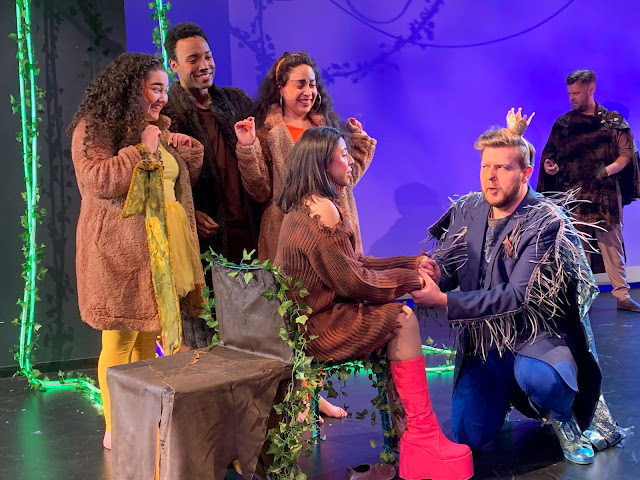
 Allie Altieri, Joseph Parrish, Linda Collazo, Shaina Martinez, and Nicholas Huff

Not 5 minutes past the curtain call we wanted to see Pauline Viardot's Cendrillon over again.  Where was the repeat button? We relished every moment of this charming work brought to the stage by City Lyric Opera, a most worthy company with high ideals. Helmed by Megan Gillis, CLO aims to provide quality art at affordable prices, providing opportunities for young artists with the aim of diversity and inclusivity.

Career advancement is not easy for female conductors and we were thrilled to see the young rapidly rising Maestro Michelle Rofrano on the podium leading an energetic and light-hearted reading of Pauline Viardot's telling of the Cinderella tale. The chamber orchestra was with her every step of the way. There were the requisite strings augmented by one each of flute, oboe, clarinet, bassoon, and horn. The plangent sound of the harp wove it all together. The melodic score has the flavor of French music hall, which we see as a good thing. Mo. Rofrano played the score as a light-hearted and enchanting bauble.

Onstage, in the role of Marie (Cendrillon) we had the rising star soprano Shaina Martinez who never fails to deliver a carefully thought out performance that somehow manages to appear spontaneous. Her rich voice lends itself to a variety of roles that we have heard her sing and this is just one more feather in her cap. Her Marie was no scullery maid but rather an overlooked member of a detestable family. Her voice conveyed more hope than despair with some winning coloration that made her relatable.

Her two Karens (oops, I meant step-sisters) demanded her help and services. Soprano Allie Altieri as Maguellone and mezzo-soprano Linda Collazo as Armelinde were as fine together as they were separately. Their  vocal coloration was exactly the opposite of Ms. Martinez'. Their facial expressions and body language were perfectly emblematic of their characters and absolutely hilarious.

In the role of La Fée we heard the extraordinary crystalline coloratura of Yejin Lee, singing in delightful bel canto style involving stunning fioritura.  Le Prince Charmant was sung by Nicholas Huff whose warmth of tone and ardent demeanor had him rise above some staged goofiness. The love duet with Cendrillon was beautifully realized by both artists. As his chamberlain Le Comte Barigoule, we heard tenor Corey Don whose fine voice and figure made it easy to believe the role reversals.

Cendrillon's father is usually portrayed as a henpecked husband who dares to show sympathy for his daughter only behind his wife's back; but in this case he is portrayed as a former dishonest merchant who has risen in status to that of Baron Pictordu. We did not quite catch how that was accomplished but there was a reference in the libretto that must have been a secret joke in Ms. Viardot's circle. The superb bass-baritone Joseph Parrish gave him the attitude of un parvenu  and filled out the character with a full rich sound. 

This one hour opera was written for Viardot's  students when she was rather advanced in years. It was likely performed at one of her salons. None of the sadistic parts of the Perrault fairytale were in evidence, nor any of the Disneyfied padding. This was a simple story of a neglected young woman whose good heart wins the affection of a prince, even though she doesn't know his identity. And it's also the story of a grasping family that has scapegoated her. Her kindness wins out in the end.

Let us not neglect the excellent chorus comprising Luxana Zepedas, Mithuna Sivaraman, Erin Rosales, Brian Jeffers, Ramon Gabriel Tenefrancia, and Nathaniel Mattingly.

The direction by Rose Freeman was right on point, giving everyone a chance to develop a unique character. There were a number of clever devices to enjoy as when La Fée asks Cendrillon to fetch a pumpkin and then to throw it out the window where it becomes a coach--projected on the upstage screen.  Similar devices were used for the horses and coachman. 

Rhea D'Souza is credited as Projection Designer and we found her projections to be a fine replacement for elaborate sets. We have been annoyed as of late by artsy-fartsy projections that distracted from the singing and staging.  Not so here. Every projection set the stage, so to speak, and contributed to the storytelling. 

Lina Younes was credited as Scenographer and Lighting Designer was Charlotte McPherson. No one is credited for the costumes but they evinced creativity and wit that exceeded what appeared to have been a modest budget. We were particularly taken with Cendrillon's "slippers"--shocking pink platform boots!

Although there was minimal dialogue in English, the opera was sung in beautiful French, translated by Quentin Bruno and projected onstage so that every member of the audience had a good view. 

The only information we are missing is the identity of the orchestrator. The work was written for piano accompaniment; perhaps Ms. Viardot did the orchestration herself. In any case it surely gave Mo. Rofrano some beautiful lines to work with.

In these trying times, light-hearted fun is just what we need. That being said, we would still want to hear this enchanting bauble even in the best of times. What an excellent choice for this company to have made!

© meche kroop

Wednesday, March 27, 2019

HEROINES OF OPERA--NEW CAMERATA OPERA GALA

Allison Gish
Eva Parr and Erik Bagger
We had a grand time last night at The Flea in Tribeca, where New Camerata Opera presented a very fun very gala evening of food, drink, entertainment, and a foretaste of some upcoming events.

The always adventuresome company not only presents works for us grownups but also brings opera into the public schools with their Camerata Piccolo Program and further has a program called CamerataWorks, creating short video operas for the video generation. One might say they have all the bases covered, if you will permit a metaphor from someone who knows nothing about sports. Let us say they are about to hit a home run with their upcoming performance of Britten's Rape of Lucretia.

Director Bea Goodwin (whose work we love and heartily endorse) gave a brief talk about female vulnerability which was brought to society's awareness by this story over two millenia ago; the situation has not yet been remedied. She spoke about the harsh reality of rape and its dire consequences.  She made a strong plea for defending citizens from tyrants. Can we relate to this when our own president is a "groper"?

Her talk was followed by some gripping performances from the opera which will be presented May 2nd, 4th, and 5th, also at The Flea, a comfortable and convenient venue.

Erik Bagger lent his soulful tenor to "Tarquinius' Ride" and showed admirable flexibility in adorning the vocal line. The excitement built just as Britten intended with the excellent Brian Holman accompanying on the keyboard.

Baritone Stan Lacy illuminated more about Tarquinius' character than we have ever heard in "Within this frail crucible of light" and, surprisingly, we found ourself understanding where this "bad dude" was coming from.

One of Ms. Goodwin's original directorial inventions was to have Amelia Hensley conveying the text of "Give him this orchid" in American Sign Language whilst the powerful mezzo-soprano Allison Gish sang the aria. The signing was so graceful to watch that we had trouble focusing on Ms. Gish's superlative singing.

Fortunately, we had another opportunity later in the program when this marvelous mezzo sang "Mon coeur s'ouvre à ta voix" from Camille Saint-Saëns' Samson et Dalila. Not since we heard Marilyn Horne sing this role have we enjoyed it as much.

Soprano Mithuna Sivaraman used her coloratura instrument effectively in "Da tempeste il legno infranto" from Händel's Giulio Cesare. The clarity of her enbellishments of the vocal line left no doubt about her gift for Baroque opera. We heard her previously in a contemporary piece but readers will have no doubt about our preference. We cannot evaluate a singer's voice until we hear him/her singing something Baroque or Bel Canto!

To end the entertainment portion of the evening, mezzo-soprano Eva Parr transported us to Lillas Pastia's taberna with "Les tringles des sistres tintaient" from Bizet's Carmen. This is not the first time we heard Mr. Bagger play the guitar and his accompaniment here was delightful and very Spanish. Ms. Parr's versatility as an artist made her a fine Carmen.

The third branch of New Camerata Opera is CamerataWorks and we watched a short video of a Charles Ives song "Songs my mother taught me". We confess that we don't "get" video and furthermore, on this topic, we prefer Dvorak! Still, it's a worthwhile project and sure to find an audience.

Aside from the upcoming Britten, on May 3rd there will be a concert of songs by women--Isabella Colbran, Pauline Viardot, and Maria Malibran. So...are the Heroines of Opera the composers, the characters of the operas, or the singers???  Let's find out on May 3rd.

(c) meche kroop


Monday, March 19, 2018

WINE WOMEN AND SONG

Tami Petty and Michael Sheetz

We know well that the talented Tami Petty won the Joy in Singing award in 2014; we were there and wrote enthusiastically about her gifts communicating the essence of song to the audience. Since that auspicious debut, we have seen, heard, and enjoyed Ms. Petty's gifts a number of times at the Brooklyn Art Song Society and once with The Bohemians. Yesterday we enjoyed her gifts even more at a salon graciously hosted by one of Joy in Singing's devoted members.

Perhaps it was the intimacy of the surroundings or perhaps Ms. Petty has been working on her English diction because we got every word of her English--the only quibble we had four years ago.

The theme for the afternoon put women composers front and center. We had just heard Clara Schumann's "Liebst du um Schonheit" Friday night and wrote how it shouldn't take second place to Mahler's setting. Ms. Petty's performance reinforced our belief. The luster of her instrument and attention to detail in the phrasing were amplified by gesture and facial expression. We want to hear this song again and again!

Ms. Petty's German ist perfekt and served her well in Alma Mahler's "Ich wandle unter Blumen", another lovely entry in the female composer sweepstakes.

We heard some lovely French as well and always admire a singer who can switch gears for each language. Regine Wieniawski (Poldowski) set Paul Verlaine's  "L'heure exquise" in 1917, a quarter century after Reynaldo Hahn did so --another tempting pair for Mirror Visions Ensemble. The two settings are different but equally lovely. The start is delicate but Ms. Petty opened up her sizable voice whilst collaborative pianist, known mainly through his work with Classic Lyric Arts, put forth some lovely arpeggi.

Cecile Chaminade's songs were popular in her time--all 125 of them!  There were clubs celebrating her oeuvre right here in the USA. Yesterday we heard the delightful "Ecrin" which was performed in a most flirtatious manner. The French was crystal clear but one got the message even if one didn't understand the language.

Pauline Viardot's "Madrid" was written for the mezzo fach but that didn't stop Ms. Petty who conveyed the high spirited vocal line whilst Mr. Sheetz conveyed all the flamenco inflected accompaniment. We loved it!

The remainder of the songs were in English but that didn't stop us from enjoying them! Amy Beach's "The Year's at the Spring" was familiar to us but "Take, O Take Those Lips Away" was new to us.  Clara Edwards' "Into the Night" was filled with longing and quite lovely.

Liza Lehmann's  "Evensong" was seriously sentimental but her "There are fairies at the bottom of our garden" is filled with sly humor and Ms. Petty used just the right amount of camp, to the delight of the audience.

We even got to hear Mr. Sheetz perform Fanny Mendelssohn's "Pastorella" which reminded us of "Lieder ohne Worte" inasmuch as we were writing words in our head!  Indeed, Fanny probably wrote a lot of music that got passed off as her brother's because of restrictions enacted upon women by society and their families.

A fun aspect of yesterday's salon was that different guests were selected to read a brief bio about each composer. So many women composers were prevented from performing; others composed out of financial necessity.

As encore, we got "SHE'S got the whole world in HER hands". We couldn't keep from thinking that Ms. Petty has the world of art song in HER hands! That spiritual never made so much sense! And who can get a song across better than Ms. Petty!

Did you know that Joy in Singing is the oldest art song organization in the USA! Did you now that you too may be eligible to attend one of these intimate salons? We highly recommend the experience.


(c) meche kroop

Sunday, January 25, 2015

RIVERA DOES ROSSINI

Jennifer Rivera and Kenneth Merrill

Last night Salon/Sanctuary Concerts took a step into the 19th c. further than they usually do and it was a welcome step.  To the many Facebook friends who wished us a musical birthday, we would like to tell them that indeed we did enjoy a very musical birthday, thanks to Jessica Gould's astute programming, Jennifer Rivera's thrilling singing, and Kenneth Merrill's warmly responsive accompanying on the piano.  The promised fortepiano was injured and replaced by a modern piano without any loss of musical value.

The program comprised music that Gioachino Rossini wrote in his later years in Paris after he retired from writing all those exciting operas we so love to hear.  It is clear to singers and audience alike that he retained all the excitement of rhythm and melody that infuse his operas.  The songs offer the same opportunity for dramatic expression as do the operas and require only the right singer to give the impression that one is hearing a very condensed version of a scene in an opera.

Take, for example, La Regata Veneziana, of which we never tire.  In Venetian dialect, Rossini gives the singer plenty to work with.  The singer "Anzoleta" gets to adopt three discrete moods, encouraging her lover Momolo, expressing the tension of the gondola race, and finally rewarding Momolo with her affection.  Mezzo-soprano Jennifer Rivera rose to the occasion and filled the venue with color and excitement.

Her superb instrument and technique (influenced by Marilyn Horne and Frederica von Stade) is more legato than that of most bel canto artists.  Her diction sacrificed not a single word on the altar of musicality.  Variety in dynamics and tempi contributed to the sense of drama.

A compelling performance of "Mi lagnerò tacendo" was fascinating in that Rossini set the work four times--for soprano, mezzo, contralto, and finally a version to be sung on  one note.  Ms. Rivera showed strength in the lower register when called for and brilliance on top where necessary.  In fact, her voice is remarkably centered throughout the entire range.  

To our surprise, the setting we enjoyed the most was the last one because there was such variety of color in both Ms. Rivera's singing and Mr. Merrill's piano that the one note kept sounding different!  The text by Pietro Metastasio has been set by Mozart, Handel, Righini, and Hasse, among others.

Ms. Rivera was able to show her stuff in French in a set of three songs.  Every word was enunciated clearly and the French line was sustained beautifully.  "L'Orpheline du Tyrol" permitted the artist to yodel, making large skips sound easy.  "La chanson du bebé" represents Rossini at his naughtiest as the child does everything he can to get the attention of his parents.  What a hoot!  Ms. Rivera squeezed every drop of humor from the song.

We were thrilled to see a set of songs by Pauline Viardot on the program.  She was a singer herself and really knew how to write for the voice.  Clearly Rossini was a big influence on her.  "Madrid" had all the lilting rhythms and melodic riffs associated with Spanish music while "Havanaise" was imbued with Latin rhythms, alternating with highly embellished verses.  "Hai luli" was the lament of a forlorn lover.

There might have been an audience riot had Ms. Rivera not performed an encore of her signature aria--"Una voce poco fa" from Il Barbiere di Siviglia.  It was in this aria that the rich mezzo quality of her voice was most evident.  The fioriture passages were unique and original, creating abundant fireworks.  We heard something for which we need to invent a word; let's call it a "tripletrill"; we have never heard the like.

Mr. Merrill's accompanying skills are legendary and it was easy to see why he is chosen by so many fine singers.  He was always right there supporting but never overshadowing or overwhelming.

We remember Ms. Rivera well from her Juilliard days and from New York City Opera. We have enjoyed her astute essays in The Huffington Post. It was a real treat to hear her up close and personal.  Should NYCO be revived we are sure to hear more of her right here in New York.

© meche kroop


Tuesday, December 11, 2012

MS. GENAUX KNOWS IT AND SHOWS IT

Vivica Genaux
Too long missing from the New York vocal scene while establishing herself as a major presence in Europe, glamorous mezzo Vivica Genaux graced the stage of the Morgan Library Sunday in the first of the season's George London Foundation recitals.  Long a fan of Ms. Genaux, we were delighted by the unique quality of her voice, her connection with the songs she selected, her stage poise and her manner of involvement with the audience.  She knows how to do it flawlessly and shows her stuff without any diva attitude.

Ms. Genaux has a liquid sound and a rich vibrato.  The flexibility and precision she demonstrated with the fioritura was like a lesson to those of us who sing.  Accompanied by the esteemed Craig Rutenberg, she delighted us with three Spanish songs by Rossini that are not often heard but which allowed her to demonstrate her subtle command of dynamics.

Three more songs by Pauline Viardot continued in the Spanish mood but included one in French, "Berceuse cosaque" in which Ms. Genaux demonstrated equal facility with the French style and  Mr. Rutenberg's pianism hauntingly evinced a Russian flavor.  These songs were almost unbearably sad.  It seemed just about right that her final Spanish selection, the lively "Zapateado" by Geronimo Gimenez from La Tempranica was a rapid patter song about being bitten by a tarantula and thus forced to dance.

Daniel Okulitch

Joining Ms. Genaux for the recital was bass-baritone Daniel Okulitch whose voice lent itself very well to his selections in Russian.  Georgy Vasilyevich Sviridov's "The Virgin in the City" was lovely although at times Mr. Rutenberg's piano overwhelmed his voice.  The lulling rhythms and tender ending were quite moving.    Sergei Rachmaninoff's "Cavatina of Aleko" was particularly well done and infused with Russian anguish which gave way to a tender messa di voce and back again to passion.

Mr. Okulitch seems to have a large investment in 20th c. songs in English, a taste which we do not share.  A W.B. Yeats poem "Aedh Wishes for the Cloths of Heaven" expresses a lovely sentiment; it rhymes but does not scan and none of the three composers who set it provided any kind of vocal line to please our ear.  Richard B. Evans' setting provided some lovely music for the piano; Thomas F. Dunhill's setting from an earlier period was more sentimental; Glen Roven's setting was filled with anxiety and dissonance.  Just not our taste.

Lowell Liebermann's "Good night" showed some fine legato singing but it was written with insufficient variety in the vocal line.  We are just not enchanted with our native tongue, especially with the semi-British pronunciation of the soft "a".  Ivor Gurney's "Sleep" permitted Mr. Okulitch to demonstrate his fine control of dynamics.

But it was in the closing number that we truly enjoyed Mr. O. when he and Ms. G. sang the well-known and well-loved duet from Mozart's Don Giovanni "La ci darem la mano".  The two singers were so relaxed and so connected with one another and having such a good time that the audience collectively grinned from ear to ear.  Mr. O. was properly lascivious and Ms. G. was adorably ambivalent.  The two voices in harmony provided all the delight to the ear for which one would wish.

The two artists chose a real winner for their encore--Irving Berlin's "I hear singing".  A little scene was invented in which Ms. G. enacted a psychiatric patient and Mr. O. portrayed her psychiatrist.  This is the type of music in which English is used to good advantage and left the audience humming on the way out.

(c) meche kroop