MISSION

We are here to encourage the development of gifted young singers and to stimulate the growth of New York City's invaluable chamber opera companies. But we will not neglect the Metropolitan Opera either. Get ready for bouquets and brickbats.
Showing posts with label Shaina Martinez. Show all posts

Thursday, December 7, 2023

LIGHTHOUSE. OPERA CHAMPAGNE GALA


 Lighthouse Opera Singers in Act I scene from Verdi's La Traviata

The Bronx is way out of our territory but the one time we went up there last year was to see one of our favorite artists perform the role of Violetta in Verdi's masterpiece La Traviata. How fitting that we got to see her in the ensemble that closed last night's gala--the party scene from Act I of the same opera. We also had the opportunity to hear other members from that same cast, but we will get to that later.

Our dearest pleasure in life is witnessing the growth of young singers. Lyric soprano Shaina Martinez is one of them. We have been writing about her since her time at Manhattan School of Music and watching her expand her repertoire. Last night we particularly enjoyed her performance of "Ernani involami" and are happy to see her expanding into new repertory as her voice grows in dimension. The aria was sung with both depth and breadth of tone and the fireworks of the cabaletta were finely executed, the ornamentation reminding us that Verdi composed on the heels of the bel canto composers we admire so greatly.

We also enjoyed a favorite aria from Bizet's Carmen. Alone and scared in the mountains near Seville, poor Micaëla "whistles in the dark", using her faith to bolster her courage in "Je dis que rien ne m'épouvante". Ms. Martinez successfully conveyed that mixture of terror and resoluteness that we want to see in the character, and did so with grand and powerful singing, filling the hall with overtones and filling the text with meaning.

Her Alfredo from the production we saw last year in The Bronx was tenor Michael Celentano, another singer whose progress delights us. . He made a convincing Don Jose in the final scene from Carmen--as convincing vocally as he was dramatically. We preferred him in that role as he portrayed Don Jose's complex emotions than his portrayal of  Walter von Stolzing from Wagner's Die Meistersinger. The fach of heldentenor may be more accessible somewhere down the road. If we noticed one thing that would top off Mr. Celentano's performance it would be some coaching in French and German.

His Carmen was portrayed by mezzo-soprano Ema Mitrevic whose selections of the evening involved three seductive women. Her defiant Carmen in the death scene with Mr. Celentano was a real hit and more believable than the "Seguidilla" in which she tries to seduce Don Jose with some not very Spanish wiggling. We found her far more believable as Dalilah in "Mon coeur s'oeuvre a ta voix" from Saint-Saëns's Samson et Delilah, creating seductiveness by means of vocal color.

Ms. Mitrevic has stayed in my memory as the Flora in The Lighthouse Opera's La Traviata,  and the fourth singer remembered from that production was tenor Scott Rubén La Marca who had portrayed Gaston. Last night he employed his sweet tenor to portray Ferrando in Mozart's Cosi fan tutte, singing "Un aura amorosa" with youthful romantic ardor.

Where he really shone was in a duet from the final act of Torroba's zarzuela Luisa Fernanda in which the heroine (beautifully sung by Ms. Martinez) tells his character Javier that she cannot marry him. (By a strange coincidence we just heard last night another duet from the same zarzuela!) Although the role of Luisa was written for the mezzo-soprano fach, it posed no challenge for the talented Ms. Martinez and the two singers worked quite well together.

The only other singer on the program that we had heard before was tenor Omar Bowey. Unfortunately, we had not had the chance to witness his vocal growth over the past decade and it was like hearing someone new. We cannot remember what he sounded like that long ago but last night we noticed an interesting vibrato. He injected a lot of dynamic variety into "Dies Bildnis its bezaubernd schön" from Mozart's Die Zauberflöte. However, we enjoyed his portrayal of the Duke in the quartet from Rigoletto even more.

We also got to hear some singers for the first time, which is always exciting. Bass-baritone Charles D. Carter has the resonant low notes and authoritative stage presence to make a fine Sarastro singing "O Isis und Osiris" from Die Zauberflöte. He also made an excellent Sparafucile from Verdi's Rigoletto showing characterological versatility--all the way from heroic to villainous. He offered his assassination skills to the hunchback Rigoletto, excellently realized by baritone Robert McNichols, Jr. who was a guest artist for the evening.

Also new to us was baritone Phillip K. Bullock whom we only got to hear once. His portrayal of the virile and self-satisfied Escamillo in Carmen was memorable,  blending nonchalance and arrogance. It left us wanting more.

Finally, soprano Lisa Eden showed a facility for French in "Depuis le jour" from Charpentier's Louise. We thought this aria suited her voice better than "Piangero la sorte mia" from Händel's Giulio Cesare. Perhaps she just liked the character more.

In the quartet from Rigoletto, Ms. Eden took the role of Gilda, Ms. Mitrovec took the role of Maddalena (another seductive woman!), Mr. Bowey performed the Duke, and Mr. McNichols, Jr. portrayed Rigoletto. The voices balanced perfectly.

As seen in the photo above, the evening concluded with the party scene from Verdi's La Traviata leaving the audience humming.

© meche kroop

Tuesday, May 2, 2023

GERDA LISSNER COMPETITION RECITAL


 Sophia Hunt, Arlene Shrut, Vladyslav Buialskyi, Jazmine Saunders, Korin Thomas-Smith, 
Alice Chung, Joseph Parrish, Erik Grendahl, and Shaina Martinez

It was a sensational recital of gifted young singers; it was a gathering of the citizens of Planet Opera, generously open to one and all; it was a celebration of the enduring legacy of Gerda Lissner; it was a memorial to the late Scott Barnes. Everyone left Zankel Hall grinning broadly. No one need worry about the future of opera.

If you care who won which prize, we direct you to www.gerdalissner.org where you can also read all about the good work of the foundation. We prefer to use our space to write about the winners who were winnowed from a huge group of applicants. We are always happy to see WQXR's renowned Midge Woolsey hosting such events and equally happy to enjoy the versatile accompaniment of pianist Arlene Shrut. We acknowledge the cooperation of the Liederkranz Foundation.

And now...on with the show! What a brilliant idea to open the program with the winner of the Zarzuela Division, the scintillating soprano Shaina Martinez, known to us since her days at Manhattan School of Music. We were overjoyed to learn that the foundation established a platform for honoring this very special art form; and who better to fulfill the mission than Ms. Martinez whose perfect Spanish flowed effortlessly and permitted her to inhabit the role of Cecilia Valdés from Gonzalo Roig's zarzuela of the same name. 

The spirited entrance aria, illuminated by meaningful gestures, served to introduce the character, a mulatto woman who is unaware that her suitor is her half-brother, both fathered by a slave trader; he is legitimate, she is not. Two centuries ago, such stories were common in the New World, particularly in Cuba with its complicated racial hierarchy. We tell you such details, dear Reader, because we want you to share our appreciation of what was going on in our own hemisphere whilst Verdi was writing his operas in Italy.

Ms. Martinez' second selection was a tragic lullabye "Hija del Amor" in which the character's mood has changed to sorrow and tenderness, illustrated by the minor mode in which it is written and the artist's facility with heart-rending legato. We felt totally involved in the singer's facility for storytelling. She truly inhabited the character without compromising her exquisite voice.

Next we heard winners from the Lieder Division. Baritone Erik Grendahl's two selections were  quite different. Georgy Viridov's "The Virgin in the City" was given a quiet reading with minimal gesture and a sweet lyrical sound. The artist came to vibrant life in Debussy's "Ballade des femmes de Paris",  in which the text has something to say about women from several different countries. Mr. Grendahl, remembered from his performances at the Santa Fe Opera, made the French very clear and told the tale with panache.

Mezzo-soprano Alice Chung is an equally fine storyteller and who doesn't love William Bolcom's "George", the tale of a colorful character who comes to a tragic and ironic end. When a singer's technique is as admirable as Ms. Chung's one tends to ignore it in favor of the stagecraft and presentation. We hung on her every word. Happily, she followed this with Choi Young-Sup's "Longing for GeumGang Mountain" which we heard her sing at WQXR's Green Room. In our review of that recital, we discussed the newness of the Korean art song tradition and the reasons for it. We would say Korea got off to a great start in this setting of Han Sang-eok's text.

Bass-baritone Joseph Parrish has been on our radar for quite some time, also having made a fine showing at the Santa Fe Opera. What a departure from the expected to have a singer accompany himself at the piano in a contemporary piece! Bob Telson wrote "Calling You" for the film Bagdad Cafe which we have never seen; Mr. Parrish's performance made us want to see the film. 

On more familiar territory, we heard the frisky "Fussreise" from Wolf's Mörike Lieder. We find this to be one of Wolf's more accessible lieder and enjoyed Mr. Parrish's fine command of German and his immersion in the spirit of the song. We also enjoyed Ms. Schrut's varied coloration of the strophic composition. He closed the set with Tchaikovsky's "Sred shumnogo bala", sung with fine Russian and intense reflection.

The second part of the concert took us into operatic territory. Korin Thomas-
Smith employed his fine baritone to sing Tarquinius' aria "Within this frail crucible of light". His technique was impressive but we wanted him to show more of Tarquinius' character. He had no problem showing us the Count's character in "Hai già vinta la causa" from Mozart's Le Nozze di Figaro. His aptitude for demonstrating the complexity of the Count's emotions was impressive. He is angry, vengeful, competitive, and bewildered, all at the same time. This is so much more interesting than the one-note interpretations we often hear.

Soprano Jazmine Saunders has a sizable instrument which she put to great use in arias by Mozart and Verdi. Her vibrato is distinctive and emotionally affecting.  Poor Pamina must arouse our sympathy in "Ach, ich fühl's" from Mozart's Die Zauberflöte as she frets about her love interest who is actually true. By comparison, Gilda is confident and enamored in Verdi's Rigoletto, not knowing that she has been woefully deceived. Both characters were given their due with the voice sustained throughout the register. Mozart gives Pamina long legato lines and Verdi gives Gilda wild leaps and breathless staccato passages. Both perfomances were memorable.

Bass-baritone Vladyslav Buialskyi chose well, illuminating the character of Figaro who mourns what he thinks is Susana's infidelity in "Aprite un po' quegli occhi". He is shocked; he is angry; rather than despairing he decides to give warning to other men. We in the audience know better; Susana adores him and is conniving to make their marriage work out.  It's a great moment in Nozze di Figaro! We particularly enjoyed the rapid patter.

The second selection was "Si, morir ella de!" from Ponchielli's La Gioconda, sung by the vengeful Inquisitor Alvise. Although we believe the role was written for a bass, the extensive passages in the lower register were no challenge for Mr. Buialskyi's powerful instrument and the aria provided an opportunity to color his voice differently.

The final singer was soprano Sophia Hunt who also wisely selected two arias that showed her versatility. The eponymous Arabella from the Strauss opera has reached a point of forgiveness and acceptance in "Das war sehr gut, Mandryka". The Countess in Nozze di Figaro, on the other hand, is aware of having lost the love of the Count who had pursued her so relentlessly and sings of her despair in "Dove sono". Two very different characters were brought to life such that the entire scenes appeared before our mind's eye. We loved the rich texture of Ms. Hunt's voice and the varied colors. The Countess was particularly well realized and we heard a hint of optimism in the second verse.

As Ms. Woolsey pointed out, we almost had the entire Nozze di Figaro onstage. Yes, it was a great treat to hear so many selections from one of our favorite operas. The evening ended with the entire group joining forces for "You'll Never Walk Alone" from Rogers and Hammerstein's Carousel.

What popped into our mind just now is "This Was a Real Nice Clambake" Concert.

© meche kroop

Sunday, June 5, 2022

THE FALLEN WOMAN


 Scott LaMarca, Aurora Bella Geis, Joe Gansert. John Tedeschi, Shaina Martinez, Michael Celentano, and Ema Mitrovic

There are rare occasions when the confluence of story, music, libretto, and performances conspires to produce a state of total immersion. One loses awareness of the identity of the artists and gets immersed in the lives of the characters.  Such is the power of great theater and opera is, fundamentally, theater.

This situation occurred last night in a large bare room of a decrepit building in the Bronx, with the barest of scenic elements, when The Lighthouse Opera Company presented Verdi's masterpiece La Traviata. So mesmerized were we that tears starting rolling down our face and we had to choke down sobs until the final tragic chord. That is Art (capital intentional).

An 1848 novel by Alexandre Dumas Fils was transformed into a play entitled La Dame aux camélias.  Seen and admired by Verdi,  Francesco Maria Piave was engaged to adapted it as a libretto. The story is a moving one about an unfortunate young woman whose past precludes the possibility of the life she might have enjoyed with the man who loves her. 19th c. morality has tarred her with a fateful brush. The story is replete with psychological resonance that Verdi's music plumbs with astonishing depth.

Since the performances were so outstanding and we have no criticism to offer, let us then look at the artistry serving this psychological depth that made the production such a compelling one. This intensity cannot be achieved without a deep understanding of the characters and their individual struggles.

For example, in Act I, our heroine Violetta (Shaina Martinez) appears to be a fun-loving member of the demi-monde, a party girl if you will, a "kept woman" whose patron is the wealthy Baron Douphol (baritone Jay Stephenson). Deep within her psyche and just waiting to be tapped is the desire to be really cared for. It is threatening to her to even admit this to herself; clearly she does not feel she deserves such love. But it arrives anyway in the person of Alfredo Germont (Michael Celentano), the scion of a conservative Provincial family, introduced to her by his friend Gastone (tenor Scott LaMarca) at a party. In a clever touch by Director John Tedeschi, Gastone peeks through a curtain to watch their interaction.  

The highlight of the act is Violetta's barely accompanied "É strano!...Ah fors'è lui" in which she exposes her inner desires. Her ambivalence is expressed in "Sempre libera". Ms. Martinez' artistry clearly showed that Violetta is afraid to give herself to the importuning of Alfredo and needs to defend a fragile core.  Her independence is a pose. Of course, Verdi's music is there to illustrate the conflict but one needs a very special soprano to capture it as accurately as Ms. Martinez does. Every bit of legato phrasing limns her desire and the fiery cabaletta was informed by all the the histrionics of desperation.  Violetta is dancing on the edge of a volcano, semi aware that her tuberculosis will eventually take her young life. 

There is more depth to come in Act II. Violetta has abandoned herself to the simple life away from the distractions of Paris. Verdi's music tells us how happy she is living with Alfredo. But much pain is coming. Germont Père (baritone Joe Gansert) has discovered his son's "scandalous" behavior and is concerned about the threat to his daughter's conventional betrothal. There is a shattering scene between him and Violetta as her dignity converts his scorn into compassion.

"Pura siccome un angelo" gets to Violetta. Until Ms. Martinez' performance of the role, we never understood why Violetta would accede to his demand that she give up Alfredo. Now we understand. She never had a protective father and she identifies with Alfredo's sister. She needs fatherly approval just as much as she needs Alfredo's love. This insight struck us like a bolt of lightning! It's all there in "Dite alla giovine", just waiting for the right soprano to bring it out.  Ms. Martinez sing it with an affecting pianissimo that demonstrates her defeat.

A moving scene between father and son shows us a great deal about the value placed on family loyalty.  Giorgio actually lays a guilt trip on his son in "Di Provenza il mar il suol". He appears to be comforting his broken hearted son but we can see that family loyalty is more important than his son's happiness.  Very 19th c.!  Mr. Gansert showed Giorgio to be a master manipulator, working on his son as he did on Violetta--all in the service of respectability.

And what about the conflicting feelings of Alfredo? In order to overcome his grief, he must cover it up with anger and spitefulness. He insults poor Violetta at Flora's party and horrifies his father who never anticipated such behavior, so inconsistent with his own values. Perhaps he doesn't want his son consorting with a fallen woman but he will not stand for uncivil behavior.

Violetta's tuberculosis, which had improved whilst living peacefully in the country with Alfredo, has taken a turn for the (much) worse in the final act. She is barely holding onto life waiting for the Germonts to come and see her. She tries to rally but cannot. One gets the impression that Giorgio's presence means as much to her as Alfredo's, lending credence to our understanding of Act II.  In a tearful farewell she unselfishly wishes Alfredo to find a worthy young woman and to give this young woman her very own portrait. Surely Dumas shows us that there can be a nobility in society's outcasts.

At this point, given the artistry of the cast, we have dissolved into a pool of tears. We had forgotten the singers and remembered only the characters. This is only possible when a singer's technique is so flawless that it doesn't call attention to itself.

Yes, we could mention the gorgeous timbre of Ms. Martinez voice (although the program describes her as a lyric soprano, we heard a lot of spinto quality in its ampleness and resonance). We could describe the effective phrasing and the breathtaking messa di voce. We could tell you that we have never heard Mr. Celentano sing better or how Mr. Gansert's sturdy baritone added luster and believability to his characterization of Giorgio.

And let us not forget the fine performance of mezzo-soprano Ema Mitrovic in her sympathetic portrayal of Flora and the arrogant but somewhat indifferent characterization of the Baron by Mr. Stephenson.

John Tedeschi's direction was effective with several interesting novel touches such as Violetta shredding her camellias in the final act and the aforementioned bit with Gastone gleefully spying on the friend he has "set up". In the second act, he has our heroine mouthing the words along with Alfredo's singing, demonstrating their complete emotional resonance.  Our only quibble is the setting of the opera in the Bronx during the Spanish flu epidemic of 1918.  It did justify the use of masks by some of the performers but the masks are clearly 21st c. ones.  More significantly the libretto mentions Paris and carriages and other 19th c. accoutrements. It felt disjunctive.The costumes seemed to belong more to the flapper era of the 1920's. 

Such quibbles seem unimportant in light of the psychological insights brought to us by Ms. Martinez whose towering vocal skills were matched by depth of understanding. Her cast mates were all caught up in this immersion that made Violetta and her sad story so very real to us.

Maestro Stephen Francis Vasta had two dozen musicians at his command and made some fine music. No complaints on that score (pun intended).

The experience was intense and has stayed with us.  This wasn't like going to the Met and boasting about hearing (insert name of famous singer) and singling out a particular high note of given soprano or the tenor's voice cracking or any other small detail. This was living breathing Art.

© meche kroop

Saturday, December 18, 2021

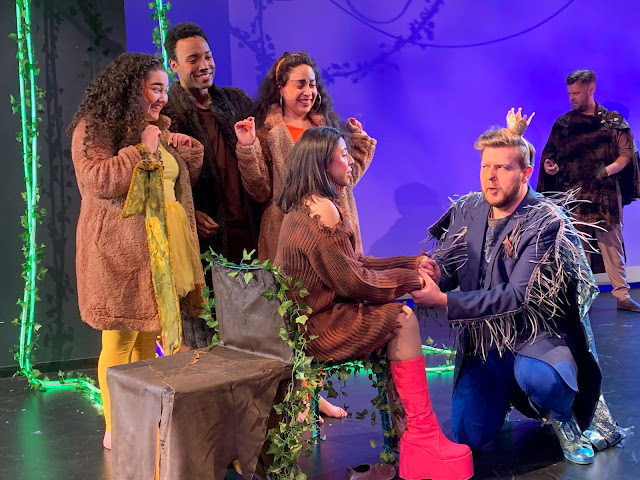
IF THE SHOE FITS


 Allie Altieri, Joseph Parrish, Linda Collazo, Shaina Martinez, and Nicholas Huff

Not 5 minutes past the curtain call we wanted to see Pauline Viardot's Cendrillon over again.  Where was the repeat button? We relished every moment of this charming work brought to the stage by City Lyric Opera, a most worthy company with high ideals. Helmed by Megan Gillis, CLO aims to provide quality art at affordable prices, providing opportunities for young artists with the aim of diversity and inclusivity.

Career advancement is not easy for female conductors and we were thrilled to see the young rapidly rising Maestro Michelle Rofrano on the podium leading an energetic and light-hearted reading of Pauline Viardot's telling of the Cinderella tale. The chamber orchestra was with her every step of the way. There were the requisite strings augmented by one each of flute, oboe, clarinet, bassoon, and horn. The plangent sound of the harp wove it all together. The melodic score has the flavor of French music hall, which we see as a good thing. Mo. Rofrano played the score as a light-hearted and enchanting bauble.

Onstage, in the role of Marie (Cendrillon) we had the rising star soprano Shaina Martinez who never fails to deliver a carefully thought out performance that somehow manages to appear spontaneous. Her rich voice lends itself to a variety of roles that we have heard her sing and this is just one more feather in her cap. Her Marie was no scullery maid but rather an overlooked member of a detestable family. Her voice conveyed more hope than despair with some winning coloration that made her relatable.

Her two Karens (oops, I meant step-sisters) demanded her help and services. Soprano Allie Altieri as Maguellone and mezzo-soprano Linda Collazo as Armelinde were as fine together as they were separately. Their  vocal coloration was exactly the opposite of Ms. Martinez'. Their facial expressions and body language were perfectly emblematic of their characters and absolutely hilarious.

In the role of La Fée we heard the extraordinary crystalline coloratura of Yejin Lee, singing in delightful bel canto style involving stunning fioritura.  Le Prince Charmant was sung by Nicholas Huff whose warmth of tone and ardent demeanor had him rise above some staged goofiness. The love duet with Cendrillon was beautifully realized by both artists. As his chamberlain Le Comte Barigoule, we heard tenor Corey Don whose fine voice and figure made it easy to believe the role reversals.

Cendrillon's father is usually portrayed as a henpecked husband who dares to show sympathy for his daughter only behind his wife's back; but in this case he is portrayed as a former dishonest merchant who has risen in status to that of Baron Pictordu. We did not quite catch how that was accomplished but there was a reference in the libretto that must have been a secret joke in Ms. Viardot's circle. The superb bass-baritone Joseph Parrish gave him the attitude of un parvenu  and filled out the character with a full rich sound. 

This one hour opera was written for Viardot's  students when she was rather advanced in years. It was likely performed at one of her salons. None of the sadistic parts of the Perrault fairytale were in evidence, nor any of the Disneyfied padding. This was a simple story of a neglected young woman whose good heart wins the affection of a prince, even though she doesn't know his identity. And it's also the story of a grasping family that has scapegoated her. Her kindness wins out in the end.

Let us not neglect the excellent chorus comprising Luxana Zepedas, Mithuna Sivaraman, Erin Rosales, Brian Jeffers, Ramon Gabriel Tenefrancia, and Nathaniel Mattingly.

The direction by Rose Freeman was right on point, giving everyone a chance to develop a unique character. There were a number of clever devices to enjoy as when La Fée asks Cendrillon to fetch a pumpkin and then to throw it out the window where it becomes a coach--projected on the upstage screen.  Similar devices were used for the horses and coachman. 

Rhea D'Souza is credited as Projection Designer and we found her projections to be a fine replacement for elaborate sets. We have been annoyed as of late by artsy-fartsy projections that distracted from the singing and staging.  Not so here. Every projection set the stage, so to speak, and contributed to the storytelling. 

Lina Younes was credited as Scenographer and Lighting Designer was Charlotte McPherson. No one is credited for the costumes but they evinced creativity and wit that exceeded what appeared to have been a modest budget. We were particularly taken with Cendrillon's "slippers"--shocking pink platform boots!

Although there was minimal dialogue in English, the opera was sung in beautiful French, translated by Quentin Bruno and projected onstage so that every member of the audience had a good view. 

The only information we are missing is the identity of the orchestrator. The work was written for piano accompaniment; perhaps Ms. Viardot did the orchestration herself. In any case it surely gave Mo. Rofrano some beautiful lines to work with.

In these trying times, light-hearted fun is just what we need. That being said, we would still want to hear this enchanting bauble even in the best of times. What an excellent choice for this company to have made!

© meche kroop

Saturday, September 18, 2021

CITY LYRIC OPERA KICKS IT UP A NOTCH!

"

A RAPT AUDIENCE THRILLS TO SEASON KICK-OFF

A frisson of anticipation filled the theater of The Mansion at Murray Hill. A sizable group of opera lovers, thirsting for live vocal artistry, filled the theater to capacity and rewarded the four splendid singers with enthusiastic applause after every offering. The accomplished artists deserved this wild applause, made even wilder by Covid-related deprivation. We felt like a starving person encountering a buffet table loaded with goodies.

The artists were known to us and have sung either for Around the World in Song or for Voce di Meche's House of Music (Manhattan's tiniest venue-- our living room to be exact)--both situations for which we thought it unfair to review. Thus, it is our greatest pleasure to finally get to tell you what great choices City Lyric Opera has made for their upcoming season.

Beautifully accompanied by the lovely pianist Dura Jun, the singers took turns showing off their versatility.  We, however, will focus on the singers individually. As is customary, we will start with our soprano Shaina Martinez. Ms. Martinez has been on our radar screen since her days at Manhattan School of Music. We were there reviewing her dazzling performances when she won the Ades Competition 3 years ago and when she astonished the huge audience at Riverside Church with a song cycle by Turina. We have thrilled to her Fiordiligi and her Violetta. We never tire of her richly textured sizable soprano.  We love that she will tackle anything and make it her own.

Last night she sang "Glück, das mir verblieb" otherwise known as "Marietta's Lied" from Korngold's Die Tote Stadt, which we never heard her sing before. As in everything else she sings, the flawless vocalism was matched by depth of feeling and understanding of the character.

As far as the Puccini canon, we have enjoyed her Liu and last night found equal pleasure in "Chi il bel sogno di Doretta" from La Rondine, perhaps Puccini's most frivolous opera. Ms. Martinez showed herself to be a superb storyteller. There was one held note that took our breath away as it progressed through an entire rainbow of feelings.

As a prelude to CLO's first offering of the season--Pauline Viardot's  Cendrillon--Ms. Martinez performed "Si je n'y venais" which we had never heard before. The artist portrayed her as a gentle soul but not a victim. We were entranced and, no matter what variant Covid throws at us in December, nothing will keep us away from this production. We advise you to jump on it as soon as the dates are announced.

 Linda Collazo has delighted New York audiences with her richly toned mezzo-soprano and wide range. Indeed, she was the first artist we went to hear just as soon as we got vaccinated when she performed a program of arias and songs about strong women. This reminds us to tell you, dear reader, that CLO is a company founded by two strong women--the lovely Megan Gillis and the equally lovely Kathleen Spencer-- both participating in announcing the season with their winning enthusiasm. To add to the gynocentric orientation, CLO's new Music Director is Maestro Michele Rofrano (no relation to Octavian).

We have mostly heard Ms. Collazo singing zarzuela arias which we love. Last night we were pleased to hear her take on Bizet's Carmen in the "Seguidilla", thankfully sung without the clichés that leave us rolling our eyes. Her Carmen is more subtle and relies more on her voice than posing and strutting. 

"Smanie implacabili" from Mozart's Cosi fan tutte allowed Ms. Collazo to get emotional--even hysterical--which showed off her strengths throughout the register.

But it was "Una voce poco fa" from Rossini's Il barbiere di Siviglia that delighted us the most. We loved the way she gave Rosina a unique personality, using her phrasing most effectively. Readers will recall how much we lean toward bel canto. We enjoyed the very delicate vibrato, the notable decoration of the vocal line, and the fiery cabaletta. The descending scale passages were finely wrought.

Our tenor Cesar Andres Parreño is as gifted dramatically as he is vocally. We first heard him just before Covid struck when, as a student at Juilliard, he participated in a NYFOS program entitled "Cubans in Paris". We were so delighted by his talent that we recruited him to sing in our Around the World in Song.  He is not Cuban but rather Ecuadorian and represented his country magnificently with a selection of folk songs. 

What a pleasure it was to hear him again! He opened the program with an aria from Torroba's Maria Fernanda entitled "De este apacible rincón de Madrid" which suited his plangent lyric tenor perfectly. The timbre is just right for zarzuela and we were thrilled to witness his performance as he varied his emotional tone from tender to powerful.

We were over the moon when he performed yet another zarzuela aria, this one the famous "No puede ser" from Sorozábal's La taberna del Puerto. There is no way to fail to grasp the pain of deception and the delusional quality of one who cannot believe that a woman he loves does not share his moral compass.

In "Una furtiva lagrima" from Donizetti's L'elisir d'amore, the hero Nemorino has the great fortune of winning the woman he loves and Mr. Parreño captured the youthful innocence of his character with his sweet tone and effective acting. It takes courage to tackle an aria that has been performed by all the greats and to make it your own!

Baritone Andres Cascante is less well known to us than the others but we recall that he was one of Opera Index' prize winners about 4 years ago and had pleased us by performing a zarzuela aria.  Maybe he is less known to us but certainly not less appreciated! He made a wonderful Count Almaviva in "Hai già vinta la causa!" from Mozart's Le nozze di Figaro. He used voice, facial expression, and bodily gesture to bring the clueless Count to vivid life. He sang with full tone and total awareness of the text.

In Puccini's Gianni Schicchi, the main character is as arrogant as the Count but a lot smarter.  In "Si corre dal Notaio" he devises a plot to fool the greedy relatives of a dying old man. Mr. Cascante showed himself to be a most effective storyteller.

We must call Mr. Cascante's performance last night "3 shades of arrogance". The Count is arrogant by birth; Schicchi by wiliness; and Escamillo by public adoration. As our artist delivered "Votre toast" from Bizet's Carmen, he created a character enamored of his skill and fame. We just loved the subtleties that limned three very different characters with the same characterological feature.

We recall CLO's initial venture a few years ago when they called the company A.R.E.-- accessible, relatable, and enjoyable.  Although the name was changed, we are happy to report that their aim is the same and their aim is true.

© meche kroop
 

Friday, May 28, 2021

A NEW LOOK AT VIOLETTA


 We would go to the ends of the earth to hear one of our favorite sopranos interpret the role of our favorite female character. Fortunately we only had to go to 112th St. to hear Shaina Martinez show us more about Violette Valery than we had ever realized. Aside from a stunning voice, it is just this sort of insight that keeps us involved and makes us want to hear the same opera repeatedly. It's all in Verdi's music, of course, but most singers fail to delve deeply enough into the role and surrender to stereotypes. 

Let us begin by thanking The Lighthouse Opera Company for this live performance of Verdi's masterpiece La Traviata. We can think of no other opera that has such a profound effect. It is the clearly drawn and complex characters of Francesco Maria Piave's  libretto (adapted from Alexander Dumas' La dâme aux camellias) and their growth from one act to the next that captivates us.

In Act I, Violetta is a brittle and shallow "party girl", burning the candle at both ends. In Act II, she is a woman who has surrendered to love and softened. She is struck down by some pretty bad news delivered by her lover's father, allowing the provincial papa to see her true feelings but bravely hiding them from her lover.

In Act III, she is a pathetic and desperate dying woman, longing for the support that may never come. Although we were not given an excerpt from Act I (the restrictions of the staging could not have allowed it) Ms. Martinez limned her characters growth in Act II and her fading hopes of Act III.

And here comes the part that was new to us, an aspect that the artist conveyed by the most subtle but effective coloration. Violetta is not just making a sacrifice to help her lover's sister achieve a respectable marriage; she is actually identifying with this pure young woman who has led a respectable life, is accepted by society, and enjoys protection by her devoted father. One could see in the artist's facial expression and hear in her voice how her nobility of character and identification with the other more fortunate woman made this sacrifice possible.

Not only did we thrill to Ms. Martinez' vocal artistry but we were captivated by the depth of her characterization. Who of us has not felt a combination of admiration, identification, and envy of those whose fortunes are far more sanguine than our own.

The vocal artistry was so perfect that it served the character without calling undue attention to itself. This is what we love to see in an opera performance. We think that those who focus on the high notes or other technical aspects are missing the boat.  The thrill of opera is in the drama! Do we believe it? Can we identify? Are we moved? Yes, yes, and yes.

The other performances were excellent. Tenor Michael Celentano did a fine job as Alfredo. His "De' miei bollenti spiriti" was as ardent as one would wish and we were pleased to note Mr. Celentano's growth as an artist since we heard him the last time.

Baritone Joseph Gansert was an effective Giorgio Germont, demonstrating all the smugness of a provincial ready to read the riot act to the unacceptable paramour of his wayward son. How effectively he rose to a position of empathy as he realized Violetta's quality! This set the stage for Act III when he comes to her deathbed with respect and affection.

The duet with Violetta "Pura siccome un Angelo" was finely rendered and his pleading with his son "Di Provenza mar e suol" revealed him to be well meaning but manipulative.

Violetta's companion Annina was performed by Ema Mitrovic and the role of Dr. Grenvil was taken by Charles Carter. Matteo Adams portrayed the messenger Giuseppe. These are small roles but were well done.

Conductor and pianist Stephen Francis Vasta stood in for the orchestra and managed to convey the textures of the music as well as a solo piano could. Director John Tedeschi did the best he could within the confines of a tiny stage in a lovely church. All he had to deal with was a couple of chairs and a lectern that stood in the way. Singers were obliged to keep their six feet of distance with exchange of letters merely suggested.

These are indeed strange times for opera and The Lighthouse Opera Company did their best. Exceptional voices and acting can make up for a lot of "lacks". The imagination of the viewer must compensate and what our mind's eye produced was definitely not the "Dr. Death and Big Clock" symbolism of the latest Metropolitan Opera iteration but rather scenes pulled from our memory of more traditional and effective productions. 

© meche kroop

Wednesday, April 17, 2019

UNDERGROND SALON


José Luis Maldonado, Shaina Martinez, Amir Farid, Michael Celentano, Chantal Brundage, Christa Dalmazio,
Angela Candela, and Andrew King

We found out about Underground Salon's April Showcase quite by accident and we are so glad we did. Angela Candela is a young woman after our own heart; we share the same goals of fostering the careers of young singers. Her idea was to get together some friends and colleagues from Manhattan School of Music and to offer them a safe space to try out new repertory. No auditions, no competition, no judgments. What a great idea!

We were delighted to hear some of our favorite young singers in a different situation. All singers know, and Joyce DiDonato pointed this out several times in her master classes last weekend, that a safe non-judgmental space makes it possible to experiment. Surely breakthroughs happen when we experiment with something new!

We would like to point out at the very start how effective it is when the singers introduce themselves and tell what they will be singing. In this salon, they went even further and told a little about the aria they would be singing and its place in the opera. They all spoke clearly and we appreciated it.

Baritone José Luis Maldonado is well known to us; indeed he was selected to sing a set of Spanish songs for the April 29th concert at St. John's in the Village--"Around the World in Song". But on Sunday we heard him sing in Russian! The selection was "Ja vas lyublyu" from Tchaikovsky's Pique Dame and we were mightily impressed.

What strikes one about Mr. Maldonado is the kind of generosity of spirit that we haven't seen since Pavarotti. The sound is generous and so is his presence. There is a magnificent connection with both the aria and the audience; one experiences him as a conduit and feels the feelings so intensely that one might overlook the superiority of his technique.

One might call him a "stage animal". There is no holding back; it's all "out there", witness his performance of Billy's soliloquy from Rodgers and Hammerstein's Carousel which proved to our satisfaction that this work is truly an American opera, far more than the tuneless pieces we have been sitting through lately. The texture and resonance of his instrument combined with the way in which he employs them, make for a thrilling listening experience.

In terms of "trying out new material", the prize goes to soprano Shaina Martinez who took a risk with "Ombre pallide" from Händel's Alcina. The reason it was a risk was that a teacher once told her that her voice wasn't suited to Händel.  We think that's a tutelary error to tell a student something like that. The best singing comes when one sings a song one truly wants to sing. We heard that advice years ago in a master class and couldn't agree more.

Ms. Martinez performed this difficult Baroque aria with complete investment, passion, and connection. She tossed off the ornamentation with style but also handled the low notes effectively. We would like to cheer on her rebellious spirit (or "phase", as she called it). Please, singers, don't let other people tell you who you are!

Ms. Candela herself won our admiration for her performance of "Mi tradi" from Mozart's Don Giovanni. There was an effective contrast between the recitativo and the aria and an admirable connection with the character of Donna Elvira. If the work wasn't 100% stage-ready, that was not a problem. It's a work in progress but we have high hopes for the finished product.

Her pretty instrument was evident in "Hear Ye Israel" from Mendelssohn's oratorio Elijah. But oratorio, religion, and English are not our favorite things so we far preferred the Mozart.

Chantal Brundage performed "Robert, toi que j'aime" from Act IV of Meyerbeer's Robert le Diable. This underrated and underperformed composer seems to write well for the voice and Ms. Brundage employed her excellent resources to convey the emotions of the character, and she did so in fine French which we had no problem understanding. Her tone at the upper end of the register is beautifully brilliant. 

Christa Dalmazio has a sparkly soprano matched by a sparkling personality that was just perfect for "Poor Wand'ring One" from Gilbert and Sullivan's Pirates of Penzance. There was personality to spare and pretty good English enunciation but at such a high tessitura, one cannot get all the words.

However, in the "Silver Aria" from Douglas Moore's Ballad of Baby Doe, she made every word clear and captured the character of Baby Doe. 

Tenor Michael Celentano sang "Addio fiorito asil" from Puccini's Madama Butterfly with more grandstanding than subtlety. We want more variety from him--variety of color, dynamics, and pacing. His instrument is a large one and a promising one and when he gets it under control there will still be more than enough volume. We want him to forget about making big sounds and to try getting inside the character.

The same comments could be made about his portrayal of Rodolfo in the Act IV duet "O Mimi, tu piu non torni" in which Mr. Maldonado took the part of Marcello.

Supportive piano accompaniment was given to the hands of Amir Farid and Andrew King--both of whom are superb.

We are hoping there will be a May Showcase and that we will be available to attend. It was a truly exciting experience!

(c) meche kroop


Saturday, December 22, 2018

TALENTS OF THE WORLD FESTIVAL


The title of "Festival" may sometimes be overused, implying an experience that is out of the ordinary. Last night at Weill Recital Hall, what we experienced was truly extraordinary. In observance of what would have been the 95th birthday of the legendary soprano Maria Callas, we were introduced to several world-class sopranos, any one of which could be the next Callas. As icing on the cake, we got to hear the two top prize winners of the Talents of the World 2018 competition. Who could ask for anything more!

The evening of arias began with a riveting performance of Lucia's Act I aria from Donizetti's masterpiece Lucia di Lammermoor by the astonishingly versatile Ukrainian coloratura soprano Ruslana Koval. "Regnava il silencio" depicts the fragile heroine relating what amounts to a ghost story to her companion. The artistry exhibited by Ms. Koval was in allowing us to see Lucia's unbalanced nature, thus establishing the groundwork for her later decompensation.

We sat in our seat, eyes wide, seeing the ghost through her eyes. Ms. Koval must have had dance training because her use of bodily gesture perfectly mirrored the text, as did her vocal coloration. The fioritura was perfectly rendered as well. Need we mention that her instrument is a gorgeous one which reflects her beauty.  One does not have to be gorgeous to be a good singer but it certainly doesn't hurt.

We appreciated her versatility when she enacted the innocent Gilda singing "Caro nome" from Verdi's Rigoletto; her portrayal of the Queen of the Night from Mozart's Die Zauberflöte had an entirely different coloration--fiery, imperious, but well modulated dynamically; the fioritura evinced pinpoint accuracy.

Her Violetta embodied all of the ambivalence of the character weighing her frenetic party life against the possibility of romance in Act I of Verdi's La Traviata. For visual interest, there were several costume changes to underscore the effect. This is a soprano to watch!

Georgian soprano Tamar Iveri has a very different instrument with a completely different set of gifts. Her voice is a spinto one with a lot of weight that stood up well to the demands made on a Verdi soprano. Her Desdemona was warm and loving toward Otello in the romantic duet "Gia nella notte densa" with Armenian tenor Arsen Soghomonya struggling with a head and chest cold.

What a change she exhibited as she portrayed the terrified Amelia in "Ma dall'arido stelo divulsa" from Ballo in Maschera. Her vocalism and acting were so intense that we could feel her terror. "Udiste? Come Albeggi" from Il Trovatore required even more of her--maintaining a beautiful tone whilst expressing a series of emotions toward the Conte di Luna. Leonora is in a rage but also must beg for pity from this vengeful rejected lover, here performed by the mellow toned baritone David Gvinianidze, President and Founder of Talents of the World.

With great versatility she conveyed the gentle character of Adriana in "Io son l'humile ancella" from Cilea's Adriana Lecouvreur and also the pathos and desperation of Manon in "Sola, Perduta, Abbandonata" from Puccini's Manon Lescaut. This is another soprano to relish, one with both power and subtlety.  She too changed costumes a couple times and if we weren't writing about the music, we would be describing the gorgeous gowns!

Talents of the World's Director Olga Lisovskaya herself has a lovely voice and delighted us with some dazzling coloratura in Juliette's waltz "Ah, je veux vivre" from the opera by Gounod. This is a pleasing sound with lovely phrasing and some impressive expansion at the top of the register. She also served as hostess for the evening, introducing the singers.

We just wrote about Anna Cley's effective master class a few days ago and were delighted to have an opportunity to hear her perform. The fair and slender Ms. Cley looks nothing like the gypsy Carmen so her performance of the "Habanera" succeeded brilliantly on the basis of vocalism alone and evoked huge applause. This is a dusky voice with the texture of a true mezzo, not just the voice of someone with low notes. 

She was similarly outstanding in the duet "Belle nuit" from Offenbach's  Les Contes d'Hoffmann with Shaina Martinez taking the soprano part. Their voices harmonized beautifully. Ms. Martinez won the First Prize in the Talents of the World 2018 International Competition. We have written several times about Ms. Martinez since her student days at Manhattan School of Music.

She gave a highly persuasive delivery of "Tu che di gel sei cinta" from Puccini's Turandot; she certainly could have melted anyone's cold heart!  She has beautiful tone and phrasing. We enjoyed her duet with Second Prize Winner Sarah Joyce Cooper in "Sull'aria" from Mozart's Nozze di Figaro.

Ms. Cooper also had a solo--"Depuis le jour" from Charpentier's Louise which showed off her sweet tone and fine French.

The program closed with three unusual ensembles.  Ms. Koval, Ms. Lisovskaya and Ms. Martinez sang the charming chanson "Les filles de Cadix" by Leo Delibes, a song loved by Ms. Callas.

Lauretta's aria "Oh mio babbino caro" from Puccini's Gianni Schicchi was performed by Ms. Koval, Ms. Iveri, and Ms. Martinez.

"Quando m'en vo" from Puccini's La Bohème was given a funny turn when Ms. Koval, Ms. Iveri, and Ms. Lisovskaya took turns upstaging one another. It was a great way to close this exciting evening, one which seemed to just fly by.

Pianist for the evening was the incredibly talented Alexandra Naumenko whom we remember well from her days with the Lindemann Young Artist Development Program. How satisfying it is to witness the artistic success of people we admire.

There is more to come from Talents of the World. Tonight there will be a testosterone fueled evening of tenors. And Sunday night will be a grand celebration with opera, operetta, and Christmas music.  This certainly does qualify as a festival!

(c) meche kroop

Wednesday, November 21, 2018

TALENTS OF THE WORLD INTERNATIONAL VOICE COMPETITION

Contestants and Judges of 2nd Annual International Voice Competition of
Talents of the World, Inc.

This was only the second annual competition run by Talents of the World, Inc. but the competition already has a reputation for fairness. Indeed, there were no voice teachers as judges, favoring their students.  Judges included President of Talents of the World David Gvinianidze, Adam Cavagnaro of IMG Artists, Metropolitan Opera star tenor Francisco Casanova,  Alexandra Naumenko of The Bolshoi Theatre, Artists Manager Matthew Laifer, and the lovely singer Olga Lisovskya of Talents of the World.

We enjoyed the informality of the competition, held at the National Opera Center. Member of the audience could hear the judges discussing which selections they wanted to hear and why they chose them. Apparently, competitors were asked to prepare a couple of arias and also a piece from the music theater or art song genre. Although we did not always agree with the judges' requests, we were mostly in agreement with their decisions about the awards.

If you want to know who won how much money, you won't find it here; perhaps Talents of the World will post it on their website or FB page. We choose to use our limited space to give our impressions of the singers who made us sit up and take notice. The overall quality was extremely high. Semi-finals had been held in both New York and Boston so we got to hear singers we had heard before and enjoyed, as well as hearing some new singers that we'd like to hear again.

We felt very involved with tenor WooYoung Yoon in the role of Tonio from Donizetti's La Fille du Regiment. We totally believed his character, equally exuberant over winning the love of Marie and over his acceptance into the regiment. There were no problems with the succession of high C's in his "Ah, mes amis!" although we hope with time they will become "easier"; we noted an improvement in his pronunciation of the French nasals. His second selection was Richard Strauss' "Heimliche Auforderung", which he imbued with clarion tone and passionate delivery.

Soprano Shaina Martinez made a superb Fiordiligi in her delivery of "Come scoglio" from Mozart's Cosi fan tutte, as firm vocally as the intention of the character she was portraying. There was dramatic clarity and a lovely centeredness throughout the register. Her tonal quality has the same kind of excitement as Mr. Young's. Furthermore, she showed considerable versatility by singing "Tu che di gel sei cinta" from Puccini's Turandot. She was persuasive and affecting enough to melt anyone's heart.  As if that were not enough, we heard a beautiful rendering of Rachmaninoff's "Zdes Khorosho" which we recognized as being "How fair this place".

Megan Moore has a lovely mezzo-soprano which she employed judiciously as Cenerentola from the Rossini opera; she delighted us with "Nacqui all'affanno...non più mesta"; she took plenty of time for the embellishments in the slow section but then in the fast section, she dazzled us with her rapidfire coloratura.  She made a splendid Komponist from Richard Strauss' Ariadne auf Naxos. She also sang Rachmaninoff's "Ya zhdu tebya" with deep feeling and dynamic variety. Although we do not speak Russian, we got the feeling of nostalgia for something lost.

Sarah Saturnino also showed impressive versatility going from the wild seductiveness of Carmen's "Seguidilla" to the wily charms of Rosina in "Una voce poco fa" from Rossini's Il barbiere di Siviglia. Her mezzo-soprano instrument delighted us with its texture.   Her appearance changed dramatically as she assumed each character, and so did her vocal coloration. We would have preferred to hear her Tchaikovsky song but the judges requested "So in Love" from Cole Porter's Kiss Me Kate, which she delivered with gorgeous vibrato.

Soprano Carolina López Moreno sang Juliette's "Dieu! Quel frisson...Amour ranime mon courage" in lovely French and followed it with Violetta's Act I aria "E strano...Sempre libera". She was persuasive both in her awe over the possibility of love and her determination to continue her life of wild abandon and pleasure.

Soprano Sarah Joyce Cooper performed the same scene with conviction and with equal attention to the two different moods. We enjoyed that as well as "Depuis le Jour" from Charpentier's Louise. 

Mezzo-soprano Elizabeth Kinder brough brightness and energy to "Nobles seigneurs, salut!" from Meyerbeer's Les Huguenots, an opera of which we cannot claim familiarity. But we very much enjoyed her stylish and waltzy performance. Equally fine was "Wie du warst", Octavian's gorgeous post-coital aria from Strauss' Der Rosenkavalier.

Soprano Laura McHugh introduced us to Adelaide's Aria "It's my Wedding" from Jonathan Dove's The Enchanted Pig, derived from Roumanian and Norwegian fairytales. We don't know how this "bridezilla" song fits into the opera but we loved Ms. McHugh's hilarious interpretation and want very much to hear it again!

Soprano Meredith Hansen exhibited a large instrument and made a good choice in "Tu puniscimi o Signore" from Verdi'sLuisa Miller.

Tenor Tianchi Zhang showed a nice ringing top and lovely pianissimo, especially in "Dein ist mein ganzes Herz" from Franz Lehár's Das Land des Lächelns.

Basso Zachary James has a powerful instrument that shows promise for Wagner. He did a great job with Claggart's nasty aria from Britten's Billy Budd. What was remarkable was his superlative English diction. Every word was clear.


Baritone Michael McAvoy did best with "Lucky to Be Me" from Bernstein's On the Town. He seemed less comfortable in French and Italian, actually a bit stiff.

We have heard tenor David Rivera Bozón before and wished that he had chosen to sing something in Spanish. His selections in English did not do justice to his talents. Singing Tony's aria "Maria" from Bernstein's West Side Story was a particularly unfortunate choice in that Tony's not being Spanish was the main problem in his love affair with the Latina Maria; hearing the song sung with a Spanish accent was just peculiar.

Baritone Chonghwa Kim's interpretation of Rodrigo's "O Carlo ascolta...Io morro" from Verdi's Don Carlo seemed a better fit for his voice than "Avant de quitter ses lieux" from Gounod's Faust.

Tenor Omar Najmi gave us one of our favorite songs, the not very seasonal "Spring Waters" by Rachmaninoff.

The judges took over an hour to deliberate and we can surely understand why.  We would absolutely hate that job!

Winners received cash prizes and opportunities to perform as well as being exposed to agents and managers.

(c) meche kroop


Friday, October 5, 2018

SHAINA MARTINEZ SINGS TURINA

Shaina Martinez onstage at Riverside Church


The splendid soprano Shaina Martinez has been on our radar screen for quite some time. We have heard her in several languages, in opera and in art song, and always found her voice to be an exciting one. The most recent appearance was in a concert of Spanish song with Voces Unidas--a truly memorable experience. The review can be found through the search bar.

Having recently been awarded her Masters in Music at the Manhattan School of Music, she was the perfect choice to sing Joaquín Turina's cycle Poema en forma de canciones, the centerpiece of last night's MSM Philharmonia Orchestra's program at Riverside Church.

Our love for Spanish music knows no bounds and hearing these songs sung so expressively was a true treat. Following the instrumental "Dedicatoria", in which the MSM Philharmonia established the Andalusian background, we heard four songs of varying moods, each one a gem.

In "Nunca olvida", the poet (Ramó María de las Mercedes de Campoamor y Campoosorio) is on her deathbed and makes a private and unexpected confession to her lover. "Cantares" begins with a thrilling vocalise on the word "Ahi" that tells us more than the words which follow. The poet is haunted by regret for being so spellbound that he was not truly present; he listened without hearing and looked without seeing. This condition is a familiar one, verdad?

Fortunately, our lovely soprano was so present that she wore the songs as well as her gown. At several points we wondered how she could maintain such fine technique whilst seemingly immersed in the feelings.

"Los dos miedos" relates the dramatic change in a woman who was afraid to get close to her lover and then became afraid to be apart; this too is a situation that seems familiar. The ending of the song "sin ti" was exquisite.

The final song "Las locas por amor" has some raucous orchestral writing in the introduction and in the brief interlude between stanzas, emphasizing the humor involved when Venus tells her admirer that she prefers intensity to duration.

We have often heard this all-too-brief cycle of songs in its original 1917 version for voice and piano, but this is the first time we have heard the 1918 orchestral version. Under the baton of the lively Perry So, the MSM Philharmonia played magnificently and captured the Andalusian flavor.

Opening the program was A Rush of Wings by Robert Sirota who was President of MSM from 2005 until 2012. This 2008 work was premiered by the MSM Chamber Sinfonia in 2009. Although we did not hear the intended spiritual emphasis of the composer, we liked the originality of the sonorities. At times the work was insistent and, at other times, ethereal. We particularly enjoyed the heraldic role of the winds and the sound of the chimes.

The program concluded with the massive Symphony #7 by Anton Bruckner, who came to symphonic composing rather late in life and who was influenced by Richard Wagner, even employing the Wagner tuba in this work. It premiered in 1884 and, performed by the MSM Philharmonia, revealed its monumental nature and an impressive variety of colors in its orchestration.

It is a muscular work and makes significant demands on the instrumentalists and on the listener with endless variety in the thematic material. We especially enjoyed the Scherzo with its skipping rhythm and leaping fifths.

An interesting arrangement put seven brasses above and behind the orchestra. We felt swept away by a tidal wave of sound!

(c) meche kroop