MISSION

We are here to encourage the development of gifted young singers and to stimulate the growth of New York City's invaluable chamber opera companies. But we will not neglect the Metropolitan Opera either. Get ready for bouquets and brickbats.
Showing posts with label Sofia Durante. Show all posts

Monday, May 18, 2026

A DIVINE COMEDY


Enes Pektas as Gianni Schicchi

Having succeeded so admirably in last year's production of Il Tabarro, Classic Lyric Art Vocal Academy has continued with their production this year of another part of Puccini's Il Trittico--Gianni Schicchi. And what a great choice it was, making full use of CLAVA's ability to collaborate as an artistic community to create a work that was greater than the sum of its parts.

These "parts" comprise an astute director (Daniel Isengart) who knows how to come up with original ideas and then to trust the cast members to take these ideas and run with them; a musically gifted conductor (Mo. Michelle Rofrano); a superlative pianist who created an entire orchestra with ten fingers (Luc Xu Cheng) and a gifted group of singers, members and graduates of CLAVA. These singers, having spent so much time with their colleagues, are imbued with ensemble spirit. There is no individual grandstanding, each singer served the telling of the tale.  And tell it they did!

Like Verdi, Puccini tackled comedy rather late in his career at the age of 60. Both of these Italian titans avoided the slapstick humor of Rossini (which we also love) and used their comedic gifts to shed light on human foibles. Verdi's Falstaff invites us to laugh at the pomposity of a Shakespearean knight of centuries earlier, whereas Puccini used humor to shed light on one of the less attractive features of Italian culture as exemplified by Dante in his Divine Comedy, also written centuries earlier. One might conclude that the temporal distance from the butt of humor makes it easier to laugh at.

No doubt there are still grasping families who can't wait for an elderly progenitor to leave this world so they can enjoy the benefits of his wealth. It is all in the telling of the tale and  Mr. Isengart told it well, making ample use of choreography that varied from chaos-- as the Donati family ransacks their dead relative's home for his will-- to elements of swirling unity as they agree on a common plan.  The character of the eponymous Schicchi is based on a real person, someone related to Dante's wife. As usual, the dramatist heightens and amplifies reality to make a dramatic point.

Puccini's librettist Giovacchino Forzano took Dante's story and embellished it, much as Mr. Isengart put his own stamp on it. What we most appreciated about the storytelling was that each character differentiated him/herself. As many times as we have seen this opera we could never tell one member of the family from another. Perhaps it was the clarity of direction and the dramatic skill of the singers, or perhaps the fact that we were sitting on the front row, we had no problem differentiating one from another.

The adorable Gherardino (Iris Whelen) was the first onstage, totally convincing as a little boy. His father Gherardo (Samuel Ng) and mother Nella (Estelina Syla) left no doubt about their annoyance with the child. Tia Zita (Miastasha Gonzales-Colon) convinced us that she was matriarch of this squabbling family and totally in control of her nephew Rinuccio (Fernando Silva-Gorbea) and his hoped for marriage to the lower-classed Lauretta (Laura Soto-Bayomi). Rinuccio's idea to bring Lauretta's father Gianni Schicchi (Enes Pektas) on board to help the family will be his ticket to romantic fulfillment.

And there's impoverished  Cousin Betto di Signa (Christopher Lau) and the wise patriarch Simone (George Baolin) with his son Marco (Henry Horstmann) and Marco's wife La Ciesca (Sofia Durante). All of them grasping, all of them furious that the dead Donato has left his wealth to the monastery, all of them willing to have Schicchi perjure himself to make themselves wealthy.

Alejandro De los Santos portrayed both doctor and notary with Quinlan Sellars portraying Pinellino the cobbler, both adding to the comedy.

And oh, how Puccini's musical ideas heighten the drama. The opening rhythmic motif that stirs our funny bone, the dirge that accompanies the phony grief of the Donati family, the lyrical love song that stirs our heart "Lauretta mia, staremo sempre qui!", the ladies' trio "Spogliati, bambolino!", and Rinuccio's philosophical paean to Florence "Firenze è come un albero fiorito". What about the most famous aria of the opera? "O mio babbino caro" was given an original interpretation that made perfect sense. Lauretta is just as devious as her father and is manipulating him into securing her future. Mr. Cheng was masterful in capturing both lyricism and humor, confusion and despair whilst Mo. Rofrano's firm conductorial hand kept it all together.

Missing were the lavish Florentine set and costumes and we can only say that the fine musical and dramatic values made them superfluous. The grieving family all wore black and the set comprised nothing but a four-poster bed for the dying Donato. Nothing more was needed.

Regular readers know that we are sick and tired of directorial conceits that must be elaborately explained in the "Director's Notes". This production managed to tell this story of comeuppance in a most relatable way with the most meager of resources. Mr. Isengart's notes were strictly academic and intellectual backstory for those who find such background information worthy of reading. Thankfully, there were no narcissistic ramblings and justifications.

It is thrilling to watch Classic Lyric Arts develop their performing arm. Although the selection of operas is probably designed to show off the talent that is available on any given year, as an audience member we felt as if the work had been chosen for our delight. The enormous space that held the performance and audience members was absolutely packed and very deserving of a proper theater with raked seating. From the front row we had no complaint but we wondered how the people in the rear fared. We cannot help but wonder why the best city in the United States has no suitable small theater. Any ideas, Dear Reader, will be welcome and passed along.

As you may know from our prior writings on the topic, New York City badly needs a small opera company to present the best of the canon in authentic productions. With our three music conservatories producing strange operas that no student needs in their repertory (I'm looking at you, Mannes) or putting weird spins on familiar works (I'm looking at you, Juilliard and Manhattan School of Music), we support CLAVA's gradual expansion and are pleased to note that next season may bring us two productions.  Stay tuned!

© meche kroop


Sunday, December 14, 2025

CLASSIC LYRIC ARTS GALA


CLASSIC LYRIC ARTS SINGERS


Although we enjoy Classic Lyric Arts students in small private concerts, it is at the yearly gala that one can see and hear a larger group of vocal and collaborative piano students of their three summer programs and also more advanced students of Classic Lyric Art Vocal Academy (CLAVA), a year round venture. It seems odd calling them students when their performances rival those with well-established careers. Many of them have been cast in operas and fortunate are the companies that hire them. The word "students" is somewhat misleading, but if you are familiar with the world of opera, you know that singers are always studying, even the most famous ones.

It is always such a treat to spend an evening seeing the results of their training. The students don't just sing, they present operatic scenes, staged and directed by faculty member Daniel Isengart. Attendees are treated to a sumptuous buffet before and after the performance and have an opportunity to mingle with the artists and to get to know them.  But the important thing is the singing so let us move on.

We will not be able to mention everyone who sang but we would like to share some of the highlights. One of our very favorite duets for tenor and baritone is the famous "Dio che nell'alma infondere" from Verdi's Don Carlo. Tenor David Freides, whom we recently heard as Rodolfo in Puccini's La Bohême, showed a heavier part of his voice as Don Carlo  and baritone Enes Pektas, recently starring as Michele in Puccini's Il Tabarro did the same for his role as  the Marquis de Posa. It is so gratifying to see young singers stretching their voices. They gave us intense dramatics as well as fine singing. Excellent accompaniment was by Marianna Vartikian.

Ms. Vartikian somehow managed to create a fine simulation of a Strauss orchestra as Laura Soto-Bayomi, Estelina Syla, and Sophia Durante enacted the heart-breaking scene from Der Rosenkavalier in which The Marschallin (LSB) steps back and watches her lover Octavian (SD) falling in love with Sophie (ES).

Soprano Sofia Gotch, a recent prizewinner of the Gloria Gari Competition (as was Mr. Pektas) performed Juliette's "Poison Aria" ("Amour, ranime mon courage") accompanied by Giancarlo Llerena. The voice soared to the ceiling of the concert room of The Kosciuszko Foundation and the overtones bounced all over the room. Furthermore, the acting was most convincing.

Particularly well directed was the scene from Donizetti's L'elisir d'amore in which the naïve Nemorino enlists in the army to get money to buy more love potion. Danny Farah accompanied tenor Wonjin Choi as the gullible Nemorino and baritone Brendon Rapushaj took the role of Sergeant Belcore. 

Accompanied by Mr. Llerena, Kimberly Alexandra Adam and Daisy Dalit Sigal each performed a poem by Tonino Guerra, set by Giovanni Fusco. The works were surprisingly composed in the 20th century, surprising because they were singable. It would seem that anything written in Italian is singable! Both singers shone.

Creating staging for scenes involving a large cast is challenging but Mr. Isengart rose to the challenge and made perfect sense of scenes from Mozart's Cosi fan tutte, Donizetti's Lucia de Lammermoor, and Rossini's Guglielmo Tell. Proof of "making sense" is when one can tell what's going on even without speaking the language.

There were two people in attendance who made perfect sense to us. One is Artistic Director Glenn Morton who introduced the evening by emphasizing the importance of language as taught in countries where the language is spoken with native teachers, and Executive Director John Viscardi who just so happens to be a superfine singer himself, one we reviewed a decade ago! Along with CLA France, CLA Italy, and CLA Vocal Academy, CLA is expanding again, moving CLA Mozart to an exceptional new location in Italy. Bravissimo!

©meche kroop


Thursday, May 15, 2025

SHOWCASE OR NEW OPERA COMPANY?


Enes Pektas as Michele


Sarah Stevens as Giorgetta and David Freides as Luigi


With his typical modest manner, Glenn Morton, Director of Classic Lyric Arts Vocal Academy, introduced CLAVA's debut opera performance at The Blue Gallery. As a member of the audience we are not obligated to be modest. As a matter of fact, we are over the moon about a completely engaging performance of Il Tabarro, one third of Puccini's  Il Trittico. The singing was stellar with major roles performed by members of CLAVA and supporting roles cast with graduates of CLA's  immersive summer programs in Italy, France, and The Berkshires.

Adding to the immeasurable vocal thrills of the evening were three factors. The finely tuned direction of Daniel Isengart (a CLAVA Faculty Member) told the timeless story with specificity of detail and characterological honesty.  The conducting by Maestro Michelle Rofrano  built the intensity of Puccini's score to a fever pitch, relaxing only briefly for the dancing scene. The piano artistry of Doug Han who, by some kind of magic, created all the colors of the orchestra.

Mr. Isengart's stage direction was so specific that our guest, who speaks no Italian, was able to relate the story to us after the curtain.  And no, he did not read the synopsis. This was an experiment because there were no projected titles. Not only was the story well told, but each character was believable, evoking memories of real people.

As Michele, the Captain of the barge, we heard baritone Enes Pektas, whose Master's Degree recital we recently reviewed. (You can, Dear Reader, enter his name in the search bar if you missed the review.) His acting was so intense and brooding that we lost sight of the artist as someone we have seen and heard before. He actually became the character and we felt the pain of being betrayed. Although Giuseppi Adami's libretto is set a century ago, the story is a timeless one. The narcissistic injury endured by a man in a loveless marriage unable to retain his wife's affection can easily turn to murderous rage. That story is not unknown today.  The sullen vocal color infused Mr. Pektas' portrayal whilst he preserved his beautiful tonal quality and phrasing.

As his unhappy wife Giorgetta, soprano Sara Stevens (also reviewed several times this year for her performances as a Master's Degree student at Manhattan School of Music) turned in a most affecting performance. By means of vocal coloration she demonstrated the coldness she felt for her much older husband and the feminine energy she projected with Luigi, a stevedore on the barge. By some fine acting one could sense that she and her lover had a past that they shared. Indeed they both came from the same suburb of Paris and probably grew up together. All this was conveyed with facial gesture and posture, but probably came from a deep belief in the character. 

There was the lighthearted side of Giorgetta as well, when she brought wine to the stevedores and danced. There was even a funny moment when Tinca (played by John Viscardi, once a CLA student but now Coach and Artistic Director) tried clumsily to dance with her and stepped on her toes.

The character of Luigi the lover was wisely drawn by tenor David Freides who was careful not to make him too sympathetic. Did he deserve his fate? That was left for the viewer to decide. That he sang with beautiful tone might have prejudiced the audience to more sympathy than he deserved.

It is said in the theater that there are no small parts and that seems to be true in opera as well.  As evidence we offer the fine performance of mezzo-soprano Sofia Durante as La Frugola who comes on board with trinkets and gossip that she shares with Giorgetta. She immersed herself so completely in this voluble role that it took us a few minutes to recognize her as someone we have heard in concert several times before. 

As her husband Talpa, Alejandro De Los Santos made an equally fine showing. The carefree domestic affection between this pair served as counterpoint to the tense relationship between Michele and Giorgetta. This is something we never perceived before and for this we thank the direction.

As far as the setting, there is no actual stage in The Blue Gallery. A metal bar stretched horizontally across the playing area and we had no trouble perceiving it as the railing of the barge. Stevedores toting large boxes across the stage added to the illusion and reminded us that much can be accomplished with minimal material resources and a lot of imagination.

The minor characters were portrayed by Samuel Ng and Sofia Gotch singing from behind the audience and in a space up near the ceiling. This was not a problem since it served to focus attention on the major characters. Costuming was minimal and timeless.

Everything served to show us that opera is theater with gorgeous voices. Famous names and elaborate sets are not as important as the music and the storytelling, of which we had the very best!

A couple years ago the late and lamented On Site Opera produced this same opera at The Seaport (review can be found in the search bar) with action taking place on a ship and the audience seated on the dock. We enjoyed the realism but the voices required amplification. This made last night's performance even more valuable as we heard Puccini's vocal lines delivered with musicality and authenticity.

Without the obligation of bringing in famous names to fill a huge theater, opera can once again be restored to its original function and we applaud this aim. This opera was chosen by CLAVA, not to please an audience, but because they had the right singers for the roles. Would this model work for a small opera company in Manhattan? We very much think so and will be first in line for their next venture. Was this experience valuable for the young artists who participated in CLAVA? We definitely think so. Academic institutions cast them in contemporary operas no one else will ever produce, or in weird productions of great operas. But to get a chance to perform in an authentic production of a great opera means that they can sing these roles anywhere in the world. And we hope that they will!!!!!

© meche kroop

Thursday, May 9, 2024

CLASSICAL, LYRICAL, AND ARTISTIC


 Luc Cheng, Glenn Morton, Young Kwang Yoo, Kevin Jasaitis, Sofia Gotch,  Sofia Durante, Sara Stevens, John Viscardi, Eliza Masewicz, Maia Sumanaweera and Samuel Ng

Regular readers recall my enthusiasm for Classical Lyric Arts, a highly esteemed immersive summer training program for young singers  held in France, Italy, and the Berkshires. Here is some great news, Dear Reader! CLA has expanded into an all year program helping recent conservatory graduates to navigate the difficult period of launching a professional career. Assistance is given in many areas including (but not limited to)  navigating auditions and competitions,  choosing repertory wisely, choosing management, and of course the finer points of singing. We think of it as polishing the gems.

Last night a private recital was held to celebrate this launch and the fortunate members of the audience had an opportunity to hear a program of Italian love songs, arias, and duets. What better language than Italian to sing of love! Even speaking Italian sounds like a love song! Our host, Glenn Morton (Artistic Director of CLA), accompanied some of the singers and the talented Luc Cheng accompanied other singers , including Executive Director John Viscardi (a graduate of CLA) about whom more later.

If we have heard a better recital, we cannot recall. The CLA singers demonstrated fine technique in which we can find no flaws. Their Italian was universally perfect, evidence of the fine immersive training they received in Italy. What most astonished us however, was how each singer showed something we call stage worthiness. They not only understood the text and the emotions which generated it, but they managed to employ the dramatic skills learned from faculty member Daniel Isengart, using facial expression, gesture, and the physical space that was available to create believable dramatic situations.

There were about 15 pieces performed and we will attempt to describe a few to illustrate this. In Rossini's Il Barbiere di Siviglia , Rosina persuades Figaro to get a note to the Count. Mezzo-soprano Sofia Durante created the character of the spunky young woman who is going to get her way whilst baritone Kevin Jasaitis was absolutely taken aback by her anticipation of his plot. They were so effective that one could imagine everything that led up to that moment and everything that would follow.

Ms. Durante also showed her aptitude for breeches roles in two scenes. From Bellini's I Capuletti e I Montecchi, we heard "Ah, crudel d'onor ragioni" in which Romeo and his Giulietta (soprano Sofia Gotch) sing a duet of conflict and anxiety. She also made a fine Nerone in duet with Poppea (soprano Maia Sumanaweera) from Monteverdi's L'incoronazione di Poppea. We heard this duet recently in which the singers "sexed it up" which removed the chemistry we felt from this performance as the singers slowly approached each other, heightening the anticipation.  Yes, we all know that Nero and Poppea were terrible people but in this opera you have to want them to triumph and so they did.

In a scene from Mozart's Don Giovanni, Mr. Jasaitis--now suave and perfectly self-assured--seduced a flirtatious Zerlina, adorably performed by soprano Eliza Masewicz. Each showed impressive comprehension of the character at that particular point in the opera.  In a different scene the seductive Don (Mr. Jasaitis who seems to own the role) performed the serenade "Deh vieni alla finestra" gazing upward at an actual window with the unknown woman actually there, lending verisimilitude to the performance.

The Cherry Duet from Mascagni's L'amico Fritz was performed by  Ms. Sumanaweera and tenor Samuel Ng with such intense chemistry that no one could have missed foretelling the romantic ending to the opera.

There were two entries from Puccini's tragic love story La Bohême. The Mimi of Act I was performed in a touching fashion by Sara Stevens, possessor of a huge and gorgeous soprano, who gave her all to "Mi chiamano Mimi". This was followed by "O soave fanciulla" with  Mr. Viscardi as the ardent Rodolfo (a role he just performed in Colorado, a role that fits him like a custom tailored suit).

There were also several more arias and songs to tickle our ears. We love Tosti's songs and Mr. Ng's impassioned delivery of "Ideale" perfectly captured the Italianate style, as did Mr. Viscardi's performance of "Sola tu manchi".

Ms. Gotch created a memorable Gilda from Verdi's Rigoletto, adorning the vocal line with precisely rendered coloratura flourishes. Similar technical precision was evinced by Ms. Masewicz performing "Qui la voce sua soave" from Bellini's I Puritani. We don't want to end without mentioning a funny moment. We were surprised when the photographer (whose photos are guaranteed to be better than ours) was called upon to sing. It turned out that Young Kwang Yoo had been pressed into service as photographer for the event and is actually an opera singer of terrific talent.

© meche kroop


Sunday, January 29, 2023

DARK SISTERS


Mannes Opera Students

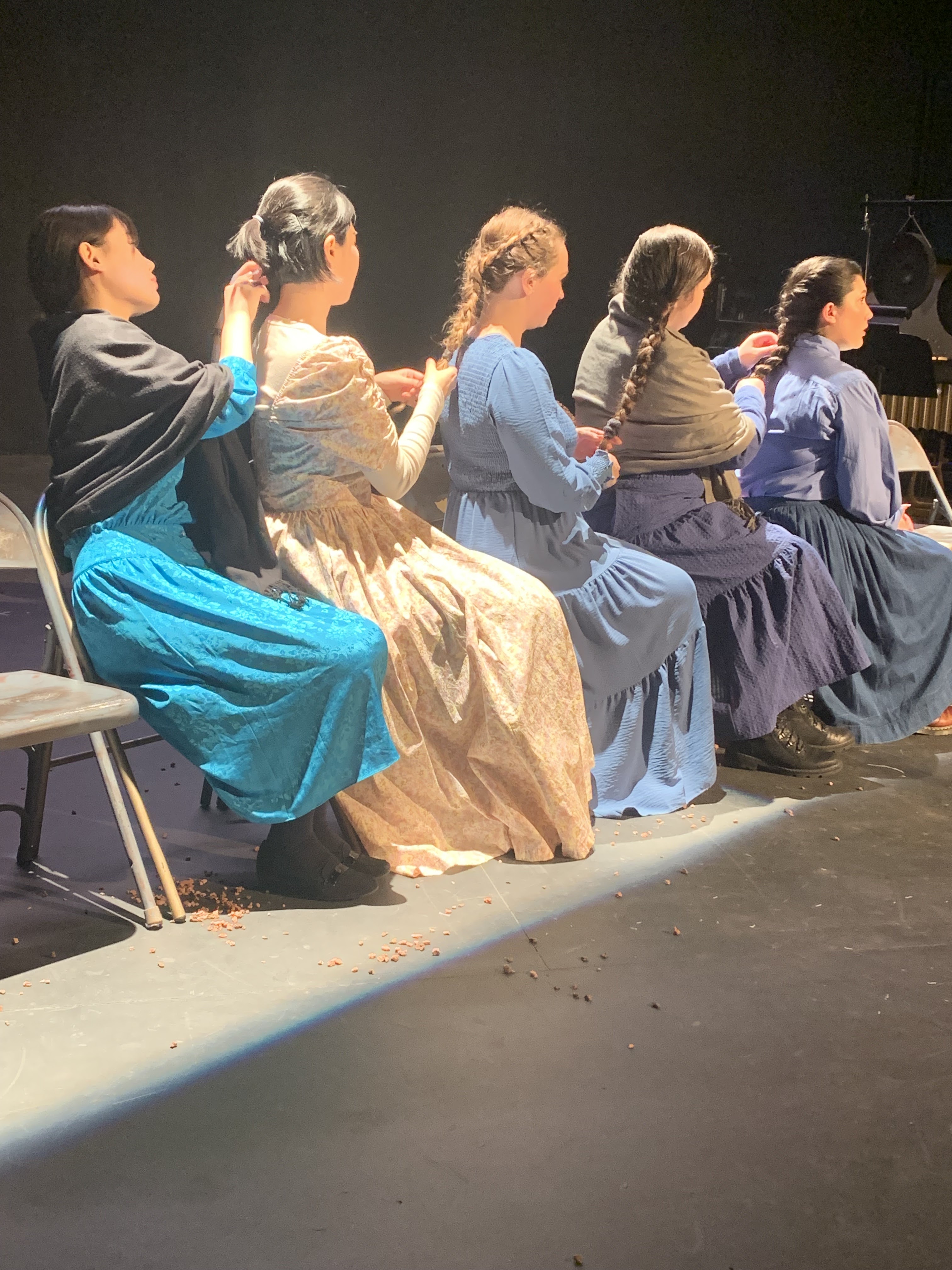
Although Managing Artistic Director of Mannes Opera Emma Griffin announced the evening as a "workshop" with minimal rehearsals, we thought the production given to Nico Muhly's Dark Sisters was first rate and required no apologies. Laine Rettmer's direction told the story (based on a true event) effectively; Geoffrey McDonald's conducting of the orchestra was up to his customary high standards; the singing of the six women and the lone bass-baritone was exemplary and notable for the clarity of their diction.

The story concerns the effects of the government raid of a compound occupied by  "The Prophet" and his five "sister wives" in which all the children were removed. The opera opens with a disturbing and dissonant orchestral clash followed by the five women lamenting the loss of their children in an interwoven choral episode. Choruses were performed a cappella or with spare accompaniment which we preferred to what sounded to our ears like a mismatch of voice and orchestra.

Although there was some interesting orchestration to be heard, the vocal lines were not among them.  More credit goes to the cast for making music out of Stephen Karam's prosy libretto. We thought this would have made a fine play! However, we did not think the music added to the story in the way that Poulenc's music and libretto (based on a play by Georges Bernanos) complemented and reinforced the storytelling of a different true story--Dialogue des Carmelites.

It is easy to be critical of the beliefs of religions other than one's own but that amounts to throwing stones when one occupies a glass house. Did "The Prophet" truly believe the nonsense he foisted upon his wives? Or was this just another case of men controlling women to suit their own desires.  We couldn't help but think of the animal world in which one male keeps a herd of females for his own insemination.

The way the talented Christopher Lau portrays him manages to sustain a hint of ambiguity.  There is plenty of ambiguity in the women as well. Eliza (well portrayed in the Saturday night cast by Sofia Durante) is the rebel in the group and uses her feminine wiles to blow the whistle on The Prophet. As the seriously troubled Ruth, Ziwan Nie was nearly mute but heartbreaking. The other women kept up the pious front and vied for the "favors" of The Prophet, probably brainwashed into believing the need to "stay sweet", a euphemism for obedience and submission. There was plenty of female "cattiness" and rivalry as one might expect. A parallel might be drawn with the complex households in ancient China in which there were several wives, often sold into what amounted to sexual slavery at a very tender age.

Mr. Lau had another role as a TV reporter, sitting in front of a photo of the Utah red rocks and interviewing the women who responded in unison as they had been brainwashed to do.  To his credit, he colored his voice differently and altered his posture for this secondary role.

The other women in the cast were equally fine, including India Rowland, Emily 
Summers, Joohyun Kim, and Carolyn Boulay.

The orchestral music, whilst not particularly melodic, offered some fine solos and duets for instruments of which we are very fond--English Horn and Bass Clarinet, not to mention the cello, harp, and percussion. No credit for costuming was given but the women looked appropriately inhibited in long drab garments and clunky boots.

© meche kroop