MISSION

We are here to encourage the development of gifted young singers and to stimulate the growth of New York City's invaluable chamber opera companies. But we will not neglect the Metropolitan Opera either. Get ready for bouquets and brickbats.
Showing posts with label Christopher Lau. Show all posts

Sunday, January 29, 2023

DARK SISTERS


Mannes Opera Students

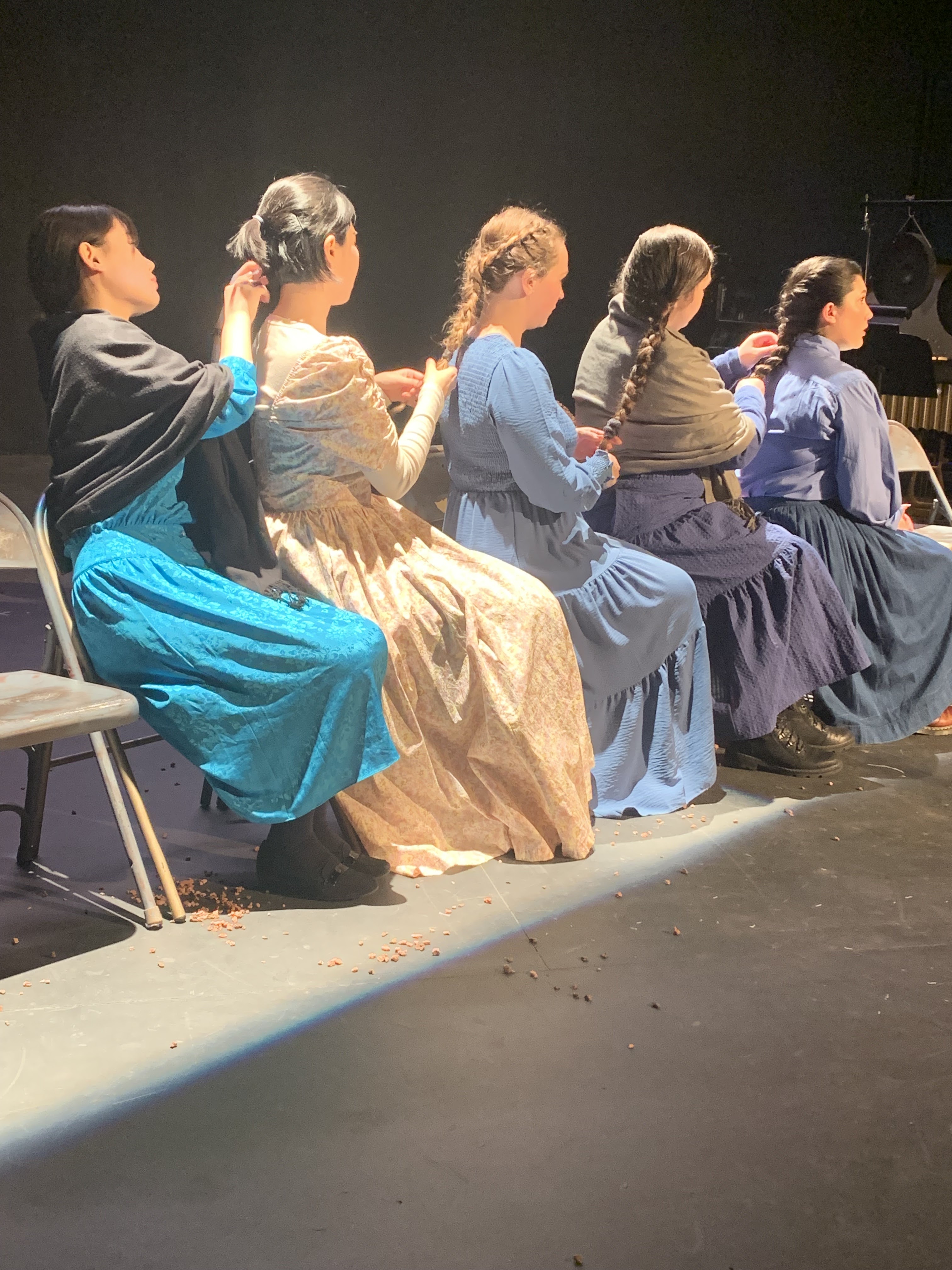
Although Managing Artistic Director of Mannes Opera Emma Griffin announced the evening as a "workshop" with minimal rehearsals, we thought the production given to Nico Muhly's Dark Sisters was first rate and required no apologies. Laine Rettmer's direction told the story (based on a true event) effectively; Geoffrey McDonald's conducting of the orchestra was up to his customary high standards; the singing of the six women and the lone bass-baritone was exemplary and notable for the clarity of their diction.

The story concerns the effects of the government raid of a compound occupied by  "The Prophet" and his five "sister wives" in which all the children were removed. The opera opens with a disturbing and dissonant orchestral clash followed by the five women lamenting the loss of their children in an interwoven choral episode. Choruses were performed a cappella or with spare accompaniment which we preferred to what sounded to our ears like a mismatch of voice and orchestra.

Although there was some interesting orchestration to be heard, the vocal lines were not among them.  More credit goes to the cast for making music out of Stephen Karam's prosy libretto. We thought this would have made a fine play! However, we did not think the music added to the story in the way that Poulenc's music and libretto (based on a play by Georges Bernanos) complemented and reinforced the storytelling of a different true story--Dialogue des Carmelites.

It is easy to be critical of the beliefs of religions other than one's own but that amounts to throwing stones when one occupies a glass house. Did "The Prophet" truly believe the nonsense he foisted upon his wives? Or was this just another case of men controlling women to suit their own desires.  We couldn't help but think of the animal world in which one male keeps a herd of females for his own insemination.

The way the talented Christopher Lau portrays him manages to sustain a hint of ambiguity.  There is plenty of ambiguity in the women as well. Eliza (well portrayed in the Saturday night cast by Sofia Durante) is the rebel in the group and uses her feminine wiles to blow the whistle on The Prophet. As the seriously troubled Ruth, Ziwan Nie was nearly mute but heartbreaking. The other women kept up the pious front and vied for the "favors" of The Prophet, probably brainwashed into believing the need to "stay sweet", a euphemism for obedience and submission. There was plenty of female "cattiness" and rivalry as one might expect. A parallel might be drawn with the complex households in ancient China in which there were several wives, often sold into what amounted to sexual slavery at a very tender age.

Mr. Lau had another role as a TV reporter, sitting in front of a photo of the Utah red rocks and interviewing the women who responded in unison as they had been brainwashed to do.  To his credit, he colored his voice differently and altered his posture for this secondary role.

The other women in the cast were equally fine, including India Rowland, Emily 
Summers, Joohyun Kim, and Carolyn Boulay.

The orchestral music, whilst not particularly melodic, offered some fine solos and duets for instruments of which we are very fond--English Horn and Bass Clarinet, not to mention the cello, harp, and percussion. No credit for costuming was given but the women looked appropriately inhibited in long drab garments and clunky boots.

© meche kroop

Sunday, November 20, 2022

MORE BAROQUE FROM MANNES OPERA


 Curtain Call from La Calisto presented by Mannes Opera


Last night we attended a performance of Francesco Cavalli's l651 opera La Calisto, presented by Mannes Opera and directed most imaginatively by Emma Griffin. We don't know why all three opera conservatories in New York City chose to present a Baroque opera during the same time period; we thought we had had our fill and had no intention of writing another review. We only went to see the performance of a couple singers we admire. However, we were so taken with the production and the artistry of the singers and musicians that we feel compelled to share it with you, dear reader. If you read this too late to see it in person, we urge you to watch the livestream on December 2.

 We were amazed by the endurance of so many aspects of love that have remained unchanged for  four centuries. The stage was filled with nymphs and satyrs, gods and goddesses--strange figures to be sure; and yet their concerns are our concerns today.  The social media generation did not invent unfulfilled romantic longing, sexual dalliances overcoming chaste intentions, rejection, cross-dressing, lesbian love, romantic deception, cheating husbands, nor vengeful wives. There was something particularly thrilling about seeing ourselves onstage in a work dating back four centuries.  Not just thrilling but moving as well. Love and sex will always be with us until the robots take over!

It is difficult to believe that this marvelous work lay dormant until 1970.  How fortunate we are that it was discovered and revived.  It lets us in on what the mid 17th c. Venetians expected from a rather new and popular art form. Cavalli was there at the birth of opera!

Impresario/librettist Giovanni Faustini had created many operas with Cavalli; this one was their penultimate production. The story was derived from Ovid's Metamorphosis and recounts the myth of Giove pretending to be the goddess Diana in order to seduce the beautiful chaste Calisto. The tale is padded out with the love story between the real Diana and the shepherd Endimione. In every case, chastity falls under the weight of sexual desire. 

The wily Mercurio (fine and funny tenor Daniel Rosenberg) convinces Giove (authoritative baritone Christopher Lau) that persuasion is no match for deception when trying to seduce a woman. Their duet was musically gorgeous and also quite humorous. 

In the title role, lovely soprano Anna Aistova sang about wanting to lead a chaste life, devoted to the goddess Diana.  Giove transforms himself into Diana (beautifully sung by soprano Lindsey Kanaga) and successfully seduces her. The two women had a tender duet before entering a cave to exchange chaste kisses (which led to much more).

When the real Diana appears (Jihye Seo) her voice and gestures are very different and there is no doubt that she is the real thing. When Calisto refers to their makeout session, Diana is outraged by the inference and tosses Calisto out of the virginal sisterhood. 

Diana, on her part, is secretly in love with the shepherd Endimione (Elisse Albian) who expresses his longing for her in the most exquisite aria.

In a scene offering comic relief, Maia Sumanaweera portrayed Linfea, one of Diana's followers, who longs for romance. In spite of her desperation, there is no way Linfea is going to settle for the importuning of Satirino (Emmet Solomon), even though he tells her that while young, his tail is still growing!  He is a member of a clutch of satyrs, of which the leader is the god Pane, portrayed by Joohyun Kim. As Silvano, one of the satyrs, we enjoyed hearing Yuan Lai.

We were met with new delights as Giunone, the jealous wife of Giove, appeared to expose her husband's infidelity.  The stunning soprano Marieke de Koker just about stole the show as she gave her all to the revenge aria, in which she instructs women not to put up with philandering husbands but rather to take revenge.  Her particular revenge is to transform Calisto into a bear. Giove cannot undo this curse but finds his beloved Calisto a place in the firmament as the constellation Ursa Major, a condition foretold in the Prologue.

The Prologue was outstanding with soprano Yixuan Li taking the role of L'Eternita, soprano Jillian Agona appearing as Il Destino, and mezzo-soprano Morena Galan taking the role of La Natura. In a stunning opening scene the three women decide that Calisto deserves her place in the heavens. 

Taking the roles of The Furies were Olivia Gray and Anna Ruhland.

Emma Griffin, Managing Artistic Director of Mannes Opera, pulled exemplary performances from these gifted young singers and told the tale in a way that resonated with contemporary listeners, without robbing the work of its authenticity. Cavalli's music is very singable and  a small chamber orchestra, such as was heard in its own time, did full justice to Cavalli's writing, led by the rising star conductor Kamna Gupta.

We do not know who was responsible for the costuming and makeup but both contributed enormously to the effectiveness of the storytelling. What impressed us the most was how these wonderful singers are also terrific actors, especially in the comic roles.  We could see both the mythic characters and ourselves simultaneously!

© meche kroop