MISSION

We are here to encourage the development of gifted young singers and to stimulate the growth of New York City's invaluable chamber opera companies. But we will not neglect the Metropolitan Opera either. Get ready for bouquets and brickbats.
Showing posts with label Nico Muhly. Show all posts

Sunday, January 29, 2023

DARK SISTERS


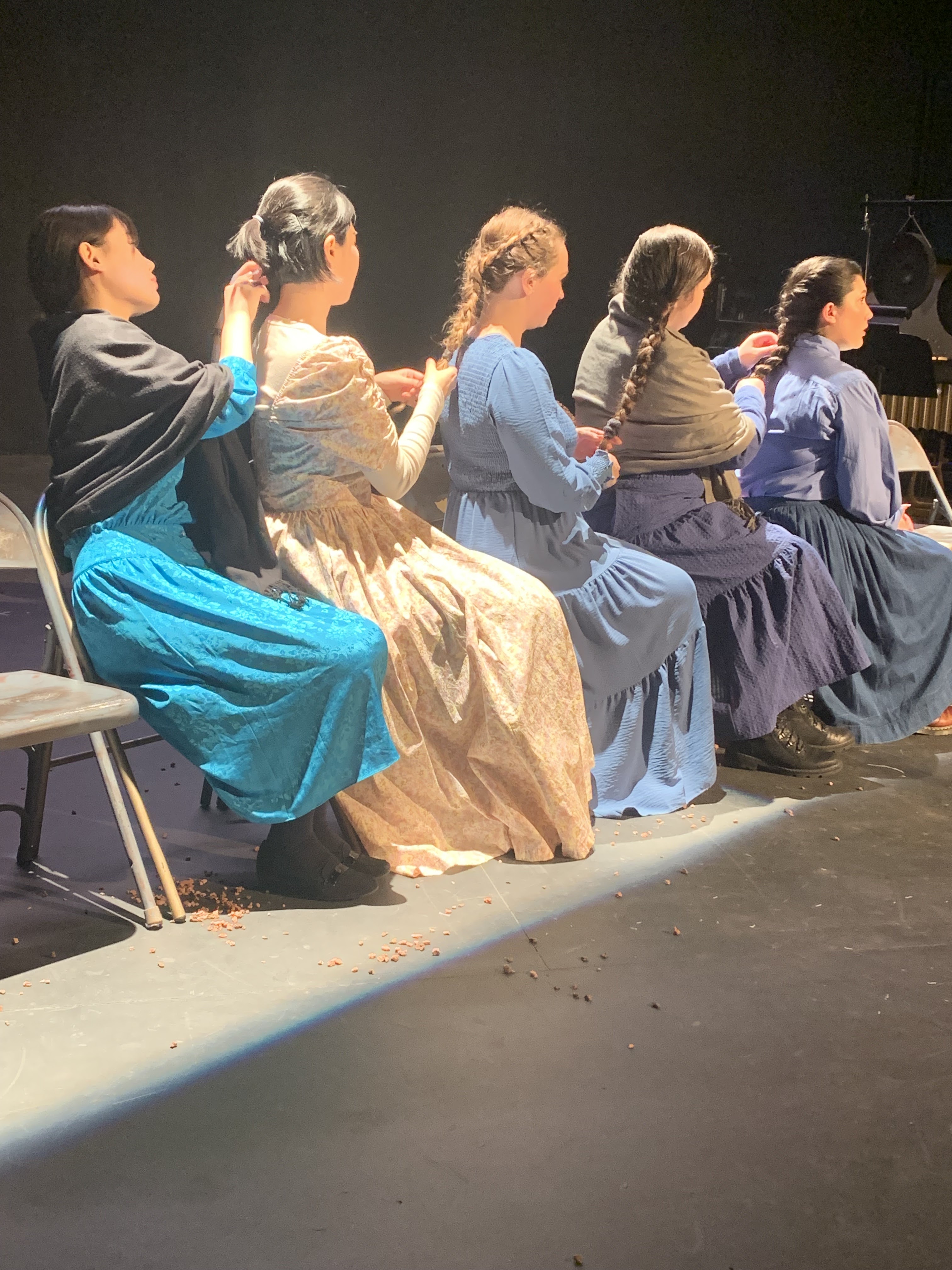
Mannes Opera Students

Although Managing Artistic Director of Mannes Opera Emma Griffin announced the evening as a "workshop" with minimal rehearsals, we thought the production given to Nico Muhly's Dark Sisters was first rate and required no apologies. Laine Rettmer's direction told the story (based on a true event) effectively; Geoffrey McDonald's conducting of the orchestra was up to his customary high standards; the singing of the six women and the lone bass-baritone was exemplary and notable for the clarity of their diction.

The story concerns the effects of the government raid of a compound occupied by  "The Prophet" and his five "sister wives" in which all the children were removed. The opera opens with a disturbing and dissonant orchestral clash followed by the five women lamenting the loss of their children in an interwoven choral episode. Choruses were performed a cappella or with spare accompaniment which we preferred to what sounded to our ears like a mismatch of voice and orchestra.

Although there was some interesting orchestration to be heard, the vocal lines were not among them.  More credit goes to the cast for making music out of Stephen Karam's prosy libretto. We thought this would have made a fine play! However, we did not think the music added to the story in the way that Poulenc's music and libretto (based on a play by Georges Bernanos) complemented and reinforced the storytelling of a different true story--Dialogue des Carmelites.

It is easy to be critical of the beliefs of religions other than one's own but that amounts to throwing stones when one occupies a glass house. Did "The Prophet" truly believe the nonsense he foisted upon his wives? Or was this just another case of men controlling women to suit their own desires.  We couldn't help but think of the animal world in which one male keeps a herd of females for his own insemination.

The way the talented Christopher Lau portrays him manages to sustain a hint of ambiguity.  There is plenty of ambiguity in the women as well. Eliza (well portrayed in the Saturday night cast by Sofia Durante) is the rebel in the group and uses her feminine wiles to blow the whistle on The Prophet. As the seriously troubled Ruth, Ziwan Nie was nearly mute but heartbreaking. The other women kept up the pious front and vied for the "favors" of The Prophet, probably brainwashed into believing the need to "stay sweet", a euphemism for obedience and submission. There was plenty of female "cattiness" and rivalry as one might expect. A parallel might be drawn with the complex households in ancient China in which there were several wives, often sold into what amounted to sexual slavery at a very tender age.

Mr. Lau had another role as a TV reporter, sitting in front of a photo of the Utah red rocks and interviewing the women who responded in unison as they had been brainwashed to do.  To his credit, he colored his voice differently and altered his posture for this secondary role.

The other women in the cast were equally fine, including India Rowland, Emily 
Summers, Joohyun Kim, and Carolyn Boulay.

The orchestral music, whilst not particularly melodic, offered some fine solos and duets for instruments of which we are very fond--English Horn and Bass Clarinet, not to mention the cello, harp, and percussion. No credit for costuming was given but the women looked appropriately inhibited in long drab garments and clunky boots.

© meche kroop

Wednesday, January 29, 2014

MOSTLY BRAHMS

Emanuel Ax and Anne Sofie von Otter onstage at Carnegie Hall
Last night at Carnegie Hall, two of the finest artists of their generation performed an evening of Brahms' music (interrupted by a lengthy work by Nico Muhly commissioned by Carnegie Hall).  It was not until the encores that we got to hear what we wanted to hear.  Highly esteemed mezzo-soprano Anne Sofie von Otter with acclaimed collaborative pianist Emanuel Ax made a fine team; what was missing was the feeling of intimacy that Brahms' songs require.  It is not their fault; it is just the size of Stern auditorium.  The number of fans and financial considerations likely dictate the size of the venue and this cannnot be helped.

Ms. Von Otter is on the contained side but during the first encore, "Sapphische Ode" her gestures grew in amplitude and somehow bridged the intimacy gap.  In the second encore she enacted, yes ENACTED! the dialogue between a young woman who has trouble expressing what she wants to her mother who feigns ignorance.  The girl gets increasingly exasperated until her mother realizes the girl wants a man.  So far we are unable to locate the name of this charming song but will supply it in the future.

Brahms oeuvre of lieder is vast and he had an affection for setting folk songs, many of which were heard last night.  We enjoyed "Sommerabend Op.85, No. 1" in which our two artists shared moments of exquisite control of dynamics.  In "Juchhe! Op. 6, No. 4" we heard a joyful side of Brahms that was pure delight.  The heartfelt "Von ewiger Liebe, Op. 43, No. 1" has won our admiration time and time again.  In "Ständchen, Op. 106, No. 1", another favorite of ours, the two artists painted a charming picture of three serenaders and their effect on a sleeping maiden.  We observed that when Ms. Von Otter uses her body her voice seems to open up and enfold the audience to a greater extent.

"Nachtwandler, Op. 86, No. 3" had a lovely delicacy; "Am Sonntag Morgen, Op. 49, No. 1" was marked by an impressive range of vocal color as the singer puts on a happy face for the world while suffering within.  There was a lovely rocking feeling in the piano in "Ruhe, Süssliebchen, Op. 33, No. 9".  We recently heard the entire cycle Magelone-Lieder performed by the Brooklyn Art Song Society and were pleased to hear the song again.

Also performed were the Zigeunerlieder, Op. 103 which have somewhat less of a gypsy flavor than those of Dvořak.  We most enjoyed "Wisst ihr, wann mein Kindchen" and the rhythmic "Brauner Bursche führt zum Tanze" which was performed with lavish rubato.

Mr. Ax had the opportunity to perform four of Brahm's late-life short pieces, three Intermezzi and a Romanze.  Our favorite was the "Intermezzo in A Major, Op. 118, No. 2" in which we are sure we heard echoes of Mendelssohn's "Ist es wahr".

About Mr. Muhly's "So Many Things", we have little to say.  Our 19th c. ears could not wrap themselves around the 21st c. music and, although certain words could be heard, entire phrases could not be understood and the text was not in the program.

We  felt privileged to be able to witness these artists onstage in spite of the drawback mentioned earlier.  It is unlikely that we would ever have the opportunity to experience them in a more intimate venue.

ⓒ meche kroop


Friday, November 30, 2012

UNDER COVER OF NIGHT

"Under Cover of Night" was the title and theme of last night's Alice Tully Vocal Arts Recital, a theme we can well relate to since, by all accounts, we operate nocturnally.  Soprano Jennifer Zetlan chose this theme in connection with the lost sleep of her pregnancy and motherhood, wondering how the night affects us emotionally and behaviorally.  The night is given over to fantasy, to romance, to fears, melancholies, dreams, nightmares and terrors.  In our case, it is given over to writing.

And what a pleasure it is to write about this lovely, gracious and talented singer whose gifts were evident from the very first "Oh" of Handel's aria from Semele, "Oh, sleep, why dost thou leave me?" which was marked by a beautifully controlled crescendo.  This was only the beginning of a varied program that gave Ms. Zetlan the opportunity to show her skills in German, Russian and Spanish and to connect with her audience as well as her material.  Her piano partner David Shimoni always supported with appropriate technique and never overwhelmed the singer or the song.

The bulk of the program was give over to the late 19th c. which is our personal favorite.  Songs by Grieg, Brahms, Wolf, Debussy, Strauss, Granados and Rimsky-Korsakov were performed with poise and secure technique.  Each song was given its own particular interpretation that sounded nothing like the other songs.  Ms. Zetlan is a remarkable story-teller and we especially enjoyed the mini-operas written into Wolf's songs, both the humorous "Elfenlied" and the horror-filled "Die Geister am Mummelsee".  The melodic "Po nebu polunochi" by Rimsky-Korsakov was filled with spiritual awe.  Strauss' "Die Nacht" expressed the poet's anxiety about losing his loved one.

Ms. Zetlan is a champion of new music and was joined by the Attacca Quartet for Nico Muhly's Far Away Songs in their world premiere.  As encores, she sang Rachmaninoff's "Son" and Irving Berlin's "Yiddishe Nightingale" which left the audience grinning as they exited.  Nighttime never sounded so good!

(c) meche kroop