MISSION

We are here to encourage the development of gifted young singers and to stimulate the growth of New York City's invaluable chamber opera companies. But we will not neglect the Metropolitan Opera either. Get ready for bouquets and brickbats.
Showing posts with label Sara Stevens. Show all posts

Thursday, May 15, 2025

SHOWCASE OR NEW OPERA COMPANY?


Enes Pektas as Michele


Sarah Stevens as Giorgetta and David Freides as Luigi


With his typical modest manner, Glenn Morton, Director of Classic Lyric Arts Vocal Academy, introduced CLAVA's debut opera performance at The Blue Gallery. As a member of the audience we are not obligated to be modest. As a matter of fact, we are over the moon about a completely engaging performance of Il Tabarro, one third of Puccini's  Il Trittico. The singing was stellar with major roles performed by members of CLAVA and supporting roles cast with graduates of CLA's  immersive summer programs in Italy, France, and The Berkshires.

Adding to the immeasurable vocal thrills of the evening were three factors. The finely tuned direction of Daniel Isengart (a CLAVA Faculty Member) told the timeless story with specificity of detail and characterological honesty.  The conducting by Maestro Michelle Rofrano  built the intensity of Puccini's score to a fever pitch, relaxing only briefly for the dancing scene. The piano artistry of Doug Han who, by some kind of magic, created all the colors of the orchestra.

Mr. Isengart's stage direction was so specific that our guest, who speaks no Italian, was able to relate the story to us after the curtain.  And no, he did not read the synopsis. This was an experiment because there were no projected titles. Not only was the story well told, but each character was believable, evoking memories of real people.

As Michele, the Captain of the barge, we heard baritone Enes Pektas, whose Master's Degree recital we recently reviewed. (You can, Dear Reader, enter his name in the search bar if you missed the review.) His acting was so intense and brooding that we lost sight of the artist as someone we have seen and heard before. He actually became the character and we felt the pain of being betrayed. Although Giuseppi Adami's libretto is set a century ago, the story is a timeless one. The narcissistic injury endured by a man in a loveless marriage unable to retain his wife's affection can easily turn to murderous rage. That story is not unknown today.  The sullen vocal color infused Mr. Pektas' portrayal whilst he preserved his beautiful tonal quality and phrasing.

As his unhappy wife Giorgetta, soprano Sara Stevens (also reviewed several times this year for her performances as a Master's Degree student at Manhattan School of Music) turned in a most affecting performance. By means of vocal coloration she demonstrated the coldness she felt for her much older husband and the feminine energy she projected with Luigi, a stevedore on the barge. By some fine acting one could sense that she and her lover had a past that they shared. Indeed they both came from the same suburb of Paris and probably grew up together. All this was conveyed with facial gesture and posture, but probably came from a deep belief in the character. 

There was the lighthearted side of Giorgetta as well, when she brought wine to the stevedores and danced. There was even a funny moment when Tinca (played by John Viscardi, once a CLA student but now Coach and Artistic Director) tried clumsily to dance with her and stepped on her toes.

The character of Luigi the lover was wisely drawn by tenor David Freides who was careful not to make him too sympathetic. Did he deserve his fate? That was left for the viewer to decide. That he sang with beautiful tone might have prejudiced the audience to more sympathy than he deserved.

It is said in the theater that there are no small parts and that seems to be true in opera as well.  As evidence we offer the fine performance of mezzo-soprano Sofia Durante as La Frugola who comes on board with trinkets and gossip that she shares with Giorgetta. She immersed herself so completely in this voluble role that it took us a few minutes to recognize her as someone we have heard in concert several times before. 

As her husband Talpa, Alejandro De Los Santos made an equally fine showing. The carefree domestic affection between this pair served as counterpoint to the tense relationship between Michele and Giorgetta. This is something we never perceived before and for this we thank the direction.

As far as the setting, there is no actual stage in The Blue Gallery. A metal bar stretched horizontally across the playing area and we had no trouble perceiving it as the railing of the barge. Stevedores toting large boxes across the stage added to the illusion and reminded us that much can be accomplished with minimal material resources and a lot of imagination.

The minor characters were portrayed by Samuel Ng and Sofia Gotch singing from behind the audience and in a space up near the ceiling. This was not a problem since it served to focus attention on the major characters. Costuming was minimal and timeless.

Everything served to show us that opera is theater with gorgeous voices. Famous names and elaborate sets are not as important as the music and the storytelling, of which we had the very best!

A couple years ago the late and lamented On Site Opera produced this same opera at The Seaport (review can be found in the search bar) with action taking place on a ship and the audience seated on the dock. We enjoyed the realism but the voices required amplification. This made last night's performance even more valuable as we heard Puccini's vocal lines delivered with musicality and authenticity.

Without the obligation of bringing in famous names to fill a huge theater, opera can once again be restored to its original function and we applaud this aim. This opera was chosen by CLAVA, not to please an audience, but because they had the right singers for the roles. Would this model work for a small opera company in Manhattan? We very much think so and will be first in line for their next venture. Was this experience valuable for the young artists who participated in CLAVA? We definitely think so. Academic institutions cast them in contemporary operas no one else will ever produce, or in weird productions of great operas. But to get a chance to perform in an authentic production of a great opera means that they can sing these roles anywhere in the world. And we hope that they will!!!!!

© meche kroop

Sunday, April 27, 2025

THE LITTLE (MERMAID) MENTAL PATIENT


Benjamin R. Sokol, Fernando Silva-Gorbea, Sara Stevens, Qing Liu, and Su Hyeon Park

Some topnotch singing, acting, and orchestral luminosity delighted our ears last night at Manhattan School of Music Graduate Opera Theatre's production of Antonin Dvořák's Rusalka. We unfortunately had to deal with an ill-advised example of regietheater devised by Director John de los Santos, whose direction we usually enjoy. According to the Director's Notes which we generally read after viewing the production, Mr. de los Santos was inspired by the fact that the building occupied by Manhattan School of Music was once an asylum for the mentally ill.

Regular readers will recall that we strongly prefer a work that speaks for itself, allowing us to draw our own analogies, which we did and may choose to share  later on. The director's concept was to transform the water spite Rusalka into a mental patient around the turn of the 20th century, just about the time that Jaroslav Kvapil wrote his libretto, adapted from a fairy tale by Hans Christian Andersen (and others)  which was, in turn, devised from a few Slavic folk legends about women water sprites who lured men to their death by tickling (!) or drowning.

In this production, Michael Ruiz-del-Vizo's double decker set design had an institutional appearance whilst Ashley Soliman's costume design had some of the characters in period costume with the inmates in drab identical shapeless garb. We deliberately called them inmates because the attendants treated them like prisoners, which, in a sense they were. (Dear Reader, do read about the Kennedy sister who was similarly imprisoned at the behest of her father Joseph.)

The stage was filled with efficient nurses in crisp nursing attire and guards with numbered arm bands, against whom the inmates struggled. Inmates were chained together cruelly by ropes and led around. It seemed more political than medical, with the exception of a kindly doctor who stood in for the opera's Vodnik, a water goblin that the water sprites call their father, except here he is their well meaning doctor. In this role, Benjamin R. Sokol used his resonant lower register and kindly demeanor to good advantage, singing with fine tone and sympathetic inflection.

As Rusalka, super soprano Sara Stevens (see what we did there?) threw herself into the role and gave the director exactly what he wanted and, through her superlative singing, gave us what we wanted--a vocally impeccable performance. The coloration was admirable and she floated her high notes when appropriate and opened up her voice when that was dramatically called for. The deservedly famous aria "Song to the Moon" expressed a longing so deep that it brought tears to our eyes. If someone told us that Rusalka was chosen as a vehicle to show off her artistry we would believe them!

In this odd version of the story, The Prince, whilst singing about spotting a white doe while out hunting, seems to be someone who stops by the asylum to read to the patients. Fernando Silva-Gorbea employed a pleasing tenor instrument with enough tenderness that we felt sad when he was stabbed to death by Rusalka However, we were wondering how a dagger would have been left lying around in an insane asylum--just one of a number of inconsistencies caused by shoehorning the story into a Procrustean bed.

The witch Ježibaba was here some kind of matron/surgeon in strange steam-punk dress who seemed to be operating on Rusalka's brain, since the latter emerges from behind a screen with a bandage on her head that was so disfiguring that we were surprised that The Prince fell in love with her. Of course, the entire thing must have been the hallucination of a paranoid schizophrenic, although a lot of women in these asylums were consigned there for dubious reasons. Qing Liu gave a fine performance in the role, employing a threatening demeanor and steely vocal coloration.

There was even some comic relief during the interaction between the Gamekeeper (Kevin Mann) and the frightened kitchen helper (Jordan Lee Gilbert) whose conversation served to advance the story about the Prince's affection wavering between Rusalka and The Foreign Princess, given an appropriate haughtiness by Su Hyeon Park.

Every voice we heard was of the highest equality, including the trio of Woodsprites (mental patients) comprising Xinran Du, Raine Filbert, and Yiqian Heng. Although Rusalka's "Song to the Moon" is the deservedly famous number, the trio in Act II would make as fine a concert piece as we have ever heard. 

Although Czech is not one of our languages, its plethora of consonants did not seem to hinder any of the singers and we were thrilled that the opera was sung in Czech since the composer's music is so well married to the text. Kudos to the large chorus and their chorus Master Jackson McKinnon.

Maestro Kelly Kuo led the Manhattan School of Music Orchestra through Dvořák's melodic and colorful score with excellent Slavic style. The weird storytelling was so distracting that at times we just closed our eyes and listened to the way the master composer told the story. Let us credit also the fine dramatic lighting of Ron Collins.

If we hadn't been force fed the director's concept, we might have been free to associate on our own, which is what storytelling should do. We imagined a small town girl who fell for a big city guy who was visiting her town and flirted with her because she was pretty and innocent. She followed him to the big city but couldn't match the sophistication and verbal expressiveness of his circle. She watched him getting infatuated with one of his own kind and returned home in despair, only to learn that she no longer fit in there and was ostracized. Now we certainly wouldn't foist that on other people but we sure enjoyed our own musings which, in our opinion, is what opera should do--give us something on stage that we can relate to on our own terms, from our own experiences.

In spite of the conflict between the dialogue and the visuals and switching back and forth between the folktale and the director's conceit, we were glad we went because of the overwhelmingly excellence of the musical values.

© meche kroop

Friday, December 13, 2024

A MOST GALA GALA


  A scene from Mozart's Cosi fan tutte

Unless you are new to Voce di Meche, you are familiar with our delight in institutions that share our goal of fostering the careers of young opera singers. Having impressed us year after year with results, Classic Lyric Arts tops our list of institutions worth supporting.  Recently expanded from their three summer programs of total immersion in Italy, France, and the Berkshires, yearling CLAVA (Classic Lyric Arts Vocal Academy) is now flourishing, providing advanced year-long training to a select group of students.

Last night we attended the annual gala in which students and alumni got to show off their vocal, linguistic, and dramatic skills. Following a two handed piano arrangement of the overture to Don Giovanni (I-Hsiang Chao and Hannah Harnest) we were treated to the tender duet "Ange adorable" from Gounod's Roméo et Juliette with Sofia Gotch lending her brilliant instrument to the role of the shy heroine with tenor Yulin Wang giving an affecting performance as the ardent Roméo. The French diction succeeded beyond the customary skill of most young singers, evidence of some fine coaching. Daniel Isengart's astute direction had the two circling each other in a dance of seduction.

Following was the delightful light hearted duet from Hahn's comic opera Ciboulette, an interesting choice to show off the charms of Alison Kessler and Kevin Douglas in the duet "Nous avons fait un beau voyage", sung in French that was as Gallic as one might wish for. Hyojeong Ham accompanied.

The crazy scene from Mozart's Cosi fan tutte was so cleverly directed by Mr. Isengard that the nonsense between the six main characters made sense and we were plunged right into the craziness. Ms. Harnest accompanied the frolic with Annelise Burghardt, Brigid Mack, Yunxin Dorothy Nie, Benjamin Truncale, Jongho Woo, and Brian Linares bringing the scene to vivid life with  Ferrando and Guglielmo feigning suicide to win the affections of Fiordiligi and Guglielmo, whilst Don Alfonso and Despina enjoy the chaos they created.

Soprano Kerrigan Bigelow used her delicate vibrato to portray the shy Micaëla in her Act I duet with Don Jose, convincingly portrayed by tenor Philippe L'Esperance who has never sounded better, although we have always enjoyed his performances. Ms. Ham accompanied.

A riveting and star-making duet from Bellini's Norma ("Mira, o Norma") gave an opportunity for stellar soprano Sara Stevens to tackle this difficult number with the well loved mezzo-soprano Briana Hunter providing fine harmony as Adalgisa. The acting was particularly effective as the two women drew closer to one another. Again, Mr. Isengart's staging was right on point. Ziyi Hong accompanied.

A different Fiordiligi, Haiming Wu, succumbed to the importunate Ferrando of Mr. Truncale in "Far gli amplessi", a bit further along in the story.  There was so much going on in the aforementioned sextet that we didn't have the opportunity to focus on any one singer, but in this duet we noticed Mr. Truncale's embouchure and how that contributed to his most Italianate sound. Ms. Wu gave an excellent rendering of Fiordiligi and I-Hsiang Chao accompanied.

Comedy filled the air as Mr. Wang showed that his Italian was just as good as his French in "Se inclinassi a prender moglie" a duet from Mozart's L'Italiana in Algeri in which Lindoro evades the wishes of Bey Mustafa, well portrayed by  Juan Angel Johnston-Chavez.  Shaobai Yuan accompanied.

If there is one scene in Massenet's Manon that moves us it is when the eponymous heroine seduces her former lover who has joined the priesthood! Soprano Brea Marshall used every vocal and dramatic device in her repertoire to accomplish her goal. Her victim Des Grieux was well sung by Jack Hicks and Hyojeong Ham accompanied.

John Viscardi, Executive Director of CLA, is well known to us in both the tenor and baritone fach and made a fine impression as he stepped right into the role of Marcello, lamenting his lost love in the final act of Puccini's La Bohême. Portraying his friend Rodolfo was tenor David Freides and we enjoyed the way the two men balanced each other. Marianna Vartikian accompanied.

Closing the program was a very funny scene from Rossini's Le Comte Ory, well staged by Mr. Isengart who, we might mention, is on the faculty of CLA. The most remarkable feature of his directing is that even an opera neophyte could understand what is happening in a scene, even without benefit of knowing the language. But there were also his well written and concise program notes as insurance! Ziyi Hong provided the lively accompaniment.

Artistic Director Glenn Morton, well known as a faculty member of all three music conservatories in New York City, gave a warm welcome to the guests who were also treated to a lovely reception before and after the program, giving guests an opportunity to mingle with the young artists and to compare notes on the performances. This format seems more agreeable than the customary costly sit-down dinner with a high price tag used by other foundations to raise money and celebrate young singers.

We don't have enough good things to say about our own experience with CLA, not to mention the feedback we get from the students, as well as the evidence of our own ears. Their format of total immersion seems most effective. There is something more to be told, Dear Reader, something we will announce in due time.  So....stay tuned, as they say.

© meche kroop


Monday, November 4, 2024

CLASSIC LYRIC ARTS SUPER-SALON


 Pianists Patrick Gallagher and Marianna Vartikian with singers Enes Pektas, Sophia Durante, 
Sara Stevens and David Freides

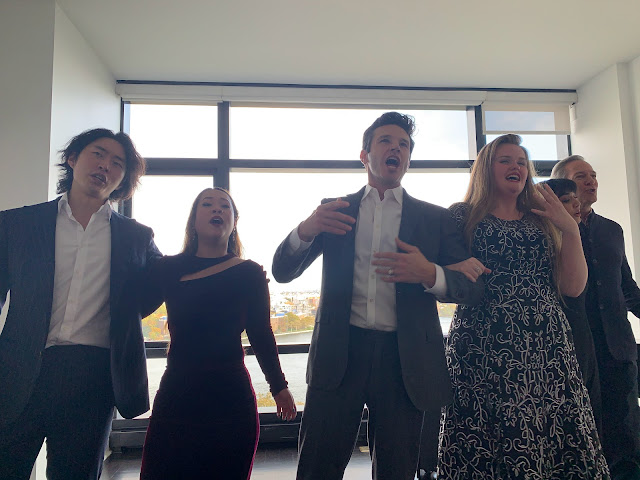
It was far more than a private salon that we attended yesterday in a gorgeous Manhattan penthouse. It was a celebration of the first year of Classic Lyric Arts Vocal Academy ( hereafter known as CLAVA) giving a chance to first year attendees to show off the impressive results of their intense post-graduate training. Young opera singers are not always getting the training they need at the conservatories in order to survive in the highly competitive and demanding world of opera. Through CLAVA they will get the rigorous training they need, at a more comprehensive level than the students at CLA summer programs get.

One has only to listen to the results to know that CLAVA is on the right track. Students are learning the repertoire that will get them jobs, not roles in obscure modern works that will never become part of the canon. That they are profiting mightily from this training is obvious. There were moments in the recital when we heard such a fresh connection between the music, the text, and the inner feelings of the character that we had chills, and, at one point, tears. This is what opera really should be!

We cannot describe the entire generous program but we would like to share a few highlights. If we have little to say about technique, it is because we were captivated by the way in which the technique dissolved into the emotions of the character.  No sets! No costumes! Just "acting" coming from such a deep place that the singer dissolved into the character.

Take, for example, the performance of soprano Sara Stevens in "Marietta's Lied" from Korngold's Die Tote Stadt.  We felt all the melancholy, the sehnsucht, the sense of the transitory nature of happiness.  Of course the German was perfekt and the dynamics contributed but our attention was taken by the emotions.

Similarly, soprano Sophia Durante completely inhabited the character of Rosina from Rossini's Il Baribiere di Siviglia, making her adorably spunky by means of lavish, daring, and accurate fioritura, thus illustrating Rosina's willful determination. We just wanted to see her get her way (forgetting, for the moment, the unhappy Countess she becomes in Mozart's Nozze di Figaro).

We haven't heard soprano Yvette Keong in a number of years and we were delighted to witness how she has grown as an artist. The clarity of her diction made every word clear in "My Ship Has Sails" from Kurt Weill's Lady in the Dark. The beautiful text was lent a hint of an unbalanced character that inspired us to look up the plot of this 20th century American opera (unfortunately called a "musical"--but that's just an opinion of ours that regular readers will understand). Indeed, the character is troubled and undergoing psychoanalysis. Could it be just an accident that Ms. Keong conveyed that? We think not.

There were two male artists performing as well, both new to us. Turkish baritone Enes Pektas enacted the clueless Count from Mozart's Nozze di Figaro, wringing from the text every ounce of male piggishness. By what magic can dynamics and phrasing create a character? We wanted to laugh at his pomposity but also felt sorry for him! We found Mr. Pektas to be quite the storyteller.

Tenor David Freides impressed us greatly. with "E lucevan le Stelle" from Puccini's Tosca. We have heard this aria sung by all the great singers of the world and admired their technique and tone but we don't think we have ever felt so invited into a man's heart at the point of his imminent death--the flood of happy memories tinged with the feeling of loss. It was at this point that we became a bit tearful, feeling Mario's depth of character, rather than admiring the overtones.

Not only was the singing first-rate but the piano accompaniment was right on point. Accompanying duties were shared by Glenn Morton, Patrick Gallagher and (new to us) Marianna Vartikian.

What an incredibly special afternoon it was! We not only enjoyed the superlative singing but we feel we learned something about the artistry that is too often neglected, overlooked, or overwhelmed by excessively showy "grandstanding".

© meche kroop

Thursday, May 9, 2024

CLASSICAL, LYRICAL, AND ARTISTIC


 Luc Cheng, Glenn Morton, Young Kwang Yoo, Kevin Jasaitis, Sofia Gotch,  Sofia Durante, Sara Stevens, John Viscardi, Eliza Masewicz, Maia Sumanaweera and Samuel Ng

Regular readers recall my enthusiasm for Classical Lyric Arts, a highly esteemed immersive summer training program for young singers  held in France, Italy, and the Berkshires. Here is some great news, Dear Reader! CLA has expanded into an all year program helping recent conservatory graduates to navigate the difficult period of launching a professional career. Assistance is given in many areas including (but not limited to)  navigating auditions and competitions,  choosing repertory wisely, choosing management, and of course the finer points of singing. We think of it as polishing the gems.

Last night a private recital was held to celebrate this launch and the fortunate members of the audience had an opportunity to hear a program of Italian love songs, arias, and duets. What better language than Italian to sing of love! Even speaking Italian sounds like a love song! Our host, Glenn Morton (Artistic Director of CLA), accompanied some of the singers and the talented Luc Cheng accompanied other singers , including Executive Director John Viscardi (a graduate of CLA) about whom more later.

If we have heard a better recital, we cannot recall. The CLA singers demonstrated fine technique in which we can find no flaws. Their Italian was universally perfect, evidence of the fine immersive training they received in Italy. What most astonished us however, was how each singer showed something we call stage worthiness. They not only understood the text and the emotions which generated it, but they managed to employ the dramatic skills learned from faculty member Daniel Isengart, using facial expression, gesture, and the physical space that was available to create believable dramatic situations.

There were about 15 pieces performed and we will attempt to describe a few to illustrate this. In Rossini's Il Barbiere di Siviglia , Rosina persuades Figaro to get a note to the Count. Mezzo-soprano Sofia Durante created the character of the spunky young woman who is going to get her way whilst baritone Kevin Jasaitis was absolutely taken aback by her anticipation of his plot. They were so effective that one could imagine everything that led up to that moment and everything that would follow.

Ms. Durante also showed her aptitude for breeches roles in two scenes. From Bellini's I Capuletti e I Montecchi, we heard "Ah, crudel d'onor ragioni" in which Romeo and his Giulietta (soprano Sofia Gotch) sing a duet of conflict and anxiety. She also made a fine Nerone in duet with Poppea (soprano Maia Sumanaweera) from Monteverdi's L'incoronazione di Poppea. We heard this duet recently in which the singers "sexed it up" which removed the chemistry we felt from this performance as the singers slowly approached each other, heightening the anticipation.  Yes, we all know that Nero and Poppea were terrible people but in this opera you have to want them to triumph and so they did.

In a scene from Mozart's Don Giovanni, Mr. Jasaitis--now suave and perfectly self-assured--seduced a flirtatious Zerlina, adorably performed by soprano Eliza Masewicz. Each showed impressive comprehension of the character at that particular point in the opera.  In a different scene the seductive Don (Mr. Jasaitis who seems to own the role) performed the serenade "Deh vieni alla finestra" gazing upward at an actual window with the unknown woman actually there, lending verisimilitude to the performance.

The Cherry Duet from Mascagni's L'amico Fritz was performed by  Ms. Sumanaweera and tenor Samuel Ng with such intense chemistry that no one could have missed foretelling the romantic ending to the opera.

There were two entries from Puccini's tragic love story La Bohême. The Mimi of Act I was performed in a touching fashion by Sara Stevens, possessor of a huge and gorgeous soprano, who gave her all to "Mi chiamano Mimi". This was followed by "O soave fanciulla" with  Mr. Viscardi as the ardent Rodolfo (a role he just performed in Colorado, a role that fits him like a custom tailored suit).

There were also several more arias and songs to tickle our ears. We love Tosti's songs and Mr. Ng's impassioned delivery of "Ideale" perfectly captured the Italianate style, as did Mr. Viscardi's performance of "Sola tu manchi".

Ms. Gotch created a memorable Gilda from Verdi's Rigoletto, adorning the vocal line with precisely rendered coloratura flourishes. Similar technical precision was evinced by Ms. Masewicz performing "Qui la voce sua soave" from Bellini's I Puritani. We don't want to end without mentioning a funny moment. We were surprised when the photographer (whose photos are guaranteed to be better than ours) was called upon to sing. It turned out that Young Kwang Yoo had been pressed into service as photographer for the event and is actually an opera singer of terrific talent.

© meche kroop


Sunday, October 22, 2023

CLA OFFERS FRENCH OPERA AND MÉLODIE


 Donghoon Kang, Yohji Daquio, John Viscardi, Sara Stevens, and Glenn Morton

Not even the stunning view across the East River could distract us from the fabulous French program presented by Classic Lyric Arts. CLA has, at present, summer programs of incomparable value in France, Italy, and The Berkshires, the latter focusing on the operas of Mozart. Graduates of these programs are showing off their acquired skills in theaters all over the world. One thinks of these programs as polishing the gems.

Yesterday's concert shed luminous light on the success of CLA's French program which provides an immersive experience for young singers who wish to up their game in French opera and mélodie. If this concert is accepted as evidence, the summer program in France has accomplished its objective beyond what one might hope for. The French language is notoriously difficult to master, largely due to the vowels, especially the nasal ones, and the necessity for long lines, almost free of the stresses one finds in English.

The program opened with CLA Artistic Director Glenn Morton accompanying Executive Director John Vicardi (a graduate of the programs from some years ago) in a moving performance of Henri Duparc's "Chanson triste". As staged by renowned director Daniel Isengart, the mood was fragrant with tristesse. This was no ordinary concert since each piece was lent dramatic impact and intent which augmented the very fine voices.

The gifted young pianist Xu Cheng accompanied the other singers in a program that seemed all too short. Most memorable were the following:  soprano Yohji Daquio singing Juliette's sparkling aria "Je veux vivre"  (from Gounod's Romeo et Juliette) with every ounce of impassioned young womanhood; baritone Donghoon Kang's  strutting demeanor as he created a formidable Escamillo, from Bizet's Carmen, capturing the hearts of the imaginary Spanish ladies (and perhaps those of the women in the audience as well); soprano Sara Stevens' performance of "Robert, toi que j'aime" from the rarely seen Meyerbeer opera Robert le diable.

We are glad that the collapse of Thaïs (Ms. Daquio) into the arms of Athanaël (Mr. Kang) from Massenet's Thaïs  was followed by the frisky "C'est l'amour" from Louis Ganne's Les Saltimbanques. The first brought us to tears and the second left us grinning from ear to ear.  And who doesn't love a happy ending!

© meche kroop