MISSION

We are here to encourage the development of gifted young singers and to stimulate the growth of New York City's invaluable chamber opera companies. But we will not neglect the Metropolitan Opera either. Get ready for bouquets and brickbats.
Showing posts with label Yohji Daquio. Show all posts

Friday, February 16, 2024

A BLISSFUL HOUR AT THE KOSCIUSZKO FOUNDATION


Nicholas Kaponyas and Yohji Daquio

Last night's brilliant recital at the Kosciuszko Foundation was warmly introduced by Ewa Zadworna who spoke briefly about the good works of the foundation, named after the Revolutionary War hero who gave extraordinary help to the new colonies as they broke free of Great Britain. This reminded us of how dedicated Poland has been to the Ukrainian cause. We prefer to discuss music and not politics but for years we have admired Kosciuszko's portrait which hangs in the place of honor in the second floor space which has been home to so much fine music over the years. The foundation is celebrating their centennial, so cheers to the next hundred years.

Of all the recitals we have heard in that elegant historic brownstone, we cannot remember a better one than the one we heard last night in which a marvelous pianist collaborated with the scintillating soprano Yohji Daquio for a stunning hour of vocal music that left us feeling the same satisfaction we experience after a gourmet meal of artfully arranged small courses, leaving us smiling and satisfied and eager to return for more.

In a world of superlative sopranos, Ms. Daquio stands out for perfect technique that never calls attention to itself but allows the listener to feel her involvement with both text and music, bringing each selection to vivid colorful life. The performing area of the space offers plenty of room for a singer to move in and Ms. Daquio took advantage of it. She has a vibrant personality and knows how to use gesture, bodily posture, and facial expression to fill out the intention of each selection.

She entered the performance space singing "Je veux vivre" from Gounod's Romeo et Juliette which we have heard her sing on prior occasions. It just keeps getting better! We loved the way she limned the fleeting moments of sorrow peeking out from behind Juliette's joy of being young and alive. The contrast was achieved by means of variation in color and dynamics. We have no doubt that every phrase had been studied and practiced, but the final impression was one of spontaneity.  Now that's art!

Similarly, in "Regnava nel  silenzio", Lucia's entrance aria from Donizetti's Lucia di Lammermoor, she gave the character lots of room to breathe, to fear, to hallucinate. We could see the spooky vision through Lucia's eyes and feel the change in her mood as she thought of Edgardo, her beloved. Again, the artist used variation of color and dynamics to lend emphasis to the daring fioritura which was stunningly precise in execution..

This precision was also notable in "Der Hölle Rache" from Mozart's Die Zauberflöte, a point in which the audience realizes that this "doting mother" is not what she seems but an angry vengeful woman. We have our own ideas but never mind, this is what Mozart wrote and Ms. Daquio captured every bit of rage with pinpoint accuracy. These are the coloratura moments that make an audience swoon, and swoon we did. If anyone in the standing-room-only audience was new to opera, they are surely devoted fans by now.

In a sweeter vein was the much loved "O mio babbino caro" from Puccini's Gianni Schicchi. No father could have resisted her blandishments and Ms. Daquio perfectly enacted a perfectly spoiled daughter.

A pleasant surprise was Constancio de Guzman's "Bayan Ko!", a sad love letter to her colonized homeland (The Republic of the Philippines) sung in Tagalog, which seems to be a beautiful language, at least coming from Ms. Daquio. The melody was a lovely one and Ms. Daquio sang it with the requisite sincerity.

Yet another treat was the artist's original take on "Poor Wand'ring One" sung by Mabel to Frederic in Gilbert and Sullivan's Pirates of Penzance. In spite of the difficulty of diction in the soprano range, every one of Gilbert's words were crystal clear and the audience loved the way Ms. Daquio involved them.  The song is a bid for love and the the audience responded fully and joyfully.

Come to think of it, the audience was involved from the beginning since she introduced each song and aria in a most unaffected manor, recapitulating the mood of a salon.

Her facility with French was evident in a pair of Poulenc songs but the use of a music stand interfered with her ability to emote. Texts by Louis Aragon are clearly anti-war, written in 1943, during the German occupation. "C" is mournful and "Fêtes Galantes" rather frantic.

Collaborative pianist for the evening was Nicholas Kaponyas and his artistry was never overshadowed. He began the evening with a pleasing performance of Chopin's Waltz in G-flat major Opus 70, #1. This was charmingly played with even more rubato than is customary with some breath-holding moments. We liked it a lot more than the modern piece by Grażyna Bacewicz--the Vivo movement of Piano Sonata #2 which appeared devilishly difficult to play with lots of percussive themes and a dense texture.

The encores were well chosen--Isabelle Aboulker's "Je t'aime"--("Vocalise amoureuse pour Soprano éperdue") and "Love is Where You Find It" composed for the 1948 film The Kissing Bandit, written by Ignacio (colloquially, Nacio) Herb Brown.  This was a clever pairing for post-Valentine's Day, the first a tantrum by a rejected woman and the second a paean to love.

Ms. Daquio has earned our love and admiration. We have the highest expectations of this young artist who has already garnered many awards and prizes.

© meche kroop


Sunday, October 22, 2023

CLA OFFERS FRENCH OPERA AND MÉLODIE


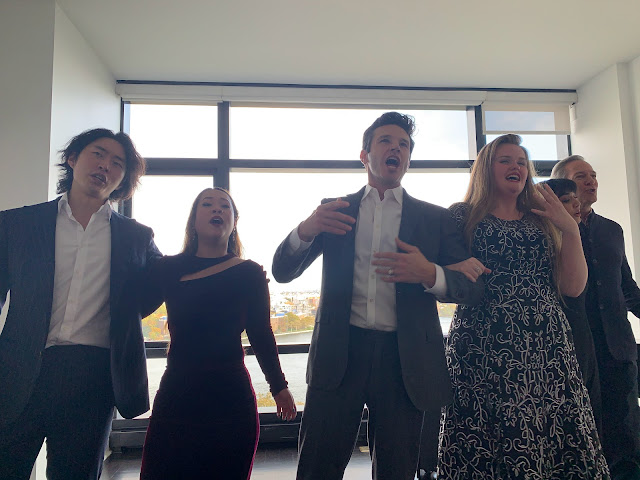
 Donghoon Kang, Yohji Daquio, John Viscardi, Sara Stevens, and Glenn Morton

Not even the stunning view across the East River could distract us from the fabulous French program presented by Classic Lyric Arts. CLA has, at present, summer programs of incomparable value in France, Italy, and The Berkshires, the latter focusing on the operas of Mozart. Graduates of these programs are showing off their acquired skills in theaters all over the world. One thinks of these programs as polishing the gems.

Yesterday's concert shed luminous light on the success of CLA's French program which provides an immersive experience for young singers who wish to up their game in French opera and mélodie. If this concert is accepted as evidence, the summer program in France has accomplished its objective beyond what one might hope for. The French language is notoriously difficult to master, largely due to the vowels, especially the nasal ones, and the necessity for long lines, almost free of the stresses one finds in English.

The program opened with CLA Artistic Director Glenn Morton accompanying Executive Director John Vicardi (a graduate of the programs from some years ago) in a moving performance of Henri Duparc's "Chanson triste". As staged by renowned director Daniel Isengart, the mood was fragrant with tristesse. This was no ordinary concert since each piece was lent dramatic impact and intent which augmented the very fine voices.

The gifted young pianist Xu Cheng accompanied the other singers in a program that seemed all too short. Most memorable were the following:  soprano Yohji Daquio singing Juliette's sparkling aria "Je veux vivre"  (from Gounod's Romeo et Juliette) with every ounce of impassioned young womanhood; baritone Donghoon Kang's  strutting demeanor as he created a formidable Escamillo, from Bizet's Carmen, capturing the hearts of the imaginary Spanish ladies (and perhaps those of the women in the audience as well); soprano Sara Stevens' performance of "Robert, toi que j'aime" from the rarely seen Meyerbeer opera Robert le diable.

We are glad that the collapse of Thaïs (Ms. Daquio) into the arms of Athanaël (Mr. Kang) from Massenet's Thaïs  was followed by the frisky "C'est l'amour" from Louis Ganne's Les Saltimbanques. The first brought us to tears and the second left us grinning from ear to ear.  And who doesn't love a happy ending!

© meche kroop

Tuesday, May 16, 2023

REALISMO ON THE DOCKS


 Eric McKeever as Michele
(photo by Dan Wright Photography)

Giacomo Puccini's Il Trittico comprises three one-act operas. We have seen all three on one long evening and we have seen them separately, often paired with other one-act operas. Recently we have seen Gianni Schicchi , a comedy, and Suor Angelica, a tragedy of victimhood. Last night we saw Il Tabarro, a drama of thwarted love and revenge, presented in riveting fashion by On Site Opera, a company we revere for fitting the opera to the setting,

This has always been the least loved one of the three operas and we confess to not really getting it until last night, staged on the Lightship Ambrose (subbing for a barge), docked at Pier 16 of the South Street Seaport. Singers moved up and down the gangplank carrying heavy loads. Women gathered around the song-seller to acquire the latest sheetmusic. The realism of the setting served to amplify the realismo of the opera. 

As in Leoncavallo's earlier work Pagliacci, a man is rejected by his wife and finds revenge in murder, a story that must have resonated with audiences at the turn of the 20th c.  Come to think of it, one has only to read newspapers to know that the "plot" still exists, although crimes of passion are, in these days, more likely to be accomplished secretly. Fortunately we were not exposed to ridiculous attempts at modernization. Costuming was accurate and served to reinforce the sense of time and place.

Director Laine Rettmer did a superb job of telling the story and Maestro Geoffrey McDonald utilized the smallish orchestra in a manner that supported the singers and yet amplified the emotions of the characters when there was a lull in the singing. Speaking of amplification, we realize it was necessary in a noisy outdoor environment and we credit the sound design for keeping a fine balance. We heard from one of the singers that each singer heard differently and standing in different places often left the singer unaware of the volume. This makes the success doubly impressive. The loss of sound of unamplified voices was more than compensated by the achievement of reality.

Baritone Eric McKeever was outstanding as the captain of the barge, projecting a sense of kindliness both toward the stevedores in his employ and toward his wife, with whom he once shared tender loving moments. He succeeded in arousing our sympathy.  What could be more damaging to a man's sense of masculinity than having his embraces rejected by his wife. 

Soprano Ashley Milanese was fine in this role and also succeeded in arousing our sympathy as she sings of the child that died. Perhaps that was what destroyed the love she once shared with Michele. As she recalls her lovely home in suburban Paris and shares these reminiscences with Luigi, her stevedore lover who came from the same banlieu, we come to appreciate the bond between them and what Luigi represents to her.

The role of Luigi was well handled by tenor Yi Li who struggled with his passion for his boss' wife. Giuseppe Adami's libretto never makes him out to be a villain, just a man led around by his sexual passions who found a partner to return his lust.

With the major roles of this love triangle so effectively portrayed, one could also make note of the success of the subsidiary roles. Jose Heredia injected some humor and fine singing in the role of the bibulous Tinca, one of the stevedores who tries to dance with Georgetta and steps on her toes.

The other stevedore Talpa was sung by Artega Wright who, in contrast with Michele and Georgetta, seems to have a reciprocal relationship with his wife La Frugola, played with marvelous low voice and comic spirit by Sharmay Musacchio. The scene in which she distributes the many treasures of her dumpster diving  served to lighten the atmosphere.

There was a wonderful moment in which the Song Seller distributed sheet music to the gathering milliners and the orchestra played a theme from Puccini's masterwork La Bohême in which we just last week heard Mr. Heredia as Rodolfo! In any event, that Puccini was a clever devil!

Let us now name the members of The Ensemble who contributed so much vocally and dramatically, some of whom we have heard singing at our local conservatories or at competitions. Sopranos Yohji Daquio, Lindsey Kanaga, Theodora Siegel, and Kiena Williams; mezzo sopranos Claire Coven and JoAnna Vladyka; Tenor Daniel Rosenberg; Baritone Paul LaRosa; and bass Brian McQueen.

From the moment the opera began we were totally engaged. There was not a single longueur. It was as if a real event was unrolling before our very eyes and ears. It was an event to remember and cherish.


© meche kroop

Sunday, November 27, 2022

CENTURY OPERA COMPETITION


Manli Deng, Yohji Daquio, Hyunju Ha, Allison Deady, Madison Marie McIntosh, Elizveta Ulakhovich, Jingjing Qi, Caroline Corrales, Rose Kearin, and Samuel White

It's always an exciting event when the finals of a competition are open. We were delighted to have been invited to The Century Opera Voice Competition to hear ten fine young singers. The singers each led off with an aria of their own choosing; then the judges requested another aria from their lists of prepared arias, presumably to learn something new about the singer, perhaps facility in a different style or different language. We enjoyed this rounding out of the picture. 

We do not envy the judges since each young singer offered something valuable. And so, we will not tell you, dear Reader, who won the prizes because they were, in our eyes (and ears) all winners! We will tell about the young artists in the order in which they appeared. 

First on the program was soprano Rose Kearin who did justice to "Ach, ich liebte" from Mozart's Die Entführung aus dem Serail, sung in good crisp German.  We regretted missing Adelaide's Aria from Jonathan Dove's The Enchanted Pig, since we had never heard it before and might never have another opportunity.

Also superb in German was mezzo-soprano Allison Deady who gave a passionate delivery of Octavian's post-coital aria "Wie du warst!" from Strauss' Der Rosenkavalier. Equally fine in Italian, she sang "All'afflitto è dolce il pianto" from Donizetti's Roberto Devereux, meeting the fioritura challenge with grace.

We hadn't heard enough of soprano Caroline Corrales at the Santa Fe Opera when she sang Donna Elvira (in a nun's habit) so we were especially delighted to get a better "listen". Her sizable sound was perfect for Verdi and "Ernani, Ernani involami" was thrilling. Ms. Corrales is an emotional singer and Jenufa's prayer from the Janáček opera of the same name was stirring. We cannot comment on the language because we are completely ignorant of Czech.

"Stridono lassù" from Leoncavallo's  Pagliacci is one of our favorite verismo arias and soprano Manli Deng created a lovely sound world including a delicate trilll. Massenet's Le Cid, however, is not well known by us, but Ms. Deng evinced some fine sounding French in "Pleurez, mes yeux". Her use of dynamics were effective in eliciting emotion.

"Chi il bel sogno di Doretta" from Puccini's La Rondine was a much better choice for soprano Jingjing Qi than "Sleeping Beauty" from Menotti's The Hero. It is difficult enough for native English speakers to sing musically in English! However, there was a heart-stopping decrescendo that tickled the ear.

Soprano Hyunju Ha invested "Ah, non credea mirarti" from Bellini's La Sonnambula with dynamic variety, fine fioritura, and an affecting vibrato. In the exposed passage without piano accompaniment we could appreciate the musicality of her phrasing. Although her second selection was not listed on the program, the choice of Sophie's "Rose Aria" from Der Rosenkavalier came as a delightful surprise, sung with wide-eyed innocence in fine German. They were good choices because they demonstrated her versatility.

Tenor Samuel White was the lone male on the program and he showed his stuff in the "Flower Aria" from Bizet's Carmen and an intense delivery of "Una parola sola..Or son sei mesi",  Ramerrez' aria from Act II of Puccini's Fanciulla del West. Mr. White has a powerful voice and we longed to hear some tenderness in places.

We would like to hear soprano Elizveta Ulakhovich on another occasion. There is a lot o beauty of tone there but her choices did not seem suitable to us. Micaela's "Je dis que rien ne m'épouvant" from Bizet's Carmen requires a singer who can sound like an innocent country girl pushed to the limits of her fearfulness, a sense of "whistling in the dark". It wasn't there. Ms. Ulakhovich projects an air of confident glamor and we could think of far better material for her to sing.

Mezzo-soprano Madison Marie McIntosh, on the other hand, knows exactly where her strengths lay and how to play to them. She has a voice of unusual and exciting timbre with great flexibility in fioritura. "O mio Fernando" from Donizetti's La favorita is the perfect vehicle to show off her finely honed bel canto technique. The judges requested "Un'altra volta ancor" from Händel's Partenope which was just as splendidly performed; however, we would have much preferred to hear Waltraute's aria "Höre mir Sinn was ich dir sage" from Wagner's Götterdammerung. We hope we will have another opportunity.

Finally, soprano Yohji Daquio did get the opportunity to show off her versatility by performing two very different characters, the sprightly Marie from Donizetti's La fille du regiment showing her patriotism in "Salut a la France" with all its fabulous fioritura--and then meeting head on "I am the Wife of Mao Tse-Tung" from Adams' Nixon in China. This aria involves a lot of rage and repetition and it takes a gifted singer to make it interesting. She succeeded. We were floored.

© meche kroop