MISSION

We are here to encourage the development of gifted young singers and to stimulate the growth of New York City's invaluable chamber opera companies. But we will not neglect the Metropolitan Opera either. Get ready for bouquets and brickbats.
Showing posts with label Allison Deady. Show all posts

Sunday, June 9, 2024

GUILTY PLEASURES


 Curtain Call for Guilty Pleasures

Friday night, Dell'Arte Opera Ensemble gave us two one-act pieces that made us think. Last night, they gave us an evening of pure entertainment. Is pure entertainment a guilty pleasure? LOL! We refuse to feel guilty about pleasure. We had a wonderful time, as did our companion. 

We think it's a great idea for opera singers to try their hand at cabaret; the need for gesture and facial expression should serve them well on the opera and concert stage. And from the audience standpoint, it was a real treat to hear the natural voice singing  the kind of music we usually avoid due to an intolerance of amplification.

Every artist was excellent and appreciated by a most enthusiastic audience. Some made a greater impact than others and only one interfered with audience engagement by the use of the loathed music stand. Let us mention a few of our favorite performances.

Mezzo-soprano Allison Deady, so effective as Annie in the previous night' production of Tickets, Please! showed a real flair for Offenbach in "Last night" from Christopher Columbus, an operetta with which we are not familiar and was equally impressive ending the show with the rousing "One Touch of Venus" from the eponymous Kurt Weill show.

From the same show, mezzo-soprano Rachelle Pike performed a sexy rendition of "Speak Low". Earlier in the evening, she delighted us with "Toothbrush Time" by William Bolcom, sharing an interesting anecdote with the audience.

Also from that show, Olivia Ericsson gave an expressive reading of "I'm a Stranger Here Myself", needing only to move around the stage more to take her performance to the next level.

Kaitlyn Tierney scored points for "Good 'n' Evil" from Frank Wildhorn's Jekyll and Hyde. Helen Haas did a great job using gestures and voice to build up to a climax in some French songs that were completely new to us. 

Elizaveta Kozlova, so effective as Anna I  in the prior night's performance of Kurt Weill's The Seven Deadly Sins, showed a completely different side of her artistry, having fun with "Whatever Lola Wants" from Adler and Ross' Damn Yankees. Valerie Filloux's charming performance of a pair of Schoenberg songs from his Brettl-Lieder reminded us that the composer wasn't always atonal. The songs were most accessible.

We enjoyed Thomas Walter's rendition of the "Alabama Song" from Kurt Weill's Mahagonny because he made every verse different. And Maestro Chris Fecteau tossed off an impressively novel arrangement of "Mack the Knife", making the old trite song fresh to our ears.

It was a fun evening and the audience left smiling. What more could one ask for on a Saturday night!

© meche kroop

THE WAGES OF SIN


 Tickets, Please!
(Photo by Brian Long)

Dear Reader!  We are halfway through Dell'Arte Opera Ensemble's exciting Spring season and having a fine time. We would, however, want you to have an even better time than we did, so we urge you to prepare yourself before the upcoming double bill of  Tickets, Please and The Seven Deadly Sins. We make it a point to avoid reading about productions before attending, hoping that the works will speak for themselves. In this case, some preparation would have been helpful.

What we enjoyed at the double bill was some excellent singing and acting and some highly astute direction by Jessica Harika. Maestro David Štech conducted and Maestro Chris Fecteau provided keyboard accompaniment. What was missing was a program with a synopsis. There were no projected titles and one's ability to understand rested heavily on the clarity of each singer's enunciation. The setup was a stage with areas of seats facing each other, somewhat reminiscent of "theater in the round" in which actors are often facing away from you and not clearly audible.

The best preparation for Tickets, Please would be reading the short story with the same title which was contained within D.H. Lawrence's compilation England My England which was published in 1922. Lawrence had plenty to say about the effects of The Great War on British society, particularly about the absence of men on the home front and the masculinization (liberation) of women who were allowed (needed) to take on "man's work". Part III of the story was adapted by Sidney L. Berger and set to some agreeable music by Robert Nelson.

The work is accessible and can be experienced as social commentary with amusing moments and rueful ones. In the past century, the battle for gender dominance has not been won, making the work relevant. A group of women employed as transit workers gang up on their supervisor who has been careless with the affections of Annie (the excellent Allison Deady). The boss John Turner (effectively portrayed by Dicky Dutton is beaten and humiliated by his crew, comprising Rachelle Pike, Sadie Spivey, Helen Sanchez, Kaitlyn Tierney, and Carlyle Quinn. You will have to see for yourself (and we do recommend it) to learn whether Annie gets vindication, or...........

Sunday, November 27, 2022

CENTURY OPERA COMPETITION


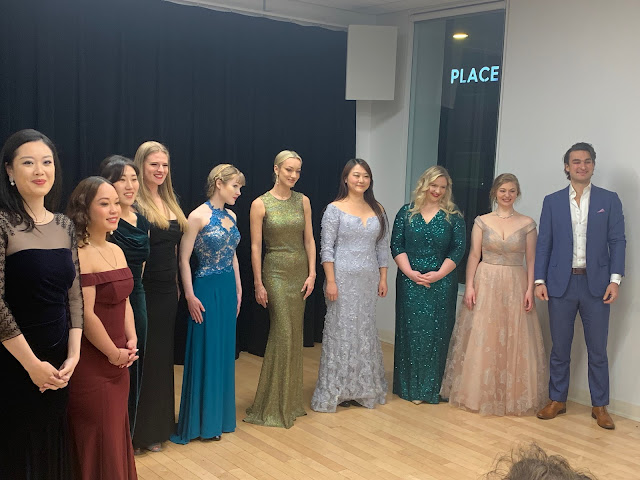
Manli Deng, Yohji Daquio, Hyunju Ha, Allison Deady, Madison Marie McIntosh, Elizveta Ulakhovich, Jingjing Qi, Caroline Corrales, Rose Kearin, and Samuel White

It's always an exciting event when the finals of a competition are open. We were delighted to have been invited to The Century Opera Voice Competition to hear ten fine young singers. The singers each led off with an aria of their own choosing; then the judges requested another aria from their lists of prepared arias, presumably to learn something new about the singer, perhaps facility in a different style or different language. We enjoyed this rounding out of the picture. 

We do not envy the judges since each young singer offered something valuable. And so, we will not tell you, dear Reader, who won the prizes because they were, in our eyes (and ears) all winners! We will tell about the young artists in the order in which they appeared. 

First on the program was soprano Rose Kearin who did justice to "Ach, ich liebte" from Mozart's Die Entführung aus dem Serail, sung in good crisp German.  We regretted missing Adelaide's Aria from Jonathan Dove's The Enchanted Pig, since we had never heard it before and might never have another opportunity.

Also superb in German was mezzo-soprano Allison Deady who gave a passionate delivery of Octavian's post-coital aria "Wie du warst!" from Strauss' Der Rosenkavalier. Equally fine in Italian, she sang "All'afflitto è dolce il pianto" from Donizetti's Roberto Devereux, meeting the fioritura challenge with grace.

We hadn't heard enough of soprano Caroline Corrales at the Santa Fe Opera when she sang Donna Elvira (in a nun's habit) so we were especially delighted to get a better "listen". Her sizable sound was perfect for Verdi and "Ernani, Ernani involami" was thrilling. Ms. Corrales is an emotional singer and Jenufa's prayer from the Janáček opera of the same name was stirring. We cannot comment on the language because we are completely ignorant of Czech.

"Stridono lassù" from Leoncavallo's  Pagliacci is one of our favorite verismo arias and soprano Manli Deng created a lovely sound world including a delicate trilll. Massenet's Le Cid, however, is not well known by us, but Ms. Deng evinced some fine sounding French in "Pleurez, mes yeux". Her use of dynamics were effective in eliciting emotion.

"Chi il bel sogno di Doretta" from Puccini's La Rondine was a much better choice for soprano Jingjing Qi than "Sleeping Beauty" from Menotti's The Hero. It is difficult enough for native English speakers to sing musically in English! However, there was a heart-stopping decrescendo that tickled the ear.

Soprano Hyunju Ha invested "Ah, non credea mirarti" from Bellini's La Sonnambula with dynamic variety, fine fioritura, and an affecting vibrato. In the exposed passage without piano accompaniment we could appreciate the musicality of her phrasing. Although her second selection was not listed on the program, the choice of Sophie's "Rose Aria" from Der Rosenkavalier came as a delightful surprise, sung with wide-eyed innocence in fine German. They were good choices because they demonstrated her versatility.

Tenor Samuel White was the lone male on the program and he showed his stuff in the "Flower Aria" from Bizet's Carmen and an intense delivery of "Una parola sola..Or son sei mesi",  Ramerrez' aria from Act II of Puccini's Fanciulla del West. Mr. White has a powerful voice and we longed to hear some tenderness in places.

We would like to hear soprano Elizveta Ulakhovich on another occasion. There is a lot o beauty of tone there but her choices did not seem suitable to us. Micaela's "Je dis que rien ne m'épouvant" from Bizet's Carmen requires a singer who can sound like an innocent country girl pushed to the limits of her fearfulness, a sense of "whistling in the dark". It wasn't there. Ms. Ulakhovich projects an air of confident glamor and we could think of far better material for her to sing.

Mezzo-soprano Madison Marie McIntosh, on the other hand, knows exactly where her strengths lay and how to play to them. She has a voice of unusual and exciting timbre with great flexibility in fioritura. "O mio Fernando" from Donizetti's La favorita is the perfect vehicle to show off her finely honed bel canto technique. The judges requested "Un'altra volta ancor" from Händel's Partenope which was just as splendidly performed; however, we would have much preferred to hear Waltraute's aria "Höre mir Sinn was ich dir sage" from Wagner's Götterdammerung. We hope we will have another opportunity.

Finally, soprano Yohji Daquio did get the opportunity to show off her versatility by performing two very different characters, the sprightly Marie from Donizetti's La fille du regiment showing her patriotism in "Salut a la France" with all its fabulous fioritura--and then meeting head on "I am the Wife of Mao Tse-Tung" from Adams' Nixon in China. This aria involves a lot of rage and repetition and it takes a gifted singer to make it interesting. She succeeded. We were floored.

© meche kroop