MISSION

We are here to encourage the development of gifted young singers and to stimulate the growth of New York City's invaluable chamber opera companies. But we will not neglect the Metropolitan Opera either. Get ready for bouquets and brickbats.

Sunday, February 19, 2023

2023 GEORGE AND NORA LONDON FOUNDATION COMPETITION FINALS


Pianist Maestro Michael Fennelly, Foundation President John H. Hauser, and finalists in the 2023 Competition

The gracious presence of the late Nora London was greatly missed but we received a warm welcome from John H. Hauser, President of the George and Nora London Foundation. The prizes awarded in this competition are generous and the winners generally go on to great careers. The twelve finalists were of the very highest caliber and the judging must have been extremely difficult. We were glad not to have been among them! We love this competition because all finalists walk away with great honor as well as financial benefit.

If you must know which five of the twelve received the greatest honor, you must look on the foundation's website. We are sure it made a difference to the competitors but to our ears, they were all winners. There seemed to be more large voices this year and also a preponderance of sopranos and tenors with a lone mezzo-soprano, a sole bass-baritone, and a singular counter-tenor.

Regardless of who won the major prizes, several performances suited our taste to the point of lingering in our memory. That they just happen to be three beautiful young women "should" be considered irrelevant but it surely doesn't hurt one's career to be as appealing to the eye as to the ear.

Karoline Podolak put a smile on our face with a spirited performance of "Je suis Titania" from Ambroise Thomas' Mignon. There was charm and expressiveness in spades, utilized to underscore the fioritura which was cleanly delivered. It was altogether enchanting.

No less enchanting was the bright soprano of Erika Bakoff who performed "A vos jeux amis" from Thomas' Hamlet. It seems curious that we have heard very little of Thomas' works and here we got to hear two on the same program. We got to realize how well he writes for young light sopranos! Along with the lovely vocal line, we appreciated a terrific trill and a smoothly descending scale passage.

The role of Sophie in Strauss' Der Rosenkavalier must impress the audience in the same fashion as Sophie herself is impressed by the attention paid her by Count Rofrano as he delivers the silver rose. In this case, Elena Villalon succeeded in conveying innocence and wonder with a sweet coloration to the voice and the assumption of a modest demeanor. It was a completely convincing characterization.

We have been hearing quite a bit of "Aleko's Cavatina" from the Rachmaninoff opera that we have never seen in its entirety. Poor Aleko sings of his despair, his Gypsy wife having fallen for a young man of her own people.  Somehow we were reminded of old King Philips's aria "Ella giammai m'amo" from Verdi's Don Carlo in which the singer must generate sympathy for a murderous man. At this task, bass-baritone William Socolof succeeded admirably  with a carefully modulated performance, generous tone, and exemplary Russian.

Contrasting with the lowest voice in the competition was the highest male voice, that of counter-tenor Aryeh Nussbaum Cohen who performed "Inumano Fratel...Stille Amare" from Händel's Tolomeo in which the eponymous title character believes he has drunk poison and cannot make it through the da capo. Mr. Cohen dazzled with his mastery of this rare fach and it's vocal fireworks. If our opinion inspires you, you can hear his video for yourself on YouTube.

It is always interesting in a competition to be introduced to an aria with which one is unfamiliar but it is an entirely different story when a young singer tackles a very familiar aria. We feel the satisfaction one feels with the familiar but we are looking for something original or different in which the singer tells us something new about the character. Tenor Matthew Cairns took on "La fleur que tu m'avais jetée" from Bizet's Carmen and he did so with full tone and a lovely vocal quality. We particularly admired the dynamic variety and a smooth decrescendo.

Tenor Joseph Sacchi has a large powerful instrument just right for the role of Max in Weber's Die Freischütz. "Durch die Walder, durch die Auen" was performed in clearly enunciated German, augmented by meaningful gesture.

We always enjoy arias more when we understand the words and tenor Jordan Loyd delivered "Inutile regrets" from the final act of Berlioz' Les Troyens in fine French. He employed his fine vibrato to express Énée's despair in an emotional performance.

Another highly emotional performance was that of tenor Ricardo Garcia who put 110% into his portrayal of Lensky facing death in Tchaikovky's Eugene Onegin. The vocal line was lovely and the gestures were Russian in their extravagance.

The only mezzo-soprano on the program, Olivia Johnson gave an expressive performance of "O ma lyre immortelle" from Gounod's Sapho. (The program listed the composer as Massenet and indeed Massenet did write a piece of that name almost a half-century later but we are quite sure that what we heard was from the Gounod.)

The only Puccini aria on the program was from Edgar, about which we know little. Amber Monroe has a sizable soprano with an expressive vibrato put to good use in "Addio mio dolce Amore" sung by the faithful Fidelia.

Perhaps it was the stress of singing first but having heard tenor Alexander McKissic several times in the past, we didn't think we were hearing him at his best in "Se all'impero amici dei" from Mozart's La Clemenza di Tito, sung by the merciful titular character. He sounded best in the pianissimi passages with a lovely legato but as the volume increased his tone sounded rough which did not suit Tito's character. We found ourselves wishing he had not been first on the program.

Splendid accompanying in all these varied styles was provided by Maestro Michael Fennelly.

© meche kroop


Wednesday, February 15, 2023

KING ARTHUR AT JUILLIARD


Juilliard 415 and students from the Marcus Institute for Vocal Arts and Juilliard Drama

(photo by Rachel Papo, courtesy of Juilliard0

What a stunning and worthwhile entertainment! In Henry Purcell's time (17th c.)  King Arthur was called a semi-opera. What shall we call it today in the version we saw at Alice Tully Hall? Whatever we call it, we were enthralled for the duration. As is our wont, we declined to read about it beforehand, the better to allow the work to speak for itself. And it spoke loudly and clearly.

The evening was representative of a successful collaboration between orchestra, storytelling, dramatic enactment, and vocal music. Each element was outstanding  but the melding added up to more than the sum of its parts.

Let us begin with the storytelling. A new script was commissioned by Juilliard, a script that tells the tale of King Arthur--not the legends of the Round Table, but rather the story of King Arthur's defeat of the Saxon King Oswald of Kent as told through the "eyes" of the blind Cornish Princess Emmeline who sees things that the sighted cannot. Oswald had kidnapped Emmeline and Arthur had to defeat the Saxon army to win her back. The script by Margot Connolly is clear and direct and allows the audience to focus on two characters--Emmeline and a Traveler who, like any good interviewer, listens to the story and asks relevant questions.

As Emmeline, Maggie Scrantom was expressive without indulging in histrionics and readily won our sympathy. Clad in elegant garb suggestive of the Middle Ages (no credit for costuming could be found in the program) we had no problem believing her storytelling. As The Traveler, Lark White was similarly convincing. She was dressed in black with a back pack and a sun hat, suggestive of a character that wanders and collects stories.

Ms. Connolly's script went well with Purcell's "programmatic" music. His composition clearly supported battles, festivals, masques, and heathen worship with concomitant horrifying blood sacrifice. (Hello Woden, Thor, and Freya!) Purcell's orchestration utilizes the forces of his orchestra to paint an aural picture.  We figuratively see with our ears, just as Emmeline does. The Frost Scene surely inspired the "Winter" movement of Vivaldi's Four Seasons.

Juilliard415  met the challenge of the music in exemplary fashion. Lionel Meunier was listed in the program as Director, not as Conductor; we surmise that his role went far beyond his dynamic conducting of the musicians. In any case, the performance of this early music ensemble always casts a fine glow on Juilliard's reputation. 

It also produced a wonderful sensation in our ears, which so loved the soft sounds of the wooden instruments--all manner of recorders which appear to have anticipated the flute, and a lovely reeded instrument (perhaps called an hautbois) that seems to have preceded the oboe. There were various string instuments listed in the program as "plucked instruments", the only one of which we recognized as the  theorbo.  And was that mellow brass instrument a natural trumpet? The string section looked far more familiar and was headed by the renowned Robert Mealy.

As far as the vocal music, we are sure Purcell started his musical life as a singer. Only a singer could have written so well for the voice. The work is as thick with melody as a Tchaikovsky symphony, giving the singers an opportunity to show off their impressive vocal skills. Female voices were often gathered at one side of the stage, whilst male voices appeared on the other side. All vocal parts represented supernatural characters, shepherds and shepherdesses, or Roman gods.

These parts were sung by sopranos Song Hee Lee, Erin O'Rourke, and Jazmine Saunders; mezzo-sopranos Lucy Altus, Stephanie Bello,and Lauren Torey; tenors Colin Aikins, Geun-hyeong Han, and Samuel Rosner; baritones Minki Hong and Shavon Lloyd,; and bass-baritone Donghoon Kang.

Consider yourself fortunate if you got to see and hear this rarely performed work in this elegant version. Should we need to find a minor quibble it would be the projections.  Meant to suggest the Medieval settings, the goal was not quite realized; the rear wall of the stage is perforated and unfortunately one could barely make out what was being projected. Nonetheless, it was a magnificent evening.

© meche kroop

Sunday, January 29, 2023

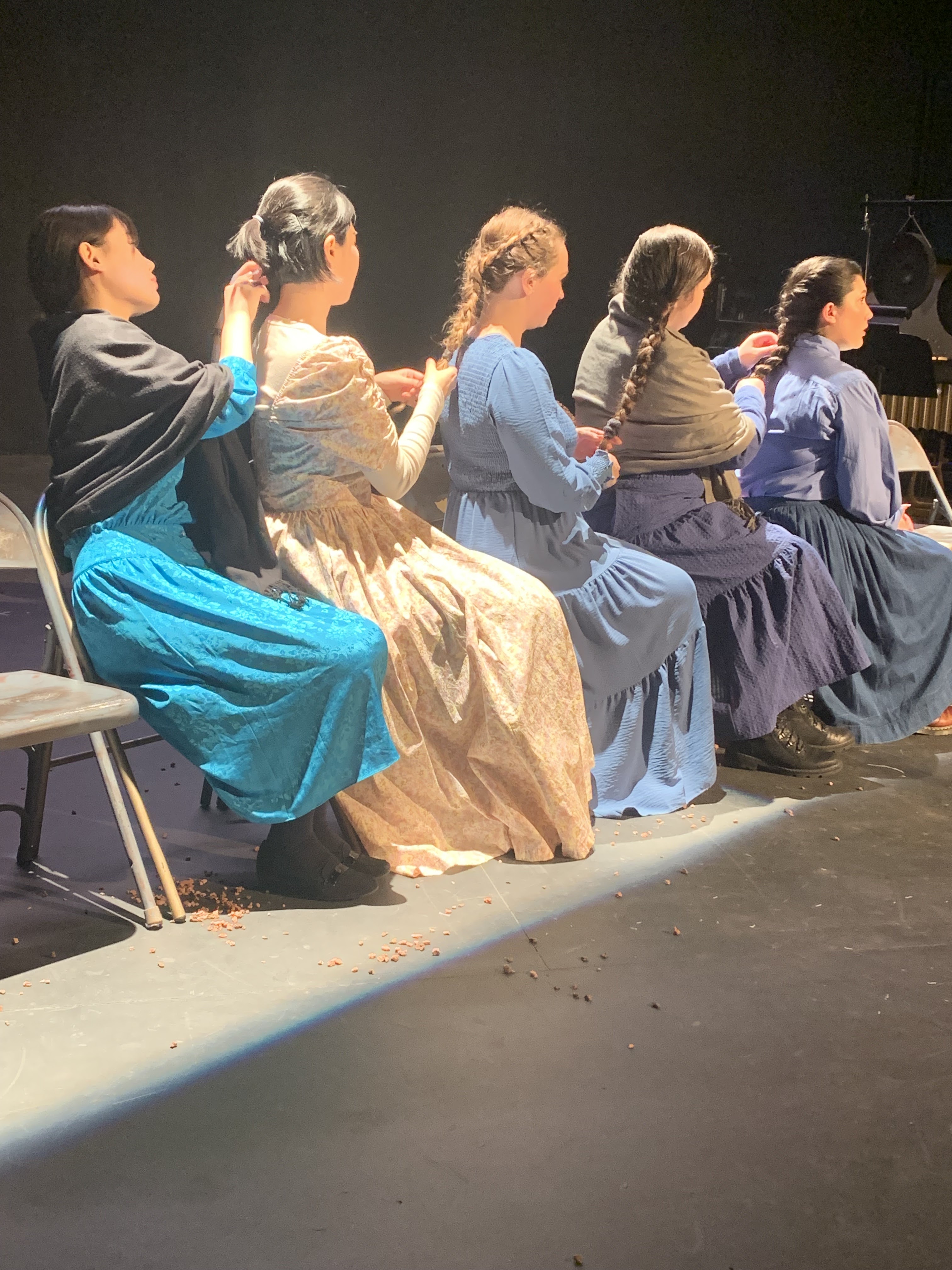
DARK SISTERS


Mannes Opera Students

Although Managing Artistic Director of Mannes Opera Emma Griffin announced the evening as a "workshop" with minimal rehearsals, we thought the production given to Nico Muhly's Dark Sisters was first rate and required no apologies. Laine Rettmer's direction told the story (based on a true event) effectively; Geoffrey McDonald's conducting of the orchestra was up to his customary high standards; the singing of the six women and the lone bass-baritone was exemplary and notable for the clarity of their diction.

The story concerns the effects of the government raid of a compound occupied by  "The Prophet" and his five "sister wives" in which all the children were removed. The opera opens with a disturbing and dissonant orchestral clash followed by the five women lamenting the loss of their children in an interwoven choral episode. Choruses were performed a cappella or with spare accompaniment which we preferred to what sounded to our ears like a mismatch of voice and orchestra.

Although there was some interesting orchestration to be heard, the vocal lines were not among them.  More credit goes to the cast for making music out of Stephen Karam's prosy libretto. We thought this would have made a fine play! However, we did not think the music added to the story in the way that Poulenc's music and libretto (based on a play by Georges Bernanos) complemented and reinforced the storytelling of a different true story--Dialogue des Carmelites.

It is easy to be critical of the beliefs of religions other than one's own but that amounts to throwing stones when one occupies a glass house. Did "The Prophet" truly believe the nonsense he foisted upon his wives? Or was this just another case of men controlling women to suit their own desires.  We couldn't help but think of the animal world in which one male keeps a herd of females for his own insemination.

The way the talented Christopher Lau portrays him manages to sustain a hint of ambiguity.  There is plenty of ambiguity in the women as well. Eliza (well portrayed in the Saturday night cast by Sofia Durante) is the rebel in the group and uses her feminine wiles to blow the whistle on The Prophet. As the seriously troubled Ruth, Ziwan Nie was nearly mute but heartbreaking. The other women kept up the pious front and vied for the "favors" of The Prophet, probably brainwashed into believing the need to "stay sweet", a euphemism for obedience and submission. There was plenty of female "cattiness" and rivalry as one might expect. A parallel might be drawn with the complex households in ancient China in which there were several wives, often sold into what amounted to sexual slavery at a very tender age.

Mr. Lau had another role as a TV reporter, sitting in front of a photo of the Utah red rocks and interviewing the women who responded in unison as they had been brainwashed to do.  To his credit, he colored his voice differently and altered his posture for this secondary role.

The other women in the cast were equally fine, including India Rowland, Emily 
Summers, Joohyun Kim, and Carolyn Boulay.

The orchestral music, whilst not particularly melodic, offered some fine solos and duets for instruments of which we are very fond--English Horn and Bass Clarinet, not to mention the cello, harp, and percussion. No credit for costuming was given but the women looked appropriately inhibited in long drab garments and clunky boots.

© meche kroop

A WINTER NIGHT AT THE OPERA


 Eric Sedgwick, Julio Mascaro, and Daniela Yurrita

Your self-styled opera critic, Dear Reader, has strong opinions that not all of you will agree with. There are opera lovers that focus on the minutiae of vocal technique and get all bent out of shape if a note is a trifle sharp or flat, or if the soprano interpolates a higher note than is written, just because she can. (We actually read an entire argument on this point in a youtube of a performance by a famous soprano, who shall remain nameless.)

We, on the other hand, come to the opera to be entertained. No matter how exquisite the singing is (and last night's concert of arias certainly did have some exquisite singing) we want to be transported to another time and place by believable characters, inhabited by artists who share our predilection. This is, of course, easier to achieve on the stage of an opera house with the help of sets and costumes. To do so in a recital is far more difficult, and yet it can be done.
 
Our passion for opera was preceded by a passion for theater and this verisimilitude is essential for us to enjoy an aria or duet. We have seen and heard some very famous artists stand in front of a full orchestra to "deliver" an aria with admirable vocal perfection. These events were not really "performances" and likely were not meant to be; still, they left us cold.

In a highly satisfying concert of arias we attended at St. John's in the Village, well known for providing a home for such concerts (a few of which we produced B.C.), our highest expectations were met. A pair of young artists sang with such involvement in their characters that we were drawn into the operatic scenes they were creating as if they were in costume and immersed in a set.

When rising star soprano Daniel Yurrita and terrific tenor Julio Mascaro sang a few selections from Donizetti's L'elisir d'amore, there was plenty of time to develop the characters of Adina and Nemorino. Both the center aisle of the sanctuary and the side door were employed to show their comings and goings. "Una parola Adina" gave the pair an opportunity to illuminate their individual characters as well as to establish their one-sided relationship with one another.  In "Una furtiva lagrima" we could feel Nemorina's elation as he realizes Adina's underlying affection for him. By the time Adina gives us "Prendi, per me sei libero" our heart was filled with joy for the success of their relationship.

A different slant on the independent woman was created by Ms. Yurrita as Manon in "Je marche sur tous les chemins...Obeissons" and Mr. Mascaro was similarly convincing as the love-stricken des Grieux  in "En fermant les yeux".

This made his creation of the elderly Don Ottavio even more impressive. All of his paternal caring for Donna Anna came across in the devilishly difficult "Il mio tesoro" from Mozart's Don Giovanni. Similarly Ms. Yurrita changed from the world conquering Manon to the despairing Pamina in "Ach, ich fühl's" from Mozart's Die Zauberflöte.

An entirely different set of emotions were conveyed in the tragic final duet from Verdi's La Traviata. In"Parigi o cara", Violetta is hopeful to the point of delusion and poor Alfredo is both grieving and ashamed.

Another set of emotions were limned in a charming selection from Torroba's Luisa Fernanda, one of our favorite zarzuelas. "Caballero del alto plumero" is a featherweight flirtation with the most memorable melody involving a turn that has become a dangerous "ear worm".

We haven't even gotten to the elation of "Maria" from Bernstein's West Side Story in which Mr. Mascaro differentially colored each iteration of his beloved's name. And how about the quieter romanticism of "Un aura amorosa"!

The evening comprised even more delights but we think you, Dear Reader, will get the point. Every emotion was covered from ecstasy to despair! So, how was this magic achieved? Much of it with vocal coloration but also with full use of the performing area, bodily freedom, facial expression, and minimal props. This is artistry!

For once, we have not a single criticism of the vocalism which was always used to develop character, rather than for show. We particularly admire the way bel canto style was used to convey character. Accompanying on the piano was the superbly versatile Eric Sedgwick.

©meche kroop


Monday, January 23, 2023

OPERA INDEX HONORS JAMES MORRIS

Last night at the Metropolitan Club, Opera Index honored legendary bass-baritone James Morris with a Lifetime Achievement Award--and who would deserve this more than the only Wotan in our memory who showed us the complexities of this character as we needed to see them. Of course, Mr. Morris' biography is an impressive and lengthy one but that is how we wish to remember him. Mr. Morris' "third act" is coaching young artists and we can tell you, Dear Reader, how many young artists have shared with us the incredible value received from his tutelage.

The evening was led by Opera Index President Jane Shaulis who herself had a legendary career and who now does so much to benefit young artists. Speeches were given, toasts were raised, and the room rang with applause. After the lengthy Covid related "intermission" this was a golden opportunity for a gathering of the tribe and we were overjoyed to see so many familiar faces. But let's get to the stellar entertainment!


Donghoon Kang, Moises Salazar, Chuanyuan Liu, Vladyslav Buialskyi, Siphokazi Molteno, and Le Bu

From among 350 applicants for the Opera Index awards, 29 finalists were chosen, and 19 winners received $74,500. in prize money provided by foundations and individually sponsored awards. We can only imagine the tough job tackled by the judges to narrow down such a wealth of talent. Guests at the gala were privileged to hear eight of the winners and thankfully, dinner was not served until after the performances. To tell the truth, we felt so satisfied by the entertainment we experienced no need for food. Maybe we should share this information with those who are trying to lose weight. Feed the ears!  Feed the soul!  Not the belly.

Opening the program was magnificent mezzo Maggie Renée who moved around the audience seducing us with a spirited  "Seguidilla" from Bizet's Carmen. It is quite a special gift to combine a rich mezzo tone with technical aplomb and firm dramatic instincts! 

Ms. Renée was not the only artist to use the entire space of the room. Ukrainian bass-baritone Vladyslav Buialskyi achieved dramatic realism in his valid portrayal of Figaro in Mozart's Nozze di Figaro, as he opens the fourth wall and addresses the audience in "Aprite un po' quegli occhi". With superb vocalism he created a character in such a sure manner that the entire scene came to mind.

It was surely a night for the bass-baritone and it came as no surprise to learn that Le Bu studies with Mr. Morris. Winner of countless awards, Mr. Bu is firmly stage ready and can look forward to inheriting Mr. Morris' roles. Tackling the moving expression of Procido's patriotism in "O tu Palermo" from Verdi's I vespri siciliani, he got everything right--a stellar performance in every respect. 

Since we are now in the midst of celebrating the Lunar New Year, it gave us pleasure to have three Asian artists on the program--and all from different fachs. Chinese countertenor Chuanyuan Liu brought out every subtlety of the fioritura in "Si, la voglio e la ottero" from Händel's Serse. The plot is as elaborate as the fioritura but, truth to tell, we appreciate the latter more than the former, especially when delivered with pinpoint accuracy and fine flexibility as it was by Mr. Liu. What would countertenors do, were it not for Händel and his crazy plots!

We heard more French from South Korean baritone Donghoon Kang who performed "Riez! Allez! Riez du pauvre ideologue" in which Sancho Panza defends his poor confused master in Massenet's Don Quichotte. Mr. Kang effectively employed variation in dynamics and expansive expression to achieve emotional impact--another fine performance. 

Yet another admirable actor took the stage in the "Chanson de Kleinzach" from Offenbach's Les Contes d'Hoffman.  Mexican tenor Moises Salazar is quite the storyteller and held us as spellbound as the character does to his audience in the opera. He colored every phrase with such dramatic interest that we almost missed noting the superb vocal qualities of his artistry.

The beautifully textured vocal quality of South African mezzo-soprano Siphokazi Molteno was also accompanied by firm dramatic intent as she portrayed the seductive Dalila in Camille Saint-Saëns'  Samson et Dalila. We have often heard "Mon coeur s'ouvre à ta voix" and indeed, it was our introduction to the Metropolitan Opera with Marilyn Horne as the doomed gypsy. It would be fair to say that in between that performance and Ms. Molteno's we have not enjoyed it as much.

We hear less French opera than we do Italian and were delighted to hear tenor Philippe L'Esperance perform Faust's serenade to Marguerite from Gounod's eponymous opera. Between Ms. Renée, Ms. Molteno, and Mr. L'Esperance we heard a lot of seduction in one night. Mr. L'Esperance's sweet tenor was well employed with some fine phrasing and Gallic style.

We did not get to hear all of the Opera Index winners but we are quite sure that the quality was equivalent. Young talent deserves our backing as well as our appreciation.  We hail the stars of tomorrow!

© meche kroop


Wednesday, December 21, 2022

COMFORT YE!


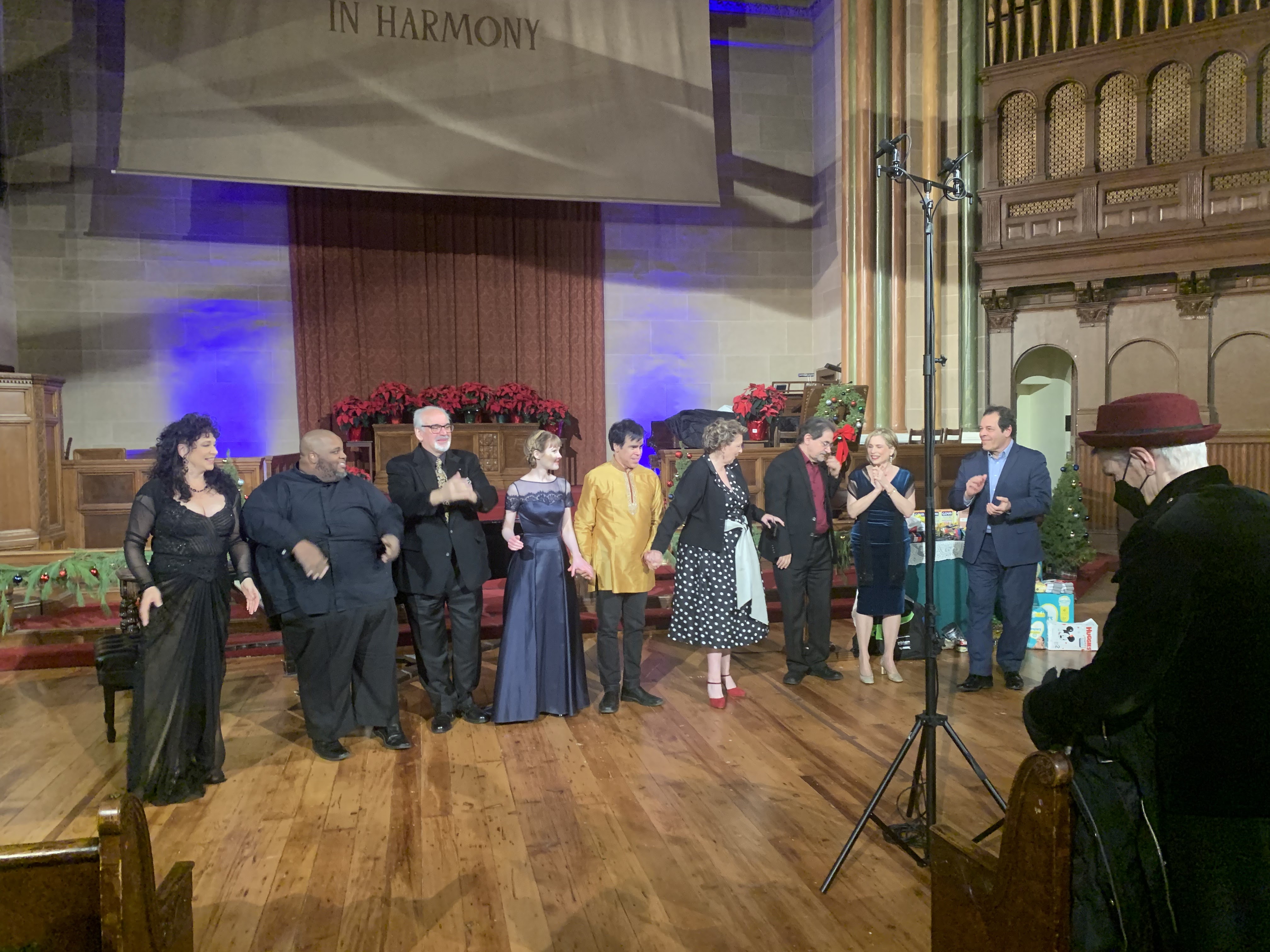
 Elizabeth Blancke-Biggs, Limmie Pulliam, Michael Recchiuti, Madison Marie McIntosh, Kamal Khan, Lauren Flanigan, John Musto, Amy Burton, and Philip Cokorinos

For a couple of decades or more, star soprano Lauren Flanigan has brought Comfort Ye to opera loving New Yorkers. We are happy to help support Ms. Flanigans's worthy initiative of helping the underserved members of our community with food, clothing, diapers, toys, and other essentials. The recipients of the donated  goods and money may change from year to year but one always knows the donations will go to a good place. In return, audience members get to hear some stunning arias sung by world class singers. One might call this annual event "Lauren and Friends". It is an event we look forward to every December and greatly missed during Covid.

The evening always begins with the selection "Comfort ye...Ev'ry valley" from Händel's Messiah. This year it was sung by the tenoriffic Won Whi Choi whose voice we have been enjoying for several years. It was thrilling to hear his voice open up for "La donna é mobile" from Verdi's Rigoletto. We love versatility and hearing an artist alter the color of his voice to suit the character. Mr. Choi is such a gentle fellow that his creation of the character of the licentious Duke was impressive.

Another favorite singer of ours, rising star mezzo-soprano Madison Marie McIntosh, swept us away with a most romantic performance of "O mio Fernando" from Donizetti's La Favorita. The fioritura was consistently on point and the cabaletta appropriately exciting. We liked the way she made use of the entire playing area and employed generous gestures to create the character of  Leonora.

Ms. Flanigan herself gave a powerhouse performance of "Do not utter a word, Anatol" from Barber's Vanessa. The richness of her voice is matched by the intensity of her characterization; we have never heard her give a performance that was less than riveting.

Chilling is the word that comes to mind when describing soprano Meigui Zhang's creation of the character of Lucia in the Donizetti opera Lucia de Lammermoor. In Act I, the soprano has to reveal the unbalanced nature of Lucia's character in order to account for the bloody act at the end of the opera. Donizetti has given the soprano plenty to work with and Ms. Zhang's facility with fioritura made the most of it. We loved the fact that the vocal line of every verse was differentially embellished. There was no problem understanding that Lucia was hallucinating even if you didn't understand Italian. We were made to see through her eyes!

Speaking of character creation, could one imagine a slimier Don Basilio than the one created by bass Philip Cokorinos? We cannot!  "La calunnia" is a standout character aria in Rossini's Il barbiere di Siviglia and demands a singer who can act.  Mr. Cokorinos milked every single word of the clever lyrics with varying coloration accompanied by facial expression and gesture.

Another artist  that took our breath away was baritone Sidney Outlaw. His artistic toolbox is complete. It wasn't until he sang "Sweet Little Jesus Boy" a capella that we realized (or maybe imagined) that his singing career began with gospel singing. We heard subtle things that one cannot quite hear with accompaniment. Surely those subtleties affected his performance of "Mein Sehnen, mein Wähnen" from Korngold's Die Tote Stadt. There was a delicately drawn out "n" at the end of "sehnen"  that emphasized the longing of the character. Then, there was that final spun out "züruck" that went right to the heart. These are the subtleties that elevate a great performance into a sensational one that lingers in the memory.

Also deeply touching was soprano Mikayla Sager's delivery of Desdemona's final prayer from Verdi's Otello. Ms. Sager has a sizable soprano but can color the words to show her character's desperation, also making use of dynamic variation. It was touching and gripping at the same time.

Verdi was so adept at limning female characters and soprano Elizabeth Blancke-Biggs, accompanied by Michael Recchiuti, created a chilling Lady McBeth in "La luce langue". She was so convincing in her nastiness, conniving,  and manipulativeness that we couldn't believe her pleasant demeanor when the performance ended. We actually felt afraid of her!  Now that's another fine example of using technique to create character!

"Doppo notte" from Händel's Ariodante offers plenty of opportunity for fioritura and we enjoyed the performance of Sarah Nelson Craft as the jubilant title character celebrates some good news. There was some cross-over as well; she sang "Have Yourself a Merry Little Christmas" as an art song, with liquid tone, variety from one verse to the next, and delightful personality.

That wasn't the only cross-over on the program.  Accompanied by John Musto, soprano Amy Burton delighted the audience with Irving Berlin's "Let's Face the Music and Dance" and "Our Love is Here to Stay" by George Gershwin.

There were two artists on the program who were new to us. The very charming mezzo-soprano Sihpokazi Molteno gave a lovely performance of Charlotte's "Va!...laissez couler mes larmes" from Massenet's Werther. This is a rich and potent voice that she colored with grief. The big surprise, however, was an aria from a Zulu opera called Princess Magogo by M. Khumalo. We didn't know that Africa had an operatic tradition so this was a real eye-opener. The language is, of course, quite foreign to our ears and makes use of an unusual sound that Ms. Molteno told me is called a. "q" and which we have been trying to recreate for the past 24 hours without success! Nonetheless, it was lovely.

The other artist new to us is tenor Limmie Pulliam who had just gone on as Radames at the Metropolitan Opera. This artist has a set of pipes and the unmistakeable sound of a great Verdi tenor. We are not going to make comparisons or tell you whose voice came to mind but once heard, it will be remembered. It is a rich and sweet instrument with a very round sound and admirable phrasing. We'd like to see him without the loathed music stand that stood in the way of communicating with the audience but one could admire the voice with eyes closed.

Ms. Flanigan closed the evening with Ned Rorem's "See How They Love Me" and Ricky Ian Gordon's tango inflected  "I Understand You Coyotes", the text of which was delivered as only Ms. Flanigan can do.

Before ending we would like to give a shot to the admirable accompanist who brought everything together, matching each singer color for color. With the exception of Ms. Blanke-Biggs and Ms. Burton he gave splendid support to all the singers.  And he did something else. He called attention to the fact that so many of Verdi's operas deal with life's injustices and addresses the victims of oppression. We love when someone gives us something to chew on! We have always loved Verdi's music but never gave a thought to the stories he chose to tell. Thank you Kamal Khan!

© meche kroop

Sunday, December 18, 2022

SO MUCH TALENT!

t

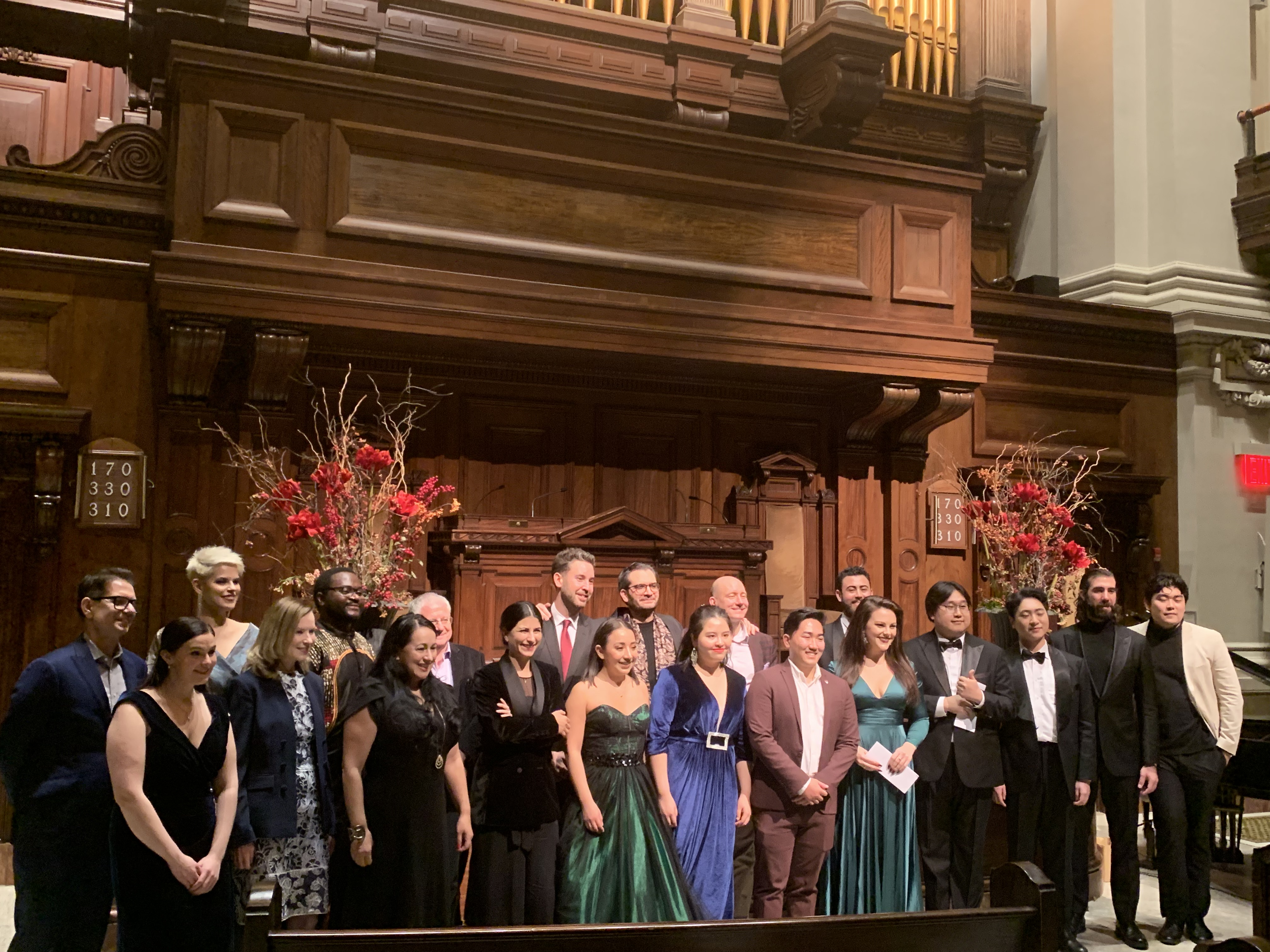
 Singers and Judges at Premiere Opera Foundation Vocal Competition Finals

We can't decide whether it is worse to be a competitor in a vocal competition or one of the judges. The former have to deal with anxiety and the latter, with making difficult decisions. We do not envy either! But being in the audience is a real treat; one gets to hear the finest young talent taking their shot for the big prize. After all, these 14 supremely gifted young singers are the result of a difficult winnowing process, having been chosen from 150 applicants. The Premiere Opera Foundation is unique in that winners receive not only prize money but also the opportunity to be heard by those who may hire them. It seems to be a win-win situation.

As is our wont, we will not tell you who won which prizes; to our ears they were all winners. As far as vocal technique, all were top notch. Most seemed to have a knack for choosing arias that showed off their versatility. And some of them managed to evoke the entire scene of their chosen aria without benefit of costume and scenery.

We will not pick apart each performance but rather try to come up with what is unique about each singer and we will do that in the order in which they sang. The way the competition was organized, each singer performed an aria and then, after 14 performances, each artist got a second chance to perform a different aria; so we got a fairly decent idea of their versatility. All were accompanied by the able pianist Michael Fennelly who seemed to have a knack for coloring each aria in much the same way as the singer did. This is the great mystery of artistic performance.  How do they do that????

We also wondered how the singers chose their arias. To choose an aria that is commonly sung puts the singer in competition with all the greats who have sung that aria before. What a challenge to make one's performance stand out, to bring something new to the interpretation!  On the other hand, to choose an unknown or rarely heard aria presents its own challenges.

Leading off the program was the sweet voiced tenor Randy Ho who brought exuberance to "Ah!  Mes amis" from Donizetti's  La Fille du Regiment and tenderness to "Dies bildnis ist bezaubernd schön" from Mozart's Die Zauberflöte He made the well-rehearsed gestures seem organic and spontaneous.

British mezzo-soprano Christine Byrne limned the character of Isabella in "Cruda sorte!" from Rossini's L'italiana in Algeri  by means of a richly textured instrument, which she also did as the doomed but peaceful Fenena in the lesser known aria "Oh! dischiuso è il firmamento" from Verdi's Nabucco.

Chinese soprano Yujin Zeng exhibited a lovely coloratura in "Ah! non credea mirarti..."Ah! non giunge" with a pleasing switch from a lovely legato to some fine fioritura in the cabaletta. There was a nice contrast with "Ach, ich fühl's" from Mozart's Die Zauberflöte. We wanted to bring Mr. Ho back onstage to do a Pamina/Tamino duet!

Chinese bass William Guanbo Su, long known to us, astonished us with his vocal growth in a forceful performance of "Quand la flamme de l'amour" from Bizet's La Jolie fille de Perth which was topped by "La calunnia" from Rossini's Il barbiere di Siviglia, a circumstance in which we preferred hearing something familiar done in a more character driven way than we have heard it before.

Kenyan tenor Lawrence Barasa Kiharangwa exhibited an ample tone in "Se all'impero amici" from Mozart's La clemenza di Tito successfully conveying the emperor's generous nature. Showing another aspect of his fine instrument, he injected all the requisite enthusiasm in Alfredo's Act II aria "De' miei bollenti spiriti...Oh mio rimorso" from Verdi's La traviata.

Chinese soprano Siyi Yan accomplished the miracle of making the clever English text of "Glitter and Be Gay" from Bernstein's Candide completely comprehensible, so unusual in that very high register. She made use of lots of gesture with each and every word. "Caro nome" from Verdi's Rigoletto was given the same highly dramatic treatment.

Mexican mezzo-soprano Rosario Hernandez Armas, well known by us and oft-reviewed, gave a touching performance of Leonora's aria "O mio Fernando" from Donizetti's La favorita. This was matched or even exceeded by the fiery "Smanie implacabili" from Mozart's Cosi fan tutte, revealing how Mozart used the vocal line to limn the character of Dorabella.

South Korean baritone Minki Hong gave a successful portrayal of the angry Ford from Verdi's Falstaff in "E sogno? O realta" which was a nice balance with the lyrical "Vision fugitive" from Massenet's Hérodiade, sung in fine French.

Soprano Avery Boettcher let out all the stops in her portrayal of the angry Donna Elvira (oh how we love those angry characters) in "In quali eccessi o numi...Mi trade quell'alma ingrata" from Mozart's Don Giovanni, letting us see the drama queen nature of the character. This was balanced by the wistful Nedda singing "Stridono lassu" from Leoncavallo's Pagliacci.

South Korean baritone Yeongtaek Yang brought humor to "Largo al factotum" from Rossini's Il barbiere di Siviglia and serious intent to "Nemico della patria" from Giordano's Andrea Chenier, successfully demonstrating his impressive versatility.

Tenor Anthony Ciaramitaro also showed versatility, choosing a strong Verdi character (Riccardo/Gustavo) from Un ballo in maschera singing "Ma se m'e forza perderti" with sorrowful renunciation and then singing the lighter role of Nemerino in "Una furtive lagrima" from Donizetti's L'elisir d'amore.

Cuban baritone Eleomar Cuello Calles performed "Mein sehnen mein wähnen" from Korngold's Die tote Stadt in the most perfect German we have heard from a non native German. It seemed a miracle that every vowel was given full value and every consonant was crisply enunciated. (Regular readers know how irritated we get when American singers maul the "ich" and the umlauts.) In Riccardo's aria "Ah per sempre" from Bellini's I Puritani, we heard a different style (bel canto) but much the same mood of romantic longing and disappointment.

Soprano Chelsea Lehnea tore up the stage with Violetta's Act I scene from Verdi's La traviata.  "È strano...Sempre libera" is a supreme challenge for any soprano who must show the heroine's ambivalence. The challenge was totally met in a way that far overshadowed her later performance of "I Can Smell the Sea Air" from Previn's A Streetcar Named Desire.

Canadian bass-baritone Vartan Gabrielian took command of the role of Banquo in "Come dal ciel precipita" from Verdi's Macbeth, successfully conveying the ominous mood. Aleko's Cavatina from Rachmaninoff's eponymous opera also deals with betrayal and we think Mr. Gabrielian is very good at conveying that, not from personal experience we hope!

It was such an exciting afternoon that we didn't want it to end. We are anticipating success for all of these gifted young artists and hope to see them all onstage again in the near future.

© meche kroop