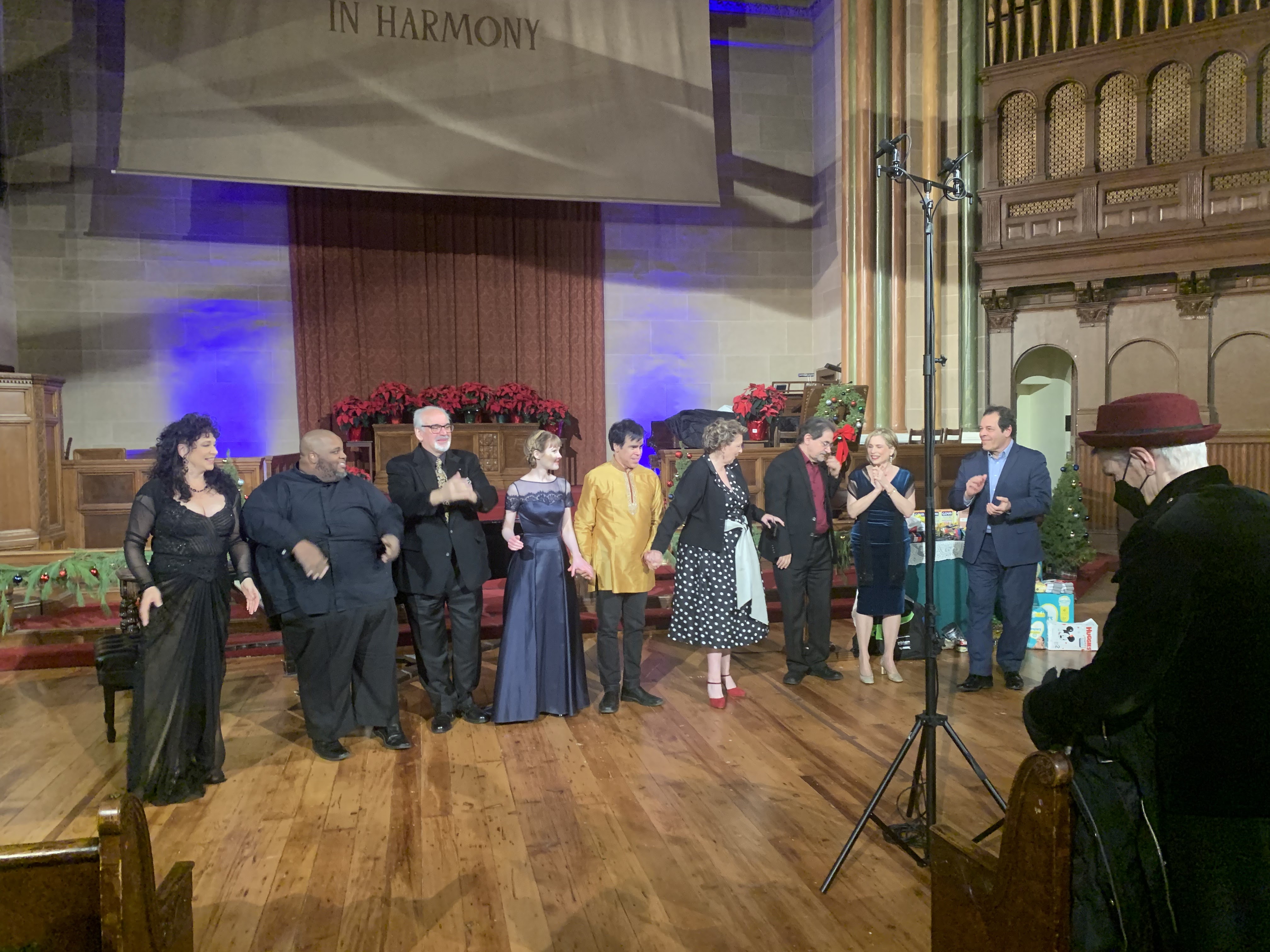
Elizabeth Blancke-Biggs, Limmie Pulliam, Michael Recchiuti, Madison Marie McIntosh, Kamal Khan, Lauren Flanigan, John Musto, Amy Burton, and Philip Cokorinos
For a couple of decades or more, star soprano Lauren Flanigan has brought Comfort Ye to opera loving New Yorkers. We are happy to help support Ms. Flanigans's worthy initiative of helping the underserved members of our community with food, clothing, diapers, toys, and other essentials. The recipients of the donated goods and money may change from year to year but one always knows the donations will go to a good place. In return, audience members get to hear some stunning arias sung by world class singers. One might call this annual event "Lauren and Friends". It is an event we look forward to every December and greatly missed during Covid.
The evening always begins with the selection "Comfort ye...Ev'ry valley" from Händel's Messiah. This year it was sung by the tenoriffic Won Whi Choi whose voice we have been enjoying for several years. It was thrilling to hear his voice open up for "La donna é mobile" from Verdi's Rigoletto. We love versatility and hearing an artist alter the color of his voice to suit the character. Mr. Choi is such a gentle fellow that his creation of the character of the licentious Duke was impressive.
Another favorite singer of ours, rising star mezzo-soprano Madison Marie McIntosh, swept us away with a most romantic performance of "O mio Fernando" from Donizetti's La Favorita. The fioritura was consistently on point and the cabaletta appropriately exciting. We liked the way she made use of the entire playing area and employed generous gestures to create the character of Leonora.
Ms. Flanigan herself gave a powerhouse performance of "Do not utter a word, Anatol" from Barber's Vanessa. The richness of her voice is matched by the intensity of her characterization; we have never heard her give a performance that was less than riveting.
Chilling is the word that comes to mind when describing soprano Meigui Zhang's creation of the character of Lucia in the Donizetti opera Lucia de Lammermoor. In Act I, the soprano has to reveal the unbalanced nature of Lucia's character in order to account for the bloody act at the end of the opera. Donizetti has given the soprano plenty to work with and Ms. Zhang's facility with fioritura made the most of it. We loved the fact that the vocal line of every verse was differentially embellished. There was no problem understanding that Lucia was hallucinating even if you didn't understand Italian. We were made to see through her eyes!
Speaking of character creation, could one imagine a slimier Don Basilio than the one created by bass Philip Cokorinos? We cannot! "La calunnia" is a standout character aria in Rossini's Il barbiere di Siviglia and demands a singer who can act. Mr. Cokorinos milked every single word of the clever lyrics with varying coloration accompanied by facial expression and gesture.
Another artist that took our breath away was baritone Sidney Outlaw. His artistic toolbox is complete. It wasn't until he sang "Sweet Little Jesus Boy" a capella that we realized (or maybe imagined) that his singing career began with gospel singing. We heard subtle things that one cannot quite hear with accompaniment. Surely those subtleties affected his performance of "Mein Sehnen, mein Wähnen" from Korngold's Die Tote Stadt. There was a delicately drawn out "n" at the end of "sehnen" that emphasized the longing of the character. Then, there was that final spun out "züruck" that went right to the heart. These are the subtleties that elevate a great performance into a sensational one that lingers in the memory.
Also deeply touching was soprano Mikayla Sager's delivery of Desdemona's final prayer from Verdi's Otello. Ms. Sager has a sizable soprano but can color the words to show her character's desperation, also making use of dynamic variation. It was touching and gripping at the same time.
Verdi was so adept at limning female characters and soprano Elizabeth Blancke-Biggs, accompanied by Michael Recchiuti, created a chilling Lady McBeth in "La luce langue". She was so convincing in her nastiness, conniving, and manipulativeness that we couldn't believe her pleasant demeanor when the performance ended. We actually felt afraid of her! Now that's another fine example of using technique to create character!
"Doppo notte" from Händel's Ariodante offers plenty of opportunity for fioritura and we enjoyed the performance of Sarah Nelson Craft as the jubilant title character celebrates some good news. There was some cross-over as well; she sang "Have Yourself a Merry Little Christmas" as an art song, with liquid tone, variety from one verse to the next, and delightful personality.
That wasn't the only cross-over on the program. Accompanied by John Musto, soprano Amy Burton delighted the audience with Irving Berlin's "Let's Face the Music and Dance" and "Our Love is Here to Stay" by George Gershwin.
There were two artists on the program who were new to us. The very charming mezzo-soprano Sihpokazi Molteno gave a lovely performance of Charlotte's "Va!...laissez couler mes larmes" from Massenet's Werther. This is a rich and potent voice that she colored with grief. The big surprise, however, was an aria from a Zulu opera called Princess Magogo by M. Khumalo. We didn't know that Africa had an operatic tradition so this was a real eye-opener. The language is, of course, quite foreign to our ears and makes use of an unusual sound that Ms. Molteno told me is called a. "q" and which we have been trying to recreate for the past 24 hours without success! Nonetheless, it was lovely.
The other artist new to us is tenor Limmie Pulliam who had just gone on as Radames at the Metropolitan Opera. This artist has a set of pipes and the unmistakeable sound of a great Verdi tenor. We are not going to make comparisons or tell you whose voice came to mind but once heard, it will be remembered. It is a rich and sweet instrument with a very round sound and admirable phrasing. We'd like to see him without the loathed music stand that stood in the way of communicating with the audience but one could admire the voice with eyes closed.
Ms. Flanigan closed the evening with Ned Rorem's "See How They Love Me" and Ricky Ian Gordon's tango inflected "I Understand You Coyotes", the text of which was delivered as only Ms. Flanigan can do.
Before ending we would like to give a shot to the admirable accompanist who brought everything together, matching each singer color for color. With the exception of Ms. Blanke-Biggs and Ms. Burton he gave splendid support to all the singers. And he did something else. He called attention to the fact that so many of Verdi's operas deal with life's injustices and addresses the victims of oppression. We love when someone gives us something to chew on! We have always loved Verdi's music but never gave a thought to the stories he chose to tell. Thank you Kamal Khan!
© meche kroop


