MISSION

We are here to encourage the development of gifted young singers and to stimulate the growth of New York City's invaluable chamber opera companies. But we will not neglect the Metropolitan Opera either. Get ready for bouquets and brickbats.
Showing posts with label Won Whi Choi. Show all posts

Wednesday, December 21, 2022

COMFORT YE!


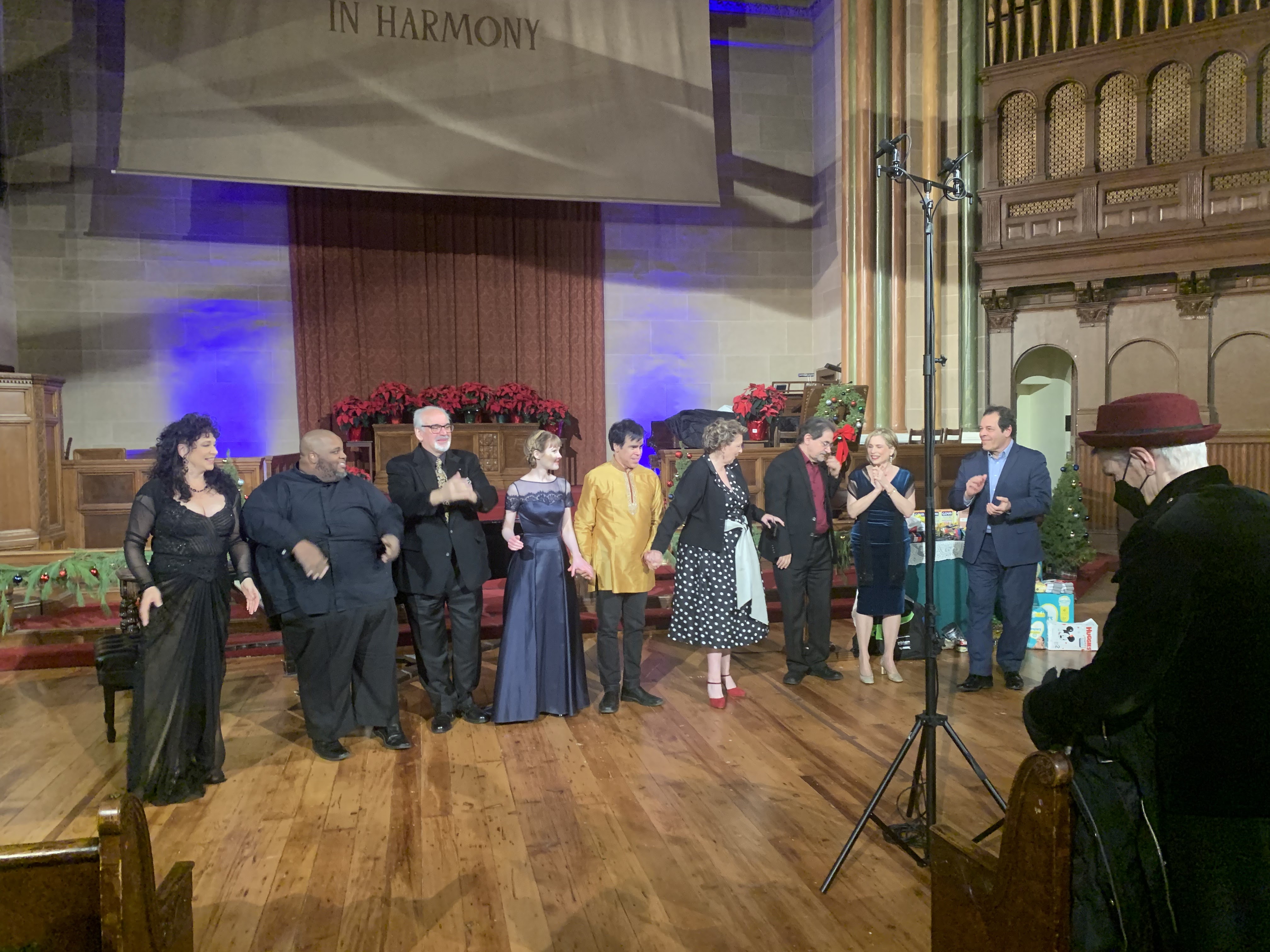
 Elizabeth Blancke-Biggs, Limmie Pulliam, Michael Recchiuti, Madison Marie McIntosh, Kamal Khan, Lauren Flanigan, John Musto, Amy Burton, and Philip Cokorinos

For a couple of decades or more, star soprano Lauren Flanigan has brought Comfort Ye to opera loving New Yorkers. We are happy to help support Ms. Flanigans's worthy initiative of helping the underserved members of our community with food, clothing, diapers, toys, and other essentials. The recipients of the donated  goods and money may change from year to year but one always knows the donations will go to a good place. In return, audience members get to hear some stunning arias sung by world class singers. One might call this annual event "Lauren and Friends". It is an event we look forward to every December and greatly missed during Covid.

The evening always begins with the selection "Comfort ye...Ev'ry valley" from Händel's Messiah. This year it was sung by the tenoriffic Won Whi Choi whose voice we have been enjoying for several years. It was thrilling to hear his voice open up for "La donna é mobile" from Verdi's Rigoletto. We love versatility and hearing an artist alter the color of his voice to suit the character. Mr. Choi is such a gentle fellow that his creation of the character of the licentious Duke was impressive.

Another favorite singer of ours, rising star mezzo-soprano Madison Marie McIntosh, swept us away with a most romantic performance of "O mio Fernando" from Donizetti's La Favorita. The fioritura was consistently on point and the cabaletta appropriately exciting. We liked the way she made use of the entire playing area and employed generous gestures to create the character of  Leonora.

Ms. Flanigan herself gave a powerhouse performance of "Do not utter a word, Anatol" from Barber's Vanessa. The richness of her voice is matched by the intensity of her characterization; we have never heard her give a performance that was less than riveting.

Chilling is the word that comes to mind when describing soprano Meigui Zhang's creation of the character of Lucia in the Donizetti opera Lucia de Lammermoor. In Act I, the soprano has to reveal the unbalanced nature of Lucia's character in order to account for the bloody act at the end of the opera. Donizetti has given the soprano plenty to work with and Ms. Zhang's facility with fioritura made the most of it. We loved the fact that the vocal line of every verse was differentially embellished. There was no problem understanding that Lucia was hallucinating even if you didn't understand Italian. We were made to see through her eyes!

Speaking of character creation, could one imagine a slimier Don Basilio than the one created by bass Philip Cokorinos? We cannot!  "La calunnia" is a standout character aria in Rossini's Il barbiere di Siviglia and demands a singer who can act.  Mr. Cokorinos milked every single word of the clever lyrics with varying coloration accompanied by facial expression and gesture.

Another artist  that took our breath away was baritone Sidney Outlaw. His artistic toolbox is complete. It wasn't until he sang "Sweet Little Jesus Boy" a capella that we realized (or maybe imagined) that his singing career began with gospel singing. We heard subtle things that one cannot quite hear with accompaniment. Surely those subtleties affected his performance of "Mein Sehnen, mein Wähnen" from Korngold's Die Tote Stadt. There was a delicately drawn out "n" at the end of "sehnen"  that emphasized the longing of the character. Then, there was that final spun out "züruck" that went right to the heart. These are the subtleties that elevate a great performance into a sensational one that lingers in the memory.

Also deeply touching was soprano Mikayla Sager's delivery of Desdemona's final prayer from Verdi's Otello. Ms. Sager has a sizable soprano but can color the words to show her character's desperation, also making use of dynamic variation. It was touching and gripping at the same time.

Verdi was so adept at limning female characters and soprano Elizabeth Blancke-Biggs, accompanied by Michael Recchiuti, created a chilling Lady McBeth in "La luce langue". She was so convincing in her nastiness, conniving,  and manipulativeness that we couldn't believe her pleasant demeanor when the performance ended. We actually felt afraid of her!  Now that's another fine example of using technique to create character!

"Doppo notte" from Händel's Ariodante offers plenty of opportunity for fioritura and we enjoyed the performance of Sarah Nelson Craft as the jubilant title character celebrates some good news. There was some cross-over as well; she sang "Have Yourself a Merry Little Christmas" as an art song, with liquid tone, variety from one verse to the next, and delightful personality.

That wasn't the only cross-over on the program.  Accompanied by John Musto, soprano Amy Burton delighted the audience with Irving Berlin's "Let's Face the Music and Dance" and "Our Love is Here to Stay" by George Gershwin.

There were two artists on the program who were new to us. The very charming mezzo-soprano Sihpokazi Molteno gave a lovely performance of Charlotte's "Va!...laissez couler mes larmes" from Massenet's Werther. This is a rich and potent voice that she colored with grief. The big surprise, however, was an aria from a Zulu opera called Princess Magogo by M. Khumalo. We didn't know that Africa had an operatic tradition so this was a real eye-opener. The language is, of course, quite foreign to our ears and makes use of an unusual sound that Ms. Molteno told me is called a. "q" and which we have been trying to recreate for the past 24 hours without success! Nonetheless, it was lovely.

The other artist new to us is tenor Limmie Pulliam who had just gone on as Radames at the Metropolitan Opera. This artist has a set of pipes and the unmistakeable sound of a great Verdi tenor. We are not going to make comparisons or tell you whose voice came to mind but once heard, it will be remembered. It is a rich and sweet instrument with a very round sound and admirable phrasing. We'd like to see him without the loathed music stand that stood in the way of communicating with the audience but one could admire the voice with eyes closed.

Ms. Flanigan closed the evening with Ned Rorem's "See How They Love Me" and Ricky Ian Gordon's tango inflected  "I Understand You Coyotes", the text of which was delivered as only Ms. Flanigan can do.

Before ending we would like to give a shot to the admirable accompanist who brought everything together, matching each singer color for color. With the exception of Ms. Blanke-Biggs and Ms. Burton he gave splendid support to all the singers.  And he did something else. He called attention to the fact that so many of Verdi's operas deal with life's injustices and addresses the victims of oppression. We love when someone gives us something to chew on! We have always loved Verdi's music but never gave a thought to the stories he chose to tell. Thank you Kamal Khan!

© meche kroop

Saturday, September 1, 2018

BEHIND THE SCENES WITH OPERA IN WILLIAMSBURG

Haeran Hong, Won Whi Choi, and Director Fabrizio Melano

Probably most opera goers realize how much work it takes to develop an operatically trained voice; but few of us give much thought to what it takes to put an opera onstage for us to enjoy. Fortunately, we had the privilege of being invited to attend a rehearsal of Verdi's tragic masterpiece La Traviata which will be performed by Opera in Williamsburg (Virginia), opening on September 12th.

We have always wished that this company were in Williamsburg, Brooklyn, but it is not. Sadly we have not been able to leave New York to attend a performance but Founder Naama Zahavi-Ely kindly gave us an opportunity to witness the creative process.

Director Fabrizio Melano's process is one we could readily understand. Every line was first spoken and then sung.  Psychological motivations were explored and justifications were offered for each stage movement.  The process was meticulous and fascinating.  Here is just one example from the final scene--Violetta, sensitively portrayed by the splendid soprano Haeran Hong, does not read the entire letter from Germont.  She reads the first few lines because she knows it by heart.  She crumples it.  She presses out the wrinkles. These small touches tell us so much about the character.

Alfredo's greeting of his father (baritone Marco Nistico) tells us how much he has grown up over the prior few months. Terrific tenor Won Whi Choi received some very detailed direction which we will not share in case you are moved to attend the performance. We can only tell you that you won't be disappointed.

The role of Dr. Grenvil was performed by Eric Lindsey, whom we just reviewed as Don Giovanni with Dell'Arte Opera Ensemble. He too received some interesting direction; when everyone else is expressing joy at Violetta's apparent recovery, he alone accepts the reality of her impending death.

Megan Pachecano in the role of Annina was given lots of direction for the way she relates to Violetta--when to rush in and when to stand back and give her room.

The rest of the cast comprises some rising stars we know and love--Suchan Kim, Pavel Suliandziga, Kirsten Scott, and William Desbiens.

The conductor is the gifted Jorge Parodi and we mustn't overlook how involved the conductor is from the very beginning of the rehearsal process. We hope you didn't think the conductor just shows up when the orchestra does!

We did not get to experience the final part of the rehearsal process with the orchestra but we did enjoy  Abdiel Vasquez' piano accompaniment.

© meche kroop

Thursday, March 2, 2017

PASTA MEETS OPERA

Jessica Rose Cambio and Won Whi Choi in the love scene from Act I of Puccini's La Boheme


"If music be the food of love, play on", said the Bard. Last night, at Giovanni Rana Pastificio, we enjoyed both music and food together, but, thankfully, in alteration--thus removing the conflict between savoring the food or the music. We got to concentrate on each in turn.

Michael Capasso, General Director of New York City Opera, rounded up three sublime sopranos and three terrific tenors to entertain us between courses of Mr. Rana's perfect pastas. Mr. Capasso himself narrated the program, supplying interesting tidbits about the life of Giacomo Puccini (especially his love life).

To begin, Jessica Rose Cambio and Won Whi Choi gave a deeply heartfelt performance of the love scene from Act I of Puccini's 1896 opera La Boheme. Who could not be affected by two young people pouring out their stories to one another! We listened and felt their attraction blossoming.

Then Kristin Sampson and James Valenti performed the scene from Act I of Puccini's 1900 Tosca. The jealous Floria Tosca confronts her lover Mario Cavaradossi with her suspicions when she notices that his painting of the Virgin has blond hair and blue eyes. The superb duet ended with Mr. Valenti dabbing dark paint onto the eyes of the painting on the easel.

The final duet was another love scene from Act I of Puccini's 1904 Madama Butterfly. Inna Dukach made a lovely delicate butterfly landing gently on the arm of her new husband Pinkerton, ably sung by Jason Karn. One could almost forget the tragedy that would come to pass.

Piano accompaniment was provided by Kathryn Olander. Costume design by Derek Lockwood was outstanding and totally appropriate for each scene.

It is a very difficult thing to perform in a restaurant where people eat and drink and talk. It was amazing that these fine voices rose above the din and captivated the crowd. We believe that the fine entertainment succeeded in bringing new people to the opera house. To have heard three such excellent duets is to become a convert.  Indeed, patrons of the restaurant were offered a 20% discount on seats to Ottorino Respighi's La Campana Sommersa which will be produced by NYCO from March 31st through April 5th. New York City has not heard a performance of this opera since 1929!

If music is food for the soul, pasta is music for the taste buds and we got to taste several varieties of Mr. Rana's creations, all of them original. His restaurant is in the Chelsea Market. What a swell evening!

(c) meche kroop


Monday, June 27, 2016

LOVE IN THE TIME OF CHOLERA

Elizabeth Caballero, Kevin Thompson, Lisa Chavez, Luis Ledesma, and Sarah Beckham-Turner on board The Eldorado (Photo by Sarah Shatz)

In 1985, the famous Colombian writer Gabriel García Márquez published his novel Love in the Time of Cholera, a brilliant work of magic realism, the themes of which seem to have influenced Daniel Catán's striking opera Florencia en el Amazonas. The opera, with libretto by Catán's student Marcela Fuentes-Berain, was the first Spanish language opera to be commissioned by a major United States opera company; indeed it was a co-commission by the Houston Grand Opera, the Los Angeles Opera, and the Seattle Opera; it premiered in 1996 and it took twenty years to get to New York!

As our readers may have noticed, we love the sound of the Spanish language which "sings" as well as Italian. We can scarcely believe that we were enthralled by a contemporary work but indeed we were. The music is lush and the orchestration lavish, not very far removed from Puccini.  Under the baton of Maestro Dean Williamson, the dense orchestration was given clarity and definition. New York City Opera presented it at the Rose Theater last weekend.

There was not a weak leak in the vocal department nor was there a single dramatic lapse. As the eponymous Florencia, soprano Elizabeth Caballero sang her heart out and was totally believable as a diva traveling incognito to the opera house in Manaus, where she hoped to reconnect with the lost love of her youth, not knowing whether he was dead or alive.

Also on board, for further romantic interest (we eschew modern opera when it is political--we want our operas to be about love) were two couples. Soprano Sarah Beckham-Turner was completely convincing as the young woman who has been taking notes for two years for a book she hopes to write about Florencia. Her focused instrument sailed over the orchestration.

Her potential love interest, the young nephew of the captain, is named Arcadio. He is vaguely unhappy with the tedium of shipboard life and longs to be free to explore the world. Terrific tenor Won Whi Choi inhabited this character perfectly and sympathetically.

In contrast with this young couple who are facing their fears of falling in love and relinquishing their independence, there is a second middle-aged couple suffering from the curdling of their love.  Paula (marvelous mezzo Lisa Chavez) and Alvaro (the gifted Mexican baritone Luis Ledesma) are painfully embattled, bickering over everything. It is only when he is washed overboard during a storm that she realizes that pride has overwhelmed her love for him.

Unlike the dissatisfied Arcadio, the captain of the Eldorado, strongly sung and played by bass Kevin Thompson, is thoroughly content with his lot in life, plying the waters of the Amazon. He represents stability and the world of reality.

The mystical world is represented by bass-baritone Philip Cokorinos, in the role of Riolobo (river wolf). His singing was superb but he was visually more believable as the sturdy first mate than as a spiritual being. His appearance as a butterfly was, well, kinda strange.

The last character of the opera was not sung.  It was the Amazon itself and well represented by the orchestra.  It gives life and it takes life.  The orchestra did a fine job of creating a wilderness of birdsong and waters that can be peaceful or churning. The latter was abetted by the agile dancers of Ballet Hispanico's BHdos who tumbled artistically in front of and below the stage proper.

This production originated from Nashville Opera, conceived by John Hoomes, who directed, with Barry Steele (Video and Lighting Designer) and Cara Schneider (Set Designer); it was bursting with creativity. Contributing enormously to its success were the effective rear projections; it made us feel as if we too were traveling on the riverboat with scenery passing by.  The shallow stage of the Rose Theater served well as the deck of the boat with ropes strung across and a captain's wheel.

When Florencia is alone in her cabin during the storm, we experienced the claustrophobia as well. Although magic realism lends itself more to the medium of the novel, the projections provided sufficient visual metaphors to realize the intentions of the story.  At the end, Florencia is transformed into a butterfly joining her beloved Cristóbal, a butterfly collector.

Ildikó Debreczeni's costumes were appropriate to the early 20th c. and quite lovely.

Some vocal highlights included not only Ms. Caballero's moving arias but the duets between Ms. Beckham-Turner and Mr. Choi. The point of the story seems to be that Florencia sacrificed her love for the sake of fame but came to realize that this love was the wellspring of her success. Hopefully, Rosalba and Arcadio will allow their love to blossom and find sustenance therefrom.

If you have read this far, we would like to share with you a linguistic point that you might have missed if you are not Spanish speaking.  Just as the boat approaches Manaus, the passengers cannot disembark for Florencia's recital because the city has been stricken by the fatal cholera.  The word "cólera" represents not just a disease but also means "passion, ire, anger". We believe that the librettist, as well as García Márquez, was making a point about love that endures for decades.  Please let us know what you think.

(c) meche kroop


Saturday, February 22, 2014

THE BOHEMIANS OF BUSHWICK

Won Whi Choi as Rodolfo, Liana Guberman as Mimi
Our trek to Brooklyn on a rainy Friday night was amply rewarded on two accounts.  For one thing, the performance of Puccini's La Bohème by Loft Opera was novel and gripping; for another, it warmed our hearts on that chilly night to see three hundred young audience members in rapt attention to the trials and tribulations of characters with whom they could identify.  When we could tear our eyes away from the action, we observed the faces of the audience members, laughing at the hijinks of the quartet of hipster/artists in Act I and later in Act IV verging on tears over Mimi's death.

This may be considered a site-specific work, staged as it was in a large chilly industrial space with makeshift lighting.  Audience members drank beer and wine and wandered through the playing area where Rodolfo was sitting at his typewriter and Marcello was painting a mural on the floor.  This clearly set the stage for the drama to follow and evoked feelings of intimacy with the singers.

The musical values were superb all around.  Conductor Dean Buck led his 21 fine musicians in a reduced score (uncredited) that made fine musical sense.  The young singers all had fine healthy voices and keen dramatic instincts.  Soprano Liana Guberman made a touching Mimi as her voice rose to dramatic heights when called for and lowered for moments of intimacy with Rodolfo, performed by the excellent tenor Won Whi Choi who showed a natural ardency of expression and fine technique.

His best bud Marcello was portrayed by the robustly voiced baritone Joshua Jeremiah whose infatuation with the fickle Musetta led to passion and jealous rage.  Musetta was given a believable characterization by Larisa Martinez whose excellent voice delivered "Quando m'en vo" with high style.

Baritone Pnini Grubner made an effective Colline; his farewell address to his overcoat is, for us, one of the highlights of the opera and of the baritone canon.  Joel Herold performed the musician Shaunard who "brings home the bacon"--apparently the only member of the quartet who can earn money.

The roles of Benoît and Alcindoro were combined and played by Paul An.  This was one of many interesting directorial concepts, some of which worked better than others.  The idea of the wealthy landlord stepping out with his tenant's girlfriend really complicates the issue of lover's rage, especially when the tenant can't pay his rent.

Between Creative Director Daniel Ellis-Ferris and Stage Director Laine Rettmer we were unsure who was responsible for the parakeet that was slaughtered but we were assured that no fauna was harmed in the production and it was just an illusion!  But that really was a huge white balloon standing in for the moon that was burst.

We are pleased to tell our readers that there will be three further opportunities to join the six hipsters onstage and to suffer through their difficult lives while listening to Puccini's gorgeous music so well played.  Tonight and next Friday and Saturday nights--if you can still get tickets.  We can guarantee you a fresh look at an old favorite and a truly bohemian experience.  We are not worried about the future of opera when we have companies like Loft Opera!

© meche kroop


Friday, July 12, 2013

LES CONTES D'HOFFMAN

Won Whi Choi and Kirsten Scott (photo by Jen Joyce Davis)
At world famous opera houses, singers fly in from all over the world, generally experienced in the role for which they have been hired; they have the briefest of rehearsal times.  Not so at Martina Arroyo's Prelude to Performance, a program she began a decade ago.  Participants in the program are chosen by audition from a large field of applicants and given scholarships; they spend a considerable period of time in concentrated study, focusing mainly on character development and authenticity.  Coaches and master teachers help them hone their skills.  The results are impressive.  The young singers, many on the cusp of major careers, work together as an ensemble and give a performance of convincing authenticity.

We do not go to the opera to learn about current events and politics; we go to be transported to another time and place.  This goal is best achieved by supporting the intentions of the composer and librettist and this is something at which Prelude to Performance excels.  We do not see machine guns, cell phones or black leather coats.  We see what audiences saw when the opera was first premiered.  In the case of Les Contes d'Hoffman, that was 1881 at the Opéra Comique.  Jacques Offenbach had seen a play entitled Les Contes Fantastique d'Hoffman, written in 1851 by Jules Barbier and Michel Carré, which had woven together a number of stories written by E.T.A. Hoffman between 1814 and 1819; he chose Mr. Barbier as his librettist.  Poor Mr. Offenbach died shortly before the premiere and had not finished orchestrating the work.  Fervent musical scholarship has nearly succeeded in eliminating the spurious changes to the work and come up with a definitive version.

The framework of the story is the character Hoffman recounting the three great loves of his life and his realization that his current lady love, the diva Stella, is an amalgam of all three-- the young girl, the musician and the courtesan.  The theme of the story is the devotion of the artist to his craft versus the pursuit of love.  The character The Muse takes on the identity of Hoffman's best friend Nicklausse and takes part in all three of his adventures, always trying to rescue him from his ill-fated romantic adventures so that he may devote his life to art.  Each act has a villain, the personification of evil and Hoffman's nemesis.

In last night's cast, tenor Won Whi Choi impressed us with his beautiful singing and convincing acting.  His Hoffman was well into his cups during the Prologue, doing a memorable rendition of "Kleinzach"; he created a sympathetic poet who cannot take care of himself and really needs The Muse to bail him out.  The power of his voice grew as the evening progressed and he shone both in his arias and in his duets.

As The Muse, Kirsten Scott created a winning character and sang with a lovely evenness of tone throughout her register.  One sensed the worthiness of her motives and the resourcefulness of her strategies.  We particularly enjoyed her "Violin Aria".

As the perennial heavy, bass-baritone Yuriy Yurchuk was evil personified.  In the tavern scene, he was the arrogant Councillor Lindorf who plots to steal the Prima Donna Stella away from Hoffman.  In the Olympia act, he portrayed the nasty Dr. Coppelius who sells Hoffman the magic glasses that make him see the doll as a real woman.  In the Antonia act, he is the wicked Dr. Miracle who causes Antonia's death.  In the Giulietta act he is the evil magician who bribes Giulietta with a diamond in order to steal Hoffman's reflection.  In every case, he created a different color of evil.  Let us not fail to mention the richness of his voice.  This man has low notes to spare!

One more character appears in every act as a servant and tenor Francisco Corredor deserves to be singled out for his contribution as comic relief.  His Cochenille moved as mechanically as Olympia causing the audience to burst into laughter; he was again hilarious as the hearing-impaired Frantz who would really prefer singing and dancing to serving Dr. Crespel.  In the Giulietta scene he portrayed Pitichinaccio.

Bass Benjamin Bloomfield made a fine Luther, absorbing all the good natured taunts of the students.  He appeared again as Crespel, Antonia's possessive father and later as Schlémil, one of Giulietta's lovers.  Again, he excelled at creating different characters.

Originally, the three important women's roles were sung by the same soprano and this is occasionally done in modern times.  Nonetheless, due to the drastically different types of voices called for, it seems better to cast each role with a different soprano.  Last night we loved the finely honed coloratura of Mizuho Takeshita as Olympia the mechanical doll.  A superb lyric soprano Lenora Green was affecting as Antonia who loves Hoffman and loves singing and must make a choice.  The larger voice of Tamara Rusqué was perfect for the wily courtesan Giulietta.

Walker Jermaine Jackson made a fine Spalanzani; Samuel Thompson did equally well as Hermann; Chantelle Grant sang the voice of Antonia's mother; and Meroe Khalia Adeeb made a great diva in the role of Stella.

Robert Lyall conducted and we heard some fine sounds, especially from the woodwinds and horns.  We appreciated the directorial choices of E. Loren Meeker who kept the action moving and told the story cleanly without any directorial conceits.  Costume design by Charles Caine was exactly right, as were Wig and Makeup Design by Steven Horak who did especially well with the villain roles.

The set design was not credited but the entire opera took place in Luther's Nurenberg tavern with half-timbered walls.  It was simple and it worked.  The three "Tales" utilized a minimum of furniture which brought the attention to the singers.  The singers were the stars last night.  Even the chorus, directed by Nicholas Fox, shone brightly.  The opera will be repeated Saturday night and we are eager to see the other cast.  We expect they will put as much magic in the magic realism as last night's cast.

© meche kroop


Thursday, June 20, 2013

TEACH 'EM LEECH

Richard Leech surrounded by Prelude to Performance singers
The major excitement of this week's Prelude to Performance Masterclass was witnessing some remarkable growth in the singers we heard a week ago and then observing even further growth based on the instruction by master teacher and renowned tenor Richard Leech. Mr. Leech's major point was the importance of communication with the audience; with that point we could not agree more.  He began by urging the students to build their craft to the level that they know their voice, know the role, and then to "just do it" by trusting that the voice will respond when the singer has something to say.

He quoted Kirsten Flagstad: "Singing is just speaking on pitch".  He further quoted his own voice teacher who told him to "be adequate" with adequacy being defined as fulfilling the task at hand.  Do the necessary work and then just set it aside!

Then Mr. Leech got down to the nitty-gritty with each student.  Over and over again he made the point of the importance of the words and counseled the students to give each vowel and consonant its full measure, especially in the recitatives.  He wanted each student to include the members of the audience and to let them into his/her inner thoughts.  The thought should precede the phrase that is sung.

Tenor James Knight sang "Una parola, o Adina" from Donizetti's L'Elisir d'Amore with the excellent Maggie Sczekan.  The instruction to have him stop briefly and change the color between his calling out to her and the more internal aspect of speaking her name with great feeling worked wonders.

Tenor Javier Bernardo, so fine last week, had managed to incorporate Mr. Owens' lesson to great advantage and this week was instructed to establish a chain of little moments with frequent breaths in between; each moment must have a specific meaning.

Ignacio Gama, singing Dulcamara, was told that the bass is the heartbeat of a duet (or trio, or quartet) and must establish a strong rhythm.  The clarity of his character was emphasized.  When James Knight (who dropped the "Edgar"?) sang "Una furtiva lagrima", he was taught to let the audience into his private thoughts; this really made a difference!  Major WOW factor!

Halfway through the class, the performance of  Les Contes d'Hoffman was addressed.  We were impressed by the growth of tenor Won Whi Choi who gave a riveting interpretation of "Kleinzach", having been instructed to engage the audience and to think more about communicating than about making pretty sounds.  In this aria, rhythm is important in the storytelling.  Later, the tenor brilliantly sang a duet ("Malheureux, tu ne comprends donc pas") with silvery-voiced Tamara Rusqué who was advised to exaggerate the commas in order to separate Giulietta's thoughts.

In the duet "C'est une chanson d'amour", sung by tenor Joseph Brent as Hoffmann and soprano Janani Sridha as Antonia, Mr. Leech explained that in an extended duet such as this one, both singers must stay committed and remain in the same physical posture for a longer than average time.

It is enormously gratifying to hear each singer improve over such a short period of time.  Each master teacher has something different to offer.  We are eagerly anticipating next Wednesday's master class with Ken Benson who always makes valuable contributions.  The final master class will be given by Tito Capobianco on Friday 6/28, also at 6PM.  If you love singing, if you love singers, if you love learning--you should be there.  Furthermore, there will be a free taste from this lavish buffet table on Saturday at 3PM in Lang Hall of Hunter College.  And finally, you would be well advised to save the weekend of July 11th.  Both operas will have two performances with two different casts.  We are sufficiently impressed by the talent to want to hear both casts.

© meche kroop