t
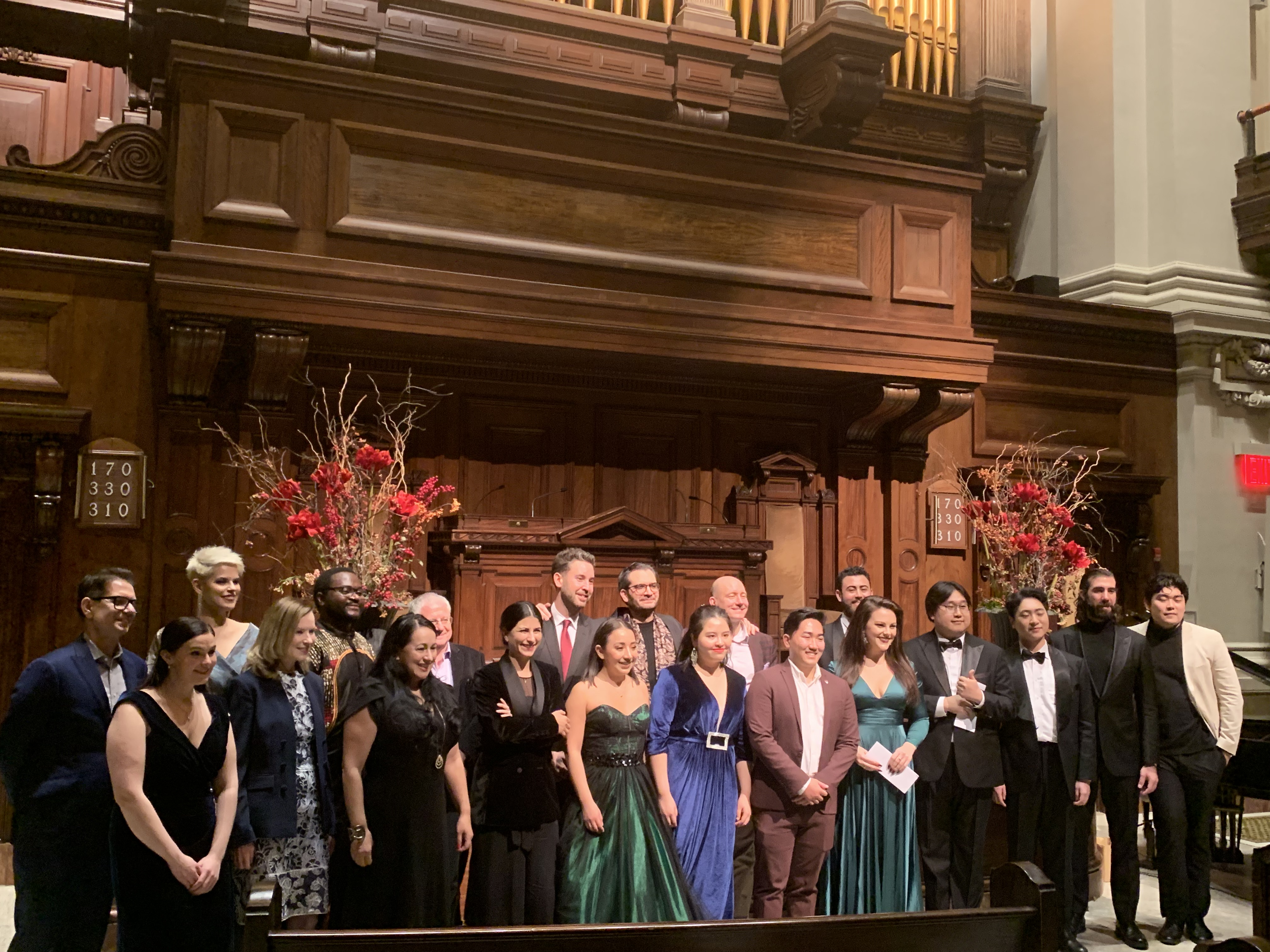
Singers and Judges at Premiere Opera Foundation Vocal Competition Finals
We can't decide whether it is worse to be a competitor in a vocal competition or one of the judges. The former have to deal with anxiety and the latter, with making difficult decisions. We do not envy either! But being in the audience is a real treat; one gets to hear the finest young talent taking their shot for the big prize. After all, these 14 supremely gifted young singers are the result of a difficult winnowing process, having been chosen from 150 applicants. The Premiere Opera Foundation is unique in that winners receive not only prize money but also the opportunity to be heard by those who may hire them. It seems to be a win-win situation.
As is our wont, we will not tell you who won which prizes; to our ears they were all winners. As far as vocal technique, all were top notch. Most seemed to have a knack for choosing arias that showed off their versatility. And some of them managed to evoke the entire scene of their chosen aria without benefit of costume and scenery.
We will not pick apart each performance but rather try to come up with what is unique about each singer and we will do that in the order in which they sang. The way the competition was organized, each singer performed an aria and then, after 14 performances, each artist got a second chance to perform a different aria; so we got a fairly decent idea of their versatility. All were accompanied by the able pianist Michael Fennelly who seemed to have a knack for coloring each aria in much the same way as the singer did. This is the great mystery of artistic performance. How do they do that????
We also wondered how the singers chose their arias. To choose an aria that is commonly sung puts the singer in competition with all the greats who have sung that aria before. What a challenge to make one's performance stand out, to bring something new to the interpretation! On the other hand, to choose an unknown or rarely heard aria presents its own challenges.
Leading off the program was the sweet voiced tenor Randy Ho who brought exuberance to "Ah! Mes amis" from Donizetti's La Fille du Regiment and tenderness to "Dies bildnis ist bezaubernd schön" from Mozart's Die Zauberflöte He made the well-rehearsed gestures seem organic and spontaneous.
British mezzo-soprano Christine Byrne limned the character of Isabella in "Cruda sorte!" from Rossini's L'italiana in Algeri by means of a richly textured instrument, which she also did as the doomed but peaceful Fenena in the lesser known aria "Oh! dischiuso è il firmamento" from Verdi's Nabucco.
Chinese soprano Yujin Zeng exhibited a lovely coloratura in "Ah! non credea mirarti..."Ah! non giunge" with a pleasing switch from a lovely legato to some fine fioritura in the cabaletta. There was a nice contrast with "Ach, ich fühl's" from Mozart's Die Zauberflöte. We wanted to bring Mr. Ho back onstage to do a Pamina/Tamino duet!
Chinese bass William Guanbo Su, long known to us, astonished us with his vocal growth in a forceful performance of "Quand la flamme de l'amour" from Bizet's La Jolie fille de Perth which was topped by "La calunnia" from Rossini's Il barbiere di Siviglia, a circumstance in which we preferred hearing something familiar done in a more character driven way than we have heard it before.
Kenyan tenor Lawrence Barasa Kiharangwa exhibited an ample tone in "Se all'impero amici" from Mozart's La clemenza di Tito successfully conveying the emperor's generous nature. Showing another aspect of his fine instrument, he injected all the requisite enthusiasm in Alfredo's Act II aria "De' miei bollenti spiriti...Oh mio rimorso" from Verdi's La traviata.
Chinese soprano Siyi Yan accomplished the miracle of making the clever English text of "Glitter and Be Gay" from Bernstein's Candide completely comprehensible, so unusual in that very high register. She made use of lots of gesture with each and every word. "Caro nome" from Verdi's Rigoletto was given the same highly dramatic treatment.
Mexican mezzo-soprano Rosario Hernandez Armas, well known by us and oft-reviewed, gave a touching performance of Leonora's aria "O mio Fernando" from Donizetti's La favorita. This was matched or even exceeded by the fiery "Smanie implacabili" from Mozart's Cosi fan tutte, revealing how Mozart used the vocal line to limn the character of Dorabella.
South Korean baritone Minki Hong gave a successful portrayal of the angry Ford from Verdi's Falstaff in "E sogno? O realta" which was a nice balance with the lyrical "Vision fugitive" from Massenet's Hérodiade, sung in fine French.
Soprano Avery Boettcher let out all the stops in her portrayal of the angry Donna Elvira (oh how we love those angry characters) in "In quali eccessi o numi...Mi trade quell'alma ingrata" from Mozart's Don Giovanni, letting us see the drama queen nature of the character. This was balanced by the wistful Nedda singing "Stridono lassu" from Leoncavallo's Pagliacci.
South Korean baritone Yeongtaek Yang brought humor to "Largo al factotum" from Rossini's Il barbiere di Siviglia and serious intent to "Nemico della patria" from Giordano's Andrea Chenier, successfully demonstrating his impressive versatility.
Tenor Anthony Ciaramitaro also showed versatility, choosing a strong Verdi character (Riccardo/Gustavo) from Un ballo in maschera singing "Ma se m'e forza perderti" with sorrowful renunciation and then singing the lighter role of Nemerino in "Una furtive lagrima" from Donizetti's L'elisir d'amore.
Cuban baritone Eleomar Cuello Calles performed "Mein sehnen mein wähnen" from Korngold's Die tote Stadt in the most perfect German we have heard from a non native German. It seemed a miracle that every vowel was given full value and every consonant was crisply enunciated. (Regular readers know how irritated we get when American singers maul the "ich" and the umlauts.) In Riccardo's aria "Ah per sempre" from Bellini's I Puritani, we heard a different style (bel canto) but much the same mood of romantic longing and disappointment.
Soprano Chelsea Lehnea tore up the stage with Violetta's Act I scene from Verdi's La traviata. "È strano...Sempre libera" is a supreme challenge for any soprano who must show the heroine's ambivalence. The challenge was totally met in a way that far overshadowed her later performance of "I Can Smell the Sea Air" from Previn's A Streetcar Named Desire.
Canadian bass-baritone Vartan Gabrielian took command of the role of Banquo in "Come dal ciel precipita" from Verdi's Macbeth, successfully conveying the ominous mood. Aleko's Cavatina from Rachmaninoff's eponymous opera also deals with betrayal and we think Mr. Gabrielian is very good at conveying that, not from personal experience we hope!
It was such an exciting afternoon that we didn't want it to end. We are anticipating success for all of these gifted young artists and hope to see them all onstage again in the near future.
© meche kroop


