MISSION

We are here to encourage the development of gifted young singers and to stimulate the growth of New York City's invaluable chamber opera companies. But we will not neglect the Metropolitan Opera either. Get ready for bouquets and brickbats.

Tuesday, August 23, 2022

FINAL SANTA FE APPRENTICE SCENES


 Justin Burgess, Vanessa Croome, Caroline Corrales, Daniel O'Hearn, and Joseph Parrish

It seems as if the eight scenes chosen to present to the public by the Santa Fe Apprentice Program are of twè kinds. One type demonstrates the ability of the young artists to work together as an ensemble; the other variety seems to highlight the particular talents of a pair or trio. 

Let us begin with the scene from Verdi's La Traviata in which the ailing courtesan Violetta is confronted by her young lover's irate father. Père Germont has come to persuade her to give up his son in order to get his virtuous daughter married off. He demands, cajoles, and manipulates. His arrogant mien softens when he realizes her humanity and dignity. Teresa Perrotta impressed us with a sizable soprano, lovely legato line, and accurate phrasing. Baritone Darren Lekeith Drone made an excellent Giorgio Germont, not only singing with intention but successfully converting our initial anger at his character for insulting our favorite operatic heroine to a feeling of sympathy for his bourgeois predicament. The scene was well directed by Crystal Manich.

Another duet  that impressed us was from Robert Ward's The Crucible. We generally find fault with contemporary opera in English for its lack of melodic interest; however, Maire Therese Carmack's performance as Elizabeth Proctor and baritone Erik Grendahl's as her husband John carried us fully into the story. The singing was superb but what we most appreciated was the completely comprehensible diction --something we never take for granted. James Robinson's direction made the relationship between husband and wife very clear. His prior adultery has left him vulnerable and his wife even more so as the community is involved in the Salem witch trials. This will not end well!

It is always a pleasure to hear young voices tackle Wagner and two tenors, singing in fine German, made much of the scene from Siegfried in which the eponymous hero confronts the dwarf who has raised him. If one didn't know the backstory one would blame the ungrateful Sigfried (sung by Eric Taylor) and feel sorry for the hard-working Mime (sung by Thomas Cilluffo) who can never satisfy his ward. Siegfried is, indeed, a dolt who "enters pursued by a bear" (oops, sorry about that, he was wearing the skin of a bear he slaughtered) and heaps abuse upon the dwarf who has raised him.  But we, the audience, know that Mime is pure evil and only wants Siegfried's treasure. This is serious business but it was clear that the pair of singers relished their roles and threw themselves into the scene, which was well directed by Ken Cazan.

The ensemble scenes offered a wide range of styles. Our favorite was the scene from Richard Strauss' Der Rosenkavalier in which the Marschallin, sung with beautiful tone and great dignity by soprano Murrella Parton, acknowledges the reality of her young lover Octavian (a most convincing Kathleen Felty in this mezzo-soprano breeches role) about to begin a romance with young Sophie (charmingly sung by Emilie Kealani). This is one of our favorite operas and we loved the way it was sung and directed. Kathleen Clawson directed the three singers to stand far apart as they each expressed different emotions. But after the Marschallin left the scene, the lovers were brought together in intimate joy.

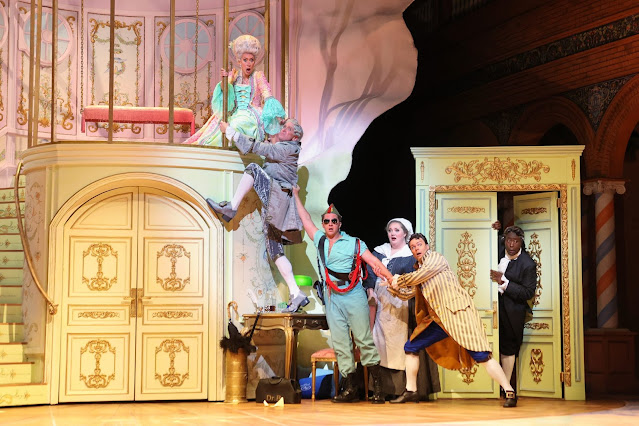
The scene from johann Strauss' Die Fledermaus was an audience favorite, a comic operetta directed by Ms. Clawson as a farce.  Gabriel von Eisenstein (baritone Justin Burgess) is delaying his departure to serve a jail sentence in order to attend a party. The maid Adele (soprano Vanessa Croome) uses an excuse to attend the same event. Gabriel's wife Rosalinda (soprano Caroline Corrales) is entertaining a former lover, opera star Alfred (tenor Daniel O'Hearn). When jailer Frank (bass-baritone Joseph Parrish) arrives to take von Eisenstein to jail, Rosalinda, for the sake of propriety, must pretend that Alfred is her husband. We suppose that the work was sung in English because of the plot complexity but we find it funnier in German. We found it a bit over directed with an excess of shtick and physical comedy.There is enough comedy in the plot! Suddenly this season we are seeing a lot of Broadway type dancing that went out of fashion decades ago.  We can't help thinking of the can-can.

Rossini's Armida began with a touching love scene between the beautiful sorceress Armida (soprano Avery Boettcher) and the lapsed warrior Rinaldo (tenor Jonah Hoskins). The melodic vocal lines gave them an opportunity to show their stuff. But then, two men in army fatigues entered threatening our hero with pistols in one hand and what might be bibles in the other hand, laying a guilt trip on him for abandoning his war hero status. We felt sorry for tenors Philippe L'Esperance and Kameron Lopreore (as Carlo and Ubaldo) whose gifts we thought were wasted, with strange gestures distracting from their singing. Perhaps director Mr. Cazan wanted us to think of the conflict in the Middle East, but it did not work.

We thought the scene selected from Mozart's Don Giovanni was not the best choice.  We are not sure why operas are recently getting tricked out with an excess of "stage business" which distracts from the singing. It seem as if an attempt was made to get as many singers onstage as possible and to give them as much to do as possible. Bass Allen Michael Jones made a believable Leporello and, to the extent that we could sort out what was going on, sang the role well. But why was Elvira (portrayed by Ms. Corrales) wearing a nun's habit when she is claiming to be DG's wife? Tenor Dylan Davis and soprano Caitlin Aloia portrayed Don Ottavio and Donna Anna, while Zerlina and Massetto were sung by Ms. Kealani and Jongwon Han. There was just too much going on to appreciate the singing.

And finally, we thought the very brief scene from Massenet's Cendrillon was also over directed by Mr. Robinson. Madame de la Haltiere was finely sung by contralto Megan Esther Grey but the severely overdone contortions of her two daughters was distracting. Noémie was performed by Amber Norelai and Dorothée, by mezzo-soprano Gloria Palermo.

In sum, it was a great evening, filled with delights and revelations. It is alway a pleasure to hear the stars of tomorrow at the relatively early stage of their careers.

© meche kroop

Sunday, August 21, 2022

A CLOSER SHAVE


Murrella Parton (Berta), Joshua Hopkins (Figaro), Emily Fons (Rosina), Jack Swanson (Count Almaviva), Nicholas Newton (Don Basilio), Kevin Burdette (Dr. Bartolo), photo by Curtis Brown for the Santa Fe Opera 


When we tell people how much we love opera, they usually assume we are speaking about a "very serious art form". They seem surprised to learn that opera can be lighthearted and even funny. Yet some of our greatest masterpieces are considered comedies. Does Il barbiere di Siviglia qualify as a masterpiece? We say YES!  In the wrong hands it could be dull and overly long.  but in the hands of the Santa Fe Opera we can not think of Rossini's work as anything but a masterpiece.  No wonder it is the hit of the 2022 season!

Stephen Barlow has directed with admirable panache. Not a single funny stone was left unturned. Andrew D. Edwards has designed sets and costumes with style and wit aplenty. The columns flanking the set were neither Dorian nor Ionian; they were "Barberian"--the familiar old-fashioned striped barber poles.

For us, the most important aspect of an opera is the singing and we cannot imagine better casting. In our review of Performance Santa Fe's recital, we admired the bel canto singing and believable chemistry between Emily Fons and Jack Swanson. What a perfect choice for the roles of Rosina and "Lindoro" (Count Almaviva). Both sounded even better than they did at the recital, and that's saying a lot. Rossini's elaborate vocal challenges were more than met. Fantastic fioriture and super scale passages, terrific trills, and commanding cadenze tickled the ear.

In the role of the eponymous barber, we heard baritone Joshua Hopkins, a Santa Fe regular whose performances we have always enjoyed. This role suited his vocal skills perfectly. His "Largo al factotum" was delivered with several original touches that rose above  the customary clichés.

Bass Kevin Burdette, another Santa Fe Opera regular, made a spectacular showing as Dr. Bartolo. The first time we saw him in a comic role we were astonished by his comic chops. Last night we were more impressed than astonished. We were not aware of the extraordinary flexibility of his body which he employed with as much artistry as he did his voice. The laughter when he slid out of his chair like a flow of lava just about drowned out the singing. The rapid patter of "A un dottor della mia forte" was executed with precision. 

The brilliant bass-baritone Ryan Speedo Green, making his SFO debut, brought his incredible artistry to the role of Don Basilio, using his magnificent instrument successfully, revealing a great sense of comic timing. We delighted in his aria "La calunnia" in spite of some excessive directorial touches which we will address later.

As a huge fan of the Santa Fe Opera Apprentice Program, we are most delighted to honor the performances of two apprentices who fulfilled their roles with equal aplomb.

Baritone Kyle Miller made a stylish Fiorello as he assembled his musicians to accompany Mr. Swanson's cavatina "Ecco ridente". Although the role is not a large one, he must set the stage for the serenade of his boss' lady love and this he did admirably.

Soprano Murrella Parton illuminated the role of Berta and was given some unusual stage business that increased her importance in the opera. We look forward to hearing more from these three gifted apprentices.

Also given quite a lot of importance was the chorus, so well prepared by Chorus Master Susanne Sheston. We are always dazzled by their vocalism but in this case they were given a great deal to do as Fiorella's musicians, each of whom had his own personality. Later they appeared as a swat team!  More on that anon!

Maestro Iván López Reynoso established the Rossinian pace right from the overture. We loved the contrast between the staccato themes and the legato ones. Just as the Finns should borrow some vowels from the Italians, so contemporary composers should borrow some tunes from Rossini! The master even borrowed from himself!

And now, we would like to address the issue of staging. Without a doubt, this production is a crowd pleaser and often the laughter drowned out the singing. We agree that humor is vital in an opera buffa but in this case we feel the direction was over the top and the high jinx frequently distracted from the singing. Surely the characters owe a debt to commedia del'arte but we want opera to build upon its origins and to rise above mono-dimensionality

We believe ours to be a minority opinion but we felt the work was over directed. Much of what we objected to involved the touches of contemporaneity. Count Almaviva, alone among the characters, is dressed in contemporary casual--a hoodie to be exact; and he pays Fiorella with a mafioso suitcase filled with cash. One of the musicians is drinking from a styrofoam coffee cup. Berta pushes a Hoover around the floor and describes the chaos to an unseen listener on the telephone. Don Basilio carries a laptop and takes selfies with his cellphone. Figaro reclines in Rosina's bathtub. The police who come to quell the chaos are a swat team. Berta emerges from her servant's uniform as a glamorous star surrounded by a chorus of men in top hats and tails. We could go on and on but we believe you, dear reader, will get the picture.

When every character acts bizarrely or inappropriately funny, the impact of comedy becomes lost. Among lots of peculiar characterization, the arrogant Dr. Bartolo was directed as a simpering fop. At one point, he donned a sweat band, spread out a yoga mat and began doing weird contortions.

This "originality" was echoed by the set. Dr. Bartolo's house was a plaster cast of Rossini's face.  His eyes were used as windows and his mouth as a door.  Hedges imitated a huge handlebar mustache. The audience applauded before the singing began. This stage element revolved to show the inside of the home. Below was a period parlor and above was Rosina's room. Bars around it suggested a cage, commenting on her imprisonment by Dr. Bartolo. She sat on a swing, going forward and back. Necessary stage elements like the doctor's piano were wheeled on and off.

If this sounds like your cup of tea, you will have a rollicking good time. On our part, we would like to "unsee" this production and remember the way the excellent cast sang Rossini's glorious music, the thrilling duets (not only the love duet but the one between Rosina and Figaro), and the many layered ensembles, so well crafted by the composer.

© meche kroop


Tuesday, August 16, 2022

FESTIVAL OF SONG--PART 2

EMILY FONS (photo by Dario Acosta)


 JACK SWANSON (Photo by Lily Lancaster)

Two of our favorite young artists presented a most satisfying vocal recital last Sunday. Thanks to Performance Santa Fe, singers from the Santa Fe Opera get an opportunity to perform art songs in an intimate environment, the charmingly decorated theater at the Scottish Rite Temple.
 
Soprano Emily Fons and tenor Jack Swanson have been on our radar for some time and we are looking forward to seeing them perform in Il barbiere di Siviglia at the Santa Fe Opera--and you should too. It is one of our favorite operas and always a good time, especially when cast with exciting young talent. These two artists have perfect voices for bel canto. 

The highlight of Sunday's program, for us anyway, was the final selection on the program, one from a different Rossini opera--Cenerentola. The two artists had excellent chemistry in the scene in which the Prince, in disguise, first meets our charming heroine. The scene opened with Mr. Swanson walking up and down the aisles, representing his search for a potential bride. We could not imagine a better depiction of love at first sight. The elaborate bel canto filigrees presented no challenge to these two remarkably flexible voices.  We were enchanted.

Now, what about the rest of the program! Ms. Fons led off with three songs by Charles Ives, of whom we have never been much of a fan. Surprise! The songs he wrote to German text were a revelation. We always love being introduced to something we never knew existed and these songs have many of the qualities we love in Schubert's canon. But of course the fine German texts that inspired Schubert could also inspire Ives to write gorgeous vocal lines. The piano parts were also notable with lyrical arpeggi in "Feldeinsamkeit" and some thrilling rolling chords in "Weil auf mir". We loved the way Ms. Fons colored her tone with gentle warmth.

Also new to us were some settings of Shakespearean text by Erich Korngold. The songs fit Ms. Fons' lovely soprano perfectly and we appreciated the clarity of her diction--a quality we never take for granted.  In "Come Away Death" there were unsettling shifts from minor to major. "Adieu Good Man Devil" gave her the opportunity to use facial expression and gesture to get the song across, and that is just what we look for in a vocal recital. Lacking costuming and scenery, the singer and pianist must tell the tale.

Ms. Fons' storytelling skills also illuminated a set of songs by Francis Poulenc. These miniature marvels also offer the artist a variety of moods to convey and she certainly did live up to the task. We loved the sweet humor of "Le carafon" and the delicacy of "Les anger musiciens". The decrescendo at the conclusion of "La reine du coeur" was exquisite. Her diction in French is just as fine as it is in English.

Alternating between these sets were those of the terrific tenor Jack Swanson. He also performed songs by Poulenc and gave a great interpretation of the ironic "C" with the support of Mr. Tweten's searching piano line. He used his instrument well and expressively; there were some lovely floated notes at the top of the register. His French was as fine as one would wish. We especially enjoyed his vocal agility in "Fêtes galantes", which was overflowing with personality and a true crowd pleaser.

We were very happy to see one of our very favorite Rossini songs on the program, one that we were introduced to by Pavarotti. "La promessa" is a simple song that goes deep, whether due to, or in spite of an uncomplicated melody, one which we have not been able to get out of our head since the concert. Of course, no one is, or ever will be Pavarotti--but Mr. Swanson did a creditable job. "Addio ai Viennesi" was new to us and must have an interesting story behind it. It suited his voice well and showed off his flexibility, although we thought the scale passages might have benefitted from a bit more articulation.

Franz Liszt's Tre sonetti di Petrarcha was an interesting choice for a bel canto voice and was only partially successful. There is power enough in the voice but pehaps insufficient variety of color. The poet is in torment in "Pace non trovo" and Mr. Swanson expressed that in spades, successfully negotiating the wide leaps. However, "Benedetto sia il giorno" requires a more tender color. In "I vidi in terra angelici costumi" the voice is placed in the lower register whilst the piano occupies the higher register. This was also well handled. We know Mr. Swanson can float his high notes and there were times in this cycle when we wished he wouldn't push for volume. Sometimes whispers speak louder than shouts!

Once again we were very engaged by the contributions of collaborative pianist Robert Tweten. It was not solely in the places in which the singer was silent that we noticed qualities of the music that had gone previously unnoticed. It was more the interplay between voice and piano that captivated us.

© meche kroop


Monday, August 15, 2022

APPRENTICE SCENES AT SANTA FE OPERA


Nicholas Newton, Amanda Lynn Bottoms, Lucy Evans, Ben Brady, Magdalena Kuzma, and Justin Burgess in a scene from L'Italiana in Algeri

What a delightful evening we spent watching and listening as this year's crop of apprentices showed their stuff.  And what stuff they showed! Nothing thrills us more than discovering new major talents and witnessing the ascendancy of their stardom. Last night, all of the apprentices sounded great but a few stood out, perhaps because they were given the right role to suit their unique gifts.

We chose the above photo of a scene from Rossini's L'Italiana in Algeri because of its superlative ensemble work. Of course, Rossini is known not only for his comedic genius but also for his ability to combine several vocal lines into a tapestry of sound, almost always composed to bring an act to a rollicking climax. If anyone starts complaining that this opera is not politically correct, we will gladly stare you down!

In this case, marvelous mezzo Amanda Lynn Bottoms created a character with wondrous spunk; her Isabella used all her ingenuity to beguile bass-baritone Ben Brady's Mustafa. No one could doubt that she would secure the release of her lover Lindoro (tenor Andrew Turner) whom Mustafa had convinced to marry his cast-off wife Elvira (soprano Magdalena Kuzma). Rounding out the well-matched ensemble were mezzo-soprano Lucy Evans as the servant Zulma, bass-baritone Nicholas Newton as Taddeo, and baritone Justin Burgess as Haly.  James Robinson's astute direction created sense out of all the confusion.

Another charming ensemble piece, directed by Cristal Manich, was a scene from Strauss' Ariadne auf Naxos. We cannot recall enjoying this scene as much as we did last night. Soprano Amber Norelai created a flirtatious Zerbinetta who teases all the members of her troupe (tenors Thomas Cilluffo and Jordan Loyd, and bass-baritone Peter Barber) before running off with the patiently waiting Harlekin of baritone Luke Sutliff. Once again we marveled at the superb vocalism and acting skills of the entire cast.

On a more serious note, we were impressed by the ensemble work of the cast of Verdi's Don Carlos as they performed, in the original French, the scene in which Elisabeth de Valois (soprano Murrella Parton) confronts her husband Phillippe II (bass Griffen Hogan Tracy) about her missing jewel box. He in turn confronts her about his suspicions of her adultery.  Never mind that he has been committing adultery with the Princess Eboli whose entrance on the scene leads to her guilty confession of betraying her beloved Queen out of jealousy. And here, we get to the meat of the scene in which the Princess sings the famous aria "O don fatale". It was exciting to hear these fine artists being given the rare opportunity to tackle Verdi and, under the direction of Kathleen Clawson, to succeed so admirably. Mezzo-soprano Sarah Saturnino's Eboli was heart wrenching as she summoned a panoply of emotions and accepted responsibility for her misdeed. This is one voice we will definitely watch for future greatness!

Another serious ensemble piece was equally filled with confrontation. Donizetti's Lucia di Lammermoor is one of our favorite operas, filled with glorious bel canto singing, luscious melodies, and a gripping story. No, we did not get Lucia's mad scene; rather we saw a scene of confrontations. Poor Lucia (Ms. Kuzma) has been forced by her desperate brother Enrico (baritone Sejin Park) to sign a marriage contract with the politically useful Arturo Bucklaw (tenor Tianchi Zhang). Her beloved Edgardo of Ravenswood (tenor Kevin Punnackal) arrives on the scene and confronts the victimized Lucia. Enrico challenges Edgardo and only the intervention of the family minister Raimondo (Mr. Newton) forestalls bloodshed. But we know that no one gets out alive. Lucia will murder Arturo and die of madness, Enrico's fate is not a good one, nor is Edgardo's. Everyone handled the bel canto lines with grace and accuracy. Ken Cazan's direction brought everything together.

Ken Cazan's direction of the scene from Mozart's Cosi fan tutte was somewhat less successful in that it tried too hard and wound up appearing excessive to the point of losing the humor. We thought it was a mistake to set the scene in what appeared to be the 1950's, as remote to us as da Ponte's time. (What's with the recent popularity of that unattractive period????)  Nonetheless, we enjoyed the singing of soprano Emily Richter as Fiordiligi, mezzo Sophia Maekawa as Dorabella, tenor Anthony León as Ferrando, baritone Kyle Miller as Guglielmo, Mr. Brady as Don Alfonso, and the Despina of soprano Amanda Olea. Conductor Robert Tweten brought the voices together into a satisfying whole.

Regular readers will recall our fondness for zarzuela and will understand how pleased we were to see a scene from Torroba's Luisa Fernanda on last night's program.The selection was brief but affecting with Ms. Oleo portraying the eponymous heroine and Mr. León filling the role of Javier Moreno. What gorgeous vocal lines! And Spanish sings so beautifully!

Another duet was staged by Ms. Clawson--the confrontation between the eponymous heroine of Puccini's Suor Angelica and her cold aristocratic aunt, the Principessa, in a stunning performance by contralto Lauren Decker, another artist marked for stardom by virtue of the unique timbre of her voice and intense delivery. We couldn't help thinking about the mores of Puccini's time and the rigid morality of Italy's declining aristocracy. Poor Angelica (affecting soprano Ardeen Pierre), having given birth without benefit of marriage, had been sent to a convent, presumably to lessen the impact of social opprobrium. For years she has longed for contact with her family.  Finally her aunt visits but only to get her to sign away her inheritance. The ultimate insult to her mental state was learning that the son she bore had died. Ms. Pierre sang movingly and was as convincing as a victim as Ms. Decker was as a rigid unfeeling tyrant.

The only contemporary scene on the program left us as cold as the Principessa. Next to all the passion and confrontation of 18th and 19th c. opera (and even into the 20th c.) Gregory Spears' Fellow Traveler lacked the intensity and melodic interest of the other seven scenes on the program. Nonetheless, the performances of Mr. Sutliff as State Department official Hawkins Fuller and tenor Jonah Hoskins as a milk-drinking young reporter were believable and vocally excellent. We just want to hear these excellent voices performing something less "conversational".

In sum, it was a stellar evening with plenty of variety. We enjoyed the piano accompaniment and never missed the orchestra. We are sure the young artists enjoyed performing with professional staging, direction, and costuming--all of which were of the highest order.

© meche kroop

Saturday, August 13, 2022

BUTTERFLY DREAM


Kangmin Justin Kim and Mark Stone
(photo by Curtis Brown)


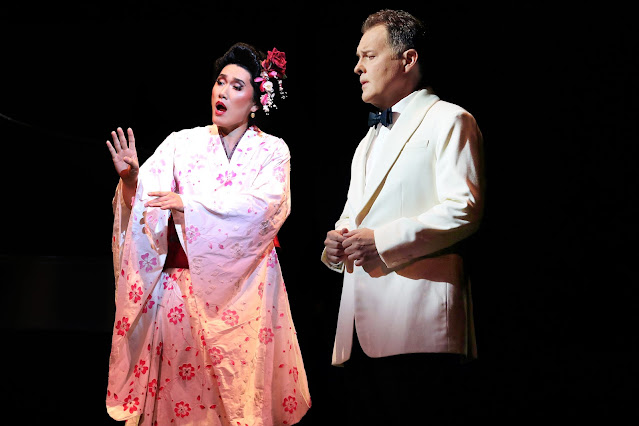
With our eyes closed, we might have thought the scintillating voice was that of a soprano; but no, it was the scintillating voice of counter-tenor Kangmin Justin Kim whose expressive instrument and superb control of the upper register was absolutely perfect for the role of Chinese opera star Song Liling. The opera M. Butterfly, commisioned by the Santa Fe Opera, is about deception, among other things. We humans are inclined to deceive ourselves based upon our wishes, our experience, and our preconceived notions. M. Butterfly tells the story of a minor French diplomat who falls in love with a male Chinese opera star who portrays female roles. Until confronted with the "naked evidence" the diplomat never accepts the fact that he has fallen in love with a man--not even after a years-long relationship.

The story originated as a play by David Henry Hwang whose tales of China have entertained us going back to his play The Dance and the Railroad. The play M. Butterfly upon which the opera is based, was a huge success at its Broadway premiere and once again at its revival and then again as a film. We have enjoyed every iteration and was looking forward to the opera ever since it was announced.

So, we are wondering why, in spite of some dazzling performances, we were somewhat disappointed in the opera. To cut to the chase, the story worked just fine as a play.  The play did not yearn for music, not even the fine music of Huang Ruo. The references to Puccini's Madama Butterfly, scattered throughout the score, only served to point out the superiority of Puccini's vocal lines. Mr. Ruo's instrumental writing is eclectic and interesting, but the vocal lines were not. This complaint of ours is not unique to Mr. Ruo. Most contemporary operas seem to have the same deficiency.

Although Mr. Hwang and Mr. Ruo have worked together before, we did not feel the union of libretto and music that we hoped for. The "recitative" (95% of the opera) was declamatory, prosy, and repetitive. The nail was hammered so hard it went right through the wood! Is it not taught to dramatists to "show, don't tell"? There were a couple arias in Act III that allowed the artists to show their stuff but were not at all melodic.

Perhaps we were alone in our assessment because there was a standing ovation at the conclusion; however we believe the thunderous applause was meant for the performances. Baritone Mark Stone sang the role of the duped accountant/diplomat René Gallimard with fine rich tone whilst creating a sympathetic and believable portrayal.

Mr. Kim's lustrous counter-tenor added to his consummate acting skills. We can see how Mr. Gallimard was fooled! All of the gestures and movements were as feminine as one could imagine and, at the end, when he appeared as a man (in full frontal glory) it came as a shock, even though we knew the artist was male.

This kind of gender fluidity is far less shocking than it was some decades ago and we do admire Mr. Hwang and Mr. Ruo for tackling issues of racial, cultural, and gender stereotypes, along with the issue of cultural misunderstanding.  The references to Puccini's opera serve to remind us how many changes have occurred in the past century.

Let us return to the quality of the performances and the production. We particularly enjoyed hearing mezzo-soprano Hongni Wu as Song Liling's communist "handler" who set the espionage in motion. We always feel great to see Asian artists cast in Asian roles, although there are other opera lovers who think it doesn't matter.

Tenor Joshua Dennis (a former apprentice) livened things up as Mr. Gallimard's tennis-playing childhood friend, appearing as a memory. Bass Kevin Burdette was fine as the somewhat arrogant French ambassador to China who promotes Mr. Gallimard, seems to admire his acquisition of a Chinese mistress, and then sends him back to France.

Adding greatly to the production was the choreography of Seán Curran who managed to combine communist tropes with the movements we have seen in Chinese opera, an art form we particularly enjoy.

Maestro Carolyn Kuan led the orchestra with a firm hand; our only regret was that more Chinese instruments were not employed. We liked the way she brought out the references to Puccini's Madama Butterfly.

Once more, we admired Chorus Master Susanne Sheston for creating a behind the scenes choral rendition of Mr Ruo's very own "Humming Chorus". The apprentices sounded great there and also as they portrayed members of French society in several scenes--as bored expats living in China, and as French citizens laughing at Mr. Gallimard's benightedness.

Director James Robinson kept the action moving along and Allen Moyer's set design was superb, especially Ms. Liling's sexy red boudoir. Christopher Akerlind's lighting made an impressive addition. James Schuette's costumes were right on point. Even the projections of Greg Emetaz were fine since they contributed location information instead of the distractions produced by other projection designers that we have found annoying.

In sum, Santa Fe Opera can be commended for commissioning a provocative and original work and for giving it a first-rate production. It is just our personal taste that wanted a more memorable vocal line and a more poetic libretto. Still, it was an interesting evening in term of getting us to think about the issues mentioned earlier. But for sheer auditory pleasure and a climax that leaves us shaken, we will choose Puccini.

© meche kroop

Monday, August 8, 2022

A FESTIVAL OF SONG


 Nicholas Brownlee, Elena Villalón and Robert Tweten

We spent a delightful Sunday afternoon with Performance Santa Fe which presented the second in a series of three vocal concerts in their Festival of Song series. The Scottish Rite Temple, which has a beautiful small theater, was just the right size for the event and possesses fine acoustics.

What a win-win situation for both Performance Santa Fe and also for Santa Fe Opera! As Nicholas Brownlee, our bass-baritone for the afternoon explained, it's a very special opportunity for an opera singer to shed all the theatrical trappings of the opera house and to achieve an intimate rapport with his audience. From the point of view of the audience, they can experience the same intimacy and also experience a connection with the poet whose words inspired the art song.

We admit to a departure from the latter benefit when we completely ignored the grim text utilized by Brahms for his Fier ernst Gesänge Op.121. Religious liturgy holds no interest for us even when translated into German by Martin Luther, a rather grim fellow himself.  Instead, we focused on the piano part, so persuasively performed by Robert Tweten, and the very textured tones of Mr. Brownlee. We particularly enjoyed the way Brahms colored both parts darkly, achieving an astonishing whole.

In a wisely contrasted set of songs by Charles Ives, Mr. Brownlee was able to reveal much more than his magnificent instrument. "Songs my mother taught me" is surely the same text used by Dvorak in his Gypsy Songs and it rings of bittersweet memories. In "Memories A&B" we loved the schoolboy enthusiasm Mr. Brownlee portrayed in "Very Pleasant" which we have always called by it's opening line, "We're sitting in the opera house". But tops on our list was the cowpoke sonnet known as "Charlie Rutledge" in which Mr. Brownlee chewed up the (absent) scenery.

Mr. Tweten also moved gracefully from the grim to the gay! Moreover, as he accompanied the stunning soprano Elena Villalón in Turina's Tres Arias, Op.26, his hands drew forth all the requisite Iberian colors and rhythms. Our lovely soprano has all the sazon needed to convey the poetry of the texts which we enjoyed reading aloud when we got home. All three texts were lengthy and profound but were explained briefly before the performance, a gracious welcome indeed!

Ms. Villalón has a voice of beauty, especially round at the top of her range. The entire upper register had a silvery sheen. Of equal importance is her gift for storytelling, not unlike that of Mr. Brownlee. We do not take that quality for granted. Nothing is more disappointing than hearing a singer of great vocal beauty but lacking in interpretive skills. 

Angel de Saavedra's "Romance" tells of a mighty warrior who stayed away so long that he lost his love. In despair, he releases his captives and renounces his bounty. How well the music, text, voice, body movement and facial expression joined together!

The text of "El Pescador" (written by Jose Ignacio Javier Oriel Encarnación) reminded us of a few of Schubert's songs but the Spanish language dictates a different kind of voice and piano. In any case a fisherman woos a young lady.  Wooing sounds different in Spanish than it does in German!

"Rima" (author unknown) is a passionate look at thecompelling attraction in a pair of eyes.

The songs of Tom Cipullo are unknown to us, since we do not pursue contemporary American song. Nonetheless, we liked the way Ms. Villalón interpreted them. "Crickets" was a bitter look at our current ecological disaster. "Summer into Autumn Slips" (text by Emily Dickinson) is a metaphor for life's declining years. If we interpreted correctly, Stanley Kunitz' text for "Touch Me" is also about the decline of love and desire.  It makes us wonder why Mr. Cipullo chose three texts about decline!

We are so looking forward to seeing what Ms. Villalón does with the role of Nanetta in Santa Fe Opera's Falstaff.  We have been enjoying Mr. Brownlee's performance on the stage for at least 8 years so we will not be surprised to see him make a fine Kurvenal in SFO's Tristan und Isolde.

© meche kroop

Sunday, August 7, 2022

STARS OF AMERICAN BALLET


                 Daniel Ulbright and Joseph Gatti in "Les Lutins "choreographed by Johan Kobborg


For the past ten years Performance Santa Fe has hosted Daniel Ulbicht's Stars of American Ballet at the charming Lensic Playhouse. This is the first year we have been in town for this highly anticipated and generously applauded event. We have spent two delightful evening enjoying dance programs of great variety that included something for everyone. In our case, nothing can compare with the fluidity and aesthetics of classical ballet; nonetheless we found plenty to enjoy about the less-than-classical choices.

The versatile Daniel Ulbricht has assembled a group of talented dancers drawn from a number of American ballet companies and taken them on the road to bring ballet to cities that do not have regular ballet performances.

We scarcely know where to begin in our admiration; so let us start with the selections that  made the biggest impression. It would be a mistake to overlook the finale of the second evening which featured Mr. Ulbricht and Joseph Gatti (well remembered by us for the occasions of winning dance competitions).. Accompanied by Elaine Chelton's piano and the lively violin of Nicholas Danielson (with whom Mr. Ulbricht interacted), the two men presented a competition in which no one ever won. It began with Mr. Ulbricht performing a fleet-footed tarantella; when Mr. Gatti entered the two played a game of "can you top this" with successful rounds of terpsichorean virtuosity. They were joined by Indiana Woodward who was attired like the men in black pants held up by suspenders, white shirts, and black ties.

Next in our affection were a number of classical pas de deux that showed how many different feelings could be evoked by the vocabulary of classical steps. It seems as if the music chosen by the choreographer and the order of the various combinations contributed to the feeling tone.

For example, the brief excerpt from Christopher Wheeldon's "Polyphonia" , performed by Tricia Albertson and Chase Swatosh, filled us with feelings of anxiety. Was it the dissonance and angularity of Ligeti's music? Was it the dark stage with chiaroscuro lighting? No matter what, the work was gripping and the dancing extraordinary with unique touches to the lifts.

Another pas de deux, entitled "De Deux", a world premiere of a work by Christopher Charles McDaniel, utilized a classical composition by the late 18th c, composer/violinist Joseph Bologne Chevalier de Saint-Georges (one of whose operas was produced and reviewed by us several years ago inNew York City). The classicism of the music dictated choreography that hewed closely to classical forms, which delighted us. Dancers Quinn Starner and  Cainan Weber captured the classicism perfectly. The feeling tone was one of pleasant mutual enjoyment.

In Balanchine's "Sonatine", Ravel's music was performed live by Elaine Chelton, and evoked feelings of romantic love. Dressed in a floaty blue costume, Megan Fairchild was gallantly partnered by Gonzalo Garcia. The tenderness of the partnering was given an unusual twist by Balanchine when Ms. Fairchield pulled Mr. Garcia offstage from behind.

For "Rouge Lullaby", choreographer Alec Knight used Bartok's modern music to create a pas de deux with completely different feelings. The skin tight red leotards worn by Quinn Starner and Cainan Weber contributed to the modern effect and the athleticism of the dancers bought it all together to stunning effect--quite different from the effect of their performance in "De Deux".

Glazounov's romantic music inspired choreographer Ariel Rose to create a lovely traditional pas de deux for Tricia Albertson and Chase Swatosh that lifted our spirits with its lighthearted mood. The work received its world premiere and left us wanting more.

Another pas de deux choreographed by Mr. Wheeldon entitled "Bitter Earth" filled us with melancholy. Sometimes a romantic work is joyful and sometimes melancholy--just like life. We found the music odd. The instrumental background suited the work perfectly but the vocalism was distracting and seemed not to fit. 

Balanchine's "Apollo" was the opening selection for the first night.  As revolutionary as Balanchine must have seemed in his day, this particular classic work seemed tired and old fashioned. Perhaps it was the awful sound production of Stravinsky's music but we found it the weakest of the classical selections. We couldn't help wondering whether Balanchine's depictions of the Greek god (Gonzalo Garcia) controlling and manipulating the three muses (Sara Adams, Megan Fairchild, and Hee Seo) was a projection of his own wish to control a bevy of ballerinas.

Regarding the remainder of the presentations, we were most impressed by David Parson's "Balance of Power",  a solo stunningly performed by Zoey Anderson. The music was odd and Ms.Anderson's strange sinuous movements alternated with sharper angular ones. The work seems to owe a debt to World Dance--mainly African and East Indian with jazz inflections.

There wasn't much in he way of program information but the colorfully clad young dancers of NDI New Mexico approached their dancing with gusto and were a pleasure to watch. An adult dancer, perhaps the director of the program, finished the number with a virtuoso solo.

The audience was equally impressed by the less classical numbers on the program but so much seemed to me recapitulations of mid-20th century Broadway dancing as seen in the movies. These works were high-spirited and energetic, as well as well danced.  They were just not our cup of tea.  That being said, the audience adored them all.

© meche kroop