MISSION

We are here to encourage the development of gifted young singers and to stimulate the growth of New York City's invaluable chamber opera companies. But we will not neglect the Metropolitan Opera either. Get ready for bouquets and brickbats.
Showing posts with label Sean Curran. Show all posts

Saturday, August 13, 2022

BUTTERFLY DREAM


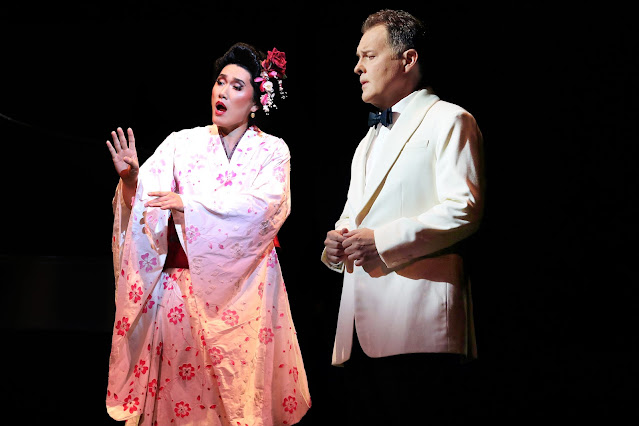
Kangmin Justin Kim and Mark Stone
(photo by Curtis Brown)


With our eyes closed, we might have thought the scintillating voice was that of a soprano; but no, it was the scintillating voice of counter-tenor Kangmin Justin Kim whose expressive instrument and superb control of the upper register was absolutely perfect for the role of Chinese opera star Song Liling. The opera M. Butterfly, commisioned by the Santa Fe Opera, is about deception, among other things. We humans are inclined to deceive ourselves based upon our wishes, our experience, and our preconceived notions. M. Butterfly tells the story of a minor French diplomat who falls in love with a male Chinese opera star who portrays female roles. Until confronted with the "naked evidence" the diplomat never accepts the fact that he has fallen in love with a man--not even after a years-long relationship.

The story originated as a play by David Henry Hwang whose tales of China have entertained us going back to his play The Dance and the Railroad. The play M. Butterfly upon which the opera is based, was a huge success at its Broadway premiere and once again at its revival and then again as a film. We have enjoyed every iteration and was looking forward to the opera ever since it was announced.

So, we are wondering why, in spite of some dazzling performances, we were somewhat disappointed in the opera. To cut to the chase, the story worked just fine as a play.  The play did not yearn for music, not even the fine music of Huang Ruo. The references to Puccini's Madama Butterfly, scattered throughout the score, only served to point out the superiority of Puccini's vocal lines. Mr. Ruo's instrumental writing is eclectic and interesting, but the vocal lines were not. This complaint of ours is not unique to Mr. Ruo. Most contemporary operas seem to have the same deficiency.

Although Mr. Hwang and Mr. Ruo have worked together before, we did not feel the union of libretto and music that we hoped for. The "recitative" (95% of the opera) was declamatory, prosy, and repetitive. The nail was hammered so hard it went right through the wood! Is it not taught to dramatists to "show, don't tell"? There were a couple arias in Act III that allowed the artists to show their stuff but were not at all melodic.

Perhaps we were alone in our assessment because there was a standing ovation at the conclusion; however we believe the thunderous applause was meant for the performances. Baritone Mark Stone sang the role of the duped accountant/diplomat René Gallimard with fine rich tone whilst creating a sympathetic and believable portrayal.

Mr. Kim's lustrous counter-tenor added to his consummate acting skills. We can see how Mr. Gallimard was fooled! All of the gestures and movements were as feminine as one could imagine and, at the end, when he appeared as a man (in full frontal glory) it came as a shock, even though we knew the artist was male.

This kind of gender fluidity is far less shocking than it was some decades ago and we do admire Mr. Hwang and Mr. Ruo for tackling issues of racial, cultural, and gender stereotypes, along with the issue of cultural misunderstanding.  The references to Puccini's opera serve to remind us how many changes have occurred in the past century.

Let us return to the quality of the performances and the production. We particularly enjoyed hearing mezzo-soprano Hongni Wu as Song Liling's communist "handler" who set the espionage in motion. We always feel great to see Asian artists cast in Asian roles, although there are other opera lovers who think it doesn't matter.

Tenor Joshua Dennis (a former apprentice) livened things up as Mr. Gallimard's tennis-playing childhood friend, appearing as a memory. Bass Kevin Burdette was fine as the somewhat arrogant French ambassador to China who promotes Mr. Gallimard, seems to admire his acquisition of a Chinese mistress, and then sends him back to France.

Adding greatly to the production was the choreography of Seán Curran who managed to combine communist tropes with the movements we have seen in Chinese opera, an art form we particularly enjoy.

Maestro Carolyn Kuan led the orchestra with a firm hand; our only regret was that more Chinese instruments were not employed. We liked the way she brought out the references to Puccini's Madama Butterfly.

Once more, we admired Chorus Master Susanne Sheston for creating a behind the scenes choral rendition of Mr Ruo's very own "Humming Chorus". The apprentices sounded great there and also as they portrayed members of French society in several scenes--as bored expats living in China, and as French citizens laughing at Mr. Gallimard's benightedness.

Director James Robinson kept the action moving along and Allen Moyer's set design was superb, especially Ms. Liling's sexy red boudoir. Christopher Akerlind's lighting made an impressive addition. James Schuette's costumes were right on point. Even the projections of Greg Emetaz were fine since they contributed location information instead of the distractions produced by other projection designers that we have found annoying.

In sum, Santa Fe Opera can be commended for commissioning a provocative and original work and for giving it a first-rate production. It is just our personal taste that wanted a more memorable vocal line and a more poetic libretto. Still, it was an interesting evening in term of getting us to think about the issues mentioned earlier. But for sheer auditory pleasure and a climax that leaves us shaken, we will choose Puccini.

© meche kroop

Saturday, August 16, 2014

DOUBLE FEATURE

Brenda Rae, Anthony Michaels-Moore and Erin Morley (photo by Ken Howard)


Erin Morley (photo by Ken Howard)


How could one make a marriage out of a 1786 Mozart singspiel and a 1914 Stravinsky fairy tale?  With great imagination!  Did the pairing work?  It depends upon who you ask.  Director Michael Gieleta has presented Le Rossignol as a production of the eponymous impresario of The Impresario and his company of performers.  The two wildly divergent works are bound together by the same cast and by the same scenic elements transformed in shape and purpose.

We have previously seen Mozart's Der Schauspieldirektor but never like this.  The hijinks occurring between the frustrated impresario and his three sopranos are here performed with much additional dialogue and interpolations of additional music by Mozart.  For some reason it is given in English.  Some of the dialogue is clever and some isn't.  It comes across as a backstage farce.

Before the opera even begins, we are treated to images of Salome with Jochanaan's head and a Tosca stabbing a Scarpia.  The stage is filled with performers of various disciplines, notably a troupe of very good dancers and three sopranos vying for parts in the new production of Le Rossignol.  The time is 1914 and the place is probably Paris; the impresario himself speaks with a Russian accent and is likely a fugitive from the Revolution.  The Countess who has supported his company is assassinated in front of our very eyes and Mr. Yussupovich fears he will have to close up shop.  Baritone Anthony Michaels-Moore handled the role well both dramatically and vocally.

His business manager Otto van der Puff (bass Kevin Burdette) proposes that Mr. Y produce operas that the public enjoys instead of radical experimental works.  Ahem!  They compromise.  There will be a Don Giovanni but there will also be this new work by Stravinsky.  And that's what we get in the second half of the program.  But not before we hear the three divas perform audition arias.  Soprano Erin Morley is filled with self-confidence as Adellina Vocedoro-Gambalunghi.  Soprano Brenda Rae has an enormous amount of fun as the over-the-top Transylvanian Vlada Vladimirescu who has brought along her husband, sung by the fine tenor Bruce Sledge.

Stepping in to replace the deceased Countess is financier Heinrich Eiler (bass-baritone David Govertsen) who wants his mistress Chlotchilda Krone (contralto Meredith Arwady) to be cast.  If the names of these three divas don't make you laugh then their shenanigans will.  Ms. Arwady is particularly funny as she sings Mozart's male roles in several registers.  We were reminded of Ira Siff's La Gran Scena Opera Company, gone but not forgotten.

After the intermission, we see the same singers onstage in the same roles but a transformation takes place as the clever set design (James Macnamara) is converted into the setting for Le Rossignol.  The piano becomes a boat and Mr. Sledge becomes a fisherman.  The outrageous Poiret-influenced costumes are stripped away and Ms. Morley becomes the eponymous nightingale.  The impresario is dressed as a Chinese emperor and Ms. Rae becomes a cook.  The costumes by Fabio Toblini are as sumptuous in the Stravinsky as they were in the Mozart.

The myth taken on by Stravinsky is that of a nightingale who sings so sweetly that she brings tears of joy to the eyes of the listener.  And that is EXACTLY what Ms. Morley achieved.  Most of her part is without words, a divine vocalise.  The cook will get an important position in the Emperor's court if she brings this splendid creature.  The nightingale does enchant the Emperor and the entire court until some Japanese envoys bring a mechanical bird (the lovely dancer Xiaoxiao Wang) that astonishes everyone.

The real live nightingale flies off; the Emperor is enraged and banishes her.  But when he is on his deathbed she returns and promises to sing 'til dawn if Death will return to the Emperor his symbols of power.  She succeeds and is offered a grand reward but the only reward she wants are the tears in the Emperor's eyes.  The opera is beautifully sung in Russian.

We loved the story.  Our thoughts ran along the lines of how in today's world we have been seduced by the faux, the virtual, the mechanical/electronic.  We need the real and the natural to heal.

Not everything worked.  We found the projections of modernist art to be ugly; they distracted from the gentle beauty of the myth and the music.  The dancers, wearing fake moustaches and glasses and rolling around on the floor dressed in knee breeches didn't make any sense whatsoever.  Sean Curran was the choreographer.

Conductor Kenneth Montgomery went all the way in limning the shimmering textures and dramatic orchestration of Stravinsky's score.  If we have nothing to say about the Mozart it is because the action onstage was so distracting that the music got very little notice.

As the myth concludes, the dancers are stripped of their lavish Oriental costumes and returned to their 1914 clothes, bringing the entire affair to a mostly satisfying conclusion.

(c) meche kroop