MISSION

We are here to encourage the development of gifted young singers and to stimulate the growth of New York City's invaluable chamber opera companies. But we will not neglect the Metropolitan Opera either. Get ready for bouquets and brickbats.
Showing posts with label Susanne Sheston. Show all posts

Saturday, August 13, 2022

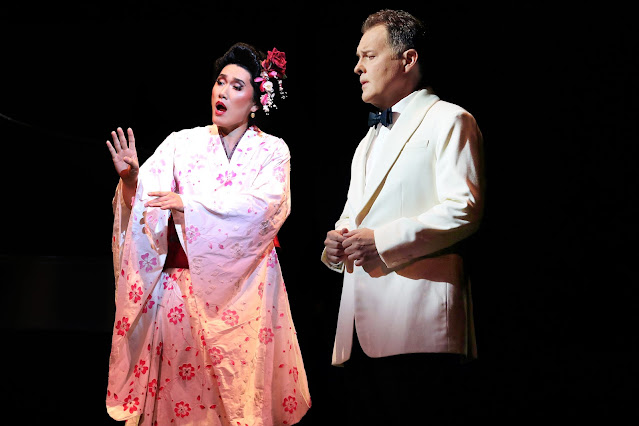
BUTTERFLY DREAM


Kangmin Justin Kim and Mark Stone
(photo by Curtis Brown)


With our eyes closed, we might have thought the scintillating voice was that of a soprano; but no, it was the scintillating voice of counter-tenor Kangmin Justin Kim whose expressive instrument and superb control of the upper register was absolutely perfect for the role of Chinese opera star Song Liling. The opera M. Butterfly, commisioned by the Santa Fe Opera, is about deception, among other things. We humans are inclined to deceive ourselves based upon our wishes, our experience, and our preconceived notions. M. Butterfly tells the story of a minor French diplomat who falls in love with a male Chinese opera star who portrays female roles. Until confronted with the "naked evidence" the diplomat never accepts the fact that he has fallen in love with a man--not even after a years-long relationship.

The story originated as a play by David Henry Hwang whose tales of China have entertained us going back to his play The Dance and the Railroad. The play M. Butterfly upon which the opera is based, was a huge success at its Broadway premiere and once again at its revival and then again as a film. We have enjoyed every iteration and was looking forward to the opera ever since it was announced.

So, we are wondering why, in spite of some dazzling performances, we were somewhat disappointed in the opera. To cut to the chase, the story worked just fine as a play.  The play did not yearn for music, not even the fine music of Huang Ruo. The references to Puccini's Madama Butterfly, scattered throughout the score, only served to point out the superiority of Puccini's vocal lines. Mr. Ruo's instrumental writing is eclectic and interesting, but the vocal lines were not. This complaint of ours is not unique to Mr. Ruo. Most contemporary operas seem to have the same deficiency.

Although Mr. Hwang and Mr. Ruo have worked together before, we did not feel the union of libretto and music that we hoped for. The "recitative" (95% of the opera) was declamatory, prosy, and repetitive. The nail was hammered so hard it went right through the wood! Is it not taught to dramatists to "show, don't tell"? There were a couple arias in Act III that allowed the artists to show their stuff but were not at all melodic.

Perhaps we were alone in our assessment because there was a standing ovation at the conclusion; however we believe the thunderous applause was meant for the performances. Baritone Mark Stone sang the role of the duped accountant/diplomat René Gallimard with fine rich tone whilst creating a sympathetic and believable portrayal.

Mr. Kim's lustrous counter-tenor added to his consummate acting skills. We can see how Mr. Gallimard was fooled! All of the gestures and movements were as feminine as one could imagine and, at the end, when he appeared as a man (in full frontal glory) it came as a shock, even though we knew the artist was male.

This kind of gender fluidity is far less shocking than it was some decades ago and we do admire Mr. Hwang and Mr. Ruo for tackling issues of racial, cultural, and gender stereotypes, along with the issue of cultural misunderstanding.  The references to Puccini's opera serve to remind us how many changes have occurred in the past century.

Let us return to the quality of the performances and the production. We particularly enjoyed hearing mezzo-soprano Hongni Wu as Song Liling's communist "handler" who set the espionage in motion. We always feel great to see Asian artists cast in Asian roles, although there are other opera lovers who think it doesn't matter.

Tenor Joshua Dennis (a former apprentice) livened things up as Mr. Gallimard's tennis-playing childhood friend, appearing as a memory. Bass Kevin Burdette was fine as the somewhat arrogant French ambassador to China who promotes Mr. Gallimard, seems to admire his acquisition of a Chinese mistress, and then sends him back to France.

Adding greatly to the production was the choreography of Seán Curran who managed to combine communist tropes with the movements we have seen in Chinese opera, an art form we particularly enjoy.

Maestro Carolyn Kuan led the orchestra with a firm hand; our only regret was that more Chinese instruments were not employed. We liked the way she brought out the references to Puccini's Madama Butterfly.

Once more, we admired Chorus Master Susanne Sheston for creating a behind the scenes choral rendition of Mr Ruo's very own "Humming Chorus". The apprentices sounded great there and also as they portrayed members of French society in several scenes--as bored expats living in China, and as French citizens laughing at Mr. Gallimard's benightedness.

Director James Robinson kept the action moving along and Allen Moyer's set design was superb, especially Ms. Liling's sexy red boudoir. Christopher Akerlind's lighting made an impressive addition. James Schuette's costumes were right on point. Even the projections of Greg Emetaz were fine since they contributed location information instead of the distractions produced by other projection designers that we have found annoying.

In sum, Santa Fe Opera can be commended for commissioning a provocative and original work and for giving it a first-rate production. It is just our personal taste that wanted a more memorable vocal line and a more poetic libretto. Still, it was an interesting evening in term of getting us to think about the issues mentioned earlier. But for sheer auditory pleasure and a climax that leaves us shaken, we will choose Puccini.

© meche kroop

Sunday, August 11, 2019

THE PEARL IN THE OYSTER

Corinne Winters  and Ilker Arcayürek in Les Pêcheurs de Perles
(photo by Curtis Brown for the Santa Fe Opera)


Last night was our first night at the Santa Fe Opera and we have nothing but wonderful things to say about their production of Bizet's Les Pêcheurs de Perles. Is this the same production we saw seven years ago? We recall enjoying it but last night's iteration brought the work into sharper focus, both dramatically and musically. This is an opera that is not frequently heard but almost every opera lover is familiar with the famous Nadir-Zurga duet "Oui, c'est elle, c'est la déesse" in which both men make vows going against the nature of love. Almost every competition and recital in New York has this duet on the program.


But hearing the entire opera is a special treat and offers several more arias and duets that merit ones attention. If you, dear reader, have never listened to the opera in toto, we recommend it highly. Even better, come to Santa Fe for one of the two final performances on 8/16 and 8/23.


Much of the credit for this success can be attributed to the excellent casting. In the role of the Brahmin Priestess Leíla, we heard one of our favorite sopranos enjoyed so often at New York Festival of Song--Corinne Winters. Opera, lieder, and cabaret are three very different categories and it is astonishing to hear someone gifted in all three. This petite young woman has a voice that is anything but petite--the timbre and resonance are appealing and the vocal colors with which she imbued the various scenes showed the measure of her artistry. Nor could one fault her superb acting.


As the Hunter Nadir who simply cannot forget her, we heard tenor Ilker Arcayürek, previously unknown to us, but making a fine impression with his pleasing instrument, fine phrasing, and convincing acting.


Equally impressive in the role of Head Honcho Zurga we heard baritone Anthony Clark Evans who sang with beautiful phrasing and heartfelt emotion. He too was successful at coloring his voice in ways that enhanced our understanding of his emotional journey. 


As happy as we were that Leíla and Nadir escaped their death sentence and went off to live happily ever after, we were equally sad for Zurga who overcame his rage at Leíla for preferring Nadir and his pain and anger at Nadir's betrayal. His vengeful anger, his forgiveness, the nobility he expressed in self-sacrifice--all were perfectly portrayed.


Bass Robert Pomakov was scarily convincing as the High Priest Nourabad. His rumbling bass and aggressive postures were chilling.


The chorus of Santa Fe Apprentice Singers performed brilliantly as usual and for this we acknowledge Susanne Sheston, whose fine work has impressed us from one year to the next


Director Shawna Lucey showed us aspects of the story that we had previously overlooked. Although the love triangle and the issues of revenge and forgiveness are universal. Ms. Lucey went a long way toward giving us the  specific context within which the story develops. The trend of setting libretti in exotic locales was common in the 19th c.--a trend that we love--and librettists Eugène Cormon and Michel Carré selected the island formerly known as Ceylon with the action taking place in a community of pearl divers.


The risk of this occupation was made clear with drowned bodies being washed ashore; the devotion in the ensuing funereal Hindu ritual was also made clear. And so we have a greater understanding of the vital role of the visiting priestess Leíla and the importance the community placed on her chastity whilst she sang and prayed all night for their safety.


The issues of love versus duty, betrayal and revenge, all can be generalized from the specific; similarly the domination of a vengeful leader whipping his followers into a frenzy of murderous rage can also be generalized and seems particularly relevant to our time. It is this work the listener performs in finding analogies with the present that we find so woefully missing in "updated" productions.


On the podium we had Maestro Timothy Myers who elicited some fine playing from the orchestra. Bizet's music is inventive of melody, lush of harmony, and colorful of orchestration. Mo. Myers brought out every recurrence of every theme. We heard an outstanding oboe solo and a beautiful chorale of muted brass. We also enjoyed the contributions of the harp. We heard what sounded like a Venetian barcarolle that certainly evoked the seaside nature of the locale.


Jean-Marc Puissant's set was serviceable but not remarkable. The action was surrounded by a gilded frame, reminding us that this is an escapist fantasy. But why did some action take place in front of the frame? And what was meant by the presence of a very European desk and chair that seemed to serve no purpose. In the final act, the gilt frame was askew and the stage was filled with broken furniture and a huge plaster sculpture that we finally figured out was the hand of a Buddha statue. Perhaps all this was meant to suggest the destruction wrought by angry gods over Leíla's betrayal of her vow of chastity.


Lighting by Rick Fisher was augmented by Mother Nature who seemed to provide flashes of lightning at all the right times, as is so often the case at Santa Fe Opera. (We recall a terrific storm one night in the final act of Rigoletto which outdid Verdi's orchestral storm.)


Brigitte Reiffenstuel's costumes for the chorus and principals were apt but Leíla's second costume was breathtaking. She looked like a mermaid sitting on a rock, or perhaps like the Lorelei luring men to their destruction.  Who could resist?


The opera premiered in 1863 at the Théâtre-Lyrique de Paris. Neither comic nor tragic, it was considered insufficiently grand for the Opéra but too serious for the Opéra-Comique. It languished until the mid 20th c. and we are glad that it has entered the repertoire.


Do see it!


(c) meche kroop


Saturday, August 18, 2018

ROSSINI ROCKS SANTA FE

Patrick Carfizzi (Taddeo), Daniela Mack (Isabella), Scott Conner (Mustafa), Stacey Geyer (Elvira), Suzanne Hendrix (Zulma), Jack Swanson (Lindoro)...Photo by Ken Howard for Santa Fe Opera


It was difficult to tell who was having more fun at the Santa Fe Opera last night at a riotous performance of Rossini's 1813 laugh riot L'Italiana in Algeri. The cast sparkled with glee and the audience roared with laughter. The original production by Edward Hastings premiered in 2002; we were there and we remember best the part in which Isabella arrives in Algeria by bi-plane!

We doubt that Rossini could have foreseen the Wright Brothers' invention so we will assume that this production has been advanced from the 19th c. a full century into the future.  That a forceful female character was invented by Rossini in the early 19th c. is rather remarkable.  Her setting an example for the dependent and lovelorn Elvira has resonance for us in the 21st c.

The story concerns this independent Italian woman who has gone searching for her missing beloved Lindoro; he had been captured by pirates and enslaved by the lecherous and self-important Sultan Mustafa, a ridiculous character whose arrogance makes him easy to fool.

Isabelle is accompanied by Taddeo who adores her.  She adores him not.

Mustafa is trying to rid himself of his adoring wife Elvira who needs some good mentoring by Isabella.  Mustafa has a yen for an Italian woman and Isabella arrives at just the right moment.  The opera story involves her plotting to free all the Italian slaves as well as Lindoro. Thus the opera became catnip for the Italians--not only for its memorable melodic score but also for patriotic reasons.

The setting in Algeria, then a vassal state of the Ottoman Empire, reminds us of Europe's fascination with all things exotic at that time. Indeed, not too long before, Mozart wrote his Die Entführung aus dem Serail, the theme of which is not too different.

During the overture, tiny bi-planes were "flown" up and down the aisles of the theater. A somewhat larger bi-plane appeared on the set, and when it was time for Isabella and Taddeo to make their entrance, a much larger bi-plane appeared on the stage.

This masterstroke of creativity set the audience to laughing and the laughs wouldn't stop all night long. For our taste, Shawna Lucey's direction was excessive but the audience loved all the gyrations, wriggling, pelvic thrusting, wild gesticulations, and Broadway chorus-style dancing. There was one trick that Ms.Lucey missed.  When Isabella and Lindoro take off in a hot-air balloon at the conclusion of the opera, there was a basket but no balloon!

We did love the set design by Robert Innes Hopkins which was well lit by Duane Schuler. There was a flat playing space with palm trees on each side; the floor unfolded upward to reveal Mustafa's palace with its Moorish arches and pillars. It reminded us of those greeting cards that are cleverly constructed to reveal a cut-out when one opens them.

David C. Woolard's costume design was wild and colorful for the Algerian court and suitable for the Europeans in their own fashion. We particularly enjoyed the scene in which Isabella tears down one of the curtains, snatches up some random decorations, goes behind a screen, and emerges in a stylish form-fitting costume.

The singing was excellent all around; Rossini's melodies paired with the vowel-dominant Italian language give one a chance to appreciate a singer's gifts--something that doesn't happen for us in contemporary operas in English. The best part of the singing was the work done as an ensemble. The voices blended in happy harmony with each character singing a different vocal line and expressing different emotions.

Mezzo-soprano Daniela Mack made a spunky Isabella, using her physical and vocal assets to get three men to do her bidding, making each one believe that he was the object of her desire. Her delivery of "Cruda sorte" was excellent.

Tenor Jack Swanson made a fine handsome Lindoro, one for whom a woman might go out searching. He was particularly admirable in his duets. Today's audience seems to love "patter songs" as much as the audience of two centuries ago; Mr. Swanson's rapid fire delivery was impressive.

Bass Scott Conner played the part of Mustafa to the hilt. His booming voice and imposing figure perfectly set off the silly nature of his actions. It is wonderful to hear that much flexibility in a large low voice.

As his rejected wife Elvira, Apprentice Singer Stacey Geyer lent her splendid soprano to the creation of a character a normal man would be foolish to abandon; but we did say that Mustafa was foolish.

Mezzo-soprano Suzanne Hendrix was excellent in the role of Zulma, Elvira's slave and confidant. She too showed a lot of spunk.

Bass-baritone Patrick Carfizzi was just about perfect in the role of Taddeo and succeeded in earning our sympathy for his unrequited love. He gets passed off as Isabella's uncle and avoids impalement by agreeing to join the court.

Baritone Craig Verm was humorously menacing as Haly, Mustafa's chief pirate and scourge of the slaves.

The chorus of Apprentice Singers served as slaves and pirates and eunuchs. We always want to thank Susanne Sheston since the chorus is always so well schooled in perfect diction. And all of them seem effective in whatever parts they are asked to play.

Last, but definitely not least, Rossini's music is a constant delight. Corrado Rovaris' baton led the Santa Fe Orchestra in a highly spirited and swiftly moving reading of the score. From the piping of the piccolo to the "Rossini Crescendo", he made every moment count.

Another triumph for the Santa Fe Opera!

(c) meche kroop


Monday, August 21, 2017

REVENGE OF THE BAT

Stephen Carroll, Devon Guthrie, and Kurt Streit in Santa Fe Opera's production of Die Fledermaus
The other night we enjoyed a delicious "Ile Flottante" for dessert at Olivier.  It was a puffy ball of soft meringue,  light and airy, floating on a pool of delicious sweet custard. It left us smiling and satisfied. It is that image that kept coming to mind during Johann Strauss' delightful opera as presented by Santa Fe Opera.

Credit for this delight can be shared by the exemplary cast, all of whom possessed impressive comic chops, and a delightful production that emphasized the frivolous French farce nature of the work. The preamble to the story is that Herr Eisenstein (tenor Kurt Streit) once played a nasty prank on his friend Dr. Falke (baritone Joshua Hopkins). abandoning the drunken doctor on a park bench one night in full bat costume.

Dr. Falke has arranged an elaborate revenge, inviting Eisenstein to a fancy masked ball hosted by the eccentric aristocrat Prince Orlovsky (mezzo Susan Graham in travesti and very very funny). Eisenstein is quite a flirt and seizes the invitation, even though he is supposed to report to jail for a brief sentence that has been extended by the supposed stupidity of his lawyer Dr. Blind (Apprentice Singer tenor Stephen Carroll).

Dr. Falke's plot will not only exact revenge but will be a source of "innocent merriment" for the bored Prince. He has invited Eisenstein's wife Rosalinda (the superlative soprano Devon Guthrie) who will pretend to be an Hungarian countess and seduce her clueless husband.  He has also invited Adele, the Eisenstein's pretentious chambermaid (splendid soprano Jane Archibald), who will pretend to be a Russian actress.

Ms. Archibald dazzled in her "laughing song" and Ms. Guthrie knocked our socks off with her paean to her "Hungarian homeland". All of the coloratura was finely rendered and as exciting as could be.

Bass-baritone David Govertsen was excellent in the role of Frank, the Warden of the jail.  He also is at the party, pretending to be a French Chevalier and speaking ridiculous pidgin French with Eisenstein who was pretending to be a Marquis.

In the role of the jailer Frosch, we had the bass-baritone Kevin Burdette. We have always enjoyed his singing but never knew how totally hilarious he could be. His performance in the final act was filled with pratfalls and sight-gags.

As the Italian Tenor, Dimitri Pittas serenaded Rosalinda in Act I and went to jail in place of her husband.

Adele's sister Ida was finely performed by Apprentice Singer soprano Adelaide Boedecker.  Everyone performed as a finely tuned ensemble, giving the work a fine unity.

Maestro Nicholas Carter wielded his baton with panache and the lively waltzes kept us swaying in our seat. Ned Canty's direction kept things moving at break-neck pace. Zack Brown and Christianne Meyers' Costume Design was perfectly suited to late 19th c. Vienna when Waltz was King.  Allen Moyer's sets were exactly right.  Act I suggested an upper class Viennese home; Act II recreated a splendid palace ballroom with all kinds of hanky-panky going on.  The jail of Act III was also true to time and place.

Sean Curran's choreography featured a quartet of ballet dancers performing what resembled a Viennese interpretation of the French Can-Can. Risque for sure but not too risque if you want to bring your youngsters. The young man in the row behind us stayed awake, didn't wriggle, and had a wonderful time, as he told us after the performance.

As we have come to expect, Susanne Sheston's chorus of Apprentice Singers performed admirably and looked sensational in the ballroom scene.

Regular readers know that we always have a little quibble, even when we love a performance.  Our quibble for this production is that it was sung in English. We greatly prefer the original German, although we admit that the singers' diction could not be faulted. Our favorite way to hear this operetta is with English dialogue and German singing. The translation and additional dialogue seemed to suit the audience, even when it didn't pass our test!

(c) meche kroop

Saturday, August 19, 2017

THE COCK HAS CROWED

Kevin Burdette, Tim Mix, and Meredith Arwady in Rimsky-Korsakov's The Golden Cockerel

We well recall the moment that we fell in love with classical music.  Rimsky-Korsakov's Scheherazade was playing on the radio and we were hooked. What a thrill for us to have seen his final opera The Golden Cockerel twice within three months. Last night we enjoyed the production by Santa Fe Opera (a co-production with The Dallas Opera) and felt the same delight in the composer's exotic melodic line and lush orchestration, so sensitively realized by Maestro Emmanuel Villaume.

On a day remembered as Bloody Sunday in Russia, the Tsar's forces massacred some peaceful protestors who were unhappy about their living conditions but also about the ill-fated Russo-Japanese War.  The composer Rimsky-Korsakov supported the protestors and thereby lost his job as head of the conservatory. Perhaps in protest he chose to set The Golden Cockerel as a satire of autocracy and Russian imperialism. This would be his last opera; he completed it in 1907 but it was banned by the Palace. It premiered 2 years later but the master had already died.

The libretto was written by Vladimir Belsky who based it upon an invented fairytale by Alexander Pushkin who, in turn, based his work on some stories by our very own Washington Irving!  How about that! Real fairytales are folktales handed down over centuries so we feel confident in calling this one invented.

King Dodon's astrologer presents him with a golden bird who will warn him of political danger and gets promised whatever he wants in return. War is declared whilst Dodon lazes about at home, relying on the bird's advice. Dodon's sons kill each other on the battlefield and Dodon himself must go to battle.. In the kingdom of Shemakh he meets the seductive Queen Shemakha who extracts a promise of marriage and returns home with him. The astrologer claims his reward--the Queen.  He will accept no less. Dodon kills him. The Golden Cockerel kills Dodon.

As the bumbling King Dodon, we heard baritone Tim Mix whose characterization was as on the mark as his singing. Sporting a red "fat suit" and curled up on a huge throne, he made quite an impression on us. But an even greater impression was made when he mounted a large wooden horse, facing backward!

As the exotic temptress from The East--the Queen of Shamakha--soprano Venera Gimadieva tickled our ears with both long lyrical lines of pure sound and volleys of wickedly challenging ornamentation which she made appear effortless. Fortunately, she also possesses physical beauty sufficient for the part, since she was obliged to perform a serious strip tease to ensnare the dense Dodon.

Contralto Meredith Arwady has a sensational instrument of great depth. She created a marvelous version of Amelfa, Dodon's housekeeper/caretaker and brought a great deal of humor to her portrayal. The scene in which she cradles him on his huge throne was unforgettable.

The General of bass Kevin Burdette was perfectly sung and acted. If King Dodon had listened to his advice the entire tale might have ended differently.

The title role was sung by a very special member of the Apprentice Program.  Soprano Kasia Borowiec has been on our radar since her student days at Manhattan School of Music and has always impressed us.  What a joy to witness her artistic growth in last night's dazzling performance. Unfortunately, in this production, she sings from offstage, but we did have the opportunity to attest to her stage presence in Sunday night's Apprentice Scenes.

Several more apprentices delivered auspicious performances.  We heard tenor Richard Smagur as Prince Guidon and baritone Jorge Espino as Prince Afron. The two rivalrous siblings wind up killing each other on the battlefield.

Tenor Adam Bonanni made a fine showing as the First Boyar, whilst bass Simon Dyer did so as the Second Boyar. As expected, the chorus, under the astute direction of Susanne Sheston, performed magnificently.

Barry Banks utilized his very high tenor as The Astrologer, a mysterious character who may or may not be "real".

Director Paul Curran had some truly excellent ideas although we take exception to two choices that seemed to violate the intent of the concept. When the Queen of Shemakha capriciously demands the (offstage) beheading of The General, it seemed tasteless to us to have paraded the severed head around the stage.  Just plain "EWWW".

Secondly, there was no justification for King Dodon to appear in a contemporary suit with a red tie in the closing scene. Similarly, the Queen of Shamakha had exchanged her finery for a white dress and sunglasses. We expect that a large percentage of members of the audience, presented with an autocratic ruler who is an inept politician, might have been considering the present political situation in the United States. But that's the kind of association that should be made in one's thoughts, not concretized onstage.

But we loved the scene in which the Queen is tryig to get the flat-footed Dodon to sing and dance!

The fantastic nature of the tale was realized by the fantastic nature of the sets and costumes by Gary McCann. King Dodon loafed about in red pajamas but went to battle in stylized armor, and courted in magnificent robes. The Queen of Shamakha wore a fantastic headdress and a slinky turquoise gown which she shed in pieces. Amelfa's costume was a wild exaggeration of peasant attire and grotesque make-up.

The other costumes were wildly colorful and fantastically exaggerated with tall black fur hats on the men. The handmaidens of The Queen were dressed in long white gowns and bore huge feathered fans with which they surrounded the Queen as she changed costumes, an impressive visual spectacle.

The set resembled a skateboarding half-pipe, all curves upon which were projected animations of the Golden Cockerel, strange astrological symbols, and line-drawings of the creatures of Dodon's dreams. Driscoll Otto was responsible for this surge of imaginative creativity.

Eye candy and ear candy joined to create an evening in which entertainment was wed to high artistic values.

(c) meche kroop


Wednesday, August 17, 2016

GOUNOD'S ROMEO ET JULIETTE AT SANTA FE OPERA

Stephen Costello and Ailyn Perez (photo by Ken Howard)

Last night's performance of Charles Gounod's Romeo et Juliette soared with stunning singing and some mighty marvelous musicianship. The chorus (directed by the incomparable Susanne Sheston) sang with such fine French diction that not a word was missed.  The orchestra, under the baton of Harry Bicket, captured all of Gounod's nuance.  This was a co-production with the Fundacio del Gran Teatre del Liceu in Barcelona. The opera was making its first appearance at The Santa Fe Opera.

Gounod's success with Faust some 8 years earlier was arguably matched by this adaptation of the play by William Shakespeare by the same librettists who adapted Goethe's masterpiece--Jules Barbier and Michel Carre. Gounod was a master melodist and both operas leave one humming--a very good sign in our estimation.

The opera hews rather closely to the Shakespeare play with a few minor changes and a few deleted characters. To suit the operatic mentality, the librettists chose to focus on the romance between the two young lovers. Nonetheless, in our day and age, with gun control and belligerence on the front page every day, we cannot fail to miss the major point that meaningless hostility between any two groups--be they religious, political, or cultural--leads to irreparable loss to all concerned. We got the message when, at the conclusion of the opera, the opposing parties lay down their swords. Would that all mankind would get the message!

Returning to the issue of melody, the opera includes a breathtaking aria in waltz time for Juliette--"Je veux vivre"; one of our favorite sopranos Ailyn Perez performed this aria with technical mastery equalled only by the sparkle of youthful high spirits. During the course of the opera, Juliette must convey emotional growth from these adolescent high spirits to the solemn lifetime commitment to Romeo,  through the panic of risk-taking to the ultimate grief of loss. These emotional changes were nicely negotiated by Ms. Perez whose instrument has a lovely silvery tone. Her phrasing is impeccable and her French, perfect.

The opera has four duets occurring at different stages of the relationship between the two young lovers. Tenor Stephen Costello, whom we always enjoy, was at the top of his form, allowing his fine sound to soar with freedom of expression. Their two voices blended harmoniously in just the way we want a soprano and tenor to blend.  His "Ah! leve-toi, soleil" was brilliant.. Mr. Costello is appearing at The Santa Fe Opera for the first time. We hope he will return.

And what a pleasure it was to hear baritone Elliot Madore in the role of Romeo's friend Mercutio. His "Queen Mab" aria was delivered with vocal excellence and dramatic validity.  It is too bad that Mercutio gets killed off so early! We would have to say that Mr. Madore owns this role and, if you miss him here in Santa Fe, you can hear him sing the role at The Metropolitan Opera in New York.

As the young page Stephano, mezzo-soprano Emily Fons impressed us as favorably as she did when she performed the role of Cherubino three years ago.  But we didn't know she could dance!

Bass Raymond Aceto whom we enjoyed as Wells Fargo agent Ashby in Fanciulla del West, demonstrated his versatility in the role of Frere Laurent.

Mezzo-soprano Deborah Nansteel portrayed Juliette's nurse Gertrude and portrayed her successfully.

The role of Tybalt was well-sung by apprentice Cooper Nolan whose versatile tenor was enjoyed Sunday night in the role of Stiffelio in the Apprentice Recital.

As Juliette's father Count Capulet, baritone Tim Mix used his substantial instrument and stage presence to create a formidable character.

In contrast with the superlative musical values, the production values were disappointing. Director Stephen Lawless chose to remove the story from its natural time and place--Renaissance Verona--and set it in Gounod's own period.  Instead of civil unrest we had two opposing armies, one dressed in red, the other in blue. (Had they been blue and grey we might have been thinking of the American Civil War). In place of a monk in a monastery, we had a doctor in an army field hospital who took off his (bloodied) white coat and joined Romeo and Juliet in marriage right there in the hospital!

Perhaps Mr. Lawless meant to create an abstract symbol for all such internecine wars.  But in our opinion, it works better to stick to the specifics of time and place and allow the audience to generalize to their own situations.

The costumes by Ashley Martin-Davis were gorgeous and we loved the way the chorus stripped away their mourning black to reveal white ball gowns.  However, the 1860's fashions seemed terribly incongruent with the story and Ms. Perez' gown seemed quite inappropriate for an adolescent.  As a matter of fact the voluminous fabric seemed to swallow her up.

We were equally dismayed by Ms. Martin-Davis' set design.  We seemed to be in some kind of mausoleum which might have worked for the final tomb scene but which did not work well for Juliette's residence. The walls were divided into squares, each bearing a name. Watching the opera from the 8th row, we could make out the names which was distracting. They were mostly British names. Did this mean we were in England?  In America? Was there a body entombed behind each plaque? In truth, it looked like a morgue and we half expected the doctor to slide one open.

But that didn't happen.  What did happen was that doors opened and closed with singers entering and exiting. It made neither dramatic sense nor spatial sense.

So once again we have reveled in the musical artistry and despaired over "concept".  We will take our opera "neat", thank you, without the concept.

(c) meche kroop


Sunday, August 14, 2016

PUCCINI'S SPAGHETTI WESTERN (or Minnie, Get Your Gun)

Mark Delavan and Patricia Racette (photo by Ken Howard)

Puccini's heroines have been called "piccole donne" but upon closer examination we observe that they have great strength of character.  In the case of La Fanciulla del West, seen last night at the Santa Fe Opera, Minnie, the titular character, manages to handle a large diverse group of gritty miners and also to fight for her man.  The libretto was derived from Girl of the Golden West, a play by David Belasco, who also wrote the play which inspired Puccini's Madama Butterfly.

Belasco wanted to portray the West with a realism unknown at the turn of the 20th century. The men in the mining camps of  mid 19th c. California participated in the Gold Rush to provide for their families or to get rich.  They came from all over and often suffered from despair and loneliness. Somehow we were made to think of Ping, Pang, and Pong  in Puccini's Turandot, longing for the peace and comfort of home.

Minnie is a notoriously difficult role to sing but soprano Patricia Racette rose to the challenge, tackling the difficult tessitura with her customary aplomb and throwing herself completely into the role, earning a vociferous standing ovation at the end.  Minnie, with all her life experience, has never been kissed and experiences her first romance with the gentleman bandit Ramerrez, alias Dick Johnson, who is leader of a band of highwaymen, come to her saloon probably to rob the men of their savings.

They fall in love and Minnie, with impressive loyalty, overcomes her anger at the deception, and hides Johnson (tenor Gwyn Hughes Jones) from Sheriff Jack Rance (bass-baritone Mark Delavan). Both male roles were sung with fine tone and commitment, providing a dramatic situation of great suspense.

We particularly enjoyed the scene in which Minnie, generally an honorable sort, resorts to cheating at poker to make sure that she beats Rance, who is so taken with her that he was willing to pay $1000. for a kiss--a kiss she happily gave to Johnson for free. At this point in the story, Puccini's music fades away and there is only the low murmur of the kettle drums. Of course, we know what is going to happen and yet Puccini's magic had us on the edge of our seat. 

Emmanuel Villaume's conducting was exemplary, as was the work of the chorus (directed by Susanne Sheston).  Actually, the miners are not exactly a chorus, since each man has a name and a specific personality.  One of them, Larkens (Adrian Smith), is so lonely and depressed that his buddies take up a collection to send him home. Baritone Craig Verm made a fine showing as the reasonable Sonora. The Wells Fargo agent Ashby was well portrayed by bass Raymond Aceto. The sizable role of Nick the bartender was finely enacted by tenor Allan Glassman.

We recognized several of the Apprentices as well, including baritone Jared Bybee as Handsome,  tenor Galeano Salas in the chorus, and a strangely pregnant Wokle sung by Kristen Choi .

If there was any fault to be found in this splendid evening, it would have to be the production, which was a co-production with the English National Opera.  Director Richard Jones seemed to lack a feel for place and period and the spare sets by Miriam Buether  failed to convince.  The saloon had a tin ceiling but the bare metal tables and chairs looked entirely too slick and modern.  And why would the Marshall's Office have a large picture window? Mimi's cabin did sport gas lighting but looked neither weathered nor thrown together. It reminded us of a skier's A-frame.

We did like the set-up of showing Minnie's office off to one side of the saloon and another room to the other side, where the miners withdrew to dance with one another, somewhat reminiscent of the four young men of La Boheme who prance around their garret to keep their spirits up.
 
The miner's costumes (Nicky Gellibrand) were appropriately scruffy but Minnie's dresses did not suggest the period of the Gold Rush.

The hanging scene in the final act was particularly poorly handled. We can surely overlook the lack of horses onstage but there was no scaffolding set up, nor even a tree-- just a box only a few inches off the ground and a rope descending from on high. This hanging would never have worked!

Fortunately, the excellent cast and marvelous music trumped the production's shortcomings.

© meche kroop


Friday, August 21, 2015

HITTING ALL THE RIGHT NOTES

Anna Christy and Alek Shrader in Fille du Regiment at the Santa Fe Opera (photo by Ken Howard)


Santa Fe Opera's production of Gaetano Donizetti's Fille du Regiment hit all the right notes, and Alek Shrader in the role of Tonio hit all the high notes, the ones we heard him sing some years ago when he won the Metropolitan Opera National Council award. His warm and funny performance was matched by Anna Christy, appealing as the tomboy Marie who counted an entire regiment as her collective father.

Ned Canty's direction was delightful, milking every ounce of humor from the story without overlooking the brief periods of melancholy. Physical humor was much in evidence with Mr. Shrader portraying Tonio as a bumbling hick who can't keep from tripping over his own feet.  Mr. Shrader's instrument is not a large one but he uses it well and is a marvelously appealing performer. But the major share of humor came from the hilarious performance of bass Kevin Burdette whose Sergeant Sulpice outdid any of the comedy greats of the silent film epoch.

Mr. Canty not only emphasized the humor but also the pathos by including plentiful spoken dialogue; this served to illuminate the circumstances of the characters in a way previously shortchanged. We felt we really got to know the characters and to care about them.

Ms. Christy's skill at bel canto singing is impressive. Her instrument has a sweet childlike quality and a great deal of tonal clarity. The fioritura was dazzling in its accuracy and organic in its relationship to the text and the emotions. The colors in her voice changed in the sad "Il faut partir" at the end of Act I, eliciting ample sympathy for her plight.
 
Mr. Shrader is also capable of coloring his voice and although  "Ah! mes amis, quel jour de fete" is the opera's hit tune with it's nine high C's, we enjoyed his "Depuis l'instant, dans mes bras" in Act I and his persuasive Hail Mary pass for Marie's hand in Act II.

As the Marquise of Berkenfeld, a name which Sulpice persisted in amusingly mispronouncing, mezzo-soprano Phyllis Pancella was haughty at first in "Pour une femme de mon nom" but became warm and likable by the end when she relents and accepts her daughter's marriage to Tonio instead of to the favored aristocrat.

Apprentice bass Calvin Griffin again impressed us with his voice and dramatic abilities as he portrayed Hortensius, the Marquise's Major-domo--typically contemptuous of the French army but indulgent toward the Marquise.  His scene at the chateau, where Sulpice is spending months recovering from a battle injury, had us in stitches as he sank into passive-aggressive behavior involving a wine bottle.

Once again we were thrilled by the performance of the apprentices in the chorus, under the direction of Susanne Sheston. The women enacted the Tyrolean  citizens praying for deliverance from the French in Act I and in Act II the guests at the Chateau who were amusingly announced by Hortensius. The men portraying the regiment of French soldiers sounded marvelous in their regimental song.

In the pit Maestra Speranza Scappucci led a spirited performance of Donizetti's tuneful music. Much of the overture was in march time but there were plenty of lyrical moments and the conducting kept up the pace. 

The opera takes place during the Napoleonic wars but there appears to be no bloodshed and the French regiment seems particularly kind to the Tyroliean natives whose land they are occupying. The praying natives have nothing to fear!

Scenic and Costume Design by Allen Moyer was delightful. In Act I, the villagers have erected a monumental pile of furniture as a barrier and in Act II, the Marquise's chateau is on a revolving stage which showed the front of the chateau and also the room behind the door where Marie gets her very funny singing lesson.  The Marquise has been trying to overcome Marie's rustic and tomboyish nature to make an aristocratic lady out of her. The efforts are doomed to failure because the influence of her army upbringing has been just too strong. This is symbolized by her breaking into the regimental songs (encouraged by Sulpice) during her singing lesson.

The soldiers' uniforms are exactly what one would wish for--colorful and accurate to the 1830's. The Marquise's costume is in the newer Empire style, whereas the elderly Duchess of Krakenthorp (a spoken role portrayed by a bewigged and powdered Judith Christin) is dressed in the style of the late 18th c., revealing just how elderly and old-fashioned she is.

Donizetti tossed off this "trifle" (HA!) in a very short period of time; it had its premiere in 1840 and we are still loving the story and the characters and the music nearly two centuries later. Contemporary composers labor for years over operas that we see once and forget about. What's wrong with this picture?

(c) meche kroop

Monday, August 17, 2015

BUONA NOTTE

QuinnKelsey and Georgia Jarman (photo credit: Ken Howard for Santa Fe Opera


It was indeed a "buona notte" at the Santa Fe Opera when a perfect storm of casting and direction created a Rigoletto to Remember. Although there was no actual weather event as there was five years ago here, when Mother Nature provided real live lightning and thunder for Act III, there were fireworks aplenty onstage.

Baritone Quinn Kelsey's portrayal of the eponymous character was both chilling and moving.  Like every other character in this work, his complexity was captured by the artist and one couldn't help but think of Shakespeare's characters, always so multidimensional. Warped in body and spirit, Rigoletto expresses his rage at his condition by verbally attacking the courtiers comprising the court of the licentious Duke of Mantua--provoking, embarrassing and humiliating them under the protection of the Duke. But he has a soft and tender side as well, expressed in his duets with his lovely daughter Gilda. Mr. Quinn's rich baritone and expressive skills worked as well in his mocking mood as they did in his tender scenes with Gilda.

Gilda is also a complex character. She is the very incarnation of innocence, having been sheltered from the world by her overprotective father. She too has another side.  She hides some very essential facts from her father and lies about the fact that  she has been oourted by the Duke himself in the guise of a poor student named Gualtier Malde. Soprano Georgia Jarman used her gorgeous instrument and consummate phrasing to show the tender caring of daughter for father in their duets together. Her admirable coloratura skills were employed for her flights of fioritura in the famous aria "Caro nome". Her prodigious vocal skills were complemented by total immersion in her character. We believed her and cared about her.

The Duke  is a more consistent character, imbued as he is with licentiousness and depravity.  But the tenor assigned this challenging role, Bruce Ledge, needs to hide his true character and convince Gilda that he is a poor student feeling the most honorable feelings toward her. Yet Verdi's music tells us everything we need to know about this scumbag. Ledge delivered his "Questa o quella" and "La donna e mobile" with the same spirit as that with which he tossed women onto the floor.

As Sparafucile, the hired assassin who is too ethical (!) to cheat a client, bass Peixin Chen made a fine chilling appearance and, as his sister Maddalena, mezzo-soprano Nicole Piccolomini made a fine showing with one of the most powerful voices we have heard recently in this fach. It was easy to see how she could overpower her reluctant brother in her wish to spare the life of the Duke, who has managed to work his seductive magic on her as well.

Gilda's caretaker Giovanna, sung by mezzo Anne Marie Stanley, was given an unusual emphasis. She was portrayed as a poor wretch, hungry enough to lick the crumbs off Rigoletto's plate. Her resentment toward her master was so great that she not only betrayed him by accepting bribes from the Duke but also from the courtiers who abducted her charge.  To add insult to injury, before her treachery can be punished, she gathers her few belongings, spits on her master and runs off.

Baritone Jarrett Ott stood out as a fine Marullo, one of the courtiers, and veteran Robert Pomakov's sturdy base lent emphasis to the aristocratic Count Monterone whose daughter (Andrea Nunez) has been disgraced by the Duke. Bass Calvin Griffin was fine as Count Ceprano whose wife, portrayed by Shabnam Kalbasi, is also in the Duke's sights. It is always a pleasure for us to see and hear so many fine young artists getting a chance to shine onstage.

Musical values were superb all around with Maestro Jader Bignamini leading a propulsive account of Verdi's score.  The evening seemed to fly by all too quickly but never felt rushed. The fine points of Verdi's orchestration were fully realized. Today's audience would scarcely believe that this major hit from Verdi's middle period (premiered in 1851) was perceived as revolutionary in its compositional innovations and was also subject to great difficulties from the Austrian censors who were occupying the north of Italy. They saw Francesco Maria Piavi's libretto (adapted from Victor Hugo's play "Le roi s'amuse"), as highly immoral.

We could just imagine how they might have reacted to Director Lee Blakeley version of 2015!  He chose to set the work in the period of The Risorgimento, Verdi's own time, also the time of the Counter-Reformation and the Restoration of the Catholic Church.  In Blakeley's version, the court is wildly lascivious and seems to be in full orgy mode at all times. Along the same lines, Sparafucile's tavern is actually a brothel with Maddalena performing sexual duties along with other "sex workers". Although one might interpret this as overkill, the concept did work as a manifestation of extreme depravity.

Other directors have updated the work from the 16th c. There was a Mafia version by Jonathan Miller, there was the Doris Dorrie version set on the Planet of the Apes (!) , the Linda Brovsky version set in Mussolini's fascist Italy, the Las Vegas version by Michael Mayer and, most recently,  Lindy Hume's version set in Berlusconi's paparazzi-driven world. For our taste, Mr. Blakeley's version suits us best. We can believe that Monterone's curse la maledizione was received with credulity and fear during that period, but not in the 20th c. We are waiting for a version set in Hugh Hefner's Playboy Mansion so we can howl with laughter.

We found the Scenic and Costume Design by Adrian Linford to be a bit distracting and unsatisfying. A rather undersized revolving stage permitted the audience to see the court, Rigoletto's house and Sparafucile' tavern in rapid succession.  This made for a speedy evening without lengthy intermissions and kept the drama moving forward.  But the set itself was crowded and puzzling. Why would the Duke tolerate threadbare furniture? Why is everything atilt? There was an overall emphasis on poverty: Giovanna seems to be starving and Sparafucile is dressed in rags like a hobo. Some characters are dressed according to the mid 19th c. and others seem to be wearing contemporary streetwear.

In sum, the Santa Fe Opera has mounted a real winner that scored well in the areas we value most highly--Verdi's tuneful yet character-driven music given its full due, and the high level of characterization and drama that led us to experience the involvement we so greatly appreciate.The casting was astute; the singers all had fine voices and enacted characters one could believe. The chorus, comprising apprentices directed by Susanne Sheston, added enormously to the musical value and to the drama.

(c) meche kroop


Monday, August 26, 2013

LA DONNA SENZA LAGO

Joyce DiDonato--photo by Ken Howard
Here you see the lovely mezzo Joyce DiDonato standing on the moors of Scotland with a painted backdrop of the sky.  Wait!  She's standing on the stage set of La Donna del Lago at the Santa Fe Opera and the SKY is REAL, seen through the proscenium.  Rossini sure had a thing for the mezzo voice and Ms. DiDonato made the most out of the master's gorgeous bel canto vocal lines. Her embellishments were as accurate as any we've heard and her trill gave us a thrill.

Here she portrays Elena in Andrea Leone Tottola's adaptation of Sir Walter Scott's poem "The Lady of the Lake"--given an Italian flavor of course.  Elena is the daughter of one Duglas d'Angus (performed by deeply resonant bass Wayne Tigges) who was once the tutor of Giacomo V--King James of Scotland; he has, at the time of the opera, joined the Highland Clan, opposed to James' rule.  He has plans for Elena to wed Rodrigo di Dhu, the fierce chief of this clan.  Elena has other ideas; she is in love with the more gentle Malcolm Groeme, portrayed by mezzo Marianna Pizzolato, who sings like an angel and looks nothing like a man.  The love duet between the two of them was one of the evening's highlights.

Fortunately, Rodrigo gets killed in an uprising and the only other rival for her hand is the king himself who, disguised as Umberto, has met her, accepted her hospitality and fallen in love with her also.  (And who wouldn't fall in love with the beautiful and charming Ms. DiDonato!)  It is the king's respect for Elena that finally heals the rift so that peace in Scotland is achieved.

Lawrence Brownlee sang the role of the king and René Barbera the role of the ill-fated Rodrigo.  Both tenors have beautiful voices for the most part but both fell into the "tenor trap" of pushing their top notes instead of floating them, lending a harsh sound to otherwise fine bel canto singing.

We enjoyed seeing several apprentices onstage in smaller roles.  Soprano Lacy Sauter made a fine Albina--an interesting variation on the customary situation in which a mezzo is the confidante of the star soprano.  David Blalock and Joshua Dennis portrayed servants.

Maestro Stephen Lord conducted with high spirits and Paul Curran directed with a sure hand, making sense out of a confusing plot.   Costumes by Kevin Knight were appropriate to time and place; his sets were spare and lit by Duane Schuler to emphasize the gloom.  The chorus sang beautifully under the director of Susanne Sheston.

We understand that this production will appear at the Metropolitan Opera in a couple years.  How wonderful that New Yorkers will get to enjoy one of Rossini's lesser known operas.  Just don't expect the sunset!

© meche kroop

Wednesday, August 8, 2012

CHECKMATE


Mariusz Kwiecien and Erin Morley

Szymanowski's King Roger at the Santa Fe Opera was             sensitively conducted by Evan Rogister and beautifully played by the Santa Fe Orchestra; the strong yet lyrical singing of   baritone Mariusz Kwiecien made the Polish libretto as easy on the ears as Italian; the thrilling coloratura sounds of soprano  Erin Morley remained constant throughout her entire register; the colorful costuming of Ann Hould-Ward was particularly       apt with the exception of that for the Shepherd;  Stephen       Wadsworth's direction did its best with what is essentially  a  plotless drama.                                                                       

The story, such as it is, concerns an inner journey of a medieval king of Sicily whom Mr. Kwiecien portrays as melancholy and     disaffected, rebuffing the tender concerns of his Queen          Roxana.  Enter the mysterious Shepherd who is supposed to be so compellingly Dionysian that he seduces the conservative       members of the congregation who initially want him imprisoned  as an heretic.  Roxana easily falls under his spell and even         King Roger, for a time being.  The problem is that tenor         William Burden is just not mysterious and compelling; his          clunky costume does nothing to help.  In spite of a fine              voice, we just could not fall under his spell.  A  slender youth with magnetic eyes might have done the trick. Laura Wilde was fine as the Deaconess and Raymond Aceto as the Archbishop.  Dennis Petersen made a fine Edrisi, the King's advisor.                                                                           
 The apprentices in the chorus, under the guidance of Susanne Sheston opened the piece with a memorable chorale.  Thomas Lynch's set was perfect in evoking a medieval church.  Peggy Hickey's choreography was fine as far as it went, but there was plenty of room for more eroticism.  The lovely lighting was by Duane Schuler.