MISSION

We are here to encourage the development of gifted young singers and to stimulate the growth of New York City's invaluable chamber opera companies. But we will not neglect the Metropolitan Opera either. Get ready for bouquets and brickbats.
Showing posts with label Jack Swanson. Show all posts

Sunday, August 21, 2022

A CLOSER SHAVE


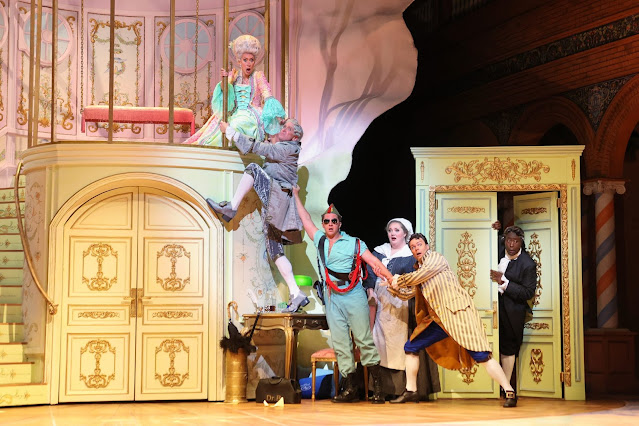
Murrella Parton (Berta), Joshua Hopkins (Figaro), Emily Fons (Rosina), Jack Swanson (Count Almaviva), Nicholas Newton (Don Basilio), Kevin Burdette (Dr. Bartolo), photo by Curtis Brown for the Santa Fe Opera 


When we tell people how much we love opera, they usually assume we are speaking about a "very serious art form". They seem surprised to learn that opera can be lighthearted and even funny. Yet some of our greatest masterpieces are considered comedies. Does Il barbiere di Siviglia qualify as a masterpiece? We say YES!  In the wrong hands it could be dull and overly long.  but in the hands of the Santa Fe Opera we can not think of Rossini's work as anything but a masterpiece.  No wonder it is the hit of the 2022 season!

Stephen Barlow has directed with admirable panache. Not a single funny stone was left unturned. Andrew D. Edwards has designed sets and costumes with style and wit aplenty. The columns flanking the set were neither Dorian nor Ionian; they were "Barberian"--the familiar old-fashioned striped barber poles.

For us, the most important aspect of an opera is the singing and we cannot imagine better casting. In our review of Performance Santa Fe's recital, we admired the bel canto singing and believable chemistry between Emily Fons and Jack Swanson. What a perfect choice for the roles of Rosina and "Lindoro" (Count Almaviva). Both sounded even better than they did at the recital, and that's saying a lot. Rossini's elaborate vocal challenges were more than met. Fantastic fioriture and super scale passages, terrific trills, and commanding cadenze tickled the ear.

In the role of the eponymous barber, we heard baritone Joshua Hopkins, a Santa Fe regular whose performances we have always enjoyed. This role suited his vocal skills perfectly. His "Largo al factotum" was delivered with several original touches that rose above  the customary clichés.

Bass Kevin Burdette, another Santa Fe Opera regular, made a spectacular showing as Dr. Bartolo. The first time we saw him in a comic role we were astonished by his comic chops. Last night we were more impressed than astonished. We were not aware of the extraordinary flexibility of his body which he employed with as much artistry as he did his voice. The laughter when he slid out of his chair like a flow of lava just about drowned out the singing. The rapid patter of "A un dottor della mia forte" was executed with precision. 

The brilliant bass-baritone Ryan Speedo Green, making his SFO debut, brought his incredible artistry to the role of Don Basilio, using his magnificent instrument successfully, revealing a great sense of comic timing. We delighted in his aria "La calunnia" in spite of some excessive directorial touches which we will address later.

As a huge fan of the Santa Fe Opera Apprentice Program, we are most delighted to honor the performances of two apprentices who fulfilled their roles with equal aplomb.

Baritone Kyle Miller made a stylish Fiorello as he assembled his musicians to accompany Mr. Swanson's cavatina "Ecco ridente". Although the role is not a large one, he must set the stage for the serenade of his boss' lady love and this he did admirably.

Soprano Murrella Parton illuminated the role of Berta and was given some unusual stage business that increased her importance in the opera. We look forward to hearing more from these three gifted apprentices.

Also given quite a lot of importance was the chorus, so well prepared by Chorus Master Susanne Sheston. We are always dazzled by their vocalism but in this case they were given a great deal to do as Fiorella's musicians, each of whom had his own personality. Later they appeared as a swat team!  More on that anon!

Maestro Iván López Reynoso established the Rossinian pace right from the overture. We loved the contrast between the staccato themes and the legato ones. Just as the Finns should borrow some vowels from the Italians, so contemporary composers should borrow some tunes from Rossini! The master even borrowed from himself!

And now, we would like to address the issue of staging. Without a doubt, this production is a crowd pleaser and often the laughter drowned out the singing. We agree that humor is vital in an opera buffa but in this case we feel the direction was over the top and the high jinx frequently distracted from the singing. Surely the characters owe a debt to commedia del'arte but we want opera to build upon its origins and to rise above mono-dimensionality

We believe ours to be a minority opinion but we felt the work was over directed. Much of what we objected to involved the touches of contemporaneity. Count Almaviva, alone among the characters, is dressed in contemporary casual--a hoodie to be exact; and he pays Fiorella with a mafioso suitcase filled with cash. One of the musicians is drinking from a styrofoam coffee cup. Berta pushes a Hoover around the floor and describes the chaos to an unseen listener on the telephone. Don Basilio carries a laptop and takes selfies with his cellphone. Figaro reclines in Rosina's bathtub. The police who come to quell the chaos are a swat team. Berta emerges from her servant's uniform as a glamorous star surrounded by a chorus of men in top hats and tails. We could go on and on but we believe you, dear reader, will get the picture.

When every character acts bizarrely or inappropriately funny, the impact of comedy becomes lost. Among lots of peculiar characterization, the arrogant Dr. Bartolo was directed as a simpering fop. At one point, he donned a sweat band, spread out a yoga mat and began doing weird contortions.

This "originality" was echoed by the set. Dr. Bartolo's house was a plaster cast of Rossini's face.  His eyes were used as windows and his mouth as a door.  Hedges imitated a huge handlebar mustache. The audience applauded before the singing began. This stage element revolved to show the inside of the home. Below was a period parlor and above was Rosina's room. Bars around it suggested a cage, commenting on her imprisonment by Dr. Bartolo. She sat on a swing, going forward and back. Necessary stage elements like the doctor's piano were wheeled on and off.

If this sounds like your cup of tea, you will have a rollicking good time. On our part, we would like to "unsee" this production and remember the way the excellent cast sang Rossini's glorious music, the thrilling duets (not only the love duet but the one between Rosina and Figaro), and the many layered ensembles, so well crafted by the composer.

© meche kroop


Tuesday, August 16, 2022

FESTIVAL OF SONG--PART 2

EMILY FONS (photo by Dario Acosta)


 JACK SWANSON (Photo by Lily Lancaster)

Two of our favorite young artists presented a most satisfying vocal recital last Sunday. Thanks to Performance Santa Fe, singers from the Santa Fe Opera get an opportunity to perform art songs in an intimate environment, the charmingly decorated theater at the Scottish Rite Temple.
 
Soprano Emily Fons and tenor Jack Swanson have been on our radar for some time and we are looking forward to seeing them perform in Il barbiere di Siviglia at the Santa Fe Opera--and you should too. It is one of our favorite operas and always a good time, especially when cast with exciting young talent. These two artists have perfect voices for bel canto. 

The highlight of Sunday's program, for us anyway, was the final selection on the program, one from a different Rossini opera--Cenerentola. The two artists had excellent chemistry in the scene in which the Prince, in disguise, first meets our charming heroine. The scene opened with Mr. Swanson walking up and down the aisles, representing his search for a potential bride. We could not imagine a better depiction of love at first sight. The elaborate bel canto filigrees presented no challenge to these two remarkably flexible voices.  We were enchanted.

Now, what about the rest of the program! Ms. Fons led off with three songs by Charles Ives, of whom we have never been much of a fan. Surprise! The songs he wrote to German text were a revelation. We always love being introduced to something we never knew existed and these songs have many of the qualities we love in Schubert's canon. But of course the fine German texts that inspired Schubert could also inspire Ives to write gorgeous vocal lines. The piano parts were also notable with lyrical arpeggi in "Feldeinsamkeit" and some thrilling rolling chords in "Weil auf mir". We loved the way Ms. Fons colored her tone with gentle warmth.

Also new to us were some settings of Shakespearean text by Erich Korngold. The songs fit Ms. Fons' lovely soprano perfectly and we appreciated the clarity of her diction--a quality we never take for granted.  In "Come Away Death" there were unsettling shifts from minor to major. "Adieu Good Man Devil" gave her the opportunity to use facial expression and gesture to get the song across, and that is just what we look for in a vocal recital. Lacking costuming and scenery, the singer and pianist must tell the tale.

Ms. Fons' storytelling skills also illuminated a set of songs by Francis Poulenc. These miniature marvels also offer the artist a variety of moods to convey and she certainly did live up to the task. We loved the sweet humor of "Le carafon" and the delicacy of "Les anger musiciens". The decrescendo at the conclusion of "La reine du coeur" was exquisite. Her diction in French is just as fine as it is in English.

Alternating between these sets were those of the terrific tenor Jack Swanson. He also performed songs by Poulenc and gave a great interpretation of the ironic "C" with the support of Mr. Tweten's searching piano line. He used his instrument well and expressively; there were some lovely floated notes at the top of the register. His French was as fine as one would wish. We especially enjoyed his vocal agility in "Fêtes galantes", which was overflowing with personality and a true crowd pleaser.

We were very happy to see one of our very favorite Rossini songs on the program, one that we were introduced to by Pavarotti. "La promessa" is a simple song that goes deep, whether due to, or in spite of an uncomplicated melody, one which we have not been able to get out of our head since the concert. Of course, no one is, or ever will be Pavarotti--but Mr. Swanson did a creditable job. "Addio ai Viennesi" was new to us and must have an interesting story behind it. It suited his voice well and showed off his flexibility, although we thought the scale passages might have benefitted from a bit more articulation.

Franz Liszt's Tre sonetti di Petrarcha was an interesting choice for a bel canto voice and was only partially successful. There is power enough in the voice but pehaps insufficient variety of color. The poet is in torment in "Pace non trovo" and Mr. Swanson expressed that in spades, successfully negotiating the wide leaps. However, "Benedetto sia il giorno" requires a more tender color. In "I vidi in terra angelici costumi" the voice is placed in the lower register whilst the piano occupies the higher register. This was also well handled. We know Mr. Swanson can float his high notes and there were times in this cycle when we wished he wouldn't push for volume. Sometimes whispers speak louder than shouts!

Once again we were very engaged by the contributions of collaborative pianist Robert Tweten. It was not solely in the places in which the singer was silent that we noticed qualities of the music that had gone previously unnoticed. It was more the interplay between voice and piano that captivated us.

© meche kroop


Saturday, August 18, 2018

ROSSINI ROCKS SANTA FE

Patrick Carfizzi (Taddeo), Daniela Mack (Isabella), Scott Conner (Mustafa), Stacey Geyer (Elvira), Suzanne Hendrix (Zulma), Jack Swanson (Lindoro)...Photo by Ken Howard for Santa Fe Opera


It was difficult to tell who was having more fun at the Santa Fe Opera last night at a riotous performance of Rossini's 1813 laugh riot L'Italiana in Algeri. The cast sparkled with glee and the audience roared with laughter. The original production by Edward Hastings premiered in 2002; we were there and we remember best the part in which Isabella arrives in Algeria by bi-plane!

We doubt that Rossini could have foreseen the Wright Brothers' invention so we will assume that this production has been advanced from the 19th c. a full century into the future.  That a forceful female character was invented by Rossini in the early 19th c. is rather remarkable.  Her setting an example for the dependent and lovelorn Elvira has resonance for us in the 21st c.

The story concerns this independent Italian woman who has gone searching for her missing beloved Lindoro; he had been captured by pirates and enslaved by the lecherous and self-important Sultan Mustafa, a ridiculous character whose arrogance makes him easy to fool.

Isabelle is accompanied by Taddeo who adores her.  She adores him not.

Mustafa is trying to rid himself of his adoring wife Elvira who needs some good mentoring by Isabella.  Mustafa has a yen for an Italian woman and Isabella arrives at just the right moment.  The opera story involves her plotting to free all the Italian slaves as well as Lindoro. Thus the opera became catnip for the Italians--not only for its memorable melodic score but also for patriotic reasons.

The setting in Algeria, then a vassal state of the Ottoman Empire, reminds us of Europe's fascination with all things exotic at that time. Indeed, not too long before, Mozart wrote his Die Entführung aus dem Serail, the theme of which is not too different.

During the overture, tiny bi-planes were "flown" up and down the aisles of the theater. A somewhat larger bi-plane appeared on the set, and when it was time for Isabella and Taddeo to make their entrance, a much larger bi-plane appeared on the stage.

This masterstroke of creativity set the audience to laughing and the laughs wouldn't stop all night long. For our taste, Shawna Lucey's direction was excessive but the audience loved all the gyrations, wriggling, pelvic thrusting, wild gesticulations, and Broadway chorus-style dancing. There was one trick that Ms.Lucey missed.  When Isabella and Lindoro take off in a hot-air balloon at the conclusion of the opera, there was a basket but no balloon!

We did love the set design by Robert Innes Hopkins which was well lit by Duane Schuler. There was a flat playing space with palm trees on each side; the floor unfolded upward to reveal Mustafa's palace with its Moorish arches and pillars. It reminded us of those greeting cards that are cleverly constructed to reveal a cut-out when one opens them.

David C. Woolard's costume design was wild and colorful for the Algerian court and suitable for the Europeans in their own fashion. We particularly enjoyed the scene in which Isabella tears down one of the curtains, snatches up some random decorations, goes behind a screen, and emerges in a stylish form-fitting costume.

The singing was excellent all around; Rossini's melodies paired with the vowel-dominant Italian language give one a chance to appreciate a singer's gifts--something that doesn't happen for us in contemporary operas in English. The best part of the singing was the work done as an ensemble. The voices blended in happy harmony with each character singing a different vocal line and expressing different emotions.

Mezzo-soprano Daniela Mack made a spunky Isabella, using her physical and vocal assets to get three men to do her bidding, making each one believe that he was the object of her desire. Her delivery of "Cruda sorte" was excellent.

Tenor Jack Swanson made a fine handsome Lindoro, one for whom a woman might go out searching. He was particularly admirable in his duets. Today's audience seems to love "patter songs" as much as the audience of two centuries ago; Mr. Swanson's rapid fire delivery was impressive.

Bass Scott Conner played the part of Mustafa to the hilt. His booming voice and imposing figure perfectly set off the silly nature of his actions. It is wonderful to hear that much flexibility in a large low voice.

As his rejected wife Elvira, Apprentice Singer Stacey Geyer lent her splendid soprano to the creation of a character a normal man would be foolish to abandon; but we did say that Mustafa was foolish.

Mezzo-soprano Suzanne Hendrix was excellent in the role of Zulma, Elvira's slave and confidant. She too showed a lot of spunk.

Bass-baritone Patrick Carfizzi was just about perfect in the role of Taddeo and succeeded in earning our sympathy for his unrequited love. He gets passed off as Isabella's uncle and avoids impalement by agreeing to join the court.

Baritone Craig Verm was humorously menacing as Haly, Mustafa's chief pirate and scourge of the slaves.

The chorus of Apprentice Singers served as slaves and pirates and eunuchs. We always want to thank Susanne Sheston since the chorus is always so well schooled in perfect diction. And all of them seem effective in whatever parts they are asked to play.

Last, but definitely not least, Rossini's music is a constant delight. Corrado Rovaris' baton led the Santa Fe Orchestra in a highly spirited and swiftly moving reading of the score. From the piping of the piccolo to the "Rossini Crescendo", he made every moment count.

Another triumph for the Santa Fe Opera!

(c) meche kroop


Wednesday, July 26, 2017

MOZART AND THEN SOME

Opening Night of Mostly Mozart

Sometimes in life we get more than we bargained for, more than we expected, more than we hoped for.  We were thrilled with the idea of six singers, all of whom we have cherished and written about, having their simultaneous debuts with the Mostly Mozart Festival. They are all rising stars and they would be onstage together performing the solo roles in Beethoven's Fantasia in C minor, also known as the Choral Fantasy--a work we have never heard performed. What excitement!

We will get to the astonishing features of the rest of the program but we will start at the end, as we sometimes do.  Brilliant young pianist Kit Armstrong distinguished himself in the prolonged opening of the work. Beethoven's wild energy was captured by Mr. Armstrong's lightning fast fingerwork in the rapid scale passages and the lyrical moments were rendered with expressive introspection.

Beethoven distributed some splendid solos to the wind instruments and we particularly admired the lengthy flute solo and the clarity of the clarinet solo. Louis Langree's conducting style is emphatic and balletic, effectively limning all the voices of Beethoven's orchestration.

The six vocal soloists we came to hear were outstanding in their handling of the vocal lines, overlapping and weaving together in a tapestry of gorgeous sonic brilliance. One could not have asked for better singing than that delivered by sopranos Janai Brugger and Brandie Sutton, mezzo-soprano Jennifer Johnson Cano, tenors Miles Mykkanen and Jack Swanson, and bass Adam Lau. Once young artists have reached this level of international fame, we have less opportunity to write about them and were doubly thrilled.

When we planned our attendance, we paid no attention to the rest of the program and were therefore non-plussed by our experience of the Young People's Chorus of New York City, a group of which we were previously unaware. Artistic Director and Founder Francisco J. Nunez must be some kind of wizard to have pulled such performances from these youngsters.

The lovely young ladies of the chorus were flatteringly dressed in royal blue dresses with red petticoats peeking out from under the skirts and matching headbands. The voices were, of course, far more important than the garb but it would have been churlish not to mention how visually attractive a picture they presented as they entered down the side aisles and took their places onstage.

The program opened with a stunning performance of the Kyrie K.90, written by the teenage Mozart. The harmonies were absolutely exquisite. But the piece that mostly astonished us was Marcos Leite's arrangement of Tres Cantos Nativos dos Indios Krao. There seemed to be no extant translation and none was necessary. What we heard (and we did NOT read the program in advance) were the sounds of a rainforest and a coming storm, just as effectively rendered as in Beethoven's Sixth Symphony.

The young singers used their bodies in unison to create all kinds of natural sounds emulating birdcalls and finally raindrops falling. They clapped their hands and tapped various parts of their bodies to create a miraculous soundscape, the beauty of which brought tears to our eyes.

The thought came to us that talent knows no age. These youngsters seemed to represent a mosaic of our wonderful New York City with complete diversity of size, shape, and color.  Glorious!  We need not worry about the future of music!

Not only were the aisles put to use for conducting, entrances, and exits--but also the balconies, giving us a "surround sound" experience with overlapping voices in the other numbers they performed--"Hark, I Hear the Harps Eternal" and "Didn't My Lord Deliver Daniel".

The Young People's Chorus was joined by the Children's Chorus for Maestro Nunez' own arrangement of "Ah vous dirai-je maman".  They were also wonderful. We thought a golden opportunity was missed to pair that with Mozart's own variations on that childhood tune.

The encore was the finale of Bernstein's Candide, a true crowd pleaser.

There were features of the programming that bothered us. Splitting up symphonies into their component movements may have been common in the 18th c. but we failed to appreciate the dissection of Mozart's "Haffner" symphony.  To our ears it was disruptive and we object to the loss of continuity and the feeling of completion we usually experience when a symphony is brought to its conclusion.

Still, we agree that the Mostly Mozart Festival Orchestra played beautifully under Maestro Langree's dramatically wielded baton. There were places in the first movement with such suspended energy that we wanted to stage it in our mind's eye as a scene in an opera, a scene ripe for explosion.

Although the program notes, which we finally read when we returned home, tried to justify the interpolation of songs by the Young People's Chorus between the movements with an overall theme of youthful energy, we thought that was working very hard to justify a peculiar decision.

There was one further decision that didn't sit well with us.  We adore Bernadette Peters on the Broadway stage but choosing her as host for the evening was not a fortuitous one. Her baby-doll voice was over amplified and her reading of the narration was frequently incomprehensible. Additionally, a host should be able to name the conductor and the composer without reading from cards.  Sorry, not sorry, dear readers--but we calls 'em as we hears 'em.

(c) meche kroop

Thursday, March 16, 2017

ON THIS ISLAND...AND OTHERS

Ho Jae Lee, Steven Blier, Benjamin Dickerson, Hannah Dishman, Jack Swanson, Christine Price

It comes as no surprise that Steven Blier (Artistic Director of New York Festival of Song, collaborative pianist, educator, coach, recording artist, etc.) graduated from Yale with Honors in English Literature. His program notes are always invaluable and highly instructive. Furthermore, they are so well written that we find ourself wanting to quote directly from them instead of finding our own words. So, dear reader, when you see a phrase in quotes, please know exactly whom we are quoting, which surely beats plagiarizing. We hope the generous Mr. Blier will feel complimented.

The theme of last night's recital was Four Islands--comprising Ireland, Cuba, Madagascar, and Manhattan. Mr. Blier finds island dwellers to be "fundamentally different from our landlocked neighbors". Having been "under attack from outside enemies (we) must learn to protect ourselves from invasion".  Just think about that when you are trying to push through the throngs of Times Square to get to the theater!

The program opened with some Irish folksongs and regular readers will recall how taken we are with folk melodies. In "Siul A Ghra", soprano Christine Price and mezzo-soprano Hannah Dishman created some exquisite harmonies a cappella, even before Mr. Blier chimed in with a spare piano accompaniment. We haven't a clue what Gaelic is supposed to sound like but to our ears it sounded authentic. 

Ms. Dishman was then joined by baritone Benjamin Dickerson for a cute romantic ditty entitled "The Palatine's Daughter". From Mr. Blier's program notes, we learned that the Palatines were a German-speaking group who were forced out of their country by war in the early 18th c. and given asylum by England. Apparently they assimilated successfully, in this case through romance. The accompaniment by the flute of Marco Granados was lovely.

Let us skip over the song by Arnold Bax, a Brit who was as entranced by Ireland as was Victor Herbert, about whom we wrote last week.  But we won't skip without mentioning the powerful piano of Ho Jae Lee whose artistry on the piano is astonishing.

John Corigliano also set Irish folksongs and Ms. Price's clear and lovely soprano wove in and out of the fanciful line of the flute.

But the song from Ireland that captured our heart was Houston Collisson's "Eileen Og" which was given a charming and humor filled performance by tenor Jack Swanson, joined by Mr. Granados' flute. The song contained a very particular lesson for men who go a-courtin'.

The ship was ready to sail and off we went to Cuba where the "Spanish elements suppressed, resisted, slowly co-opted, and finally embraced the rhythms of the oppressed Afro-Cubans". Does that scenario sound familiar? Afro-Cubans were not freed from slavery until 1886 and yet, today, seem far more integrated than Afro-Americans.  Cuban music is a "grafting of Spanish elegance onto the complex throb of African rhythms".  (Wish we'd written that!)

It took four hands of piano (Mr. Blier and Mr. Lee) to give enough textural support to Mr. Swanson and Mr. Dickerson as they performed "Guarina", a lyrical serenade written by the untrained but gifted composer Sindo Garay.

Ms. Price, accompanied by Mr. Lee, excelled in Ernesto Lecuona's setting of "Quiero ser hombre", text by the Uruguayan feminist poet Juana Ibarbourou.

Cuba must stand among the nations of the New World which adapted the Spanish operetta known as zarzuela to their own use. Mr. Brier's droll explication added much to our enjoyment of "Aria de Matilde" from Jose Mauri's La Esclava. It was not the only piece to highlight difficult social issues like interracial romance, but it was one of the first.  Dark-skinned heroine (soprano) has dark-skinned lover (baritone) but gets seduced by aristocratic light-skinned man (tenor) gets pregnant and commits suicide. In this case, however, the aria was sung by a mezzo and Ms. Dishman sang it with lovely tone and depth of feeling.

The funniest song in Cuba must have been Emilio Grenet's "Tu no sab ingle" (sic) which sounds like a Spanish answer to ebonics. Mr. Dickerson (whom we have now heard in French, German, English, and Spanish) was hilarious lecturing his friend about his linguistic failure with American girls.

After the interval, we weighed anchor once more and set sail for Madagascar. The traditional Zulu melody, gloriously harmonized by Ms. Price, Ms. Dishman, and Mr. Swanson thrilled us with its strange words and interesting harmonies. 

However, as hard as we tried to like Maurice Ravel's Chansons Madecasses, we were unable to relate to the music. The French text of "Nahandove" and "Il est doux" was incredibly sensual which we readily picked up from Mr. Lee's piano and the delicacy of the cello, beautifully bowed by Nan-Cheng Chen. However, the vocal line did nothing for us and Mr. Dickerson's use of the music stand prevented us from feeling the connection we felt in the Zulu piece.

We were very happy to dock in Manhattan and Cole Porter's "I Happen to Like New York" perfectly expressed our sentiments. All four singers and all four hands on the piano were enlisted for this exciting final song with its punchy Anglo-Saxon rhymes.

But let us not omit the other wonderful songs in the Manhattan group. Ms. Price gave a galvanizing performance of "One Life to Live" from Kurt Weill's 1941 Lady in the Dark, in which she has a YOLO moment.  Ms. Dishman gave a highly convincing portrait of an auditioning actress in Jason Robert Brown's "When you Come Home to Me". (We sincerely hope that none of last night's artists ever have to endure such humiliation.)

Mr. Swanson sang an unpublished song by Irving Berlin, cut from the musical As Thousands Cheer. "Through a Keyhole" was considered too risque for its Depression-era Broadway and it certainly is filled with naughty innuendo which Mr. Swanson captured without exaggerating.  It was done just right.

As encore, we heard a composition by Villa Lobos based on the NewYork Skyline. 

It was a great cruise and we are glad to be home safe and sound to tell you all about it.

(c) meche kroop