MISSION

We are here to encourage the development of gifted young singers and to stimulate the growth of New York City's invaluable chamber opera companies. But we will not neglect the Metropolitan Opera either. Get ready for bouquets and brickbats.
Showing posts with label Emily Fons. Show all posts

Sunday, August 21, 2022

A CLOSER SHAVE


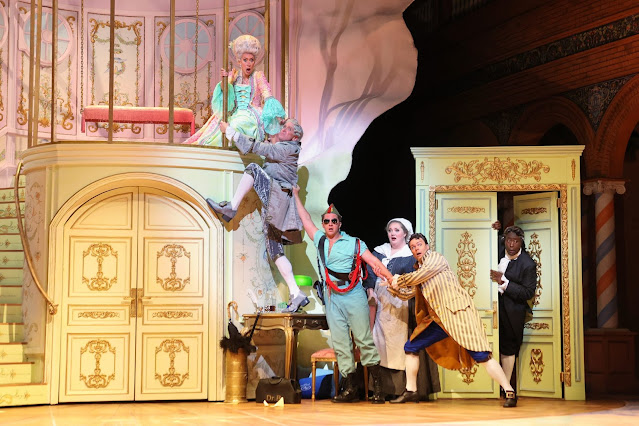
Murrella Parton (Berta), Joshua Hopkins (Figaro), Emily Fons (Rosina), Jack Swanson (Count Almaviva), Nicholas Newton (Don Basilio), Kevin Burdette (Dr. Bartolo), photo by Curtis Brown for the Santa Fe Opera 


When we tell people how much we love opera, they usually assume we are speaking about a "very serious art form". They seem surprised to learn that opera can be lighthearted and even funny. Yet some of our greatest masterpieces are considered comedies. Does Il barbiere di Siviglia qualify as a masterpiece? We say YES!  In the wrong hands it could be dull and overly long.  but in the hands of the Santa Fe Opera we can not think of Rossini's work as anything but a masterpiece.  No wonder it is the hit of the 2022 season!

Stephen Barlow has directed with admirable panache. Not a single funny stone was left unturned. Andrew D. Edwards has designed sets and costumes with style and wit aplenty. The columns flanking the set were neither Dorian nor Ionian; they were "Barberian"--the familiar old-fashioned striped barber poles.

For us, the most important aspect of an opera is the singing and we cannot imagine better casting. In our review of Performance Santa Fe's recital, we admired the bel canto singing and believable chemistry between Emily Fons and Jack Swanson. What a perfect choice for the roles of Rosina and "Lindoro" (Count Almaviva). Both sounded even better than they did at the recital, and that's saying a lot. Rossini's elaborate vocal challenges were more than met. Fantastic fioriture and super scale passages, terrific trills, and commanding cadenze tickled the ear.

In the role of the eponymous barber, we heard baritone Joshua Hopkins, a Santa Fe regular whose performances we have always enjoyed. This role suited his vocal skills perfectly. His "Largo al factotum" was delivered with several original touches that rose above  the customary clichés.

Bass Kevin Burdette, another Santa Fe Opera regular, made a spectacular showing as Dr. Bartolo. The first time we saw him in a comic role we were astonished by his comic chops. Last night we were more impressed than astonished. We were not aware of the extraordinary flexibility of his body which he employed with as much artistry as he did his voice. The laughter when he slid out of his chair like a flow of lava just about drowned out the singing. The rapid patter of "A un dottor della mia forte" was executed with precision. 

The brilliant bass-baritone Ryan Speedo Green, making his SFO debut, brought his incredible artistry to the role of Don Basilio, using his magnificent instrument successfully, revealing a great sense of comic timing. We delighted in his aria "La calunnia" in spite of some excessive directorial touches which we will address later.

As a huge fan of the Santa Fe Opera Apprentice Program, we are most delighted to honor the performances of two apprentices who fulfilled their roles with equal aplomb.

Baritone Kyle Miller made a stylish Fiorello as he assembled his musicians to accompany Mr. Swanson's cavatina "Ecco ridente". Although the role is not a large one, he must set the stage for the serenade of his boss' lady love and this he did admirably.

Soprano Murrella Parton illuminated the role of Berta and was given some unusual stage business that increased her importance in the opera. We look forward to hearing more from these three gifted apprentices.

Also given quite a lot of importance was the chorus, so well prepared by Chorus Master Susanne Sheston. We are always dazzled by their vocalism but in this case they were given a great deal to do as Fiorella's musicians, each of whom had his own personality. Later they appeared as a swat team!  More on that anon!

Maestro Iván López Reynoso established the Rossinian pace right from the overture. We loved the contrast between the staccato themes and the legato ones. Just as the Finns should borrow some vowels from the Italians, so contemporary composers should borrow some tunes from Rossini! The master even borrowed from himself!

And now, we would like to address the issue of staging. Without a doubt, this production is a crowd pleaser and often the laughter drowned out the singing. We agree that humor is vital in an opera buffa but in this case we feel the direction was over the top and the high jinx frequently distracted from the singing. Surely the characters owe a debt to commedia del'arte but we want opera to build upon its origins and to rise above mono-dimensionality

We believe ours to be a minority opinion but we felt the work was over directed. Much of what we objected to involved the touches of contemporaneity. Count Almaviva, alone among the characters, is dressed in contemporary casual--a hoodie to be exact; and he pays Fiorella with a mafioso suitcase filled with cash. One of the musicians is drinking from a styrofoam coffee cup. Berta pushes a Hoover around the floor and describes the chaos to an unseen listener on the telephone. Don Basilio carries a laptop and takes selfies with his cellphone. Figaro reclines in Rosina's bathtub. The police who come to quell the chaos are a swat team. Berta emerges from her servant's uniform as a glamorous star surrounded by a chorus of men in top hats and tails. We could go on and on but we believe you, dear reader, will get the picture.

When every character acts bizarrely or inappropriately funny, the impact of comedy becomes lost. Among lots of peculiar characterization, the arrogant Dr. Bartolo was directed as a simpering fop. At one point, he donned a sweat band, spread out a yoga mat and began doing weird contortions.

This "originality" was echoed by the set. Dr. Bartolo's house was a plaster cast of Rossini's face.  His eyes were used as windows and his mouth as a door.  Hedges imitated a huge handlebar mustache. The audience applauded before the singing began. This stage element revolved to show the inside of the home. Below was a period parlor and above was Rosina's room. Bars around it suggested a cage, commenting on her imprisonment by Dr. Bartolo. She sat on a swing, going forward and back. Necessary stage elements like the doctor's piano were wheeled on and off.

If this sounds like your cup of tea, you will have a rollicking good time. On our part, we would like to "unsee" this production and remember the way the excellent cast sang Rossini's glorious music, the thrilling duets (not only the love duet but the one between Rosina and Figaro), and the many layered ensembles, so well crafted by the composer.

© meche kroop


Tuesday, August 16, 2022

FESTIVAL OF SONG--PART 2

EMILY FONS (photo by Dario Acosta)


 JACK SWANSON (Photo by Lily Lancaster)

Two of our favorite young artists presented a most satisfying vocal recital last Sunday. Thanks to Performance Santa Fe, singers from the Santa Fe Opera get an opportunity to perform art songs in an intimate environment, the charmingly decorated theater at the Scottish Rite Temple.
 
Soprano Emily Fons and tenor Jack Swanson have been on our radar for some time and we are looking forward to seeing them perform in Il barbiere di Siviglia at the Santa Fe Opera--and you should too. It is one of our favorite operas and always a good time, especially when cast with exciting young talent. These two artists have perfect voices for bel canto. 

The highlight of Sunday's program, for us anyway, was the final selection on the program, one from a different Rossini opera--Cenerentola. The two artists had excellent chemistry in the scene in which the Prince, in disguise, first meets our charming heroine. The scene opened with Mr. Swanson walking up and down the aisles, representing his search for a potential bride. We could not imagine a better depiction of love at first sight. The elaborate bel canto filigrees presented no challenge to these two remarkably flexible voices.  We were enchanted.

Now, what about the rest of the program! Ms. Fons led off with three songs by Charles Ives, of whom we have never been much of a fan. Surprise! The songs he wrote to German text were a revelation. We always love being introduced to something we never knew existed and these songs have many of the qualities we love in Schubert's canon. But of course the fine German texts that inspired Schubert could also inspire Ives to write gorgeous vocal lines. The piano parts were also notable with lyrical arpeggi in "Feldeinsamkeit" and some thrilling rolling chords in "Weil auf mir". We loved the way Ms. Fons colored her tone with gentle warmth.

Also new to us were some settings of Shakespearean text by Erich Korngold. The songs fit Ms. Fons' lovely soprano perfectly and we appreciated the clarity of her diction--a quality we never take for granted.  In "Come Away Death" there were unsettling shifts from minor to major. "Adieu Good Man Devil" gave her the opportunity to use facial expression and gesture to get the song across, and that is just what we look for in a vocal recital. Lacking costuming and scenery, the singer and pianist must tell the tale.

Ms. Fons' storytelling skills also illuminated a set of songs by Francis Poulenc. These miniature marvels also offer the artist a variety of moods to convey and she certainly did live up to the task. We loved the sweet humor of "Le carafon" and the delicacy of "Les anger musiciens". The decrescendo at the conclusion of "La reine du coeur" was exquisite. Her diction in French is just as fine as it is in English.

Alternating between these sets were those of the terrific tenor Jack Swanson. He also performed songs by Poulenc and gave a great interpretation of the ironic "C" with the support of Mr. Tweten's searching piano line. He used his instrument well and expressively; there were some lovely floated notes at the top of the register. His French was as fine as one would wish. We especially enjoyed his vocal agility in "Fêtes galantes", which was overflowing with personality and a true crowd pleaser.

We were very happy to see one of our very favorite Rossini songs on the program, one that we were introduced to by Pavarotti. "La promessa" is a simple song that goes deep, whether due to, or in spite of an uncomplicated melody, one which we have not been able to get out of our head since the concert. Of course, no one is, or ever will be Pavarotti--but Mr. Swanson did a creditable job. "Addio ai Viennesi" was new to us and must have an interesting story behind it. It suited his voice well and showed off his flexibility, although we thought the scale passages might have benefitted from a bit more articulation.

Franz Liszt's Tre sonetti di Petrarcha was an interesting choice for a bel canto voice and was only partially successful. There is power enough in the voice but pehaps insufficient variety of color. The poet is in torment in "Pace non trovo" and Mr. Swanson expressed that in spades, successfully negotiating the wide leaps. However, "Benedetto sia il giorno" requires a more tender color. In "I vidi in terra angelici costumi" the voice is placed in the lower register whilst the piano occupies the higher register. This was also well handled. We know Mr. Swanson can float his high notes and there were times in this cycle when we wished he wouldn't push for volume. Sometimes whispers speak louder than shouts!

Once again we were very engaged by the contributions of collaborative pianist Robert Tweten. It was not solely in the places in which the singer was silent that we noticed qualities of the music that had gone previously unnoticed. It was more the interplay between voice and piano that captivated us.

© meche kroop


Wednesday, August 17, 2016

GOUNOD'S ROMEO ET JULIETTE AT SANTA FE OPERA

Stephen Costello and Ailyn Perez (photo by Ken Howard)

Last night's performance of Charles Gounod's Romeo et Juliette soared with stunning singing and some mighty marvelous musicianship. The chorus (directed by the incomparable Susanne Sheston) sang with such fine French diction that not a word was missed.  The orchestra, under the baton of Harry Bicket, captured all of Gounod's nuance.  This was a co-production with the Fundacio del Gran Teatre del Liceu in Barcelona. The opera was making its first appearance at The Santa Fe Opera.

Gounod's success with Faust some 8 years earlier was arguably matched by this adaptation of the play by William Shakespeare by the same librettists who adapted Goethe's masterpiece--Jules Barbier and Michel Carre. Gounod was a master melodist and both operas leave one humming--a very good sign in our estimation.

The opera hews rather closely to the Shakespeare play with a few minor changes and a few deleted characters. To suit the operatic mentality, the librettists chose to focus on the romance between the two young lovers. Nonetheless, in our day and age, with gun control and belligerence on the front page every day, we cannot fail to miss the major point that meaningless hostility between any two groups--be they religious, political, or cultural--leads to irreparable loss to all concerned. We got the message when, at the conclusion of the opera, the opposing parties lay down their swords. Would that all mankind would get the message!

Returning to the issue of melody, the opera includes a breathtaking aria in waltz time for Juliette--"Je veux vivre"; one of our favorite sopranos Ailyn Perez performed this aria with technical mastery equalled only by the sparkle of youthful high spirits. During the course of the opera, Juliette must convey emotional growth from these adolescent high spirits to the solemn lifetime commitment to Romeo,  through the panic of risk-taking to the ultimate grief of loss. These emotional changes were nicely negotiated by Ms. Perez whose instrument has a lovely silvery tone. Her phrasing is impeccable and her French, perfect.

The opera has four duets occurring at different stages of the relationship between the two young lovers. Tenor Stephen Costello, whom we always enjoy, was at the top of his form, allowing his fine sound to soar with freedom of expression. Their two voices blended harmoniously in just the way we want a soprano and tenor to blend.  His "Ah! leve-toi, soleil" was brilliant.. Mr. Costello is appearing at The Santa Fe Opera for the first time. We hope he will return.

And what a pleasure it was to hear baritone Elliot Madore in the role of Romeo's friend Mercutio. His "Queen Mab" aria was delivered with vocal excellence and dramatic validity.  It is too bad that Mercutio gets killed off so early! We would have to say that Mr. Madore owns this role and, if you miss him here in Santa Fe, you can hear him sing the role at The Metropolitan Opera in New York.

As the young page Stephano, mezzo-soprano Emily Fons impressed us as favorably as she did when she performed the role of Cherubino three years ago.  But we didn't know she could dance!

Bass Raymond Aceto whom we enjoyed as Wells Fargo agent Ashby in Fanciulla del West, demonstrated his versatility in the role of Frere Laurent.

Mezzo-soprano Deborah Nansteel portrayed Juliette's nurse Gertrude and portrayed her successfully.

The role of Tybalt was well-sung by apprentice Cooper Nolan whose versatile tenor was enjoyed Sunday night in the role of Stiffelio in the Apprentice Recital.

As Juliette's father Count Capulet, baritone Tim Mix used his substantial instrument and stage presence to create a formidable character.

In contrast with the superlative musical values, the production values were disappointing. Director Stephen Lawless chose to remove the story from its natural time and place--Renaissance Verona--and set it in Gounod's own period.  Instead of civil unrest we had two opposing armies, one dressed in red, the other in blue. (Had they been blue and grey we might have been thinking of the American Civil War). In place of a monk in a monastery, we had a doctor in an army field hospital who took off his (bloodied) white coat and joined Romeo and Juliet in marriage right there in the hospital!

Perhaps Mr. Lawless meant to create an abstract symbol for all such internecine wars.  But in our opinion, it works better to stick to the specifics of time and place and allow the audience to generalize to their own situations.

The costumes by Ashley Martin-Davis were gorgeous and we loved the way the chorus stripped away their mourning black to reveal white ball gowns.  However, the 1860's fashions seemed terribly incongruent with the story and Ms. Perez' gown seemed quite inappropriate for an adolescent.  As a matter of fact the voluminous fabric seemed to swallow her up.

We were equally dismayed by Ms. Martin-Davis' set design.  We seemed to be in some kind of mausoleum which might have worked for the final tomb scene but which did not work well for Juliette's residence. The walls were divided into squares, each bearing a name. Watching the opera from the 8th row, we could make out the names which was distracting. They were mostly British names. Did this mean we were in England?  In America? Was there a body entombed behind each plaque? In truth, it looked like a morgue and we half expected the doctor to slide one open.

But that didn't happen.  What did happen was that doors opened and closed with singers entering and exiting. It made neither dramatic sense nor spatial sense.

So once again we have reveled in the musical artistry and despaired over "concept".  We will take our opera "neat", thank you, without the concept.

(c) meche kroop


Wednesday, August 19, 2015

ON COLD MOUNTAIN


Isabel Leonard and Nathan Gunn in Cold Mountain at Santa Fe Opera (photo by Ken Howard for SFO)


You read Charles Frazier's best-selling novel.  You saw the movie with Jude Law, Nicole Kidman, and Renee Zellweger. Do you want to see the opera premiering this season at the Santa Fe Opera?  Yes, you do! You want to hear mezzo-sopranos Isabel Leonard and Emily Fons create the roles of Ada Monroe and Ruby Thewes, two characters who bond in sisterhood and change each other's lives for the better.  You want to hear baritone Nathan Gunn as the war-weary defector W.P. Inman and you want to hear tenor Jay Hunter Morris as the slimy villain Teague. They were as excellent dramatically as they were vocally.

Will you want to see this opera a second time?  Probably not.  And why is that?  Like so many contemporary operas in English, the language itself has not inspired award-winning composer Jennifer Higdon to write any memorable vocal lines, indeed, not any melody whatsoever.  And what is opera without melody?  A play with music is what it is. We were reminded of the soundtrack of a film. We have only good things to say about Ms. Higdon's instrumental writing which is highly textured and interesting.  Even in its dissonant passages illuminating battles, it is accessible.  But the vocal lines are strictly conversational and without lyricism. They might as well have been spoken.

We sensed a number of missed opportunities. When Pangle and Storbrod appeared onstage with a banjo, we became all excited, hoping that Ms. Higdon would have chosen an unorthodox path by including a banjo in the orchestra and by employing some folk tunes indigenous to that part of the South. No such luck! And when apprentice soprano Chelsea Basler (in an excellent performance as Sarah) sang to her baby, her vocal line did not even begin to suggest a lullabye, although we heard some lovely sounds coming from the harp. When the group of men-starved young women (beautifully sung and acted by apprentices Heather Phillips, Shabnam Kalbasi, Megan Marino, and Bridgette Gan) try to seduce Inman and Veasy (Roger Honeywell), we longed for more seductive music.  We were thinking of the Rhinemaidens!

Miguel Harth-Bedoya's conducting cannot be faulted and the orchestra sounded crisp and clear. The chorus sang magnificently, as usual, under the direction of Susanne Sheston. We particularly enjoyed the chorus of dead soldiers at the end which was quite moving.

Dramatically, everything worked. Leonard Foglia's effective direction had us experiencing Ada and Ruby's hardship on the home front in alternation with Inman's frightening and tortuous efforts to evade the Home Guard and come home to the waiting Ada. Librettist Gene Scheer wrote some fine texts that added to the drama and hewed closely to the spirit of the novel.

The scenic design by Robert Brill was a chaotic jumble of wooden planks, appearing somewhat dangerous for the artists, but fortunately there were no mishaps.  The set  worked best when some planks were repurposed as a boat in which Inman is crossing a river, a boat which sank. David C. Woolard's costumes were superb, giving us a good picture of the stylish but helpless Charleston lady that Ada had been and the capable farm woman she became under Ruby's tutelage and exhortation.

As a matter of fact, the relationship between the two women was more interestingly portrayed than Ada's relationship with Inman. For the latter, there is only a brief scene of their meeting and then their final ill-fated reunion for which we yearned to hear a more lyrical and tender duet. (This parallels the construction of the novel, of course.) Still we were intrigued by the idea that two very different women could form such a loving and worthwhile bond.  Ada teaches Ruby to read and to appreciate some of the finer things in life while Ruby teaches Ada to be independent and strong.

As Ruby's father Storbrod, bass Kevin Burdette turned in his usual fine performance.  Tenor Jay Hunter Morris not only sang magnificently as Teague, but created a character of menace who chilled us to the bone.

The Civil War was indeed a disgraceful event in our nation's history and, after a century and a half has passed, we observe that the wounds have still not healed.  That makes the topic eminently suitable for a great American opera. Our dismay over the evils of war will always be relevant to contemporary times.  The topic of damaged lives strikes very close to home as we deal with veterans of wars in the Middle East. So this is a valid subject for operatic treatment.  We only wish that the music had reflected our musical history as well.

(c) meche kroop

Saturday, August 24, 2013

SANTA FE OPERA GETS FIGARO MARRIED OFF IN HIGH STYLE

Lisette Oropesa, Zachary Nelson, Susanna Phillips, Daniel Okulitch--photo by Ken Howard
When the Santa Fe Opera gets it right the delight factor is a 9.9 on the Richter Scale.  Perfect casting and a fine production are responsible for the enormous success of Nozze di Figaro.  High art embellished with great entertainment values?  That's what opera should be but often isn't.  One can always tell when this magic occurs.  Members of the audience walk around with big grins during intermissions and on the way home.

In a fortuitous confluence of casting wisdom, the entire cast operated as an ensemble.  We felt as if we were visiting an aristocratic household in which the inhabitants had known each other for years and were familiar with each other's quirks.

One could not have asked for a better Figaro than fast-rising baritone Zachary Nelson who was an apprentice at SFO just last year!  His fine expressive voice is matched only by his spot-on acting choices.  "Se vuol ballare" never sounded so good; this is a lovable Figaro!  His Susana was an equally wonderful Lisette Oropesa whom we have enjoyed long before she graced the stage at The Metropolitan Opera.  Her silver soprano and the spunky character she created were a great match with her Figaro.  Her love for her husband showed through in her "Deh vieni non tardar".

Just as perfect was the pairing of lovely soprano Susanna Phillips as the neglected Countess whose "Porgi Amor" brought tears to our eyes, as did her "Dove sono".  Her Count was portrayed by the handsome Daniel Okulitch, his elegant and aristocratic appearance joining with his resonant bass-baritone to create an entitled aristocrat whom young women would not work too hard to fight off.  He excelled at demonstrating the Count's cluelessness.

Mezzo Emily Fons did a splendid job in the trouser role of Cherubino--looking amazingly like a hormonal youth and throwing herself into her "Non so piu" and "Voi che sapete" with excellent breathless phrasing that somehow managed not to lose its legato line.  Bass-baritone Dale Travis was effective as the pompous Dr. Bartolo who must go through even more changes than the Count during the course of the bridal day.  Mezzo Susanne Mentzer delighted as the snarky housekeeper Marcellina who also must make an attitudinal about-face.  Tenor Keith Jameson, who always turns in a fine performance, was true to form as the slimy Don Basilio.

Apprentice Rachel Hall was just as adorable as Barbarina should be and has a promising voice.  We hope to hear more of her.  As her bibulous father Antonio we heard apprentice Adam Lau who was so effectively made up that we didn't recognize him.  Apprentice Jonathan Winell sang the role of Don Curzio and apprentices Lindsay Russell and Samantha Korbey appeared as bridesmaids.  We just love seeing apprentices onstage!

John Nelson conducted Mozart's endlessly melodic music with appropriate elan.  Bruce Donnell directed with a sure hand.  Susanne Sheston ensured that the chorus sang beautifully.  Sets and Costumes by Paul Brown hit the mark consistently.  But whoever was responsible for Ms. Phillips' wig in Act III should be forced to wear it in public!  EWWW!

And one final quibble in a 99% wonderful production by Jonathan Kent--all that flower picking and replacing has GOT to GO.  All that stage business during the overture gives the impression that someone didn't trust the audience to enjoy Mozart's masterpiece without some eye candy.

© meche kroop