MISSION

We are here to encourage the development of gifted young singers and to stimulate the growth of New York City's invaluable chamber opera companies. But we will not neglect the Metropolitan Opera either. Get ready for bouquets and brickbats.
Showing posts with label Thomas Cilluffo. Show all posts

Friday, August 26, 2022

A STAR IS BORN


Quinn Kelsey as Falstaff  (photo by Curtis Brown for Santa Fe Opera)


We planned on writing about baritone Quinn Kelsey and his lusty and self-deluding Falstaff.  However, we were so taken with Teresa Perrotta's performance in the role of Alice Ford that we can think of nothing else. Stepping out of her apprentice position and into this role (substituting for Alexandra LoBianco) was a fabulous opportunity and one she seized with a stunning role interpretation and consummate vocalism that garnered deafening applause at the conclusion of the opera.

Of course, the entire cast was cause for celebration, as was the astute conducting of Maestro Robert Tweten, but to see a newcomer shine like that is revelatory. This young soprano has a major voice and was undaunted by Verdi's writing. She possesses a superb instrument, as we noted when writing about the  apprentice scenes. Having been mightily impressed by her Violetta in a scene from La Traviata, we cannot claim to be completely astonished; however, assuming a major role like this one with so much stage time is an entirely different story.

Her Alice Ford was substantial and real, good natured but a bit mischievous. Ms. Perrotta is probably very close in age to the adorable soprano Elena Villalón who portrayed her daughter Nanetta; however, her bearing and the weight of her voice succeeded in creating a convincing mother/daughter relationship. We foresee a brilliant future for Ms. Perrotta and nothing could make us happier.

Similarly, Ms. Villalón was completely believable as Nanetta, a young girl in love. The high tessitura of Verdi's writing seemed to offer no challenge to her focused soprano and her acting was everything it should be. She charmed us with her Act III aria  "Sul fil d'un soffio etesio". Lyric tenor Eric Ferring as Fenton made an ardent lover as they teased one another and flew into each other's arms. Although the opera lacks large Verdian arias, Fenton gets a lovely brief one in "Dal labbro il canto estasiato vola" which served to highlight Mr. Ferring's  pleasing timbre and phrasing; we admired a graceful diminuendo and the easeful approach to high notes. When the two young voices joined for "Labbra di foco", we were smiling from ear to ear.

If one were looking for major arias in this opera one might be disappointed; however baritone Roland Wood made the most of his jealousy aria "È sogno o realtà?"  His character is difficult to like, not only because of his unwarranted jealousy but also because he would sacrifice his daughter to provide a wife for his elderly friend Dr. Caius (tenor Brian Frutiger). We liked him better by the conclusion of the opera when he graciously accepted the new son-in-law whom he had unwittingly blessed .

Trickery would seem to be the theme of the story. Falstaff would like to trick two women to get their money to pay for his lavish self-indulgence. Bardolfo and Pistola trick Falstaff into taking them back into service by pretending to be repentant. Mistress Quickly tricks Falstaff into believing that Alice appreciates his interest. Alice Ford tricks her husband into marrying their daughter to Fenton. The biggest tricks of all are played on Falstaff. Don't we all love to see people get the comeuppance they deserve? We think of this as "The Revenge of the Merry Wives".

And Falstaff certainly deserves comeuppance for his treatment of women and for his narcissistic self-delusion. So how does a shameless fraud like Falstaff achieve the sympathy of the operatic audience? The secret lies in the light hearted music created by Verdi, which tells us not to take him seriously, and in the artistry of the singer portraying him. For this we have Mr. Kelsey to thank for his resonant baritone and his total immersion in the role. We felt sorry for him when the townspeople beat him up in Act III. He affects repentance for his bad behavior but we know he is not "cured". Although he has seen his own folly, he readily points out the folly of others.  Verdi's brilliantly written fugue ends the opera with "Tutto nel mondo è burla".

The factors that made Sir David McVicar's production so successful comprise the splendid ensemble feel of the work, and Robert Tweten's conducting, which brought out every comic element of Verdi's score. We have tried for years to grasp what makes music funny and invite our dear readers to comment below. At one point we heard the orchestra laughing! Was it the unexpected rhythmic shifts that created the humor?

As far as the ensemble work, the contributions of bass Scott Conner as Pistola and tenor Thomas Cilluffo (one of the apprentices) as Bardolfo doubled the comic impact of the work. Each had a unique personality and style of movement. Consider yourself fortunate if you were close enough to see their facial expressions as well as their antics. The audience loved it when Bardolfo, disguised as Nanetta, got married to Dr. Caius. Oh how he pranced!  Oh how we laughed.

Mezzo-soprano Megan Marino made a funny Meg Page in a very funny hat and mezzo-soprano Ann McMahon Quintero delighted with her exaggerated "Reverenza". It seemed that the enjoyment of the audience reflected the joy of the cast. They seemed to be having a great time onstage.

As you probably already know, Arrigo Boito's libretto was adapted from Shakespeare's play Merry Wives of Windsor, with some additions to Falstaff's character from Henry IV, parts I and II. Boito's close working relationship with Verdi shows in the successful marriage of word and music.

Thankfully, the costumes were of the period (Shakespeare's) and the unit set was effective, comprising a playing area flanked by sets of stairs leading up to a gallery, allowing characters to spy on one another and permitting several activities to occur simultaneously. And this leads us to our sole quibble about the production. At times there was so much going on that it distracted from the singing. We have noticed this recently in a number of productions, along with unnecessary choreography with characters lined up, performing inappropriate dance moves.

In the opening scene, Falstaff is in bed with a male child and a somewhat older female in a nightdress. At the end of the scene it appears that Falstaff and she are in copulatory position. In other scenes, the young woman is seen twirling around the stage.  None of this was necessary, nor did it add to the storytelling or character development.

In other scenes, servants are chasing each other up and down the stairs, or raking leaves, or hanging up the wash. When done between acts, it added to the verisimilitude but when singers were singing it was just distracting.

In sum, it was a delightful evening, marked by superb ensemble work and a glorious rendering of Verdi's music by singers and conductor alike. That we witnessed the birth of a star soprano was icing on the cake.


© meche kroop

.


Tuesday, August 23, 2022

FINAL SANTA FE APPRENTICE SCENES


 Justin Burgess, Vanessa Croome, Caroline Corrales, Daniel O'Hearn, and Joseph Parrish

It seems as if the eight scenes chosen to present to the public by the Santa Fe Apprentice Program are of twè kinds. One type demonstrates the ability of the young artists to work together as an ensemble; the other variety seems to highlight the particular talents of a pair or trio. 

Let us begin with the scene from Verdi's La Traviata in which the ailing courtesan Violetta is confronted by her young lover's irate father. Père Germont has come to persuade her to give up his son in order to get his virtuous daughter married off. He demands, cajoles, and manipulates. His arrogant mien softens when he realizes her humanity and dignity. Teresa Perrotta impressed us with a sizable soprano, lovely legato line, and accurate phrasing. Baritone Darren Lekeith Drone made an excellent Giorgio Germont, not only singing with intention but successfully converting our initial anger at his character for insulting our favorite operatic heroine to a feeling of sympathy for his bourgeois predicament. The scene was well directed by Crystal Manich.

Another duet  that impressed us was from Robert Ward's The Crucible. We generally find fault with contemporary opera in English for its lack of melodic interest; however, Maire Therese Carmack's performance as Elizabeth Proctor and baritone Erik Grendahl's as her husband John carried us fully into the story. The singing was superb but what we most appreciated was the completely comprehensible diction --something we never take for granted. James Robinson's direction made the relationship between husband and wife very clear. His prior adultery has left him vulnerable and his wife even more so as the community is involved in the Salem witch trials. This will not end well!

It is always a pleasure to hear young voices tackle Wagner and two tenors, singing in fine German, made much of the scene from Siegfried in which the eponymous hero confronts the dwarf who has raised him. If one didn't know the backstory one would blame the ungrateful Sigfried (sung by Eric Taylor) and feel sorry for the hard-working Mime (sung by Thomas Cilluffo) who can never satisfy his ward. Siegfried is, indeed, a dolt who "enters pursued by a bear" (oops, sorry about that, he was wearing the skin of a bear he slaughtered) and heaps abuse upon the dwarf who has raised him.  But we, the audience, know that Mime is pure evil and only wants Siegfried's treasure. This is serious business but it was clear that the pair of singers relished their roles and threw themselves into the scene, which was well directed by Ken Cazan.

The ensemble scenes offered a wide range of styles. Our favorite was the scene from Richard Strauss' Der Rosenkavalier in which the Marschallin, sung with beautiful tone and great dignity by soprano Murrella Parton, acknowledges the reality of her young lover Octavian (a most convincing Kathleen Felty in this mezzo-soprano breeches role) about to begin a romance with young Sophie (charmingly sung by Emilie Kealani). This is one of our favorite operas and we loved the way it was sung and directed. Kathleen Clawson directed the three singers to stand far apart as they each expressed different emotions. But after the Marschallin left the scene, the lovers were brought together in intimate joy.

The scene from johann Strauss' Die Fledermaus was an audience favorite, a comic operetta directed by Ms. Clawson as a farce.  Gabriel von Eisenstein (baritone Justin Burgess) is delaying his departure to serve a jail sentence in order to attend a party. The maid Adele (soprano Vanessa Croome) uses an excuse to attend the same event. Gabriel's wife Rosalinda (soprano Caroline Corrales) is entertaining a former lover, opera star Alfred (tenor Daniel O'Hearn). When jailer Frank (bass-baritone Joseph Parrish) arrives to take von Eisenstein to jail, Rosalinda, for the sake of propriety, must pretend that Alfred is her husband. We suppose that the work was sung in English because of the plot complexity but we find it funnier in German. We found it a bit over directed with an excess of shtick and physical comedy.There is enough comedy in the plot! Suddenly this season we are seeing a lot of Broadway type dancing that went out of fashion decades ago.  We can't help thinking of the can-can.

Rossini's Armida began with a touching love scene between the beautiful sorceress Armida (soprano Avery Boettcher) and the lapsed warrior Rinaldo (tenor Jonah Hoskins). The melodic vocal lines gave them an opportunity to show their stuff. But then, two men in army fatigues entered threatening our hero with pistols in one hand and what might be bibles in the other hand, laying a guilt trip on him for abandoning his war hero status. We felt sorry for tenors Philippe L'Esperance and Kameron Lopreore (as Carlo and Ubaldo) whose gifts we thought were wasted, with strange gestures distracting from their singing. Perhaps director Mr. Cazan wanted us to think of the conflict in the Middle East, but it did not work.

We thought the scene selected from Mozart's Don Giovanni was not the best choice.  We are not sure why operas are recently getting tricked out with an excess of "stage business" which distracts from the singing. It seem as if an attempt was made to get as many singers onstage as possible and to give them as much to do as possible. Bass Allen Michael Jones made a believable Leporello and, to the extent that we could sort out what was going on, sang the role well. But why was Elvira (portrayed by Ms. Corrales) wearing a nun's habit when she is claiming to be DG's wife? Tenor Dylan Davis and soprano Caitlin Aloia portrayed Don Ottavio and Donna Anna, while Zerlina and Massetto were sung by Ms. Kealani and Jongwon Han. There was just too much going on to appreciate the singing.

And finally, we thought the very brief scene from Massenet's Cendrillon was also over directed by Mr. Robinson. Madame de la Haltiere was finely sung by contralto Megan Esther Grey but the severely overdone contortions of her two daughters was distracting. Noémie was performed by Amber Norelai and Dorothée, by mezzo-soprano Gloria Palermo.

In sum, it was a great evening, filled with delights and revelations. It is alway a pleasure to hear the stars of tomorrow at the relatively early stage of their careers.

© meche kroop

Monday, August 15, 2022

APPRENTICE SCENES AT SANTA FE OPERA


Nicholas Newton, Amanda Lynn Bottoms, Lucy Evans, Ben Brady, Magdalena Kuzma, and Justin Burgess in a scene from L'Italiana in Algeri

What a delightful evening we spent watching and listening as this year's crop of apprentices showed their stuff.  And what stuff they showed! Nothing thrills us more than discovering new major talents and witnessing the ascendancy of their stardom. Last night, all of the apprentices sounded great but a few stood out, perhaps because they were given the right role to suit their unique gifts.

We chose the above photo of a scene from Rossini's L'Italiana in Algeri because of its superlative ensemble work. Of course, Rossini is known not only for his comedic genius but also for his ability to combine several vocal lines into a tapestry of sound, almost always composed to bring an act to a rollicking climax. If anyone starts complaining that this opera is not politically correct, we will gladly stare you down!

In this case, marvelous mezzo Amanda Lynn Bottoms created a character with wondrous spunk; her Isabella used all her ingenuity to beguile bass-baritone Ben Brady's Mustafa. No one could doubt that she would secure the release of her lover Lindoro (tenor Andrew Turner) whom Mustafa had convinced to marry his cast-off wife Elvira (soprano Magdalena Kuzma). Rounding out the well-matched ensemble were mezzo-soprano Lucy Evans as the servant Zulma, bass-baritone Nicholas Newton as Taddeo, and baritone Justin Burgess as Haly.  James Robinson's astute direction created sense out of all the confusion.

Another charming ensemble piece, directed by Cristal Manich, was a scene from Strauss' Ariadne auf Naxos. We cannot recall enjoying this scene as much as we did last night. Soprano Amber Norelai created a flirtatious Zerbinetta who teases all the members of her troupe (tenors Thomas Cilluffo and Jordan Loyd, and bass-baritone Peter Barber) before running off with the patiently waiting Harlekin of baritone Luke Sutliff. Once again we marveled at the superb vocalism and acting skills of the entire cast.

On a more serious note, we were impressed by the ensemble work of the cast of Verdi's Don Carlos as they performed, in the original French, the scene in which Elisabeth de Valois (soprano Murrella Parton) confronts her husband Phillippe II (bass Griffen Hogan Tracy) about her missing jewel box. He in turn confronts her about his suspicions of her adultery.  Never mind that he has been committing adultery with the Princess Eboli whose entrance on the scene leads to her guilty confession of betraying her beloved Queen out of jealousy. And here, we get to the meat of the scene in which the Princess sings the famous aria "O don fatale". It was exciting to hear these fine artists being given the rare opportunity to tackle Verdi and, under the direction of Kathleen Clawson, to succeed so admirably. Mezzo-soprano Sarah Saturnino's Eboli was heart wrenching as she summoned a panoply of emotions and accepted responsibility for her misdeed. This is one voice we will definitely watch for future greatness!

Another serious ensemble piece was equally filled with confrontation. Donizetti's Lucia di Lammermoor is one of our favorite operas, filled with glorious bel canto singing, luscious melodies, and a gripping story. No, we did not get Lucia's mad scene; rather we saw a scene of confrontations. Poor Lucia (Ms. Kuzma) has been forced by her desperate brother Enrico (baritone Sejin Park) to sign a marriage contract with the politically useful Arturo Bucklaw (tenor Tianchi Zhang). Her beloved Edgardo of Ravenswood (tenor Kevin Punnackal) arrives on the scene and confronts the victimized Lucia. Enrico challenges Edgardo and only the intervention of the family minister Raimondo (Mr. Newton) forestalls bloodshed. But we know that no one gets out alive. Lucia will murder Arturo and die of madness, Enrico's fate is not a good one, nor is Edgardo's. Everyone handled the bel canto lines with grace and accuracy. Ken Cazan's direction brought everything together.

Ken Cazan's direction of the scene from Mozart's Cosi fan tutte was somewhat less successful in that it tried too hard and wound up appearing excessive to the point of losing the humor. We thought it was a mistake to set the scene in what appeared to be the 1950's, as remote to us as da Ponte's time. (What's with the recent popularity of that unattractive period????)  Nonetheless, we enjoyed the singing of soprano Emily Richter as Fiordiligi, mezzo Sophia Maekawa as Dorabella, tenor Anthony León as Ferrando, baritone Kyle Miller as Guglielmo, Mr. Brady as Don Alfonso, and the Despina of soprano Amanda Olea. Conductor Robert Tweten brought the voices together into a satisfying whole.

Regular readers will recall our fondness for zarzuela and will understand how pleased we were to see a scene from Torroba's Luisa Fernanda on last night's program.The selection was brief but affecting with Ms. Oleo portraying the eponymous heroine and Mr. León filling the role of Javier Moreno. What gorgeous vocal lines! And Spanish sings so beautifully!

Another duet was staged by Ms. Clawson--the confrontation between the eponymous heroine of Puccini's Suor Angelica and her cold aristocratic aunt, the Principessa, in a stunning performance by contralto Lauren Decker, another artist marked for stardom by virtue of the unique timbre of her voice and intense delivery. We couldn't help thinking about the mores of Puccini's time and the rigid morality of Italy's declining aristocracy. Poor Angelica (affecting soprano Ardeen Pierre), having given birth without benefit of marriage, had been sent to a convent, presumably to lessen the impact of social opprobrium. For years she has longed for contact with her family.  Finally her aunt visits but only to get her to sign away her inheritance. The ultimate insult to her mental state was learning that the son she bore had died. Ms. Pierre sang movingly and was as convincing as a victim as Ms. Decker was as a rigid unfeeling tyrant.

The only contemporary scene on the program left us as cold as the Principessa. Next to all the passion and confrontation of 18th and 19th c. opera (and even into the 20th c.) Gregory Spears' Fellow Traveler lacked the intensity and melodic interest of the other seven scenes on the program. Nonetheless, the performances of Mr. Sutliff as State Department official Hawkins Fuller and tenor Jonah Hoskins as a milk-drinking young reporter were believable and vocally excellent. We just want to hear these excellent voices performing something less "conversational".

In sum, it was a stellar evening with plenty of variety. We enjoyed the piano accompaniment and never missed the orchestra. We are sure the young artists enjoyed performing with professional staging, direction, and costuming--all of which were of the highest order.

© meche kroop

Wednesday, May 11, 2022

CAREER BRIDGES GALA


 Career Bridges Grant Winners of 2022

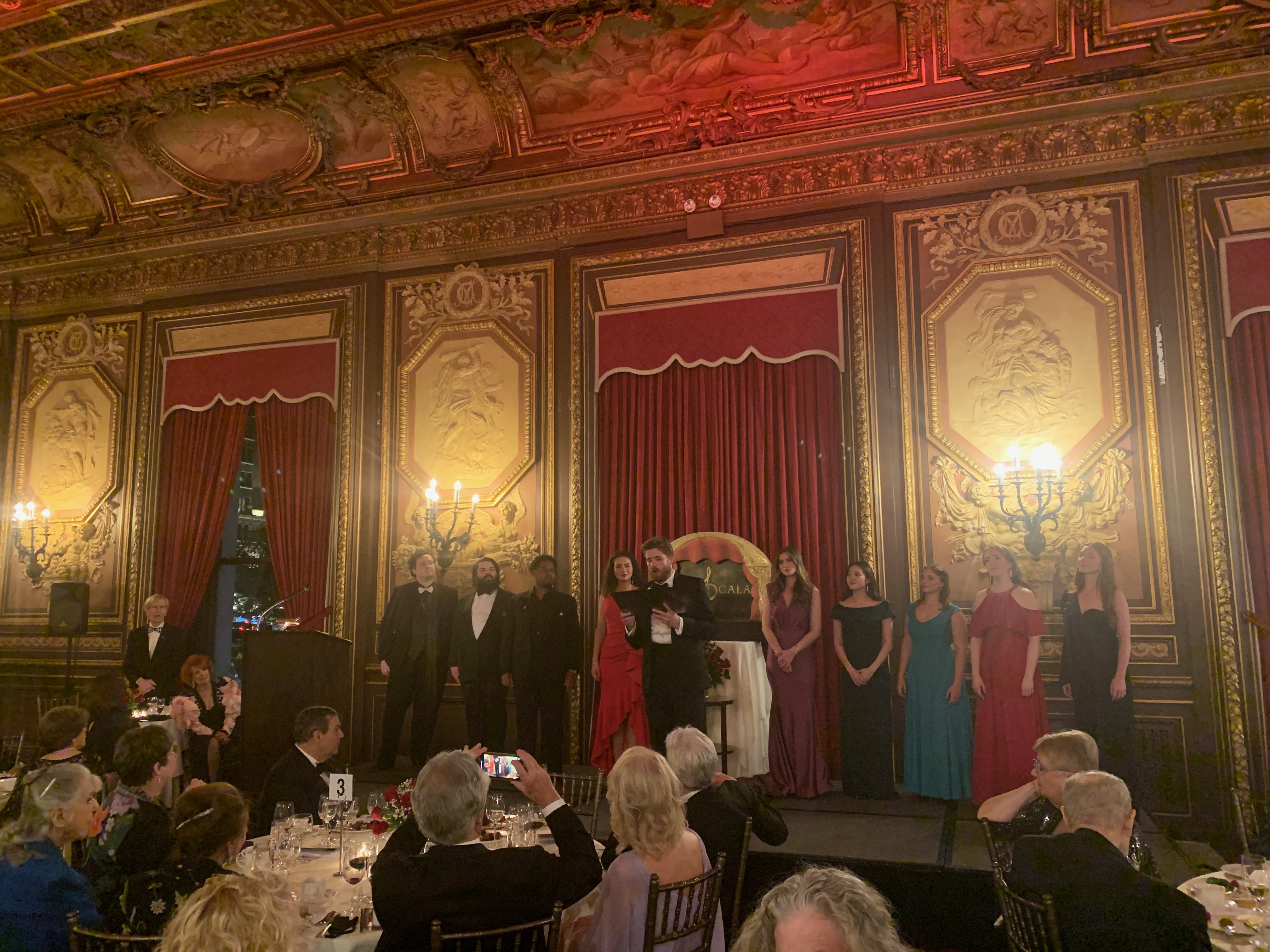
The most gala of all galas was held last night at the Metropolitan Club to celebrate The Career Bridges Grant winners. It was particularly gala since it was the first "gathering of the tribe" since the onset of the Covid epidemic. What a grand pleasure it was to see all the luminaries of the opera world there to celebrate a new generation of young opera singers.

This was the 18th such celebration brought to us by that most glamorous and warmly welcoming couple--David Schuyler Bender and Barbara Meister Bender who co-founded the Schuyler Foundation for Career Bridges. For anyone who doesn't know about this worthy foundation, their mission is to help young singers to launch their careers, a mission dear to our heart. They accomplish this goal over a period of three years during which these talented young singers are provided with grants, expert mentoring, training, and performance opportunities. So far, there have been 160 grant winners and over half of them can be considered "launched" whilst 20 are having major careers.  Pretty good results, wouldn't you agree?

Part of the evening comprised awards given to notable luminaries of Planet Opera. The Lifetime Achievement Award was given to Maestro Eve Queler whose enviable conducting of the Opera Orchestra of New York at Carnegie Hall introduced us to many young opera singers who went on to major careers and also to rarely performed operas.  We recall climbing endlessly to reach the top balcony of Carnegie Hall, binoculars in hand, to participate in these highly anticipated events.

The Distinguished Achievement Award was given to Jane Shaulis who had a long distinguished career as a character mezzo and whom we know mainly from Opera Index, another group of opera lovers who support young singers with generous cash awards. Under her stewardship, generations of young opera singers have been brought to our notice. We were delighted by her sense of humor which brought wide and knowing smiles to those who understand the roles played by mezzo-sopranos. We do believe there is a rather funny song that describes that and if any of our dear readers can tell us the composer and title we will be forever grateful.

The entertainment part of the evening came as "courses" along with the food (dinner must be served) and we hope to hear each and every one of the award recipients in an environment where we might focus more intently on their artistry. Musical Direction and piano accompaniment was provided by Ted Taylor with impressive versatility--from Baroque  to Broadway. As a matter of fact, the evening began with Handel and ended with Broadway.

Accompanied by the sonorous trumpeting of David Glukh, mezzo-soprano Joanne Evans gave a fine account of "Or la tromba" from Handel's Rinaldo. We noticed and enjoyed the clarity of her fioritura.

Bass Matthew Soibelman delivered "In diesen heil'gen Hallen" from Mozart's Die Zauberflöte with consummate authority and depth of resonance at the bottom of his register.

From Richard Strauss' Der Rosenkavalier, soprano Kayleigh Riess  performed the Presentation of the Rose with the requisite air of innocence. She floated the high notes in a manner that any tenor would do well to emulate.

Tenor Thomas Cilluffo colored his fine tenor in the gentlest fashion for Duparc's delicate melodie "Phydilé" in magnificent contrast with his later performance of Mime's aria "Zwangvolle Plage" from Wagner's Siegfried. Accompanying himself with clanging sticks to emulate the sound of the forge, he imbued his character with bitterness and frustration.  What a pleasure to witness such versatility!

Baritone Samson McCrady gave an expansive performance of Figaro's aria from Rossini's Il barbiere di Siviglia. We enjoyed his facility with the rapid patter and his leaps into falsetto for humorous effect. Later we would hear him close the program with "The Impossible Dream" from Leigh's Man of La Mancha, joined by the rest of the singers as chorus.

Countertenor Key'mon Murrah utilized a finely wrought vibrato in his performance of "Ah! quel giorno ognor rammento" from Rossini's Semiramide.  Not everyone loves this fach but we surely do!

Mezzo-soprano Lisa Rogali has a true mezzo sound that was just right for Rosina's aria "Una voce poco fa" from Rossini's Il barbiere di Siviglia. We heard some more than usually interesting embellishments of the vocal line,  all successfully negotiated.

Mezzo Mary Beth Nelson gave a heartfelt performance of "Sein wir wieder gut!" from Strauss' Ariadne auk Naxos, reminding us that opera is a "heilige Kunst".  We enjoyed the expansiveness at the top of her register.

Mezzo Mala Weissberg gave a lighthearted reading of "Nobles seigneurs, salut!" from Meyerbeer's Les Huguenots. Her fine French was particularly lyrical.

From Bellini's I Puritani soprano Kungeun Lee  performed "Qui la voce sua soave...vien diletto". We enjoyed the long phrases, the skips, and a well executed portamento.

No evening is complete without the "Flower Duet" from Delibes' Lakme. Ms. Reiss and Ms. Weissberg performed it in perfect hermony, to our delight.

We don't often hear Wagner in recitals like this so it was a special treat to have 2005 Winner John Dominick III perform Wotan's aria from Das Reingold.  "Abendlich" would have us believe that things would go well for the gods, LOL.  We take it, judging by Mr. Dominick's performance that things are going well for him!

It was a completely satisfying evening and we look forward to the success of this year's award winners

© meche kroop