MISSION

We are here to encourage the development of gifted young singers and to stimulate the growth of New York City's invaluable chamber opera companies. But we will not neglect the Metropolitan Opera either. Get ready for bouquets and brickbats.
Showing posts with label Rodolfo Zanetti. Show all posts

Monday, March 2, 2026

LAS MALDICIONES


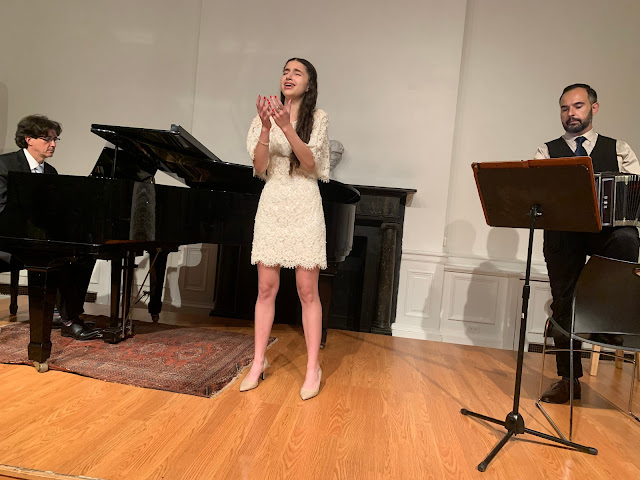
 Soprano Sasha Gutiérrez, Maestro Jorge Parodi, members of the Arya String Quartet, and Rodolfo Zanetti

National Sawdust seemed just the right venue for the premiere of Rodolfo Zanetti's song cycle. The stage is shallow and wide and the seating arrangement permits everyone to have clear visual access to the performers. One would not want to have missed the intense expressiveness of soprano Sasha Gutiérrez, nor the interesting fingering of Mr. Zanetti's bandoneon. The four lovely ladies of the Arya String Quartet provided visual interest and we enjoyed being able to distinguish who was doing the bowing and who was doing the plucking in Mr. Zanetti's interesting score. Furthermore, Maestro Jorge Parodi eschewed the baton in favor of eloquent hands, each finger expressing a mood or color or emphasis. We thought of these fingers as a corps de ballet, sometimes performing in unison and at other times, with one standing out as soloist. What an interesting performance!

Produced by Opera Hispanica, in collaboration with New York City Opera, Las Maldiciones comprises fifteen sections. With only a couple sections as solely instrumental, the voice of Ms. Gutiérrez carried the evening. And what a voice that is! We have enjoyed her performances for several years and can only say that her artistry has grown with time.

Addressing the work as a whole, we were reminded of Schubert's Winterreise in that the theme is a monochromatic one. Winterreise is all about grief whereas  Las Maldiciones is about rage. Both are about suffering. In the Schubert, the suffering is turned inward. In the Zanetti, the suffering is turned against the cause of the suffering, presumably a man who has disappointed the singer romantically. 

However there is a major difference that has resulted in the enduring popularity of the Schubert. Schubert told a story in which the words paint a picture that we can create in our mind's eye. Every song is different. Each of his twenty-four songs has a memorable melody and a varied piano part. Two centuries later, a male singer of reputation will consider the work a challenging summit to be climbed, a capstone to a career, an attempt to create 24 shades of grief. Schubert accomplished this through two artists, a singer and a piano.

By contrast, in the Zanetti cycle, our ears did not pick up 24 shades of rage not even 15 in spite of the fact that the four members of the string quartet gave full expression to the written parts and that the composer's bandoneon produced some fascinating sounds. The members of the Arya String Quartet (violinists Melisa Atoyan and Rebecca Racusin, violist Laura Sahin, and cellist Molly Von Gutzeit) alternated in legato and staccato parts, lending aural interest alongside Mr. Zanetti's bandoneon.

However the text was devoid of variety and it was only through the artistry of Ms. Gutiérrez, both her facial expression and vocal coloration, that we perceived enough variety to hold our interest.  We couldn't help wondering what Mr. Zanetti had in mind when he wrote the text. In the 12th section, "Maldición Cuarta", we were enchanted by the musicality of the Spanish text and musical phrasing that put it way above the other sections. We found ourselves waiting for some transformation of the heroine. She found peace through rage? Perhaps there is something within Latin American culture that we missed but we didn't feel any growth or transformation.

That being said, we were glad we experienced it due to the excellent performances. However we are still waiting for a contemporary work that will take our breath away, one that tells a story by means of melody and linguistic beauty. We have a feeling that it will probably be in the Spanish language.

© meche kroop

Friday, October 14, 2022

ARGENTINIAN SOUL


Maestro Jorge Parodi, Mezzo-soprano Morena Galán, and Bandeónista Rodolfo Zanetti


If New Yorkers are ignorant of Argentinian music, we are sure that will not last long since Maestro Jorge Parodi has assumed the helm of Opera Hispánica; he will see to it that these treasures will be mined. The most interesting feature of Latin American music, in our opinion, is that their composers were not seduced by the destructive tendencies of the world of music academia which gave the old heave-ho to melody and key signatures.; Latin American music remained melodic and relatable all through the 20th c. and on into our own epoch.

Last night, hosted by The Consulate General of Argentina in New York, a full house was gifted with a program of Argentinian music, including art song, folkloric song, piano compositions, and, of course, tango. There was no shortage of melody and rhythm, joined in celebration of a wide range of human emotion.

Included among the artists were Maestro Parodi himself, appearing as collaborative pianist, solo pianist Pablo Lavandera, Metropolitan Opera star baritone Fabián Veloz, baritone Gustavo Ahualli, two lovely young mezzo-sopranos Morena Galán and Malena Dayén, guitarist Andrés Guerra, and bandoneónista Rodolfo Zanetti.

The above photo captures an intense moment in which Ms. Galán offered a passionate rendition of a tango from the 1920's entitled "Romance de Barrio" by Anibal Troilo. Aside from possessing an appealing and well-supported instrument, this young artist has a formidable ability to connect with the audience, an ability than can only come from a deep connection with the music. We enjoyed equally Carlos Gardel's "Por una cabeza" which allowed her the opportunity to show off a smoky lower register. The more modern "El clavel del aire blanco" by Carlos Guastavino was also given the same heartfelt treatment.

From the same song cycle, the familiar. "La rosa y el sauce" was beautifully performed by Ms. Dayén whose rich mezzo was put to good use in her phrasing of the gorgeous melody and in the fine use of dynamic variation.  In the livelier dance-like "Pampamapa", also by Guastavino, we had trouble staying still. Splendidly accompanied by Mr. Guerra, she introduced us to Daniel Toro's "Samba para olvidarte". Unfortunately, the audience broke into applause before we could hear the conclusion of Mr. Guerra's tender postlude.

Mr. Veloz' generous textured baritone filled the room with resonance in a stunning rendition of Guastavino's "Cita", making ample use of phrasing and dynamics. The dancy rhythm of Jorge Cafrune's "Cuando llegue el alba" was delightful. He wisely matched his large voice to the size of the room.

Mr. Ahaulli's powerful baritone fit well with Guastavino's "Abismo de sed" which was preceded by a complex introduction in the piano part which was stunningly performed by Maestro Parodi. We also enjoyed Carlos Gardel's familiar "El dia que me quieres" which just oozed romance.

Mr. Lavandera performed Tres Danzas Argentinas Op. 2  by Ginastera, composed early in his life. The rapid fire "Danza del viejo boyero" was followed by the lilting adagio "Danza de la moza donosa" (our favorite), and finally  "Danza del gaucho matrero"  the complex rhythm of which the artist was thoughtful enough to explain to the audience.

He also performed a gentle work by the recently deceased Claudia Montero entitled "Junio", given its New York premiere. He shared with the audience the fact that what sounded like improvisation was written down note by note. The work was marked by. thrilling runs and lilting arpeggi.

There were many more delights in the generous program, including tangos by the famous Astor Piazzolla. One could not fail to appreciate the wide variety found in this program which was entitled An Argentinian Affair. For us it was a golden opportunity to get a taste of many different styles of composition and to hear some new voices.  A big bravissimo to all concerned!

© meche kroop

Tuesday, May 10, 2022

ENDINGS AND BEGINNINGS


Ahmed Alom Vega and Rosario Armas

There are pleasant recitals, there are excellent recitals, and there are recitals that one will never forget.  Mezzo-soprano Rosario Armas, just completing her Master of Music degree at Manhattan School of Music, gave a recital in collaboration with her new husband Ahmed Alom Vega that has us groping for superlatives.
 
Before describing the program let us begin by trying to analyze what made this recital so outstanding.  There are a lot of great voices out there; many programs are designed to show off the singer in many languages and styles; but rare is a recital in which the singer's artistry is such that he or she melts into the character.

We were not at all surprised that Ms. Armas perfectly inhabited the character of Cherubino in the recent production of Mozart's Nozze di Figaro at Manhattan School of Music. However, doing the same thing in an art song is far more challenging.

For example, how many times we have enjoyed hearing a baritone singing Mahler's emotionally shattering cycle Lieder eines fahrenden Gesellen; on a rare occasion we have heard a female singer make an attempt, leaving us with a kind of negative opinion of singers tackling works meant for the other gender. Last night was completely different! It was the essence of the text that came across as Ms. Armas completely disappeared. (If a baritone ever does the same with Schumann's Frauenlieben und Leben we may very well fall off our chair.)

Serving the music and the text to this degree requires the abandonment of self indulgence. The narrator in this cycle is suffering from the loss of his beloved and in spite of the beauties of nature he sinks into despair.  Eventually his agony yields to a calm acceptance.  Ms. Armas limned each and every emotion; even if the listener did not understand the German (which our singer enunciated with Teutonic perfection) one could not fail to understand.

The narrator of Henri Duparc's "Au pays où se fait la guerre" is in a different type of despair. She is pining for a lover who has gone off to war. The text was performed in an even Gallic style but was no less affecting.  We couldn't help but thinking that the world hasn't changed much.  Men still go off to fight foolish wars and women are left to pine. Here, Ms. Armas' phrasing was accompanied by a very affecting vibrato.  Variety from one verse to the next was achieved by astute variations in dynamics and tempi.

Three Italian songs from three different periods permitted the appreciation of those lovely Italian vowels.  From the late Baroque period we heard "Sposa son disprezzata" from Vivaldi's Bajazet.  A lovely pianissimo aria was followed by a fierce cabaletta marked by clarity in the fioritura; the ritornello was given a different color.

"Non t'accostare all'urna" from Verdi's Sette Romanze is one of our favorite songs and as Ms. Armas performed it we felt as if we knew the woman who was singing the words and we knew her as if she were a character in an unknown opera. We wondered whether Verdi had intended it that way.

The more modern "Nebbie" is a real mood piece and we found it chilling in its intensity, achieved by both singer and pianist.

Two selections from Kurt Weill's Trois chansons reminded us that there is truly no difference between a cabaret song and an art song. If the singer has a great voice and sings unamplified, even a Broadway song can stand next to an aria.  There is an operatic depth of feeling in "Je ne t'aime pas" and plenty of irony and denial, all made clear by our marvelous mezzo by means of word coloration. "Youkali" came as somewhat of a relief from all that pain.

More pain was experienced in two selections from Manuel de Falla's Siete canciones populares with guitar accompaniment by Eduardo Gutterres.  The pain of "Asturianas" is a gentle sorrow but the pain of "Polo" is an angry pain--all made clear by Ms. Armas' Iberian intensity.  If we are not mistaken, we were first introduced to the artist when she performed the cycle some years ago!

After all that pain it was surely time for some exuberance and fun.  From Obradors' Canciones clasicas españolas, "El Vito" was given a raucous reading my Ms. Armas, Mr. Gutterres, and Mr. Vega providing rhythmic accompaniment on the cajon. This may be a good time to mention how outstanding we found his pianistic collaboration throughout the entire concert. We particularly noted it during a set of Burleigh songs when he gave the most delicate introduction to "Among the Fuchsias" and some lovely arpeggi in "Till I Wake". There were some impressive trills in the bass register in Mahler's "Die zwei blauen augen".  There were also some sharp attacks in the Mahler that emphasized the pain.

There were more delights to come in a spirited performance of "Yo soy Maria" from Piazzolla's tango opera Maria de Buenos Aires. Rodolfo Zanetti was featured on bandoneon and Nicholas Danielson on violin with both providing interesting solos. Pedro Giraudo played string bass and Mr. Vega, the piano.

An encore was enthusiastically demanded and Agustin Lara's "Granada" was the perfect ending to a perfect concert, sending everyone out smiling.

We have said little about Ms. Armas' vocal assets. There is absolutely nothing to criticize, not a single quibble. It is a rich sizable instrument with a lovely quality. There is ample resonance in the lower register and a bright expansive top. It is seamless in its transitions. Languages are perfect. Phrasing is always elegant. All of this "technique" disappears into the performance; Its perfection is what allows the listener to focus on the music.

We have the greatest confidence in Ms. Armas' future, both on the opera stage and as a recitalist. All doors should open for such an artist.

© meche kroop


Monday, November 15, 2021

CUANDO EL FUEGO ABRASA


Nancy Fabiola Heerrera and Gustavo Feulien in Astor Piazzolla's Oblivion

The post-covid season of opera has been slow getting started, but for a weekend of delights we can thank the newly revived Opera Hispanica,  which has joined forces with Teatro Grattacielo. With Maestro Jorge Parodi at the helm, it seemed quite natural to begin with a work by Argentinian master of tango--Astor Piazzolla.

The first half of the program was his 1982 Oblivion which was used in the film Enrico IV. At this late stage of his life, Piazzolla was already famous for incorporating many musical styles into his tangos, from baroque to jazz. This work can be performed in a variety of instrumentations and we were fortunate to hear members of Metamorphosis Chamber Orchestra conducted by Maestro Parodi himself, comprising a string quartet augmented by flute (doubling on piccolo), oboe, trumpet and French horn. Double bassist Pedro Giraudo did some ear-catching riffs of rhythmic vitality and pianist Rodrigo Ilizaliturri provided support and unification to the individual parts.

The star of the instrumentalists was, of course, bandoneonista Rodolfo Zanetti, whose performance was filled with vitality. The structure of the work is a series of songs, mainly about the suffering of lost love. Baritone Gustavo Feulien, whose Onegin we so admired a couple of years ago, sang with full tone and a depth of anguish in voice, facial expression, and body language. A powerful singer as he is can make you feel the torment in one's own body.  Indeed, who has not loved and lost and suffered!

There were interludes of instrumental music, sometimes a tenderness given to the strings, sometimes a harshness given to the winds. Maestro Parodi kept a firm hand and a gentle touch, as called for by the music. Mezzo-soprano Nancy Fabiola Herrera made only a brief appearance but starred in the second half of the program in which Mr. Feulien only showed up incidentally.

Manuel de Falla's El Amor Brujo began life as a work commissioned by a renowned flamenco dancer and was scored for voice, actors, and chamber orchestra.  Its 1915 premiere in Madrid was not successful; it has gone through a number of changes--getting scored for full orchestra and a suite for piano and has also been performed as a ballet.

Ms. Herrera's electrifying performance gave full attention to both vocalism and dance. Not for a moment did our attention lapse as she created the role of Candela, a gypsy woman haunted by her dead husband. Dressed in black she haunted the stage, or rather the cave in which she sought una bruja to rid her of the ghost. Swirling her mantilla madly she employed a style of singing verging on the jondo flamenco style. Boundaries were transcended on the part of the artist and the audience; we nearly forgot we were in the theater. It was one of those performance one is unlikely to forget.

Troy Ogilvie is credited as choreographer yet Ms. Herrera's performance seemed spontaneous. The set and lighting design was by Jon de Gaetano; it was simple but effective--a few reflective box-like elements scattered about the stage.  At times they were lit so that they appeared as fireplaces, which was particularly effective. Direction was by Malena Dayen. The excellent subtitles were credited to Francisco Miranda

© meche kroop


Sunday, April 7, 2019

NOPERA

Malena Dayen, Daniel Irizarry, Eugenia Forteza, Suchan Kim, Mouna R'miki, and Marcelo Guzzo

Defying our concept of opera at every turn, Astor Piazzolla's 1968 tango operita was nonetheless a compelling piece of music theater which captivated the audience with some fine performances and musical values. The main characters, Maria and El Payador, were portrayed by mezzo-soprano Malena Dayen and baritone Marcelo Guzzo who introduced us to the work six years ago, performing excerpts as part of the Opera Hispanica Festival.

The work itself was performed at Le Poisson Rouge in Greenwich Village. Beth Greenberg's inventive direction was accompanied by program notes, providing an exegesis of Horacio Ferrrer's libretto, comprising surreal poetry which we found to be abstruse. We are quite sure that those who love poetry were better able to plumb the depths of the very symbolism which baffled us. If one hadn't seen the work before or read about it, one would have no clue as to the story.

The work has been produced recently by the New York City Opera and by Arizona Opera, among other companies.  But for this sold-out run by Bare Opera, Ms. Dayen, herself a Porteño, got her chance to direct the piece; she staged it in the spacious rear gallery of the Bellewether with plenty of "meta" input from a videographer whose images were projected in real time on the rear wall of the space, behind the musicians. It is a powerful but puzzling production.

We enjoyed the boutique orchestra, especially the piano of Music Director/Conductor David Rosenmeyer and the bandoneón of Rodolfo Zanetti. The rest of the orchestra comprised guitar, flute, a string quartet, a double bass, and two percussionists. There was even some recorded music. The persistence of a descending scale of five notes recurred throughout the piece, lending unity.

The pleasures of enjoying the unamplified operatic voice went missing, although we admit that the amplification was not excessive. Much of the text was recited rather than sung.

Ms. Dayen and Mr. Guzzo are both powerful and intense; they performed with commitment. Also onstage were two women who often mirrored Ms. Dayen's movements--Eugenia Forteza and Mouna R'miki. 

The male roles were performed by Suchan Kim and Daniel Irizarry.  Ms. R'miki and Mr. Irizarry were listed as "Duende", the role of the trickster spirit, although that was not conveyed dramatically.

We thought highly of the choreography of Troy Ogilvie who made singers look like dancers, creating effective movement that was minimally challenging. Maximally challenging were the movements of Mr. Irizarry who may find a new career as a break dancer; he climbed the steel beams overhead with the agility of a simian.

Anthony Tornambene's lighting design was effective; at a couple points, the women held small lights in the palms of their hands and moved them around their bodies providing eerie illumination.

Taylor Mills' Costume Design was simple and executed in neutral unobtrusive colors.

This female led company is noted for five years of unconventional productions, never failing to reinvent the opera-going experience. Entering "Bare Opera" in the search bar above will give you the opportunity to read about some of their other revolutionary additions to the operatic landscape.

(c) meche kroop