MISSION

We are here to encourage the development of gifted young singers and to stimulate the growth of New York City's invaluable chamber opera companies. But we will not neglect the Metropolitan Opera either. Get ready for bouquets and brickbats.
Showing posts with label Malena Dayen. Show all posts

Friday, October 14, 2022

ARGENTINIAN SOUL


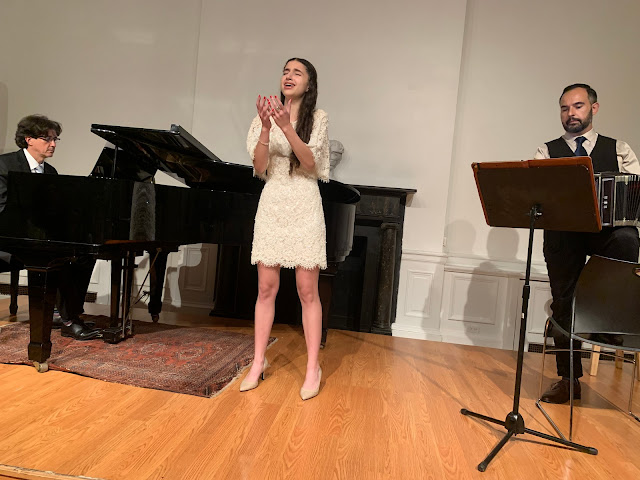
Maestro Jorge Parodi, Mezzo-soprano Morena Galán, and Bandeónista Rodolfo Zanetti


If New Yorkers are ignorant of Argentinian music, we are sure that will not last long since Maestro Jorge Parodi has assumed the helm of Opera Hispánica; he will see to it that these treasures will be mined. The most interesting feature of Latin American music, in our opinion, is that their composers were not seduced by the destructive tendencies of the world of music academia which gave the old heave-ho to melody and key signatures.; Latin American music remained melodic and relatable all through the 20th c. and on into our own epoch.

Last night, hosted by The Consulate General of Argentina in New York, a full house was gifted with a program of Argentinian music, including art song, folkloric song, piano compositions, and, of course, tango. There was no shortage of melody and rhythm, joined in celebration of a wide range of human emotion.

Included among the artists were Maestro Parodi himself, appearing as collaborative pianist, solo pianist Pablo Lavandera, Metropolitan Opera star baritone Fabián Veloz, baritone Gustavo Ahualli, two lovely young mezzo-sopranos Morena Galán and Malena Dayén, guitarist Andrés Guerra, and bandoneónista Rodolfo Zanetti.

The above photo captures an intense moment in which Ms. Galán offered a passionate rendition of a tango from the 1920's entitled "Romance de Barrio" by Anibal Troilo. Aside from possessing an appealing and well-supported instrument, this young artist has a formidable ability to connect with the audience, an ability than can only come from a deep connection with the music. We enjoyed equally Carlos Gardel's "Por una cabeza" which allowed her the opportunity to show off a smoky lower register. The more modern "El clavel del aire blanco" by Carlos Guastavino was also given the same heartfelt treatment.

From the same song cycle, the familiar. "La rosa y el sauce" was beautifully performed by Ms. Dayén whose rich mezzo was put to good use in her phrasing of the gorgeous melody and in the fine use of dynamic variation.  In the livelier dance-like "Pampamapa", also by Guastavino, we had trouble staying still. Splendidly accompanied by Mr. Guerra, she introduced us to Daniel Toro's "Samba para olvidarte". Unfortunately, the audience broke into applause before we could hear the conclusion of Mr. Guerra's tender postlude.

Mr. Veloz' generous textured baritone filled the room with resonance in a stunning rendition of Guastavino's "Cita", making ample use of phrasing and dynamics. The dancy rhythm of Jorge Cafrune's "Cuando llegue el alba" was delightful. He wisely matched his large voice to the size of the room.

Mr. Ahaulli's powerful baritone fit well with Guastavino's "Abismo de sed" which was preceded by a complex introduction in the piano part which was stunningly performed by Maestro Parodi. We also enjoyed Carlos Gardel's familiar "El dia que me quieres" which just oozed romance.

Mr. Lavandera performed Tres Danzas Argentinas Op. 2  by Ginastera, composed early in his life. The rapid fire "Danza del viejo boyero" was followed by the lilting adagio "Danza de la moza donosa" (our favorite), and finally  "Danza del gaucho matrero"  the complex rhythm of which the artist was thoughtful enough to explain to the audience.

He also performed a gentle work by the recently deceased Claudia Montero entitled "Junio", given its New York premiere. He shared with the audience the fact that what sounded like improvisation was written down note by note. The work was marked by. thrilling runs and lilting arpeggi.

There were many more delights in the generous program, including tangos by the famous Astor Piazzolla. One could not fail to appreciate the wide variety found in this program which was entitled An Argentinian Affair. For us it was a golden opportunity to get a taste of many different styles of composition and to hear some new voices.  A big bravissimo to all concerned!

© meche kroop

Monday, November 15, 2021

MATCHMAKER MATCHMAKER MAKE ME A MATCH


 PRINCIPALS ALEXANDRA RAZSKAZOFF, MARCUS DE LOACH, AND JOHN BELLEMER
(PHOTO BY GUSTAVO MIRABILE)

Teatro Grattacielo is known for producing realismo operas that one is unlikely to see elsewhere. We have lost count of the the number of worthy works they have brought to our attention. So many of them have been heavyweight tragedies but yesterday's production of Mascagni's L'Amico Fritz was just what we needed after the prior night's tragic impact. For this we thank General Director and Artistic Director Stefanos Koroneos.

Cavalleria Rusticana is Mascagni's masterwork and we never ever turn down a chance to see it.  We recall seeing a rather odd production of his rather odd opera Iris at Bard College's Summer Festival a few years ago. But this may be our first exposure to the simple story of L'Amico Fritz.  Of course, any opera lover would have heard the "Cherry Duet" performed as a set piece.

This is a slight work but the simple story is easily relatable. A confirmed bachelor is tricked into marriage by his well meaning friend. In this case, the local rabbi David (baritone Marcus DeLoach) loves to get people married off but Fritz, a local landowner,(John Bellemer) is a confirmed bachelor. The nubile daughter (Alexandra Razskazoff) of one of his tenant farmers seems like a good match and David figures out a way to get them together. Bravi tutti!  A happy ending!

The outstanding features of the evening were the voices and the musicianship of the Queens Symphony Orchestra, conducted by James Bagwell. If the other two principal roles had not been so well sung, we would have said that Ms. Razskazoff ran away with the show. What made her performance so outstanding was not just her sweet finely produced soprano voice but her acting. She completely embodied a shy young country girl trying to deal with a crush on a man of high social status.

Due to the lack of a firm directorial hand by Mr. Koroneos and Malena Dayen, the cast pretty much stood around woodenly with nothing to do. Indeed it was billed as "semi-staged" but the fact that the theater has wrap around balconies that were put to use indicates that there was an attempt at story telling. The absence of set was unfortunate; a mere stepladder for Suzel to climb to pick cherries would have been welcome; we supplied one in our mind's eye. There was a huge chandelier that was eye catching but did not contribute anything.

Mr. Bellemer came alive dramatically as the evening progressed and Mr. DeLoach did his best but they seemed to be floundering onstage with nothing to do. We understand a concert performance in which singers use music stands but this was not the case. It would have been simple to have a couple pieces of furniture or props.

An attempt to involve multi-media seemed to us to be a complete failure. We will not mention the names of those involved but the projections were nothing if not distracting. We would not have minded a still shot in the background of a farm or a living room but the kinetic falling ellipses (cherry blossoms maybe) distracted from the singing. Even worse were the closeups of the singers' faces as they sang.

Costuming by Theresa Miles was generic but serviceable. Since the story is not particular to epoch or locale, it was fine. Except for Beppe, a gypsy of indeterminate gender whose costume was just weird.  Nonetheless, Mariya Kaganskaya did a lovely job with her aria.

There was a servant (Kiena Williams) and a couple friends (David Santiago and Rick Agster) who mainly just stood around and a chorus who made a nice vocal contribution.

Mr. Bagwell drew a lovely performance from the orchestra and we just loved the melodic arias and the aforementioned duet.

In sum, it was a delightful evening of music that only needed some directorial ideas and a few props to make it work as drama.

© meche kroop

CUANDO EL FUEGO ABRASA


Nancy Fabiola Heerrera and Gustavo Feulien in Astor Piazzolla's Oblivion

The post-covid season of opera has been slow getting started, but for a weekend of delights we can thank the newly revived Opera Hispanica,  which has joined forces with Teatro Grattacielo. With Maestro Jorge Parodi at the helm, it seemed quite natural to begin with a work by Argentinian master of tango--Astor Piazzolla.

The first half of the program was his 1982 Oblivion which was used in the film Enrico IV. At this late stage of his life, Piazzolla was already famous for incorporating many musical styles into his tangos, from baroque to jazz. This work can be performed in a variety of instrumentations and we were fortunate to hear members of Metamorphosis Chamber Orchestra conducted by Maestro Parodi himself, comprising a string quartet augmented by flute (doubling on piccolo), oboe, trumpet and French horn. Double bassist Pedro Giraudo did some ear-catching riffs of rhythmic vitality and pianist Rodrigo Ilizaliturri provided support and unification to the individual parts.

The star of the instrumentalists was, of course, bandoneonista Rodolfo Zanetti, whose performance was filled with vitality. The structure of the work is a series of songs, mainly about the suffering of lost love. Baritone Gustavo Feulien, whose Onegin we so admired a couple of years ago, sang with full tone and a depth of anguish in voice, facial expression, and body language. A powerful singer as he is can make you feel the torment in one's own body.  Indeed, who has not loved and lost and suffered!

There were interludes of instrumental music, sometimes a tenderness given to the strings, sometimes a harshness given to the winds. Maestro Parodi kept a firm hand and a gentle touch, as called for by the music. Mezzo-soprano Nancy Fabiola Herrera made only a brief appearance but starred in the second half of the program in which Mr. Feulien only showed up incidentally.

Manuel de Falla's El Amor Brujo began life as a work commissioned by a renowned flamenco dancer and was scored for voice, actors, and chamber orchestra.  Its 1915 premiere in Madrid was not successful; it has gone through a number of changes--getting scored for full orchestra and a suite for piano and has also been performed as a ballet.

Ms. Herrera's electrifying performance gave full attention to both vocalism and dance. Not for a moment did our attention lapse as she created the role of Candela, a gypsy woman haunted by her dead husband. Dressed in black she haunted the stage, or rather the cave in which she sought una bruja to rid her of the ghost. Swirling her mantilla madly she employed a style of singing verging on the jondo flamenco style. Boundaries were transcended on the part of the artist and the audience; we nearly forgot we were in the theater. It was one of those performance one is unlikely to forget.

Troy Ogilvie is credited as choreographer yet Ms. Herrera's performance seemed spontaneous. The set and lighting design was by Jon de Gaetano; it was simple but effective--a few reflective box-like elements scattered about the stage.  At times they were lit so that they appeared as fireplaces, which was particularly effective. Direction was by Malena Dayen. The excellent subtitles were credited to Francisco Miranda

© meche kroop


Sunday, October 20, 2019

THE DON DONE IN

Suchan Kim, Maestro Teddy Poll, Brace Negron, Sarah Hayashi, Jesus Murillo, Pavel Suliandziga, and Laura León
(Liana Guberman and Paul An not visible)

We have lost count of the number of times we have seen Mozart's meisterwerk Don Giovanni; this year alone we have seen it at least 4-5 times. We never tire of it; the marriage of Mozart's music and Da Ponte's libretto always makes for a great evening--but only if the singing is superb. Bare Opera assembled a stellar group of singers for their current production and we would expect no less of this exemplary company in their fifth season. There was no one onstage who didn't give their all.

Directors always look for something new to say about the reprobate Don--the pussy grabbing predator who uses his position of power to seduce or overcome women, a sociopathic narcissist who has no awareness of other people's feelings, one who will readily betray those who are dumb enough to fall under his spell. If this sounds familiar and relevant to you, dear reader, please know that it does to us as well.

Taking for granted that the performances were uniformly excellent from both dramatic and vocal standpoints, let us take a look at what Stage Director Malena Dayen added to our understanding of the story. Her Don was almost completely lacking in charm; baritone Suchan Kim (a very nice man--trust us on this point) was obliged to search for an inner demon to come up with such a nasty portrayal. Our only opportunity to hear the gentle colors of his beautiful instrument was in the serenade "Deh, vieni alla finestra".

Donna Anna (the splendid soprano Laura León) was the Don's victim-- excuse me, she was a "survivor" in today's parlance--and there was not a whiff of disdain for the loyal Don Ottavio (tenorrific Pavel Suliandziga) who evinced strength of character in place of the usual wimpiness. We have no doubt he will stand by his beloved until her grief abates and they will wed.

Zerlina (portrayed by the winsome Sarah Hayashi) is rather narcissistic herself, wanting to have her cake and eat it too, manipulating the poor Masetto (the excellent Jesus Murillo) who is understandably angry but just as enthralled by her as Donna Elvira is by Don Giovanni, and just as ready to forgive--an interesting parallel.

In this production, Donna Elvira is not a source of amusement but one of those women who just cannot give up on her desire to reform a "bad boy". Soprano Liana Guberman in the role showed a wide range of emotions from rage to forgiveness. We get it. She is complicit in her own misery which we see a lot in women who are taken in by sociopathic men. The vocalism was as fine as the acting.

Bass Brace Negron did a swell job creating the role of Leporello and demonstrated how flunkies can be bought by an artful and deceitful leader. So much of this story resonates with the current political climate.

Paul An made a brief appearance as the Commendatore trying to protect his daughter's honor and later as the statue who invites the Don to dinner in Hell.

There were directorial touches that we liked a lot. Our favorite one found Don Giovanni seducing Zerlina in a partner changing dance that was choreographed by Troy Ogilvie with Emily Morrison's assist.

There were a few minor lapses as well. Changing the duel between Don Giovanni and the Commendatore into the Don stabbing the Commendatore in the back emphasized his evil nature but gave the lie to Donna Anna's anguish about the wound in her father's breast.

Also, if the text involves calling someone over, it seems strange if they are already there. And to say someone has fallen when they are still standing is likewise a minor flaw. But we notice the little things; just can't help it.

There were several omissions or cuts that kept the story moving along without comic relief. We rarely see the scene between Zerlina and Leporello and did not miss it but we must admit that we missed the final scene in which the Don is dining and teasing Leporello who is sneaking food behind his back. We also missed the epilogue in which the moral of the story is reiterated.

In terms of musical values, it seemed criminal to omit "Il mio tesoro" with such a terrific tenor as Mr. Suliandziga on board. Yes, we know that Mozart himself revised his own work to suit the artists available and that only strengthens our case.

Under the direction of Maestro Teddy Poll, the chamber orchestra (string quartet plus bass, flute, oboe, clarinet, bassoon, and horn with Laetitia Ruccolo performing the piano part) sounded just right except for the ballroom scene in which there are three types of dance music played simultaneously. There just wasn't enough "manpower" to pull that off.

The major innovation brought by Ms. Dayen was the use of video projections designed by Sangmin Chae. This is an interesting idea to replace sets with video but the results were mixed. The offstage rape scene is always difficult to accept; what woman pursues her would be rapist???? But the video projections during the overture did not do much to illuminate the event. We saw a distorted face and maybe some hands choking a neck.

At one point something was projected that looked vaguely like an apple. We found much of this distracting and puzzling. Our companion kept looking at us and shrugging and peppered us during the intermission with questions we couldn't answer.

The projection of the Commendatore's face in the final scene was projected as an old fashioned "negative" with white and black reversed.  It just looked like an ugly mask. And there was a delay between the sound and the visuals that just looked like bad lip-syncing. The presence of the videographers on set and next to the orchestra was distracting and audience members kept twisting around in their chairs.

The work was performed in a large empty space with the audience seated on two opposing sides in two rows, an arrangement providing a sense of intimacy with the story. One minor improvement of such an arrangement might be to angle the chairs a bit toward the center. This is the same problem we observe at the New York Philharmonic in the levels above the orchestra, as well as the side boxes at the Metropolitan Opera House.  Just sayin'.

Costumes by Theresa Miles were completely off base and Donna Elvira's was completely unflattering. The only distinguishing feature of the aristocratic women was the headdress--you know, the comb with a mantilla. It seems important to us to mark the difference between the aristocrats and the peasants. A sense of time and place was lacking.

Before we close we would like to acknowledge the contributions of the ensemble: Estelina Syla, Folei Browne, Sarah Blau, Pedro Sequera, Zachary Sebek, and Sanford Leff.

There is only one more performance today and, as of last night, only two seats remaining. Will you be the lucky one?

© meche kroop

Friday, October 4, 2019

A DON GIOVANNI FOR OUR TIME

Pavel Suliandziga, Laura León, Sarah Hayashi, Yuri Napoli, and Liana Guberman

Last night we were at the glamorous Norwood Club which is filled with stunning works of art, none of which could compete with the artistry of the singers assembled for the 6th annual Bare Opera Gala.

This fundraising event was held to introduce those of us who love Bare Opera to the cast and director of the upcoming production of Don Giovanni. Kirsten Scott, Co-Founder and General Director of this boutique opera company, gives good speech just as she gives good singing. If you didn't leave excited about the production you need to be on life support!

With Co-Founder and Artistic Director Laetitia Ruccolo at the piano, we were given a few selections from the production which premieres October 18 at the Bellwether, one of the more interesting spaces chosen by Bare Opera for their productions.

Not only does Bare Opera take opera out of the concert hall and into interesting venues, but they bring in directors with vision who can strip operas of their accumulated clichés, kinda like stripping barnacles off the hull of a boat.

Director Malena Dayen has interpreted Mozart's tragi-comedy in the light of the #metoo movement. It is difficult for us to perceive the gentle and handsome baritone Suchan Kim as a vile seducer but we suppose that's what acting instruction accomplishes.

We have no such trouble seeing tenor Pavel Suliandziga as a devoted Don Ottavio who, we understand, will not be the customary wimp. Having dazzled us with his Tchaikovsky at Around the World in Song, we are ready to be redazzled or bedazzled, if you will.  He is definitely the anti-Don.

The women will not be portrayed as victims and, we can tell you, soprano Liana Guberman makes a fiery but sympathetic Donna Elvira, not the comic figure to which we are accustomed. She was in superb voice last night and knocked our socks off.

The other two female roles were played by singers relatively new to us. Cuban soprano Laura León has the role of Donna Anna and connected well with Mr. Suliandziga.

Zerlina was sung by Sarah Hayashi who connected well with Mr. Kim, the smarmy seducer.

Each singer was interviewed by Yuri Napoli who asked all the right questions, encouraging each singer to reveal something about the character he/she would play.

Director Malena Dayen was present to tell us just enough about how she interprets the story to ensure our attendance at the performance. She will utilize the services of video artist Sangmin Chae to bring 21st century technology to this 18th century opera. We will not say too much about this innovation until we have the opportunity to see it in action.

Consider yourself encouraged to take a walk on the wild side with Bare Opera, Mozart, and Da Ponte. We've got our walkin' shoes on!

© meche kroop


Sunday, April 7, 2019

NOPERA

Malena Dayen, Daniel Irizarry, Eugenia Forteza, Suchan Kim, Mouna R'miki, and Marcelo Guzzo

Defying our concept of opera at every turn, Astor Piazzolla's 1968 tango operita was nonetheless a compelling piece of music theater which captivated the audience with some fine performances and musical values. The main characters, Maria and El Payador, were portrayed by mezzo-soprano Malena Dayen and baritone Marcelo Guzzo who introduced us to the work six years ago, performing excerpts as part of the Opera Hispanica Festival.

The work itself was performed at Le Poisson Rouge in Greenwich Village. Beth Greenberg's inventive direction was accompanied by program notes, providing an exegesis of Horacio Ferrrer's libretto, comprising surreal poetry which we found to be abstruse. We are quite sure that those who love poetry were better able to plumb the depths of the very symbolism which baffled us. If one hadn't seen the work before or read about it, one would have no clue as to the story.

The work has been produced recently by the New York City Opera and by Arizona Opera, among other companies.  But for this sold-out run by Bare Opera, Ms. Dayen, herself a Porteño, got her chance to direct the piece; she staged it in the spacious rear gallery of the Bellewether with plenty of "meta" input from a videographer whose images were projected in real time on the rear wall of the space, behind the musicians. It is a powerful but puzzling production.

We enjoyed the boutique orchestra, especially the piano of Music Director/Conductor David Rosenmeyer and the bandoneón of Rodolfo Zanetti. The rest of the orchestra comprised guitar, flute, a string quartet, a double bass, and two percussionists. There was even some recorded music. The persistence of a descending scale of five notes recurred throughout the piece, lending unity.

The pleasures of enjoying the unamplified operatic voice went missing, although we admit that the amplification was not excessive. Much of the text was recited rather than sung.

Ms. Dayen and Mr. Guzzo are both powerful and intense; they performed with commitment. Also onstage were two women who often mirrored Ms. Dayen's movements--Eugenia Forteza and Mouna R'miki. 

The male roles were performed by Suchan Kim and Daniel Irizarry.  Ms. R'miki and Mr. Irizarry were listed as "Duende", the role of the trickster spirit, although that was not conveyed dramatically.

We thought highly of the choreography of Troy Ogilvie who made singers look like dancers, creating effective movement that was minimally challenging. Maximally challenging were the movements of Mr. Irizarry who may find a new career as a break dancer; he climbed the steel beams overhead with the agility of a simian.

Anthony Tornambene's lighting design was effective; at a couple points, the women held small lights in the palms of their hands and moved them around their bodies providing eerie illumination.

Taylor Mills' Costume Design was simple and executed in neutral unobtrusive colors.

This female led company is noted for five years of unconventional productions, never failing to reinvent the opera-going experience. Entering "Bare Opera" in the search bar above will give you the opportunity to read about some of their other revolutionary additions to the operatic landscape.

(c) meche kroop


Wednesday, October 3, 2018

BARE OPERA GALA

Kirsten Scott, Suchan Kim, SungWook Kim, and Liana Guberman with Laetitia Ruccolo at the piano

Last night Bare Opera initiated their fourth season with a "let out all the stops" celebration that will linger in our memory for a long time. The singing was beyond wonderful, but before we get to that, we'd like to tell you what made the evening somewhat unusual.

First of all was the audience. Our heart is made very glad when we see young people having a great time at the opera. The guests last night remained totally silent during the performances (in spite of the generous bar and buffet of goodies) but exploded into enthusiastic applause and "bravo"s after each performance. 

If opera is to survive it must be performed with artistry and commitment and it must be taken to venues were twenty-somethings feel comfortable. Last night's "opera party" was held in a fine resonant space, an art gallery on East 46th Street which was generously donated for the use of Bare Opera. There were only a couple chairs and the crowd was happy to stand.

Secondly, Music Director Laetitia Ruccolo, involved the audience in learning the choral parts to "Nessun Dorma" and later to "Toreador". Not only did everyone participate but they sounded great. As any wise teacher/coach might have, the engaging Ms. Ruccolo first taught the pronunciation of the words, and then, the melody. People are learning that opera can be fun!  Perhaps Karaoke parlors will soon include operatic arias!

As to the performances, most of them involved the four mainstays of the company--soprano Liana Guberman, mezzo-soprano Kirsten Scott, tenor SungWook Kim, and baritone Suchan Kim.  Each one is a gem but their ensemble singing revealed genuine unselfish collaboration.

In the opening quartet from Puccini's La Rondine, the four characters offered a toast to love. In the final ensemble, the cast joined in for the "Brindisi" from Act I of Verdi's La Traviata.  There is nothing like a drinking song to put people in a party mood! 

Everything in-between was similarly successful. We have never warmed to John Adams' Doctor Atomic, although we have seen it twice.  But mezzo-soprano Briana Hunter performed Kitty's aria (text by Muriel Rukeyser) with deep feeling and clear enunciation which, taken together, made sense of Kitty's loneliness. More credit for the lovely texture of her instrument!

Delicious pleasure was provided by Ms. Guberman as Poppea and Ms. Scott as Nerone in "Pur ti miro, pur ti godo" from Claudio Monteverdi's L'incoronazione di Poppea", a work Bare Opera will produce next month. The exquisite harmonies and overlapping lines still resonate in our ears. As a matter of fact, we have an "ear worm".  Not bad for a work written at the very dawn of opera!

SungWook Kim dazzled the audience with a powerful performance of "Nessun dorma", backed by the audience/chorus, Ms. Ruccolo's aforementioned master stroke.

Ms. Guberman and Suchan Kim seemed to have as much fun as the audience in a charming performance of the Papageno/Papagena duet from Mozart's Die Zauberflöte. Clever use was made of the space as they began from opposite sides of the gallery and moved closer together, each exhibiting a spunky personality.

For vocal blending, nothing can beat the final quartet from Verdi's Rigoletto. On one side of the gallery, Ms. Guberman enacted the innocent Gilda, appalled by witnessing the Duke's flirtation with Maddalena on the other side of the gallery. As her father, the court jester, Suchan Kim appeared to comfort her distress.  Meanwhile, Ms. Hunter as the tantalizing Maddalena flirted shamelessly with the deceiving Duke, sung by SungWook Kim.  Each character is singing something different but Verdi's writing and the artists' performances brought everything together.

Without missing a beat, the versatile Ms. Guberman changed character and became Violetta as she reconsidered her attitude toward love in "Sempre libera" from Verdi's La Traviata. Sungwook Kim played the offstage Alfredo.

Suchan Kim assumed the appropriate attitude and vocal coloration as he performed the Toreador song from Bizet's Carmen, with dramatic assistance from three adoring ladies (Ms. Guberman, Ms. Scott, and Ms. Hunter) and vocal assistance from the audience/chorus. One truly felt a part of the action!

The penultimate number before the final "Brindisi" came as a complete surprise. Accompanied by Maestro David Rosenmeyer, Argentinian artist Malena Dayen performed "Yo soy Maria" from Astor Piazzolla's 1968 tango operita. We have heard the work before-- but not performed as powerfully as we heard it last night. Bare Opera will produce it in the Spring and we can barely wait.

We left feeling satisfied in head and heart, wanting for nothing. Opera can do that!

(c) meche kroop