MISSION

We are here to encourage the development of gifted young singers and to stimulate the growth of New York City's invaluable chamber opera companies. But we will not neglect the Metropolitan Opera either. Get ready for bouquets and brickbats.
Showing posts with label Laura León. Show all posts

Monday, April 11, 2022

A WELL DONE CLASSIC

Laura León and John Riesen (photo by Richard Termine)
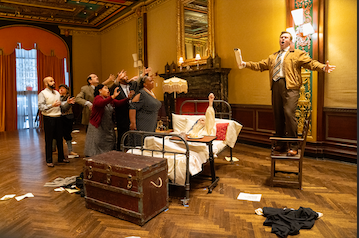
Cast of On site Opera's Gianni Schicchi (photo by Richard Termine)

Luis Ledesma (photo by Richard Termine)

Of all the opera companies we have missed, On Site Opera heads the list. Unique among opera companies, On Site Opera makes an asset out of "homelessness".  As they say, home is where the heart is, and On Site Opera's heart is wherever they can set a given opera in a meaningful locale. 
For tonight's delight, Director Eric Einhorn decided quite rightly that The Prince George Ballroom, ornate and dripping in luxury, would be the right home for Gianni Schicchi, Puccini's late life comedic masterpiece.

Any dramatist will tell you that comedy is more difficult to write and more challenging to act, than tragedy. It must also be true for composition because neither Puccini nor Verdi tackled the genre until the end of their writing careers.  As a matter of fact, it was the last work to which Puccini set his pen. Although he intended the work to be part of a trilogy, this trilogy has often been broken up and this work, the most popular of the three one-act operas, has been wed to quite a number of other one-act operas. On Site Opera chose to present it alone which, given the discomfort of sitting with a mask over one's breathing organs, was a wise decision. Coming in at one hour it was just right, leaving the audience with (sadly invisible) smiles on their faces.

How was this delight achieved? To start with, Giovacchino Forzano's libretto, derived from an 1866 edition of Dante's Inferno (based on real 14th c. Florentine characters), pokes fun at the greed of a selfish family of "aristocrats" and also at the contempt they had for the rising "middle class". Now isn't that the kind of satire we can relate to today? Do we not also get a secret kick out of scoundrels getting away with bad behavior? And what about that very very valuable mule?? There is something truly hilarious about this family fighting over said mule!

Secondly, Puccini's music is filled with humor. We cannot say what makes music amusing but likely a musicologist could elaborate on the rhythms and recurrent motifs lacing the score that tickle the ear and bring a smile to the face. There is a wonderful contrast between the dirge-like music as the family pretends to be grieving, the frisky music of everyone rushing around to create their false scenario, and the romantic music for the lovers. Geoffrey McDonald's conducting of his chamber orchestra--strangely but effectively situated behind the audience--brought out every twist and turn of the score such that we heard things we had not noticed in prior hearings. 

Finally, It is the joyful attitude of the cast who seemed to revel in their creation of characters drawn somewhat from the commedia del'arte tradition. In the title role we had the rubber-faced Luis Ledesma whose fine baritone filled out the role as effectively as his shape filled out the apropos costume of a man climbing out of the peasant class by means of a sharp wit and a lack of compunction about breaking the law.

This seems a rather odd association but we kept thinking about Tony Soprano, a criminal who won over his audience by charm. He kept his dirty dealings from his daughters, much the way Schicchi protected Lauretta by sending her out to feed the birds whilst he schemed and set up his self-serving plot. In the character's way of thinking, he was providing for his daughter's future, even risking hell for himself. There is nothing odd about a parvenu marrying into an aristocratic family headed for impoverishment, as we observed in Il Gattopardo, taking place at the time of the Risorgimento.

As Lauretta we heard the charming soprano Laura León who interpreted her character as a sweet innocent girl who loves Rinuccio for who he is, wealth or no wealth. To her is granted the most famous aria of the opera "O mio babbino caro" which, in a master directorial stroke, she delivered standing on top of a trunk, allowing her not only a sense of importance but also permitted her to mime throwing herself into the Arno. The winsomeness of her presence and the clarity of tone and phrasing made this an unforgettable performance.

As Rinuccio, tenor John Riesen turned in a similarly winning performance. He was successful in winning over his nasty squabbling relatives with his finely tuned tenor in "Avete torto... Firenze è come un albero fiorito" as well as winning over the audience. His duet with Ms. León was particularly fine with their voices blending in well balanced fashion.

David Langan's resonant bass and haughty demeanor were just right for Simone in an interpretation that we had not witnessed previously. As Zita Patrice P. Easton created a formidable matriarch who tolerated no nonsense. The lower part of her register was just perfect and at one point she took the artistic risk of growling out her line and we couldn't keep from laughing out loud.  It was one of those perfect moments.

Often, in an ensemble work like this one, it is difficult to differentiate the characters. However, up close and personal as this was, we were able to discern their individuality. Simone's son Marco and his wife La Ciesca were portrayed by baritone Jonathan R. Green and mezzo-soprano Alexandria Crichlow.  Poor relation Betto was sung by Jay Louis Chacon. The roles of nephew Gherardo  and his wife Nella were well sung by tenor Michael Kuhn and soprano Sarah Beth Pearson. Their son Gherardino was portrayed as a bratty kid who didn't want to run an errand without getting paid. The voluptuous Savannah McElhaney acted the part well without quite convincing us that she was a 7-year-old boy.

The small parts were also well cast and well performed. Brian McQueen managed to differentiate Dottore Spinelloccio and the Notario Amantio. Pinellino the cobbler was played by David Kahng. The non-singing part of the dying Buoso Donati was played by Martin Pfefferkorn.

We are aware that Woody Allen set the work in a tenement which makes no sense whatsoever. Lots of liberties have been taken with the work. Bringing it into the mid 20th c. by means of the costuming (Susan Memmott Allred) worked OK. But we couldn't stop thinking how this century-old work was composed at the time of the tragic flu epidemic and how that relates to the present. But these connections are best made in the minds of the audience.

© meche kroop


Sunday, October 20, 2019

THE DON DONE IN

Suchan Kim, Maestro Teddy Poll, Brace Negron, Sarah Hayashi, Jesus Murillo, Pavel Suliandziga, and Laura León
(Liana Guberman and Paul An not visible)

We have lost count of the number of times we have seen Mozart's meisterwerk Don Giovanni; this year alone we have seen it at least 4-5 times. We never tire of it; the marriage of Mozart's music and Da Ponte's libretto always makes for a great evening--but only if the singing is superb. Bare Opera assembled a stellar group of singers for their current production and we would expect no less of this exemplary company in their fifth season. There was no one onstage who didn't give their all.

Directors always look for something new to say about the reprobate Don--the pussy grabbing predator who uses his position of power to seduce or overcome women, a sociopathic narcissist who has no awareness of other people's feelings, one who will readily betray those who are dumb enough to fall under his spell. If this sounds familiar and relevant to you, dear reader, please know that it does to us as well.

Taking for granted that the performances were uniformly excellent from both dramatic and vocal standpoints, let us take a look at what Stage Director Malena Dayen added to our understanding of the story. Her Don was almost completely lacking in charm; baritone Suchan Kim (a very nice man--trust us on this point) was obliged to search for an inner demon to come up with such a nasty portrayal. Our only opportunity to hear the gentle colors of his beautiful instrument was in the serenade "Deh, vieni alla finestra".

Donna Anna (the splendid soprano Laura León) was the Don's victim-- excuse me, she was a "survivor" in today's parlance--and there was not a whiff of disdain for the loyal Don Ottavio (tenorrific Pavel Suliandziga) who evinced strength of character in place of the usual wimpiness. We have no doubt he will stand by his beloved until her grief abates and they will wed.

Zerlina (portrayed by the winsome Sarah Hayashi) is rather narcissistic herself, wanting to have her cake and eat it too, manipulating the poor Masetto (the excellent Jesus Murillo) who is understandably angry but just as enthralled by her as Donna Elvira is by Don Giovanni, and just as ready to forgive--an interesting parallel.

In this production, Donna Elvira is not a source of amusement but one of those women who just cannot give up on her desire to reform a "bad boy". Soprano Liana Guberman in the role showed a wide range of emotions from rage to forgiveness. We get it. She is complicit in her own misery which we see a lot in women who are taken in by sociopathic men. The vocalism was as fine as the acting.

Bass Brace Negron did a swell job creating the role of Leporello and demonstrated how flunkies can be bought by an artful and deceitful leader. So much of this story resonates with the current political climate.

Paul An made a brief appearance as the Commendatore trying to protect his daughter's honor and later as the statue who invites the Don to dinner in Hell.

There were directorial touches that we liked a lot. Our favorite one found Don Giovanni seducing Zerlina in a partner changing dance that was choreographed by Troy Ogilvie with Emily Morrison's assist.

There were a few minor lapses as well. Changing the duel between Don Giovanni and the Commendatore into the Don stabbing the Commendatore in the back emphasized his evil nature but gave the lie to Donna Anna's anguish about the wound in her father's breast.

Also, if the text involves calling someone over, it seems strange if they are already there. And to say someone has fallen when they are still standing is likewise a minor flaw. But we notice the little things; just can't help it.

There were several omissions or cuts that kept the story moving along without comic relief. We rarely see the scene between Zerlina and Leporello and did not miss it but we must admit that we missed the final scene in which the Don is dining and teasing Leporello who is sneaking food behind his back. We also missed the epilogue in which the moral of the story is reiterated.

In terms of musical values, it seemed criminal to omit "Il mio tesoro" with such a terrific tenor as Mr. Suliandziga on board. Yes, we know that Mozart himself revised his own work to suit the artists available and that only strengthens our case.

Under the direction of Maestro Teddy Poll, the chamber orchestra (string quartet plus bass, flute, oboe, clarinet, bassoon, and horn with Laetitia Ruccolo performing the piano part) sounded just right except for the ballroom scene in which there are three types of dance music played simultaneously. There just wasn't enough "manpower" to pull that off.

The major innovation brought by Ms. Dayen was the use of video projections designed by Sangmin Chae. This is an interesting idea to replace sets with video but the results were mixed. The offstage rape scene is always difficult to accept; what woman pursues her would be rapist???? But the video projections during the overture did not do much to illuminate the event. We saw a distorted face and maybe some hands choking a neck.

At one point something was projected that looked vaguely like an apple. We found much of this distracting and puzzling. Our companion kept looking at us and shrugging and peppered us during the intermission with questions we couldn't answer.

The projection of the Commendatore's face in the final scene was projected as an old fashioned "negative" with white and black reversed.  It just looked like an ugly mask. And there was a delay between the sound and the visuals that just looked like bad lip-syncing. The presence of the videographers on set and next to the orchestra was distracting and audience members kept twisting around in their chairs.

The work was performed in a large empty space with the audience seated on two opposing sides in two rows, an arrangement providing a sense of intimacy with the story. One minor improvement of such an arrangement might be to angle the chairs a bit toward the center. This is the same problem we observe at the New York Philharmonic in the levels above the orchestra, as well as the side boxes at the Metropolitan Opera House.  Just sayin'.

Costumes by Theresa Miles were completely off base and Donna Elvira's was completely unflattering. The only distinguishing feature of the aristocratic women was the headdress--you know, the comb with a mantilla. It seems important to us to mark the difference between the aristocrats and the peasants. A sense of time and place was lacking.

Before we close we would like to acknowledge the contributions of the ensemble: Estelina Syla, Folei Browne, Sarah Blau, Pedro Sequera, Zachary Sebek, and Sanford Leff.

There is only one more performance today and, as of last night, only two seats remaining. Will you be the lucky one?

© meche kroop

Friday, October 4, 2019

A DON GIOVANNI FOR OUR TIME

Pavel Suliandziga, Laura León, Sarah Hayashi, Yuri Napoli, and Liana Guberman

Last night we were at the glamorous Norwood Club which is filled with stunning works of art, none of which could compete with the artistry of the singers assembled for the 6th annual Bare Opera Gala.

This fundraising event was held to introduce those of us who love Bare Opera to the cast and director of the upcoming production of Don Giovanni. Kirsten Scott, Co-Founder and General Director of this boutique opera company, gives good speech just as she gives good singing. If you didn't leave excited about the production you need to be on life support!

With Co-Founder and Artistic Director Laetitia Ruccolo at the piano, we were given a few selections from the production which premieres October 18 at the Bellwether, one of the more interesting spaces chosen by Bare Opera for their productions.

Not only does Bare Opera take opera out of the concert hall and into interesting venues, but they bring in directors with vision who can strip operas of their accumulated clichés, kinda like stripping barnacles off the hull of a boat.

Director Malena Dayen has interpreted Mozart's tragi-comedy in the light of the #metoo movement. It is difficult for us to perceive the gentle and handsome baritone Suchan Kim as a vile seducer but we suppose that's what acting instruction accomplishes.

We have no such trouble seeing tenor Pavel Suliandziga as a devoted Don Ottavio who, we understand, will not be the customary wimp. Having dazzled us with his Tchaikovsky at Around the World in Song, we are ready to be redazzled or bedazzled, if you will.  He is definitely the anti-Don.

The women will not be portrayed as victims and, we can tell you, soprano Liana Guberman makes a fiery but sympathetic Donna Elvira, not the comic figure to which we are accustomed. She was in superb voice last night and knocked our socks off.

The other two female roles were played by singers relatively new to us. Cuban soprano Laura León has the role of Donna Anna and connected well with Mr. Suliandziga.

Zerlina was sung by Sarah Hayashi who connected well with Mr. Kim, the smarmy seducer.

Each singer was interviewed by Yuri Napoli who asked all the right questions, encouraging each singer to reveal something about the character he/she would play.

Director Malena Dayen was present to tell us just enough about how she interprets the story to ensure our attendance at the performance. She will utilize the services of video artist Sangmin Chae to bring 21st century technology to this 18th century opera. We will not say too much about this innovation until we have the opportunity to see it in action.

Consider yourself encouraged to take a walk on the wild side with Bare Opera, Mozart, and Da Ponte. We've got our walkin' shoes on!

© meche kroop