MISSION

We are here to encourage the development of gifted young singers and to stimulate the growth of New York City's invaluable chamber opera companies. But we will not neglect the Metropolitan Opera either. Get ready for bouquets and brickbats.
Showing posts with label Ahmed Alom Vega. Show all posts

Monday, December 9, 2024

A MUSICAL POWER COUPLE


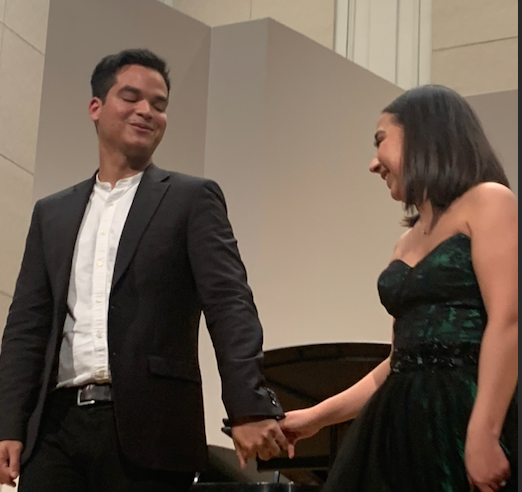
Ahmed Alom and Rosario Armas

We searched our brain for words to describe an artistic partnership that is more than an artistic partnership. When you take an unusually gifted mezzo-soprano and put her onstage with her equally gifted conductor/pianist husband, the musical consequence is more than transporting. We apologize for our clumsy attempt to represent the love and connection between Mexican  Rosario Armas and her Cuban husband Ahmed Alom by juxtaposing two photos. The two speak the same language as well as the same musical and emotional language.

The occasion for sharing in this love fest was the final concert of The Washington Square Music Festival, of which Mr. Alom is the Musical Director. The concert was held at St. Mark's Church-in-the-Bowery and drew a standing room only crowd of music lovers. Beside our favorite musical couple, The Festival Chamber Orchestra was on hand, about which more later.

The part of the program that best expressed the mutual affection of this darling couple was a set of songs by Clara Schumann who, as is widely known, defied her strict parents to marry the famous Robert Schumann, whose output of art songs was stimulated by his adoration for Clara. We wish that more vocal concerts would include her excellent songs and felt grateful that Ms. Armas gave them the attention they deserve. 

The passionate "Er ist gekommen in stürm und regen" was followed by Clara's  gentle setting of "Liebst du um Schönheit" (also set by Gustav Mahler) and "Warum willst du and're fragen".  Ms. Armas' instrument has both depth and breadth and remained even throughout the entire register. The tone quality was moving in its varied emotional coloration and the vibrato was just right for the material.

Mahler was not to be neglected. His Lieder eines fahrenden Gesellen rivals Schubert's Die Winterreise in its depiction of the agony of lost love. No doubt, Mahler's wife Alma and her constant stream of lovers inspired this painful song cycle. The singer must convey  the many shades of sorrow, disappointment, rage, and failed attempts to rise above it all with an assist from the natural world. This was brilliantly achieved by Ms. Armas with Mr. Alom echoing the feelings every step of the way. We were fighting back tears throughout and hoping that the artists will never ever have to experience such pain!

The final vocal event on the program consisted of a song cycle Canciones de la Muerte op.20  by Julián de la Chica, a living composer with whom Ms. Armas has frequently worked. It is quite an honor to participate in an orchestral world premiere and the sonorities captured by the orchestra were various and often pungent. However, we found the death-oriented text by Padre António da Ascençao (translated from Portuguese into Spanish by the composer) to be too solemn, grim, and ponderous for our taste.

Also on the program was Johann Sebastian Bach's Brandenburg Concerto no. 5 conducted from the piano by Mr. Alom, who achieved a lively and concise reading. For our musical tastes however, we preferred Debussy's Prelude à l'après midi d'un faune for its dreamlike exoticism. The introductory flute solo was beautifully handled by flutist Sheryl Henze who was joined by clarinetist Mitchell Kriegler.

It was a lovely well-balanced and varied program. The memories we will take away, however, will be that of the lovely attunement of Ms. Armas and Mr. Alom!

© meche kroop


Tuesday, May 10, 2022

ENDINGS AND BEGINNINGS


Ahmed Alom Vega and Rosario Armas

There are pleasant recitals, there are excellent recitals, and there are recitals that one will never forget.  Mezzo-soprano Rosario Armas, just completing her Master of Music degree at Manhattan School of Music, gave a recital in collaboration with her new husband Ahmed Alom Vega that has us groping for superlatives.
 
Before describing the program let us begin by trying to analyze what made this recital so outstanding.  There are a lot of great voices out there; many programs are designed to show off the singer in many languages and styles; but rare is a recital in which the singer's artistry is such that he or she melts into the character.

We were not at all surprised that Ms. Armas perfectly inhabited the character of Cherubino in the recent production of Mozart's Nozze di Figaro at Manhattan School of Music. However, doing the same thing in an art song is far more challenging.

For example, how many times we have enjoyed hearing a baritone singing Mahler's emotionally shattering cycle Lieder eines fahrenden Gesellen; on a rare occasion we have heard a female singer make an attempt, leaving us with a kind of negative opinion of singers tackling works meant for the other gender. Last night was completely different! It was the essence of the text that came across as Ms. Armas completely disappeared. (If a baritone ever does the same with Schumann's Frauenlieben und Leben we may very well fall off our chair.)

Serving the music and the text to this degree requires the abandonment of self indulgence. The narrator in this cycle is suffering from the loss of his beloved and in spite of the beauties of nature he sinks into despair.  Eventually his agony yields to a calm acceptance.  Ms. Armas limned each and every emotion; even if the listener did not understand the German (which our singer enunciated with Teutonic perfection) one could not fail to understand.

The narrator of Henri Duparc's "Au pays où se fait la guerre" is in a different type of despair. She is pining for a lover who has gone off to war. The text was performed in an even Gallic style but was no less affecting.  We couldn't help but thinking that the world hasn't changed much.  Men still go off to fight foolish wars and women are left to pine. Here, Ms. Armas' phrasing was accompanied by a very affecting vibrato.  Variety from one verse to the next was achieved by astute variations in dynamics and tempi.

Three Italian songs from three different periods permitted the appreciation of those lovely Italian vowels.  From the late Baroque period we heard "Sposa son disprezzata" from Vivaldi's Bajazet.  A lovely pianissimo aria was followed by a fierce cabaletta marked by clarity in the fioritura; the ritornello was given a different color.

"Non t'accostare all'urna" from Verdi's Sette Romanze is one of our favorite songs and as Ms. Armas performed it we felt as if we knew the woman who was singing the words and we knew her as if she were a character in an unknown opera. We wondered whether Verdi had intended it that way.

The more modern "Nebbie" is a real mood piece and we found it chilling in its intensity, achieved by both singer and pianist.

Two selections from Kurt Weill's Trois chansons reminded us that there is truly no difference between a cabaret song and an art song. If the singer has a great voice and sings unamplified, even a Broadway song can stand next to an aria.  There is an operatic depth of feeling in "Je ne t'aime pas" and plenty of irony and denial, all made clear by our marvelous mezzo by means of word coloration. "Youkali" came as somewhat of a relief from all that pain.

More pain was experienced in two selections from Manuel de Falla's Siete canciones populares with guitar accompaniment by Eduardo Gutterres.  The pain of "Asturianas" is a gentle sorrow but the pain of "Polo" is an angry pain--all made clear by Ms. Armas' Iberian intensity.  If we are not mistaken, we were first introduced to the artist when she performed the cycle some years ago!

After all that pain it was surely time for some exuberance and fun.  From Obradors' Canciones clasicas españolas, "El Vito" was given a raucous reading my Ms. Armas, Mr. Gutterres, and Mr. Vega providing rhythmic accompaniment on the cajon. This may be a good time to mention how outstanding we found his pianistic collaboration throughout the entire concert. We particularly noted it during a set of Burleigh songs when he gave the most delicate introduction to "Among the Fuchsias" and some lovely arpeggi in "Till I Wake". There were some impressive trills in the bass register in Mahler's "Die zwei blauen augen".  There were also some sharp attacks in the Mahler that emphasized the pain.

There were more delights to come in a spirited performance of "Yo soy Maria" from Piazzolla's tango opera Maria de Buenos Aires. Rodolfo Zanetti was featured on bandoneon and Nicholas Danielson on violin with both providing interesting solos. Pedro Giraudo played string bass and Mr. Vega, the piano.

An encore was enthusiastically demanded and Agustin Lara's "Granada" was the perfect ending to a perfect concert, sending everyone out smiling.

We have said little about Ms. Armas' vocal assets. There is absolutely nothing to criticize, not a single quibble. It is a rich sizable instrument with a lovely quality. There is ample resonance in the lower register and a bright expansive top. It is seamless in its transitions. Languages are perfect. Phrasing is always elegant. All of this "technique" disappears into the performance; Its perfection is what allows the listener to focus on the music.

We have the greatest confidence in Ms. Armas' future, both on the opera stage and as a recitalist. All doors should open for such an artist.

© meche kroop