MISSION

We are here to encourage the development of gifted young singers and to stimulate the growth of New York City's invaluable chamber opera companies. But we will not neglect the Metropolitan Opera either. Get ready for bouquets and brickbats.

Wednesday, October 26, 2022

ERIC OWENS AND FRIENDS


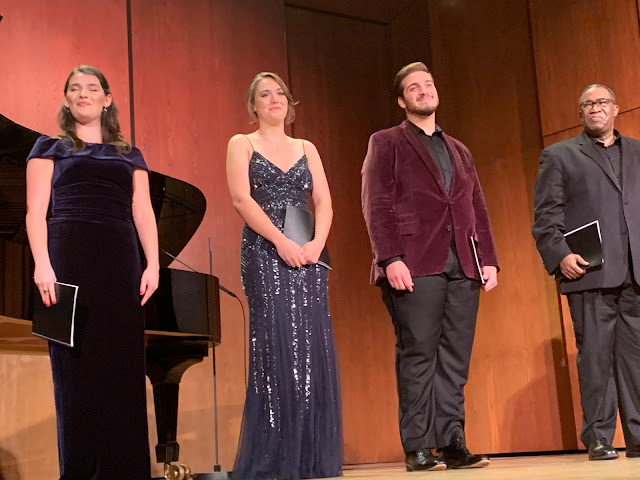
Sarah Fleiss, Lucy Baker, Joseph Tancredi, and Eric Owens

What a magical evening we spent in the company of four artists from the Curtis Institute of Music in Philadelphia, on tour as part of Curtis on Tour. Led by esteemed bass-baritone Eric Owens, who graduated from the Curtis Institute a quarter century ago and who now serves on their faculty, three emerging artists dazzled us with their artistry. Mr. Owens' legendary gifts have been sufficiently recognized and treasured worldwide, so let us focus on the three young artists who seem to have profited enormously by his tutelage.

Let us begin by praising the program which contained not a single disappointment. There was something for every taste--art songs, folk songs, cabaret songs, musical theater songs, and of course a couple operatic scenes. The theme of the evening seemed to be love in all of its many manifestations--the longing, the satisfaction, the disappointments.

Who beside Brahms has brought so much artistry to the folk song! We never pass up an opportunity to hear his Liebeslieder Waltzer, Op. 52, but are far less familiar with his Neue Liebeslieder Walzer, Op. 65. We imagine that the first collection was so successful that Brahms was urged to set more of Georg Friedrich Daumer's text. (The final song of the group was written to text by Goethe but it was not included.)

Accompanied by 4-handed piano (Ting Ting Wong and Miloš Repicky) The soprano of Sarah Fleiss blended beautifully with Lucy Baker's mezzo-soprano, Joseph Tancredi's tenor, and Mr. Owens' bass-baritone. Each song offered a different combination of voices and therefore different textures. 

The solos were particularly poignant, especially those given to Ms. Fleiss which seemed to emphasize the woes of a maiden unsuccessful at love--"An Jeder Hand die Finger" in which a maiden has bestowed all her rings on worthless men, and in "Rosen steckt mir an die Mutter", in which she sees herself wilting and stripped of leaves like a rose.  This characterization would be repeated at the conclusion of the evening when she sang a most pathetic Gilda in the quartet from Verdi's Rigoletto.

Ms. Baker was very well suited to the role of temptress in "Wahre, wahre deine Sohn" in which she tells a neighbor that she is going to bewitch her son. Later, she would be similarly seductive as Maddalena. Hearing the two women bring Sophie and Octavian to life in "Mir ist die Ehre widefahren" from Richard Strauss' Der Rosenkavalier was all one could wish for and gave the two of them an opportunity to interact, which was not possible in the Brahms. 

When a performance is that exquisite, the mind's eye supplies the costumes and settings and we were transported right into 19th c. Vienna. The two women sounded so harmonious together that we longed to hear them sing "Dôme épais le jasmin" from Delibes' Lakme. We are putting that on our wish list! 

We were also happy to hear all voices together in a few of the songs and cannot think of any work written for four voices that we enjoy more . None of the songs were written for two male voices but we did get to hear Mr. Tancredi and Mr. Owens harmonize in double delight with "Au fond du temple saint" from Bizet's Les Pêcheurs de perles, our favorite duet for male voices. 

We noticed a few things about Mr. Tancredi that augurs well for his future success. One is his vocal artistry; few tenors produce such round Italianate vowels, which we attribute to his consistent embouchure. There is no "spreading" and no forcing--rather, complete security of technique. We have reviewed Mr. Tancredi as an undergraduate at Manhattan School of Music where we noticed his promise. Again we observed his growth as a Santa Fe Apprentice in 2019. Nothing makes us happier than seeing growth in an artist. The other thing we appreciated was his total immersion in the character of Nadir. We saw the temple and the crowd through his eyes-- and that is the excitement of opera!

We have also heard Ms. Fliess  a few years ago, singing a duet from Rossini's Tancredi, singing the title role as a mezzo-soprano. We were surprised to hear her as a soprano but happy to report that the high notes are crystalline and unforced. It will be interesting to see where she goes next. Her duet with Mr. Tancredi from Rodgers and Hammerstein's Carousel was a joy to hear.

Ms. Baker is new to us and we can hardly wait to hear her again. Aside from a lovely instrument she knows how to get a song across and we delighted in her delivery of "Langsamer Walzer" from Schoenberg's Brettl Lieder which is also known as "Den Spiegel von Arkadien" which we alway call "the Bum bum song". Her interpretation was highly dramatic and filled with humor, making every word count.

We have alluded to the closing number, the famous quartet from Rigoletto and it was the perfect way to end this varied program, leaving us with the impression that great voices and great music need not be categorized. Art song or folk song, aria or cabaret, just sing it with style and substance and we are happy.

© meche kroop

Friday, October 21, 2022

TERRIFIC TRIAD


 Larisa Martinez and Joshua Bell
(photo by Shervin Lainez)

It is rare to find a concert as well planned and exquisitely performed as last night's "Voice and the Violin" at the Kaufmann Concert Hall of the 92nd St. Y. We were thinking "Divine Duo" for the title of our review but that would have neglected the exceptional collaboration of pianist Peter Dugan, so well remembered from his Juilliard days. Much pandemic labor went into researching works for violin and voice and in adapting works for this combination. This would seem to be a labor of love--love between husband (violinist Joshua Bell) and wife (soprano Larisa Martinez), since this beautiful pair of artists are indeed wed. The pacing of this concert held us spellbound from beginning to end and left us feeling elevated.

The concert opened with a rarely heard work by Mendelssohn entitled Infelice. Musical scholars claim that the work comprises two separate works written in two different periods but both are settings of text by Pietro Metastasio and both were written in the same key. Perhaps this would explain why the audience burst into applause after the recitativo. In any case, it is a lovely concert aria and allowed Mr. Bell and Mr. Dugan to create an entire orchestra to back up Ms. Martinez' astute handling of the two sections, particularly the urgency of the cabaletta. We admired the fineness of the trills and the drawn out diminuendo of the conclusion.

Ernest Bloch's "Nigun" from Baal Shem alternated sorrowful melodies with aspirational ones; forcefulness was met with delicacy in rapid alternation. We know little about violin performance but couldn't help noticing how much like the human voice it is--but also capable of something else that is beyond the reach of the voice, the double stop. Although ignorant of violin technique, we are capable of recognizing and appreciating artistry which Mr. Bell has in spades, as they say.

The eponymous heroine of Massenet's Manon begins her journey as a wide-eyed impressionable convent-bound young woman and Ms. Martinez's acting here was just as exceptional as her vocal artistry. She created a very believable character, so believable that our mind's eye supplied the town square and the coach! There was something else that impressed us. The artist gave a glimmer of the wildness behind the innocence, hinting at what would follow. What a performance!

In Ferdinand Hérold's. "Jours de mon enfance" from Le pré aux clercs, the gorgeous melodies bounced back and forth between violin and soprano, made delicious by the rapport between the two artists. If Mr. Dugan was denied the benefit of eye contact, he never faltered in his support of the other two artists.

Chopin's Nocturne in E-flat Major, Op. 9, No. 2 is one of our favorite works and to hear Mr. Bell play his own arrangement, with Mr. Dugan relegated to a supportive role, was a revelation. It allowed us to hear the piece with fresh ears and to realize the very different colors and capabilities of two different instruments.

Ms. Martínez voice and personality were perfect for the Iberian inflected. "Les filles de Cadix" by Delibes. Her highly spirited performance was countered by dreamy delicacy in her performance of Richard Strauss' "Morgen".

Mr. Bell's performance of Henryk Wieniawski's  Scherzo-Tarantelle, Op. 16 showed off his astonishing technique, driving the audience wild. We might mention here how much we appreciated the unassuming manner in which he addressed the audience, sharing with us that he played this piece as a 12-year-old. The achieved intimacy belied the size of the packed auditorium and we felt as if we were in a salon in our own home.

Our lovely soprano took over with a rapid fire performance of the lively "Zapateado" from Gerónimo Giménez' zarzuela , La Tempranica. Regular readers will recall how enthusiastic we are about zarzuela

We enjoyed Narciso Figueroa's "Mi Rancho" so much that we were inspired to learn something about him. Ms. Martínez is rightfully proud of her Puerto Rican heritage and what a good choice it was to share a work by her homeland's Father of Danzas, as he is called. The work she sang comes from a set of four songs entitled Cuatro Decímas and we want to hear the other three!  Mr. Figueroa was born to a Puerto Rican dynasty of musicians, studied classical composition in Europe and returned home to Puerto Rica to apply what he learned to his country's folkloric musical traditions and to assume a position as professor and director of the piano department of the Conservatory of Music of Puerto Rico, a position which he held for many years.

The evening ended with West Side Story Suite, an arrangement of Leonard Bernstein's opera by Brohn and Czarnecki. The violin introduction sounded uncomfortably dissonant to our ears but once Ms. Martínez started to sing (both female parts) we grew to love it. We were ready to leave on a "high" but our vivacious soprano took us even higher with a work well suited to her beauty--"Quando m'en vo" from Puccini's La Bohême, bringing the audience to its collective feet once more.

We understand that this divine program will be touring the United States, so if you are living outside New York, watch out for it.

© meche kroop

Friday, October 14, 2022

ARGENTINIAN SOUL


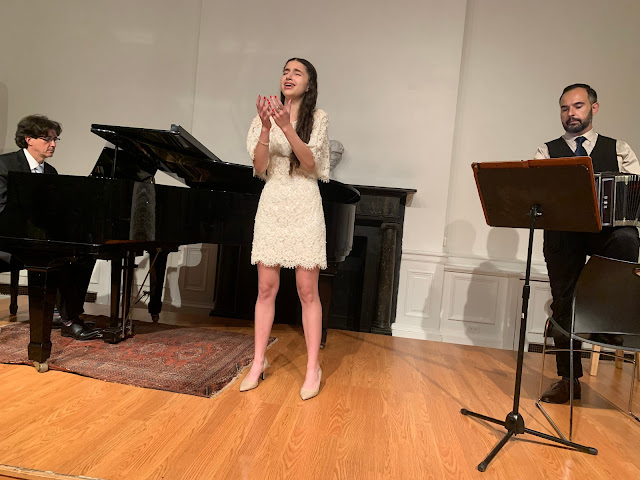
Maestro Jorge Parodi, Mezzo-soprano Morena Galán, and Bandeónista Rodolfo Zanetti


If New Yorkers are ignorant of Argentinian music, we are sure that will not last long since Maestro Jorge Parodi has assumed the helm of Opera Hispánica; he will see to it that these treasures will be mined. The most interesting feature of Latin American music, in our opinion, is that their composers were not seduced by the destructive tendencies of the world of music academia which gave the old heave-ho to melody and key signatures.; Latin American music remained melodic and relatable all through the 20th c. and on into our own epoch.

Last night, hosted by The Consulate General of Argentina in New York, a full house was gifted with a program of Argentinian music, including art song, folkloric song, piano compositions, and, of course, tango. There was no shortage of melody and rhythm, joined in celebration of a wide range of human emotion.

Included among the artists were Maestro Parodi himself, appearing as collaborative pianist, solo pianist Pablo Lavandera, Metropolitan Opera star baritone Fabián Veloz, baritone Gustavo Ahualli, two lovely young mezzo-sopranos Morena Galán and Malena Dayén, guitarist Andrés Guerra, and bandoneónista Rodolfo Zanetti.

The above photo captures an intense moment in which Ms. Galán offered a passionate rendition of a tango from the 1920's entitled "Romance de Barrio" by Anibal Troilo. Aside from possessing an appealing and well-supported instrument, this young artist has a formidable ability to connect with the audience, an ability than can only come from a deep connection with the music. We enjoyed equally Carlos Gardel's "Por una cabeza" which allowed her the opportunity to show off a smoky lower register. The more modern "El clavel del aire blanco" by Carlos Guastavino was also given the same heartfelt treatment.

From the same song cycle, the familiar. "La rosa y el sauce" was beautifully performed by Ms. Dayén whose rich mezzo was put to good use in her phrasing of the gorgeous melody and in the fine use of dynamic variation.  In the livelier dance-like "Pampamapa", also by Guastavino, we had trouble staying still. Splendidly accompanied by Mr. Guerra, she introduced us to Daniel Toro's "Samba para olvidarte". Unfortunately, the audience broke into applause before we could hear the conclusion of Mr. Guerra's tender postlude.

Mr. Veloz' generous textured baritone filled the room with resonance in a stunning rendition of Guastavino's "Cita", making ample use of phrasing and dynamics. The dancy rhythm of Jorge Cafrune's "Cuando llegue el alba" was delightful. He wisely matched his large voice to the size of the room.

Mr. Ahaulli's powerful baritone fit well with Guastavino's "Abismo de sed" which was preceded by a complex introduction in the piano part which was stunningly performed by Maestro Parodi. We also enjoyed Carlos Gardel's familiar "El dia que me quieres" which just oozed romance.

Mr. Lavandera performed Tres Danzas Argentinas Op. 2  by Ginastera, composed early in his life. The rapid fire "Danza del viejo boyero" was followed by the lilting adagio "Danza de la moza donosa" (our favorite), and finally  "Danza del gaucho matrero"  the complex rhythm of which the artist was thoughtful enough to explain to the audience.

He also performed a gentle work by the recently deceased Claudia Montero entitled "Junio", given its New York premiere. He shared with the audience the fact that what sounded like improvisation was written down note by note. The work was marked by. thrilling runs and lilting arpeggi.

There were many more delights in the generous program, including tangos by the famous Astor Piazzolla. One could not fail to appreciate the wide variety found in this program which was entitled An Argentinian Affair. For us it was a golden opportunity to get a taste of many different styles of composition and to hear some new voices.  A big bravissimo to all concerned!

© meche kroop

Sunday, August 28, 2022

MUSIC 10 --LOOKS 2


 Isabel Leonard and Michael Fabiano (photo by Curtis Brown for Santa Fe Opera)


Where are we? We are sitting in the Santa Fe Opera's lovely theater, wishing we were being transported to Seville in the 19th c., the world created by Georges Bizet and librettists Henri Meilhac and Ludovic Halévy (originally created by novelist Prosper Mérimée)--a world of gypsies, smugglers, and bull fights. But no, that is not going to happen. We can't tell where we are from a confusing set and ugly costumes. We are in the world of a misguided director who wants to tell a different story.  Of our beloved Carmen, only the "romantic" obsession remains and the good girl/bad girl dichotomy.

We were inspired to do a search of our reviews of every Carmen we have ever written about.  And there are dozens. Significantly, the last Carmen done by Santa Fe Opera was similarly egregious. The most affecting one we ever saw was performed by a small (now defunct) company in New York City. The most original one was presented by a psychoanalytic colleague whose concept it was to be interviewing Don Jose in prison, after the stabbing. His character was explored by means of flashbacks to various scenes of the opera.  It was original and illuminating. If you are going to have a concept, it better be cohesive and show us something new about the characters. This production was about as interesting and as believable as Lucia in overalls in the rustbelt of the United States, as presented by the Metropolitan Opera.

If one closed ones eyes, which we frequently needed to do, one was treated to some superb singing and a glorious reading of the score by Maestro Harry Bicket. The music moved right along with big dramatic orchestrations, as in the overture, alternating with gentle pianissimo lyricism, as in the introduction to Act III.

Poor mezzo-soprano Isabel Leonard, drably dressed in jeans and dun colored top gave her all to make sense of the character. She possesses a magnificent instrument which she uses skillfully throughout the entire range. She clearly worked hard to fulfill the director's requirements and to tell us something new about the eponymous heroine. In the 19th c. there was something shocking and fascinating about a woman who marched to her own tune. Set in contemporary times, it's just old hat.

Tenor Michael Fabiano sounded just fine as Don Jose but was perhaps directed to be particularly awkward with his body movements, leading us to speculate that Don Jose had some rare ailment that contributed to his unbalanced mental state.  His violence did not evolve gradually but was present right from his ungracious shoving of Micaëla as she tried to give him a kiss from his mother. 

Soprano Sylvia D'Eramo scored vocally with her Act III aria. Dressed in overalls, backpack, and Keds, she looked nothing like an innocent country girl although she did her best to act the part, contrasting with Ms. Leonard's worldly wise mien.

Four apprentices delighted us with their performances, seemingly removed from the intensity of the main story. Soprano Magdalena Kużma's Frasquita and mezzo-soprano Kathleen Felty's Mercédès made a fine pair and we enjoyed their card reading duet. Tenor Anthony Léon's Remendado  and baritone Luke Sutliff's Dancaire brought Act II to vivid life. The quintet with Ms. Leonard resisting their blandishments was one of the vocal highlights of the evening.

Bass-baritone Michael Sumuel was put in the ambiguous position of portraying Escamillo as a bullfighter in authentic dress, and also some kind of entertainer in a saloon pretending to be a bullfighter. Nonetheless, we enjoyed his singing of the Toreador Song.

Bass-baritone David Crawford was effective as Zuniga; Apprentice David Lekeith Drone sang the role of Morales; Omen Thomas Sade took the non-singing role of the famed Lilias Pastia.

A terpsichoreally challenged female child was onstage so much, for no apparent reason, that we were not surprised at the muttering of the woman sitting next to me, muttering we choose not to repeat. These constant appearances were most resented when they occurred during the big arias. How unforgivably distracting! Perhaps she is the offspring of a big donor. Why was she holding her ears during the overture? Why was she prancing around stage making odd faux flamenco moves with her arms and swishing her skirt? Whatever the director had in mind was lost on every audience member we spoke with or overheard in the ladies room during intermission.

French director Mariame Clément obviously comes from the European régie theatre school.  Silly us to think that opera is about singing that enhances logical story telling! Whatever happened to authenticity and honoring the intentions of the composer and librettist? We would beg directors to stop trashing the classics. Modern touches added to comedies are just misdemeanors but to ruin a tragedy is a felony.

Julia Hansen's set and costumes for Act I were not awful.  Just a bunch of soldiers on one side and a fenced in area on the other side, enclosing a yard for the cigarette factory workers to take their breaks. But things got progressively worse.  In Act II, there was something like a nightclub with what appeared to be a drag show onstage; but then appeared to be Frasquita and Mercedes in hideous garish costumes. And another smaller stage was wheeled on with Escamillo in full toreador costume singing his big aria.

Act IV was completely incomprehensible.  At first, the chorus of onlookers were waving flags behind a wooden barrier. So, it's a bullfight and we had no problem using our imagination to recreate the parade of chulos, picadors, and toreros that were being sung about.  But then the set became a garish amusement park with a ticket office with a sign reading "CAJA"--Spanish for cashier or box office--and the only sign that the action is supposed to be taking place in Spain. A lone merry-go-round horse witnessed the violence perpetrated by Don Jose on the complacent but defiant Carmen.

Not only were the characterizations impossible to fathom but the stage business frequently belied the text. Please don't sing about a rope and then produce handcuffs to restrain Carmen.

We could go on and on about the directorial  misjudgment but we would prefer to use the space to once again applaud the excellent chorus of apprentices, directed by Susanne Sheston.  The chorus has been a winning element throughout the season.

© meche kroop

Friday, August 26, 2022

A STAR IS BORN


Quinn Kelsey as Falstaff  (photo by Curtis Brown for Santa Fe Opera)


We planned on writing about baritone Quinn Kelsey and his lusty and self-deluding Falstaff.  However, we were so taken with Teresa Perrotta's performance in the role of Alice Ford that we can think of nothing else. Stepping out of her apprentice position and into this role (substituting for Alexandra LoBianco) was a fabulous opportunity and one she seized with a stunning role interpretation and consummate vocalism that garnered deafening applause at the conclusion of the opera.

Of course, the entire cast was cause for celebration, as was the astute conducting of Maestro Robert Tweten, but to see a newcomer shine like that is revelatory. This young soprano has a major voice and was undaunted by Verdi's writing. She possesses a superb instrument, as we noted when writing about the  apprentice scenes. Having been mightily impressed by her Violetta in a scene from La Traviata, we cannot claim to be completely astonished; however, assuming a major role like this one with so much stage time is an entirely different story.

Her Alice Ford was substantial and real, good natured but a bit mischievous. Ms. Perrotta is probably very close in age to the adorable soprano Elena Villalón who portrayed her daughter Nanetta; however, her bearing and the weight of her voice succeeded in creating a convincing mother/daughter relationship. We foresee a brilliant future for Ms. Perrotta and nothing could make us happier.

Similarly, Ms. Villalón was completely believable as Nanetta, a young girl in love. The high tessitura of Verdi's writing seemed to offer no challenge to her focused soprano and her acting was everything it should be. She charmed us with her Act III aria  "Sul fil d'un soffio etesio". Lyric tenor Eric Ferring as Fenton made an ardent lover as they teased one another and flew into each other's arms. Although the opera lacks large Verdian arias, Fenton gets a lovely brief one in "Dal labbro il canto estasiato vola" which served to highlight Mr. Ferring's  pleasing timbre and phrasing; we admired a graceful diminuendo and the easeful approach to high notes. When the two young voices joined for "Labbra di foco", we were smiling from ear to ear.

If one were looking for major arias in this opera one might be disappointed; however baritone Roland Wood made the most of his jealousy aria "È sogno o realtà?"  His character is difficult to like, not only because of his unwarranted jealousy but also because he would sacrifice his daughter to provide a wife for his elderly friend Dr. Caius (tenor Brian Frutiger). We liked him better by the conclusion of the opera when he graciously accepted the new son-in-law whom he had unwittingly blessed .

Trickery would seem to be the theme of the story. Falstaff would like to trick two women to get their money to pay for his lavish self-indulgence. Bardolfo and Pistola trick Falstaff into taking them back into service by pretending to be repentant. Mistress Quickly tricks Falstaff into believing that Alice appreciates his interest. Alice Ford tricks her husband into marrying their daughter to Fenton. The biggest tricks of all are played on Falstaff. Don't we all love to see people get the comeuppance they deserve? We think of this as "The Revenge of the Merry Wives".

And Falstaff certainly deserves comeuppance for his treatment of women and for his narcissistic self-delusion. So how does a shameless fraud like Falstaff achieve the sympathy of the operatic audience? The secret lies in the light hearted music created by Verdi, which tells us not to take him seriously, and in the artistry of the singer portraying him. For this we have Mr. Kelsey to thank for his resonant baritone and his total immersion in the role. We felt sorry for him when the townspeople beat him up in Act III. He affects repentance for his bad behavior but we know he is not "cured". Although he has seen his own folly, he readily points out the folly of others.  Verdi's brilliantly written fugue ends the opera with "Tutto nel mondo è burla".

The factors that made Sir David McVicar's production so successful comprise the splendid ensemble feel of the work, and Robert Tweten's conducting, which brought out every comic element of Verdi's score. We have tried for years to grasp what makes music funny and invite our dear readers to comment below. At one point we heard the orchestra laughing! Was it the unexpected rhythmic shifts that created the humor?

As far as the ensemble work, the contributions of bass Scott Conner as Pistola and tenor Thomas Cilluffo (one of the apprentices) as Bardolfo doubled the comic impact of the work. Each had a unique personality and style of movement. Consider yourself fortunate if you were close enough to see their facial expressions as well as their antics. The audience loved it when Bardolfo, disguised as Nanetta, got married to Dr. Caius. Oh how he pranced!  Oh how we laughed.

Mezzo-soprano Megan Marino made a funny Meg Page in a very funny hat and mezzo-soprano Ann McMahon Quintero delighted with her exaggerated "Reverenza". It seemed that the enjoyment of the audience reflected the joy of the cast. They seemed to be having a great time onstage.

As you probably already know, Arrigo Boito's libretto was adapted from Shakespeare's play Merry Wives of Windsor, with some additions to Falstaff's character from Henry IV, parts I and II. Boito's close working relationship with Verdi shows in the successful marriage of word and music.

Thankfully, the costumes were of the period (Shakespeare's) and the unit set was effective, comprising a playing area flanked by sets of stairs leading up to a gallery, allowing characters to spy on one another and permitting several activities to occur simultaneously. And this leads us to our sole quibble about the production. At times there was so much going on that it distracted from the singing. We have noticed this recently in a number of productions, along with unnecessary choreography with characters lined up, performing inappropriate dance moves.

In the opening scene, Falstaff is in bed with a male child and a somewhat older female in a nightdress. At the end of the scene it appears that Falstaff and she are in copulatory position. In other scenes, the young woman is seen twirling around the stage.  None of this was necessary, nor did it add to the storytelling or character development.

In other scenes, servants are chasing each other up and down the stairs, or raking leaves, or hanging up the wash. When done between acts, it added to the verisimilitude but when singers were singing it was just distracting.

In sum, it was a delightful evening, marked by superb ensemble work and a glorious rendering of Verdi's music by singers and conductor alike. That we witnessed the birth of a star soprano was icing on the cake.


© meche kroop

.


Wednesday, August 24, 2022

LOVE AND DEATH


 Tamara Wilson and Simon O'Neill (photo by Curtis Brown for Santa Fe Opera)


We felt quite a bit of envy last night at the Santa Fe Opera's production of Wagner's Tristan und Isolde; we were envious of the bulk of the audience who seemed enthralled and greeted the artists with thunderous applause at the curtain call which took place a hefty 4 3/4 hours after the disturbing opening chord. Sadly, we were not enthralled.

It was not the length that we objected to; we have sat through Wagner's Ring Cycle a number of times and the hours flew by. It may have had something to do with the medieval legend upon which Wagner based his libretto. The influence of Schopenhauer's pessimism made the love story unlovely. We cannot deem the idea of uniting in some fantasied afterlife as a desirable goal for lovers.

As a matter of fact, the situation between the two titular characters had nothing to do with love but rather with obsession. Who was Wagner to write about love! The philandering narcissistic composer disrespected his own wife! The true loves in this opera are that of the forgiving King Marke for his adopted heir, and that of Kurvenal for his friend Tristan.

Since you, dear reader, have probably already read about the prodigious gifts of soprano Tamara Wilson who used her huge instrument effectively and acted convincingly as the captured Irish princess, we would like to begin by noting the performances that captured our flagging attention.

When bass Eric Owens walked onstage in Act II, our tedium dissolved. In contrast with the wooden performance of heldentenor Simon O'Neill, Mr. Owens has stage presence to spare and a commanding voice, offering a sympathetic portrayal of a childless widower who has been pressured into remarrying the resentful Irish princess. The poor guy got a raw deal, getting betrayed by his designated heir Tristan with his designated bride Isolde. This bring us to our contrarian opinion that this is not so much a love story as a story of the consequences of betrayal.  Not only is King Marke betrayed by Tristan but Tristan is betrayed by his jealous friend Melot, well sung by apprentice Eric Taylor who made such a fine showing on Sunday as Siegfried. We are always happy to hear young voices tackling Wagner!

It helped significantly that Mr. Owens was costumed (by Carlos J. Soto) in regal red, quite a standout against the grey and white geometric set, designed by architects Charlap Hyman and Herrero. One could call the architectonic set interesting in its flexible uses but we found it sterile and more suitable to Schopenhauer's philosophy than to a mythic love story. Costuming for Mr. O'Neill was less successful; the armor made him appear to have no neck. The women, however were graced by long flowing gowns.

Mezzo-soprano Jamie Barton made a convincing Brangäne and made good use of her rich middle and lower register. The performance we most enjoyed, however, was that of Nicholas Bownlee in the role of Kurvenal. He showed a deep commitment to the role and wanted for nothing in terms of dramatic effectiveness. His voice was the most successful at cutting through Wagner's dense orchestration and showed an interesting timbre. One might, however, wish for a bit more variety in volume. (His recent recital for Performance Santa Fe's Festival of Song revealed just how deep his artistry runs.)

Speaking of Wagner's orchestration, we are quite aware of the novelty of his harmonic structure and the way he avoided any kind of harmonic resolution until the very end, creating a sense of unease throughout the entire work. What we liked best were the quotations from his Wesendonck Lieder. The rising four note scale passage from "Im Treibhaus"  reveals how a simple four note rising scale passage can produce substantial emotional involvement.

The conducting of Maestro James Gaffigan was excellent and went a long way toward illuminating Wagner's dense orchestration. We were particularly taken with the lengthy searching solos for English horn and bass clarinet, an instrument we don't get to hear as often as we would wish.

It is always a thrill to hear apprentices onstage, making an impact in smaller roles. Tenor Jonah Hoskins sounded great in the role of a sailor, singing a song that Isolde takes as insulting. Tenor Dylan M. Davis appeared as a shepherd responsible for playing  a tune when Isolde's ship arrives to heal the dying Tristan. Baritone Erik Grendahl sang the role of the Steersman.

Although this particular production of this particular opera did not resonate with us, we admire Santa Fe Opera for tackling it and for bringing so much satisfaction to so many opera lovers. How gratifying that very few people left early. Although not overwhelmed we were left with some satisfying memories of King Marke and Kurvenal, the afore-mentioned woodwind solos, the play of John Torres' lighting on the set, and the formidable voices of Ms. Wilson and Ms. Barton.

Although we were not inspired to read more of Schopenhauer's philosophy, we were moved to think upon the heavy cost of betrayal. We did wonder how Wagner felt about his own bad behavior, betraying his wife and betraying his patrons by seducing their wives.

(c) meche kroop


Tuesday, August 23, 2022

FINAL SANTA FE APPRENTICE SCENES


 Justin Burgess, Vanessa Croome, Caroline Corrales, Daniel O'Hearn, and Joseph Parrish

It seems as if the eight scenes chosen to present to the public by the Santa Fe Apprentice Program are of twè kinds. One type demonstrates the ability of the young artists to work together as an ensemble; the other variety seems to highlight the particular talents of a pair or trio. 

Let us begin with the scene from Verdi's La Traviata in which the ailing courtesan Violetta is confronted by her young lover's irate father. Père Germont has come to persuade her to give up his son in order to get his virtuous daughter married off. He demands, cajoles, and manipulates. His arrogant mien softens when he realizes her humanity and dignity. Teresa Perrotta impressed us with a sizable soprano, lovely legato line, and accurate phrasing. Baritone Darren Lekeith Drone made an excellent Giorgio Germont, not only singing with intention but successfully converting our initial anger at his character for insulting our favorite operatic heroine to a feeling of sympathy for his bourgeois predicament. The scene was well directed by Crystal Manich.

Another duet  that impressed us was from Robert Ward's The Crucible. We generally find fault with contemporary opera in English for its lack of melodic interest; however, Maire Therese Carmack's performance as Elizabeth Proctor and baritone Erik Grendahl's as her husband John carried us fully into the story. The singing was superb but what we most appreciated was the completely comprehensible diction --something we never take for granted. James Robinson's direction made the relationship between husband and wife very clear. His prior adultery has left him vulnerable and his wife even more so as the community is involved in the Salem witch trials. This will not end well!

It is always a pleasure to hear young voices tackle Wagner and two tenors, singing in fine German, made much of the scene from Siegfried in which the eponymous hero confronts the dwarf who has raised him. If one didn't know the backstory one would blame the ungrateful Sigfried (sung by Eric Taylor) and feel sorry for the hard-working Mime (sung by Thomas Cilluffo) who can never satisfy his ward. Siegfried is, indeed, a dolt who "enters pursued by a bear" (oops, sorry about that, he was wearing the skin of a bear he slaughtered) and heaps abuse upon the dwarf who has raised him.  But we, the audience, know that Mime is pure evil and only wants Siegfried's treasure. This is serious business but it was clear that the pair of singers relished their roles and threw themselves into the scene, which was well directed by Ken Cazan.

The ensemble scenes offered a wide range of styles. Our favorite was the scene from Richard Strauss' Der Rosenkavalier in which the Marschallin, sung with beautiful tone and great dignity by soprano Murrella Parton, acknowledges the reality of her young lover Octavian (a most convincing Kathleen Felty in this mezzo-soprano breeches role) about to begin a romance with young Sophie (charmingly sung by Emilie Kealani). This is one of our favorite operas and we loved the way it was sung and directed. Kathleen Clawson directed the three singers to stand far apart as they each expressed different emotions. But after the Marschallin left the scene, the lovers were brought together in intimate joy.

The scene from johann Strauss' Die Fledermaus was an audience favorite, a comic operetta directed by Ms. Clawson as a farce.  Gabriel von Eisenstein (baritone Justin Burgess) is delaying his departure to serve a jail sentence in order to attend a party. The maid Adele (soprano Vanessa Croome) uses an excuse to attend the same event. Gabriel's wife Rosalinda (soprano Caroline Corrales) is entertaining a former lover, opera star Alfred (tenor Daniel O'Hearn). When jailer Frank (bass-baritone Joseph Parrish) arrives to take von Eisenstein to jail, Rosalinda, for the sake of propriety, must pretend that Alfred is her husband. We suppose that the work was sung in English because of the plot complexity but we find it funnier in German. We found it a bit over directed with an excess of shtick and physical comedy.There is enough comedy in the plot! Suddenly this season we are seeing a lot of Broadway type dancing that went out of fashion decades ago.  We can't help thinking of the can-can.

Rossini's Armida began with a touching love scene between the beautiful sorceress Armida (soprano Avery Boettcher) and the lapsed warrior Rinaldo (tenor Jonah Hoskins). The melodic vocal lines gave them an opportunity to show their stuff. But then, two men in army fatigues entered threatening our hero with pistols in one hand and what might be bibles in the other hand, laying a guilt trip on him for abandoning his war hero status. We felt sorry for tenors Philippe L'Esperance and Kameron Lopreore (as Carlo and Ubaldo) whose gifts we thought were wasted, with strange gestures distracting from their singing. Perhaps director Mr. Cazan wanted us to think of the conflict in the Middle East, but it did not work.

We thought the scene selected from Mozart's Don Giovanni was not the best choice.  We are not sure why operas are recently getting tricked out with an excess of "stage business" which distracts from the singing. It seem as if an attempt was made to get as many singers onstage as possible and to give them as much to do as possible. Bass Allen Michael Jones made a believable Leporello and, to the extent that we could sort out what was going on, sang the role well. But why was Elvira (portrayed by Ms. Corrales) wearing a nun's habit when she is claiming to be DG's wife? Tenor Dylan Davis and soprano Caitlin Aloia portrayed Don Ottavio and Donna Anna, while Zerlina and Massetto were sung by Ms. Kealani and Jongwon Han. There was just too much going on to appreciate the singing.

And finally, we thought the very brief scene from Massenet's Cendrillon was also over directed by Mr. Robinson. Madame de la Haltiere was finely sung by contralto Megan Esther Grey but the severely overdone contortions of her two daughters was distracting. Noémie was performed by Amber Norelai and Dorothée, by mezzo-soprano Gloria Palermo.

In sum, it was a great evening, filled with delights and revelations. It is alway a pleasure to hear the stars of tomorrow at the relatively early stage of their careers.

© meche kroop