MISSION

We are here to encourage the development of gifted young singers and to stimulate the growth of New York City's invaluable chamber opera companies. But we will not neglect the Metropolitan Opera either. Get ready for bouquets and brickbats.

Monday, April 11, 2022

A WELL DONE CLASSIC

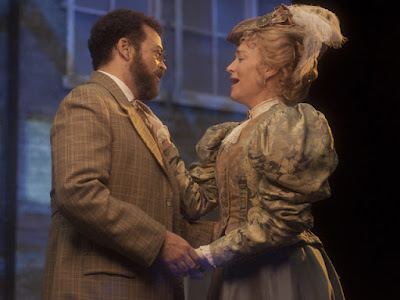
Laura León and John Riesen (photo by Richard Termine)
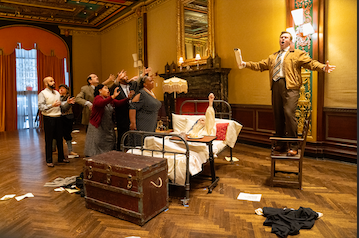
Cast of On site Opera's Gianni Schicchi (photo by Richard Termine)

Luis Ledesma (photo by Richard Termine)

Of all the opera companies we have missed, On Site Opera heads the list. Unique among opera companies, On Site Opera makes an asset out of "homelessness".  As they say, home is where the heart is, and On Site Opera's heart is wherever they can set a given opera in a meaningful locale. 
For tonight's delight, Director Eric Einhorn decided quite rightly that The Prince George Ballroom, ornate and dripping in luxury, would be the right home for Gianni Schicchi, Puccini's late life comedic masterpiece.

Any dramatist will tell you that comedy is more difficult to write and more challenging to act, than tragedy. It must also be true for composition because neither Puccini nor Verdi tackled the genre until the end of their writing careers.  As a matter of fact, it was the last work to which Puccini set his pen. Although he intended the work to be part of a trilogy, this trilogy has often been broken up and this work, the most popular of the three one-act operas, has been wed to quite a number of other one-act operas. On Site Opera chose to present it alone which, given the discomfort of sitting with a mask over one's breathing organs, was a wise decision. Coming in at one hour it was just right, leaving the audience with (sadly invisible) smiles on their faces.

How was this delight achieved? To start with, Giovacchino Forzano's libretto, derived from an 1866 edition of Dante's Inferno (based on real 14th c. Florentine characters), pokes fun at the greed of a selfish family of "aristocrats" and also at the contempt they had for the rising "middle class". Now isn't that the kind of satire we can relate to today? Do we not also get a secret kick out of scoundrels getting away with bad behavior? And what about that very very valuable mule?? There is something truly hilarious about this family fighting over said mule!

Secondly, Puccini's music is filled with humor. We cannot say what makes music amusing but likely a musicologist could elaborate on the rhythms and recurrent motifs lacing the score that tickle the ear and bring a smile to the face. There is a wonderful contrast between the dirge-like music as the family pretends to be grieving, the frisky music of everyone rushing around to create their false scenario, and the romantic music for the lovers. Geoffrey McDonald's conducting of his chamber orchestra--strangely but effectively situated behind the audience--brought out every twist and turn of the score such that we heard things we had not noticed in prior hearings. 

Finally, It is the joyful attitude of the cast who seemed to revel in their creation of characters drawn somewhat from the commedia del'arte tradition. In the title role we had the rubber-faced Luis Ledesma whose fine baritone filled out the role as effectively as his shape filled out the apropos costume of a man climbing out of the peasant class by means of a sharp wit and a lack of compunction about breaking the law.

This seems a rather odd association but we kept thinking about Tony Soprano, a criminal who won over his audience by charm. He kept his dirty dealings from his daughters, much the way Schicchi protected Lauretta by sending her out to feed the birds whilst he schemed and set up his self-serving plot. In the character's way of thinking, he was providing for his daughter's future, even risking hell for himself. There is nothing odd about a parvenu marrying into an aristocratic family headed for impoverishment, as we observed in Il Gattopardo, taking place at the time of the Risorgimento.

As Lauretta we heard the charming soprano Laura León who interpreted her character as a sweet innocent girl who loves Rinuccio for who he is, wealth or no wealth. To her is granted the most famous aria of the opera "O mio babbino caro" which, in a master directorial stroke, she delivered standing on top of a trunk, allowing her not only a sense of importance but also permitted her to mime throwing herself into the Arno. The winsomeness of her presence and the clarity of tone and phrasing made this an unforgettable performance.

As Rinuccio, tenor John Riesen turned in a similarly winning performance. He was successful in winning over his nasty squabbling relatives with his finely tuned tenor in "Avete torto... Firenze è come un albero fiorito" as well as winning over the audience. His duet with Ms. León was particularly fine with their voices blending in well balanced fashion.

David Langan's resonant bass and haughty demeanor were just right for Simone in an interpretation that we had not witnessed previously. As Zita Patrice P. Easton created a formidable matriarch who tolerated no nonsense. The lower part of her register was just perfect and at one point she took the artistic risk of growling out her line and we couldn't keep from laughing out loud.  It was one of those perfect moments.

Often, in an ensemble work like this one, it is difficult to differentiate the characters. However, up close and personal as this was, we were able to discern their individuality. Simone's son Marco and his wife La Ciesca were portrayed by baritone Jonathan R. Green and mezzo-soprano Alexandria Crichlow.  Poor relation Betto was sung by Jay Louis Chacon. The roles of nephew Gherardo  and his wife Nella were well sung by tenor Michael Kuhn and soprano Sarah Beth Pearson. Their son Gherardino was portrayed as a bratty kid who didn't want to run an errand without getting paid. The voluptuous Savannah McElhaney acted the part well without quite convincing us that she was a 7-year-old boy.

The small parts were also well cast and well performed. Brian McQueen managed to differentiate Dottore Spinelloccio and the Notario Amantio. Pinellino the cobbler was played by David Kahng. The non-singing part of the dying Buoso Donati was played by Martin Pfefferkorn.

We are aware that Woody Allen set the work in a tenement which makes no sense whatsoever. Lots of liberties have been taken with the work. Bringing it into the mid 20th c. by means of the costuming (Susan Memmott Allred) worked OK. But we couldn't stop thinking how this century-old work was composed at the time of the tragic flu epidemic and how that relates to the present. But these connections are best made in the minds of the audience.

© meche kroop


Sunday, April 10, 2022

HEART FAILURE


We have reviewed Heartbeat Opera's productions from its inception. We have often written "Our heart beats for Heartbeat Opera".  We have rushed home from their productions bursting with energy, eager to share their prodigious creativity with our readers.  Last night our heart went into arrhythmia; had Quando lasted another moment, we might have had a heart attack. In any case we are heartbroken.

We always like to begin our reviews with something we enjoyed about a production. The only positive thing about last night was the venue.  It is always fun to visit the McKittrick Hotel; the fellow who took us up in the elevator was pleasant.

We believe a work of art should stand on its own merit. Requiring a lengthy exegesis seems to portend disaster.  It's like trying to "explain" a painting.  You know the typical drivel from the Director' Notes--"The way I conceive this work is....yada yada yada".  "What I am trying to illustrate here is....yada yada yada".

There were, of course, note for the press. We generally don't read these, preferring instead to meet a work face on.  Either we "get" it or we don't. Well, dear reader, we did not. We were reminded of that species of "performance art" that is neither here nor there, but something existing in the self-absorbed mind(s) of the so-called creator(s). We decline to name the participants in this worthless production. They are probably filled with joy over the sold-out nature of the performances and we do not wish to rain abuse on their parade.

The performance began with a short film that made little sense, if any.  A  couple is sauntering down a dark street dressed in evening clothes. He thinks she is mysterious because she won't tell him her last name. They come close to an argument about protesting. She doesn't like his wealthy friends.  He tells her they are not friends, they just have "deep pockets".

Suddenly he urges her to pick up the pace. She dawdles spitefully, listening to a street performer playing a saxophone. He leaves her there.

A butler dressed in white is handing out white costumes to some people in their undies. One is wearing "tighty whities".  There seems to be some sort of protest with people carrying signs. There is an orgiastic quality.

The aforementioned woman arrives.  She and the aforementioned man sing some operatic arias, including a love duet from Verdi's La Traviata.  At this point, dear reader, we thought the idea was to expose members of the mostly young audience to opera, in which case the poor sound design did nothing to achieve the goal and did a disservice to the highly regarded singers who shall remain nameless. The woman appears to stab the man with what looks like a cello bow.  He bleeds from the mouth. The "protesters" were horrified. So were we.

There was a 5 minute intermission during which we went to the ladies rest room to eavesdrop. Young women were gossiping about their lives and no one said a word about the performance. We asked the young man sitting next to me what he thought.  "It's OK", was all he was willing to share. 

The performance resumed.  The women on the other side of me resumed their texting. The film was shown again and this time two characters called "Disruptors" made weird noises and hurled imprecations at the screen. The white haired woman banged the piano and played what seemed to be a flute. The young man banged on cymbals and scraped the edge of same with a bow. He cruised around the audience which remained impassive. The two reminded me of unruly schoolchildren. We felt like doing some disrupting of our own. Finally, we fled into the rainy streets, regretting the misuse of our Saturday night. 

Clearly, the "creators" wanted to say something but they failed abysmally to get their point across. If they were trying to skewer traditional opera, they only managed to send us running back to The Metropolitan Opera which, for all its flaws, does occasionally bring beauty into the world. Quando was produced in collaboration with Long Beach Opera and this was the world premiere. We cry "bullshit"!


© meche kroop

Saturday, April 9, 2022

INFINITE ENERGY


Erik Bagger and Brittany Fowler 

An evening spent with New Camerata Opera is always interesting, entertaining, and valuable. Their latest entry into the world of intimate opera is a production of a one act opera by Kamala Sankaram with libretto by Rob Handel. The opera is called The Infinite Energy of Ada Lovelace and  it is obvious that infinite care was given to the evening in order to focus upon women. Additionally, the cast brought the story to life with infinite energy.

We confess we knew nothing about Ada Lovelace before last night; however, we spent infinite energy in learning about her since the work in question succeeded in arousing my curiosity. Lady Lovelace was the legitimate daughter of Lord Byron and his half-sister Annabella who left her husband and raised her daughter to be scientifically curious. The young girl was undoubtedly precocious and without benefit of formal education became quite a whiz at science and mathematics.

She married William Lord Lovelace and bore him three children whilst becoming the world's first computer programmer, mentored by Charles Babbage. The mid-18th c. saw impressive discoveries as well as impressive opera!  Sadly, Ada was sickly and died at the age of 36. Her story is an impressive one, particularly light of the fact that she was a woman without any formal training.

The opera focused on her relationship with those around her--her somewhat supportive husband, her importunate mentor, and her disgruntled housekeeper who bemoaned her neglect of her children. She came very close to abandoning the project with Babbage.

Another independent and talented woman was written into the libretto--Harriet Beecher Stowe. In the opera, she came to the Lovelace household to interview Ada about the family scandal. We were unable to find any evidence that this visit took place but we were so fascinated by the idea that this prominent abolitionist who wrote Uncle Tom's Cabin also wrote the untold story of Lady Byron, written about extensively in the Atlantic in 1869. If she never visited Ada, she certainly had quite an involvement with Ada's mother.

The fact that the opera led us down this rabbit hole is evidence of a wise choice by New Camerata Opera. The story is indeed a compelling one and it is to the credit of the cast that we were so drawn in, in contrast with the stories of most contemporary operas that leave us uninspired.

We are quite sure that both casts are equally effective. The cast we saw impressed us by bringing the story to life. As the conflicted Ada Brittany Fowler created a forceful character, reminding us that talented women who reached beyond the boundaries of wifely and motherly duties to achieve something important are not unique to our own time.

As her husband Lord Lovelace, Erik Bagger gave a sympathetic portrayal of a husband who wa somewhat protective and mainly supportive, however threatened he may have been by his wife's closeness to her scientific mentor/partner Charles Babbage, portrayed by a most effective Virdell Williams. Barbara Porto turned in her typically superb performance as Harriet Beecher Stowe. Heather Michele was believably grumpy and critical as the disapproving nanny and Ryan Allais made a welcome appearance as the butler.

If we have paid more attention to the drama than to the music, let us amend that right away. Music Director Nell Flanders conducted the string quartet plus piano with precision. Unlike most contemporary operas, the music was kind to our ears and definitely supported the action; like most contemporary operas, the vocal lines were not particularly melodic but better than most. Every member of the cast sang well; it's just difficult for us to say much about phrasing and technique with the particular style of writing. The libretto was surely adequate. Our companion agreed with our opinion that what we saw was a play with music--a very good well acted play with adequate music.

We applaud Jennifer Williams for her fine direction, Lianne Arnold for the set design which gave equal measure to science and mathematical equations, and to Asa Benally for her apt costume design.  We refer you dear Reader to our Facebook Page--Voce di Meche--for photos.

The all-too-brief work was bookended by cabaret acts.  We failed to appreciate the pre-opera singing of English translations of songs by Fannie Mendelsohn which involved masked singers; it was impossible to appreciate the vocal technique or the words. The post-opera performances were delightful with  members of the company performing the unexpected. We particularly enjoyed Ryan Allais singing something from Charlie and the Chocolate Factory, acrobatics by Heather Michele and Emily Solo, and Kristin Renee Young singing an aria from Berg's Lulu. Our apologies to those we left out.  As is common these days, there was no printed program.

It was not until we found some information by scanning the hashtag that we learned that composer Kamala Sankaram also wrote a piece we saw some years ago involving data-mining of the audience.  It was called Looking at You and it totally freaked us out!

© meche kroop

Friday, April 8, 2022

Y VOLVER


 Pablo Zinger, Verónica Villarroel, Sonia Olla, and Ismael Fernández

Last night found us at the stunning theater of El Museo del Barrio for an exciting evening of Spanish music presented by the newly reborn Opera Hispanica. It was an exciting evening for us, dear Reader, not just because of the thrilling performances, but because we were there at the original birth of Opera Hispanica some years ago, with Daniel Frost Hernandez at the helm. We were overwhelmed with excitement that New York City would have a company to bring Spanish music to the forefront of the cultural scene.

And now, with brilliant conductor Jorge Parodi at the helm, Opera Hispanica is receiving a timely rebirth, just when we need Spanish music the most. Two years of pandemic restrictions and isolation have left our populace low in spirits and what could be better than Spanish music to lift them from lethargy to passion!

The title of the program Y Volver (I will come back) is not only the title of one of the songs on the program (Jorge Ramón Lucero/María I Lo Forte) but also symbolic of the comeback of Opera Hispanica and the comeback of the arts in NYC.

Starring in this extravaganza were world renowned Chilean opera star Verónica Villarroel,  Spanish flamenco dancer Sonia Olla, Spanish cantaor Ismael Fernández, and Uruguayan pianist Pablo Zinger who used his multiplicity of talents to provide interesting commentary on the program as well as to accompany.  As Musical Director, he also arranged many of the selections.

Before telling about the program, let us mention the fine guitar work of Olli Hirvonen, the double bassist Pedro Giraudo, and the percussionist Danny Mallon. Yang Yu's lighting design comprised brilliantly colored washes on the rear screen that consistently set off the artists' costuming and set the mood. As far as Anthony Riveron's sound design, it is worth mentioning, since we have no affection whatsoever for amplification, that is was never overamplified.

The program itself demonstrated the wide variety of Spanish and Latin American music. Not only was the singing in crossover mode but also the instrumentals.  Boleros, tangos, canciones populares, and Spanish art song existed side by side and melded into a guisado deliciosa.

Regular readers could probably guess that our personal preference lay in the unamplified delivery of Carlos Guastavino's "La Rosa y el Sauce", a tender art song that never fails to touch our heart. We have no doubt that Ms. Villarroel's voice could have easily filled the theater without amplification for the entire evening which we would have preferred.

Each artist had at least one selection that was unforgettable. Isaac Albéniz' "Tango in D" was stunningly delivered by Mr. Zinger and Mr. Giraudo.  We think Mr. Zinger must have a special connection with Albeniz because his performance of "Cádiz" was performed with particular attention to a gorgeous recurrent theme that lingered in the ear.

Mr. Fernández' emotional performance of Astor Piazzolla's "Oblivion" gave a flamenco slant to the tango master's composition,  accompanied by Mr. Zinger with Mr. Hirvonen's guitar solo capturing the ear.

Flamenco dance has long been a subject of our admiration but we have eschewed the sanitized over-choreographed performances that seem to have taken over the stage in recent years. We will probably never get to see a real tablao in a cave in Seville but Ms. Olla's performance surely satisfied our yen for authenticity. Her precise footwork was marked by rhythmic intensity; her arms were exquisitely expressive; the arch of her back was perfect. In one number she made great use of an enormous red mantoncillo--at first covering her entire body like a curtain and then swirling it around with great poetry of motion.

We always love the Canciones Españolas Antiguas which were arranged and popularized by Federico García Lorca; in this case they were jazzed up and amplified which may have pleased other members of the audience more than me.

Similarly, the romantic songs of the Mexican composer Maria Grever are among our favorites and we heard "Júrame" and the lovely "Te quiero dijiste".  Just the phrase "muñequita linda" gives us goosebumps. We would have preferred less jazziness. Still, we are always happy to witness a celebration of female composers. The program ended with the lovely "Gracias a la Vida" by Violeta Parra.

We have a quibble (when don't we?) that will not surprise our regular readers.  That quibble is the loathed music stand.  Just as amplification interferes with our auditory appreciation of a singer's natural voice, so does the music stand interfere with our visual connection. A phrase begins, we connect, the singer glances down, the connection is broken.  Just sayin'!

What we have seen and heard of Opera Hispanica' season has been exciting and rewarding. There is more to come and we refer you to www.operahispanica.org for details. 

© meche kroop
 

Tuesday, March 22, 2022

SUPPORTING UKRAINE


An International Group of World Class Artists in Support of Ukraine

Dear Reader! If you can't wait to read about the brilliant concert produced by Natalie Burlutskaya of Spotlight Artists Management, so graciously hosted by St. John's in the Village, please scroll down to avoid our rant.  Since this is our "soapbox" we feel the need to say something about the crisis in Ukraine. Tyrants must be stopped in their tracks.  Appeasing Hitler did not stop him from trying to take over the world.

There is nothing new about major world powers trying to colonize other countries and deprive them of their independence. The USA fought courageously to free itself from the yoke of Great Britain. Mexico had to drive the Spanish out. Of course, in all fairness, it is not lost on us that the USA is not innocent of meddling in foreign countries who want to be free of our influence.

Yet, there is something particularly egregious about Putin waging war on his smaller neighbor and murdering his own people, mostly innocent women and children, to gratify his swollen ego. We are reminded of the narcissistic men who cannot control partners who want to leave them and react by maiming and murdering them. Unfortunately, there are no shelters or safe houses for the beleaguered Ukrainians in their own country.  The men are demonstrating remarkable bravery defending their homeland whilst their wives and children are fleeing to other countries--a version, we opine, of a safe house.

We have no faith in "thoughts and prayers". Those who are not in a position to affect national politics must be content with sending money. We urge you to support any four-star charity that is helping with food and medical supplies. Ms. Burluskaya created last night's benefit to help musicians in two cities of Ukraine. We must each of us find a way to help.

And now, let us speak of the artists who donated their gifts to raise money for this project. The cast comprised artists from Russia and Ukraine, Argentina, Turkey, China, and the United States.  Music knows no politics, no prejudice.  We are all on the same team. 

Before we get to the singers, we must credit the collaborative pianist Alexander Chaplinsky who put heart and soul into his fingers and brought forth an entire orchestra from a sole piano. We were not surprised to learn that Mr. Chaplinsky is also a conductor because we could hear the inner lines as clearly as the melody and the bass. Each section of the orchestra was right there in this amazing performance.

The program opened with his own arrangement of the Ukrainian Anthem which was filled with "soul". The program ended with his performance of "Golden Gate of Kiev", one of the episodes from Musssorgsky's Pictures at an Exhibition, marked by majestic chords and rhythmic vitality.

Just prior to that we heard the charming Galina Ivannikova singing a Ukrainian folk song called "Black brows". We did not understand the lyrics of Konstantin Dumitrashko but the haunting melody touched a place in our memory and filled us with hope and happiness.

Many of the evening's selections reflected upon the theme of fascism. (Make no mistake! Putin's government is fascistic and not particularly communistic.)
Puccini's opera Tosca is about artists fighting fascism in the person of Baron Scarpia. Soprano Dilara Unsal made a perfect Tosca in "Vissi d'arte", singing with passion for her art. Her vibrato was affecting and there was a lovely diminuendo.

Ms. Ivannikova sang Joan of Arc's aria of willingness to fight for her beloved homeland from Tchaikovsky's eponymous opera. There was some lovely phrasing and an admirable smoothness in the wide skips.

Menotti's The Consul is an opera about a displaced individual being crushed by an indifferent  bureaucracy. In "Papers"  Zoya Gramagin's expressiveness gave voice to a woman's anger, desperation, and despair. The unaccompanied phrases were particularly well rendered. Her eye color was "tears"; her occupation was "waiting". 

The evening was not all gloomy.  There was also romance (both happy romance and betrayed love) and lightheartedness. From Verdi's Ballo in Maschera, Ulrica's conjuring of supernatural forces was given particular menace by Ema Mitrovic's chilling contralto, convincingly bringing the seer to life. With incredible strength at the bottom of her range, the brilliance at the top was particularly impressive. We also enjoyed the dynamic variety.

Particularly moving was Amelia's "Morrò, ma prima in grazia" performed by Ms. Gramagin. The guilty wife's pleading with her husband melted our heart, if not her husband's! Portraying Renato was Jonathan R. Green whose big resonant sound gave life to a betrayed husband. He began with brutal coloration but later in the aria he gave us a different color--the hurt underneath the rage.

Sara Pearson performed an aria of a betrayed woman--Marguerite's aria from Gounod's Faust. She produced a lovely legato line whilst Mr. Chaplinsky delivered rapid figures in the piano representing the sound of spinning. We enjoyed the graceful portamenti and the lovely pianissimo ending.

One of our favorite young singers is Joseph Parrish whose deeply resonant tone is never booming but rather subtly colored. His portrayal of Aleko in Rachmaninov's opera of the same name was yet another example of betrayal. Mr. Parrish gave the character a range of sorrow by varying his dynamics. Although his voice is sizable, he is also able to rein it in for some stunning pianissimi. Mr. Chaplinsky's piano was admirably lyrical.

Later in the program he demonstrated another side of his artistry, singing "Deep River", an Afro-American spiritual which he sang with all the respect one would give to an art song--phrasing, coloration, and dynamic variety. We have never heard it sung like that and were deeply moved.

As far as art songs go, what is deeper than those of Schubert?  Another young artist of whom we are very fond, Xi Chen, performed "Der Lindenbaum" from Winterreise. This is our very favorite song cycle and we are waiting eagerly for the day when he learns the entire cycle. 

He also won an enthusiastic round of applause from the audience by his performance of the well known "Parlami d'amore, Mariu". His is a huge voice which he employs with a lovely legato.

Our stunning contralto reappeared for "Amour viens aider ma faiblesse", Dalilah's aria from Saint-Saëns' Samson et Dalilah. Just as she effectively created the character of Ulrika, she also created a seductive temptress-- by means of vocal coloration and bodily gesture. We reckon that the audience got seduced!

Regular readers recall how fond we are of duets and we were not disappointed. We got to hear one of our favorites--the "Barcarolle" from Offenbach's Contes d'Hoffman performed by Ms. Pearson and Ms. Gramagin in affecting and well-balanced harmony.  We must note Mr. Chaplinsky gorgeous introduction which set the mood before the singers began. We tried not to sway in our seat!

The lighter pieces we mentioned earlier were eagerly greeted as they provided some relief from the sad and the serious. The lovely young soprano-turned-mezzo Eugenia Forteza made a charming and believable Cherubino as she performed "Non so piu cosa son" from Mozart's Nozze di Figaro. We have watched Ms. Forteza for a number of years and take particular delight in her artistic growth. This aria should definitely be her signature piece. Were we auditioning we would definitely give her the part!

She also sang "Somewhere" from Bernstein's West Side Story which the program notes indicated was a "dreamlike world of peace"--something we all are wishing for.

There were also instrumentalists on the program.  Accompanied by Yuliya Basis, violinist Andy Didorenko performed "Meditation" from Bortkiewicz' Four Pieces for violin and piano. They also performed. Mr. Didorenko's own composition "Reminiscence" in which he treated the piano as an equal partner to his violin.  It is a lovely piece and was dedicated to his Ukrainian hometown.

What a full and generous evening! The energy in the sanctuary of St. John's in the Village was at a high level and the audience responded to every offering with gratitude and warm applause. 100% of the proceeds is going to people who lost their homes as a result of heavy shelling. Musicians from Kharkiv National Theater of Opera and Ballet are among them. Spotlight Artists Management stays connected with Dmitry Morozov, the Principal Conductor, learning about the situation first hand,  and avoiding the funds being stuck in huge foundations or national banks.

© meche kroop

Tuesday, March 8, 2022

A NEW ART FORM?

Nathan Granner and Marnie Breckenridge in Gordon Getty’s opera “Goodbye, Mr. Chips”


There is nothing new about filming opera. Indeed one can find almost every opera in a filmed version on YouTube. The past decade has shown a major advance with the advent of opera in HD.  In this case, the film directors have become as important as the stage directors in that they can focus the attention of the audience on a particular singer or some small but significant stage object that only front row audience members might have seen during the live performance.

Last week at the Walter Reade Theater, we were introduced to a further advance in the field, which is "opera reimagined for film". It was easy to perceive "Goodbye, Mr. Chips" as a film with award-winning music composed by Gordon Getty, music which amplified the drama. The story began life as a 1934 novella by James Hilton and tells the story of a revered teacher at a British boarding school in the early years of the 20th c.

The eponymous teacher (tenor Nathan Granner), long a bachelor, had his life changed by falling in love with and marrying the lovely Kathie (soprano Marnie Breckenridge). Her lamentable death in childbirth did not put an end to his personal and professional growth. There is yet more sorrow as he lives to witness the death of several of his former students in World War I. There is not much conflict, just a difference of opinion with  snarky new Headmaster Ralston, played to the hilt by bass-baritone Kevin Short, who wants Latin taught in a new way. Parental support of Mr. Chips prevails.

As a film, this hybrid worked reasonably well. There is a narrator--Merrivale, well played by baritone Lester Lynch; there is a succession of scenes that tell the story logically with clearly inserted flashbacks; there are some "tricks of the trade" best known to film people (of which I am not) that permitted the overlapping of images of Mr. Chips as a young man with his younger self. The students of the school were somehow projected onto the set although they were obviously not present.

The set worked fairly well although a revolving element, commonly used on the theater stage, kept revolving and revolving at one point, and to no apparent purpose.  The turn of the 20th c. costuming was apropos with Kathie wearing a gorgeous dress.

Director Brian Staufenbiel managed to coordinate the diverse element to form a cohesive whole with the orchestra, conducted by Nicole Paiement, recorded separately.

The opera side of this synthesis was a mixed bag. The instrumental writing left nothing to be desired. It neatly supported the onstage drama in a most effective way, which led us to think of this as an award-winning soundtrack to a film. However, the vocal lines did not "sing" and there was no melody to speak of (or to sing of). We wish contemporary composers would take a page from Broadway's book and give the audience the tunes our ears are hungry for.

The singing of the members of the Young People’s Chorus of New York City, on the other hand, was pure delight as they joined their voices in singing what was probably a hymn or an anthem. One may scoff, but it had melody.

The cast of four did everything they could to make the prosy text musical. Since Mr. Getty wrote the libretto himself, there is no one else to blame for the lack of musicality. Mr. Granner was outstanding, not only for his velvet tone but for fine phrasing that almost compensated for the meandering vocal line. Ms. Breckenridge made a lovely Kathie and we were sorry her character got killed off so early in the film. Mr. Lynch was a believable Merrivale, a former student who is sharing his memories of Mr. Chips. Mr. Short was equally convincing as the hostile new headmaster who had to change his tone when he needed help from Mr. Chips at the end of the film.

There were several scenes that just begged for an old-fashioned aria or duet.

This work was originally conceived as a staged opera and, like so many other projects derailed by the pandemic, had to be reinvented.  The world premiere took place last November as part of Festival Napa Valley and Mill Valley Film Festival. This New York premiere was presented by Festival Napa Valley and New York City Opera.

We invite you, dear reader, to add your comments. An experiment like this is sure to arouse all kinds of opinions.

© meche kroop


Saturday, February 26, 2022

PAST, PRESENT, AND FUTURE

Donata D'Annunzio Lombardi and John Viscardi


On Wednesday evening we were privileged to attend Classic Lyric Arts' "Concert at the Castle" along with a crowd of CLA Supporters, all of whom were delighted to witness the past, present, and future of this estimable program. A warm welcome from Founder and Artistic Director Glenn Morton, well known in operatic circles for his astute coaching and pedagogy in all three NYC music conservatories, introduced us to the myriad achievements of CLA--not only the immersive programs in Italy and France but the newly initiated program in the Berkshires which began last summer, focusing on the operas of Mozart.

Representing the past of CLA was tenor John Viscardi, a major light on American opera stages, who serves as Executive Director of CLA. Mr. Viscardi is an alumnus of both CLA's French program and Italian program; his linguistic facility gives evidence.  He opened the concert program with the tender "Chanson Triste" by Duparc. The performance was marked by perfect French diction (of course) and consummate expressiveness, alternating tender moments with expansive ones. He also closed the program performing a stunning duet with a surprise guest artist; we are going to keep you guessing her identity until the end of the review.

Another alumna of CLA is the lovely Daniela Magura, a beautiful mezzo-soprano with a luscious tone. She showed off her fine French in "Tristes apprêts", an aria from Rameau's Castor et Pollux that was new to our ears.  Her "Habanera" from Bizet's Carmen, on the other hand, is almost overly familiar but we always enjoy hearing a singer whose take on the character is a bit different.  Ms. Magura's Carmen is more subtle than most, so confident in her ability to seduce that she can underplay it, thereby avoiding all the encrusted clichés. What an advantage to hear her diversity in two such different arias and to hear French sung so authentically in Gallic style.  More credit to CLA's French program which she attended twice.

Baritone Jared Werlein is new to us and we are always happy to hear a singer with comedic flair.  He is a student of Mr. Morton at Juilliard and his fluency in Italian surely comes from his prior attendance at CLA's Italian program. We were able to appreciate his ability to go from the well-known classic ("Madamina, il catalogo è questo" from Mozart's Don Giovanni) to a delightful 20th c British song, "The green-eyed dragon" by Wolseley Charles. The lyrics were so clever in their rhymes and the music so tuneful that we plan to search out more of Mr. Charles' music. Mr. Werlein did justice to both styles, more evidence of the versatility that we admire. 

Tenor Michael McDermott, another student of Mr. Morton at Juilliard also chose two very different pieces. His Italian selection was the well known and beloved Tosti song "Non t'amo piu" which he sang with Italianate passion and the multiplicity of emotions that the librettist intended. His use of pacing and dynamic variation brought intensity to the performance. Quite different was his more delicate delivery of "Ah, lève-toi soleil" from Gounod's Roméo et Juliette in which he showed an easily produced upper register and pleasing French which will be fine tuned this coming summer at CLA's French program.

New to CLA and representing its future is the beautiful soprano Julianne Casey who also alternated a French selection with an Italian one. "Il est doux, il est bon" from Massenet's Hérodiade was sung with youthful rapture and some lovely resonance in the upper register. We liked the expansive top in "Se come voi piccina" from Le Villi, an early opera by Puccini with which we are unfamiliar. We cannot wait to hear her after her attendance at CLA's Italian program next summer.

And now we will tell you dear reader, as promised, about the stunning surprise climax to the program. One of Europe's most sought after sopranos, Donata D'Annunzio Lombardi, performed the role of Tosca in the first act duet, with Mr. Viscardi as her Mario. We found ourselves captivated not only by the vocal excellence but by the characterization given by Ms. D'Annunzio. We felt as if we really understood Tosca, not only her devotion to Mario but the insecurity that underlay her display of jealousy and the good will that allowed her to turn the jealousy into a little tease.

Ms. D'Annunzio Lombardi is on the faculty of CLA and brings to their programs a very unusual method of teaching, the likes of which we have never seen. Suffice it to say that the changes wrought by her tutelage have been astonishing. We have the greatest respect for results and for those master teachers that add value. Students can consider themselves extremely fortunate to fall into her hands.

The collaborative pianist for the evening was the gifted Xu Cheng who never fails to keep pace with the singers and permits all of them to shine in their own fashion.

We advise keeping an eye on Classic Lyric Arts.  Their history is significantly worthwhile, their present shows the flexibility demanded by the Covid pandemic, and they have a brilliant future as they expand in new ways, some of which are in the works and some of which we foresee in our crystal ball.

If you, dear reader, care to see photos of the event, they will be on our FB page--Voce di Meche.

© meche kroop