MISSION

We are here to encourage the development of gifted young singers and to stimulate the growth of New York City's invaluable chamber opera companies. But we will not neglect the Metropolitan Opera either. Get ready for bouquets and brickbats.
Showing posts with label William Guanbo Su. Show all posts

Sunday, December 18, 2022

SO MUCH TALENT!

t

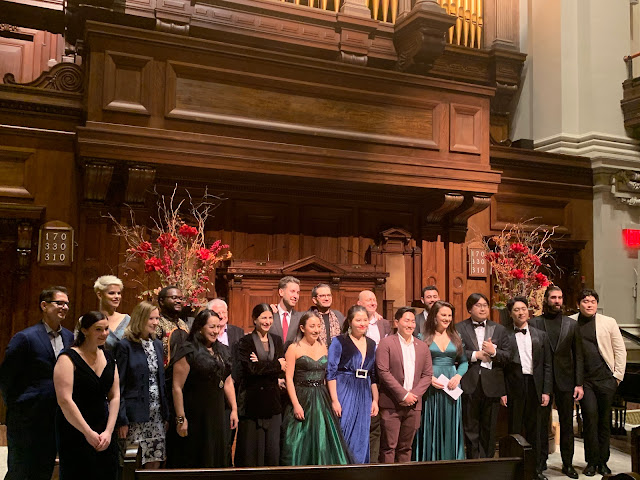
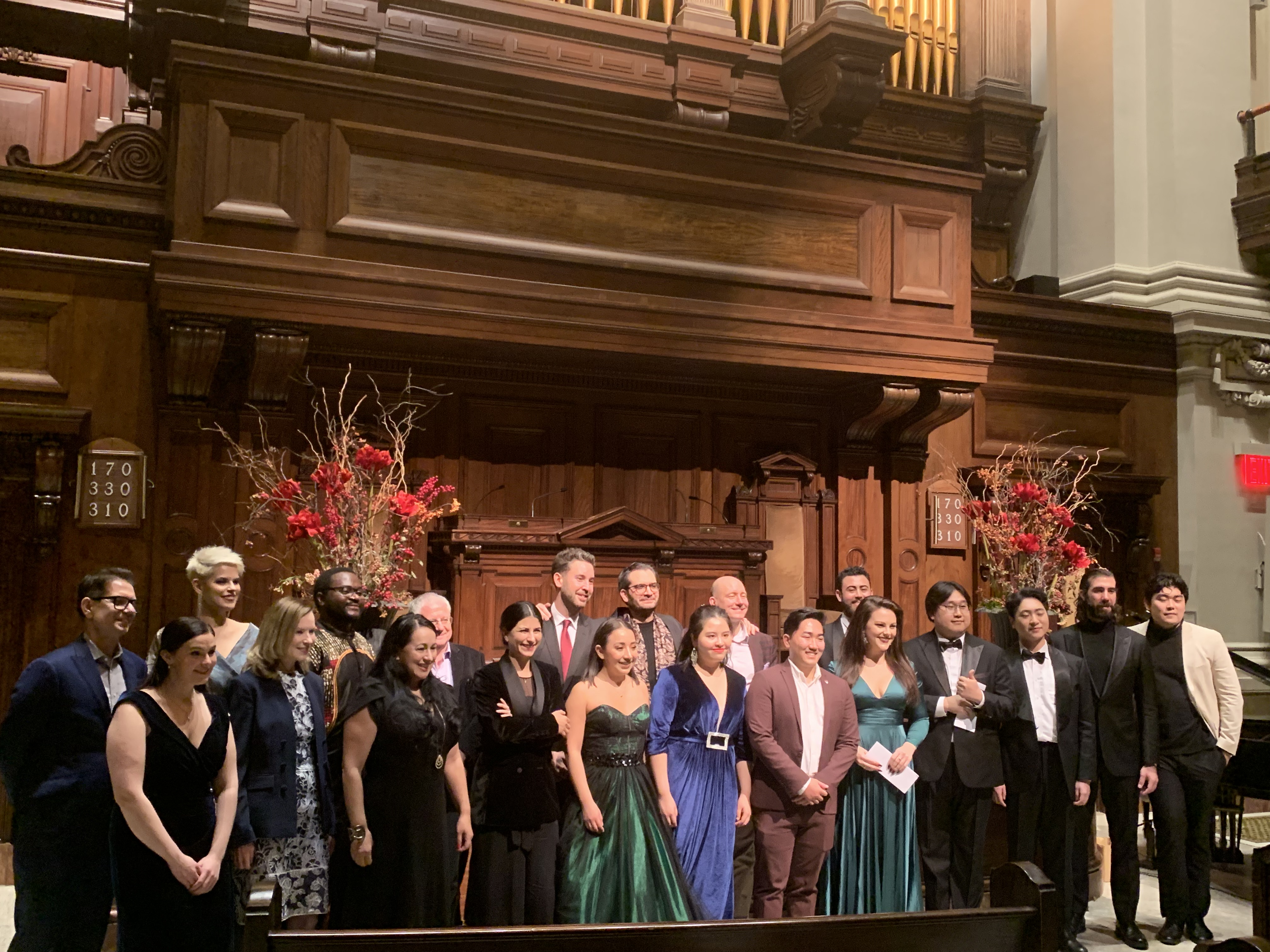
 Singers and Judges at Premiere Opera Foundation Vocal Competition Finals

We can't decide whether it is worse to be a competitor in a vocal competition or one of the judges. The former have to deal with anxiety and the latter, with making difficult decisions. We do not envy either! But being in the audience is a real treat; one gets to hear the finest young talent taking their shot for the big prize. After all, these 14 supremely gifted young singers are the result of a difficult winnowing process, having been chosen from 150 applicants. The Premiere Opera Foundation is unique in that winners receive not only prize money but also the opportunity to be heard by those who may hire them. It seems to be a win-win situation.

As is our wont, we will not tell you who won which prizes; to our ears they were all winners. As far as vocal technique, all were top notch. Most seemed to have a knack for choosing arias that showed off their versatility. And some of them managed to evoke the entire scene of their chosen aria without benefit of costume and scenery.

We will not pick apart each performance but rather try to come up with what is unique about each singer and we will do that in the order in which they sang. The way the competition was organized, each singer performed an aria and then, after 14 performances, each artist got a second chance to perform a different aria; so we got a fairly decent idea of their versatility. All were accompanied by the able pianist Michael Fennelly who seemed to have a knack for coloring each aria in much the same way as the singer did. This is the great mystery of artistic performance.  How do they do that????

We also wondered how the singers chose their arias. To choose an aria that is commonly sung puts the singer in competition with all the greats who have sung that aria before. What a challenge to make one's performance stand out, to bring something new to the interpretation!  On the other hand, to choose an unknown or rarely heard aria presents its own challenges.

Leading off the program was the sweet voiced tenor Randy Ho who brought exuberance to "Ah!  Mes amis" from Donizetti's  La Fille du Regiment and tenderness to "Dies bildnis ist bezaubernd schön" from Mozart's Die Zauberflöte He made the well-rehearsed gestures seem organic and spontaneous.

British mezzo-soprano Christine Byrne limned the character of Isabella in "Cruda sorte!" from Rossini's L'italiana in Algeri  by means of a richly textured instrument, which she also did as the doomed but peaceful Fenena in the lesser known aria "Oh! dischiuso è il firmamento" from Verdi's Nabucco.

Chinese soprano Yujin Zeng exhibited a lovely coloratura in "Ah! non credea mirarti..."Ah! non giunge" with a pleasing switch from a lovely legato to some fine fioritura in the cabaletta. There was a nice contrast with "Ach, ich fühl's" from Mozart's Die Zauberflöte. We wanted to bring Mr. Ho back onstage to do a Pamina/Tamino duet!

Chinese bass William Guanbo Su, long known to us, astonished us with his vocal growth in a forceful performance of "Quand la flamme de l'amour" from Bizet's La Jolie fille de Perth which was topped by "La calunnia" from Rossini's Il barbiere di Siviglia, a circumstance in which we preferred hearing something familiar done in a more character driven way than we have heard it before.

Kenyan tenor Lawrence Barasa Kiharangwa exhibited an ample tone in "Se all'impero amici" from Mozart's La clemenza di Tito successfully conveying the emperor's generous nature. Showing another aspect of his fine instrument, he injected all the requisite enthusiasm in Alfredo's Act II aria "De' miei bollenti spiriti...Oh mio rimorso" from Verdi's La traviata.

Chinese soprano Siyi Yan accomplished the miracle of making the clever English text of "Glitter and Be Gay" from Bernstein's Candide completely comprehensible, so unusual in that very high register. She made use of lots of gesture with each and every word. "Caro nome" from Verdi's Rigoletto was given the same highly dramatic treatment.

Mexican mezzo-soprano Rosario Hernandez Armas, well known by us and oft-reviewed, gave a touching performance of Leonora's aria "O mio Fernando" from Donizetti's La favorita. This was matched or even exceeded by the fiery "Smanie implacabili" from Mozart's Cosi fan tutte, revealing how Mozart used the vocal line to limn the character of Dorabella.

South Korean baritone Minki Hong gave a successful portrayal of the angry Ford from Verdi's Falstaff in "E sogno? O realta" which was a nice balance with the lyrical "Vision fugitive" from Massenet's Hérodiade, sung in fine French.

Soprano Avery Boettcher let out all the stops in her portrayal of the angry Donna Elvira (oh how we love those angry characters) in "In quali eccessi o numi...Mi trade quell'alma ingrata" from Mozart's Don Giovanni, letting us see the drama queen nature of the character. This was balanced by the wistful Nedda singing "Stridono lassu" from Leoncavallo's Pagliacci.

South Korean baritone Yeongtaek Yang brought humor to "Largo al factotum" from Rossini's Il barbiere di Siviglia and serious intent to "Nemico della patria" from Giordano's Andrea Chenier, successfully demonstrating his impressive versatility.

Tenor Anthony Ciaramitaro also showed versatility, choosing a strong Verdi character (Riccardo/Gustavo) from Un ballo in maschera singing "Ma se m'e forza perderti" with sorrowful renunciation and then singing the lighter role of Nemerino in "Una furtive lagrima" from Donizetti's L'elisir d'amore.

Cuban baritone Eleomar Cuello Calles performed "Mein sehnen mein wähnen" from Korngold's Die tote Stadt in the most perfect German we have heard from a non native German. It seemed a miracle that every vowel was given full value and every consonant was crisply enunciated. (Regular readers know how irritated we get when American singers maul the "ich" and the umlauts.) In Riccardo's aria "Ah per sempre" from Bellini's I Puritani, we heard a different style (bel canto) but much the same mood of romantic longing and disappointment.

Soprano Chelsea Lehnea tore up the stage with Violetta's Act I scene from Verdi's La traviata.  "È strano...Sempre libera" is a supreme challenge for any soprano who must show the heroine's ambivalence. The challenge was totally met in a way that far overshadowed her later performance of "I Can Smell the Sea Air" from Previn's A Streetcar Named Desire.

Canadian bass-baritone Vartan Gabrielian took command of the role of Banquo in "Come dal ciel precipita" from Verdi's Macbeth, successfully conveying the ominous mood. Aleko's Cavatina from Rachmaninoff's eponymous opera also deals with betrayal and we think Mr. Gabrielian is very good at conveying that, not from personal experience we hope!

It was such an exciting afternoon that we didn't want it to end. We are anticipating success for all of these gifted young artists and hope to see them all onstage again in the near future.

© meche kroop

Monday, April 1, 2019

METROPOLITAN OPERA NATIONAL COUNCIL FINALS

MONC Finalists onstage at the Metropolitan Opera


It was a wild rollercoaster ride yesterday at The Metropolitan Opera when nine young singers competed in the MONC finals. Host Anthony Roth Costanzo, who won in 2009, made an excellent and witty host; he explained to the crowd of opera fans how the National Council is run by volunteers and about how rigorous the selection process is, narrowing down applicants in several stages.We were happy to hear that the competition is extending to include Mexico! There are so many fine voices coming from our southern neighbor!

We love so many things about this competition except for one issue which we will mention later. If you want to know which of the nine singers "won", you won't get that from us. For us, they are all winners.

We love that each singer gets two chances to show different aspects of their artistry. We love the fact that they get generous coaching. Each singer used the stage with "presence" and effectively conveyed the emotions of the character they were portraying. Everyone was linguistically adept. Although all are in their twenties, they are already singing around the world, winning competitions, and participating in young artist development programs. So, winning this competition is another feather in the cap and perhaps a step up on the path to stardom.

Here, we will issue a disclaimer. We confess to being partial to singers we "grew up with", those whom we have been reviewing for a few years. This means students from Juilliard and Manhattan School of Music; both schools were well represented as well they should be.

We are also more involved when a singer's repertory is consistent with our taste in opera, which favors the 19th c.  That being said, we make every effort to overcome our biases.  So here goes!

Knocking it out of the box was tenor Miles Mykkanen whose very unusual artistry has always delighted us at Juilliard and with New York Festival of Song. Mr. Mykkanen has sung some very unusual arias and duets that show off his unique personality. Yesterday his presentation was on the conservative side but the artistry survived intact. His "Kuda, kuda" from Tchaikovsky's Eugene Onegin plumbed the depths of Lensky's soul and left us with tears rolling down our face. He used the consonants well to project his gorgeous tone up and out. His Russian was impeccable.

We also loved his "Je crois entendre encore" from Bizet's Les Pécheurs du Perles which was delivered with long Gallic line and perfect French. The dynamics he chose were highly effective as was the vibrato. There was a decrescendo that spun out to a fine thread and high notes that floated up to the balcony and hung in the air. We scarcely breathed!

The bass fach was never one of our favorites, except for James Morris. That is until we heard William Guanbo Su at Manhattan School of Music.  Mr. Su is now at Juilliard and did credit to both institutions. The bass voice is considered to be a late maturing fach; we do expect there is a Wotan in his future. 

Yesterday he sang the rapid fire "Sorge infausta una procella" from Händel's Orlando and demonstrated plenty of flexibility in the embellishments, in spite of the substantial weight of his voice. Fortunately, his second selection "Vi ravviso" from La Sonnambula showed off his facility with Bellini's long legato lines which were beautifully phrased. We enjoyed hearing both sides of his artistry.

Meghan Kasanders, also known from many recitals at Juilliard, has a sizable soprano and "Dich, teure Halle" from Wagner's Tannhäuser revealed her Wagnerian promise with an heroic quality that never compromised the tender aspect. Her top notes soared and thrilled the ear.

We don't recall hearing her Russian before but she sounded superb in an aria from Tchaikovsky's Pique Dame which she brought to an expressive climax.

Tenor Dashuai Chen, also from Juilliard, is less well known to us but we found the sweetness of his instrument to be immensely appealing. In "Fra poco a me ricovero...Tu che a Dio spiegasti l'ali" from Donizetti's Lucia di Lammermoor, he established his character in the recitativo and never let up. The performance was exquisitely modulated to evoke our sympathy.

In "Salut! demeure chaste et pure" from Gounod's Faust, his French flowed like miel and the delivery emphasized the character's motivation to seduce, rather than a tenor's grandstanding. We loved every minute!

Tenor Piotr Buszewski also has roots in Juilliard. His first selection was "Seul sur la terre" from Donizetti's Dom Sebastien, an aria with which we are not familiar. We loved the sweetness of his tone until he pushed on a few high notes. We enjoyed the way his voice played against the harp.

We preferred his second selection which was in Polish. We never heard Moniuszko's opera The Haunted Manor but we were inspired to learn about the opera; all we could find is that it is a romantic and patriotic comedy written in the 1860's, much loved in Poland but rarely produced outside of Poland. We would love to get one of our local opera companies to mount a production. (But where would they find all those Polish singers?) The melody was gorgeous, the orchestration colorful, the harmonies inventive, and Mr. Buszewski's delivery was stirring, even though we had no idea what it was about. Sometimes we just love the beauty of sound. 

Alaysha Fox is a soprano of great promise with a sizable instrument and fine dramatic instincts. We recently heard her at a salon which we enjoyed a great deal but admit to being unprepared for her artistry in a huge house like the Met. She was a highly persuasive Donna Anna in "Or sai chi l'onore" from Mozart's Don Giovanni.

Her second selection was "Ich ging zu ihm" from Korngold's Das Wunder der Heliane, another aria with which are unfamiliar. The overtones were bouncing around the Met in great profusion. It made us want to hear this opera.

Soprano Elena Villalón was the youngest singer of the group but already quite accomplished. She made a lovely Giulietta in "Oh! quante volte" from Bellini's I Capuleti e i Montecchi. She and the harp made some lovely music, the harp with its arpeggi and Ms. Villalón with a lovely legato line. The coloratura was splendid and the embellishments in the final section very well handled.

We were even more impressed by Sophie's aria "Ich bin Euer Liebchen sehr verbunden" from Richard Strauss' Der Rosenkavalier. Her voice literally sparkled and the top soared to the stratosphere.

Mezzo-soprano Michaela Wolz performed "Addio addio, o miei sospiri" from Gluck's Orfeo ed Euridice with some thrilling melismatic singing. So much for Gluck's rebellion against ornamentation!

She delighted the audience with Stefano's aria "Que fais-tu blanche tourterelle?" from Gounod's Roméo et Juliette in which she pranced around the stage wielding an imaginary sword and created a very believable character. We have one quibble. If a female singer performs a breeches role wearing a man's suit, she shouldn't have to do it in pumps with heels!

Thomas Glass utilized a fine lyric baritone in the aria "Captain Ahab? I must speak with you". Although he made every word clear, he couldn't make us want to see this Jake Heggie opera Moby Dick. We cannot get a good idea of a singer's voice in English.

Fortunately, he turned to French for his second selection, the oft heard aria sung by Valentin in Gounod's Faust--"Avant de quitter ces lieux" which succeeded in giving us a better picture of his vocal assets. He created a long lyrical line even when the orchestra depicts a military march. He colored his voice differently for each section, which we appreciated.

Whilst the judges met to do their thing, bass-baritone Christian Van Horn, a winner from 2003 who is having a successful career at The Met, entertained us with "Ella giammai m'amo" from Verdi's Don Carlo. It was technically fine but failed to limn King Philip II's character, neither the evil filicidal side nor the pathetic whimper of an old man.

Maestro Carlo Rizzi's handling of the always wonderful Metropolitan Opera Orchestra was always brilliant. Whatever he asked for, they delivered.

And then...the "winners" were announced and this is the part where we tell you what we do not like about this competition. Five "winners" are announced and the other four are left hanging out to dry. If there were three winners chosen out of the nine it would not be so egregious. Just sayin'!

(c) meche kroop


Sunday, January 27, 2019

SongStudio with RENEE FLEMING

Renée Fleming and Emerging Artists

Those of us who remember Marilyn Horne's "The Song Continues" are glad that the annual week of master classes and recitals have been continued by star soprano Renée Fleming.  The institute is now called "SongStudio" and has a mission to "renew and refresh the presentation and experience of the vocal recital...exploring innovative approaches to both classic and current song repertoire". We hope they will continue to attract new audiences "to engage with the art form".

Let it be said that the quality of the participants was extremely high. Both singers and pianists were well chosen. A few days ago we attended Ms. Fleming's master class and had a closer look at four of the participants, giving us a more well-rounded picture of their gifts. Some of the participants are known to us through their advanced studies at Juilliard, somewhat coloring our view of their performances last night at the Weill Music Room of the Resnick Education Wing of Carnegie Hall.

Also coloring our view is our distinct preference for music of the Romantic period and our distaste for contemporary song sung in English. Please, dear reader, accept this as our taste, not judgment of the artistry of those singers who chose works that we didn't care for.

Tenor James Ley sang two Schubert lied that touched us deeply--exactly what we want from a song recital. In the Fleming master class he performed Schubert's "Die Musensohn" in a manner that we felt required more gesture and which Ms. Fleming felt needed more energy. There were no such problems last night with "Ständchen". Mr. Ley's tender tone expanded magnificently at the top and he ended the song with the image of a disappointed lover whose serenade went unrequited.  In "Nacht und Träume" he wove a spell by caressing each word. Collaborative pianist Seoyon MacDonald reinforced his interpretation.

Another singer who captivated us was bass-baritone Enrico Lagasca. In Ms. Fleming's master class, he put us into an altered state with Gustav Mahler's "Urlicht" which many of you will know from the 4th movement of Mahler's Second Symphony. Although we are not of a spiritual bent, we got "the feels" from the simple spare delivery and Michael Hey's collaborative piano.

Last night Mr. Lagasca sang a song in Tagalog from his native Phillipines--"Sino ang Baliw" by Elizabeth Barcelona and Eudenice Palaruan. It was haunting and grew in power. Because of a projector dysfunction, he sang it twice so we had double the pleasure. We loved it without the titles and photographs, just for the pleasure of the sound.

French soprano Axelle Fanyo was also heard in the Fleming master class, accompanied by Adriano Stampanato who ripples arpeggi with consummate skill. We enjoyed her Brahms but thought last night's performance of Poulenc's "La Dame de Monte-Carlo" gave her more opportunity to act with her entire body, telling the tale like the master story-teller the text requires.

Soprano Coraine Tate is remembered from the master class for incorporating some work on breathing offered by Ms. Fleming. Something extremely useful was the image of "breathing into the armpits" which truly made a difference. We were not crazy about the Jake Heggie song she sang then, nor the one she sang last night--both settings of texts by Emily Dickinson which, in our opinion, never asked to be set to music. We did enjoy the way she engaged the audience with a story of her family, which led to a performance of Richard Strauss' "Einerlei" in fine German. We liked Peyson Moss' light touch on the piano.

Icelandic soprano Álfheidur Erla Gudmundsdóttir teamed up with pianist Kunal Lahiry in an act of "piano abuse" that the audience seemed to love.  It was George Crumb's "The Night in Silence Under Many a Star" from Apparitions. We thought of it as what is presently called "performance art"; we admit that the singer is beautiful and graceful draped around and encircling the piano but the strange sounds made by plucking the strings did not please our ears.

She began the program with Schubert's "Die junge Nonne", a song we love. The novitiate moves from stormy feelings, well evoked in the piano, to feelings of spiritual peace. For Mendelssohn's "Hexenlied", she loosened her hair to convey the wildness of the text. She is definitely on the right dramatic track but we would like to hear it more in the vocal coloration.

The wonderful Schumann song "Die Soldatenbraut" was performed by Ukrainian mezzo-soprano Ekaterina Chayka-Rubinstein and Ana Mazaeva. We liked the singer's fine vibrato and her gestures, which emphasized the light-hearted tone. In Debussy's "Colloque sentimental" from Fêtes Galantes, we longed to hear more contrast between the voices of the two lovers.

Our passion for song in Spanish was gratified many times over by tenor Jose Simerilla Romero and pianist Andrew King who performed Ernesto Lecuona's "Siempre en mi corazón" sung with romantic tone and gorgeous pianissimi. Even better was Obradors' "Del cabello más sutil" in which he caressed every word. Mr. King's rippling arpeggi added to the effect and we were transported.

Mezzo-soprano Kayleigh Decker and pianist Madeline Slettedahl captured the ironic humor of Poulenc's "Il vole". This is a difficult song to understand because of all the wordplay! There was some lovely dynamic variety in Jean Sibelius' "Var det en dröm" and we enjoyed Ms. Slettedahl's feathery touch on the piano.

Bass William Guabo Su, whom we have heard and enjoyed so many times, chose two songs in English which we did not care for; Kurt Weill's "Oh captain, my captain" and Samuel Barber's "I hear an army" just did not move us at all. But that didn't prevent us from enjoying the gorgeous texture of his instrument and the artistry of his phrasing. Richard Yu Fu's piano was superb.

Similarly, the choices of Magdalena Kuźma did not thrill us. She sang three selections from Tom Cipullo's How to Get Heat Without Fire. Sitting so far on the side, we did not understand the words and had to Google the text when we returned home. The final song "The Pocketbook" was humorous  but the other two were just obscure. Again, we didn't think the text was meant to be set to music.  Oh, well.  We were hoping to have another opportunity to hear Ms. Kuźma and pianist William Woodard, and we sort of did.

We enjoyed the encore which was performed by Ms. Kuźma, Ms. Decker, and Ms. Fanyo.  English sounds a lot better in popular and musical theater pieces.
"Sing for your Supper" was written as a trio for the 1938 musical The Boys from Syracuse  by Lorenz Hart and Richard Rodgers. We know it well from several hearings at Steven Blier's New York Festival of Song, often done as a solo by the inimitable Miles Mykkanen. It was great to hear it as written, by three lovely ladies in gorgeous harmony.

(c) meche kroop


Thursday, November 8, 2018

OPERA INDEX RECITAL

Michael Fennelly, Hubert Zapiór, Xiaomeng Zhang, Jane Shaulis, William Guanbo Su, Felicia Moore, and Helena Brown

In any given year there is a "crop" of promising young singers who seem to garner awards from all of the award giving foundations. They are generally emerging artists that we have been writing about for a year or several years. They are surely going on to bigger and better things in their lives but seem to be at the peak of their enthusiasm and skills, needing only the polish one acquires by being out in the world, away from the sheltering environment of the conservatory and young artist programs. Most of them have a lot of performing experience already.

Personally we experience a kind of bittersweet feeling, knowing that they will probably leave New York and, when they return they will be onstage at The Metropolitan Opera and we may never be up close and personal again.

But last night we were very up close and personal with five young singers whom we absolutely adore. They were all award winners of the Opera Index 2018 Vocal Competition who were kind enough to entertain at the annual membership party, in spite of the fact that they were auditioning the following morning for the Met National Council.

Sixteen singers were chosen from a field of 270 applicants and $55,000. was awarded. President Jane Shaulis gave a warm welcome to the gathering of the tribe, comprising luminaries in the field and aficionados of opera. The well known and excellent pianist Michael Fennelly was the accompanist.

Soprano Helena Brown, whom we reviewed often over the past five years has made a successful transition from mezzo-soprano to soprano, retaining the rich mezzo texture whilst expanding the upper register to a glorious and powerful sound. She performed "Dich, teure halle" from Richard Wagner's Tannhaüser with a huge sound, glorious vibrato, and fine pacing. The overtones bounced around the room and filled our ears.

We felt so fortunate to get another opportunity to hear baritone Xiaomeng Zhang sing in Russian, after his excellent performance at a Juilliard liederabend last month. We have been writing about Mr. Zhang for several years, since his days at Manhattan School of Music; his progress has been a real treat for us to witness.  Last night he performed "Vy mne pisali" from Act I of Tchaikovsky's Eugene Onegin in which the eponymous hero must give Tatyana his "sermon" or "Dutch uncle talk".

Mr. Zhang sounds wonderful in Russian, although our initial admiration for his artistry centered around his facility in bel canto. But Mr. Zhang is marvelously versatile in his talent and we admired the texture of his tone, his phrasing and the most gorgeously floated final note.

Bass William Guanbo Su is another artist we have been writing about and enjoying in a variety of roles. He made a marvelous impression as Mefistofele in Gounod's Faust; we think he enjoyed himself performing as much as we enjoyed listening. The devilish laughter he produced in "Vous qui faites l'endormie" impressed us as much as the rich depth of his tone and his captivating stage presence.

Soprano Felicia Moore portrayed Ariadne in exactly the way we think Richard Strauss wanted her portrayed in "Es gibt ein Reich" from his Ariadne auf Naxos; the character is a diva who takes herself seriously.  Ms. Moore has a large soaring top yet never fails in the lower register. She sang with brilliant tone and sufficient grandeur. There are a lot of repeated notes in this aria and she managed to subtly alter the color from one to the next. We have heard her sing so many different roles and always admire her versatility.

Baritone Hubert Zapiór repeated the "Largo al Factotum" which he just performed in his prize winning performance at the Marcella Sembrich competition. Were we bored? Definitely not! The way Rossini wrote this aria from Il barbiere di Siviglia, there is ample room for subtle variations and Mr. Zapiór's performance last night was subtly different from that of three days earlier.  It seemed very much "of the moment" and delighted us immensely. His Figaro is a man we'd enjoy knowing.

We were completely satisfied by the program but our lily got gilded and our cake got iced. Mr. Zhang returned with an encore, a song in Mandarin which was, on the surface, about the Yangtze River; symbolically it was about the passage of time and the passage of our lives--very pensive and finely sung.

Ms. Brown also provided an encore, a riveting performance of "My Man's Gone Now" from Gershwin's Porgy and Bess. Her tone and words--every one of which was crystal clear in spite of the high tessitura--went right to the gut and left us a bit shaken.  Good art can do that!

Just to ensure the recital ended on a happier note, Mr. Su performed a terrifically romantic Broadway song from Rodgers and Hammerstein's South Pacific--"Some Enchanted Evening", leaving us totally enchanted.

It was a stellar evening and left us glowing. Right now our thoughts are with these young artists and their auditions. In our opinion, they are all winners.

(c) meche kroop

Wednesday, April 18, 2018

DEUS EX MACHINA AT JUILLIARD

Natalia Kutateladze and cast of Rameau's Hippolyte et Aricie (photo by Richard Termine)


Jean-Philippe Rameau's 1733 opera Hippolyte et Aricie was presented last night at The Juilliard School in an impressive collaboration among the Ellen and James S. Marcus Institute for Vocal Arts, Juilliard415 (the renowned historical performance group), and Juilliard Dance. We cannot imagine any other cultural institution that could have pulled this off so effectively and with such high artistic and entertainment value.  What a coup!

Employing a libretto by Simon-Joseph Pellegrin (based on Racine's tragedy  Phèdre) , Rameau broke new musical and dramatic ground in this work; based upon myth, it carries substantial psychological weight. Like life, it is not quite comedy (in the sense of a happy ending) and not quite tragedy.

For the lovers Hippolyte and Aricie, a mostly happy future awaits. Having moved beyond the stance of denial of love in her long-standing feud with Cupid, the goddess Diana appoints Hippolyte as the new leader of her order.  At Hippolyte's side will be the lovely Aricie, probably named for the town of Aricia, a place near Rome in which shrines to Diana have been erected.

For Thésée, the war hero (a demigod sired by Neptune), the future is not so rosy.  He has been rescued from the Underworld by Mercure bearing a message from Neptune. Upon his release he discovers his wife Phèdre in a suspicious confrontation with his son Hippolyte. Phèdre has been lusting after Hippolyte secretly and, urged by her nurse Oenone, has revealed her secret passion and has offered him the throne.  He loves Aricie and does not want the throne either.  Swords are drawn.

Oenone casts blame on Hippolyte and Thésée banishes his own son. At the end of the opera he is a broken man, having lost everything. The remorseful Phèdre dies by her own hand. This is just the bare bones of the plot, told just so readers will know that a lot happens!

The casting was astute and the singers never flagged in this lengthy and difficult score. Several performances stood out for their psychological insightfulness. It is always special when a singer portrays a hateful character but inspires your sympathies. Mezzo-soprano Natalia Kutateladze is just such an artist. The librettist gives us no clue about her backstory but Ms. Kutateladze's Phèdre seems a victim of forces beyond her control with which she has done battle.  Of course, in this genre it is always the fault of the gods. There is a lot of fire available in her instrument and also the ability to express pain and remorse, both in her arias and in the recitativi.

As Thésée, bass Alex Rosen opened the opera with a show of arrogance, that of a conqueror.  In this spoken prelude (we have no evidence but believe its contemporaneous bent suggests it has been written recently), he is countered by the words of Diana who has no use for male stupidity. In the Underworld, we see him tortured by the Furies (more about them anon) and begging for mercy. Then we find him in a rage over a perceived betrayal by his son, and finally as a shadow of his formal self, stumbling across the stage. Mr. Rosen captured all this in his voice and gesture.

The Diana of mezzo-soprano Kelsey Lauritano was similarly effective as she went through a softening of attitude toward love, inspired by the devotion of her two followers Aricie and Hippolyte. Just another magnificent performance from this gifted artist!

As Aricie, soprano Onadek Winan, as lithe of body as she is of voice, conveyed all the innocence of the ingenue role. She is not called upon for much emotional upheaval but rather to use her pure sweet instrument to make us love her and want her to be happy.  She succeeded.

As Hippolyte, tenor Kyle Stegall sang his beautiful phrases with  ardency and fine phrasing. He disappears for awhile fighting a sea monster (offstage) and we were very happy that he was restored by Diana, both to make the dear Aricie happy but also so we could hear him sing some more!

Star baritone Hubert Zapiór, previously hidden in the chorus, made an appearance at the end of the opera with godlike bearing, to refuse Thésée's wish for death. He neatly sums up the moral of the tale--"Leave to the gods what the gods alone can do".

Act II takes place in the Underworld and is staged to evoke maximum horror. Tenor Joshua Blue's portrayal of the Fury Tisiphone produced chills that were only exceeded by the Pluton of bass William Guanbo Su who has the vocal heft and imposing bearing to carry off the role. In a bit of luxury casting, the roles of the three Fates went to tenor Charles Sy, baritone Xiaomeng Zhang (singing baritenor, and singing it just fine) and bass Andrew Munn. Their trio was a highlight of the evening.

The role of Oenone was performed by soprano Meghan Kasanders; the role of La Grande Prétresse was sung by soprano Shaked Bar; tenor Chance Jonas-O'Toole created the character of Mercure with just a few phrases and a special color to his voice.

We were admiring one of the petite dancers and later figured out she was one of the singers who happens to be a fine dancer!  It was soprano Jessica Niles as Une Matelote. It seemed to us that the singers at Juilliard are so well trained in movement that it was difficult to discern and we can be forgiven for the error. As a matter of fact, everything that happened onstage was as seamless as the music. With Stephen Wadsworth as Director we are not surprised. Zack Winokur's choreography reminded us of Mark Morris' oeuvre and was simple enough that the singers blended right in with the dancers.

Stephen Stubbs conducted the splendid Juilliard 415, playing on period instruments that lent a soft sound to Rameau's music. Considered revolutionary in its day, Rameau broke ground both harmonically and in the organization of the parts. There were some exquisite duets for the couple in love and Ms. Winan and Mr. Stegall made the most of them. Rameau created several memorable ensemble pieces as well as a few choruses. The integration of arias, ensembles, choruses, dances, and instrumental interludes was superb.

We understand that there were parts that the singers of the period could not handle and they had to be excised. Here, they were restored. Juilliard knows no challenge it cannot meet!

The effective sets by Charlie Corcoran involved trompe l'oeil Greek temples and a woodland with seashore, as well as the menacing Underworld. David Lander's lighting emphasized the sunshine of a new day at the conclusion of the opera.

Costumes by Sarah Cubbage were outstanding with as much influence of the 18th c. as of the days of mythology as we imagine them. Aricie wore a simple white shift to emphasize her purity whereas Phèdre wore an impressive red gown with billowing skirt. The gods wore long brocade coats, all of them looking as regal as could be. Diana and her followers looked exactly the way one might imagine them, and carried bows and arrows in a quiver.

Seems like all the artists at Juilliard have lots of arrows in their quivers!

(c) meche kroop

Thursday, February 15, 2018

THE INNOCENT MERRIMENT OF THE MERRY WIVES OF WINDSOR

Die lustigen Weiber von Windsor at The Juilliard School (photo by Richard Termine)
The overwhelmingly talented students of the Ellen and James S. Marcus Institute for Vocal Arts at The Juilliard School deserved the thunderous applause given at the end of their production of  Otto Nicolai's opera, based, as so many fine operas are, on a work by Shakespeare.  The Merry Wives of Windsor has produced many iterations, including Salieri's earlier Falstaff (produced recently by Dell'Arte Opera Ensemble) and the subsequent Falstaff by Verdi, a staple in the canon.

Nicolai's version is quite different and filled with interesting characterizations and some of the jauntiest music we have heard in some time. The German composer, co-founder of the Vienna Philharmonic, received his musical education in Italy, and died way too young. His music shows both Italian and German influences.

We wish the term "comic opera" had not been wasted on what we would call "dramas with happy endings". Because this work is truly comic in the best sense of the word. The students, most of them at the graduate level, mined the work for its humor and delivered the lovely vocal lines with equal measure of vocal beauty. The mid-19th c. tradition of bel canto is prominent.

Nicolai himself called the work a "komisch/fantastiche Oper"; it was written in the form of a singspiel, with spoken dialogue. In this case, the spoken dialogue was delivered in English and arranged by Director John Giampietro to include lines from Henry IV (both parts) and from A Midsummer Night's Dream. The young romantic couple Anna (soprano Jessica Niles) and Fenton (tenor John Chongyoon Noh) recite to one another lines spoken by Oberon and Titania.

The production was a clever one; the action remained in Windsor but the time was updated to the 1940's and the action took place in a munitions factory which was owned by the wealthy Spärlich (tenor Matthew Pearce). Working on the bombs at opposing tables were two friends--Frau Fluth (Christine Taylor Price) and Frau Reich (mezzo-soprano Kady Evanyshyn).

The two married women are being simultaneously "courted" by Sir John Falstaff (bass Alex Rosen in a fat suit). The major plot shows how the women get their revenge by humiliating him and how he is forgiven, once he shows remorse, in a burst of community spirit. This theme is particularly relevant today as misbehaving men are being publicly shamed and humiliated by women they have wronged.

In a plot point reminiscent of the Countess Almaviva's revenge on her jealous husband (in Mozart's Nozze di Figaro), Herr Fluth (baritone Hubert Zapiór) gets his comeuppance as well.  There is even a scene where he locks the door before looking for his wife's imagined lover.

Librettist Salomon Hermann von Mosenthal transferred parenthood of young Anna to the Reich's thereby giving them more stage time. Frau Reich has selected a suitor for Anna--Dr. Cajus (bass Andrew Munn with an hilarious French accent); Herr Reich (bass William Guanbo Su) has chosen the aforementioned wealthy owner of the factory.

Anna has a mind of her own and manages to marry Fenton, giving them some gorgeous duets. They seem to have escaped the war between the sexes.

Fleshing out the funny bones of this opera is the most delightfully melodic music. Conductor Teddy Poll kept things moving along at a brisk pace and the four-handed piano reduction was brightly performed by Chris Reynolds and Adam Rothenberg, two of our favorite pianists at Juilliard. They played behind a wall, out of sight.

It would be remiss not to mention the two lovely instrumentalists who accompanied Mr. Cho onstage--violinist Cherry Choi Tung Yeung and Lisa Choi who deftly handled the piccolo part, especially when she imitated the lark.

If we mentioned every musical and dramatic moment that tickled us, we would have to go on for hours, but let us mention just a few.  The Act I duet between Ms. Price (whom we are thinking of as Ms. Pipes) and Ms. Evanyshyn was a perfect representation of what a soprano and mezzo can do with gorgeous intertwining lines.

Mr. Rosen's "serenade" was hilariously pompous. It was quite a thrill to hear three basses in one opera. They were all different and all superb.

Dazzling our ears was Mr. Zapiór's rich and mellow baritone. He was also hilarious stomping around with his cane in a jealous rage and climbing into the laundry basket to look for Falstaff.

Ms. Price nearly stole the show practicing her seductive moves on a factory worker whose facial expressions in response were classic. Her contentious duet with Mr. Zapiór was another highlight.

Ms. Niles' interaction with Mr. Cho was as tender as their singing. Their voices were perfect for the ingenue roles they performed.

Mr. Pearce got some laughs when he agreed to marry Anna whom he thought he might "grow to love in time".  His tenor fell beautifully on the ear.

The chorus of townspeople commenting on the action was well integrated-- Khady Gueye, Brittany Hewitt, Ryan Hurley, Connor Ouly, Shereen Pimental, James Rootring and Maggie Renée Valdman. Mr. Hurley had a brief appearance as Prince Hal and Brittany Hewitt performed Mistress Quickly.

Scenic Designer Alexis Distler created a very believable munitions factory as seen in the photo above, and Kate Ashton lit it cleverly. Audrey Nauman's costumes were appropriate to the time and place, including the head scarves one sees in photos of female factory workers of the time.

As is our wont, we don't read program notes until after the performance, hoping that the production will speak for itself. This one did. We got every nuance that Mr. Giampietro was going for.

Since the performing space was flanked by audience seated on both sides of the room, we had an opportunity to observe the wide smiles on the faces across from us, whenever we could tear our eyes away from the action. It is rare to have that much fun at the opera! It was difficult to tell whether the cast or the audience was enjoying more.

If we have one beef it is only that too few people will get to see this worthy show. It surely deserves a wider audience!

As fine as the piano reduction was written and played, we would love to see this opera again with a full orchestra. Listening to the overture online, we concluded that Nicolai had a wonderful feel for orchestration.

This opera deserves to be right up there with Rossini's comedies!

(c) meche kroop


Saturday, January 27, 2018

MAESTRO YANNICK NÉZET-SÉGUIN'S MASTER CLASS AT JUILLIARD

Jacob Scharfman, Onadek Winan, William Guanbo Su, Dominik Belavy, Kathryn Henry, Meghan Kasanders, John Chongyoon Noh and Maestro Yannick Nézet-Séguin (photos by Claudio Papapietro)


Yesterday's Master Class at Juilliard was somewhat of a departure from the typical master class for singers. The audience was welcomed by Brian Zeger, Artistic Director of the Vocal Arts Department. He prepared observers by saying that this would not be a one-on-one event with an individual getting coaching on a prepared aria. It would be a renowned conductor (Music Director elect of the Metropolitan Opera) teaching Juilliard Singers how to perform in an ensemble.

The Maestro is a highly engaging presence, filled with humor as well as prodigious artistic knowledge and experience; it was deeply satisfying to witness how the students trusted his judgment and followed his suggestions.

The highlight of the class was the septet from Act I of Mozart's Don Giovanni. This highly elaborate piece of writing makes different demands on each singer. Each character has a different intention.

Donna Anna (soprano Meghan Kasanders) and her intended Don Ottavio (tenor John Chongyoon Noh) are praying for divine protection in "Protegga il giusto cielo". The maestro suggested more direction from Ms. Kasanders. Donna Elvira (soprano Kathryn Henry) needed more "fire".

The rapid-fire duet between Don Giovanni (baritone Dominik Belavy) and Leporello (bass William Guanbo Su--being reviewed for the third time this week!) was greatly improved when the two of them got in rhythm and in tune with each other. 

Zerlina (soprano Onadek Winan) needed to exhibit repressed anger. Masetto (baritone Jacob Scharfman) was helped to get into character and coached to put different colors and emphasis on the repeated "Va bene!".

We confess that we were happy with the first run through but after hearing the improvements we were thrilled. The gifted pianist Michal Biel can always be counted on to accompany skillfully.

We also got to hear two different singers perform the roles of Donna Anna and Don Ottavio in their first act duet "Ma qual mai s'offre oh Dei...Fuggi crudele, fuggi". Their voices were magnificent! They were coached to trust Mozart's dynamics (didn't we just hear that at last night's master class?). Jinhee Park did her customary fine accompaniment on the piano.

Subtle changes can make a big difference and we agree with the maestro that the singer must draw people in. Much of the work was on using the breath to amplify the gestures.  Used judiciously, it can be used to highlight emotional breathlessness.

We also enjoyed the coaching for the marriage scene from Gounod's Roméo et Juliette. Soprano Tamara Banješević was encoouraged to be an excited 14 year old girl. The entire scene needed to be more intimate and less "ceremonial".  Vocal colors were encouraged to avoid a "four square" sound. Too many singers establish a color and then abandon it too soon. 

Bass Alex Rosen made a fine Friar Lawrence and tenor James Ley did well as Roméo with mezzo-soprano Myka Murphy portraying Gertrude. Art Williford accompanied beautifully.

The class closed with some questions from the audience and some general remarks from the maestro about how exceptional vocal and language preparation allows the singer the freedom to personalize his/her performance. The result is the alignment of heart and mind. We couldn't agree more!

(c) meche kroop

Wednesday, January 24, 2018

DOUBLY TALENTED

Minjung Jung and Ji Yung Lee at uilliard Morse Hall


Last night was a chance for Ji Yung Lee to shine with dual artistry. She appeared first as a singer, offering three selections from Richard Strauss' Mädchenblumen in which the text compares different flowers to different types of women. This is an opportunity for the singer to exhibit different colors and moods, which this lovely soprano had no difficulty achieving.

Her bright soprano sounded beautiful in the upper register, but we could best appreciate her facility with German in "Epheu" which has a lower tessitura.  Our only complaint was the use of the music stand. This loathed piece of stage furniture was used for the entire recital, to our dismay. The collaborative pianist for the Strauss was the excellent Minjung Jung.

For the remainder of the program, Ms. Lee served as collaborative pianist; it would be an understatement to say that we are impressed when an artist can do justice to two fields. 

Her accompaniment of bass William Guanbo Su was excellent; she has a real feel for Brahms. We confess to a certain antipathy for this composer's  Vier Ernste Gesänge largely due to their pious nature. The Bible comes in last in our appreciation of literature. We far prefer the sanguine Brahms with his lighthearted folk songs and ironic romantic despair.

That being said, a wonderful singer can nudge our appreciation in a positive direction and this was accomplished by Mr. Su whose richly textured instrument and expressive coloration went a long way toward alleviating the tedium of the preachy text.  He was particularly fine in the lowest end of the register.  Now, if only he could abandon the music stand!

If mezzo-soprano Marie Engle continued this connection-blocking habit, we were feeling more tolerant since she was a last minute replacement for the ailing Kady Evanyshyn. We are sure she has studied Schumann's Frauenliebe und -leben for some time, however, because she invested the work with all the various moods and colors called for by the text.

Ms. Engle has a pleasant voice quality and a fine command of German. Her interpretation of the earlier songs dealing with naiveté, excitement and girlish glee were right on point. That she was also able to convey shock and sorrow came as a surprise to us since that emotion is more difficult to convey by acting. In the final song, she employed a wider vibrato that added to the depiction of grief and despair.

It was in the affecting major/minor shifts that the two artists showed their stuff, leading to a very effective performance in spite of the music stand! We would love to hear this pair perform the same cycle off the book.  Put it on my wishlist!

(c) meche kroop


Tuesday, January 23, 2018

OPERA INDEX GALA

Michael Fennelly, Brittany Nickell, Tamara Banjesevic, James Ley, Bryan Murray, Courtney Johnson, William Guanbo Su, and Jane Shaulis

Sunday evening was special for many reasons. The Opera Index Gala is a golden opportunity to socialize with fellow opera lovers in the beautiful Essex House on Central Park South. Most of the luminaries of the opera world were in attendance. 

It is also a chance to witness the future of opera by hearing six stellar singers who filled our ears with music in between salad and steak.  Trust us! With talent like this, one needn't worry about the future of opera.

Mistress of ceremonies was Opera Index President Jane Shaulis who did a fine job keeping the evening moving along briskly and giving due honors to the lovely Mignon Dunn, recipient of the Opera Index 2018 Distinguished Achievement Award. Both women possess the gracious and dynamic presence so specific to great singers.

Opera Index is a nonprofit volunteer organization with a mission to advocate for opera and support its artists. The six singers who so delighted us at the gala were among a group of sixteen young artists who received a total of $55,000. in awards. You too, dear reader, can be a member of this fine organization for the paltry membership fee of $45/year. Members have a number of activities to enjoy and share with other opera lovers.

As is our wont, we will focus on the singers and the songs, not on the amounts of the awards. The recital opened with the sparkling soprano Tamara Banjesevic who enchanted the members with Juliette's paean to life "Je veux vivre" from Charles Gounod's Roméo et Juliette. She let loose volleys of joy in fine French as she left the stage and circulated between the tables just as Juliette might have done at her birthday party.

Baritone Bryan Murray evinced oceanic depths of feeling in his performance of "Mein Sehnen mein Wähnen" from Erich Korngold's Die tote Stadt. His mellifluous baritone was well suited to the requisite sincerity of expression. His fine phrasing, superb German diction, and dynamic variety made for a splendid performance.

Soprano Courtney Johnson's performance of "Come scoglio" from Mozart's Cosi fan tutte revealed a vocal firmness that echoed Fiordiligi's firmness of character (at least at this point of the opera). This firmness extended from the bottom to the top of her register, allowing the wide skips of this difficult aria to be successfully negotiated. An impressive ease in the fioritura was icing on this delectable cake.

James Ley has the sweetest tenor which he put to good use in "Vainement, ma bien-aimée" from Edouard Lalo's rarely performed opera Le roi d'Ys. (Interestingly, one of the luminaries in attendance at the Gala was Eve Queler who conducted her Opera Orchestra of New York in a concert version of this opera in 1985!) Although this opera is in no way comedic, this particular aria is a love song sung by the knight Mylio to his lady love and Mr. Ley's light touch and delicate French were perfect, as was the accompaniment by pianist Michael Fennelly, who can always be counted on for taking his lead from the singer. 

Bass William Guanbo Su is one of those young basses whose advanced vocal development belies their youth. Considered a late maturing fach, it is tempting to mentally cast him in all kinds of marvelous roles with a lengthy and enduring career. He sang "Vi ravviso", Count Rodolfo's Act I aria from Bellini's La Sonnambula and he totally convinced us that he was a man returning to the beautiful land of his childhood. It was a completely wonderful performance.

Closing the entertainment portion of the evening was soprano Brittany Nickell who employed her fine instrument with intense expressivity in "Robert, toi que j'aime" from Meyerbeer's Robert le Diable. There was ample brilliance at the top and Mr. Fennelly's piano matched the singer's urgency. We particularly admired the very fine vibrato which suited the aria perfectly.

Having heard six such excellent singers at the Gala, and a few more at the November Membership Party, we commend the judges for their fine choices. We would have happily exchanged our steak for more music! But we suppose that the belly demands its due as well as the ears and the heart.

(c) meche kroop


Tuesday, December 12, 2017

RUSSIAN DREAMS


Last night's Liederabend at The Juilliard School comprised an hour of Russian songs, curated and coached by Gina Levinson. It is hard to believe that our interest in Russian songs was late in arriving. We have become ardent fans recently; the more we hear of them the better we like them.  It didn't hurt to learn a few words in Russian so that the sound has become familiar to our ears.

The program was beyond wonderful and the artists who took part earned our attention, our affection, and our applause.  Speaking of applause, the members of the audience could not restrain themselves from applauding after each and every song.

What all the singers had in common was stage presence. Each one introduced him/herself with poise and told a little about the songs they would sing. This is a superb strategy to form a connection with the audience, one that is often omitted.

Tenor Joshua Blue and pianist Minjung Jung opened the program with a song by Mikhail Glinka who is considered the grandfather of Russian song. His work fits squarely into the style of the early 19th c. but is filled with Russian soul. Pushkin's text for "I remember that magical moment" conveys despair and the balm of a soothing memory.

Mr. Blue's sweet tenor falls pleasantly on the ear and his use of dynamic variety and vocal colors brought the song to vivid life. He seemed to caress each tone with ease, never pushing for volume or pitch.

He followed this with a pair of songs by Sergei Rachmaninov. "In the silence of the mysterious night" is very much a product of the turn of the 20th c. and also deals with memory.

From much later in Rachmaninov's career, we heard "Arion", the tale of a sailor who survived a storm by singing. The storm was beautifully reproduced by Ms. Jung on the piano, and Mr. Blue convinced us as a good story teller.

Next on the program was bass William Su with Katelan Terrell as his able piano partner.  Although the bass fach is a late blooming one, Mr. Su, whose graduation recital at Manhattan School of Music had impressed us greatly last Spring, seems to be developing at a rapid pace.

We heard four songs by Nikolai Rimsky-Korsakov, whose Golden Cockerel we reviewed twice this year.  His works date from the second half of the 19th c. The first was about secret dreams and was quite lovely. The second one sets a beautiful stage for a rendezvous but ends with the poet being disappointed when the awaited one fails to appear.

The third song, "Lean thy cheek to mine" was both tender and passionate with text translated from Heinrich Heine. It was the fourth song that we loved the best. A lover singing to an unknown beloved is compared to a nightingale singing to an indifferent rose.  The melody to this song is distinctly Asiatic and haunting. The piano is given some gorgeous arpeggi and the conclusion is whistled! Boy, can William whistle!

We would not be left in a mournful mood however.  The conclusion of the set was Modest Mussorgsky's "Song of the flea". We imagine that this song-- about a king who adopted a troublesome flea that annoyed everyone at court--was a political parable. The humor was effectively conveyed by both Mr. Su and Ms. Terrell.

The concluding set was a cycle of songs by Dmitri Shostakovich, a 20th c. composer whose work has never thrilled us.  However, this cycle appealed to us quite a bit, especially as performed by soprano Meghan Kasanders, mezzo-soprano Myka Murphy, and tenor Chance Jonas-O'Toole. The rotating pianists were Candace Chien, Jinhee Park, and Richard Fu.

The cycle Jewish Folk Poetry, Op.79 comprises 11 songs, 10 of which were performed by the three singers in various combinations. Eight of the songs described all kinds of disappointments and sufferings with the final two describing happiness under Communism.  We speculated that this was written for political reasons.

We loved the sound of Ms. Kasanders and Ms. Murphy in the duets "Lament for a dead infant" and "A concerned mother and aunt".  In "Before a long separation", Ms. Kasanders is terribly troubled and Mr. Jonas-O'Toole tries to console her with joyful memories. By the end of the song their roles have reversed. The harmonies were exquisite and unusual with plentiful dissonance.

In "Winter" the three singers created the howling of the wind. On the whole, the cycle paints a grim picture of life on the shtetl--nothing like the joyous murals painted by Marc Chagall.

The hour flew by and we were left wanting more.  "Ochen harasho!" and a big "Spassiba" to the singers.

(c) meche kroop