MISSION

We are here to encourage the development of gifted young singers and to stimulate the growth of New York City's invaluable chamber opera companies. But we will not neglect the Metropolitan Opera either. Get ready for bouquets and brickbats.
Showing posts with label Yeongtaek Yang. Show all posts

Monday, September 23, 2024

A PAIR OF NEW STARS


Pianist Kanae Matsumoto Giampietro, soprano Alexandra Razskazoff, and baritone Yeongtaek Yang

Nothing gives us greater joy than observing the growing accomplishments and concomitant fame of young singers. The recital we heard yesterday at The American Opera Center celebrated the prodigious talents of two winners of awards from Opera Index, a most worthwhile foundation that supports the same young singers whose careers we diligently follow. One could not have imagined a more thrilling afternoon.

The recital went from one high to another; by the time intermission rolled around we were breathless from excitement, hoarse from repeated "bravos", and sore of hands from applauding. We would have been completely satisfied if the recital had ended there but there was another half, leaving us giddy with enthusiasm.

We have written about soprano Alexandra Razskazoff for about nine years, admiring the way she gave consummate vocalism and dramatic artistry to such an amazing variety of roles as a student at Juilliard and as an Apprentice Artist at Santa Fe Opera.   Baritone Yeongtaek Yang did not appear on our horizon until about two years ago as a student at Manhattan School of Music when it was plain to see that he embodied the qualities necessary for operatic success. The mark of James Morris is upon him!

Leaving the past aside (although, Dear Reader,if you wish to know more about the past glories of these two young artists, you may enter their names in the search bar), let us create a snapshot of the present. The recital opened with Mr. Yang delivering the Prologue to Leoncavallo's I Pagliacci. It was the perfect introduction to the concert itself, speaking of what we had to look forward to, with Mr. Yang embodying the persona of Tonio who, in his moment of fame, gets to prepare the audience for the upcoming performance. Audience members did not fail to notice a well-trained voice, skilled at the refinements of singing, and lavish at dramatic intent and focus.

Ms. Razskazoff followed with a group of songs by Puccini, sung with delicacy and charm, saving the ample breadth of her instrument for material later in the program that requires those qualities. We suspect that "Sole e amore" was a study for the role of Mimi in La Bohême. We loved the expressivity of her voice, the delicate diminuendos, and the floated high notes which would be the envy of many a tenor. The sorrowful "Do not Sing to Me" by Rachmaninoff captured the extent of the poet's grief so successfully that we were more than close to tears.

In a set of Duparc songs, performed with excellent Gallic flair, we preferred the existential terror of "La vague et la cloche", the images limned solely by Mr. Yang's vocal coloration. Notes that reached deep into the lower register were delivered in fine pianissimo.

The second act of Verdi's La Traviata presents a challenge for both Violetta and for Germont Père. The latter must shift from an angry father to a position of respect for his "wayward" son's mistress. The former must also make a profound shift from a dignified woman angry at Germont's invasion of her home to a submissive position, willing to accept reality and sacrifice her present happiness. We have previous written our theory about why she does so. For the moment we will not repeat our psychoanalytic musings and just say that the scene worked brilliantly. Ms. Razskazoff clearly showed the exact moment in which Violetta makes the emotional adjustment, demonstrating a clear understanding of her character.

Mr. Yang gave a thrilling rendition of Gérard's aria "Nemico della patria" from Giordano's Andrea Chenier. This is a cynical moment in the opera when Gérard realizes that, in spite of The Revolution, he is still a servant, just of another master. Mr. Yang captured it all with strong singing in realismo fashion.

Ms. Razskazoff astonished us with the aforementioned breadth of tone in the cavatina "Tacea la notte placida" from Verdi's Il Trovatore in which Leonora sings of her love for Manrico. The cabaletta was exquisitely rendered.

To add some humor to the evening, Mr. Yang offered "The Green Eyed Dragon" by Wolseley, showing off some impressive skills with comedic storytelling. If you never heard this song, Dear Reader, you owe it to yourself to look up the lyrics. It is in such comic works with short phrases that the English language sings best.

Proving our point that the operatic tradition is well represented by 20th c. American musical theater, Ms. Razskazoff offered "Somewhere" from Bernstein's West Side Story and "I Could Have Danced All Night" from Loewe's My Fair Lady. While well done, we prefer a more British style but the artist made it her own by Americanizing the accent and the acting.

The evening ended with a charming duet from Mozart's Die Zauberflôte in which Pamina and Papageno get acquainted--"Bei Männern, welche Liebe fühlen".

As encore the pair gave us an English translation of the waltz from Lehar's Die Lustige Witwe. We cannot write a review without finding some small quibble and that was it. Although well sung, it missed the particular marriage of text and music that makes the duet so charming. Well, maybe next time they will sing it in German!

The excellent piano accompaniment was provided by Kanae Matsumoto Giampietro who has an admirably delicate touch.

To those of you who are not aware of the great and generous support given young artists by Opera Index we urge you to find out. There will be more recitals like this one with exposure to young singers on the brink of world stardom. Indeed these singers have had multiple awards showered upon them by various foundations who believe in their respective futures as much as we do. Note that Sir Bryn Terfel will be honored by Opera Index on January 19th at The Metropolitan Club, a yearly event that draws the luminaries of Planet Opera, many of whom were in attendance at yesterday's recital.

© meche kroop

Friday, May 3, 2024

BRAVA GERDA LISSNER


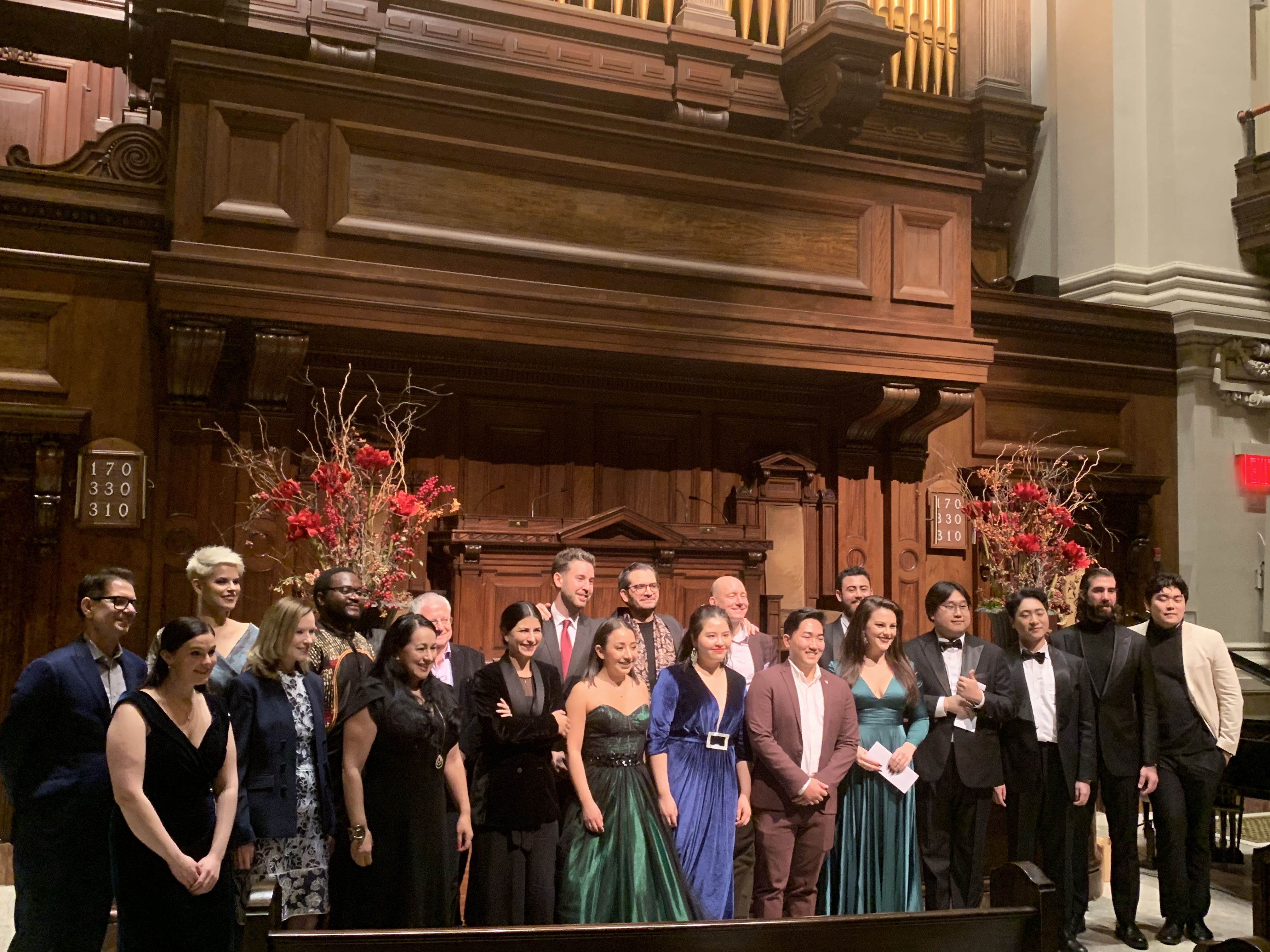
 Arlene Shrut, Aryeh Nussbaum Cohen, Yeongtaek Yang, Matthew Cairns, Tatev Baroyan, Karoline Podolak, Shelen Hughes, Rosario Armas, Gemma Nha, and Anna Kelly

Thanks to the generosity of philanthropist Gerda Lissner, several generations of opera singers have been supported in their artistic growth. In addition, citizens of Planet Opera were gifted a thrilling evening of impressive singing at Zankel Hall.  Out of 300 presumably worthy applicants, ten winners were selected to perform and were the fortunate recipients of 95 thousand dollars. No, Dear Reader, you will not learn their ranking here. That is the difficult and unenviable task of the judges. Our "task" is to share our impressions.

It is particularly rewarding for us to witness the success of singers we have followed throughout their conservatory years; it is astonishing to catch up with the dramatic artistic growth of those who left New York City and haven't been heard by us for some time; it is exciting to discover artists who are new to us. It is also a delight to experience the gracious hosting of Midge Woolsey who made up for the lack of titles and translations by giving a brief synopsis of each selection. And finally, it is always a pleasure to see how pianist Arlene Shrut manages to switch genres and styles with ease, giving the young singers the collaboration and accompaniment they deserve.

It seemed to us that the audience comprised people who know and love opera, lieder, art song and zarzuela, all of which were represented in the award categories.  No one distracted other audience members. Everyone listened with rapt attention and applauded generously and enthusiastically--and never at inopportune times. 

Speaking of applause, it made us deliriously happy to hear the audience going wild over the zarzuela selection sung with consummately professional style by mezzo-soprano Rosario Armas. Regular readers know how highly we value this art form and how we always jump at the chance to attend a performance.  The selection that Ms. Armas chose was from Chapi's humorous Las Hijas del Zebedeo. Every gesture was on point and Ms. Armas used her rich expressive voice to create a character.

In a similarly light-hearted mood, soprano Shelén Hughes charmed us with a selection from Victor Herbert's operetta "Mlle. Modiste" which we sadly missed when Victor Herbert Renaissance Project Live! presented it. It is a fine achievement when a singer is so secure in her technique and so well rehearsed that the performance seems spontaneous and very much "of the moment".

A coloratura soprano named Caroline Podolak gave a stunning performance of "Glitter and Be Gay" from Leonard Bernstein's Candide, giving the song just the right amount of humor as Cunegonde alternates between the shame of her status (which you all know) and the pleasure of receiving expensive jewelry. The high tessitura presented no challenge for her and the vocal effects were sensational. To add to the performance, this beautiful blond looked the part.

Similarly, mezzo-soprano Maire Therese Carmack looked and sounded exactly the way one would wish for the daughter of Wotan as she performed "Du bist der Lenz" from the first act of Wagner's Die Walküre. The entire setting of the Otto Schenk version (the only one that made sense to us) appeared in our mind's eye--always a sign of a great performance.

Soprano Tatev Baroyan gave a lovely and affecting performance as Liu, singing "Tu, che di gel sei cinta" from Puccini's Turandot. Mezzo-soprano Anna Kelly employed a sweet tone and personal charm in a Joseph Marx lied entitled "Jugend und Alter".  Soprano Gemma Nha performed Joowon Kim's "Like the Wind That Met with Lotus" with a haunting feeling and ringing top notes.

And now, let us get to the men. Guest artist counter-tenor Anthony Ross Costanzo delivered an inspiring "speechlet" about Orfeo and the power of music and then involved the audience in his performance of a scene from 
Gluck's Orfeo ed Euridice (in which he is starring at The Metropolitan Opera) which everyone seemed to enjoy.

Counter-tenor Aryeh Nussbaum Cohen was definitely not overshadowed by Mr. Costanzo's fame and performed two Händel arias, a deeply felt "Stille Amare" from Tolomeo and the spirited "Empio, dirò , tu sei" from Giulio Cesare in Egitto in which he dazzled us with fiery fioritura.

Yeongtaek Yang used his gorgeous baritone instrument to create a highly involving introduction to Leoncavallo's I Pagliacci, bringing Tonio to vivid life. It felt so real that we nearly forgot where we were and were waiting for the opera to begin!

Tenor Matthew Cairns has a sizable voice with an interesting texture and fine French diction that he brought to "Ô Paradis sorti de l'onde" from Meyerbeer's L'Africaine.

What a wonderful evening--a gathering of the tribe joining to celebrate young artists. May they all achieve the professional success that they deserve!

© meche kroop


Monday, January 22, 2024

OPERA INDEX HONORS MATTHEW POLENZANI


 Tenor Matthew Polenzani

It is surely a capstone of one's career to be publicly honored with an award, especially one from Opera Index. It is perhaps a more private honor to witness the next generation of singers, knowing how many have learned from you, directly or indirectly. Mr. Polenzani, a much loved tenor, is at the peak of his brilliant career and his gracious unassuming manner must be an inspiration to upcoming opera singers.

The occasion was last night's Opera Index Gala, at which event the denizens of Planet Opera gather every year to honor a distinguished artist and to celebrate the prizewinners of their competition. Unlike open competitions at which observers form their own opinions and argue the merits of their favorite singers, Opera Index's competition takes place behind closed doors. 

We think it fair to say that this year's winners were well selected from among 400 applicants and are totally deserving of their awards. Singers are notoriously financially strapped, what with the cost of lessons, tuition, coaching and such. Those donating funds to Opera Index can be confident that their funding goes a long way toward helping these young artists to achieve their goals.

We heard seven promising young artists artists last night, all outstanding in their own way. Piano support was provided by the well known collaborative pianist Kamal Khan who slides gracefully from one period of music to the next. A warm welcome by Opera Index President Jane Shaulis, who put together a most satisfying. evening, was warmly received. Let us tell you about it without reference to the size of  each individual's award, as is our wont.

The program opened with baritone Ben Reisinger performing everyone's favorite drinking song "O vin, dissippe la tristesse" from Thomas' Hamlet. Glass in hand, he illustrated the character's exuberance with a lovely resonant texture, fine phrasing and sufficient variety of tempi  to hold our interest. We love the way his voice opens up at the upper end  of the register.

Following, we heard the adorable soprano Sofia Gotch singing "Je veux vivre" from Gounod's Romeo et Juliette. She conveyed all the breathless enthusiasm (which takes enormous breath control) of a young woman bursting with life. She paced the aria well and evinced bright clean top notes. There were some trills that gave us thrills and chills! The command of the French style and diction were remarkable.

Tenor Travon Walker began his performance seated on the edge of the stage, accurately reflecting the despair of young Sam in "Lonely House" from Kurt Weill's 20th c. opera Street Scene. Mr. Walker, having established the mood of his character, proceeded to get up and walk around, delivering his aria with fine technique and (gasp) understandable English. We enjoyed the way he used dynamic variation and felt emotionally affected--a good thing.

It is quite a challenge for any young singer to portray an older person but bass Younggwang Park achieved it in his performance of "Vi ravisso", Count Rodolfo's nostalgic aria from Bellini's La sonnambula. We sensed a connection with the depth of the character as much as we perceived the depth of tone. As is common in Bellini's writing, the demands on the singer are vocally great, especially in terms of the breath control needed for his long lyric phrases. Mr. Park handled it deftly, especially in the runs.

Soprano Luna Seongeun Park (no relation) gave a spirited performance of "Chacun le sait", the regimental song from Donizetti's La fille du regiment in which Marie, the titular character, expresses her pride in the regiment that has raised her. We observed a consistency through the registers, culminating in a pure tone at the top. We liked the smoothness in negotiating the portamenti.

Bass-baritone Byeongmin Gil proved himself to be a forceful interpreter of Procido's joy at returning to his beloved homeland after a period of exile in "O tu Palermo" from Verdi's I vespri Siciliani. Variety in dynamics and a keen sense of pacing did justice to this showpiece. The texture of Gil's voice created a sound that was sufficiently mature.

Closing the musical portion of the evening was Yeongtaek Yang's impassioned delivery of "Nemico della patria" from Giordano's Andrea Chenier. He effectively portrayed Gérard's cold calculating nature as he lists the accusations toward Chenier, accusations that he may not truly believe. The sound was full and the menace was palpable.  Mr. Yang built the emotion to an intense crescendo at the end.

This fulfilling program was followed by the award ceremony and dinner. This was indeed a memorable night! We might close by urging you to join Opera Index in supporting these gifted young artists. The membership fee is extremely modest.

© meche kroop

Sunday, December 18, 2022

SO MUCH TALENT!

t

 Singers and Judges at Premiere Opera Foundation Vocal Competition Finals

We can't decide whether it is worse to be a competitor in a vocal competition or one of the judges. The former have to deal with anxiety and the latter, with making difficult decisions. We do not envy either! But being in the audience is a real treat; one gets to hear the finest young talent taking their shot for the big prize. After all, these 14 supremely gifted young singers are the result of a difficult winnowing process, having been chosen from 150 applicants. The Premiere Opera Foundation is unique in that winners receive not only prize money but also the opportunity to be heard by those who may hire them. It seems to be a win-win situation.

As is our wont, we will not tell you who won which prizes; to our ears they were all winners. As far as vocal technique, all were top notch. Most seemed to have a knack for choosing arias that showed off their versatility. And some of them managed to evoke the entire scene of their chosen aria without benefit of costume and scenery.

We will not pick apart each performance but rather try to come up with what is unique about each singer and we will do that in the order in which they sang. The way the competition was organized, each singer performed an aria and then, after 14 performances, each artist got a second chance to perform a different aria; so we got a fairly decent idea of their versatility. All were accompanied by the able pianist Michael Fennelly who seemed to have a knack for coloring each aria in much the same way as the singer did. This is the great mystery of artistic performance.  How do they do that????

We also wondered how the singers chose their arias. To choose an aria that is commonly sung puts the singer in competition with all the greats who have sung that aria before. What a challenge to make one's performance stand out, to bring something new to the interpretation!  On the other hand, to choose an unknown or rarely heard aria presents its own challenges.

Leading off the program was the sweet voiced tenor Randy Ho who brought exuberance to "Ah!  Mes amis" from Donizetti's  La Fille du Regiment and tenderness to "Dies bildnis ist bezaubernd schön" from Mozart's Die Zauberflöte He made the well-rehearsed gestures seem organic and spontaneous.

British mezzo-soprano Christine Byrne limned the character of Isabella in "Cruda sorte!" from Rossini's L'italiana in Algeri  by means of a richly textured instrument, which she also did as the doomed but peaceful Fenena in the lesser known aria "Oh! dischiuso è il firmamento" from Verdi's Nabucco.

Chinese soprano Yujin Zeng exhibited a lovely coloratura in "Ah! non credea mirarti..."Ah! non giunge" with a pleasing switch from a lovely legato to some fine fioritura in the cabaletta. There was a nice contrast with "Ach, ich fühl's" from Mozart's Die Zauberflöte. We wanted to bring Mr. Ho back onstage to do a Pamina/Tamino duet!

Chinese bass William Guanbo Su, long known to us, astonished us with his vocal growth in a forceful performance of "Quand la flamme de l'amour" from Bizet's La Jolie fille de Perth which was topped by "La calunnia" from Rossini's Il barbiere di Siviglia, a circumstance in which we preferred hearing something familiar done in a more character driven way than we have heard it before.

Kenyan tenor Lawrence Barasa Kiharangwa exhibited an ample tone in "Se all'impero amici" from Mozart's La clemenza di Tito successfully conveying the emperor's generous nature. Showing another aspect of his fine instrument, he injected all the requisite enthusiasm in Alfredo's Act II aria "De' miei bollenti spiriti...Oh mio rimorso" from Verdi's La traviata.

Chinese soprano Siyi Yan accomplished the miracle of making the clever English text of "Glitter and Be Gay" from Bernstein's Candide completely comprehensible, so unusual in that very high register. She made use of lots of gesture with each and every word. "Caro nome" from Verdi's Rigoletto was given the same highly dramatic treatment.

Mexican mezzo-soprano Rosario Hernandez Armas, well known by us and oft-reviewed, gave a touching performance of Leonora's aria "O mio Fernando" from Donizetti's La favorita. This was matched or even exceeded by the fiery "Smanie implacabili" from Mozart's Cosi fan tutte, revealing how Mozart used the vocal line to limn the character of Dorabella.

South Korean baritone Minki Hong gave a successful portrayal of the angry Ford from Verdi's Falstaff in "E sogno? O realta" which was a nice balance with the lyrical "Vision fugitive" from Massenet's Hérodiade, sung in fine French.

Soprano Avery Boettcher let out all the stops in her portrayal of the angry Donna Elvira (oh how we love those angry characters) in "In quali eccessi o numi...Mi trade quell'alma ingrata" from Mozart's Don Giovanni, letting us see the drama queen nature of the character. This was balanced by the wistful Nedda singing "Stridono lassu" from Leoncavallo's Pagliacci.

South Korean baritone Yeongtaek Yang brought humor to "Largo al factotum" from Rossini's Il barbiere di Siviglia and serious intent to "Nemico della patria" from Giordano's Andrea Chenier, successfully demonstrating his impressive versatility.

Tenor Anthony Ciaramitaro also showed versatility, choosing a strong Verdi character (Riccardo/Gustavo) from Un ballo in maschera singing "Ma se m'e forza perderti" with sorrowful renunciation and then singing the lighter role of Nemerino in "Una furtive lagrima" from Donizetti's L'elisir d'amore.

Cuban baritone Eleomar Cuello Calles performed "Mein sehnen mein wähnen" from Korngold's Die tote Stadt in the most perfect German we have heard from a non native German. It seemed a miracle that every vowel was given full value and every consonant was crisply enunciated. (Regular readers know how irritated we get when American singers maul the "ich" and the umlauts.) In Riccardo's aria "Ah per sempre" from Bellini's I Puritani, we heard a different style (bel canto) but much the same mood of romantic longing and disappointment.

Soprano Chelsea Lehnea tore up the stage with Violetta's Act I scene from Verdi's La traviata.  "È strano...Sempre libera" is a supreme challenge for any soprano who must show the heroine's ambivalence. The challenge was totally met in a way that far overshadowed her later performance of "I Can Smell the Sea Air" from Previn's A Streetcar Named Desire.

Canadian bass-baritone Vartan Gabrielian took command of the role of Banquo in "Come dal ciel precipita" from Verdi's Macbeth, successfully conveying the ominous mood. Aleko's Cavatina from Rachmaninoff's eponymous opera also deals with betrayal and we think Mr. Gabrielian is very good at conveying that, not from personal experience we hope!

It was such an exciting afternoon that we didn't want it to end. We are anticipating success for all of these gifted young artists and hope to see them all onstage again in the near future.

© meche kroop