MISSION
Monday, October 23, 2023
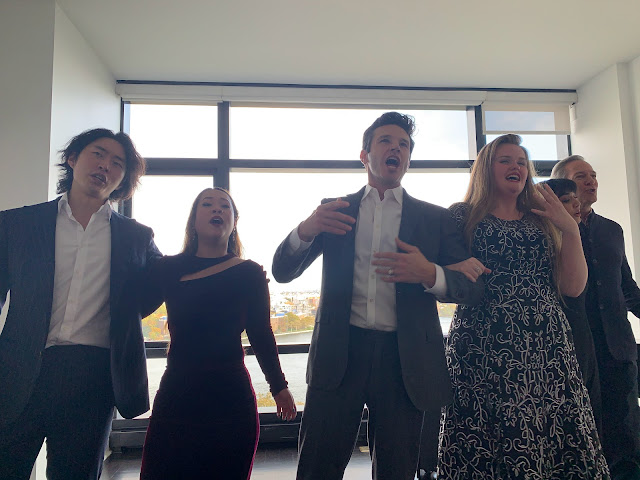
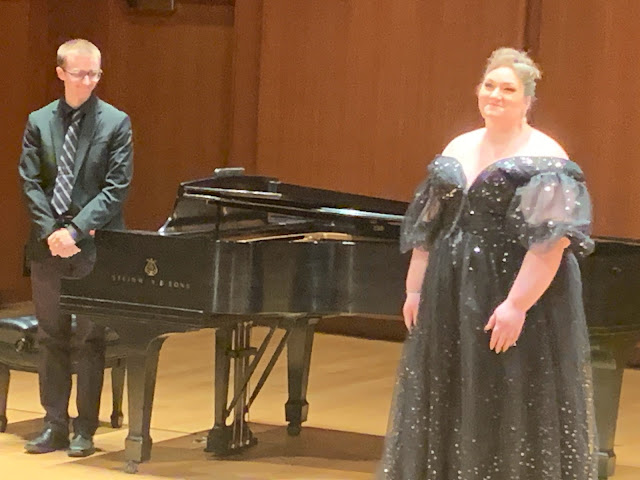
LONDON FOUNDATION RECITAL
Sunday, October 22, 2023
CLA OFFERS FRENCH OPERA AND MÉLODIE
Monday, October 16, 2023
GIULIO GARI FOUNDATION WINNERS CONCERT
Friday, October 6, 2023
SHORT, STARK, AND SILENT
Yorgos Lanthimos, Emma Stone, and Dennis Lim, Artistic Director of the NewYork Film Festival
We observe a rugged bleak landscape with goats clambering up and down the rocks. They stare impassively at the camera. Inside a simple dwelling, a black clad woman stares at the camera with similar impassivity. The room is filled with old women, expressionless. We guess that it is a wake. We are correct. The priest and the guests leave and finally the woman feels free to express her anguish. In the next room is a corpse. His face is not hidden. We guess it is her dead husband. We are correct.
What happens after that in this chiaroscuro film, in the space of a half hour, is not so easy to guess. It appears that the woman satisfies her sexual urges with the corpse. It appears that the corpse comes back to life and dons the woman’s black garb. He drives off in a truck and thrusts a dagger into the ground and dances. By the end of the film we are mystified and shaken.
We are at the New York Film Festival watching Bleat, a black and white silent film directed by Yorgos Lanthimos, starring Emma Stone as the bereaved woman. We rarely review theater, ballet, and film, preferring to stay with opera, about which we know quite a bit; but something special drew us to this event. This silent film, never seen outside of Athens, can only be performed to live music. This was quite a novelty for the New York Film Festival audience. It made us wonder whether silent films a century ago were accompanied by live music. In this case there was an enormous chorus and a chamber group including a cimbalom, playing music by Bach, Knut Nystedt, and Toshio Hosokawa. The music amplified the unspoken feelings, which, in our book, qualifies as "opera".
The film is a co-production between the Greek National Opera (GNO) and NEON, originally commissioned as part of the Artist on the Composer program curated by GNO’s artistic director Giorgos Koumendakis and NEON’s director Elina Kountouri.
The Q and A after the film involved Dennis Lim, Artistic Director of the New York Film Festival, interviewing Ms. Stone and Mr. Lanthimos. Probably related to the AGFA strike, the conversation skirted issues which were not able to be discussed but the director and actress were modest and engaging and the audience applauded wildly nonetheless.
(c) meche kroop
Wednesday, October 4, 2023
SONGS AND SPIRITUALS UNDERGROUND
Friday, September 29, 2023
DISCOVERIES OF THE SEASONS
Saturday, September 23, 2023
AND A NIGHTINGALE SANG... IN MANHATTAN WEST
Chrystal E. Williams and Bernard Holcomb
(Photo by Fadi Kheir, courtesy of Brookfield Properties)
Something special happens when an artistic creation hits all the right notes. At its conclusion we feel satisfied; we may be smiling or we may be tearful, but we have been moved as well as entertained. We want to share the experience with our friends. Sometimes we may be stimulated to learn more about a subject or a time period. Sometimes we go back to the source, be it a play, a novel, or an epic poem.
Such is the case with the charming one-act opera we saw Thursday night, Song of the Nightingale presented by the always wonderful On Site Opera in partnership with Brookfield Properties Arts and Culture. We hope you will read this review and reserve a place next weekend downtown at Brookfield Place. Tickets are free and we consider this a generous and priceless gift to the people of New York City.
First we would like to tell you about the performance and, if you stay with us, we will share with you a bit about the consequences of our attendance. The work is a rather loose adaptation of a Hans Christian Anderson fairy tale in which a Chinese emperor hears of a nightingale with a remarkable voice which he manages to get installed in his porcelain palace. The nightingale is displeased with the confinement and escapes. The Japanese emperor sends a mechanical bird which eventually wears out. The emperor is dying and the nightingale returns and sings Death away and sings the emperor back to health. She agrees to keep him informed of what is going on as long as she has her freedom.
Having read the "Spark Notes" and also the original story, we conclude that the moral of the tale is that one cannot confine what is beautiful and meaningful; grasping is destructive and freedom is best. There are other themes, of course, and most notable is the healing property of good music. Another is that true inner beauty may hide beneath external drabness.
In this case, the "good music' was provided by composer Lisa Despain who has dispelled my grumblings about contemporary music with a lively score notable for being melodic and accessible. Melisa Tien's clever libretto has taken Anderson's folk tale and adapted it to suit modern times. (Unlike current "adaptations" of classic works that make no logical sense, her libretto makes perfect sense). A wealthy collector, sung by Chrystal E. Williams, substitutes for the Chinese emperor, and, as effectively directed by Katherine M. Carter, demonstrates the obsessive qualities of a person who must possess what she craves.
Substituting for the Emperor's minion we have The Curator, sung by Bernard Holcomb, who is responsible for The Collector's acquisitions.
As The Nightingale, we heard the gorgeous coloratura of Hannah Cho whose fabulous fioritura could bring tears to anyone's eyes, just like in the Anderson fairy tale.
As the mechanical nightingale we heard the lovely voice of Nicole Haslett who furthered the subsidiary theme that what is fancy and artificial can never replace what is natural and pure. Ms. Haslett also portrayed the part of the Frog who interacts with Nightingale, along with Cow, portrayed with good humor by Jonathan R. Green.
All of the performances were exceptional and were well supported by the chamber orchestra, comprising flute, clarinet, violin and cello, conducted by Cris Frisco. Orchestration was accomplished by Scott Ethier. The inventive costumes were designed by Kara Harmon. Although we are no fan of amplification we admit that Beth Lake's sound design was effective and did not distort the sound of the voices.
Although everything worked just fine in the public space of Manhattan West, we would love to see it again in a proscenium situation with subtitles. Performances in the round carry their own drawbacks with performers often facing away from you. And looking at one's phone to read titles takes attention away from the stage. In spite of these minor inconveniences, the performance amounted to a most well spent hour that flew by. We were particularly delighted to witness such enthusiasm from the audience and by the feel-good conclusion of the work in which all the characters unite in celebration of freedom and nature.
We were inspired to come home and read the original story, the language of which is a bit archaic but possesses a wealth of captivating detail about the life of the emperor and also about his near-death experience. None of the summaries achieved the same satisfaction.
Next we recalled an operatic experience at the Santa Fe Opera in 2014 in which Stravinsky's take on the tale, Le Rossignol, was paired with Mozart's one-act opera The Impressario. The concept was a clever one in which the singers from the Mozart opera performed the Stravinsky piece after an intermission. Our review (still available, if you are interested, by typing the name in the search bar) indicates a not totally successful pairing but some dazzling singing by Erin Morley in the title role. Stravinsky's opera hewed rather closely to the Anderson fairly tale.
Next we started thinking about the word itself and how often it comes up in lieder; we now know the word for nightingale in many languages and it is always a beautiful word. It is used to symbolize the beauty and power of music.
Then we began to think about the role of birds in music. We will never forget the voice of Dawn Upshaw as the Forest Bird in Wagner's Siegfried. And how about Rimsky-Korsakov's The Golden Cockerel, which we heard at Santa Fe Opera in 2017. The bird warns the Czar of upcoming dangers.
By now, Dear Reader, you may have realized that we are just as obsessive as The Collector in Song of the Nightingale. We love to collect ideas, not things. We hope that you will snag a seat for this lovely work and that it leads to some searching on your part as well.
© meche kroop