MISSION

We are here to encourage the development of gifted young singers and to stimulate the growth of New York City's invaluable chamber opera companies. But we will not neglect the Metropolitan Opera either. Get ready for bouquets and brickbats.
Showing posts with label The George and Nora London Foundation. Show all posts

Friday, May 1, 2026

LOVE OF THE ART AND THE ART OF LOVE


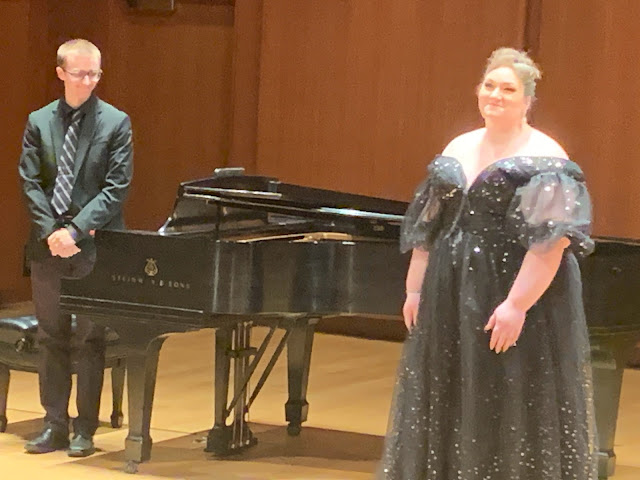
 Daniel Jimenez, Diego Fernandez, Amir Farid, Joseph Parrish, and Shelén Hughes Camacho

We cannot recall being as enraptured at a vocal concert as we were last night when artistic "power couple" Shelén Hughes Camacho and Joseph Parrish performed A Love Letter to the Americas at Merkin Hall.  We owe thanks to The George and Nora London Foundation for this gift of love. Love was definitely in the air--not just the love of music and love for homeland, but also the very obvious love this couple has for one another. It was so present that it spilled off the stage and encompassed the entire theater.

Assisted by a trio of excellent musicians--pianist Amir Farid, guitarist Diego Fernandez, and percussionist Daniel Jimenez, our lovebirds shared the stage for 90 minutes, sometimes singing a duet or listening intently to each other's solos. The intensity of the energy held us so firmly that we never once looked at the program nor did we take a single note! Diction was always crystal clear and, if the Spanish language was unfamiliar to you, Ms. Camacho's gestures told the story.

Let us see how much we can recall without benefit of notes. The program began with several duets which, presumably, the couple staged themselves in a manner that was not lifted from some production but rather seemed original. Figaro took measurements while Susanna preened and tried to get his attention.  This scene segued into Belcore's wooing of Adina, which then continued into Suzel's cherry picking aria, and finally into Don Giovanni's seduction of Zerlina. The last one was particularly well staged as the two began from distant parts of the stage with Zerlina being reeled in like a fish. We are so familiar with the vocal artistry of these two artists that we didn't monitor the embellishments or the phrasing or the vocal quality (all of which were superb) but we allowed ourself to just enjoy the various dramas.

Gershwin's Promenade gave pianist Amir Farid a chance to shine and the remainder of the program comprised art songs, folk songs, and spirituals. We agree with Steven Blier that good songs are just good songs with popular music, Broadway tunes, folk songs, and art songs being programmed side by side.

The program continued with welcome contributions from guitarist Diego Fernandez and percussionist Daniel Jimenez adding a latin flavor.

We particularly enjoyed the spirituals, some of which we have heard before and others which were new to us. Moses Hogan's arrangement of "Were You There" gave Mr. Parrish an opportunity to invest each "tremble" with a different color. Lead Belly's "Sylvie" was new to us but Hall Johnson's "Dusty Road" has been on Mr. Parrish's other programs. Both are now favorites.

Latin American music always falls gently on our ear and especially when given voice by Ms. Camacho. We enjoyed some songs in Portuguese by Villa-Lobos and the romantic "Cuando vuelva a tu lado" by Eydie Gormé.

This concert confirmed our belief in the future success of these two very special artists about whom we have written many time. Their stars are on the rise and the many prizes they have won include The George and Nora London Foundation and Opera Index. Their careers are taking them far and wide and we secretly enjoy congratulating ourself on having predicted their successes from the start. They just keep getting better and better with each inspiring the other, as one could see from the program. They even join in supporting the same charity-- Voices for Bolivia. It is by the generosity of those foundations that support young artists that these emerging talents are able to achieve a wider audience and performance opportunities.

© meche kroop


Sunday, February 22, 2026

LONDON COMPETITION FINALS


Korin Thomas-Smith, Nicholas Newton, Trevor Haumschilt-Rocha, John Arida, John H. Hauser, Tiffany  Choe, Adia Evans, and Anna Thompson

The George and Nora London Foundation Competition is one we look forward to every year. We get to see a group of talented young singers, many of whom are new to us.  We may become fans of theirs and follow their careers with great pleasure. We still remember the year that Nadine Sierra won; we recall having a delightful conversation with her whilst waiting for the judges to do their thing. We called her "the diva next door" in our review. Her star has risen!

This year, we were again on the outlook for a winning performance and we witnessed a few. First among them was that of soprano Tiffany Choe whose performance of "Senza mamma" from Puccini's Suor Angelica brought tears to our eyes. We don't recall ever being so moved by this aria in spite of at least a dozen hearings. When a performance is this powerful we forget to note the phrasing, the diction, the resonance, or any other technical details. The most important aspect of a vocal performance, in our opinion, is the communication of the intent of the composer and the meaning of the text.

Contrasting with that tragic offering was the comedy of "Come un ape ne giorni d'Aprile" from Rossini's La Cenerentola. In this aria, the Prince and his servant Dandini have exchanged roles and Dandini is very much overplaying the role of a prince and having the time of his life. Baritone Korin Thomas-Smith has great stage presence and was clearly enjoying himself which allows us, as members of the audienc, to enjoy along with him.  His connection with the character was equivalent to that of the lovely Ms. Choe.

In Rachmaninoff's opera Aleko, the eponymous "hero" sings a cavatina in which he engages in a bit of introspection before murdering his unfaithful wife and her lover. Although we have never seen the opera, we have heard one of our favorite young singers perform this aria on a few occasions, giving us the opportunity to appreciate the performance of Nicholas Newton, whose textured bass-baritone and tortured demeanor connected us to the character and held our interest. John Arida's piano introduction established an air of portent.

In Strauss' comedy Ariadne auf Naxos, Ariadne delivers the very serious aria "Es gibt ein Reich" in contrast with some rather comical elements occurring simultaneously. Soprano Adia Evans employed an imposing stage presence and powerful instrument to create a formidable character.

Soprano Anna Thompson created a lovely Thaïs in "Dis-moi que je suis belle" from the Massenet opera but we wanted her to reveal more of the character's vanity and insecurity. The listener should not be reminded of Marguerite in Gounod's Faust who is also looking in the mirror!

Lately we have been hearing a lot of "Mein Sehnen, mein Wähnen" and actually had the opportunity to coach it. We found nothing missing in the vocalism of baritone Trevor Haumschilt-Rocha but we missed the feeling of nostalgic reminiscing which could best be conveyed with the eyes.  We did like the pianissimo ending.

Mezzo Grace Ryan exhibited some lovely colors in the lower register in her performance of "Sgombra è la sacra selva" from Bellini's Norma. However, we longed to hear a bit of Adalgisa's ambivalence and guilt.

Tenor Matthew Sink gave a full-throated and powerful performance of "Mein lieber Schwan" from Wagner's Lohengrin. His delivery would benefit from the replacement of stock gestures with some more specific movement and expression.

Jennifer Robinson has a lovely instrument, well suited to coloratura roles like Amina in La Sonnambula; we found her "Care compagne" appealing. The contrast between Bellini's lengthy legato lines and the vocal fireworks of the cabaletta was well executed.

We are completely unfamiliar with Danielpour's Margaret Garner, so when mezzo-soprano Maiya Williams sang "Margaret's Lullaby" we had nothing to base our opinion on. In spite of some lovely pianissimi and gentle coloring, we were not tempted to hear any more of this opera. We were, however, interested in reading about it and it seems to have a compelling story about the African-American slave experience. But given the choice we would prefer the lullaby "Summertime" from Gershwin's Porgy and Bess. Opera of the 21st century has not delighted our ears.

Much credit for the success of the program must be given to collaborative pianist John Arida whose playing is always in support of the singer.

Before ending we would like to express a few thoughts. Moving the competition from the Morgan Library to Merkin Hall enhanced the intimacy of the event. However, we do not like the idea of giving large awards to half the competitors and small encouragement grants to the rest. It reminds me of the Laffont Competition at The Metropolitan Opera. We would prefer a more traditional approach, one more graduated.

And finally, we will likely expose ourself to criticism on this point but we would like to see female competitors dress down a bit. Bare skin, exposed breasts, long slits in the skirts, spangles, and glitter all distract from the performance. Male competitors don't have to deal with this issue and we find it much easier to focus on the voice. 

We close with fond memories of Nora London whose gracious and welcoming manner cannot be duplicated. That being said we are grateful to John H. Hauser, President and Executive Director of the Foundation, for keeping the torch lit and fulfilling the mission of supporting young opera singers in their uphill climb to success.

© meche kroop


Sunday, February 18, 2024

GEORGE AND NORA LONDON FOUNDATION COMPETITION


 Finalists and Judges of the George and Nora London Foundation 2024 Competition 
(Photo by Beth Bergman)

Whilst the esteemed judges (Carolyn Blackwell, Dimitir Pittas, John H. Hauser, and Susan Quittmeyer) were debating over the dozen finalists, audience members were ushered into the lobby where they enjoyed the opportunity to mingle with the finalists, offering hope and encouragement; they were also debating over their favorites and trying to outguess the judges. It is always a tense 45 minutes or so, softened by wine and nuts.

The twelve singers had made a fine showing, one and all. The audience was treated to a particularly diverse and enjoyable program and now were discussing among themselves the relative merits of their favorites.  After this lively and intense interlude, we were welcomed back into the auditorium of The Morgan Library to learn which six singers would receive the generous awards of $10,000 each whilst the other six finalists would be awarded $2000. It is a step upward in the world of vocal competitions to ensure that all finalists receive something. It is not our wont to tell you, Dear Reader, how much each finalist received. If that issue is important to you, we refer you (as we usually do) to the foundation's website.

We prefer to share with you our impressions of our most favored singers which, interestingly enough, were shared by our companion, a professional singer. The opening aria was a stunning one as soprano Adia Evans tackled Elisabeth's aria "Dich teure Halle" from Wagner' Tannhäuser. We liked the way she modulated her sizable instrument, shading it to the demands of the text. Furthermore, her German diction was quite good with no dropping of final consonants.

Baritone Benjamin Dickerson gave an excellent performance of the cynical aria "Nemico della patria" from Giordano's Andrea Chénier. He employed his finely textured instrument in a highly emotional fashion and used the full stage and his entire body to convey Gérard's complex feelings whilst preserving the legato line.
 
Mezzo-soprano Erin Wagner chose an aria that is a paean to music, sung by The Komponist--"Sein wir wieder gut". This rhythmically difficult aria from Richard Strauss' backstage comedy Ariadne auf Naxos was a fine choice. Ms. Wagner  handled the upper register with aplomb (Strauss wrote it for the soprano fach) and showed us all the intensity of a young composer in a most convincing fashion.

In Elisabetta de Valois' aria "Tu che la vanita" from Verdi's Don Carlo, the soprano gets to show off her skills with bel canto legato and also her wide range of registers. Katerina Burton did not disappoint, evincing a firm center and a pleasing vibrato that shows great promise for other Verdi roles.

Baritone Darren Drone got to perform "Schicchi's Aria" from Puccini's one-act opera Gianni Schicchi and perform he did! We enjoyed the personality with which he filled out the role and experienced all the requisite humor. This artist has personality to spare and so convincingly inhabited the character that his fine technique receded to the background. 

Piano accompaniment was provided by Maestro Michael Fennelly who can play just about anything. At moments when the voice was silent, we noticed his many gifts, especially in Massenet's Sapho and Britten's Peter Grimes.

The remaining singers each showed something noteworthy and if we didn't elaborate here, it is likely because they chose an aria that didn't suit their voice or their style.  Their names can be found on the foundation's website. We enjoyed them all to a great extent and had only two criticism, one of  which we have often mentioned here. We wish tenors wouldn't push their high notes, especially for the climax; we can feel our own throat constrict. It ain't pretty! Learn to float those high notes please!

We also have a criticism for the women. Please do not wear anything gaudy! When you are famous and giving a recital at Carnegie Hall, you can be as glamorous as you please, but when auditioning or competing, it would serve you better to dress simply, so as not to distract from your singing.  'Nuff said!

© meche kroop


Monday, October 23, 2023

LONDON FOUNDATION RECITAL


 Alex Munger and Lindsay Kate Brown

We recall hearing mezzo-soprano Lindsay Kate Brown over three years ago in the very same venue--The Morgan Library-- as one of the winners of the George and Nora London Foundation Competition. It was pre-Covid and there was a full house.  Yesterday Ms. Brown presented a beautifully planned recital in the same venue but the house was half empty. We realize that post-Covid, people are staying home more, so we are urging you, dear reader, to come out and support our vocal artists who work so diligently to bring artistry into our lives!

Ms. Brown entitled her program "Serenading the Hours: A Day to Night Recital" and it was evident that she put a great deal of thought into selecting a variety of composers; she sang in three languages--Russian, German, and English.  Having heard an entire concert of Rachmaninoff's music last night, our ears were particularly attuned to the Russian language and we were glad that political sentiment did not punish Tchaikovsky for Putin's transgressions. Art always trumps politics in our world!

The set of Tchaikovsky songs were well chosen, beginning with the haunting and melancholy "Autumn" and ending with the familiar "None But the Lonely Heart". Johann Wolfgang von Goethe's poignant text must have appealed to the composer who certainly had a lonely heart.  But it also appealed to Schubert who included "Nur ver die Sehnsucht kennt" in his Wilhelm Meister songs. But, on the other hand, it has also been set by Schumann and Beethoven. Someday we would love to hear all four settings on the same program!

Ms. Brown has an engaging onstage presence and chatted naturally with the audience, making us feel welcome. She has an ample instrument and one well suited to Wagner and Verdi but we found it most appealing in the rich lower register and especially in the pianissimo sections. At times when called upon to sing fortissimo in the upper register, we heard a sound that was harsh to our ears.

The "Day" section of the recital continued with songs in English by Jennifer Higdon who provided her own original texts; they were sung with clarity of diction. We particularly enjoyed the lyrical piano part performed by the excellent collaborative pianist Alex Munger. 

The section ended with songs by Alma Mahler who was sadly stifled by her husband, the famous composer Gustav Mahler. The composer's choice of text seems to indicate a woman of great passion. Our favorite was the gentle "Bei dir ist es traut" which showed off the part of Ms. Brown's voice that fell most pleasantly on our ear. The rippling piano in "Ansturm" was a further source of delight. "Erntelied" ended with a lovely vocalise.

The "Night" half of the program began with songs by Joseph Marx, a composer whose lieder should be more frequently heard.  His "Suss duftende Lindenblüthe" produced feelings of sweet nostalgia, underscored by gentle rippling in the piano. Mr. Munger also captured the rushing brook in "Erinnerung".

Ms. Brown is considerably fonder of Samuel Barber's songs than we are although "Sure on this Shining Night" has an affecting text by James Agee.

Closing the program were six songs from Alban Berg's Sieben frühe Lieder. Although Berg composed about the same time as Marx, his works are far less accessible. Even after multiple hearings we find them difficult to relate to. There is one, however, that enchants us and that is "Die Nachtigall". Theodor Storm's text is rather mystical but the melody lingers and leaves us satisfied. The nightingale sings and roses bloom. A young woman wanders deep in thought.

We don't think we have ever heard a nightingale sing, at least not the avian version, but we just did hear a human nightingale and that is enough for us.

© meche kroop