MISSION
Thursday, May 1, 2025
THE GERDA LISSNER FOUNDATION VOCAL COMPETITION WINNERS CONCERT 2024/2025
Friday, May 3, 2024
BRAVA GERDA LISSNER
Thursday, April 25, 2024
A COMPASSIONATE RULER
Thursday, March 21, 2024
TWO SINGERS BOTH ALIKE IN ARTISTRY
Last night at Merkin Hall we had the pleasure of hearing two equally excellent partnerships between two sopranos and their respective collaborative pianists.
The occasion was The Juilliard School's Vocal Arts Honors Recital at which singers who were nominated by their respective teachers were submitted to a panel of esteemed judges. We thought the judges chose well and we enjoyed seeing the rapt faces of the audience, not to mention the radiant pride observed in both Artistic Director Brian Zeger and Steven Blier who has programmed them both in his New York Festival of Song recitals.
It is significant that each artist chose her own program. Whether they chose to sing works that they love or works that would best show off their unique artistry was impossible to tell; perhaps they are one and the same. In any case, it was a grand opportunity for us to forget about technique and to focus on the various factors that make for a great performance--audience engagement, the ability to get inside a song, and the ability to tell a story with dramatic validity. We personally are not in favor of a singer standing still and accomplishing everything with the voice. We enjoy acting, as long as it seems organic. Of course, we know that gesture and facial expression must be rehearsed but it must appear organic.
The first half of the program introduced us to Juilliard undergraduate Kerrigan Bigelow, whose artistry seems way beyond her years. She opened with a song composed by a fellow Juilliard student by the name of Juliette Di Bello who not only composed the music but wrote the text herself. "Full of Fire and Future" was in blank verse and full of feelings and imagery. To us she seemed to show promise as a composer.
The rest of Ms. Bigelow's program seemed centered around the theme of women abused by narcissistic men! Was this just an accident? Schubert set Goethe's text, "Gretchen am Spinnrade", with great attention to detail and, although we have heard it countless times, we never tire of it. Ms. Bigelow took us on a tour of poor Gretchen's distracted state and variety of emotions in a most affecting way whilst collaborative pianist Amber Scherer (heard and reviewed last night at a NYFOS concert) let us feel the insistence of the spinning wheel. We truly felt shaken.
The next work was handled in a most original way. The artist began speaking about (we thought) her relationship with her father, which we thought would be an introduction to a song she recalled from her childhood. But no! We gradually realized that she was speaking in the voice of Iphegenie as an introduction to the Schubert lied "Iphigenia", a setting of text by Mayrhofen. What a brilliant and original idea, bringing the victim's pain into sharp focus!
The woman in Rebecca Clark's "The Seal Man" is led to her doom by a man too self-absorbed to realize that she is from a species that is not "waterproof". That poor girl was love-bombed into following him blindly into the sea. She drowns.
We read in the bio section that our young artist sang "Try Me Good King" for its composer Libby Larsen and we can only imagine how dazzled Larsen must have been by Ms. Bigelow's riveting performance. We have heard the work before and did not find it at all compelling--just letters from a bunch of unfairly condemned wives of that master narcissist King Henry VIII.
However, our young artist made each doomed Queen into an individual with strong feelings underneath the professed forgiveness and religiosity. We heard anger, meekness, irony, and bitterness. This lent variety to this rather long work. The only disappointment was not in the performance but in the audience--sheeple who heard one person applaud after each Queen's declaration and found it necessary to join in, thus disturbing the flow of the piece.
And thus it was that soprano Shelén Hughes entered the stage after the intermission and kindly suggested that the audience refrain from applause until each set ended. It's a sad state of affairs that people are so maleducato that they need to be taught basic concert etiquette. With that problem out of the way we felt free to enjoy the second half of the evening and to revel in the performance of one of our favorite artists.
We have vague recollections of her undergraduate years at Manhattan School of Music and a performance class taught by Catherine Malfitano and a very vivid recollection of her performance as Snegurechka in Rimsky-Korsakov's The Snow Maiden. We confess to a surge of self-congratulation in recalling our thoughts at the time that she was a true star in the making. It is always gratifying to watch a singer's growth but especially so when we have recognized their gifts early on.
Accompanied by the excellent collaborative pianist Michal Skowronek who is new to us, she opened with a selection of songs from Banalités by Francis Poulenc sung in superb French and fine Gallic style. Our favorites were the languorous "Hôtel" which contained a most delicate and expressive portamento and the charming "Voyage à Paris". "Sanglots" amounted to fifty shades of sorrow, all colored differentially.
The rest of the program was in Spanish, an excellent choice for this lovely Bolivian artist, and a treat for our ears which find the language as singable as Italian. The cadence of those two languages seems to dictate a most melodic vocal line and we noted that Ms. Hughes performed her own translations.
From Carlos López Buchardo's Canciones argentinas al estilo popular we heard the romantic "Vidalito". which conveyed, through the artist, the thrill of love with a touch of pain, as did "Desdichas de mi pasión" and "Jujeña". "Si los hallas" and "Frescas sombras" joined love and nature. Here we noticed how much we enjoyed Mr. Skowronek's light touch on the piano.
The final set, our favorite, comprised Dos Canciones Mexicanas by Manuel Ponce."Serenata Mexicana" is marked by simplicity and a momentary minor note in the piano, showing us that hopefulness is always tinged by anxiety. The famous "Estrellita" makes the anxiety a little more prominent whilst the hopefulness is there in the background. Ms. Hughes captured all the subtleties of the Latin soul.
© meche kroop
Wednesday, December 6, 2023
GRACIAS A LA VIDA
Thursday, December 1, 2022
RETURNING TO JUILLIARD
Saturday, November 12, 2022
HIP HÄNDEL
Mary Beth Nelson and Shelén Hughes
Richard Pittsinger and Maggie Renée (Photo by Richard Termine)
Now that masking is optional, we have happily returned to reviewing performances at The Juilliard School and last night we saw TWO performances. The first one was a musically authentic production of a Händel opera in which the stellar Maestro Gary Thor Wedow led Juilliard 415, the schools principal period instrument ensemble, in a musically authentic reading of Atalanta. Thanks to some recent exposures to Baroque performances, we were not surprised by the presence of musicians onstage with the singers from time to time. As a matter of fact, the overture put trumpeter John Thiessen onstage and some excellent duets were heard with the woodwinds and theoborist/lutenist Dušan Balarin. Harpsichords were played by Mo. Wedow himself and David Belkovski,
Not only did Mo. Wedow draw such admirable performances from his orchestra, but the vocal values were equally dazzling. Soprano Shelén Hughes, whom we wrote about when she was a student at Manhattan School of Music, made a powerful Atalanta who is supposed to be a Princess disguised as a shepherdess named Amarilli. Ms. Hughes has a voice of notable flexibility and a strong stage presence.
As her beloved "Tirsi" (actually King Meleagro in shepherd disguise) we had the remarkable mezzo-soprano Mary Beth Nelson (whom we heard recently at the National Arts Club as Cenerentola) utilizing the same dazzling technique as she used in the Rossini.
Another mezzo-soprano Maggie Renée immersed herself totally in the role of Irene, aggressively tormenting the man who loves her in spite of some better advice by her father Nicandro (bass-baritone Donghoon Kang). Richard Pittsinger made an excellent Aminta who had such stunning vocal moments that we found ourself holding our breath.
The hit of the evening was baritone Jared Werlein (whom we wrote about enthusiastically in a freshman recital) who brought the opera to a close as Mercutio, about which more later. Keep reading!
So, what was the second performance we attended at Juilliard? Well, it was simultaneous with the one we just described! It was a Broadway show with a lavish set (by Ryan Howell) and striking costumes (by Ryan Park) with a crazy story having nothing to do with the libretto Händel chose on which to drape his fluent arias, of which there were many.
We completely understand that audiences of three centuries ago were enchanted by pastoral stories which could be rather boring for contemporary audiences. We have observed an unending series of performances of Händel's operas tricked out with beach chairs and umbrellas and all kinds of nonsense meant to engage a 21st c. audience. It seems like a lack of trust in the music to stage it so.
The theme of the story is how young people play games on the court of love. Our association was that of middle school students who fake disinterest in those on whom they are crushing and who try to make their crushes jealous by flirting with others. So we appreciate that there is room here for a "concept". Much as we dislike updating, audiences must be attracted or opera will die.
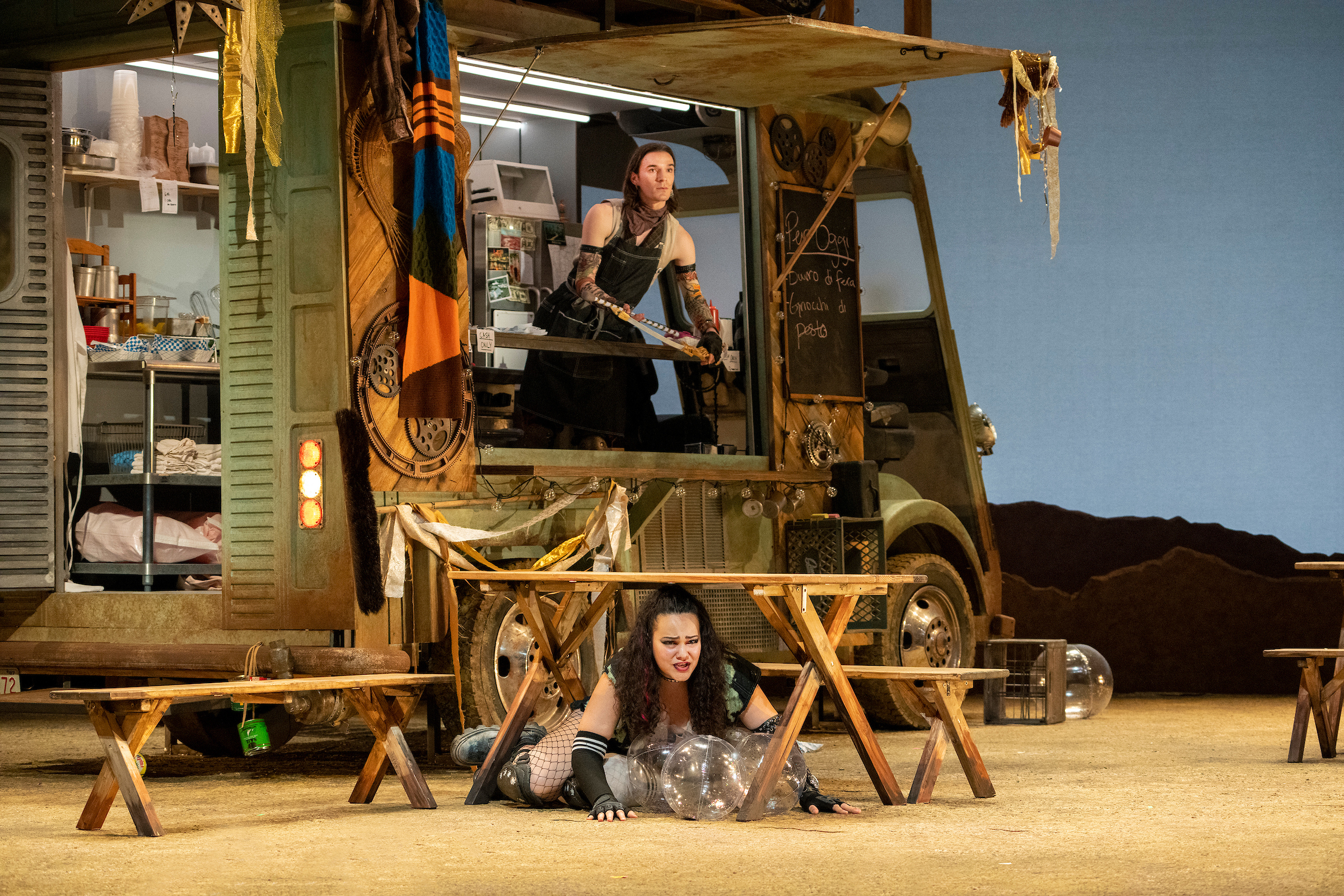
In this production, director Omer Ben Seadia's concept was a group of young people at some kind of music/art festival in the desert. An overhead sign on stage read "Bacchanalia". On stage left was a performing stage with drums that didn't get played until the final postlude with the fantastically costumed cast trying to disco dance to Baroque music. You can imagine!
On stage right was a food truck in which Aminta seemed well supplied with ingredients and a chef's knife which he wielded whilst singing, making us a bit nervous. When he and Irene finally get their games straightened out at the end of the opera they can be seen through frosted glass, presumably fornicating.
Irene seemed to be the one admitting outlandishly costumed participants to the festival, checking ID's and cell phones. But the platform shoes seemed more suggestive of the 70's. Does it matter? No one seemed to care but rather enjoyed the eye candy. But the story seemed shoehorned into Ms. Ben Seadia's concept. After the opera we read her Director's Note and can see where she was coming from. However, the stage business was so overdone that it distracted from the music. It seemed as if every important aria was overshadowed by someone moving furniture or performing some kind of acrobatic activity. There were times when we had to shut our eyes to hear the beauty of the voices.
We did promise to tell you about Mr. Werlein's performance since one might say he stole the show. In extravagant white drag and platform boots, his Mercurio sang about the blessings of love, reminding us that this work was created to celebrate a royal marriage between Frederick (son of George II) and Augusta of Saxe-Gotha. The bridal couple did not deign to attend the premiere which was anything but modest and involved a great deal of spectacle. Well, this 21st c. audience did not suffer from want of spectacle!
© meche kroop