MISSION

We are here to encourage the development of gifted young singers and to stimulate the growth of New York City's invaluable chamber opera companies. But we will not neglect the Metropolitan Opera either. Get ready for bouquets and brickbats.
Showing posts with label Brian Zeger. Show all posts

Tuesday, March 28, 2023

HEAVENLY BODIES ALIGNED


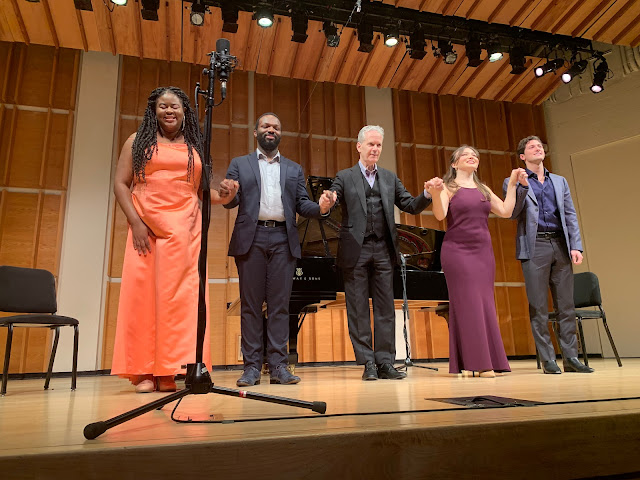
 Brian Zeger, Francesco Barfoed, Joseph Parrish, Megan Moore, and Hera Hyesang Park

We understand that the planets of the solar system were all lined up last night and presumably visible in early evening in the Western sky. Rain and city lights likely made it impossible for New Yorkers to observe this interesting astronomical event. However, we participated in something even better--a lineup of vocal stars associated with The Juilliard School's  Ellen and James S. Marcus Institute for Vocal Arts. This stellar event took place at WQXR's The Greene Space and was introduced by the gracious announcer Midge Woolsey. The event was sponsored by the Gerda Lissner Fund-- Michael Fornabaio (President of the Lissner Charitable Fund). Karl Michaelis sponsored the Juilliard event at WQXR, which was the final entry in a 3-part series in partnership with WQXR including Manhattan School of Music, the Academy of Vocal Arts, and The Juilliard School.

The vocal gifts of these artists are so overwhelming that the listener can take for granted the fine points for which we are always listening. It becomes unnecessary to pick out details like dynamics and phrasing when the artistry is so flawless. Let us instead focus on what really counts in a vocal recital. Does the singer channel the intentions of the poet and the composer? Do we feel involved and connected? Do we perhaps get in touch with something private and access memories and feelings? Do we leave the concert feeling somehow enlarged in spirit?

Dear Reader, you have probably already guessed the answer.  Yes, yes, yes, and yes. We were enraptured for over an hour in a varied and interesting program, pulled into different worlds established by the singers.

Soprano Hera Hyesang Park was on loan from The Metropolitan Opera where she is enchanting audiences with her portrayal of Nanetta in Verdi's Falstaff. We will probably not get to see that performance but we think it's fair to say that Ms. Park has subsumed Nanetta's character, which showed in the girlish charm with which she sang "Non si da follia maggiore" from Rossini's Il Turco in Italia as well as Fiordiligi in the trio that ended the evening-- "Soave sia il vento" from Mozart's Cosi fan tutte.

But what a surprise to hear her show a bit of Iberian temperament in Maria Grever's "Te Quiero, Dijiste".  Our only disappointment is that the use of the detestable music stand marred the communication of Agustin Lara's Grenada. This is one of our favorite songs and we missed the thread of contact which should have remained unbroken. Still, the Spanish flavor was there, enhanced by the piano of Brian Zeger who just happens to be Artistic Director of the Vocal Arts Program at Juilliard.

Mezzo-soprano Megan Moore achieved great depth of connection in a selection of lieder by Franz Schubert, who chose his poets wisely and added great emotion to the text with his melodic invention. Perhaps the reason contemporary songs seem so unmelodic is that Schubert used up all the melodies in his 600-plus lieder output.

In "Auf dem Wasser zu singen", the lilting piano of the excellent collaborative artist Francesco Barfoed introduced us to the timelessness of the waves and the transitory nature of our own existence. Ms. Moore captured Schubert's alternation of modes and moods with joyful expansiveness and melancholy introspection. "Im Frühling" reminds us of the bittersweetness of nostalgia, employing again the heart-piercing alternation of major and minor modes.

"Meeres Stille" takes on the concept of the calm before the storm with Ms. Moore showing us the fearful anticipation described by Goethe's text. Lest we expect that mood to last, we received Goethe's  joyous "Versunken" with memories of our own infatuations.  All these emotions were perfectly conveyed by Ms. Moore's many distinct colorations in a carefully calculated performance that came across as totally spontaneous, as it should. The audience applauded after every lied!

Ms. Moore also included songs by two 20th c. composers that were unknown to us but so pleasing to the ear that we want to hear more of them. Yvette Souviron wrote her own texts for "Carnavalito" and the sensual "Al Banco Solitario" and avoided the atonal pitfalls of most 20th c. composers. It was a surprising but welcome inclusion in the program, as was the Danish "Spring Song"  by Rued Langgaard, also unknown to us. The very lovely and tonal music pleased the ear and reminded us of the exultation attendant upon Spring's arrival as much as the Rachmaninoff song "Spring Waters".

The other singer on the program was bass-baritone Joseph Parrish who chose to sing quite a bit of Russian with excellent diction--two by Rachmaninoff--"Morning" and "My Child, You are as Beautiful as a Flower" with its lavish piano introduction. Mr. Parrish has a wondrously textured instrument and conveyed the stillness of daybreak described in Alezander Yanov's poetry.

His Tchaikovky selections presented a fine contrast. Our favorite was "Amid the Din of the Ball" and we couldn't keep from thinking of Onegin glimpsing Tatyana in the final act of the Tchaikovky opera. However, Tolstoy's  singer is hopeful and only dreams about the mysterious woman whereas Pushkin's ball-goer will push his case to Tatyana. In any case, Mr. Parrish brought out the wonder of the would be lover. Lermontov's narrator in "The Love of a Dead Man" is tormented by jealousy and is not sleeping peacefully and our singer captured that as well.

However, what we enjoyed most of his selections was his accompanying himself on the piano in Donny Hathaway's "A Song for You", setting of a text by Leon Russell. This bluesy song is, in our opinion, a true American art song, a heartfelt confession with interesting interplay between voice and piano. It was all the more meaningful because it was unexpected, unknown, and yet marvelously accessible and relatable.

The evening ended with the afore-mentioned trio from Cosi fan tutte with the three voices in splendid harmony; it sent us out into the rainy night feeling fulfilled by a superb concert and caring little about missing the planets.

© meche kroop

Thursday, December 1, 2022

RETURNING TO JUILLIARD


 Natalie Lewis, Shavon Lloyd, Brian Zeger, Shelén Hughes, and Colin Aikins

Masks off!!!!  Time to give Juilliard the attention they deserve.  After such a lengthy covid-induced hibernation, how happy we were to watch four gifted students showing off what this incomparable institution has to offer. Last week we reviewed some superb singers doing justice to Händel's glorious music in Atalanta and this week we had a grand time at the annual Juilliard Songfest.  

Brian Zeger, Artistic Director of the Marcus Institute for Vocal Arts, has lent his formidable collaborative piano artistry to some of the world's greatest voices; he offered no less to these post-graduate students. We loved his idea for the first half of the program--that of letting  the four singers choose their own programs.  Long ago, when Isabel Leonard was being coached by Maestro James Levine in a master class, he dropped some words of wisdom.  "Sing what you love!" Hearing these singers performing songs of their own choosing gave us a glimpse into their inner lives.

Leading off was soprano Shelén Hughes who impressed us as a student at Manhattan School of Music when she performed the lead in Snegurochka, Rimsky-Korsakov's opera of the same name (known in English as The Snow Maiden). This review is available by using the search bar. At the above-mentioned performance of Atalanta, she shone in the eponymous lead role. At this Songfest, her personal choice was Joseph Canteloube's Chants d'Auvergne.

Ms. Hughes' connection with the material was a deeply felt one. The dialect is strange and difficult to understand without looking at the program; but the several stories came across by virtue of the artist's winning personality and artistic choices. Regular readers know how much we love folk songs for their memorable melodies and simple direct meaning. In "Baïlero" we particularly responded to the nonsense syllables which reminded us of "scat" in the jazz realm. What an opportunity to show off exemplary bel canto technique expressively used to convey emotion. 

The emotion of "La delaïssádo" was a mournful one, painting a portrait of an abandoned maiden.  In "Lo fiolairé" Ms. Hughes flirtatiously portrayed a frivolous girl who gives two kisses to the boy who asks for one. We had a smile from ear to ear. The cycle ended with a paean to the joys of female singlehood.

Next on the program was Shavon Lloyd whose richly textured baritone lent gravitas to text by Langston Hughes set by Leslie Adams. A composer himself, Mr. Lloyd clearly responded to this music and sang with conviction. Text by Georgia Douglas Johnson, "The Heart of a Woman", had a satisfying rhyme scheme, as did "Creole Girl" with text by Leslie Morgan Collins.  What we observed about Mr. Lloyd's fine technique was the strong connection between his rich round sound and his precise embouchure. This is something we never noticed before and we love learning new aspects of technique. We might add that every single word was intelligible, a rare quality on which we place a high value.

Tenor Colin Aikins's performance also taught us something new--that a supernal performance can change our opinions. When we saw the program our first impression was one of despair. We have complained bitterly about composers setting prose because it's never musical and the vocal lines are not interesting. We gritted our teeth when we saw a cycle called Dear Theo, settings of Vincent van Gogh's letters to his brother, adapted and set by Ben Moore. We were sure to be bored.

Not only were we not bored, we were riveted. We experienced Mr. Moore's composition as music to support an intense monologue that was delivered so dramatically by Mr. Aikens that it seemed he was channeling the painter, expressing the intense joys and despairs of a seriously troubled artist; and he did so with impeccable diction. This was one of those performances for which our impoverished words are no match. It was unforgettable!

Finally we heard mezzo-soprano Natalie Lewis perform four songs from Gustav Mahler's Rückert-Lieder, omitting only the transcendent "Um Mitternacht". Mahler's music always has a profound effect on us with his memorable melodic lines and pungent harmonies. We tried to figure out what disappointed us about the vocal performance. Did we mind that the songs were not sung in the compositional order, nor the publication order? We don't think so.

Was the German muddled? No. As a matter of fact we did understand every word. Our German companion noticed that the ending consonants were crisply and accurately enunciated, although we both noticed the inconsistent enunciation of the terminal "ich" which seems to create problems for many American singers.

We found ourselves listening more to Mr. Zeger's piano--the earnestness of "Liebst du um Schönheit", the gentle airy lyricism of "Ich atmet' einen linden Duft", the hidden humor in "Blicke mir nicht in die Lieder", and the quiet resignation of "Ich bin der Welt abhanden gekommen".

It is just a speculation on our part but perhaps, although Ms. Lewis enjoys singing these songs, the singer needs more age and experience to do them justice. We have never felt this when hearing a young tenor tackling Schubert's two song cycles --Die Schöne Mullerin and Winterreise.

We had no such problem enjoying Ms. Lewis' charming performances of several selections from Hugo Wolf's Italienisches Liederbuch in the second half of the program. We have always been tickled by these miniature portraits of young lovers with all of their longings and adolescent angst. We are not familiar with the original Italian folk songs but the translation into German by Paul Heyse both rhymes and scans and surely inspired Wolf to write these accessible songs.

Mr. Zeger's idea to stage them with all four singers onstage interacting with one another was a clever one and added a new dimension. Ms.Lloyd seemed far more comfortable here and we were able to enjoy her ample sound and on point acting. There was courtship aplenty, jealousy, rejection, and every other shade of emotion found in early experimental relationships. We have never enjoyed this cycle more than we did with these four artists bringing the songs to life. They brought the evening to a satisfying close with "Nun lass uns Frieden schliessen".

© meche kroop

Friday, December 6, 2019

CLARA AND ROBERT

Brian Zeger, Keshav Moodliar, Chance Jonas-O'Toole, Libby Sokolowski, Chris Reynolds, Lauren Norvelle, Jessica Niles, Kyle Miller, and Erin Wagner


Last night at Alice Tully Hall, Juilliard presented one of their Songfests, an occasion we never miss. The program, curated by world renowned collaborative pianist Brian Zeger, who just so happens to be the Artistic Director of the Marcus Institute for Vocal Arts at Juilliard, was one of enormous value for several reasons.

Primarily, we were impressed by the concept of presenting the lives of Clara and Robert Schumann in a theatrically valid way, involving dramatic readings of their letters interspersed with songs that were related to that particular period in their romance. This shed new light on the songs and affected us in a new way.

Clara's letters were brought to vivid life by recent Juilliard graduate Lauren Norvelle who was most remarkable in expressing the young Clara's childhood infatuation with Robert. She was but a pre-teen prodigy when Robert fell deeply in love with her. It was a long courtship since Clara's father was vehemently opposed to the match, even though Robert had been his student; the two were obliged to wait 9 years for Clara's 21st birthday to wed.

Robert's letters were read by Keshav Moodliar, also a Juilliard drama student who keenly expressed Robert's youthful extravagant expressions of love.

Previously known for his piano compositions, 1840 brought forth a torrent of lieder, filled with joy. Apparently, years of separation had made his heart fonder and fonder; the consummation was therefore amplified by the power of ten. Anyone who has yearned for an impossible love will recognize this phenomenon.

The opening duet of the program "Er und Sie" was performed by soprano Jessica Niles and tenor Chance Jonas-O'Toole; the subtle dynamics, the sweet voices, and the blended harmonies successfully expressed the joys of mutual love. The boughs of "Der Nussbaum" inclined their delicate heads to kiss in sincere symbolism, tenderly sung by soprano Libby Sokolowski. 

Symbolism was not necessary in "Intermezzo, Op. 39, No. 2" which speaks openly of the singing of the heart. Baritone Kyle Miller gave it a lovely interpretation.

Mezzo-soprano Erin Wagner expressed a woman's youthful infatuation in
"Seit ich ihn gesehen" from Robert's song cycle Frauenliebe und Leben and later she sang of the joys of sharing pregnancy with "Süsser Freund" from the same cycle. Indeed, the Schumann's would have eight children!

"Widmung", so passionately sung by Mr. Miller, was composed as a wedding gift for Clara and Mr. Miller allowed the song to grow in intensity and passion.

Of course, as we all know, there is no "happily ever after" in real life and Robert's early enthusiasm became increasingly manic and his low periods became increasingly black. Unfortunately, in the early 19th c. there was no effective treatment for mental illness and poor Clara was left to cope with a large family, all the while championing Robert's music, performing at the piano, and composing.

The first time we heard her "Liebst du um Schönheit" we thought of it as having been surpassed by Mahler's setting. However, the more we hear it the higher it grows in our estimation and Ms. Niles gave it a lovely performance.  She was similarly effective in Clara's "Er ist gekommen" which seemed filled with anxiety. We heard a sense of loss in Clara's "Ich stand in dunklen Träumen", finely performed by soprano Libby Sokolowski.

Schumann's compositions toward the end of his life are dark. Listening to Mr. Miller's performance of "Der Spielmann" we can take the Hans Christian Andersen text (translated by Adelbert von Chamisso) as more than usually meaningful. "It's hideous for a man to die in this way, When his heart's still young and striving for joy" and "Let none of us go mad: I too am just a poor musician". We can only wonder what kind of visions and hallucinations troubled the unfortunate musical genius. Similarly, we can only wonder what his artistic output might have been if treatment had been available.

We were sitting close enough to the stage to feel as if we were participating in a salon at the Schumann's home. Singers and actors were all onstage together; it was a highly effective way of presenting the music. Mr. Zeger shared the accompanying duties with the super-talented Chris Reynolds. It was an altogether worthwhile evening that fulfilled both as theater and concert.

© meche kroop

Tuesday, February 5, 2019

TAG TEAM SCHUBERTIADE

Äneas Humm, Brian Zeger, James Ley, Erik van Heyningen, and William Socolof


Last night at Alice Tully Hall, The Juilliard School Vocal Arts Department delighted us with an evening of Schubert. As far as we are concerned, no composer has equalled Schubert's output of songs; the master, in his sadly truncated life, produced over 600 songs (all of which were presented a few years ago, over the course of a year, by pianist Lachlan Glen).

When we ask what made Schubert great, it was not only his preternatural compositional skills, but his wise choice of text. The German language has a special rhythm and cadence to it and Schubert's poets created works that rhymed and scanned. This text inspired memorable melodies; indeed we have yet to walk out of a lieder recital without humming one of Schubert's terrific tunes. This is what makes music "popular" and the reason why most contemporary vocal compositions, relying as they do on lengthy abstruse prose, is so consistently forgettable.

In a talk Saturday night at the Brooklyn Public Library, Michael Brofman, Artistic Director and Founder of the Brooklyn Art Song Society, chose Schubert's "Im Frühling" as one of his two favorite songs and played a couple verses for the gathered masses. Heads bobbed and bodies swayed; one didn't even have to understand the language to get "the feels". It was this very song that opened last night's Juilliard Songfest. 

Äneas Humm is a young singer who has impressed us since his American debut with the German Forum a few years ago. He identifies as a baritone but we and our operatic companion agree that his sound has a tenorial quality--light, lyrical, and sweet. Of Swiss background, his German is naturally flawless and his delivery is filled with dramatic import. He wears each song like a fine bespoke suit. We loved the graceful crescendo on the word "hell" and the prolonged "ihr". The change to minor mode was heartbreaking.

The text of the four songs which prefaced the main event of the evening were all written by Ernst Schulze, a contemporary of Schubert; he grew up motherless and fell in love with a young woman who died of tuberculosis, an illness which claimed his own life shortly thereafter. His texts are melancholy and seem focused on loss of love, just as does Wilhelm Müller's text for Winterreise. The programming seemed appropriate since the concert was dedicated to the memory of the recently deceased and deeply mourned Sanford Sylvan. It was a fitting tribute.

Bass-baritone William Socolof employed his deeply resonant bass-baritone for "Der liebliche Stern" in which the poet sees his lost love as a star in the sky which he cannot reach; but perhaps the reflection in the water below can be reached by drowning himself; at least that is how we interpret the text. Mr. Socolof has a most interesting texture at the bottom of his register and took us straight to the depths.

Bass-baritone Erik van Heyningen has a different tonal quality that was well-suited to "An mein Herz" in which the poet recommends brave endurance in the face of grief and an indifferent universe. The beating of the heart was clearly conveyed by collaborative pianist Brian Zeger, whose incomparable artistry at accompaniment was well deserved by the four singers.

Mr. Zeger's piano was especially fine conveying all the images of nature in "Im Walde", performed by tenor James Ley who succeeded in connecting with the audience whilst holding the score, no mean feat. Mr. Ley's tenor manages to be both sweet and powerful at the same time; the restlessness of the text and the music let us know that this wanderer will never find rest.

The major part of the program was Winterreise, one of our favorite song cycles. It too is relentless in its melancholy but the grief is punctuated by anger, bitterness, sarcasm, and occasional false hope. Although the poet is not explicit about the backstory, it seems obvious that the poet found love with a young woman and intended marriage. For unknown reasons, the plan failed to come to fruition and the once-friendly town now appears as rejecting as his former sweetheart. He goes on a journey through a cold and forbidding landscape, yearning for a bed in the cemetery. Every natural element reinforces his depression and symbolizes an element in his psychology. Scholars cannot agree on whether the "leiermann" playing his hurdy-gurdy at the end of the cycle symbolizes Death. 

Some critics find the cycle rather over-cooked and histrionic. We see it as an exemplar of German Romanticism. Is it relevant today?  Just ask a young person how he feels after a romantic rejection. Some will say "whatever" and move on.  Others of a more sensitive nature may slip into depression and contemplate suicide. The lucky ones will receive psychopharmacological relief but others will succeed in self destruction.

We long ago lost count of how many times we have thrilled to this cycle. There have been only two failures, in our eyes and ears. One performance employed a modern dance company which distracted from the singing; another was presented by a scholar of sub-minimum vocal gifts who wanted to rearrange the songs to suit Müller's original ordering.

So, although we are less than enthusiastic about tinkering with this masterpiece, last night's tinkering was interesting and not offensive.  Parcelling out the two dozen songs among the four young artists was an original idea and served to emphasize the "Everyman" aspect of the story. John Giampietro's dramatic consultation was probably responsible for the staging, with each of the four artists sitting on his own piano bench; each seemed lonely, depressed, and isolated, lost in his own misery. Eye contact was avoided.

Some songs were shared by two singers and the final "Der Leiermann" involved all four in a quartet of despair. Keys were changed to accommodate each singer's fach. Holding it all together was Mr. Zeger's piano, unfailingly supportive of each singer. We loved the rippling figures in "Erstarrung",so beautifully sung by Mr. Ley who created a lovely messa di voce in "Die Krähe".

Mr. van Heyningen excelled in "Der Wegweiser" which has many relentlessly repeated notes which he made interesting by maintaining a long uninterrupted line. He was powerful and fierce in "Mut". In "Wasserflut" he seemed to bend the notes to suit the text.

Mr. Humm, who excels at the upper end of his register, successfully negotiated the low tessitura of "Der Lindenbaum", our favorite song of the cycle. Our second favorite song is "Frühlingstraum" in which his dramatic gifts permitted a shift from the false hope of the dreamer to the disillusionment of wakefulness.

The rhythmic "Die Post" was shared by Mr. van Heyningen and Mr. Socolof and the two different bass-baritones played well off one another whilst Mr. Zeger's piano introduced the horses hooves and the poet's pounding heart. Mr. Socolof also made much of the short clipped phrases of "Der stürmische Morgen" and the varied dynamics of the opening "Gute Nacht".

German diction was exemplary all around and for this we credit Marianne Barrett who coached. Start to finish it was a revelation. We may never hear Winterreise sung like this again and feel grateful for the experience.

Bravi tutti!

(c) meche kroop


Friday, November 2, 2018

HYESANG SANG

Brian Zeger and Hyesang Park

Hyesang sang and oh how she sang! Up and coming soprano Hyesang Park gave a transporting recital last night at Alice Tully Hall.  This was the 21st Alice Tully Vocal Arts Recital, established originally with a gift from the Alice Tully Foundation to promote exceptionally talented Juilliard singers on the threshold of a professional career.  This recital had been postponed due to illness and, in the intervening period, this incredibly talented artist has crossed the threshold with engagements all over Europe.  It was a recital well worth the wait.

Ms. Park illuminates everything she sings with her crystalline instrument and her engaging stage presence. There are a couple of interesting qualities which set her apart. One is the self-effacing manner in which she invites the audience into the songworld. The other is the way she sets up the song with an intense but brief period of introspection. You can almost feel the emotional wheels turning.

There is another aspect worth mentioning. Ms. Park's taste in fashion is as keen as her taste in programming. No fashion show could have dazzled the eye more successfully. In the first half of the program this beautiful young lady wore a dress of midnight blue with tiny scintillating "stars"; we called it "celestial". After the intermission she appeared in a gown that recalled a blooming flower.  We know that it's the voice that counts but it doesn't hurt to delight the eye at the same time!

And now, as to the music!  It was a totally satisfying recital with piano collaboration provided by the estimable Brian Zeger who doesn't need our encomia. His playing is always supportive and there is no whiff of "showmanship". He certainly knows how to avail himself of the acoustics of Alice Tully Hall and ended many songs in a trailed off decrescendo that left the final note hanging in the air whilst we held our breath.

Ms. Park knows how to work her prodigious skills such that they become art. Every song was given her full involvement. Phrasing always honored the intent of poet and composer. Exquisite control of dynamics lent variety and she used every color on her vocal palette.

The program opened with five songs by Clara Schumann whose modest oeuvre we wish would appear on more programs. We particularly enjoyed hearing how originally she set the familiar "Liebst du um Schönheit", the Rückert text which was later set so differently by Gustav Mahler. We have heard it before but as it grows in familiarity, we increasingly appreciate Schumann's peaceful version. 

Not so peaceful was Rückert's "Er ist gekommen in Sturm und Regen" in which both artists created a storm of passion. Yet, our favorite was "Die stille Lotosblume" (text by Emanuel Geibel) with its meditation on mortality, symbolized by the singing swan.

A set of four songs by Gabriel Fauré brought yet further delights. We loved the Gallic sweetness of "Nell" (text by Leconte de Lisle) and the meditative quality of "Au bord de l'eau" (text by Sully Prudhomme). These songs were new to us but the two with text by Paul Verlaine are well known--"Mandoline" and "Clair de lune".  With a great artist like Ms. Park, an aural portrait is painted, one that reminds us of paintings by Fragonard.

Reynaldo Hahn composed around the turn of the 20th c. but his compositional style often looks backward, as in our favorite "À Chloris" with its baroque turns. We found Ms. Parks' French to be quite lovely.

After intermission we were gifted with three Korean songs. We never realized how "singable" this language is. We generally love folk songs for their simplicity and melodiousness. Our favorite of this group was the first --"Milyang Arirang" and Ms. Park gave it some passionate cries and highly expressive gestures. "Bird Song" was highly rhythmic and "Song of Loom" was interesting for the rippling figures in the right hand of the piano, with the left hand crossing over. It certainly suggested weaving to us.

There were also many songs about mothers by varied composers. How pleased we were to hear Ms. Park sing in Spanish! It seems to us that Spanish composers of the 20th c. remained free of many of the 20th c. "advances" that we deplore. We particularly enjoyed Obradors' "Con amores, la mi madre" and Montsalvatge's "Canción de cuna para dormir" which is particularly evocative of time (1940's)and place (Cuba). 

Turina's Poema en forma de canciones gave Mr. Zeger an opportunity to shine solo in the extended opening "Dedicatoria", after which Ms. Park delighted us with three ironic songs "Nunca olvida", "Cantares" which began and ended with a stunning vocalise, "Los dos miedos", and "Las locas por amor". Her acting really put the songs across!

We don't want to leave out Claude Debussy's evocative "Nuit d'étoiles" in which Mr. Zeger's piano created the twinkling of the stars. The text by Théodore de Banville was presented in Rondo fashion with the artists shedding new light on the "refrain" each time it recurred.

After such a generous program, we weren't expecting an encore but we got not one but two. The first was in Korean and the second was "O mio babbino caro" from Puccini's comic opera Gianni Schicchi. No one could have refused Lauretta's imploring!

(c) meche kroop

Friday, December 9, 2016

STRAUSS AS HE'S MEANT TO BE HEARD

Brian Zeger, Julia Wolcott, Alex Rosen, Christine Taylor Price, Kathryn Henry, and Samantha Hankey


When we learned who was singing at the Juilliard Songfest at Alice Tully Hall last night, we knew we were in for a special treat. When we saw the program, our eyes opened wide--all those songs by Richard Strauss that we had never heard before! As is the case with Schubert (whose output was considerably larger than that of Strauss, and larger than anyone else's for that matter), certain songs become popular and appear frequently on recital programs while others languish unfortunately unsung.

Brian Zeger, Artistic Director of Juilliard's Marcus Institute for Vocal Arts, was on hand as collaborative pianist and, in this case, perhaps more importantly, as curator for this thrilling evening. There were only a few familiar songs on the program and the others were delightful discoveries.

That Strauss loved sopranos is not news; indeed he had a fruitful marriage with one!  But just hear the three sopranos and singular mezzo-soprano who brought these songs to vivid and meaningful life!  Each one has remarkable technique which she applied to bring out the best of her glorious instrument. We will get to the bass later.

Kathryn Henry is a sensational soprano whom we previously had only heard briefly, and in French. We enjoyed her pure and lovely sound even more in German and in the songs selected for her to sing. She opened the program with a set of four of his songs--"Nichts", "Nachtgang", "Leises Lied" and "Die Georgine", all beautifully performed.

Later in the program she sang "Ich liebe dich" and the more familiar but very sad "Befreit". Her delivery was deeply felt and marked by perfect phrasing. Mr. Zeger introduced this wonderful song with some gorgeous arpeggios.

Soprano Christine Taylor Price has a pure crystalline sound that soars into the stratosphere.  We have enjoyed reviewing her work on prior occasions (reviews are archived) but don't recall hearing her sing Strauss; her instrument is just perfectly Taylor-ed (pardon the pun) for it. 

She opened the second half of the program with a set of four songs, each one a precious jewel--"Ich schwebe", the familiar and worshipful "Du meines Herzens Kronelein", the tender "Meinem Kinde", and the expansive "Fruhlingsgedrange".  To hear her spin out a pianissimo line is to experience pure auditory joy.

We loved "Die sieben Siegel", a setting of a text by Friedrich Ruckert, and the gentle "Traum durch die Dammerung" in which her vocal colors matched the text "weiches samteness Band"--soft velvet ribbon indeed!

Soprano Julia Wolcott performed "O susser Mai" and another Ruckert song "Morgenrot" to our delight. We make no apologies for enjoying text that scans and rhymes and Ruckert always fills the bill on that count! Our appreciation for this lovely artist grew as we witnessed her talent for drama and comedy. "Muttertandelei" is the outpouring of maternal pride. No one on earth has such a child!  Ms. Wolcott showed a real flair here and, moreover, got to show up a facility for melismatic passages that were beautifully handled.

Strauss included plenty of roles for mezzo-sopranos in his operas and we hope we will be hearing Samantha Hankey performing them in the near future. The timbre is just right.  Just thinking that the artists we heard tonight would comprise a perfect cast for Der Rosenkavalier (one of our favorite operas).

"Waldseligkeit"is a wonderful paean to nature and Ms. Hankey's voice expanded in a rapturous climax at the end. In "Lob des Leidens" she evinced the beauties to be found in sorrow. Our favorite, however, was "Einerlei" which speaks to the irony of diversity coming from sameness.

The evening truly belonged to the female voice but bass Alex Rosen was on hand to perform a few songs which were perhaps written for that fach, but we have been unable to verify. "Aus den Lieder der Trauer" was sung with intensity. Mr. Rosen certainly does have the strength in the lower register as heard in his mastery of the low tessitura of "Das Tal".

We liked him better in the light-hearted "Ach weh mir ungluckhaftem Mann' in which a poor man fantasizes about going courting in high style.  And our favorite was the gentle "Traum durch die Dammerung".

The encore was perfectly chosen for the four female voices, a setting of Heinrich Heine's "Fruhlingsfeier"; we are not sure if it has ever been arranged for four voices before but it was a stirring way to end a splendid evening.

© meche kroop


Thursday, December 1, 2016

LIEDERABEND IN HALF

Minjung Jung and Seiyoung Kim

It was a nasty night of wind and rain and broken umbrellas but our trip to Juilliard seemed worthwhile, even though we were not able to stay for the entire program, due to a prior commitment.  It is always worthwhile to be introduced to young artists we may not have heard before.

First on the program was tenor Seiyoung Kim who has the lovely clean and warm tone that a young tenor should have.  His performance of songs by Schubert and Beethoven impressed us by its musicality.  We liked his phrasing, the clarity of his German diction, and the variety of dynamics with which he made the line interesting. 

His onstage presence is confident and unfussy with most of the expressiveness emanating vocally. The texts bore a great deal of repetition but his change of coloration made each repetition sound fresh.  Beethoven's upbeat "Adelaide" stood in contrast with the composer's downbeat "Resignation". Minjung Jung's piano accompaniment gave full throat to the nightingales!

From Schubert's oeuvre, he contrasted the melancholy "Erster Verlust" with the joyful and passionate "Ganymed", reminding us of Schubert's fortunate attraction to the poetry of Goethe.  There is much to be said, in terms of planning a program, for alternation of moods!

Perhaps that was what was missing from the set of Schubert songs performed by bass Andrew Munn who was accompanied by Nathaniel LaNasa. Songs written for the bass fach are generally dark but after a group of grim songs we noticed our spirits sinking and longed for something cheerful.  It was well that Mr. Munn ended with the sanguine "Der Schiffer".

The bass fach is a late-blooming one; Mr. Munn surely has the stuff at the lower end of the register but has plenty of room to develop the overtones that will make his voice more varied and interesting. He has a strong presence onstage and is generous with gesture.

The final singer we had time to hear was soprano Kathryn Henry, with the always excellent collaborative pianist Cherie Roe. She sang two chansons in graceful French that needed only a little refinement of the nasal vowels and more legato in the line, to be superbe.  In Cesar Franck's "Nocturne" we loved the top note floating effortless into the stratosphere.

Ernest Chausson's "Chanson Perpetuelle" is lengthy and sad but Ms. Henry kept it interesting.  We were sorry to leave before the final two sets.

(c) meche kroop

Thursday, October 13, 2016

FIRST LIEDERABEND OF THE SEASON AT JUILLIARD

Alex Rosen, Julia Wolcott, Onadek Winan, Maria Brea, and Thomas West

Everything about yesterday's liederabend at Juilliard delighted us--the entire program was in German and, since it was coached by Brian Zeger, the German diction was excellent and not a word was slighted. The choice of composers included our favorites and the young artists performed them well, each with his/her own style.

We haven't spoken to Mr. Zeger about this but we suspect that he encourages each singer to honor his/her own performance style and each one seemed comfortable with his/her own choice. There is no right or wrong in lieder performance.  Some artists are highly expressive and make ample use of gesture to get across the meaning of the text. Others are more reserved and rely on vocal colors and the barest minimum of dramatic expression.  We can appreciate the entire spectrum.

Soprano Maria Brea opened the program and we enjoyed her highly expressive style in a half dozen songs by Richard Strauss. Not only did she employ ample gesture but used her facial expression to fine effect.  Even her eyes danced along with the music. Her bright tone was just right for Strauss. 

She opened the set with the sprightly "Wozu noch, Mädchen" and invested the final repetition of the opening verse with sufficient variation. She captured the sensuality of "Breit' über mein Haupt". The blind hope of "Hoffen und wieder verzagen" was made clear; the closing "Mein Herz ist stumm, mein Herz ist kalt" had appropriately chilly colors. Collaborative pianist Nathan Raskin provided excellent dynamic support.

Baritone Thomas West performed a quintet of songs by Brahms--songs with which we are unfamiliar--from Lieder und Gesänge, Op. 32.  Most of the Brahms songs that we love are of a folksy nature; these songs are quite serious and deal with more complex and troubling emotions.

Mr. West is an artist of the more reserved type, employing an economy of gesture and relying predominantly on vocal colors to convey the mood. That he translated the songs himself lent a word-by-word authenticity to his performance.  In "Wie rafft ich mich auf", Brahms repeats certain phrases and Mr. West handled this beautifully. His piano partner Jinhee Park evinced ample strength.

We particularly enjoyed the final song "Wie bist du, meine Königen", a more romantic affair to be sure, and a lied which permitted Mr. West to use a lighter tender tone, especially in the final verse. Every time he repeated "Wonnevoll!" we felt an inner smile.

Bass Alex Rosen performed a pair of serious songs by Schubert, lieder with opposing spiritual values. In "Prometheus" Goethe's text speaks of anger toward Zeus; the cynicism is so thick you could cut it with a knife.  In "Grenzen der Menschheit", the same poet speaks with spiritual reverence.

Mr. Rosen captured both attitudes and did it with low notes to spare. Collaborative pianist Chérie Roe made a powerful statement throughout.

Some genie must have read our Friday night review of the Brooklyn Art Song Society in which we expressed the wish for more songs by Joseph Marx to appear on recital programs.  How delighted we were that soprano Julia Wolcott performed four of them! Although he came along a generation after Strauss, his music is entirely accessible and melodic. Ms. Wolcott's performance was lovely and her instrument brilliant in tone.

We had heard two of the songs "Nocturne" and "Selige Nacht" Friday night and had enjoyed them entirely. How delightful to hear them again. Piano partner Dror Baitel enjoyed the dazzling runs of the former and Ms. Wolcott clearly enjoyed the sensuality of the latter, which has become one of our favorites. It is interesting that Otto Erich Hartleben wrote the text for both of them.

Soprano Onadek Winan closed the program with four selections from Strauss' Brentano-Lieder, Op. 68. which she translated herself; this lent an immediacy to her performance. Our ears feasted on her beautiful tone and our eyes on a lovely stage presence.

In "An die Nacht" piano partner Ho Jae Lee's passion matched hers.  But our favorite is always "Amor" in which she gave a charming reading and some stunning vocal fireworks.  Mr. Lee's piano was particularly fine in "Als mir dein Lied erklang".  This summed up the recital for us--"Your song rang out to me"!  Indeed, these five singers managed, in 80 minutes, to erase an entire day's cares.  Long live music.  Long live song!

(c) meche kroop


Tuesday, May 10, 2016

THE THING ABOUT YING

Brian Zeger and Ying Fang at Alice Tully Hall

Ying Fang's Neighborhood Concert on April 16th (archived here) was one of the highlights of the season. We were overjoyed to learn that she would be repeating the same program last night at Alice Tully Hall. The Alice Tully Vocal Arts Recital is given to promote exceptionally talented Juilliard singers on the threshold of a professional career. And Ms. Fang seems to have crossed that threshold and has had an enviable season of music making with more coming up.

 But we felt that we already said everything there was to say about the program and used every encomium at our disposal to describe Ms. Fang's overwhelming artistry. What more could we say?

That everything she sang was well worth a second hearing? That we would gladly hear her again tomorrow? That her opening song "Endless Pleasure" from Händel's Semele gave us endless pleasure?

We could add that she provided her own translations for three of the four lovely Chinese songs on the program sung in mellifluous Mandarin and that a second hearing of these songs convinced us that their quality merited their inclusion in the program.

Brian Zeger, Artistic Director of the Juilliard Vocal Arts Department and Executive Director of the Metropolitan Opera Lindemann Young Artist Development Program, last night wore his collaborative pianist hat. He has played for all the greats of the opera world and we are happy to see Ms. Fang included in that illustrious company, a position she well deserves.

We love the softness of Mr. Zeger's hands and the way he always supported Ms. Fang. We noticed the unusual piano part of Bizet's "Oeuvre ton coeur" which has a martial feel but is in 3/4 time. We noticed how spontaneous was the appearance of Ms. Fang's gestures and facial expressions, in spite of the fact that everything must have been rehearsed down to the last flick of a finger. Artful but artless.

The audience would not be silenced, even after the encore. There were torrents of applause and a lengthy standing ovation afrer the moving "Shepherd's Song" from Wagner's Tannhäuser, which Ms. Fang has performed onstage at the Met. There had to be a second encore--and there was. Ms. Fang sang an aria from Händel's first oratorio from the 1707 Il Trionfo del Tempo e del Disnganno, a work she will sing at the Festival d'Aix-en-Provence, in the middle of a very busy summer.

Aren't we lucky to have had her here in New York?

(c) meche kroop

Sunday, January 18, 2015

HAPPY BIRTHDAY MARILYN

Brian Zeger and Susan Graham

As far as song recitals go, Susan Graham has everything one would wish for in a performer--stage presence, communicative skills, understanding of the text, linguistic perfection, a gorgeous instrument, a sensitive partnership with her collaborative pianist (the eminent Brian Zeger) and that something extra that makes people adore her.

Her performance at the conclusion of the Marilyn Horne Song Celebration at Zankel Hall seemed to be a lesson for prospective lieder singers and a superlative way to honor Ms. Horne, whose contributions to the world of song is legendary.  Significantly she has mastered the rare art of making French comprehensible.  We wish we could say the same for the other singers on the program.

Alfred Bachelet's "Chère nuit" was given a rapturous and romantic reading, as was "Quand je fus pris au pavillon" by Bachelet's contemporary Reynaldo Hahn.  Poulenc came along at a later period and his waltz "Les chemins de l'amour" filled us with nostalgia for our own sacred memories.  As encore, Ms. Graham and Mr. Zeger offered another Poulenc song of a more surrealistic nature--the well known languorous "Violon".

Of the rest of the program, we feel obligated to point out that it was not as celebratory as we had hoped.  Glamorous mezzo-soprano Cecelia Hall made some fine music in Arnold Schoenberg's Vier Lieder, Op.2 with its many references to natural elements and colors--poet Richard Dehmel must have been very fond of gold and green, red and blue.  Ms. Hall has a fine stage presence and a fine instrument that sounds rather soprano-y for the most part.  

Her German was excellent but her French diction in Ravel's Cinq mélodies populaires grecques fell short.  A native born French speaker of my acquaintance shared the same opinion.  The words to these charming folk songs deserve to be understood! The melodies nonetheless came through with charm to spare.  Renate Rohlfing's accompaniment was marked by a delightfully soft touch.

A last minute replacement for a singer who was generously "lent out" to the Philharmonic, bass DeAndre Simmons has a marvelously resonant sound.  He and his piano partner, the superb Brent Funderburk, were asked to step in with a program they had already prepared for another engagement.  In the entire Brahms canon, we cannot think of a group of songs we like less than "Vier ernste Gesänge".  To our ears they are painfully preachy and the bible is not what we want to hear quoted in an evening of celebration. Perhaps we are alone in this opinion but that is how we felt.

That being said, Mr. Simmons sang them well with an expressive rich tone and fine German diction.  Mr. Funderburk's piano handled the many scale passages with elegance.  It is obvious that he studied with Mr. Zeger!

Edward Parks has a marvelous baritone that we have enjoyed to the point of fanaticism on prior occasions.  Last night his delivery of selections from Schubert's Schwanengesang did not live up to his earlier performances. Schubert knew he was dying at the time of their composition and the settings of Heine's poetry are tinged with underlying sadness, even when they appear cheerful at first hearing.

We always love the lilting "Das Fischermädchen" and the eerie arpeggios of "Die Stadt"; the music made by pianist Keun-A Lee was extraordinary.  We just wanted a little more color and variety from Mr. Parks, the color and variety he lent to Schubert the last time we heard him.

We got plenty of color and variety from soprano Alison King, accompanied by Peter Walsh, in a selection of songs by Pauline Viardot. This musical polymath should be included in more vocal recitals!  As a singer, she wrote exceptionally well for the voice.  Her Havanaise had some marvelous melodies and exciting rhythm.  

Ms. King sounded a lot better in German than she did in French, mainly because of the diction.  We understood every word of the delightful "Nixe Binsefuss" and she injected an interesting bit of irony in Ms. Viardot's setting of "Das ist ein Schlechtes Wetter" in which Mr. Walsh conveyed the state of the weather in stormy fashion. We prefer the Viardot setting of the Heine text to that of Richard Strauss.

And so the week of celebration came to a successful conclusion with Ms. Graham's stunning appearance.  Lieder lovers come from all over the world for this glorious week of song.  We hope some new converts were made.

© meche kroop

Friday, December 5, 2014

BAUDELAIRE IN MANY HANDS

Brian Zeger, Austin Smith, Eric Jurenas, Miles Mykkanen, Virginie Verrez and Christine Price


As we have noted previously, the very best kind of recital nourishes the listener intellectually as well as artistically.   Last night's Juilliard Songfest presented the songs of Charles Baudelaire in such a manner that we were inspired to return to our copy of Fleur du Mal to reinforce the pleasure we experienced while listening to the music.

For us, the highlight of this presentation was hearing our favorite text "L'Invitation au voyage" in the familiar setting by Henri Duparc and later in a setting by Alexander Gretchaninov, a student of Rimsky-Korsakov.  The magnificent mezzo Virginie Verrez has the advantage of being a native speaker of French and her total comfort with the language enabled her to immerse herself totally into conveying the textual significance.  

Along with the gorgeous instrument she employs with such fine technique, she possesses the rare artistry to bring you into the core of the song as she experiences it. One could break down the components of this artistry but there are times when we prefer to just allow ourselves to feel the music and the sound of the words as they envelop us.  This was one of those times.  We wanted to feel the exoticism and the erotic languor.

Gretchaninov's setting was unfamiliar to us but the Romanticism was beautifully interpreted by soprano Christine Price whose voice has a pleasant ring and a fine vibrato.  While not a native French speaker, Ms. Price's French diction was quite fine. 

Ms. Verrez seems to have a particular affinity for Duparc and we thrilled to her delivery of "La vie Antérieure".  The vivid fantasy elements of the text were given astonishing word coloring and we entered a strange beautiful world.  Likewise in "Harmonie du soir" when her voice joined with Mr. Zeger's piano and took us on a journey of simile and metaphor.  The imagery of a "flower offering incense to the night" and "a violin trembling like a heart betrayed" were particularly striking.  (The phrases sound much better in French!)

Ms. Price was particularly touching in Debussy's setting of "La Mort des amants" which, in spite of the title, struck us as far more romantic than morbid.

Special honors go to tenor Miles Mykkanen who appeared in the second half of the program and sang Fauré's setting of "Hymne, Op. 7, No. 2" a song without any of the darkness so common in Baudelaire's poetry.  Mr. Mykkanen shares with Ms. Verrez that very special quality of using gesture and voice in a completely organic way that makes a song appear to be spontaneous, belying all the effort and technique necessary to reach that point.

But he outdid that stellar performance with "Le Jet d'eau" in which a fountain is compared with "a white bouquet whose flowers sway until the moon releases showers of bright tears" (translations by Richard Howard).  In this, Mr. Zeger's piano offered a shower of harp-like tones.  Mr. Zeger's collaboration with these young singers knows no equal.  He is artistic director of the Ellen and James Marcus Institute for Vocal Arts at Juilliard, among many other titles.  He seems to have perfect judgment in suiting the singer to the song.

Equally dazzling was their performance of Gretchaninov's setting of "Je t'adore" in which Mr. Zeger and Mr. Mykkanen united so perfectly that we were totally swept away.  This artistic partnership is the very reason for attending vocal recitals--when a voice and a piano can take you places you've never visited before.

Counter-tenor Eric Jurenas gave a fine performance of Debussy's setting of "Recueillement" in which the "Sun will die in its sleep beneath a bridge". Here, Mr. Zeger's piano laid down a thick carpet of Impressionistic sound for Mr. Jurenas. Sad to say but Mr. Jurenas' diction was not quite up to that of the others.  We caught a word here and there but never an entire sentence.

We have quoted some of the text to demonstrate the evocative nature that inspired such beautiful compositions.  How could one go wrong with imagery like that!  If you want to write a good song, you should choose good poetry!

More songs on the program included settings by Ernest Chausson, André Caplet, Daron Aric Hagen and Paul Hindemith--all fine songs but not as much to our taste as Fauré, Debussy, Duparc, and Gretchaninov.

We had only one quibble with the program.  Austin Smith was onstage reading the text in English translation.  Translations may give us the imagery of the text but not the innate musicality of the French language.  Furthermore, his reading lacked the dramatic impact we noted three months ago when Lucy Rowan narrated a Tennyson text at the Manhattan School of Music.

© meche kroop


Tuesday, January 28, 2014

STRAIGHT FROM THE HEART

Ken Noda, Brian Zeger, Paul Appleby
There are singers who are sensational on the opera stage and can create wonderful characters but who just do not come across well on the recital stage.  Tenor Paul Appleby manages to excel in both places.  What seems obvious to us is that he is totally enamored of the songs he sings and selflessly submerges his own identity so that the soul of the poet shines forth. 

When he steps out on the recital stage, as he did Sunday afternoon as part of a new series at Pace University, he addresses the audience in a way that makes one feel as if a dear friend were sharing his loving feelings with you.  His sweet voice caresses your ear in a way that is almost tactile.  His enthusiasm is conveyed as he tells you about the songs he will sing and you feel as if he is singing them just for YOU.  And that, reader, is a major gift.  His artistry is such that the supporting technique becomes invisible.

The first half of the recital was sung in impeccable German; accompanied by the wonderfully supportive Ken Noda, Mr. Appleby did complete justice to Beethoven's lovely "Adelaide" and sang five songs by Schubert.  Our personal favorite was "Im Abendrot"; according to Mr. Appleby, Schubert was not a particularly religious man, but his setting of Karl Gottlieb Lappe's text as sung by Mr. A. would move anyone into a spiritual state of mind.

We next enjoyed seven songs selected from Schumann's Myrten Op.25; as Mr. A. shared with the audience, this cycle was part of the composer's outpouring of song during the year 1840 when Herr Wieck's opposition to his daughter Clara's marriage to poor young Robert was trumped by the court.  One can hear his love for his bride reflected in the music.  "Widmung", a setting of a text by Rückert, is bursting with all-consuming passion.  Julius Mosen's text "Der Nussbaum" is a gentle lyrical account of a young woman dreaming of her coming marriage.

The set also included a couple drinking songs which allowed Mr. A. an opportunity to appear rather bibulous.  Following were two songs about Venice and gondoliers to texts by Thomas Moore which were translated into German by Ferdinand Freiligrath.

In the second half of the program, the acclaimed Brian Zeger took over the role of collaborative pianist, one at which he excels.  The songs were in English and although Mr. Appleby clearly threw himself into them with the same enthusiasm, we personally do not relate as much to 20th c. works as much as we do to works of the 19th c.  We miss the scanning and the rhyming which elicits a vocal line more agreeable to our ears.

We did enjoy the tinkling piano in Britten's "Fish in the Unruffled Lakes", a setting of text by Auden, and the quiet sombre chords of "Nocturne" in which the text rhymed and scanned in trochaic meter as did "Underneath the abject willow" which was of a friskier vein.

Two songs by Leonard Bernstein followed. "To what you said" is a dissonant setting of text by Walt Whitman.  Cellist Dane Johansen joined Mr. Appleby and Mr. Zeger and made some lovely music.  But we far preferred the accessible "Dream with Me" written for Peter Pan but bumped off the show.

Three songs by Harbison from Simple Daylight with texts by Michael Fried struck us as unlovely.  The very angry "Someday a Seed" could not measure up to Schumann's "Ich grolle nicht" on the same topic.

Two Langston Hughes poems set by John Musto left us similarly cold in spite of Mr. A.'s deeply committed performance.  Just call us a fugitive from the 19th c. wandering lost in the 20th!

© meche kroop


Thursday, January 23, 2014

EIN LIEDERABEND

 Mary Feminear, Angela Vallone, Michael St. Peter, Kara Sainz
If you've never been to a liederabend at Juilliard let us tell you what you're missing.  You are missing an opportunity to see the opera stars of tomorrow (or maybe next year) in an early stage of development.  They are in no way beginners.  They have been cherry-picked from an enormous field of applicants and given superb instruction and coaching in all aspects of performance.  They are definitely performance-ready and have already been performing around the country and often abroad.

Last night, for example, we heard four fine singers perform songs we love, most of them familiar and a few new to us.  Soprano Angela Vallone opened the program with five songs by Brahms.  With each song her voice opened up and her connection to the text deepened.  She and her sensitive collaborative pianist Jung A Bang made a fine team and exhibited excellent dynamic control.  Her German diction made the words clear.  Our personal favorites were the sad "Mädchenlied" and the charming "Ständchen" which painted such a colorful picture.

Mezzo-soprano Kara Sainz, in fine partnership with pianist Kyung Hee Kim, followed with a set of songs by Fauré .  Together they did justice to "Mandoline", another lied about a serenade that brought a smile to our face. But it was in "Les berceaux" that Ms. Sainz reached a depth of feeling that touched our heart; one could feel the ships rocking in the waves and the cradles rocking at the hands of the sailors' wives.

Michael St. Peter has a sweet lyric tenor that he employed to great advantage in a set of lieder by Hugo Wolf.  We loved the play on the word "elf" in "Elfenlied", a frisky little narrative.  But the tender tale of a man seeking peace at any price with his beloved, "Nun lass uns Frieden schliessen", moved us deeply.  Furthermore we are delighted to report that Mr. St. Peter has mastered the pronunciation of "ich"; as our readers have probably noticed, we are unhappy when a singer pronounces it as "ick", or, worse yet, avoids it altogether.  We didn't even need to look at the libretto to understand his German.  Bravo!  Raymond Wong accompanied beautifully.

The final set of songs by Gounod were performed by Mary Feminear whose rich creamy soprano recently graced the stage at Gotham Chamber Opera.  She has a lovely voice and a facility for French.  In "Sérénade" there was a beautiful arpeggiated melisma on the word "chantez".  There was plenty of excitement conveyed in "Viens, les gazons sont verts!"  Ms. Feminear was accompanied by none other than Brian Zeger himself who coaches the students of the Institute for Vocal Arts.  To hear his piano in "Venise" was to be transported; the minor key and the delicacy of the playing were enough to put us in a traveling mood.

If this description is tempting to you, watch out on the Juilliard calendar for the next Liederabend.  They occur monthly at 6PM on Wednesdays.  A better hour could not be spent--a true mid-week respite.

© meche kroop


Thursday, January 16, 2014

SPOTLIGHT ON JOSEPH LIM

Joseph Lim
Last night's Spotlight Recital as part of "The Song Continues" featured baritone Joseph Lim who has been making quite a name for himself at the Lyric Opera of Chicago and winning prizes from the Met National Council and the Gerda Lissner Foundation.  And he also won the hearts of the audience when his recital encore was dedicated to Ms. Horne herself--the brothers Gershwin's  1927 "Embraceable You".  This entire week has been a celebration of Ms. Horne's (unbelievable) 80th birthday.  As she herself said on Monday "I'm still here!" and we are glad of it.  After her very major opera career she has used her time, energy and talent to guide the next generation of singers and collaborative pianists at The Music Academy of the West.  A big big hurrah for this grande dame!

Mr. Lim's final set of songs was our personal favorite of the hour-long recital.  Ravel's Don Quichotte à Dulcinée offers the singer an opportunity to portray many moods--the grand and the intimate, the funny and the reverent.  Mr. Lim seized the opportunity and ran with it.  In some mighty fine French, he was undaunted by the low-lying phrases and clearly connected with the material.  We loved the delicate decrescendo on the final "amen" of "Chanson épique" and the humorous "Chanson à boire".

His opening set of songs were by Tosti and it took awhile for the unfussy Mr. Lim to open up his creamy baritone and invest the songs with the expansive Italianate style that is called for.  "Non t'amo piu" sat well on his voice and by expressing its passion he demonstrated that he has the goods.

Just this past Saturday night we reviewed Jazimina MacNeil singing Schumann's Liederkreis, op.39 and were delighted to hear it so soon afterward sung by a baritone to different effect.  Mr. Lim's delivery of "In der Fremde" was very moving and in "Zweilicht" we enjoyed some lovely word coloring that we want to hear more of from this fine young singer.  For example, in "Waldesgespräch" we yearned to hear greater differences between the voice of the seductive man and the voice of the Wood Witch.  In any event, Mr. Lim showed fine volume control and lovely phrasing.

We found his German diction somewhat inconsistent.  He was meticulous about pronouncing the final consonants with a few exceptions.  The "er" ending sounded like an "uh" which is commonly called a "schwa".  And the "ich" (the bane of many American singers as well) was on the muddy side.  These tiny quibbles sound nit-picky in the face of the overall delight of the recital but we would feel remiss in letting slide an easily correctable flaw in so fine an artist.

The esteemed pianist, coach and educator Brian Zeger was the collaborative pianist for the recital and, as usual, his playing was sensitive, authoritative and marvelously relaxed.  There is nothing like experience!

© meche kroop