MISSION

We are here to encourage the development of gifted young singers and to stimulate the growth of New York City's invaluable chamber opera companies. But we will not neglect the Metropolitan Opera either. Get ready for bouquets and brickbats.
Showing posts with label Sara Couden. Show all posts

Friday, November 10, 2023

THE GOLDEN COCK(erel)

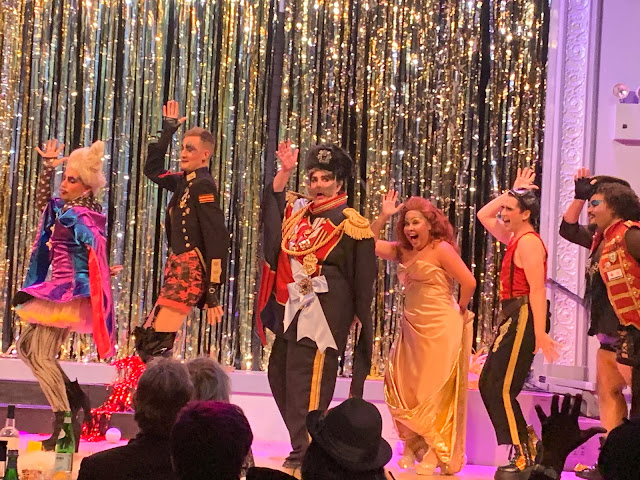
Heartbeat Opera Gala Drag Show--"The Golden Cock"

Our beloved Heartbeat Opera has been undergoing major changes for the past couple years.  We are excited about an upcoming Eugene Onegin; they can be expected to put a most original stamp on it, as they usually do. We will withhold judgment until we see/hear it.  But there is never any doubt in our mind about the joyful entertainment provided at their annual drag show.

What we love about them comprises the wildness and originality of the costumes, the imaginative script, the bawdy gay humor, the clever play on words, the excellence of the musical values, and the sneaky topicality.

With Russian operas and Russian singers being cancelled (both literally and figuratively), how completely outrageous it was to do a send up of Rimsky-Korsakov's final opera The Golden Cockerel, composed in 1907 but not performed until after his death. It is rarely produced but six years ago we had the pleasure of seeing it twice! It is the story of an autocratic king who invades an innocent country (!) and gets advice from a bird.  The music is just as glorious as one might expect and the not-so-hidden message was as true today as it was in the early part of the 20th c. and six years ago.

The story was, of course, fractured and splintered to provide opportunities for typical Heartbeat hijinx and double entendres. Rimsky-Korsakov's music received lots of stage time but so did several other Russian composers. Our companion joined me in identifying most of them including Rachmaninoff's "vocalise" and Tatiana's waltz from Eugene Onegin. We also heard some Rossini for good measure.

Musical values are always excellent with Heartbeat Opera. The chamber orchestra comprised Co-Musical Directors Jacob Ashworth (violin) and Daniel Schlosberg (piano) with Angela Shankar playing clarinet and saxophone and Deanne Cirielli enchanting us with her harp. It was impressive that four musicians could create such a full sound, but with Mr. Schlosberg doing the arrangements, we would expect no less.

The singing was exceptional as well with bass John Taylor Ward towering over everyone else. Tenor Elliot Paige is another "regular" that we always look forward to seeing and hearing.  Countertenor Daniel Moody made a fine showing as well. The female voices had less stage time but were also excellent--soprano Ariana Wehr and contralto Sara Couden. Special guest artist John Holiday provided a rare treat as well with his inimitable countertenor

The show was created by  Mr. Ashworth and Nico Krell who also directed. The extravagant costumes were designed by David Quinn. The Master of Ceremonies was Maxim Ibadov. One thing about the annual drag show that impresses us is how well everyone works together; the ensemble feel is unmistakeable. Everyone seems to be having fun and this mood is infectious. The audience was filled with smiling faces.  Yours could be among them if you read this in time.  There will be two shows at Roulette tonight, Friday November 10th. It is well worth a trip to Brooklyn. In these troubled times, there is nothing like gay humor to lift one's spirits!

© meche kroop


Friday, May 3, 2019

AN UNLIKELY MARRIAGE

Patrick Kilbride, Paul Max Tipton, and Lucía Martín Cartón  (photo by Russ Rowland)

It seemed like a strange coupling but strange couplings often produce very special children and such is the case with the marriage of Heartbeat Opera with Opera Lafayette. Opera Lafayette is a longstanding (25 years) fixture in D.C. and we have enjoyed their annual visits to NYC for some time since they bring lovely productions of Baroque opera. Heartbeat Opera has been growing for only five years and is best known for their radical reinterpretations of the classics, thus achieving impressive recognition and honors from the opera community.

The lovechild of this visit was a riveting production of Alessandro Stradella's 1681 opera La Susanna, a retelling of the story from The Book of Daniel about an innocent young woman blackmailed by two venerable but lustful judges and condemned to death. The story has a happy ending due to a deus ex machina in the person of the youth Daniel who cross-examines the two judges, thus exonerating Susanna and condemning the wicked judges to death.

This story was the inspiration for Carlisle Floyd's 1955 opera Susanna and the Elders, remembered primarily for the soprano aria "Ain't it a Pretty Night". The story has been immortalized by many Renaissance painters; many of the works so inspired were exhibited in the Gallery of BAM Fisher where last night's opera was performed.

Ethan Heard's direction shed so much light on the issue presented by the story that we had tears dripping from our eyes. The story was presented with specificity, leaving us to identify with Susanna and her predicament; memories were evoked that left us shaken and angry. Good art should make us feel and think; this Mr. Heard accomplished, all while the Baroque ensemble soothed us with lovely harmonies. 

If this had been set by a contemporary composer, it would likely have had a jagged atonal setting that would have just left us irritated. The contrast between the lovely music and the horrifying story worked to great advantage.

The framing device for the story was an academic lecture on female studies and also art history, since the scenes of the violation employed a stop-action or freeze strategy which imitated the many paintings we saw in the Gallery. This narration is generally performed by a male character named Testa, but was here performed by Sara Couden whose powerful contralto was employed both effectively and musically to further the characterization.

As the eponymous Susanna, the plangent soprano of Lucía Martín Cartón could not have been better. She radiated joy and innocence in Act I, and conveyed both fear and hope in Act II. 

As the wicked judges we heard two fine singers who had the unenviable task of making us hate them. Tenor Patrick Kilbride and bass-baritone Paul Max Tipton were scarily convincing in their lust and deceit. Moreover they sang a particularly fine trio with Ms. Couden in Act I.

Soprano Ariana Douglas rounded out the cast. She didn't have much to do as a student in Act I but in Act II she portrayed Daniel as a White Knight who got involved by conducting the cross-examination whilst Ms. Couden's professor kept her distance.

These fine voices were matched by some splendid playing of the chamber orchestra off to the side. We never would have expected to hear Ryan Brown, founder and artistic director of Opera Lafayette and Jacob Ashworth, music director of Heartbeat Opera (as well as music director of Cantata Profana) sitting side by side bowing their violins! A theorbo, a cello, a bass, and a harpsichord completed the group.

Reid Thompson's scenic design was simple and effective. There was a large round vessel center stage which served well for Susanna's Act I bath, as well as a prisoner's docket for Act II. There were three enormous statues onstage,  male authority figures--a statesman, a priest, and a soldier--representative of all types who have been involved in abuse of power toward women.  All were carried offstage at the end. Lighting by Oliver Wason was effective.

Beth Goldenberg's costumes for Act I were perfect. Susanna wore a shimmering body suit for which, fortunately, she had the right body; it fostered the image of happiness, innocence, and moisture. (In place of water there were tiny sparkly confetti.) The judges were dressed in what appeared to be Renaissance robes.  

In Act II, Susanna wore an orange prisoner jumpsuit which jolted us into contemporary times. Our main quibble was with the Professor who was costumed a bit too glamorously for someone giving an academic lecture. It would have been more appropriate had she been wearing a tailored pantsuit.

Emma Jaster's movement direction was as fine as we have come to expect from her.

Of course this story has contemporary resonance. What upset us the most, among the many memories that were evoked, was a documentary we saw that was smuggled out of a Middle-Eastern country in which an innocent woman was buried up to her neck and stoned to death--all captured on film. Every time we see a woman on the streets of New York who has been taught to cover up her beauty so as not to inflame a man's lust, we feel the same anger; oh, the injustice of it all! 

The success of this particular treatment of this particular opera drove the point home without spoonfeeding, without hammering us on the head with contemporary examples.  Therein lay the artistry.

Although opening night was sold out, perhaps you will be able to snag tickets for tonight, tomorrow or Sunday matinée. We recommend it highly. We reviewed two operas this past week in which the directors tried too hard to make the stories "relevant". This was different.

(c) meche kroop

Sunday, October 28, 2018

DRAGUS MAXIMUS--a Homersexual Opera Odyssey

Justin Mock, Nicolette Mavroleon, Sara Couden, John Taylor Ward, Drae Campbell, and Jamilyn Manning-White at Roulette

We didn't even have to think of a clever title for our review. The supernally creative team at Heartbeat Opera did it for us. Conceived by Co-Artistic Directors Louisa Proske and Ethan Heard, and directed by Mr. Heard, the 2018 version of Heartbeat Opera's annual Halloween drag extravaganza left us grinning from ear to ear. What an overdose of imagination we witnessed, surpassing even last year's Mozart in Space.

The overall concept was that of the blind poet Homer, wearing golden winged shoes provided by Mercury,visiting various mythological creatures in ancient Greece.  He encounters one phantasmagoric creature after another, many of whom offered arias of the Baroque period, when operas were written based on mythology.

The entire evening was dazzling and we scarcely know what to write about first. Since our focus is on opera, let us begin with Nicolette Mavroleon in drag as Nerone singing "Come nube che fugge dal vento" from Handel's Agrippina, fiddling on a golden violin whilst Rome burned virtually through projections by Shawn Boyle. Nero renounces love in favor of political power. We confess to being distracted by her golden costume but not too much to miss appreciation of a fine vocal performance.

Similarly, Jamilyn Manning-White's elaborate black and silver costume, complete with snakes coming out of her head almost distracted us from the world premiere of "Feed the Snakes", composed by Co-Music Director Daniel Schlosberg with lyrics by Royce Vavrek. Ms. Manning-White is a riveting performer with equal dramatic and vocal skills.

These two fine artists reappeared as Sappho and her Muse singing "Pur ti miro, Pur ti godo" from Monteverdi's L'incoronazione di Poppea, the gorgeous final duet between Poppea and Nerone.

Sara Couden impressed as Dejanira singing "Where Shall I Fly?" from Handel's rarely produced Hercules. Dejanira has gone mad after causing the death of her husband Hercules. She gets many changes of mood, color, and tempi.

The always marvelous John Taylor Ward appeared as the scary-looking cyclops Polyphemus, singing "Fra l'ombre e gl'orrori" from Handel's Aci, Galatea, e Polifemo. Who but Mr. Ward has the vocal range and agility to pull off this buffa aria!

In a totally different role, Mr. Ward created a very tall and very skinny leather-bound fly, a manifestation of Jupiter, buzzing around the lovely Eurydice (lovely Ms. Manning-White) who attacked him with an electrified fly swatter, in the duet from Offenbach's Orpheus in the Underworld. There was also a performance of the famous "Can-Can" with a Minotaur doing a split at the end.

Drae Campbell was just right as Homer, feeling his way around with a blind man's cane. Justin Mock appeared as the winged Cupid, as Cerberus (the three-headed dog) and as the Minotaur. Aphrodite was performed by Pearl Harbor, whose real name is Wo Chan. This role was lip-synced and the beautiful voice we heard was that of Peregrine Teng Heard who also wrote the show with Mr. Heard.

Co-Musical Directors Jacob Ashworth and Daniel Schlosberg provided the music with Mr. Schlosberg's arrangements for violin (Mr. Ashworth and Mélanie Clapiès), cello (Clare Monfredo), bass (Dara Bloom) and clarinet (Gleb Kanasevich). Mr. Schlosberg conducted from the harpsichord.

The fantastic costumes, hair, and makeup were designed by Fabian Aguilar, Jon Carter, Miodrag Guberinic, and Andrew Jordan. Their contributions were essential to putting the concept across.

Choreographer was Heartbeat regular Emma Crane Jaster. Lighting was by Krista Smith. Props were designed by Corinne Gologursky.

All of these wildly talented people contributed to an evening that made our heart beat faster. We could not imagine a better celebration of the arts and gender diversity/fluidity!

(c) meche kroop


Wednesday, April 26, 2017

KATYA KABANOVA AT JUILLIARD

Gerard Schneider and Felicia Moore (photo by Hiroyuki Ito)


We love introducing newbies to opera! Leo Janacek's Katya Kabanova is not our idea of a "starter opera" but our guest last night absolutely loved it. For this we credit the superb artists of Juilliard Opera whose superlative singing and convincing acting brought the story to vivid life, bringing out the themes of rebellion against a constricted life and the costs to society of subjugating women.

We also credit the astute direction of Stephen Wadsworth and the fine instrumentalists of the Juilliard Orchestra, under the baton of Anne Manson, who also conducted Janacek's  The Cunning Little Vixen some four years ago.

For this opera, Janacek wrote the libretto himself, based upon Alexander Ostrovsky's 1859 Russian play The Storm. It premiered in Brno in the Czech Republic in 1921 and the music is modern but not painfully so. There are riffs on Moravian folk music and lyrical passages, as well as plenty of anguished discordancy.

We think of it as a tale of two families, the interrelationships of which are complex. The small town in which they live is like small towns everywhere, filled with busybodies, familial obligations, hypocrisy, and religiosity.

At the head of the Kabanov family is the widow Kabanova (Kabanicha) who rules with an iron fist. We never learn what makes her so vicious toward her daughter-in-law Katya and her unhappy son Tichon who drinks and is afraid to defend his wife. Everyone tries to please Kabanicha but no one succeeds. The very idea of her accepting sexual pleasure from her neighbor seemed unbelievable.

There is a lovely young woman in the household--Varvara, a foster child who is somewhat less afraid of her adopted mother. She is having a romance with Kudrjas, a clerk for the wealthy next door neighbor Dikoj. Dikoj is another nasty person who bullies his young nephew Boris.  Boris has to curry favor with Dikoj who controls his inheritance.

When mother-in-law Kabanova (Kabanicha) sends her son away for 10 days on business, the unstable Katya begs her husband to stay, or to take her away, or to place control on her impulses. When repression is so severe, there are always unacceptable impulses!

Boris has met Katya only once but has seen her daily in church and has fallen in love with her. Kudrjas warns him that Katya is a married woman but Boris cannot control his lust.

Katya makes an attempt to control her desires but Varvara eggs her on to meet Boris in the locked up summerhouse in the garden. She meets him nightly in spite of her feelings of guilt. When Tichon returns she confesses and brings on the wrath of both son and mother. Her religiosity and her guilt lead her to drown herself in the river.

Janacek's opera seems to follow two divergent paths: on the one hand, it immerses itself in the life of a small provincial town in 19th c. Russia; on the other hand it makes use of Realism in its dispassionate view of this culture, somewhat at a remove. This duality can be heard in the music as well.

The lead role was sung by soprano Felicia Moore, whom we so much admired recently in a Mozart concert aria, was most affecting in the emotional final scene.  As Varvara, mezzo-soprano Samantha Hankey was a vivid and enlivening presence and sang with her customary gorgeous tone. Inwardly, we cheered when she and Kudrjas made plans to escape the oppressive environment and leave for Moscow. Tenor Sam Levine made an excellent Kudrjas and was fortunate enough to get the only "aria" in the opera--it was a folk song of simple and repetitive form but we loved it. 

Bass Alex Rosen was a brutal Dikoj, and represented all the ignorance of his generation and that stifling culture. In the storm scene, he denied the existence of electricity and called lightening a punishment from God. Rosen's booming bass was just right for the part. As his nephew Boris, tenor Gerald Schneider used his fine instrument and effective acting to create a romantic hero, in spite of the fact that Janacek eschewed Romanticism.

Mezzo-soprano Sara Couden colored her voice with nastiness in the role of Kabanicha. Ms. Couden was fearless in creating such an unlikeable character.
Tenor Miles Mykkanen has such a particular talent in recital that it is astonishing to see him melt into his character on the opera stage. He looked and sounded exactly right as the bullied son Tichon, strangely bound to his miserable mother.

The role of the servant Glasa was sung by soprano Maria Fernanda Brea. Mezzo-soprano Nicole Thomas was Feklusa, another servant. Baritone Xiaomeng Zhang portrayed Kudrjas' friend Kuligin. We even saw the lovely Kady Evanyshyn (reviewed yesterday) onstage, as well as Chance Jonas-O'Toole.

Vita Tzykun's costumes were perfect with the servants getting the colorful dresses.

Charlie Corcoran's set comprised one large room divided into areas--a bed, a wardrobe, a table and chairs.  This was behind a facade showing the exterior of the house which, when raised, gave one a feeling of voyeurism. A gate stood for the entrance to the garden. We were a bit puzzled by the flying bed which was raised and dangled from the roof of the theater.

Nicole Pearce's lighting was subtle but evocative.

Anne Ford-Coates did the Wig and Makeup Design.

There is one point of argument that will never be resolved because opinions on both sides are strong. It is our opinion that using an English translation robbed the work of something special. Janacek's vocal lines were dictated by Czech speech patterns.  Shoehorning an English translation into the vocal line just didn't sound right to our ears. Often, too many words were forced onto too few notes.  Half a dozen people we know and discussed this with agreed with us but two were happy with the English.

We do understand that learning a rarely produced opera in Czech might have been too much for the singers. We also understand that many people believe that "accessibility" is a more important value. In non-musical theater we also would prefer to hear our own language in the interest of accessibility. But opera is more than theater!

We will say that the translation by Yveta Synek Graff and Robert T. Jones was as good as could be expected and we commend the singers on superb enunciation. Titles were projected but were unnecessary.

(c) meche kroop


Wednesday, February 10, 2016

NO SLEEPWALKING HERE!

Hyesang Park and Kang Wang (photo by Nan Melville)

Initially, we felt a trifle disappointed that Juilliard Opera would be presenting Bellini's La sonnambula in a semi-staged version, hoping to see a production that would wipe from our memory the overly complicated production at the Metropolitan Opera. Within the first few minutes we recognized that the performances themselves created the set and the action, much the way that mountains create their own weather.

With flawless conducting, instrumentalism, and vocal performance, this was a knockout production of which Bellini would have been very proud. It is well known how important to Bellini was the casting.

Two star sopranos took the stage last night and showed their mettle as masters of bel canto style. As Amina, we heard Hyesang Park, who first impressed us exactly two years ago when she performed the famous aria from this selfsame opera "Ah, non credea mirarti" in a master class with Renée Fleming. Clearly she has been working on this role for some time and appeared to inhabit it with ease.

Here, she had the opportunity to portray the modest and innocent Amina, in contrast with the flirtatious Florilla she portrayed in Rossini's Il turco in Italia. She colored her bright voice just right for the role, sounding as young and innocent as the character is meant to be. Her command of the trills, swoops, turns and other embellishments was definitive. Her petite stature abetted the characterization.

Clarissa Lyons was equally impressive as Lisa. We were introduced to this statuesque beauty last month at one of Marilyn Horne's Spotlight Recitals (all these reviews are archived and available through the search bar). It was exciting to see what she can do on an opera stage with her expressive instrument, splendid technique, and fine acting.

We have always found Elvino to be an unlikeable character by dint of his inconstancy. He abandoned Lisa for Amina and was ready to abandon Amina for Lisa when he suspected Amina of infidelity. But his arias and duets are divine, so we can forgive his fickleness! Last night the excellent tenor Kang Wang turned in a fine performance. His instrument is larger and darker than one would expect in this role but he handled it beautifully and musically.

Much of the plot hangs on the shoulders of the mysterious Count Rodolfo who appears in the Swiss town where he grew up and manages to restore sanity to the superstitious townfolk who think the sleepwalking Amina is a ghost. He must convince Elvino that Amina's presence in his room was innocent, as indeed it was.

On the broad shoulders of bass Sava Vemič rested this task and he acquitted himself admirably, as he always does. He has a wonderful instrument that can only grow with the years and the physical presence to assume a variety of roles in that fach.

We have always read between the lines of Felice Romani's libretto. If the Count observes that Amina bears a strong resemblance to a woman he once loved, and if he restrains himself from taking advantage of her sleepwalking into his room at the inn, and if he defends her honor vigorously, isn't it possible that he is her father?

We have never read the play by Eugène Scribe nor have we seen the ballet on which the opera is based, so we have made up the backstory for ourselves. "The Count got a local girl pregnant and disappeared. The woman died in childbirth and Teresa adopted her". Seeing some of this "backstory" acknowledged in the program notes gave us quite a sense of satisfaction!

As Lisa's rejected suitor, bass-baritone Thesele Kemane managed to be both ridiculous and touching. We look forward to hearing more of him.

Tenor Miles Mykkanen excels at putting a personal spin on a great variety of roles and last night he took the role of the Notary which offered little room for characterization but space to appreciate his characteristic sound.

Mezzo-soprano Sara Couden sang the part of Teresa, Amina's caring and protecting mother.

On the podium we had the compelling conductor Speranza Scappucci whom we always admire. She is one of those conductors who uses her entire body to elicit what she wants from the orchestra and The Juilliard Orchestra gave her exactly what she wanted.

The balance was perfect, particularly between the orchestra and the off-stage musicians. The woodwinds made a particularly fine showing and cellist Philip Sheegog's duet with Ms. Park was exquisite. Maybe not as terrifying as Lucia's mad scene with the glass harp but replete with gorgeous harmonies.

As noted above, the artists created the set, so to speak, but Kate Ashton's lighting design surely helped things along. There was one dramatic shift of lighting that deftly underscored the shift in the plot.

David Paul was dramatic consultant.

The chorus of townsfolk supported the action beautifully.

There was a moment when the townsfolk onstage were riveted by the apparition of Lisa sleepwalking. Elvino, the Count, Lisa, and Theresa seemed spellbound. This was a perfect parallel to the audience's rapt attention to the stage.

This production was a product of the fruitful partnership between Juilliard Opera and The Metropolitan Opera's Lindemann Young Artist Development Program. 

(c) meche kroop