MISSION

We are here to encourage the development of gifted young singers and to stimulate the growth of New York City's invaluable chamber opera companies. But we will not neglect the Metropolitan Opera either. Get ready for bouquets and brickbats.
Showing posts with label John Holiday. Show all posts

Friday, November 10, 2023

THE GOLDEN COCK(erel)

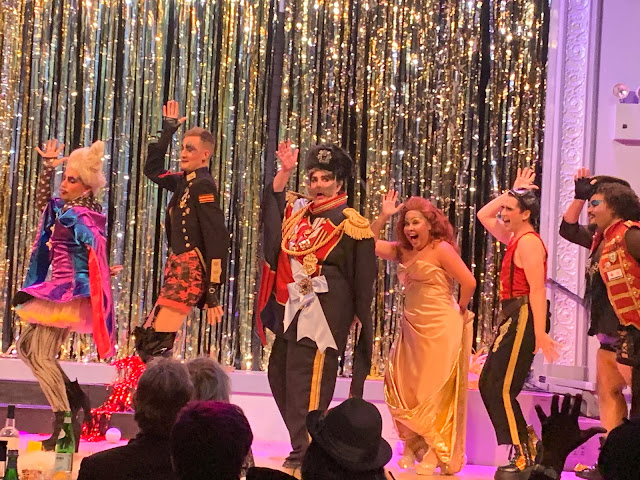
Heartbeat Opera Gala Drag Show--"The Golden Cock"

Our beloved Heartbeat Opera has been undergoing major changes for the past couple years.  We are excited about an upcoming Eugene Onegin; they can be expected to put a most original stamp on it, as they usually do. We will withhold judgment until we see/hear it.  But there is never any doubt in our mind about the joyful entertainment provided at their annual drag show.

What we love about them comprises the wildness and originality of the costumes, the imaginative script, the bawdy gay humor, the clever play on words, the excellence of the musical values, and the sneaky topicality.

With Russian operas and Russian singers being cancelled (both literally and figuratively), how completely outrageous it was to do a send up of Rimsky-Korsakov's final opera The Golden Cockerel, composed in 1907 but not performed until after his death. It is rarely produced but six years ago we had the pleasure of seeing it twice! It is the story of an autocratic king who invades an innocent country (!) and gets advice from a bird.  The music is just as glorious as one might expect and the not-so-hidden message was as true today as it was in the early part of the 20th c. and six years ago.

The story was, of course, fractured and splintered to provide opportunities for typical Heartbeat hijinx and double entendres. Rimsky-Korsakov's music received lots of stage time but so did several other Russian composers. Our companion joined me in identifying most of them including Rachmaninoff's "vocalise" and Tatiana's waltz from Eugene Onegin. We also heard some Rossini for good measure.

Musical values are always excellent with Heartbeat Opera. The chamber orchestra comprised Co-Musical Directors Jacob Ashworth (violin) and Daniel Schlosberg (piano) with Angela Shankar playing clarinet and saxophone and Deanne Cirielli enchanting us with her harp. It was impressive that four musicians could create such a full sound, but with Mr. Schlosberg doing the arrangements, we would expect no less.

The singing was exceptional as well with bass John Taylor Ward towering over everyone else. Tenor Elliot Paige is another "regular" that we always look forward to seeing and hearing.  Countertenor Daniel Moody made a fine showing as well. The female voices had less stage time but were also excellent--soprano Ariana Wehr and contralto Sara Couden. Special guest artist John Holiday provided a rare treat as well with his inimitable countertenor

The show was created by  Mr. Ashworth and Nico Krell who also directed. The extravagant costumes were designed by David Quinn. The Master of Ceremonies was Maxim Ibadov. One thing about the annual drag show that impresses us is how well everyone works together; the ensemble feel is unmistakeable. Everyone seems to be having fun and this mood is infectious. The audience was filled with smiling faces.  Yours could be among them if you read this in time.  There will be two shows at Roulette tonight, Friday November 10th. It is well worth a trip to Brooklyn. In these troubled times, there is nothing like gay humor to lift one's spirits!

© meche kroop


Friday, April 27, 2018

HOLIDAY IN THE CRYPT

Countertenor John Holiday


This will be the fifth time we reviewed countertenor John Holiday and his artistry just keeps on growing. The very first time we heard him was over five years ago at Lachlan Glen's year-long survey of Franz Schubert's 600+ songs. We noted the sweetness of his voice. Later that year we had a lot more to say about his performance in the title role of Handel's Radamisto, noting his artistry in the legato lines and his fireworks in the fioritura.

In 2015 we swooned over his rather good natured Cesare in Vivaldi's Catone in Utica, presented by Opera Lafayette. And in 2016, we loved his performance in Huang Ro's Paradise Interrupted, as part of the Lincoln Center Festival.

Last night we heard new aspects of his artistry in an all-too-short (but nonetheless satisfying) recital in the Crypt of the Church of the Intercession, a bit spooky in atmosphere but with incredible acoustics. The recital was part of the sold-out Unison Media series, curated by Andrew Ousley who has managed to come up with several unusual recitals.  Keep reading, dear reader, and we will tell you what he has up his musical sleeve for the summer and fall.

But first look at what Mr. Holiday had up his sleeve! He baited his hook with some delicious Italian and French favorites so that by the time he got to music that was somewhat outside our sphere of devotion, we were hooked and it was too late to protest that it wasn't "our kind of music".  Obviously, everything Mr. Holiday performed was dear to his heart; the communication from his heart to those of the audience members was so effective that people spontaneously burst into applause after every single song.

He began with "Frondi tenere e belle...Ombra mai fu" from Handel's Serse. We've heard so many singers try to do justice to this gorgeous paean to nature but Mr. Holiday simply nailed it.  His high pitched instrument is never effete but full and rich. We speculate that the famous castrati back in the day were so widely praised because they sounded like this. Thankfully, Mr. Holiday's sacrifices for his art did not extend that far!

There followed a series of songs in French, from the wistful "Romance" of Claude Debussy, to the ennui of Poulenc's "Hôtel", and three familiar songs of Reynaldo Hahn--"Si mes vers avaient des ailes", "Offrande", and "À Chloris". We loved the way Mr. Holiday can spin out a pianissimo like a silken thread, even at the top of his register. The overtones bounced around the room like pingpong balls.

When an artist is this good we are willing to follow him anywhere and we were surprised at how much we enjoyed Margaret Bonds' mid 20th c. setting of Langston Hughes' text. The phrases are short and the composer matched melody to text better than any other composer we have heard who set Hughes' text. "Minstrel Man", "Dream Variations", and the forceful "I, too am American" affected us deeply.

Theodore Morrison was commissioned by countertenor David Daniels to write a song cycle and we felt privileged to hear his setting of text by James Joyce. The music was blissfully accessible without a whiff of "the academy" to make our eyes roll. Our favorite was the final song "I hear an army charging upon the land" in which Mr. Holiday gave us some very powerful singing and some delicious melismatic singing. We believe that this is the same Theodore Morrison who composed the opera Oscar which we heard in Santa Fe a few years ago.

We also heard Hall Johnson's arrangement of the spiritual "I'm Gonter Tell God All O' My Troubles" in which Mr. Holiday bent the tone as if it were putty in his hands.

Pianist Kevin J. Miller did a fine job as Mr. Holiday's partner for the aforementioned  part of the program; for the remaining part, Mr. Neeki Bey took over and seemed to be an expert at jazz improvisation.

At this point, the piano scores disappeared from the piano and a snazzy fedora appeared on Mr. Holiday's head. Although jazz is not our thing, we found much to enjoy except for the first piece--a jazz arrangement of "Summertime" from Gershwin's Porgy and Bess. That opera is sacred to us and we didn't want it messed with!

The following standards were all enjoyable with the bluesy "Round Midnight" being our hands down favorite. There was a time when we did like jazz, before we fell in love with opera, and we are quite sure that we listened to recordings of this song by Sarah Vaughn and perhaps also by Ella Fitzgerald. What a surprise to learn that Thelonious Monk wrote it when he was 18.

We admired Mr. Holiday's word painting in Karl Suessdorf's "Moonlight in Vermont" and tapped our toe to Fats Waller's jaunty "Ain't Misbehavin". Mr. Bey had a piano solo in this and in the following lively Nat King Cole song "Straighten Up and Fly Right" which way played in a medley with "My Funny Valentine", sung at a slow tempo with a swoop up to the highest register.

There was more to come by way of encores. Mr. Bey abdicated the piano and Mr. Holiday sat down and let loose with "Amazing Grace" and "This Little Light of Mine". We are sure everyone in the audience left feeling lighter than when they arrived. Standing ovations do give us that impression!

We promised to tell you what Mr. Ousley and Unison Media have in store. Perhaps motivated by the success of The Crypt Sessions, they are planning a series in the catacombs of Greenwood Cemetery! The first entry will be in June and the series is already half sold out! So be a chooser, not a loser and stake your claim now.  See www.deathofclassical.com (really!) for details.

(c) meche kroop


Thursday, July 14, 2016

PARADISE INTERRUPTED

Qian Yin in Paradise Interrupted (photo by Stephanie Berger)

Last night was the opening of the Lincoln Center Festival and we were filled with anticipation for Paradise Interrupted, playing at the Gerald W. Lynch Theater at John Jay College, a comfortable venue for productions of this kind.  Like all summer art festivals, risks are taken, rules are broken, and much debate ensues.

One's appreciation for this "art installation opera" largely depends upon how one approaches the work. The booklet that we received will occupy us for some time to come if we wish to learn more about the kunqu style of Chinese opera and the interesting instruments (dizi, sheng, and pipa) that were included in the 14-piece orchestra. The words of the director (and visual designer) Jennifer Wen Ma offer an almost exegesis-like description of her concept--the melding of Eve's expulsion from the Garden of Eden and a dream of Du Liniang of The Peony Pavilion, which we unfortunately have never seen.

But we have seen and enjoyed Chinese opera of every variety from the most rustic works of the provinces to the refined Beijing Opera. We have discussed with some of our Chinese singer friends how they incorporate the various tones of Mandarin into the melody of the Chinese songs they have sung on their programs. We were informed that the tones of each word are more or less ignored in deference to the overall melody.

In the case of Huang Ruo's composition of Paradise Interrupted, such was not the case and Mr. Ruo (composer of Dr. Sun Yat Sen, which we so enjoyed at the Santa Fe Opera) put a great deal of effort into composing the vocal line to respect the tones of the words. The artistry of Qian Yi gave the same respect in her execution of the vocal line.

In our opinion, a work of art needs to stand alone and to be appreciated for what it is, not for what the director tells us it is.  If there is a story, or a moral, we want to find it for ourselves. Each of us brings something to a work of art and it will resonate with us in a unique way. We personally don't want to be thinking about the underlying machinery.

On this basis, our appreciation of this work was guided by our senses and private associations. The work seemed to be about the search for something lost--a lover perhaps. Toward the end, the heroine finds love in what seems to be a geometric flower but is held captive and must escape. Is love a trap? What seems to be a rain of ashes becomes a pool of ink.  Could this be the ink a woman needs to write or paint her own destiny?

We enjoyed the performance of Qian Yi to the maximum possible extent. Her lovely voice brought out every nuance of Mr. Ruo's music and her movement, while not quite what we Westerners think of as dance, had all the grace of ballet. Her arms, as flexible as a swan's neck, spoke volumes and the delicacy of her hands expressed an entire range of emotion. Her tiny shuffling steps across the stage made her appear to be floating an inch off the ground. Gwen Welliver is credited as choreographer.

There were four male voices acting as elements of nature and when they joined in harmony toward the end, it was a very special moment. Counter-tenor John Holiday is known to us and greatly admired; he got a huge hand during the curtain call. Tenor Yi Li, baritone Joo Won Kang, and bass-baritone Ao Li were similarly excellent.

Mr. Ruo's music delighted us with its strange harmonies and textures; it was at times thoughtful, at other times vivid, at other times playful.  It was never ugly as so much contemporary music is. Maestro Wen-Pin Chien guided the  Ensemble Fire into a harmonious union of East and West.

The libretto, by Ji Chao, Jennifer Wen Ma, Huang Ruo, and Qian Yi had little to add. Perhaps the Chinese poetry lost something in translation but we enjoyed just listening and looking.

The stark set by Matthew J.Hilyard was entirely black and white--quite a departure from the vibrant colors of traditional Chinese opera. There was a bare tree that eventually bore fruit. There was a "garden" constructed of intricately cut and folded paper. 

Video projections of moving lights (meant to be fireflies) were shown in the background during one of the more interesting segments. They seemed to respond to Ms. Yi's voice. Austin Switser is credited as Video Designer with Guillermo Acevedo responsible for the Interactive Video Design.

The costuming by Melissa Kirgan and Xing-Zhen Chung-Hilyard was perfect in every respect.  Ms. Yi wore a loose white shift with a long white scarf substituting for the traditional water sleeves. The four men were in traditional garb in shades of grey making them look almost like statues of stone when they were not moving.

Toward the end, the set was illuminated with colored light and we realized how thirsty were our eyes for some color! Lighting design by Lihe Xiao was adapted by Andrew Cissna. 

The work premiered last summer at the Spoleto Festival USA in Charleston.  The brief 80 min. production will be repeated Friday and Saturday night.

Although we failed to grasp Ms. Ma's "concept" we were content to appreciate the work on its aural and visual terms.

(c) meche kroop


Wednesday, December 2, 2015

CATONE vs CESARE

Julia Dawson and John Holiday as Emilia and Caesar in Vivaldi's Catone in Utica (photo by Louis Forget)


Opera librettists often play fast and loose with history and Pietro Metastsio's libretto for Antonio Vivaldi's Catone in Utica is no exception.  Do we care?  Truthfully, not very much. But we did very much enjoy Maestro Ryan Brown's introductory lecture which enhanced our experience last night of Opera Lafayette's production at the perfectly suitable theater of John Jay College.

This seems to be our week for a side of education with our feast of entertainment. We learned that Metastasio, a highly celebrated Roman educated in the law, wrote two versions of the story--the first set by Leonardo Vinci which was a failure.  Romans of the early 18th c. were unhappy with his violation of the convention against showing death onstage. (Imagine all the wonderful Italian operas written in the 19th c. and how they would play out without the death scene!  Perish forbid!) Therefore, Cato's grisly self disembowelment could not be shown.

His second version (set by Vivaldi and several other composers) left the ending ambiguous or had Cato commit suicide offstage.  We did not see the version performed at Glimmerglass but last night's performance appeared to have an almost happy ending with Cato walking offstage--which ended the otherwise thrilling evening in a not quite satisfying manner.

It is always a special event when Opera Lafayette visits from our nation's capitol, usually bringing a delectable and overlooked French opera. This time they brought a largely forgotten Italian Baroque opera composed toward the end of Vivaldi's life. Of this prolific composer's oeuvre, barely twenty opera scores survived. In point of fact, the music for Act I was lost but the clever director Tazewell Thompson utilized the overture (borrowed from another Vivaldi opera) to introduce the characters onstage with some illustrative comments on the surtitle screen--a most successful ploy to replace a perhaps boring exposition.

The story concerns the intransigent and uncompromising Cato in opposition to the conquering Caesar who was here depicted, not as a tyrranical dictator, but as a swell fella, cheerful and ready to compromise. Metastasio invented a love story between Caesar and Cato's daughter which causes the rigid and unlikable Cato to disown his daughter in a most ugly fashion. Se non è vero, è ben trovato!

As to the music, Opera Lafayette achieved a stunning success, thanks to apt casting and the truly excellent Opera Lafayette Orchestra, the string section of which was called upon to limn the action with painterly color; Vivaldi himself was a gifted violinist.  Significant contributions came from the oboe which sang of nature,  the trumpets which blared of battle, and the valveless horns which referenced the wounded lion. The superb continuo, comprising Andrew Appel at the harpsichord, Loretta O'Sullivan on the cello, and Michael Leopold on the guitar and theorbo, supported the unusually expressive recitativi.

The singers all had superb voices and acting skills, making the far-fetched completely believable. We are very fond of the countertenor fach and it was quite a treat to hear two of them side by side and to hear the subtle differences.

The role of Cesare was performed by John Holiday whose tone is larger than most. His vocal colors varied widely from his legato love aria toward Cato's daughter Marzia to his whooping upward glissandi while threatening battle. Mr. Holiday is truly a stage animal.

In the smaller role of Fulvio, Caesar's lieutenant, Eric Jurenas exhibited a lighter sound that was pleasant to the ear.

There were three mezzo-sopranos in the cast.  Julia Dawson, well remembered from her major George London award last winter, put heart and soul into her portrayal of Emilia, the widow of Pompey, who is seeking revenge against Caesar. We have written about the many shades of sadness in Schubert's song cycles; here, Ms. Dawson created the many shades of anger. Her voice, like Mr. Holiday's, is a force of nature and she acts in such a visceral manner, using her entire body, that we were actually feeling it. Her handling of the fioritura was nothing short of dazzling.

Anna Reinhold's Marzia was a different kind of performance. Vivaldi did not give this character much to sing in the way of memorable arias but she was incredibly musical in the recitativi. Her voice is on the slender side and was overwhelmed by the orchestra when she was in the middle and lower part of her range. At the upper register she came through perfectly.

Marguerite Krull performed the pants role of the prince Arbace, an ally of Cato's, who was promised Marzia's hand. It was painful to watch her reject his advances, even as she occasionally seemed to lead him on. But, Marzia is in love with Caesar and will defy her father and the entire world to have him.

As the eponymous Cato, tenor Thomas Michael Allen gave an excellent portrayal of the stubborn holdout against Caesar, but the deck is stacked against him. Without substantial arias to show off, he was obliged to use the recitativi to convey both his higher quality of idealism and his negative quality of stubbornness.  His unsympathetic character was difficult to relate to but that seems to us to be the mark of a fine performance.

Costume Consultant Sara Jean Tosetti dressed all the characters in modern attire and the nearly bare stage (a simple metal throne for Cato and a few upturned sarcophagi) was sensitively lit by Lighting Designer Amith Chandrashaker--a simple wash of color on the back wall, corresponding to the mood of the scene.

Opera Lafayette will return in February with Emmanuel Chabrier's Une Education Manquée. We are filled with anticipation for another major success.

(c) meche kroop

Thursday, November 21, 2013

RADAMISTO AT JUILLIARD

John Holiday and Virginie Verrez (photo by Nan Melville)
Radamisto was the first opera composed by G. F. Handel for the Royal Academy of Music.  It was a great success in 1720 and was rewritten substantially to accommodate a different cast.  Then it lay dormant for two centuries.  No doubt it is being revived in present days due to the availability of so many superb countertenors.  (We would not be surprised if someone told us that The Department of Vocal Arts at Juilliard chose this opera as a vehicle for the brilliant countertenor John Holliday--but no one did.)  The vocal fireworks were evident from the start but it was Mr. Holiday's rapid fire fioritura that stole the show--and there was a lot of show to steal.  We will not neglect to mention how moving his singing was in the slow passages.  What a thrill to hear a young singer in a starring role, so gifted at presto and adagio both.

Radamisto is kind and good and devoted to his wife Zenobia, a role sung with grace and total commitment by the glamorous Virginie Verrez.  Offering a huge contrast to their devotion is the tyrannical Tiridate, King of Armenia, and his unhappy neglected wife Polissena.  Bass-baritone Aubrey Allicock made a splendid villain and utilized his large round sound to great advantage.  Polissena was stunningly portrayed by soprano Mary Feminear who was able to convince us that she so loved her cheating husband that she would stand by his side even when he was ready to kill her brother Radamisto and their father Farasmane, well-sung by bass Elliott Carlton Hines.

Tiridate's two commanders were likewise brilliantly sung by two superb sopranos in pants roles--Pureum Jo impressed with her magnificent coloratura and Elizabeth Sutphen with her sublime phrasing.  It would be fair to say that the casting and performance were perfect--and how often can one say that?

Handel's music was performed by Juilliard415, the school's principal period-instrument ensemble.  Conducted expressively by Julian Wachner with Patrick Jones at the harpsichord, the sound was magnificently enveloping.  The instruments would have appeared unfamiliar to those unexposed to baroque music, especially the winds.  We were tempted to spend more time watching Kevin Payne playing the exotic theorbo but we couldn't take our eyes and ears off the singers.

The story is loosely based on history and nothing much happens; the libretto is attributed to Nicola Francesco Haym.  It's mostly a case of off-again on-again murder because Tiridate would do anything to acquire Zenobia and threats are made and withdrawn many times.  Thinking of the piece as a character study is more useful, but even then Tiridate's last minute relenting seems psychologically invalid.  The absence of action was quite a challenge for Director James Darrah to deal with and we drew the same conclusion when we saw the opera in Santa Fe in 2008:  it's all about the singing.  Some of the invented movement was puzzling but the alternative would be to have the singers just stand there and sing.  There were several arias that we'd love to hear as "stand-alones"; chief among them were "Cara sposa" and "Ombra cara".  We do love love songs!

Sets and lighting were attributed to Emily Anne MacDonald and Cameron Jaye Mock.  Although the set was minimal--a few chairs against a wall--the lighting was effective.  When Zenobia throws herself into the river, blue ripples washed over the stage.  When splendor was called for the dominant lighting was golden.  Visual interest depended upon Costume Designer Sara Jean Tosetti's glamorous gowns and regal costumes for the men.  We are replete with ear and eye candy.

© meche kroop


Monday, January 28, 2013

MORE SCHUBERT, MORE GOETHE

Goethe
Schubert
Not everything in last night's recital was Schubert's settings of Goethe's poetry but it would be fair to say that the best of the program was just that.  Soprano Devon Guthrie opened the program with a trio of such marvels; our favorite was "Der Schatzgräber" in which the poet learns how to have a good life: "Work by day!  Guests by evening!  Hard weeks!  Merry feasts!"  This sounds like good advice to us! 

The supremely talented Ms. Guthrie was joined by bass-baritone Tyler Simpson for the scene from Goethe's Faust in which an evil spirit does everything in his power to intimidate poor Gretchen; Mr Simpson's large sound was produced in an admirably effortless manner.  He demonstrated comfort in his higher register in a subsequent song.

Soprano Mary Feminear used her agile voice and charming manner to good advantage in "Wer kauft Liebesgötter" and "Der Fischer", two lied we hope to hear again at some point.  The long strophic tale of "Der Gott und die Bajadere" also made a fine impression, reminding us of what a fine storyteller Goethe is.   Baritone Benjamin Bloomfield gave a powerful reading of "An Schwager Kronos" and shone as the defiant "Prometheus"; he is also capable of harnessing this power for some beautiful pianissimo singing. We further enjoyed the sweet countertenor of John Holiday who sang "Geistes-Gruss", "Trost in Tränen", and Meeresstille".

As usual the pianism of Artistic Directors Lachlan Glen and Jonathan Ware was exemplary.  We particularly enjoyed Mr. Ware in "Lied der Anne Lyle" and Mr. Glen's "Ganymed" in which we distinctly heard the nightingale call.

Again, we commend these artists for their total commitment to bringing over 600 Schubert lieder to life.  More to come!

(c) meche kroop