MISSION

We are here to encourage the development of gifted young singers and to stimulate the growth of New York City's invaluable chamber opera companies. But we will not neglect the Metropolitan Opera either. Get ready for bouquets and brickbats.
Showing posts with label Manhattan School of Music Graduate Opera Theater. Show all posts

Sunday, November 23, 2025

TOYS ARE US


 Anthony Blatter, Shengyang Lin, Carter Bonyeop Gu, Maestro Michael Sakir, Grace Christensen, and Miryoung Song

We just saw a colorful and original performance of Donizetti's charming comedy L'elisir d'amore at Manhattan School of Music, performed by an impressive young cast possessed of fine voices and convincing dramatic ability. The "concept" of Director Katherine M. Carter was surely original and added a quantity of eye candy that at times seemed excessive and distracting. We are familiar with her work and have found it superb at times and puzzling at other times.

Her concept was to set the opera in a child's toy box, a child who seemed to have an excess of toys. This, of course, served to get a lot of students onstage which we do understand and applaud, and it provided an excellent opportunity for Costume Designer Caitlin Cisek and for Loryn Pretorius who designed the clever wigs, hairstyles and makeup.

We are decades past childhood but it seems like centuries. We imagine that children talks to their toys and invent dramatic situations and dialogues for them to participate in and we further imagine (although we have never participated in child psychotherapy) that children work through their problems in such play. So presumably a child might work through problems of jealousy, rejection, and acceptance in romantic love.

Felice Romani's delightful libretto concerns the most important young woman in a village, one who has the benefit of literacy, and her initial rejection of a young man who worships her. A situation is devised in which he manages to win her love when he becomes more romantically desirable and she becomes jealous. This situation seems to us to transcend location and epoch.  The humor of the story comes from the fact that the gullible villagers are cozened by a traveling salesman pretending to be a doctor who peddles a love serum which is actually wine. Who of us has not been "taken in" by influencers online who promise unrealistic remedies?

The young man Nemorino has been recast as a Raggedy Andy doll and tenor Carter Bonyeop Gu used his vocal and dramatic skills to bring the character to vivid life, inviting our understanding of shy but sincere young men who are missing nothing but confidence. For the opera to work the singer must win our affection and our wish for him to succeed. At this, Mr. Gu succeeded admirably. His "Quanto è bella, quanto è cara" told us everything we needed to know about him.

The object of his affection is Adina, here portrayed as a ballerina, played by the adorable soprano Grace Christensen  whose fine flexible instrument was matched by a charming presence. The audience must want to see her feelings transform from indifference to respect. By the end of the opera, her "Prendi, per me sei libero" convinced us of her emotional growth.

The humor comes from the fact that Nemorino believes that Dr. Dulcamara's "love potion" is responsible for his sudden success with women when it is actually the fact that his wealthy uncle has died and he has inherited a fortune. Adina must confront the fact that she might lose him to the crowd of worshipping women.

Of course, there must be a romantic rival and this place is occupied by a military man passing through town. Sergeant Belcore is here played by the fine young baritone Shengyang Lin, costumed as a G.I. Joe doll who preens and struts. his "Come Paride vezzoso" demonstrated his vocal prowess as well as acting chops.

The affable but exploitative Dr. Dulcamara came in his own toy box and was given a fine humorous performance by Anthony Blatter who shone in his duet with Adina "Io son ricco e tu sei bella" in the wedding scene of Act II.

The big aria that we were all waiting for, "Una furtive lagrima", left us a bit disappointed. All through the opera, Mr. Gu's vocalism was beyond admirable and his gestures were entirely on point. However, this final aria was marred a bit by some stock gestures that seemed generic and misplaced according to the text and the vocalism was not as admirable as it was during the rest of the opera. This left us wondering whether he was vocally fatigued or perhaps trying to imitate some famous tenor or maybe he was suffering from a nervous awareness of the importance of the capstone aria.

Miryoung Song gave a fine performance as Gianetta when she tells the villagers about Nemorino's inheritance.

Maestro Michael Sakir's conducting emphasized the lighthearted nature of this opera buffa and the performance elicited from the MSM orchestra members was nothing short of wonderful.   James Rotondo's set design was apropos to the story. We particularly liked the figure of Dr. Dulcamara emerging from a toy box.

In terms of the direction, we felt the cleverness exceeded desirable limits. When there is much cavorting onstage that detracts from the singing we feel unhappy. This is opera not film, and we want to focus on the voices. The concept was not a poor one but the execution was excessive. We have written about Ms. Carter's direction on a few prior occasions and have admired her imagination and also deplored liberties of time and place that seemed irrationally taken.

We found the costuming of Caitlin Cisek to be colorful and varied and the hairstylings, wigs, and makeup of Loryn Pretorius to be outstanding.

In conclusion, we found our evening with Manhattan School of Music Graduate Opera Theatre to be well spent.

© meche kroop

Saturday, November 23, 2024

WHEREFORE ART THOU?


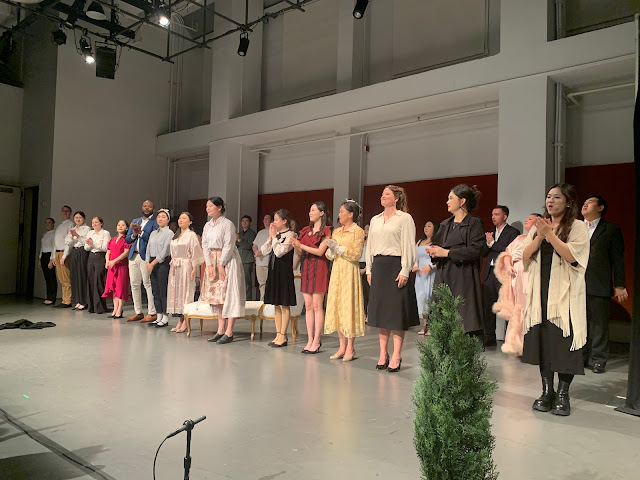
 Curtain call at Manhattan School of Music's Romeo et Juliette

Love stories are timeless, as is said; and so are antagonistic families. Nonetheless, Gounod's beloved opera Roméo et Juliette seems to us to be very specific to Renaissance Italy or what, in Gounod's time, would become the nation of Italy. (At the time in which Shakespeare set his play, upon which Jules Barbier and Michel Carré based their libretto, Verona was a city-state ruled by the Scaligero family, for which the famed opera house La Scala was named.)  

The peculiar staging of the opera at Manhattan School of Music appeared to be an ante-bellum ball in the American South and seemed to be a bad directorial decision.  Fortunately, nothing was altered musically or text wise, leaving us free to ignore the costumes and focus on some truly superb voices.

In terms of capturing the emotion of the story, we have been most deeply affected by Kenneth MacMillan's ballet for American Ballet Theater which utilizes a highly dramatic score by Sergei Prokofiev. We have seen 40-year-old ballerinas convince us that they were 14 years old and still playing with dolls. Not so effective were the play and prior opera productions we have attended. It is believed that only mature actors can fulfill the two starring roles and only mature opera singers can fulfill the vocal requirement.

For that reason, we were thrilled to see comely young graduate students (from Manhattan School of Music) with finely tuned voices bring the opera to convincing life before our very eyes. 

For example, Sofia Gotch sang the role of Juliette with brightness and clarity, exhibiting excellent French diction. In her Act I aria "Je veux vivre" she showed us a spunky young woman, full of life and ready for adventure, making her ultimate demise even more tragic. Gounod made many demands on the soprano portraying Juliette, and she definitely rose to the occasion. She also showed herself to be a fine scene partner in her tender duets with Romeo scattered throughout the opera, each one outdoing the prior one

Her Roméo was sung by tenor Wonjin Choi, whose fine instrument revealed itself immediately in  "Ange adorable" and even more in "Ah! Lêve-toi Soleil!". His infatuation started strong and only got stronger. The performances of the leads were stellar, leaving absolutely nothing for us to criticize.

Other roles were similarly well cast and well performed. Two mezzo-sopranos made a fine impression. Xiaowei Fang seemed to relish her part as Gertrude, fussing over Juliette, and filling out a couple of lovely quartets, which, we might add, were well balanced. As the page Stephano, Yiqian Heng made a strong impression with "Que fais-tu, blanche tourterelle?", taunting the Capulet family with a provocative aria, likening Juliet to a dove in a flock of vultures.

Benjamin R. Sokol made a fine Frère Laurent, portraying the friendly friar with an admirable combination of gravity and levity. Blake Stevenson admirably fulfilled the role of the pugnacious Mercutio and impressed us with his dueling skills--as did Fernando Silva-Gorbea as the unpleasant and menacing Tybalt. Props to Fight Director Chris Dumont.

Donghoon Kang made Capulet a gracious host but a demanding father. Making a brief appearance as Le Duke was Daniel Navarrete-Estassi, appearing quite authoritative as he commutes Roméo's death sentence to banishment. The unfortunate suitor Paris was enacted by Graham Rui Guan. Grégorio was portrayed by Juan Angel Johnston-Chavez and Justin Hong took the role of Benvolio.

Just as excellent as the singing was the orchestra conducted by Maestro Pierre Vallett. The simple set by James Rotondo was dark and simple with lots of doors and windows serving multiple purposes. Evocative lighting was by Marika Kent. Stephanie Sutherland's choreography gave the large and effective chorus plenty to do and provided dances appropriate to the weird 19th century. setting. 

And this brings us back to the peculiar direction by Katherine M. Carter.  As is our habit, we looked for the Director's Notes after the performance, hoping to learn some justification for moving this Renaissance story to, judging by the costumes, the early 19th century. We had to keep trying to block Gone with the Wind from our mind to focus on the singing.

We also wondered why, with a perfectly good upper level, the balcony scene was staged at ground level. Another nitpicky observation was that during the several emotionally intense duets, Roméo and Juliette were positioned so that they did not appear to be facing each other. This is generally accomplished by placing them at a 90 degree angle to one another, thus creating the illusion of actually facing each other.  

And while we are nitpicking, Juliette's face should not be smiling when she is told she is being married off.  Her face changed to misery when Paris' name was mentioned. But clearly she should be expressing misery at the idea of being married to anyone. The way it was played made it seem as if she had something personal against Paris. One of the features of sitting on the front row is being aware of small details like that.

Nitpicking aside, we commend the entire cast, and especially the members of the chorus, for creating an absorbing performance that was dramatically and musically compelling.

© meche kroop


Friday, April 26, 2024

LA RONDINE at MSM


 Curtain Call for La Rondine at Manhattan School of Music

Puccini's 1917 opera La Rondine is about falling in love in a moment; we fell in love with the work a couple minutes after Maestro Marcello Cormio raised his baton. There is no doubt that Mo. Cormio was completely in touch with Puccini's lavish melodies as well as the master's use of dance rhythms. As a matter of fact he appeared to be dancing on the podium and his obvious enthusiasm for the work was communicated to the student orchestra which responded in a manner that a professional orchestra might envy.

Puccini appears to have rewritten many of his operas; we believe we have seen several versions of his Madama Butterfly and we are rather opinionated about our favorite. That he also wrote three versions of La Rondine was unknown to us until we did some reading.  Director Katherine M. Carter wisely chose the first version in which our heroine Magda has agency. A century later, we are in a position to admire a woman who weighs her options, thinks about the future with a clear eye and makes her own decisions. We will not give away the ending here because we hope you will go and see for yourself, since there are several more performances this weekend.

It might have been tempting for a self-serving director to have moved the plot to contemporary times but we are very glad that Ms. Carter did not. It just doesn't ring true to tell a story about a "kept woman" who feels like an outcast, not when females college students have no shame about becoming "sex workers".

One could make a case for La Rondine being considered an operetta due to its lively tunes, its use of tropes familiar to us from Johann Strauss Jr.'s Die Fledermaus and its sharing of tunefulness with the operettas of Victor Herbert. However, we make no such distinction between opera and operetta. It is simply gorgeous music lending gravity to a story that resonates with us. Who has not regretted fleeing from a tempting situation in their youth, then hoping to recreate that situation years later. One recognizes that one cannot put one's foot in the same river twice. The river of time flows on and cannot be stopped.

The lovely Magda, so convincingly portrayed by the silver-voiced soprano Seolbin Oh, occupies a grand apartment, presumably paid for by her "patron" Rambaldo (the fine baritone Blake Stevenson who somehow manages to look and act like an older man) who provides her with costly gifts. She has a sassy maid named Lisette (the funny Sanne Vleugels) who thinks nothing of purloining her mistress' clothes for a night on the town. She has charming friends--Yvette (Abigail Williams), Bianca (Hailey Hye-In Ji) and Suzy (Grace Verbic)-- gorgeously costumed by Rodrigo Muñoz--who gossip about the newest trends in romance. Attending her salon is the poet Prunier (the sweet voiced tenor SeongBeom Choi) who gets to sing the opera's most famous aria "Chi il bel sogno di Doretta" which becomes a duet when Magda adds her verse.

A young man arrives (as one does in La Traviata) who is the son of a friend of Rambaldo; the women fuss over Ruggero (tenor Fernando Silva-Gorbea)  and recommend that he spend his first night in Paris at Bullier's. Everyone leaves and Magda, dreaming of a missed opportunity of her youth, decides to go to the same nightclub. Of course, she winds up sitting with Ruggero. Of course they fall in love. Of course Lisette and Prunier show up. Of course Rambaldo also shows up.  And Magda breaks off her relationship with him.

As in Act II of La Traviata, the couple spend an idyllic time in the country and get to sing a beautiful love duet.  However, Ruggero's father does not show up to chastise him. On the other hand, his mother wants to welcome Magda (now calling herself Paulette) to the family and is anticipating a grandchild. And this is where our storytelling ends. You will have to see what happens for yourself.

You will also have to make up your own mind Dear Reader, whether this is a comedy or a tragedy. For us it was neither, rather a bittersweet tale that reminds us that we do not always get what we want and that every event in our lives has its own time and place. Thus, the resonance that makes this work of art meaningful and relatable. We learned (thanks, Wikipedia) that in 1995, one of those self-important directors of Eurotrash created a version in which Magda drowns herself at the end! This version was picked up by the Washington National Opera and the Los Angeles Opera. We are so happy that Manhattan School of Music and Ms. Carter did not burden this beautiful work with a toxic ending. One wants to leave this very human story with a wry smile, not sobbing in grief. We can save our sobs for Butterfly, Violetta, and Mimi.

We would like to give a shout to the many members of the Ensemble who provided such a lively and believable atmosphere to the scene at Bullier's with choreography by Stephanie Sutherland. Chorus Master Jackson McKinnon is to be praised as is set designer Brendan Gonzales Boston who created a glamorous Parisian salon as well as a stunning red nightclub.

© meche kroop

Tuesday, December 12, 2023

THE MAGNIFICENT SEVEN


Victoria Magnusson,  Anna Maria Vacca,  Scott Rubén La Marca, Huiying Chen,  Tamara Teine-'Aulelei Bowden, Alexander Young, and Zhenpeng Zhang

Mozart wrote La Finta Giardiniera when he was 18 years old! That it has survived for 250 years is a testament to its sparkling melodies, tumbling over each other whilst suffering from a case of l'abbondanza. Mozart ha been characterized as "classical", overcoming the excesses of the Baroque period and preceding the lavish embellishments of the Bel Canto period. Watching his youthful excursion into opera, one could be forgiven for debating that assertion.

The youthful voices of The Manhattan School of Music Graduate Opera Theatre did exemplary justice to Mozart's composition. The libretto (variously attributed) is silly but no sillier than many operas of the late 18th c.  The tropes invariably involve mismatched lovers and disguises. 

The kindly servant Roberto, under the assumed name of Nardo (Zhenpeng Zhang) is taken with the devious servant Serpetta (Victoria Magnusson) who is in love with her befuddled boss the Podesta (mayor) played by Alexander Young. He, in turn, is in love with the unhappy gardener Sandrine (Huiying Chen)  who has entered his employ to escape from her former existence as The Marchioness Onesti. She is still in love with the fickle Count Belfiore (Scott Rubén La Marca) who stabbed her in a fit of jealous rage. The Count arrives at the home of The Podesta to marry the latter's demanding niece Arminda (Samara Teine-'Aulelei Bowden) who is rejecting her former lover, the loyal Cavalier Ramiro (Anna Maria Vacca in travesti).  

Got all that? If you have a few moments to spare, you might enjoy reading our humorous take on these romantic entanglements in a review from several years ago.  Here's the link. http://www.vocedimeche.reviews/2015/08/crazy-in-love.html
Actually, we saw this charming work thrice in the space of two years and always enjoyed it.

Every member of the cast was outstanding both vocally and dramatically. If we were not otherwise engaged we would return to see it tomorrow with a different but equally excellent cast and again  on Wednesday with the same cast! We had a smile on our face for two hours and are smiling again, recalling the joyful performance. We reckon that the cast enjoyed themselves equally.

The work was directed by Jennifer Williams who made the complicated relationships quite clear but did not have a solution for the weird scene in the forest which Eric Einhoirn wisely omitted in the On Site Opera production we also reviewed. In her defense, neither the Santa Fe Opera production nor The Juilliard Opera Center production made sense of it either.

But it mattered little in the overall scheme of things because by whatever deus ex machina, all the couples get sorted out by the end. Reading the program notes on the way home confirmed our opinion that the so-called "Director's Notes" should be left out of the program.  Either a work speaks for itself or it doesn't. As a matter of fact, it speaks to each of us differentially, dependent upon what we bring to it. Given a certain orientation one might even put a social class interpretation upon it, as we might on Mozart's Nozze di Figaro. We might see it as an expression of poor romantic judgment, or of forgiveness, or of emotional growth, or of acceptance of fate. Whatever!

We find mating behavior fascinating--pursuit, rejection, betrayal, reconciliation--far more than stories about terrorism, politics, and inventions. We wish more contemporary composers would write about romance. Don't we all love to see our foibles onstage?

The work was conducted with liveliness and precision by Maestro Djordje Nesic, who also served as Vocal Coach. The responsive chamber orchestra of strings was augmented by a keyboard, played by Eric Sedgwick, leading us to mistakenly hear some sounds of wind instruments.

The set by Matthew Leabo was simple with some large mirrored panels behind which characters could hide and some very apt gardening implements, including a lawn mower, which established the setting. A tray full of psychedelically colored mushrooms may have been an attempt to establish the setting as a "rave" which Ms. Williams intended, as we read after the performance.

The costumes by Asa Benally helped to establish the characters identity. and were mostly white. Sandrine and Nardo wore coveralls, the Podesta wore a natty suit suitable to his station whilst Belfiore's white suit smacked of narcissism. The pants role of Ramiro was less ostentatious. Armida, as befitting her demanding personality, wore riding boots and wielded a riding crop.

We never did figure out Serpetta's manipulation of a device which projected meaningless abstract projections on a side wall.  Oh well, we seem to be seeing projections everywhere these days and find them distracting.

The bottom line is--this is a "must see". You won't regret it!  Let us hope there are still tickets to be had.

© meche kroop

Sunday, October 29, 2023

STUDENTS 10- DIRECTOR 0


 Members of Manhattan School of Music Opera Theater
in Graduate Opera Scenes

We have lost count of the number of operas and opera scenes we have enjoyed at Manhattan School of Music. We have always gone home eager to share with you, our dear readers. What uncomfortable feelings we are having at the moment, reluctant to have anything negative to say. In no way do we have any negative criticism of the lovely young singers we heard Friday night. The negative feelings come from an egregiously directed program--feelings so strong that we will spare the director the embarrassment of being named. 

This was one of those loathsome "concepts" designed to show off the so-called originality of the director, rather than the gifts of the singers. The "concept" was so murky as to require a lengthy Director's Note to explain and so unwieldy as to leave us baffled. Operas from different periods and different languages were forced into a Procrustean bed with heads and feet chopped off willy-nilly. (And maybe some willys chopped off as well. We laugh that we do not weep.)

What was this Procrustean bed? Everything was meant to take place in the 1950's; why this unattractive decade has been favored by recent directors is beyond us.  Everything was meant to take place in the Waldorf Astoria Hotel. We kid you not. Perhaps the director was stealing from Neil Simon's Broadway play Plaza Suite. We have neither the time nor the inclination to share the director's posturing but we will mention that she claims to have made great use of her experience with "Method acting". Perhaps this was fun for the students but we have seen much more persuasive acting from MSM students under the directorship of Thomas Muraco and Dona Vaughn, among others.

A printed paper tried to justify the scene changes thusly--"In the bridal suite" and "In the alleyway" and "Down in the banquet hall". If one knew the opera and understood what was going on, the setting and the text made even less sense. Some scenes were announced by students and it is here that we saw (heard) room for improvement. Diction and enunciation were sloppy and delivery was rushed; explanations could not be understood. Strangely, a young woman gave a couple of these announcements in Mandarin and, although we are a rank beginner in the language, we caught more words from her than from the English speakers. Singers need to learn how to use their voice differently when speaking.

As to the singing, a few singers caught our attention and by singling them out we apologize for not mentioning others who were equally good.  The problem was that it was difficult to focus on the singing whilst trying to figure out what was happening onstage. 

Ladies first! Sara Nicole Stevens whom we recently reviewed elsewhere, gave a riveting performance in a truly horrible scene from a Missy Mazzoli opera that we would not sit through upon pain of death or imprisonment. It was impossible to comprehend what was going on.

Ziyi Zhang accepted the challenge of "Come scoglio" from Mozart's Cosi fan tutte. This notoriously difficult aria will be something to work on. Verdi's music is considered beyond the grasp of young singers but given the small size of the Ades Performing Space, Brooke Romaine employed a large instrument in Leonora's aria "Tacea la notte...Infida! Qual voce!" from Il Trovatore , although the staging was puzzling, as we had come to expect.

As the Conte di Luna in that scene we liked Yeong Taek Yang's powerful baritone and threatening presence. In an evening marked by disappointing diction, Fernando Watts evinced fine French diction that we could actually understand in Rameau's Castor et Pollux.

In terms of ensemble singing, three female voices (Ziyuan Deng, Young-hae Jeon, and Yining Liu) created lovely harmonies in a trio from Berlioz' Béatrice et Bénedict.

Voccal coaches/Pianists for the evening were Ji Young Lee and Joel Harder. Perhaps it was because we were seated at the end of the row closest to the piano, there were many moments when the singers were drowned out.

Regarding the choice of scenes, we were puzzled.  Young singers profit most by learning roles in the standard repertory.  What good will it do them to learn roles from unknown operas that are unlikely to be produced. Of nine scenes, only two were part of the canon--the aforementioned Verdi and Mozart.

© meche kroop

Sunday, April 30, 2023

FOXY AND FABULOUS


 Vulpine Nuptials at Manhattan School of Music
(photo by Brian Hatton)

We wish to heap accolades upon Manhattan School of Music Graduate Opera Theater's production of Leos Janaček's fairytale opera The Cunning Little Vixen, also known as Vixen Sharp-Ears. It is a perfect example of team effort, involving the participation of Maestro Kirk Severtson who used the fine resources of the MSM Orchestra to illuminate Janaček's painterly score; of Director Dennis Whitehead Darling who told the story in the most engaging fashion; of the large cast of singers who filled our ears with the most thrilling sounds and, under the tutelage of Diction Coach Kathryn LaBouff, obviated the need for subtitles; of Costume Designer Jen Gillette and Wig, Hair, and Makeup Designer Loryn Pretorius who helped all the singers to embody their given characters; and of Scenic Designer Brian Ruggaber who provided the setting for this gem of a production.

We have yet to mention the dancing. Woodland scenes were populated by swarms of beautiful butterflies recruited from the ranks of the Music Theater Department. Choreography by Felicity Stiverson was just about perfect.

It is almost 10 years to the day that we were introduced to this work by Juilliard Opera and it was performed in street clothes and used a non-woodland set with a good translation by Yveta Synek Graff and Robert T. Jones. We were to see it several more times within a couple years, once at MSM Summer Voice Festival in a deficient translation that fought with the music, and once by Dell'Arte Opera in an imaginative production, sung in Czech, which we found most effective in following the accents of the music.

And oh, what music it is! Although it was written a quarter of the way into the 20th century, the utilization of Moravian folk tunes overrode any instances of atonalism. Showing evidence of the excellent teaching by James Morris, Yeong Taek Yang employed his superlative vocalism and convincing acting to create the character of The Forester as an Everyman, longing for the romance he missed when he married, and now perhaps more in love with his dog Lapák (the excellent Alexandra Lovisa Olsson Andersen) and just maybe the fox kit he captures and brings home as a pet.

And this brings us to the completely winning performance of Joo Yeon Kim as Sharp-Ears. She managed to convey a blend of animal instinct and human foibles. She is a proto-feminist, urging the hens to rebel against their pimp (sorry, the rooster) but then reverts to animal instinct by killing the hens. Like a human woman, she flirts with a possible mate--Gold Stripe (finely performed by Seolbin Oh) who wins her by bringing fresh meat.  (Think wooing with a steak dinner in contemporary times!) The pair move into a home seized from  the grumpy Badger in a swipe at capitalism since the Badger ( effectively portrayed by Benjamin R. Sokol) keeps the den all for himself and does not share. Woodland gossip about their cohabitation leads to a shotgun marriage.

There is a great deal of mime which, along with the evocative music, serves to tell the story. The Forester's wife (Zhe Nancy Xiong) scolds her husband for bringing home the fox cub but he persuades her to relent. Who cannot relate to the familial conflict? Their two bratty boys Pepik and Frantik (Madison Marie Fitzpatrick and Grace Verbic) beat and taunt the kit until she lashes out and Mama must console her crybaby son. We can sense The Forester's despair at losing the battle and losing the kit that maybe he has fallen in love with. Who has not grieved when a parent or spouse has made them give up a beloved pet?

When Vixen and Sharp-Ears meet we are no less moved than we are by the meeting of Mimi and Rodolfo in Act I of Puccini's La Bohême. When The Forester sits at the tavern with his two drinking buddies, their conversation could take place today. The sad sack Schoolmaster (Woo Jin Dong) mourns the unavailability of the gypsy girl who prefers another.  Life has passed him by. The pedantic Parson (Mr. Sokol again) will find employment in another town. The men stagger home inebriated (falling down drunk). The tavernkeeper and his wife (William Velasco and Julia Johnstone) seem like any couple running a business together and dealing with rowdy customers who don't like to pay up.

The joyful wedded bliss of Fox and Vixen is ended by the poacher Harašta (Nan Wang) who wants a fox pelt for Terynka, his bride to be. He doesn't consider all the kits in the litter left without maternal care. Our world today has daily reminders of people who kill for spoils or for fun. Is the human world crueler than the animal world?

This wonderful story of love, death, and rebirth was adapted by Janáček from a story which originated as a serial comic strip. He wrote the libretto himself. The work was "reduced" by Jonathan Dove but there was no mention of the translator in our program. Fortunately there were no "Director's Notes" to tell us what to see and feel. The work speaks for itself and allows us to appreciate many issues on our own--the cycle of life, the rituals of courtship, the selfishness of human beings, disappointments, loss, social injustice, the treatment of women, the treatment of animals.  Every moment since the curtain has brought a new insight. As we were writing we just thought that foxes are know for their cunning. Who was more devious, Sharp-Ears or Harašta who puts on an innocent air whilst poaching animals?

In spite of all the sadness and loss, this work is never maudlin; it is a clear-eyed view of reality and also allows us moments of lighthearted humor, as when the Mosquito (Mr. Dong again) uses a hypodermic to draw blood from a human and then squirts it into his mouth. It is to the credit of Mr. Darling that we enjoyed many similar moments of directorial invention. Every character had a personality and every singer did a fine job of acting.

Our mind is filled with images and thoughts about life that can only come from great theater and only when the direction gives us leave to draw connections on our own. This can be thought of as the best operatic experience we have enjoyed.  OR, we wish to call it the best THEATRICAL experience. It has been said that art holds up a mirror to our society and shows us who we are. This production succeeded equally as entertainment and illumination.

© meche kroop