MISSION

We are here to encourage the development of gifted young singers and to stimulate the growth of New York City's invaluable chamber opera companies. But we will not neglect the Metropolitan Opera either. Get ready for bouquets and brickbats.
Showing posts with label Yining Liu. Show all posts

Wednesday, April 23, 2025

ON THE ROPES or KO


Sofia Gotch, Ya Gao, Yining Liu, Irene Hyun Young Shin, and Skyler La Nier

Händel's Rinaldo premiered in 1711 in London. In spite of its being a pastiche of melodies from other operas, it achieved immediate success, then lay dormant for centuries, until Baroque opera became popular once again in the 20th c. Perhaps its popularity rests on the fact that Händel used all his best melodies! 

Loosely based on Tasso's epic poem Gerusalemme Liberata, the work explores the themes of love, war, and redemption and is set during the time of the First Crusade, at the turn of the 12th century. The work provided materials for a number of operas and perhaps the subject is now a touchy one because of the battle between Christianity and the Muslim faith depicted onstage.

In a radical and radically truncated version produced by The Manhattan School of Music Graduate Opera Theater, Director George R. Miller chose to set the work as a presumably televised wrestling match in contemporary times. As is our wont, we never read the Director's Notes until after the opera in order to allow the work to speak for itself. Miller's work didn't speak, it screamed--at least as it opened with loud music (rap?  hiphop?) and an array of spectators at what we thought was a boxing ring, cheering and booing, carrying signs. We were rolling our disbelieving eyes

However, as the performance wore on, we were captivated by the musical values and, ultimately, came to appreciate, or at least to understand, what Mr. Miller was going for. Having eliminated all of the magic of the original to focus on both the battle between good and evil and the battle between the sexes, the playing area, which we thought was meant to be a boxing ring, began to make more sense. Except we began to suspect that it was a wrestling match with "anything goes" and a lot of performative fighting which was nonetheless convincing and wince-inducing.

The wacky costuming by Chloe Levy began to make more sense. The lovely heroine Almirena was played by the even lovelier Sofia Gotch who was dressed all in white with sparkly hair and delivered a "Lascia ch'io pianga" as fine as we've ever heard. Moreover, her acting as she manipulated her captor, the Muslim warrior Argante, was hilarious. At times, she posed like what we took to be a star of reality TV.

Argante was brilliantly portrayed by the burly voiced Skyler La Nier who was convincingly warrior-like in his all black Hell's Angel get up.  The eponymous Rinaldo was beautifully sung by Ya Gao whose "Cara sposa, amante cara" went right to the heart by dint of depth of feeling and varied dynamics.  A delicate body build was not the most convincing as a fighter, in spite of fatigue pants and wife-beater top.

The sorceress Armida was given a strong interpretation by Irene Hyun Young Shin, appearing very "goth" in studded black leather.  Her singing was marked by great facility with ornamentation of the vocal line. We particularly enjoyed her  "Ah! crudel, Il pianto mio" especially in the rapid-fire B section. Her performance as "the bad girl" was replete with snarling and quite effective. 

Duets between lovers were deftly handled with voices well matched and expressive.

As Almirena's father Gioffredo, Yining Liu added to the fine performances, although the costume puzzled us. Was the character supposed to be Rinaldo's trainer? And if so, why was Gioffredo joining the fighting? And wearing a suit with a red baseball cap? Perhaps we are just ignorant of wrestling matches.

There were umpires wearing black and white stripes and a couple sitting at a desk off to the side. Were they television commentators as they have at ice skating competitions? In any event, they provided excellent percussion accompaniment to the superb piano of Jeremy Chan and the equally superb harpsichord of Jocelyn Stewart, the two being Co-Music Directors. To say that the pair produced the colors of an orchestra would not be excessive praise. As a matter of fact, the reduction of the score gave us an opportunity to appreciate it in a new way.

As we left the theater, our thoughts wandered into the territory of the terrors of love, which Mozart had such fun with in Cosi fan tutte. In Rinaldo, the sorceress/biker-chick Armida loves Argante the Saracen/biker but tries to seduce Rinaldo. And Rinaldo's intended Almirena behaves very seductively toward Argante whilst being held prisoner. Jordan Jones in drag as a siren was hilarious in his attempt  to seduce Rinaldo. By the end of the opera we began to appreciate what Mr. Miller was going for--the battle between the sexes. No wonder the young cast and young audience enjoyed it so much!

© meche kroop

Sunday, October 29, 2023

STUDENTS 10- DIRECTOR 0


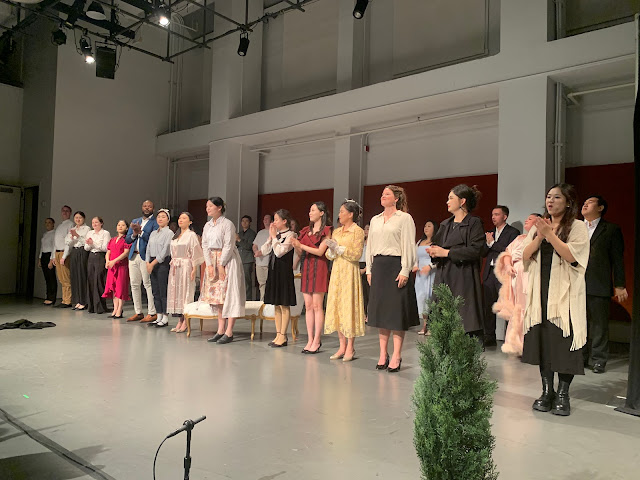
 Members of Manhattan School of Music Opera Theater
in Graduate Opera Scenes

We have lost count of the number of operas and opera scenes we have enjoyed at Manhattan School of Music. We have always gone home eager to share with you, our dear readers. What uncomfortable feelings we are having at the moment, reluctant to have anything negative to say. In no way do we have any negative criticism of the lovely young singers we heard Friday night. The negative feelings come from an egregiously directed program--feelings so strong that we will spare the director the embarrassment of being named. 

This was one of those loathsome "concepts" designed to show off the so-called originality of the director, rather than the gifts of the singers. The "concept" was so murky as to require a lengthy Director's Note to explain and so unwieldy as to leave us baffled. Operas from different periods and different languages were forced into a Procrustean bed with heads and feet chopped off willy-nilly. (And maybe some willys chopped off as well. We laugh that we do not weep.)

What was this Procrustean bed? Everything was meant to take place in the 1950's; why this unattractive decade has been favored by recent directors is beyond us.  Everything was meant to take place in the Waldorf Astoria Hotel. We kid you not. Perhaps the director was stealing from Neil Simon's Broadway play Plaza Suite. We have neither the time nor the inclination to share the director's posturing but we will mention that she claims to have made great use of her experience with "Method acting". Perhaps this was fun for the students but we have seen much more persuasive acting from MSM students under the directorship of Thomas Muraco and Dona Vaughn, among others.

A printed paper tried to justify the scene changes thusly--"In the bridal suite" and "In the alleyway" and "Down in the banquet hall". If one knew the opera and understood what was going on, the setting and the text made even less sense. Some scenes were announced by students and it is here that we saw (heard) room for improvement. Diction and enunciation were sloppy and delivery was rushed; explanations could not be understood. Strangely, a young woman gave a couple of these announcements in Mandarin and, although we are a rank beginner in the language, we caught more words from her than from the English speakers. Singers need to learn how to use their voice differently when speaking.

As to the singing, a few singers caught our attention and by singling them out we apologize for not mentioning others who were equally good.  The problem was that it was difficult to focus on the singing whilst trying to figure out what was happening onstage. 

Ladies first! Sara Nicole Stevens whom we recently reviewed elsewhere, gave a riveting performance in a truly horrible scene from a Missy Mazzoli opera that we would not sit through upon pain of death or imprisonment. It was impossible to comprehend what was going on.

Ziyi Zhang accepted the challenge of "Come scoglio" from Mozart's Cosi fan tutte. This notoriously difficult aria will be something to work on. Verdi's music is considered beyond the grasp of young singers but given the small size of the Ades Performing Space, Brooke Romaine employed a large instrument in Leonora's aria "Tacea la notte...Infida! Qual voce!" from Il Trovatore , although the staging was puzzling, as we had come to expect.

As the Conte di Luna in that scene we liked Yeong Taek Yang's powerful baritone and threatening presence. In an evening marked by disappointing diction, Fernando Watts evinced fine French diction that we could actually understand in Rameau's Castor et Pollux.

In terms of ensemble singing, three female voices (Ziyuan Deng, Young-hae Jeon, and Yining Liu) created lovely harmonies in a trio from Berlioz' Béatrice et Bénedict.

Voccal coaches/Pianists for the evening were Ji Young Lee and Joel Harder. Perhaps it was because we were seated at the end of the row closest to the piano, there were many moments when the singers were drowned out.

Regarding the choice of scenes, we were puzzled.  Young singers profit most by learning roles in the standard repertory.  What good will it do them to learn roles from unknown operas that are unlikely to be produced. Of nine scenes, only two were part of the canon--the aforementioned Verdi and Mozart.

© meche kroop