MISSION

We are here to encourage the development of gifted young singers and to stimulate the growth of New York City's invaluable chamber opera companies. But we will not neglect the Metropolitan Opera either. Get ready for bouquets and brickbats.
Showing posts with label Mestro Jorge Parodi. Show all posts

Monday, March 2, 2026

LAS MALDICIONES


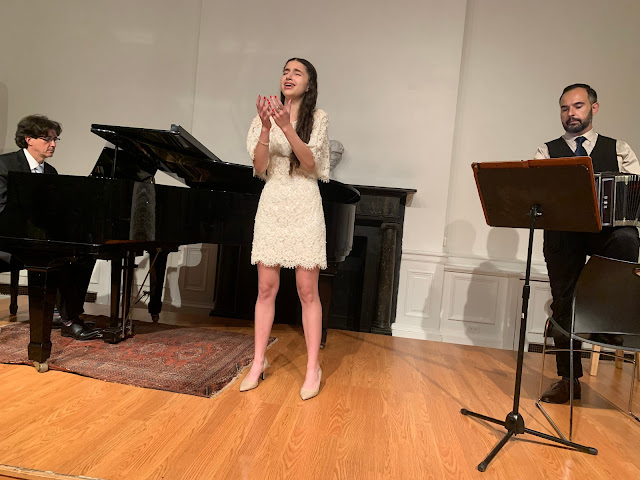
 Soprano Sasha Gutiérrez, Maestro Jorge Parodi, members of the Arya String Quartet, and Rodolfo Zanetti

National Sawdust seemed just the right venue for the premiere of Rodolfo Zanetti's song cycle. The stage is shallow and wide and the seating arrangement permits everyone to have clear visual access to the performers. One would not want to have missed the intense expressiveness of soprano Sasha Gutiérrez, nor the interesting fingering of Mr. Zanetti's bandoneon. The four lovely ladies of the Arya String Quartet provided visual interest and we enjoyed being able to distinguish who was doing the bowing and who was doing the plucking in Mr. Zanetti's interesting score. Furthermore, Maestro Jorge Parodi eschewed the baton in favor of eloquent hands, each finger expressing a mood or color or emphasis. We thought of these fingers as a corps de ballet, sometimes performing in unison and at other times, with one standing out as soloist. What an interesting performance!

Produced by Opera Hispanica, in collaboration with New York City Opera, Las Maldiciones comprises fifteen sections. With only a couple sections as solely instrumental, the voice of Ms. Gutiérrez carried the evening. And what a voice that is! We have enjoyed her performances for several years and can only say that her artistry has grown with time.

Addressing the work as a whole, we were reminded of Schubert's Winterreise in that the theme is a monochromatic one. Winterreise is all about grief whereas  Las Maldiciones is about rage. Both are about suffering. In the Schubert, the suffering is turned inward. In the Zanetti, the suffering is turned against the cause of the suffering, presumably a man who has disappointed the singer romantically. 

However there is a major difference that has resulted in the enduring popularity of the Schubert. Schubert told a story in which the words paint a picture that we can create in our mind's eye. Every song is different. Each of his twenty-four songs has a memorable melody and a varied piano part. Two centuries later, a male singer of reputation will consider the work a challenging summit to be climbed, a capstone to a career, an attempt to create 24 shades of grief. Schubert accomplished this through two artists, a singer and a piano.

By contrast, in the Zanetti cycle, our ears did not pick up 24 shades of rage not even 15 in spite of the fact that the four members of the string quartet gave full expression to the written parts and that the composer's bandoneon produced some fascinating sounds. The members of the Arya String Quartet (violinists Melisa Atoyan and Rebecca Racusin, violist Laura Sahin, and cellist Molly Von Gutzeit) alternated in legato and staccato parts, lending aural interest alongside Mr. Zanetti's bandoneon.

However the text was devoid of variety and it was only through the artistry of Ms. Gutiérrez, both her facial expression and vocal coloration, that we perceived enough variety to hold our interest.  We couldn't help wondering what Mr. Zanetti had in mind when he wrote the text. In the 12th section, "Maldición Cuarta", we were enchanted by the musicality of the Spanish text and musical phrasing that put it way above the other sections. We found ourselves waiting for some transformation of the heroine. She found peace through rage? Perhaps there is something within Latin American culture that we missed but we didn't feel any growth or transformation.

That being said, we were glad we experienced it due to the excellent performances. However we are still waiting for a contemporary work that will take our breath away, one that tells a story by means of melody and linguistic beauty. We have a feeling that it will probably be in the Spanish language.

© meche kroop

Monday, April 24, 2023

FERNANDA

César Delgado and Laura Soto-Bayomi

Kelly Guerra and Marcelo Guzzo


Things have a way of coming full circle.  It was Maestro Jorge Parodi who taught us everything we know about the art of zarzuela and launched our deep interest in this art form. And now several years have elapsed and it is Mo. Parodi who, having taken over the reins of Opera Hispanica as General and Artistic Director, brought one of our favorite zarzuelas to the stage!  He has done so in an accessible fashion, emphasizing the gorgeous melodies of Federico Moreno Torroba's 1932 masterpiece Luisa Fernanda and omitting the confusing Republican versus Royalist politics of 1868 during the reign of Isabel II.

Although some day we would love to see the work produced in toto, for the time being we were more than satisfied to hear the memorable melodies sung by an excellent Panamerican cast, accompanied by Mo. Parodi himself at the piano, joined by violinist Mia Nardi-Huffman. We were delighted but not at all surprised that Mo. Parodi accomplished the excellent reduction of the lavish orchestral score.

Like many zarzuelas, the story of Luisa Fernanda is a combination of romantic issues and political ones. Poor Luisa, sensitively sung by Peruvian mezzo-soprano Kelly Guerra, is enamored of the dashing military man Javier, (dashingly performed by tenorific Mexican  César Delgado) who happens to be a "player". He surprises everyone by falling for the Duchess Carolina (seductively sung by Puerto Rican soprano Laura Soto-Bayomi) and switching political affiliations. Meanwhile Luisa is being courted by the wealthy landowner Vidal (authoritatively performed by Uruguayan baritone Marcelo Guzzo) who switches his political affiliations to win Luisa's affection. What political turmoil there was in 1862 Spain, matched only by the characters' romantic turmoil! We are not going to tell you the romantic outcome.

By eliminating the dialogue and extraneous characters, Mo. Parodi allowed the audience at the Instituto Cervantes (a most appreciative audience, we might add) to focus on each character's emotional shifts, which are so well delineated by Torroba's music. No doubt, the melodies may sound as familiar to your ears as they did to ours and, be warned, may lead to an infestation of "ear worms". We have been humming the themes all day!

The work was performed with minimal set but authentic period costumes by Eric Lamp, lending an air of verisimilitude.

Mo. Parodi, himself an Argentinian, succeeded on so many levels, from adapting the score to finding an attractive quartet of gifted singers who had the right style and the acting chops to make us care about the characters.

Fortunately, the opera world has not seen the end of this gem, since it will be performed at Opera in Williamsburg on May 13th. We left with our appetite appeased but somehow a hunger for more. Let us hope that this project will be developed further.

© meche kroop

Friday, October 14, 2022

ARGENTINIAN SOUL


Maestro Jorge Parodi, Mezzo-soprano Morena Galán, and Bandeónista Rodolfo Zanetti


If New Yorkers are ignorant of Argentinian music, we are sure that will not last long since Maestro Jorge Parodi has assumed the helm of Opera Hispánica; he will see to it that these treasures will be mined. The most interesting feature of Latin American music, in our opinion, is that their composers were not seduced by the destructive tendencies of the world of music academia which gave the old heave-ho to melody and key signatures.; Latin American music remained melodic and relatable all through the 20th c. and on into our own epoch.

Last night, hosted by The Consulate General of Argentina in New York, a full house was gifted with a program of Argentinian music, including art song, folkloric song, piano compositions, and, of course, tango. There was no shortage of melody and rhythm, joined in celebration of a wide range of human emotion.

Included among the artists were Maestro Parodi himself, appearing as collaborative pianist, solo pianist Pablo Lavandera, Metropolitan Opera star baritone Fabián Veloz, baritone Gustavo Ahualli, two lovely young mezzo-sopranos Morena Galán and Malena Dayén, guitarist Andrés Guerra, and bandoneónista Rodolfo Zanetti.

The above photo captures an intense moment in which Ms. Galán offered a passionate rendition of a tango from the 1920's entitled "Romance de Barrio" by Anibal Troilo. Aside from possessing an appealing and well-supported instrument, this young artist has a formidable ability to connect with the audience, an ability than can only come from a deep connection with the music. We enjoyed equally Carlos Gardel's "Por una cabeza" which allowed her the opportunity to show off a smoky lower register. The more modern "El clavel del aire blanco" by Carlos Guastavino was also given the same heartfelt treatment.

From the same song cycle, the familiar. "La rosa y el sauce" was beautifully performed by Ms. Dayén whose rich mezzo was put to good use in her phrasing of the gorgeous melody and in the fine use of dynamic variation.  In the livelier dance-like "Pampamapa", also by Guastavino, we had trouble staying still. Splendidly accompanied by Mr. Guerra, she introduced us to Daniel Toro's "Samba para olvidarte". Unfortunately, the audience broke into applause before we could hear the conclusion of Mr. Guerra's tender postlude.

Mr. Veloz' generous textured baritone filled the room with resonance in a stunning rendition of Guastavino's "Cita", making ample use of phrasing and dynamics. The dancy rhythm of Jorge Cafrune's "Cuando llegue el alba" was delightful. He wisely matched his large voice to the size of the room.

Mr. Ahaulli's powerful baritone fit well with Guastavino's "Abismo de sed" which was preceded by a complex introduction in the piano part which was stunningly performed by Maestro Parodi. We also enjoyed Carlos Gardel's familiar "El dia que me quieres" which just oozed romance.

Mr. Lavandera performed Tres Danzas Argentinas Op. 2  by Ginastera, composed early in his life. The rapid fire "Danza del viejo boyero" was followed by the lilting adagio "Danza de la moza donosa" (our favorite), and finally  "Danza del gaucho matrero"  the complex rhythm of which the artist was thoughtful enough to explain to the audience.

He also performed a gentle work by the recently deceased Claudia Montero entitled "Junio", given its New York premiere. He shared with the audience the fact that what sounded like improvisation was written down note by note. The work was marked by. thrilling runs and lilting arpeggi.

There were many more delights in the generous program, including tangos by the famous Astor Piazzolla. One could not fail to appreciate the wide variety found in this program which was entitled An Argentinian Affair. For us it was a golden opportunity to get a taste of many different styles of composition and to hear some new voices.  A big bravissimo to all concerned!

© meche kroop