MISSION

We are here to encourage the development of gifted young singers and to stimulate the growth of New York City's invaluable chamber opera companies. But we will not neglect the Metropolitan Opera either. Get ready for bouquets and brickbats.
Showing posts with label Kevin Burdette. Show all posts

Sunday, August 21, 2022

A CLOSER SHAVE


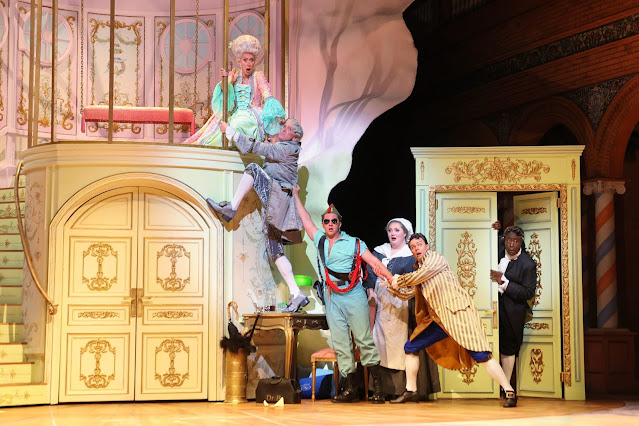
Murrella Parton (Berta), Joshua Hopkins (Figaro), Emily Fons (Rosina), Jack Swanson (Count Almaviva), Nicholas Newton (Don Basilio), Kevin Burdette (Dr. Bartolo), photo by Curtis Brown for the Santa Fe Opera 


When we tell people how much we love opera, they usually assume we are speaking about a "very serious art form". They seem surprised to learn that opera can be lighthearted and even funny. Yet some of our greatest masterpieces are considered comedies. Does Il barbiere di Siviglia qualify as a masterpiece? We say YES!  In the wrong hands it could be dull and overly long.  but in the hands of the Santa Fe Opera we can not think of Rossini's work as anything but a masterpiece.  No wonder it is the hit of the 2022 season!

Stephen Barlow has directed with admirable panache. Not a single funny stone was left unturned. Andrew D. Edwards has designed sets and costumes with style and wit aplenty. The columns flanking the set were neither Dorian nor Ionian; they were "Barberian"--the familiar old-fashioned striped barber poles.

For us, the most important aspect of an opera is the singing and we cannot imagine better casting. In our review of Performance Santa Fe's recital, we admired the bel canto singing and believable chemistry between Emily Fons and Jack Swanson. What a perfect choice for the roles of Rosina and "Lindoro" (Count Almaviva). Both sounded even better than they did at the recital, and that's saying a lot. Rossini's elaborate vocal challenges were more than met. Fantastic fioriture and super scale passages, terrific trills, and commanding cadenze tickled the ear.

In the role of the eponymous barber, we heard baritone Joshua Hopkins, a Santa Fe regular whose performances we have always enjoyed. This role suited his vocal skills perfectly. His "Largo al factotum" was delivered with several original touches that rose above  the customary clichés.

Bass Kevin Burdette, another Santa Fe Opera regular, made a spectacular showing as Dr. Bartolo. The first time we saw him in a comic role we were astonished by his comic chops. Last night we were more impressed than astonished. We were not aware of the extraordinary flexibility of his body which he employed with as much artistry as he did his voice. The laughter when he slid out of his chair like a flow of lava just about drowned out the singing. The rapid patter of "A un dottor della mia forte" was executed with precision. 

The brilliant bass-baritone Ryan Speedo Green, making his SFO debut, brought his incredible artistry to the role of Don Basilio, using his magnificent instrument successfully, revealing a great sense of comic timing. We delighted in his aria "La calunnia" in spite of some excessive directorial touches which we will address later.

As a huge fan of the Santa Fe Opera Apprentice Program, we are most delighted to honor the performances of two apprentices who fulfilled their roles with equal aplomb.

Baritone Kyle Miller made a stylish Fiorello as he assembled his musicians to accompany Mr. Swanson's cavatina "Ecco ridente". Although the role is not a large one, he must set the stage for the serenade of his boss' lady love and this he did admirably.

Soprano Murrella Parton illuminated the role of Berta and was given some unusual stage business that increased her importance in the opera. We look forward to hearing more from these three gifted apprentices.

Also given quite a lot of importance was the chorus, so well prepared by Chorus Master Susanne Sheston. We are always dazzled by their vocalism but in this case they were given a great deal to do as Fiorella's musicians, each of whom had his own personality. Later they appeared as a swat team!  More on that anon!

Maestro Iván López Reynoso established the Rossinian pace right from the overture. We loved the contrast between the staccato themes and the legato ones. Just as the Finns should borrow some vowels from the Italians, so contemporary composers should borrow some tunes from Rossini! The master even borrowed from himself!

And now, we would like to address the issue of staging. Without a doubt, this production is a crowd pleaser and often the laughter drowned out the singing. We agree that humor is vital in an opera buffa but in this case we feel the direction was over the top and the high jinx frequently distracted from the singing. Surely the characters owe a debt to commedia del'arte but we want opera to build upon its origins and to rise above mono-dimensionality

We believe ours to be a minority opinion but we felt the work was over directed. Much of what we objected to involved the touches of contemporaneity. Count Almaviva, alone among the characters, is dressed in contemporary casual--a hoodie to be exact; and he pays Fiorella with a mafioso suitcase filled with cash. One of the musicians is drinking from a styrofoam coffee cup. Berta pushes a Hoover around the floor and describes the chaos to an unseen listener on the telephone. Don Basilio carries a laptop and takes selfies with his cellphone. Figaro reclines in Rosina's bathtub. The police who come to quell the chaos are a swat team. Berta emerges from her servant's uniform as a glamorous star surrounded by a chorus of men in top hats and tails. We could go on and on but we believe you, dear reader, will get the picture.

When every character acts bizarrely or inappropriately funny, the impact of comedy becomes lost. Among lots of peculiar characterization, the arrogant Dr. Bartolo was directed as a simpering fop. At one point, he donned a sweat band, spread out a yoga mat and began doing weird contortions.

This "originality" was echoed by the set. Dr. Bartolo's house was a plaster cast of Rossini's face.  His eyes were used as windows and his mouth as a door.  Hedges imitated a huge handlebar mustache. The audience applauded before the singing began. This stage element revolved to show the inside of the home. Below was a period parlor and above was Rosina's room. Bars around it suggested a cage, commenting on her imprisonment by Dr. Bartolo. She sat on a swing, going forward and back. Necessary stage elements like the doctor's piano were wheeled on and off.

If this sounds like your cup of tea, you will have a rollicking good time. On our part, we would like to "unsee" this production and remember the way the excellent cast sang Rossini's glorious music, the thrilling duets (not only the love duet but the one between Rosina and Figaro), and the many layered ensembles, so well crafted by the composer.

© meche kroop


Saturday, August 13, 2022

BUTTERFLY DREAM


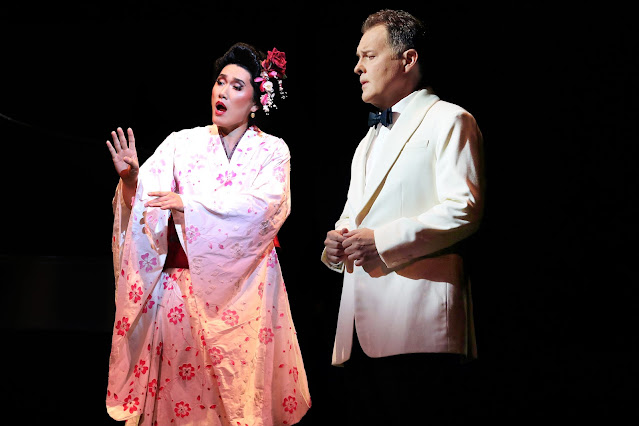
Kangmin Justin Kim and Mark Stone
(photo by Curtis Brown)


With our eyes closed, we might have thought the scintillating voice was that of a soprano; but no, it was the scintillating voice of counter-tenor Kangmin Justin Kim whose expressive instrument and superb control of the upper register was absolutely perfect for the role of Chinese opera star Song Liling. The opera M. Butterfly, commisioned by the Santa Fe Opera, is about deception, among other things. We humans are inclined to deceive ourselves based upon our wishes, our experience, and our preconceived notions. M. Butterfly tells the story of a minor French diplomat who falls in love with a male Chinese opera star who portrays female roles. Until confronted with the "naked evidence" the diplomat never accepts the fact that he has fallen in love with a man--not even after a years-long relationship.

The story originated as a play by David Henry Hwang whose tales of China have entertained us going back to his play The Dance and the Railroad. The play M. Butterfly upon which the opera is based, was a huge success at its Broadway premiere and once again at its revival and then again as a film. We have enjoyed every iteration and was looking forward to the opera ever since it was announced.

So, we are wondering why, in spite of some dazzling performances, we were somewhat disappointed in the opera. To cut to the chase, the story worked just fine as a play.  The play did not yearn for music, not even the fine music of Huang Ruo. The references to Puccini's Madama Butterfly, scattered throughout the score, only served to point out the superiority of Puccini's vocal lines. Mr. Ruo's instrumental writing is eclectic and interesting, but the vocal lines were not. This complaint of ours is not unique to Mr. Ruo. Most contemporary operas seem to have the same deficiency.

Although Mr. Hwang and Mr. Ruo have worked together before, we did not feel the union of libretto and music that we hoped for. The "recitative" (95% of the opera) was declamatory, prosy, and repetitive. The nail was hammered so hard it went right through the wood! Is it not taught to dramatists to "show, don't tell"? There were a couple arias in Act III that allowed the artists to show their stuff but were not at all melodic.

Perhaps we were alone in our assessment because there was a standing ovation at the conclusion; however we believe the thunderous applause was meant for the performances. Baritone Mark Stone sang the role of the duped accountant/diplomat René Gallimard with fine rich tone whilst creating a sympathetic and believable portrayal.

Mr. Kim's lustrous counter-tenor added to his consummate acting skills. We can see how Mr. Gallimard was fooled! All of the gestures and movements were as feminine as one could imagine and, at the end, when he appeared as a man (in full frontal glory) it came as a shock, even though we knew the artist was male.

This kind of gender fluidity is far less shocking than it was some decades ago and we do admire Mr. Hwang and Mr. Ruo for tackling issues of racial, cultural, and gender stereotypes, along with the issue of cultural misunderstanding.  The references to Puccini's opera serve to remind us how many changes have occurred in the past century.

Let us return to the quality of the performances and the production. We particularly enjoyed hearing mezzo-soprano Hongni Wu as Song Liling's communist "handler" who set the espionage in motion. We always feel great to see Asian artists cast in Asian roles, although there are other opera lovers who think it doesn't matter.

Tenor Joshua Dennis (a former apprentice) livened things up as Mr. Gallimard's tennis-playing childhood friend, appearing as a memory. Bass Kevin Burdette was fine as the somewhat arrogant French ambassador to China who promotes Mr. Gallimard, seems to admire his acquisition of a Chinese mistress, and then sends him back to France.

Adding greatly to the production was the choreography of Seán Curran who managed to combine communist tropes with the movements we have seen in Chinese opera, an art form we particularly enjoy.

Maestro Carolyn Kuan led the orchestra with a firm hand; our only regret was that more Chinese instruments were not employed. We liked the way she brought out the references to Puccini's Madama Butterfly.

Once more, we admired Chorus Master Susanne Sheston for creating a behind the scenes choral rendition of Mr Ruo's very own "Humming Chorus". The apprentices sounded great there and also as they portrayed members of French society in several scenes--as bored expats living in China, and as French citizens laughing at Mr. Gallimard's benightedness.

Director James Robinson kept the action moving along and Allen Moyer's set design was superb, especially Ms. Liling's sexy red boudoir. Christopher Akerlind's lighting made an impressive addition. James Schuette's costumes were right on point. Even the projections of Greg Emetaz were fine since they contributed location information instead of the distractions produced by other projection designers that we have found annoying.

In sum, Santa Fe Opera can be commended for commissioning a provocative and original work and for giving it a first-rate production. It is just our personal taste that wanted a more memorable vocal line and a more poetic libretto. Still, it was an interesting evening in term of getting us to think about the issues mentioned earlier. But for sheer auditory pleasure and a climax that leaves us shaken, we will choose Puccini.

© meche kroop

Saturday, March 23, 2019

MARTINU ON DREAMING

Sara Jakubiak, Maestro Leon Botstein, Aaron Blake, David Cangelosi, Alfred Walker, Kevin Burdette, Rebecca Jo Loeb, Philip Cokorinos, Tichina Vaughn, and Raehann Bryce-Davis


Diehard opera lovers, fans of the rare, and a sprinkling of Czech nationals gathered in force last night at Carnegie Hall for a concert production of Bohuslav Martinu's Julietta, a 1937 opera based on a French play Juliette, ou La clé des songes by Georges Neveux. There must have been something very appealing about the theme for the composer to get it translated into Czech by Alex Zucker.
We speculated about the historical forces extant in Europe at that time--the insecurity of living on the same continent as a megalomaniac madman (What's old is new again!) making a dream world more appealing than reality. We thought at length about the surreal aspects of the story which gave the composer free rein to utilize massive orchestral forces in strange and colorful ways, developing new and wonderful colors with surprising rhythmic twists. 

We loved these orchestral colors, the French Horn fanfares, the use of the English Horn and the Bass Clarinet. Liberal use was also made of an accordion and there were sounds we could not identify.

The odd story concerns a Parisian bookseller (performed by terrific tenor Aaron Blake) who revisits a small coastal town where three years earlier he had become enchanted by a woman singing a love song, heard through an open window. There are some pretty strange things going on in this town; the citizens have no memories and live in the present. The railway station disappears. Michel gets elected to high office because he has memories--of a rubber duckie from childhood. 

The chief of police (astutely enacted by David Cangelosi) later becomes a postman and denies his earlier occupation. Everything is off-kilter, the way it is in dreams. So, we realize that Michel is dreaming. But was his earlier visit also a dream? One can only speculate; but credence is lent this theory by our own experience of returning occasionally to a certain place in our dream life that doesn't really exist.

Dreams are utilized in the theater quite often.  Think of Shakespeare's A Midsummer Night's Dream and Pedro Calderón de la Barca's La Vida es Sueño. Although Eastern religions claim that what we call reality is really maya or illusion. Nonetheless, we are Westerners and see things differently.

In this libretto, an innkeeper tells stories to an elderly couple, which makes them happy. Is that not true today when many rely on film and other media to make life more interesting?

Act I sets the stage for the action which follows; Act II is surely more compelling as Julietta appears and seems to know and remember Michel. The music given to Julietta, so beautifully sung by soprano Sara Jakubiak, is the most lyrical of the evening. After a romantic reunion there is a spat and the frustrated Michel fires his pistol at the fleeing Julietta. But no one else hears the shot and there is no body. Visiting her home yields no further information. The resident denies her existence. Does this absurdity not resemble dreams of anxiety and frustration you may have had?

Act III brings things together. Michel is in the Central Office of Dreams and there are episodes of humor--a bellhop who wants to dream about the Wild West, a convict who wants dreams of a huge cell, a beggar who wants a dream seaside holiday. At the end Michel refuses to leave and becomes one of the "people in grey", madmen all, deniers of reality. How suitable for Hitlerian Europe!

The singers did yeoman's work in learning this extremely difficult language and managed to capture the rhythmic thrust of the sound as matched to the music. The vocal lines were not at all melodic, as is common in opera of the mid 20th c. The lines were often parlando and there were some lines spoken in English. Although there were no titles, libretti were distributed with the programs and house lights were left on. Most members of the audience elected to read along with the performance.

Aside from the outstanding performances of Ms. Jakubiak, Mr. Blake, and Mr. Cangelosi, we particularly enjoyed mezzo-soprano Rebecca Jo Loeb whose versatility animated a number of roles; equivalent versatility can be claimed by bass Kevin Burdette and bass-baritone Philip Cokorinos. The resonant bass-baritone Alfred Walker also fulfilled a number of roles to perfection.

Two mezzo-sopranos added significantly to the performance--Tichina Vaughn and Raehann Bryce-Davis who each assumed a number of different roles. The Bard Festival Chorale, directed by James Bagwell made significant contributions as well.

But the main event was the orchestra which played magnificently under the baton of Leon Botstein, who loves discovering neglected works. Julietta has not been heard in the United States before. Martinu was a prolific composer who left Czechoslovakia in 1923 for France where his music certainly acquired a degree of Gallic influence. This work premiered in Prague in 1938 but was also translated into French. Shortly afterward Martinu came to the United States, bringing the score with him. Strange that it had to wait nearly 80 years to be brought to the stage of Carnegie Hall. Thank you Maestro Botstein!

(c) meche kroop


Sunday, August 12, 2018

LET'S GET CANDIDE

Leonard Bernstein's Candide at Santa Fe Opera (photo by Ken Howard for Santa Fe Opera)

If you think you've seen and heard Candide, guess again. If you want to experience this brilliant work in all its glory, you'd do well to get yourself to Santa Fe, New Mexico for one of the two final performances of the season.

The success of this production rests on many shoulders. We scarcely know where to begin but Maestro Harry Bicket's superb conducting resulted in applause almost as vociferous as that received by the presence in the audience of Supreme Court Justice Ruth Bader Ginsburg!  The light-hearted music composed by Bernstein seemed to underscore the dark humor of the book, based on the satirical 18th c. novella written by Voltaire. As in Mozart's music, a melody in a major key may drift momentarily into a minor key; Bicket's attention to these shifts made for a poignant listening experience.

The scholarship of dramaturg Matthew Epstein, Senior Artistic Advisor at Santa Fe Opera, must have involved some intense activity in choosing which scenes and dialogue to include and what to leave out. The work itself began its life in the middle of the 20th c. and was not successful. It took many decades and the inclusion and later exclusion of a parade of lyricists to ensure its ultimate success. The version we saw last night, one of four extant iterations, is the Old Vic version, an expansion for the Scottish Opera of the Hal Prince/Hugh Wheeler version.

This is an exception to the maxim that "too many cooks spoil the broth". Voltaire's novella provides enough material for a variety of treatments. We will not get into a discussion of Candide's fluid identity. We will call it an opera as long as it is presented unamplified. Although we heard this version recently at Carnegie Hall with a fine cast and all the original music, the voices were badly amplified and we missed all the clever lyrics. Last night, the talented cast was quite intelligible and were supported by excellent titles, in case one missed a word.


In this story of innocence betrayed and reality accepted, we are exposed to countless trials and tribulations; we witness the heroes of the story pursuing their ideals and surviving their hardships. Perhaps this is one of the reasons that the public has such affection for the work.

The literary work upon which it is based is Voltaire's 1759 novella, a satiric attack on war, religious persecution, and the positivist philosophy of Gottfried Wilhelm Leibniz who claimed that whatever happens in this world is divinely ordered and for the best.

What we didn't know was that one of the episodes is based upon true events. In Lisbon, the horrendous death toll of an earthquake resulted in religious persecutions meant to "appease God". Well!  If that doesn't sound like some contemporary stuff going on in the Middle East we will eat the score for breakfast!

If anyone doesn't know the story, it involves the picaresque adventures of an innocent youth named Candide and his beloved Cousin Cunegonde who were tutored by one Dr. Pangloss, a stand-in for Leibniz. The two survive the horrors of war, shipwrecks, deceits and betrayals, as well as the aforementioned auto-da-fe;  they get continually separated and reunited more than once until at the end they decide to have a quiet life with modest pleasures.

Director Laurent Pelly conceived the work in almost cartoon style with highly exaggerated gestures; although we personally did not care for this style, the audience loved it; we do admit that it made the somber end more impactful--kinda like a punch in the gut. There were quite a few moist eyes to be seen and sniffles to be heard.

Pelly's costume designs for the principals were as colorful and sweet as candy. The excellent chorus, comprising Santa Fe Opera Apprentices led by the always wonderful Susanne Sheston, sang clearly, and were dressed in period costumes executed in fabric that emulated printed words on a page. Chantal Thomas' set design was minimalistic but also reflected the work's literary origins. Projections by 59 Productions augmented the simple set.

As the eponymous Candide, tenor Alek Shrader was given several more arias than were assigned to the character in either the Broadway version or the New York City Opera version (both of which we enjoyed). He was convincing in his portrayal and his light tenor was musical throughout; we particularly enjoyed "It must be so".

Soprano Brenda Rae sang and acted up a storm. Cunegonde was never an innocent and Ms. Rae's delivery of "Glitter and Be Gay", one of our favorite coloratura arias, had just the right edge of irony to it.

Jarrett Ott, one of our favorite baritones, has become a regular at Santa Fe Opera; we loved his performance in the role of Maximilian to which he brought his own style ,substance, and wit.

It was very satisfying to witness mezzo-soprano Gina Perregrino, well remembered from Manhattan School of Music and International Vocal Arts Institute, fulfilling the promise we observed over the past six years. Her performance of Paquette was as on-point dramatically as it was vocally.

As The Old Lady, mezzo-soprano Helene Schneiderman tackled this wonderful role with gusto. There were no flaws in her portrayal but there was something about the performance that begged for more presence.  Perhaps it was the costume which failed to limn the character. 

In the customary doubling of roles as the storyteller Voltaire and the character of the indestructible Doctor Pangloss we heard Santa Fe Opera regular Kevin Burdette, whose resonant bass rang out with authority. We didn't even recognize him in the roles of Martin and the slave/valet Cacambo.

Anthony Robin Schneider appeared as the Grand Inquisitor, and also as the Baron with only his face showing through a hole in his portrait. Similarly, Kathleen Reveille's brief appearance as the Baroness was also as a face in her portrait. This same technique was used when The Old Lady arrived in Spain and sang "I am easily assimilated" with her head appearing atop a parade of costumes painted on a board each with different Spanish costumes. In the latter case it was merely distracting

With a couple roles apiece, bass-baritone Erik van Heyningen and tenor Abraham Bretón impressed as the two rivals for Cunegonde's sexual favors; the former portrayed the Cardinal Archbishop of Paris whilst the latter took the role of Don Issachar the Jew.

Tenor Richard Troxell also sang several roles and was so successfully costumed that we didn't recognize him.

It was an altogether stunning Santa Fe Opera premiere and we recommend it highly--not only for Bernstein's magnificent music (Oh how we loved the fugue-like quartet for Candide, Cunegonde, Maximilian, and Paquette!) and the clever lyrics, but also for the highly resonant stance of Voltaire against religious excess, silly philosophies, war, and greed.

(c) meche kroop


Saturday, August 19, 2017

THE COCK HAS CROWED

Kevin Burdette, Tim Mix, and Meredith Arwady in Rimsky-Korsakov's The Golden Cockerel

We well recall the moment that we fell in love with classical music.  Rimsky-Korsakov's Scheherazade was playing on the radio and we were hooked. What a thrill for us to have seen his final opera The Golden Cockerel twice within three months. Last night we enjoyed the production by Santa Fe Opera (a co-production with The Dallas Opera) and felt the same delight in the composer's exotic melodic line and lush orchestration, so sensitively realized by Maestro Emmanuel Villaume.

On a day remembered as Bloody Sunday in Russia, the Tsar's forces massacred some peaceful protestors who were unhappy about their living conditions but also about the ill-fated Russo-Japanese War.  The composer Rimsky-Korsakov supported the protestors and thereby lost his job as head of the conservatory. Perhaps in protest he chose to set The Golden Cockerel as a satire of autocracy and Russian imperialism. This would be his last opera; he completed it in 1907 but it was banned by the Palace. It premiered 2 years later but the master had already died.

The libretto was written by Vladimir Belsky who based it upon an invented fairytale by Alexander Pushkin who, in turn, based his work on some stories by our very own Washington Irving!  How about that! Real fairytales are folktales handed down over centuries so we feel confident in calling this one invented.

King Dodon's astrologer presents him with a golden bird who will warn him of political danger and gets promised whatever he wants in return. War is declared whilst Dodon lazes about at home, relying on the bird's advice. Dodon's sons kill each other on the battlefield and Dodon himself must go to battle.. In the kingdom of Shemakh he meets the seductive Queen Shemakha who extracts a promise of marriage and returns home with him. The astrologer claims his reward--the Queen.  He will accept no less. Dodon kills him. The Golden Cockerel kills Dodon.

As the bumbling King Dodon, we heard baritone Tim Mix whose characterization was as on the mark as his singing. Sporting a red "fat suit" and curled up on a huge throne, he made quite an impression on us. But an even greater impression was made when he mounted a large wooden horse, facing backward!

As the exotic temptress from The East--the Queen of Shamakha--soprano Venera Gimadieva tickled our ears with both long lyrical lines of pure sound and volleys of wickedly challenging ornamentation which she made appear effortless. Fortunately, she also possesses physical beauty sufficient for the part, since she was obliged to perform a serious strip tease to ensnare the dense Dodon.

Contralto Meredith Arwady has a sensational instrument of great depth. She created a marvelous version of Amelfa, Dodon's housekeeper/caretaker and brought a great deal of humor to her portrayal. The scene in which she cradles him on his huge throne was unforgettable.

The General of bass Kevin Burdette was perfectly sung and acted. If King Dodon had listened to his advice the entire tale might have ended differently.

The title role was sung by a very special member of the Apprentice Program.  Soprano Kasia Borowiec has been on our radar since her student days at Manhattan School of Music and has always impressed us.  What a joy to witness her artistic growth in last night's dazzling performance. Unfortunately, in this production, she sings from offstage, but we did have the opportunity to attest to her stage presence in Sunday night's Apprentice Scenes.

Several more apprentices delivered auspicious performances.  We heard tenor Richard Smagur as Prince Guidon and baritone Jorge Espino as Prince Afron. The two rivalrous siblings wind up killing each other on the battlefield.

Tenor Adam Bonanni made a fine showing as the First Boyar, whilst bass Simon Dyer did so as the Second Boyar. As expected, the chorus, under the astute direction of Susanne Sheston, performed magnificently.

Barry Banks utilized his very high tenor as The Astrologer, a mysterious character who may or may not be "real".

Director Paul Curran had some truly excellent ideas although we take exception to two choices that seemed to violate the intent of the concept. When the Queen of Shemakha capriciously demands the (offstage) beheading of The General, it seemed tasteless to us to have paraded the severed head around the stage.  Just plain "EWWW".

Secondly, there was no justification for King Dodon to appear in a contemporary suit with a red tie in the closing scene. Similarly, the Queen of Shamakha had exchanged her finery for a white dress and sunglasses. We expect that a large percentage of members of the audience, presented with an autocratic ruler who is an inept politician, might have been considering the present political situation in the United States. But that's the kind of association that should be made in one's thoughts, not concretized onstage.

But we loved the scene in which the Queen is tryig to get the flat-footed Dodon to sing and dance!

The fantastic nature of the tale was realized by the fantastic nature of the sets and costumes by Gary McCann. King Dodon loafed about in red pajamas but went to battle in stylized armor, and courted in magnificent robes. The Queen of Shamakha wore a fantastic headdress and a slinky turquoise gown which she shed in pieces. Amelfa's costume was a wild exaggeration of peasant attire and grotesque make-up.

The other costumes were wildly colorful and fantastically exaggerated with tall black fur hats on the men. The handmaidens of The Queen were dressed in long white gowns and bore huge feathered fans with which they surrounded the Queen as she changed costumes, an impressive visual spectacle.

The set resembled a skateboarding half-pipe, all curves upon which were projected animations of the Golden Cockerel, strange astrological symbols, and line-drawings of the creatures of Dodon's dreams. Driscoll Otto was responsible for this surge of imaginative creativity.

Eye candy and ear candy joined to create an evening in which entertainment was wed to high artistic values.

(c) meche kroop


Friday, August 21, 2015

HITTING ALL THE RIGHT NOTES

Anna Christy and Alek Shrader in Fille du Regiment at the Santa Fe Opera (photo by Ken Howard)


Santa Fe Opera's production of Gaetano Donizetti's Fille du Regiment hit all the right notes, and Alek Shrader in the role of Tonio hit all the high notes, the ones we heard him sing some years ago when he won the Metropolitan Opera National Council award. His warm and funny performance was matched by Anna Christy, appealing as the tomboy Marie who counted an entire regiment as her collective father.

Ned Canty's direction was delightful, milking every ounce of humor from the story without overlooking the brief periods of melancholy. Physical humor was much in evidence with Mr. Shrader portraying Tonio as a bumbling hick who can't keep from tripping over his own feet.  Mr. Shrader's instrument is not a large one but he uses it well and is a marvelously appealing performer. But the major share of humor came from the hilarious performance of bass Kevin Burdette whose Sergeant Sulpice outdid any of the comedy greats of the silent film epoch.

Mr. Canty not only emphasized the humor but also the pathos by including plentiful spoken dialogue; this served to illuminate the circumstances of the characters in a way previously shortchanged. We felt we really got to know the characters and to care about them.

Ms. Christy's skill at bel canto singing is impressive. Her instrument has a sweet childlike quality and a great deal of tonal clarity. The fioritura was dazzling in its accuracy and organic in its relationship to the text and the emotions. The colors in her voice changed in the sad "Il faut partir" at the end of Act I, eliciting ample sympathy for her plight.
 
Mr. Shrader is also capable of coloring his voice and although  "Ah! mes amis, quel jour de fete" is the opera's hit tune with it's nine high C's, we enjoyed his "Depuis l'instant, dans mes bras" in Act I and his persuasive Hail Mary pass for Marie's hand in Act II.

As the Marquise of Berkenfeld, a name which Sulpice persisted in amusingly mispronouncing, mezzo-soprano Phyllis Pancella was haughty at first in "Pour une femme de mon nom" but became warm and likable by the end when she relents and accepts her daughter's marriage to Tonio instead of to the favored aristocrat.

Apprentice bass Calvin Griffin again impressed us with his voice and dramatic abilities as he portrayed Hortensius, the Marquise's Major-domo--typically contemptuous of the French army but indulgent toward the Marquise.  His scene at the chateau, where Sulpice is spending months recovering from a battle injury, had us in stitches as he sank into passive-aggressive behavior involving a wine bottle.

Once again we were thrilled by the performance of the apprentices in the chorus, under the direction of Susanne Sheston. The women enacted the Tyrolean  citizens praying for deliverance from the French in Act I and in Act II the guests at the Chateau who were amusingly announced by Hortensius. The men portraying the regiment of French soldiers sounded marvelous in their regimental song.

In the pit Maestra Speranza Scappucci led a spirited performance of Donizetti's tuneful music. Much of the overture was in march time but there were plenty of lyrical moments and the conducting kept up the pace. 

The opera takes place during the Napoleonic wars but there appears to be no bloodshed and the French regiment seems particularly kind to the Tyroliean natives whose land they are occupying. The praying natives have nothing to fear!

Scenic and Costume Design by Allen Moyer was delightful. In Act I, the villagers have erected a monumental pile of furniture as a barrier and in Act II, the Marquise's chateau is on a revolving stage which showed the front of the chateau and also the room behind the door where Marie gets her very funny singing lesson.  The Marquise has been trying to overcome Marie's rustic and tomboyish nature to make an aristocratic lady out of her. The efforts are doomed to failure because the influence of her army upbringing has been just too strong. This is symbolized by her breaking into the regimental songs (encouraged by Sulpice) during her singing lesson.

The soldiers' uniforms are exactly what one would wish for--colorful and accurate to the 1830's. The Marquise's costume is in the newer Empire style, whereas the elderly Duchess of Krakenthorp (a spoken role portrayed by a bewigged and powdered Judith Christin) is dressed in the style of the late 18th c., revealing just how elderly and old-fashioned she is.

Donizetti tossed off this "trifle" (HA!) in a very short period of time; it had its premiere in 1840 and we are still loving the story and the characters and the music nearly two centuries later. Contemporary composers labor for years over operas that we see once and forget about. What's wrong with this picture?

(c) meche kroop

Wednesday, August 19, 2015

ON COLD MOUNTAIN


Isabel Leonard and Nathan Gunn in Cold Mountain at Santa Fe Opera (photo by Ken Howard for SFO)


You read Charles Frazier's best-selling novel.  You saw the movie with Jude Law, Nicole Kidman, and Renee Zellweger. Do you want to see the opera premiering this season at the Santa Fe Opera?  Yes, you do! You want to hear mezzo-sopranos Isabel Leonard and Emily Fons create the roles of Ada Monroe and Ruby Thewes, two characters who bond in sisterhood and change each other's lives for the better.  You want to hear baritone Nathan Gunn as the war-weary defector W.P. Inman and you want to hear tenor Jay Hunter Morris as the slimy villain Teague. They were as excellent dramatically as they were vocally.

Will you want to see this opera a second time?  Probably not.  And why is that?  Like so many contemporary operas in English, the language itself has not inspired award-winning composer Jennifer Higdon to write any memorable vocal lines, indeed, not any melody whatsoever.  And what is opera without melody?  A play with music is what it is. We were reminded of the soundtrack of a film. We have only good things to say about Ms. Higdon's instrumental writing which is highly textured and interesting.  Even in its dissonant passages illuminating battles, it is accessible.  But the vocal lines are strictly conversational and without lyricism. They might as well have been spoken.

We sensed a number of missed opportunities. When Pangle and Storbrod appeared onstage with a banjo, we became all excited, hoping that Ms. Higdon would have chosen an unorthodox path by including a banjo in the orchestra and by employing some folk tunes indigenous to that part of the South. No such luck! And when apprentice soprano Chelsea Basler (in an excellent performance as Sarah) sang to her baby, her vocal line did not even begin to suggest a lullabye, although we heard some lovely sounds coming from the harp. When the group of men-starved young women (beautifully sung and acted by apprentices Heather Phillips, Shabnam Kalbasi, Megan Marino, and Bridgette Gan) try to seduce Inman and Veasy (Roger Honeywell), we longed for more seductive music.  We were thinking of the Rhinemaidens!

Miguel Harth-Bedoya's conducting cannot be faulted and the orchestra sounded crisp and clear. The chorus sang magnificently, as usual, under the direction of Susanne Sheston. We particularly enjoyed the chorus of dead soldiers at the end which was quite moving.

Dramatically, everything worked. Leonard Foglia's effective direction had us experiencing Ada and Ruby's hardship on the home front in alternation with Inman's frightening and tortuous efforts to evade the Home Guard and come home to the waiting Ada. Librettist Gene Scheer wrote some fine texts that added to the drama and hewed closely to the spirit of the novel.

The scenic design by Robert Brill was a chaotic jumble of wooden planks, appearing somewhat dangerous for the artists, but fortunately there were no mishaps.  The set  worked best when some planks were repurposed as a boat in which Inman is crossing a river, a boat which sank. David C. Woolard's costumes were superb, giving us a good picture of the stylish but helpless Charleston lady that Ada had been and the capable farm woman she became under Ruby's tutelage and exhortation.

As a matter of fact, the relationship between the two women was more interestingly portrayed than Ada's relationship with Inman. For the latter, there is only a brief scene of their meeting and then their final ill-fated reunion for which we yearned to hear a more lyrical and tender duet. (This parallels the construction of the novel, of course.) Still we were intrigued by the idea that two very different women could form such a loving and worthwhile bond.  Ada teaches Ruby to read and to appreciate some of the finer things in life while Ruby teaches Ada to be independent and strong.

As Ruby's father Storbrod, bass Kevin Burdette turned in his usual fine performance.  Tenor Jay Hunter Morris not only sang magnificently as Teague, but created a character of menace who chilled us to the bone.

The Civil War was indeed a disgraceful event in our nation's history and, after a century and a half has passed, we observe that the wounds have still not healed.  That makes the topic eminently suitable for a great American opera. Our dismay over the evils of war will always be relevant to contemporary times.  The topic of damaged lives strikes very close to home as we deal with veterans of wars in the Middle East. So this is a valid subject for operatic treatment.  We only wish that the music had reflected our musical history as well.

(c) meche kroop

Sunday, December 7, 2014

A VERY COOL CAT

Gotham Chamber Opera's El Gato Con Botas (photo by Richard Termine)

What an enthralling hour we spent at El Museo del Barrio!  The many auditory and visual delights we experienced were the result of a collaboration among the always adventurous Gotham Chamber Opera, Works and Process at the Guggenheim, Blind
Summit Theater and Tectonic Theater Project.

This collaboration brought to vivid life a fairy tale dating back to the 16th c.  The hero is a member of the class known in nearly every culture as "helper animals", those who help humans to survive and thrive.  Puss in Boots is a rascal--he lies and cheats to get what he wants; but he is clever and resourceful and secures a princess bride and a castle for his poor master who, as third son of a miller, received no other inheritance.

The inventive Bunraku-style puppets were created by London's Blind Summit Theater (designed by Nick Barnes) and interacted with live performers and characters who were half human and half puppet as seen in the photo above.  They were supremely effective in telling the story (puppet direction by Mark Down and stage direction by Moisés Kaufman). Sets were designed by Andromache Chalfant and lit by David Lander. Costume design was by Clint Ramos.  Every element was as close to perfection as one could get.

Musical values were beyond wonderful.  Under the baton of Neal Goren the Gotham Chamber Opera Orchestra, comprising but a dozen musicians, realized Xavier Montsalvatge's music in the most delightful manner.  There was an outpouring of melody and most interesting textures in the harmonies.  Sung in Spanish, it is a work we would happily listen to even without the visual component. We heard great variety in mood and tempo throughout.  The music for the love letter sent by the miller to the princess excelled in sensuality.  Much of the other music was propulsive and energetic.  

Dressed in black and singing the role of Puss was the incomparable mezzo-soprano Ginger Costa-Jackson whose work we have reviewed before.  Her expressive voice conveyed all the wily manipulations of Puss although the puppet was doing the cavorting.  Ms. Costa-Jackson is a gorgeous woman but unafraid to hide her beauty in the service of a role, as seen in Nixon in China and Fanciulla del West, both at The Metropolitan Opera.

Andrea Carroll made a winning princess and used her sensual soprano to good advantage.  Her interaction with her father the king (effective baritone Stefanos Koroneos) was quite amusing since the singer's face sat above a tiny body, as did the members of his court--chamberlain, friar and cook.

The role of the miller's son was finely sung and acted by baritone Craig Verm.  He went from the resentful inheritor of the mangy cat to the son-in-law of the king, all due to the deceitful antics of the cat.  Instead of skinning and eating the cat in the first scene, he was persuaded to provide a feathered cap, a cape, a sword and (of course) a pair of boots for the demanding feline.  That scene was pure delight.

The fiction used to win the princess' hand was that the poor miller's son was a Marquis.  The castle for this "Marquis" was taken away from an ogre in an hysterical scene in which Puss tricks the Ogre (sung convincingly by bass Kevin Burdette).  We were reminded of the scene in Wagner's Das Rheingold when Wotan and Loge descend to Nebelheim and trick Alberich into giving up the Tarnhelm.

Let us give due credit to the gifted black-clad puppeteers, led by Stefano Brancato; Jonothon Lyons and Aaron Schroeder manipulated Puss; Joseph Gallina, Ben Liebert, Marta Mozelle MacRostie, Jessica Scott and Teddy Yudain did the rest.  Not only was there the king's court but a colony of rabbits and the various body parts composing the ogre.  Everything was amazing.

Regular readers will recall how much we love the Spanish language and how much we love puppetry.  This work scored on both accounts.  There is no point protesting the brevity of the work; it was completely satisfying. There are several more performances until December 14th and we urge you to go and see how much fun opera can be.

© meche kroop


Saturday, August 16, 2014

DOUBLE FEATURE

Brenda Rae, Anthony Michaels-Moore and Erin Morley (photo by Ken Howard)


Erin Morley (photo by Ken Howard)


How could one make a marriage out of a 1786 Mozart singspiel and a 1914 Stravinsky fairy tale?  With great imagination!  Did the pairing work?  It depends upon who you ask.  Director Michael Gieleta has presented Le Rossignol as a production of the eponymous impresario of The Impresario and his company of performers.  The two wildly divergent works are bound together by the same cast and by the same scenic elements transformed in shape and purpose.

We have previously seen Mozart's Der Schauspieldirektor but never like this.  The hijinks occurring between the frustrated impresario and his three sopranos are here performed with much additional dialogue and interpolations of additional music by Mozart.  For some reason it is given in English.  Some of the dialogue is clever and some isn't.  It comes across as a backstage farce.

Before the opera even begins, we are treated to images of Salome with Jochanaan's head and a Tosca stabbing a Scarpia.  The stage is filled with performers of various disciplines, notably a troupe of very good dancers and three sopranos vying for parts in the new production of Le Rossignol.  The time is 1914 and the place is probably Paris; the impresario himself speaks with a Russian accent and is likely a fugitive from the Revolution.  The Countess who has supported his company is assassinated in front of our very eyes and Mr. Yussupovich fears he will have to close up shop.  Baritone Anthony Michaels-Moore handled the role well both dramatically and vocally.

His business manager Otto van der Puff (bass Kevin Burdette) proposes that Mr. Y produce operas that the public enjoys instead of radical experimental works.  Ahem!  They compromise.  There will be a Don Giovanni but there will also be this new work by Stravinsky.  And that's what we get in the second half of the program.  But not before we hear the three divas perform audition arias.  Soprano Erin Morley is filled with self-confidence as Adellina Vocedoro-Gambalunghi.  Soprano Brenda Rae has an enormous amount of fun as the over-the-top Transylvanian Vlada Vladimirescu who has brought along her husband, sung by the fine tenor Bruce Sledge.

Stepping in to replace the deceased Countess is financier Heinrich Eiler (bass-baritone David Govertsen) who wants his mistress Chlotchilda Krone (contralto Meredith Arwady) to be cast.  If the names of these three divas don't make you laugh then their shenanigans will.  Ms. Arwady is particularly funny as she sings Mozart's male roles in several registers.  We were reminded of Ira Siff's La Gran Scena Opera Company, gone but not forgotten.

After the intermission, we see the same singers onstage in the same roles but a transformation takes place as the clever set design (James Macnamara) is converted into the setting for Le Rossignol.  The piano becomes a boat and Mr. Sledge becomes a fisherman.  The outrageous Poiret-influenced costumes are stripped away and Ms. Morley becomes the eponymous nightingale.  The impresario is dressed as a Chinese emperor and Ms. Rae becomes a cook.  The costumes by Fabio Toblini are as sumptuous in the Stravinsky as they were in the Mozart.

The myth taken on by Stravinsky is that of a nightingale who sings so sweetly that she brings tears of joy to the eyes of the listener.  And that is EXACTLY what Ms. Morley achieved.  Most of her part is without words, a divine vocalise.  The cook will get an important position in the Emperor's court if she brings this splendid creature.  The nightingale does enchant the Emperor and the entire court until some Japanese envoys bring a mechanical bird (the lovely dancer Xiaoxiao Wang) that astonishes everyone.

The real live nightingale flies off; the Emperor is enraged and banishes her.  But when he is on his deathbed she returns and promises to sing 'til dawn if Death will return to the Emperor his symbols of power.  She succeeds and is offered a grand reward but the only reward she wants are the tears in the Emperor's eyes.  The opera is beautifully sung in Russian.

We loved the story.  Our thoughts ran along the lines of how in today's world we have been seduced by the faux, the virtual, the mechanical/electronic.  We need the real and the natural to heal.

Not everything worked.  We found the projections of modernist art to be ugly; they distracted from the gentle beauty of the myth and the music.  The dancers, wearing fake moustaches and glasses and rolling around on the floor dressed in knee breeches didn't make any sense whatsoever.  Sean Curran was the choreographer.

Conductor Kenneth Montgomery went all the way in limning the shimmering textures and dramatic orchestration of Stravinsky's score.  If we have nothing to say about the Mozart it is because the action onstage was so distracting that the music got very little notice.

As the myth concludes, the dancers are stripped of their lavish Oriental costumes and returned to their 1914 clothes, bringing the entire affair to a mostly satisfying conclusion.

(c) meche kroop


Friday, May 30, 2014

PIG-TURE PERFECT

Gorgeous Gloria, as sketched by Doug Fitch

You have exactly two opportunities to catch Gloria--a Pig Tale at the Metropolitan Museum of Art:  tonight at 7:00 and Sunday at 2:00.  Since this is the first contemporary piece that left us happy and artistically fulfilled, we want you to share our joy. By some mysterious magic, all the elements of music, story and design came together in a delightful barnyard stew.

The fine music by the Viennese composer HK Gruber has the jazzy and raucous flavor of German cabaret mixed with French comic opera.  One could not have asked for a better performance than that given by Juilliard's AXIOM ensemble comprising a solo violin and harp, two percussionists, and lots of wind instruments including our beloved bass clarinet, tuba, flugelhorn and several varieties of saxophone.  As conductor, the eminent Alan Gilbert not only led the ensemble but joined in the fun.  There was a stunning moment at the end of Act I when the musicians quit the ensemble one by one, leaving only the violinist bowing away at her instrument.  One could not help thinking of Poulenc's Dialogue des Carmelites.

The libretto by Rudolf Herfurtner is a lot more sanguine than Janacek's  well known The Cunning Little Vixen, making it suitable for children.  The story concerns a very beautiful pig named Gloria who has glorious golden curls.  She is, as they say, "pretty as a pig-ture" and, like Cunegonde in Bernstein's Candide, she knows it.  But she is different from her swinish family and feels lonely and rejected.  At the end of Act I, she dreams of her Prince Charming and the music becomes absolutely luminous.

But the man she expects to rescue her from her sad state turns out to be (YIKES!) a farmer who means to butcher her.  And then the REAL prince charming shows up, a wild boar named Rodrigo, and comes to her rescue.  In the epilogue, there is a family of piglets and Rodrigo feels.....trapped.

The success of this whimsical tale rests upon the artistic design and for this we must thank the director, costume designer and co-set designer Doug Fitch.  The masks were witty and, realized by Anna Yates, outstandingly effective, allowing the singers voices to emerge successfully while still conveying pigs and boar, not to mention the frogs and birds and sausages.

About those singers we have nothing but praise.  Each of the five cast members assumed many roles.  Soprano Lauren Snouffer made a winsome pig and tenor Alexander Lewis shone in the role of the farmer/butcher.  Mezzo Brenda Patterson and baritone Carlton Ford were also excellent while bass Kevin Burdette almost stole the show as a sexy wild boar with a most effective boar's head around his torso which nodded when he moved his pelvis.

We loved the chorus of frogs and the duet for sausages.

Co-Set Designer was Kate Noll and Lighting Designer was Jeanette Oi-Suk Yew.  The fairy-tale designs were colorful and apropos.

We have only one small criticism.  The English diction left much to be desired and, although the gist of the story was easy to understand, we missed a lot of the dialogue which we think was probably too clever to be missed.  We would have appreciated projected titles or, even better, to have heard the work in it's original German since it is a work of singular Austrian flavor.  There is no point in presenting a work in translation if the English is not crystal clear.  The English version was by Amanda Holden.  Maestro Gilbert warned us at the beginning that we might not understand the animals who were speaking gibberish, but that was only a small part of the libretto.

This work was part of the New York Philharmonic Biennial Festival and a worthy entry.  Giants are Small was founded in 2007 by the above-mentioned Doug Fitch and the Swiss filmmaker and producer Edouard Getaz with multimedia entrepreneur Frédéric Gumy.  We can barely wait to see what they come up with next.

© meche kroop

Thursday, August 22, 2013

OSCAR!

David Daniels, Composer Theodore Morrison, Heidi Stober and Director Kevin Newbury--photo by Ken Howard
Much of contemporary opera comes across as theater with music and Theodore Morrison's fine new opera Oscar, premiered at Santa Fe Opera, is just that.  The text has been adapted by John Cox from quotations by Oscar Wilde himself and by his contemporaries.  It is a sad story of persecution of homosexuals by the British justice system.  The story telling makes it clear that Mr. Wilde contributed to his own downfall by letting his love for "Bosie" (Lord Alfred Douglas) cloud his judgement.  His pretty young lover had a big grudge against his father The Marquess of Queensberry and used Wilde badly by pushing him to sue his father for libel.  This resulted in Wilde's conviction for committing "acts of gross indecency" resulting in a two year sentence to hard labor and solitary confinement.  By the end of the opera, our hero has become a broken man but enlarged in spirit such that he is admitted by Walt Whitman into the hall of literary immortals.

Director Kevin Newbury did a fine job of limning the story.  Conductor Evan Rogister conducted briskly.  The music is powerful and is in many places closely allied with the words but not always; at times it seemed as if Morrison were trying for an ironic effect.  There are some arresting uses of winds, percussion and harp.

The set by David Korins with lighting design by Rick Fisher created some vivid images suitable to the story.  The very Victorian Redding Gaol where Wilde was imprisoned was frighteningly convincing.  Costumes by David C. Woolard were appropriately Victorian.

Famous countertenor David Daniels was convincing as the eponymous hero; indeed it appears that the role was written for him.  There are vocal melismatics reminiscent of Handel.  There is a wonderful warm scene in Wilde's friend Ada Leverson's nursery which she has offered to him when he has been denied lodging all over London.  Soprano Heidi Stober portrays this character beautifully and their singing about Wilde's preference for absinthe is delightful.  In this scene they are joined by Wilde's other friend Frank Harris, sung by the always excellent William Burden.

Another wonderful scene--this one upsetting, not delightful--occurs in the prison the night before a man will be hung and the inmates are mad with anxiety; this was a case in which the music reinforced the text.  As awful as the prison was, Wilde did enjoy a modest period of kindness from a kindly warder named Thomas Martin, sympathetically portrayed by fast-rising baritone Ricardo Rivera, also seen as an unpleasant hotel manager who refuses Wilde lodging. 

The scene in which Wilde's show trial is staged as a farce with nursery toys re-enacting the proceedings is a directorial marvel.  The very funny bass Kevin Burdette portrayed Mr. Justice Sir Alfred Wills and the Jury Foreman was portrayed by Reuben Lillie.  Mr. Burdette was also seen as the vicious Colonel Isaacson who ran Reading Gaol with an iron fist.

The prologue and epilogue featured a fine Dwayne Croft as the American poet Walt Whitman who befriended Wilde.

Several apprentices appeared in smaller roles--Patrick Guetti as a pompous butler, Yoni Rose as a bailiff, Aaron Pegram and Benjamin Sieverding as detectives and prison warders--the latter joined by David Blalock as patients in the infirmary.

Having the role of "Bosie" taken by a dancer instead of a singer was an interesting decision and Reed Luplau was a fine casting choice.  Choreography was by Sean Curran.  So, instead of some love duets between Wilde and Bosie, we got to watch some fine ballet because Bosie's image appeared regularly to Wilde.  Although Bosie managed to forget Wilde and leave the country, Wilde remained deeply affected by his love for Bosie.

This was a worthy entry into the world of contemporary opera and we were glad for the opportunity to attend its premiere.

© meche kroop

Tuesday, August 20, 2013

THE GRANDEST DUCHESSE OF THEM ALL

Susan Graham and Paul Appleby (photo by Ken Howard)
When the divine Susan Graham is onstage with the equally divine Paul Appleby, comedic chemistry takes over.  Last year we might have called Mr. Appleby "up and coming" but by now he is well-established for his warm inviting tone and dramatic excellence.  But who knew he had comedic chops?

Offenbach's La Grande Duchesse de Gerolstein is a trifle, a cream puff filled with air that could collapse if it were roughly handled.  Not so here!  The work was affectionately and gently handled by Director Lee Blakely.  There is nothing here to sink your teeth into but there is plenty to get the corners of your mouth to turn up.  We dare you to try to wipe the grin off your face.

The story concerns one very domineering Duchess who refuses her suitor, the pink-suited Prince Paul -- hilariously portrayed by the versatile baritone Jonathan Michie (who apprenticed at SFO for two years)-- in favor of Fritz, a very clumsy private in the army whom she elevates to general.  One can imagine the irate reaction of General Boum, hilariously portrayed by bass Kevin Burdette who has a real flair for Offenbach (seen in that composer's  La Périchole at New York City Opera) who gets successively demoted as Fritz gets promoted.  Mr. Appleby has major fun portraying Fritz who is transformed from a bumbling private into a confident general. 

His sweetheart was beautifully sung by lovely soprano Anya Matanovič. The Baron Puck was performed by a funny Aaron Pegram, a character tenor of great talent.  We were further delighted to see several apprentices onstage, doing justice to their roles as Baron Grog (Jared Bybee), a notary (Dan Kempson), an aide-de-camp (Theo Lebow) and bridesmaids (Shelley Jackson, Julia Ebner, Sarah Mesko and Sishel Claverie).


The wild onstage antics and sight gags are so effective that it is easy to lose sight of the glorious singing onstage but mezzo Ms. Graham never disappoints and throws herself into the outrageous role with delicious abandon.  We loved the chorus lineup of soldiers collapsing like dominoes and we loved the sound they produced (thanks to Chorus Master Susanne Sheston).  We laughed ourselves silly over Fritz' going into battle on a wooden pyramid masquerading as a horse.  We loved the seduction scene between clueless Fritz and the predatory Duchess.  Other scenes that captured our fancy include the group of women reading letters from their soldier sweethearts and Fritz describing his triumph over the enemy by getting them drunk. 

The frothy melodies kept the orchestra on their collective toes, conducted in true Gallic style by Maestro Emmanuel Villaume.  Scenic design by Adrian Linford was effective, as was lighting by Rick Fisher.  Dazzling period costumes and resplendent officer's uniforms were by Jo van Schuppen. We would be remiss not to mention the no-holds-barred choreography by Peggy Hickey; it seemed to us the dancers had as much fun as the singers, dancing the can-can with wild abandon.  Oh how the audience of 1867 must have loved that!  But the audience of 2013 loved it no less.

Dialogue by Mr. Blakeley was spoken in English; songs were sung in French.  Diction was excellent on all accounts.  Our only tiny quibble was setting the piece in a military academy when it is clearly an army outpost.  To have a Duchess, you would have had to have a European army.  We do not think that this "adjustment" made the piece any more relevant to a contemporary audience.

© meche kroop

Wednesday, May 1, 2013

ANOTHER TRIUMPH FOR NYCO

Philippe Talbot and Marie Lenormand--photo by Carol Rosegg
New York City Opera closed its season with another indisputable hit--Offenbach's charming 1968 Opera bouffe, La Périchole.  The silly plot concerns a couple of down and out street singers in Lima, Peru who are so unlucky or so untalented that they cannot afford a marriage license.  Don Andrès de Ribeira, the Viceroy, falls in lust with La Périchole and offers her a position at the court; she is so hungry that she accepts.  The Mayor of Lima, Don Pedro de Hinoyoso and the First Gentleman of the Bedchamber, Count Miguel de Panatellas, are charged with finding a husband for La Périchole because the law demands that the position must be filled by a married woman.  The two men unwittingly select her beloved Piquillo, get him drunk and obtain his consent to marry.

La Péerichole recognizes the man she loves but he doesn't recognize her.  When he sobers up he is furious with her and won't present her to the court and is thrown in a prison for "recalcitrant husbands", one of whom has been trying to tunnel his way out for a dozen years.  The rest of the story deals with their escape and the obligatory happy ending.  We have Henri Meilhad and Ludovic Halévy to thank for this wacky story.  But it is Offenbach to whom our most ardent thanks are given, for his frothy melodies delight the ear to such an extent that we have been humming them for days.

We also must express gratitude to Emmanuel Plasson for his Gallic spirit on the podium; he kept the orchestra humming along with one spirited number after another.  And the chorus? They too kept the action moving along and sounded just great doing so.  It could not have been easy to find such superb singers to enchant us with their singing and delight us with their comic skills.  Our compliments to the casting director!

Mezzo Marie Lenormand is a tiny gamine with a huge personality; she met the vocal and dramatic demands of the eponymous role with talent to spare.  As Piquillo, tenor Philippe Talbot hit all the high notes of comedy and pathos.  Even funnier was bass Kevin Burdette who created a lecherous wacky Viceroy by using his long loose limbs to great comic effect.  Baritone Joshua Jeremiah and tenor Richard Troxell filled the parts of the Viceroy's two henchmen in fine form.  The three cousins who cater the Viceroy's parties and have a lot of stage time were soprano Lauren Worsham and mezzos Naomi O'Connell and Carin Gilfry.  There was not a single weakness in the casting and there was a terrific sense of ensemble.  Special credit must be given to the hilarious bartender (Philip Littell) who did not sing but whose subtle facial expressions were an additional stimulus of audience laughter, not to mention his bassoon solo.

Director Christopher Alden can be credited for his plethora of ideas; director Christopher Alden can be blamed for his plethora of ideas!  He certainly kept the laughs coming but he tends to get carried away by his ideas and overdoes things to a certain extent.  We thought there was an excess of "shtick" but the audience seemed not to mind a bit.  There was a bit with a pair of tongs that amusingly clacked along with the music but then were used in a gratuitously sexual manner.  EWWW!

Sets by Paul Steinberg were lively in color and design and modern in time period.  The prison for "recalcitrant husbands" contained a Barcalounger with wrist and ankle restraints.  Piñatas hung from the ceiling and large saguaro cacti made us think of Mexico or Arizona rather than Peru.  Costumes by Gabriel Berry were also somewhat contemporary.  In the opening scene the chorus was dressed in shorts or clam-diggers with bright printed shirts, looking like guests at a suburban backyard barbecue.  Our suspicions were confirmed when the three passive-agressive cousins started passing out hot dogs.  The Viceroy appeared in a succession of outlandish costumes we call "Early Halloween".

The running joke is that the population of Peru must pretend to be happy about the Viceroy's rule but they are completely miserable.  We wonder how the director presented the opera back in Offenbach's day; at NYCO everything that could be done to make it funny to today's audience was done--and then some! 

Still, it was a vastly entertaining evening; audience members left with big smiles.  We are thrilled to see NYCO back on its feet.

© meche kroop