MISSION

We are here to encourage the development of gifted young singers and to stimulate the growth of New York City's invaluable chamber opera companies. But we will not neglect the Metropolitan Opera either. Get ready for bouquets and brickbats.
Showing posts with label John Taylor Ward. Show all posts

Sunday, November 2, 2025

ORGY AND BESS


Jamilyn Manning Bernard Holcomb Angela Yam and John Taylor Ward
in Heartbeat Opera's "Orgy and Bess"

We chose to spend our Halloween evening at Judson Memorial Church with Heartbeat Opera at their annual drag show and we are so glad we did. The show succeeded on so many levels we scarcely know where to begin. 

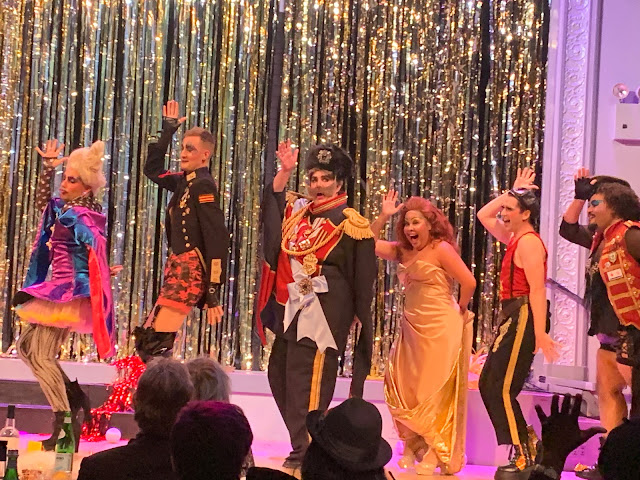
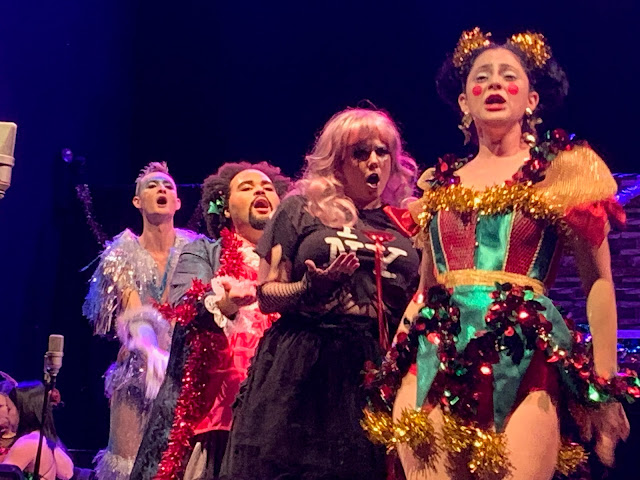
If you came to have a riotous good time you would have been titillated by the off-color repartee and private jokes . If you came to hear your favorite arias professionally sung you would have been well satisfied. If you came because you love cleverly snarky dialogue and lyrics you would have left smiling. If you came for the visual impact you would have been thrilled by the costumes. 

This annual show is always top notch and this one even outdid prior iterations, thanks to the astute direction of Ethan Heard, the fine singing and acting by the cast, the lavish costuming by David Quinn and the outstanding make up design by Maiko Ando. The script was written by Ethan and Peregrine Heard and Jacob Ashworth.

If outrageous costuming is your thing stop reading and look at our FB and IG entries to see why we were so impressed. Nothing anywhere in NYC could have been as colorful and creative. If you came for the snarky gay humor we wish we had a transcript for you to read.  Better yet, you may be able to snag tickets since the show has been extended through next week.

If you are interested in the operatic offerings this is the right place to learn how context is so vital. Arias can be given different shades of meaning by virtue of the setting. Should you be offended by such tinkering, your opinion would have seemed well represented by John Taylor Ward's impression of an opera patroness of the Upper East Side variety. Eventually the hi jinx won her over and she joined in the fun, shedding her pearls and pumps to participate in the foreshadowed orgy. You will not be offended since said orgy takes place behind a white sheet leaving the various shadows to the interpretation of your imagination.

If suffering heroines comprise your operatic taste you might have fixated on Jamilyn Manning's interpretation of Lucia, complete with bloody wedding gown and great big knife. Or you may have preferred the Cio-Cio San of Angela Tam (also a knife-wielder) whose costume echoed contemporary Japanese girl fashions like "decora"and "gyaru". Poor Serena from Porgy and Bess is another suffering heroine and Bernard Holcomb gave her lament "My Man's Gone Now" a unique twist. Multiple pants roles were enacted by Sichel Claverie who, as a male, did not seem to suffer much!

Ears that were attuned to opera were kept entertained, identifying familiar arias and choruses no matter how out of context.  A medley of tunes related to Asian inspired operas and musical theater melded Puccini with Gilbert and Sullivan, Rogers and Hammerstein, Schönberg and Boublil. Vastly entertaining in the moment, it did lead to some reflection on the cultural depiction of Asian women from Flower Drum Song to Miss Saigon to Madama Butterfly.

There was a banquet of cleverness that was supported by a deep knowledge of the repertory. We would have loved to have been a fly on the wall during some of the writing sessions but must be content with marveling at the results. Opera lovers must have had a fine time playing "Name that Tune".  We are sure most of us picked up on the Wagner, the Verdi (loved the "Anvil Chorus" from Il Trovatore) ,the Donizetti, Bellini, Leoncavallo, Händel, and Orff. We probably missed a few such as Rameau's Les Indes Gallants and The Wiz, neither of which we have seen. And what an astonishment to hear Aretha Franklin's version of "Nessun dorma" performed by Mr. Holcomb.

All of the performances were spot on and, as you can see from the photos, David Quinn's costumes were outstanding, as was Maiko Ando's makeup design.  It comes as no surprise that Ethan Heard returned to direct the show; his artistic stamp is always recognizable.

The marvelous musical direction was in the hands of Jacob Ashworth and Dan Schlossberg who played, respectively, violin and piano. Mr. Ashworth made quite an impression as a Valkyrie when he took to the stage after the performance. A guitar and clarinet made up the remainder of the accompaniment and we have nothing but praise for the arrangements.

Although we have occasionally objected to HeartbeatOpera's tampering with the classics, their artistic leanings are always welcome on the occasion of the annual Halloween drag show which we have never missed.  Braving the Greenwich Village crowds and transportation snafus seemed a small price to pay for such an evening. It is amazing to know that a collection of musical and visual artists can conspire to produce an impressive evening like that.

We urge you Dear Reader to get tickets for the few remaining shows. Halloween is such a fun holiday that it seems worth extending the celebration of it for another week.

We will close by expressing the wish that the ghost of Al Carmines, the late Minister of Judson Memorial Church, might have visited the church and enjoyed the production. Mr. Carmines was himself a creator of vast talent and filled the church with a succession of original musical theater performances that were our introduction to the art form. On All Saint's Day, the dead are allowed to return to earth and enjoy an ofrenda from the living-- so our fantasy is not so far-fetched! We think of Heartbeat's production as an ofrenda to the spirit of Mr. Carmines. Does anyone still remember him, his warm and loving personality, and his original productions? We know for a fact that the renowned Ira Siff does, since he starred in one.

© meche kroop


Saturday, May 17, 2025

THE DEVIL MADE ME DO IT


 John Taylor Ward and Rachel Kobernick
(photo by Andrew Boyle)

The Faust legend has been the basis for many literary, artistic, cinematic, and musical works that have reinterpreted it through the ages. Plays and comic puppet theatre loosely based on this legend were popular throughout Germany in the 16th century, often reducing Faust and Mephistopheles to figures of vulgar fun. The story was popularized in England by Christopher Marlowe, who gave it a classic treatment in his 1592 play The Tragical History of Doctor Faustus.  In Goethe's reworking of the story over two hundred years later, Faust became  a dissatisfied intellectual who yearns for "more than earthly meat and drink" in his life.

In terms of the operatic canon, There are dozens of iterations, two of them preceding Gounod's, beginning with Louis Spohr's Faust in 1816 and Berlioz' La Damnation de Faust in 1846. Following Gounod's Faust in 1859, there was Boito's Mefitofele in 1868. And that's just in the 19th century. The 20th century brought many more iterations.

So why wouldn't it be acceptable for Director Sara Holdren to tell the story her own way?    So why not stage scenes in a bar? Why not have the denizens of the bar dance around with party hats. Why not characterize Seibel as a female bartender enamored of the shy Marguerite. Why not replace the original spoken dialogue of Jules Barbier (adapted from Michel Carré's play Faust et Marguerite)  with contemporary chatter? Why not make Martha a yenta who loves shopping? Why not end the opera with Marguerite, Seibel, and Martha having a picnic outdoors with Marguerite's baby in a cradle ?

Part of us wishes that Music Director Jacob Ashworth had commissioned arranger Francisco Ladrón de Guevara to write a contemporary score instead of co-opting Gounod's music. A motley collection of instruments (violin, mandolin, cello, bass, harmonium, piano,flute, clarinet, and trumpet) produced some interesting sounds indeed. But they could also have played original music instead of Gounod's.

Among the singers, baritone Alex DeSocio gave an excellent performance as Valentin with a robust yet mellow tone and a sincerity of acting that made us regret his death at th hands of Faust, a most unlikable character.. We enjoyed his "Avant de quitter ces lieux".The last time we heard him sing he played a nasty bigoted drill sergeant. How odd to see him as a military man once more.

Rachel Kobernik made a shy and innocent Marguerite. John Taylor Ward used his lengthy flexible body to create a very slimy Mephistopheles. We enjoyed "Faites-lui mes aveux" sung by mezzo-soprano Addie Rose Brown portraying  Siebel, but not as a pants role. (We think it's impossible for Heartbeat Opera to resist the impulse to have homosexual references in their productions, witness the love affair between Eugene Onegin and Lensky in their recent production of the Tchaikovsky opera.) The role of Faust was played by Orson Van Gay II and the role of Martha was played  for comic relief by Eliza Bonet.

What set this Faust apart were the special effects; there was perhaps too much of a good thing. Imagination ran high; the execution was sometimes magical and at other times the effects distracted from the singing. Borrowing from Japanese Kabuki theater, puppeteers Rowan Magee and Emma Wiseman, dressed completely in black, manipulated the set and props to magical effect, with objects seeming to float in the air.  Co-Scenic Designers were Forest Entsminger and Yichen Zhou who also designed the effective lighting. Costumes were designed by Elvia Bovenzi Blitz. Nick Lehane designed the puppets. And yes, you did see two puppets copulating.

Gounod's opera was squeezed into two hours without intermission and we found our attention wandering and our senses overloaded by the visual effects. The standing ovation at the conclusion indicated that our tedium was not shared.

Heartbeat Opera will continue to do what they do, reinterpreting the classics, and we have resigned ourself to a position of ambivalence. Sometimes we will see an old work with new eyes, as we did with their recent Salome;  sometimes we will believe that a masterpiece was trashed; sometimes we will enjoy a clever and original reduction of a score as in the all-clarinet chamber orchestra in Salome and in Faust's unusual scoring; sometimes we will miss the traditional orchestral colors.

© meche kroop

Tuesday, October 15, 2024

SLAYLEM WITCH TRIALS


 Judge and Witches at Heartbeat Opera's "Slaylem"

 Those Heartbeat Opera mischief-makers were at it again with this year's version of their annual drag show, this year held at the venerable and oh-so-appropriate Judson Memorial Church, home to wild theatrical events since our earliest days in Manhattan.  Here's a little secret "dish" for you, Dear Reader. Someone very famous in the opera world got his start there portraying The Operatic Prince in Al Carmine's radical interpretation of the fairy tale Snow White. What a glorious thing to return to our very first exposure to NYC's radical theatrical scene!

We have never missed any of Heartbeat Opera's annual drag shows, always marveling at the creativity, originality, and gender bending. One can always count on stunning performances and fabulous costuming and makeup. This year was no exception and an enormous crowd of revelers had the time of their lives enjoying the exposure of hypocrisy from America's past history. 

In the 17th c. the colonies were not immune to the witch hunting craze consuming Europe. Arthur Miller chose to dramatize this embarrassing piece of history with a serious drama The Crucible, referencing McCarthyism, whilst Heartbeat Opera's devilish crew chose to treat the subject with satiric ridicule, which mass hysteria richly deserves. We hope at least some members of the audience were able to draw parallels with some of the issues being dealt with even today four centuries later.

It appears to us that Heartbeat is moving in a more popular direction than it has in prior years, engaging more of the audience by adaptation, changing of lyrics, and inclusion of more contemporary references for which we needed some assistance from our companion who is more familiar with pop culture and pop music than we are.

Some pieces were instantly recognizable such as the "Lacrimosa" from Mozart's Requiem, and "I am the Wife of Mao Tse Tung" from John Adams' Nixon in China. Our opera singer companion was able to identify some bel canto numbers that we missed. And who could have failed to identify Copland's "Simple Gifts" although we did not know it came from a ballet Appalachian Spring, written for the Martha Graham Company.

But this was not the point. The point was to entertain, to amuse, to play mind games by means of double entendre and gender bendingto poke fun at the pompous, and, above all, to make everything outrageously sexual as seen through the LGBTQ lens.  The work brought the audience to their collective feet.

The performers got into their characters with glee, intensity, and over-the-top humor. The always notable John Taylor Ward made good use of his long lanky frame to portray The Judge and Jamilyn Manning White went from Abigail to a sexy red-clad devil. The similarly long and lanky Hans Tashjian portrayed Misery; Bernard Holcomb took the role of Clemency; Angela Yam performed the role of Rebecca; Mercy was portrayed by Rodolfo Girón; Chastity was brought to life by Curtis Bannister. Needless to say, the voices are operatic and nothing was out of their vocal reach. It was a real mind fuck to hear familiar melodies with new English lyrics and to be unable to identify the music!

These unexpected lyrics were supplied by Director Nico Krell, violinist Jacob Ashworth, and Co-writer Garrett Bell. Mr. Krell did a fine job of keeping the story moving with raunchy vignettes. All three are credited as "Creators".

Under the direction of Dan Schlosberg, the orchestra comprised Mr. Schlosberg himself at the piano, Mr. Ashworth playing violin, with Mira Williams playing viola and Julia Henderson playing cello. Just as fantastically costumed (see our entries on Facebook and Instagram) as the stage performers, they did a fine job moving seamlessly from classical music to numbers of the popular genre.

The fantastic costumes were designed by David Quinn and we were most impressed by Ms. White's red devil costume. A sexier devil we have never seen! The costumes of the Pilgrims were grim on the outside but often hid racier elements. Maiko Ando's makeup added to the effects.

This queer extravaganza ended with a touching group sing of "Make Our Garden Grow" from Bernstein's Candide. As Generation Z would say "They ate and left no crumbs.

© meche kroop

Wednesday, May 8, 2024

COMEDY TONIGHT!


 Opera Lafayette performance of Mouret's Les Fêtes de Thalie

It is always an occasion when Opera Lafayette comes to New York City. They are unique in combining scholarship with entertainment and doing a superb job on both counts. We attended the pre-performance lecture and learned a great deal about the historical and musical context of Les Fêtes de Thalie; our companion arrived in time for the performance; both of us enjoyed the performance.  So, although scholarly knowledge added something, it wasn't necessary for the "pleasure principle" to take hold.

It is on this aspect that we choose to focus. The structure of this light-hearted early 18th c. romp by Jean-Joseph Mouret involved a Prologue, in which two Muses duke it out.  Dramatic soprano Angel Azzarra lent her full-throated voice to the role of Melpomene, Muse of Tragedy and the charming lighter-voiced soprano Paulina Francisco appeared as Thalie, Muse of Comedy. 

We were reminded of Richard Strauss' comedy Ariadne auf Naxos in which the down to earth Zerbinetta is in contest with the haughty diva who was to perform a tragedy. But in this opera, a compromise is reached by Apollo (Jonathan Woody) who makes the decision that tragedy would be performed in the winter and comedy in the summer.  Just like today, when we seek lighter entertainment in the summertime. 

After the three acts, all based on the same theme of how women deal with love, there is "La Critique" in which the Muses representing all the arts involved in the production vie for importance. Polyhymnia, Muse of Music (Ariana Wehr, dressed as a conductor) joins Thalie and Terpsichore, Muse of Dance (Pascale Beaudin) and get a rather mediocre review from Momus, God of Mockery (Patrick Kilbride). You will get no such mediocre review here, Dear Reader. We found the entire evening delightful.  This scene brought to mind another Strauss opera Capriccio in which the relative merits of libretto and music are compared.

Sandwiched in-between "Prologue" and "Critique" were three scenes in which cast members took various parts.  In "La Fille", a ship's captain (Jean-Bernard  Cerin) arrives in Marseille bringing with him Cléon (whom he rescued from pirates, played by Mr. Woody.  The captain is unsuccessful at wooing Cléon's daughter (Ms. Francisco) until he flirts with Cléonte's wife (Mr. Kilbride in a frock).

In "La Veuve Coquette", a happy widow (Ms. Beaudin) refuses to give up her single status in spite of the heroic efforts of the wealthy Chrisogon (a very funny John Taylor Ward) and the earnest military man Léandre (Scott Brunscheen) and the urging of her friend (Ms. Azzarra). Do we see a theme here? Yes, we do! We had no idea that 18th c. women were so disinclined to wed!

In the third scene "La Femme" Ms. Beaudin portrays a clever wife who outwits her philandering spouse (Mr. Cerin). She pretends to go away and arrives in disguise at a masked ball her husband is throwing and fools him into believing she is his latest potential conquest. She delays the unmasking as long as possible and when she finally does they both take the joke well. Now she knows he really loves her!  Does this remind you of an operetta? Since this work has lain undiscovered for centuries, it is unlikely to have influenced subsequent composers; but it does remind us that such tropes are common in opera.

Each of the three scenes involved spectacular dancing (Thanks, Terpsichore!) In "La Fille" we had sailors dancing the Hornpipe, choreographed by Julian. Donahue and Julia Bengtsson with dancers from the New York Baroque Dance Company. In "La Veuve Coquette" the dance choreographed by Anuradha Nehru and Pragnya Thamire was a village wedding party and the dancers from Kalanidhi Dance made a fine showing. Perhaps the most exciting dances were those at the masked ball in "La Femme". Particularly exciting was a bullfighter. Those dancers were choreographed by Caroline Copeland.

The colorful costumes were designed by Marie Anne Chiment. Melpomene was dressed in a floor length dramatic caftan of royal purple whilst Thalie was costumed in a motley jacket and mini-skirt with punk look combat boots. The best costumes, however were in  "La Femme" in which we noted some commedia dell'arte characters as well as the aforementioned bullfighter.

We have devoted most of our space to the libretto (by Joseph de La Font) and the colorful costuming and dancing but let us not neglect Polyhymnia. The excellent conductor for the evening was Maestro Christophe Rousset whose effective conducting of Mouret's music was the necessary underpinning for the action, singing, and dancing. 

The Stage Director, Catherine Turocy, kept the action moving briskly and managed to make the work seem not only historically intact but also contemporary and relevant.

The amount of labor it must have taken over a period of several years to bring this lost work to vivid life is astonishing. Musical preparation, coordination of different choreographers, assigning several roles to each artist, getting the entire project onstage--who but Opera Lafayette would have the interest and the means to have achieved all this, a major feather in their already multi-feathered cap.  
We do hope the work was recorded on video since so few people got to experience it. The theater at Museo del Barrio was packed and we assume the theater in Washington D.C. was as well, but it surely deserves a wider audience.

© meche kroop

Friday, November 10, 2023

THE GOLDEN COCK(erel)

Heartbeat Opera Gala Drag Show--"The Golden Cock"

Our beloved Heartbeat Opera has been undergoing major changes for the past couple years.  We are excited about an upcoming Eugene Onegin; they can be expected to put a most original stamp on it, as they usually do. We will withhold judgment until we see/hear it.  But there is never any doubt in our mind about the joyful entertainment provided at their annual drag show.

What we love about them comprises the wildness and originality of the costumes, the imaginative script, the bawdy gay humor, the clever play on words, the excellence of the musical values, and the sneaky topicality.

With Russian operas and Russian singers being cancelled (both literally and figuratively), how completely outrageous it was to do a send up of Rimsky-Korsakov's final opera The Golden Cockerel, composed in 1907 but not performed until after his death. It is rarely produced but six years ago we had the pleasure of seeing it twice! It is the story of an autocratic king who invades an innocent country (!) and gets advice from a bird.  The music is just as glorious as one might expect and the not-so-hidden message was as true today as it was in the early part of the 20th c. and six years ago.

The story was, of course, fractured and splintered to provide opportunities for typical Heartbeat hijinx and double entendres. Rimsky-Korsakov's music received lots of stage time but so did several other Russian composers. Our companion joined me in identifying most of them including Rachmaninoff's "vocalise" and Tatiana's waltz from Eugene Onegin. We also heard some Rossini for good measure.

Musical values are always excellent with Heartbeat Opera. The chamber orchestra comprised Co-Musical Directors Jacob Ashworth (violin) and Daniel Schlosberg (piano) with Angela Shankar playing clarinet and saxophone and Deanne Cirielli enchanting us with her harp. It was impressive that four musicians could create such a full sound, but with Mr. Schlosberg doing the arrangements, we would expect no less.

The singing was exceptional as well with bass John Taylor Ward towering over everyone else. Tenor Elliot Paige is another "regular" that we always look forward to seeing and hearing.  Countertenor Daniel Moody made a fine showing as well. The female voices had less stage time but were also excellent--soprano Ariana Wehr and contralto Sara Couden. Special guest artist John Holiday provided a rare treat as well with his inimitable countertenor

The show was created by  Mr. Ashworth and Nico Krell who also directed. The extravagant costumes were designed by David Quinn. The Master of Ceremonies was Maxim Ibadov. One thing about the annual drag show that impresses us is how well everyone works together; the ensemble feel is unmistakeable. Everyone seems to be having fun and this mood is infectious. The audience was filled with smiling faces.  Yours could be among them if you read this in time.  There will be two shows at Roulette tonight, Friday November 10th. It is well worth a trip to Brooklyn. In these troubled times, there is nothing like gay humor to lift one's spirits!

© meche kroop


Friday, December 17, 2021

FUN(D) RAISING


 John Taylor Ward, Elliott Paige, Alissa Anderson, and Samarie Alicea

Last night marked a major event on the New York music scene. It was the opening night gala of Heartbeat Opera's annual extravaganza; it was extraordinary and extravagant--over the top in terms of concept and execution. With his customary wit and originality, Director Ethan Heard created an evening of satire and camp that left the audience exhilarated. The evening scored high marks even for the fundraising which was actually fun. One would have to be a Scrooge not to make a financial contribution to a company that actually pays its members.

The concept for the show Messy Messiah was having fun with Händel's masterpiece.  Methinks that singers love the piece because they get paid; but perhaps it is overplayed at this time of year and a worthy object for poking, prodding, twisting, and toppling. We adore satire and particularly the LGBTQ version. We want you to go to one of the two shows tonight (if there are seats available) and hesitate to spoil the fun so...if you are going, read no further. Here come the spoilers.

Cast members and musicians come down through Elliott Paige's chimney as this tenorrific artist relaxes by the fire. Lengthy-limbed bass-baritone John Taylor Ward sweeps around the stage with stature exaggerated by what must be platform shoes, fingers elongated into icicle-like appendages. Soprano Samarie Alicea, cute as a button, prances about in harlequinish attire. Adele's "laughing song" from Johann Strauss' Die Fledermaus was given quite the twist. Contralto Alissa Anderson, wrapped in a voluminous black cloak and carrying a lantern, gave us a novel interpretation of "Must the Winter Come So Soon" from Barber's Vanessa. Ballet dancer Jourdan Epstein left us gasping by balancing on point on the top of a wine bottle--on one foot!

We are posting multiple photos on Facebook for those who will not have the privilege of attending. Even those fortunate enough to attend one of tonight's performances will miss one of the highlights of the evening.  A mystery guest arrived wrapped in gold fabric like a gift. Hearing an ethereal voice singing "Vedrò con mio diletto", we instantly recognized the brilliant voice of counter-tenor Anthony Ross Costanzo. How appropriate to portray this guest artist as a gift! 

There were gags both subtle and obvious, including a photo of the late drag persona Divine showing up in the middle of "Oh night divine".

The chamber orchestra was completely in the mood with Music Director and violinist Jacob Ashworth conducting Daniel Schlosberg's inventive arrangements of the Händel, Tchaikovsky, Barber, and Strauss selections. Trumpeter Evan Honse had a fine solo onstage. In the "pit" he played alongside Mr. Schlosberg on the piano, violist Hannah Levinson, oboist Hsuan-Fong Chen, and Mr. Ashworth.

The lavish and witty costumes were designed by Fabian Aguilar and  makeup, by Maiko Ando. Choreography was realized by Eamon Foley.

The energy never let up nor did the dazzlements cease. Heartbeat Opera never heard of the "Irish goodbye".  Just when you thought there could be no further entertainment, on came yet another solo. The evening was capped by a role-reversed onstage proposal. We are keeping that a secret!

© meche kroop

Saturday, November 2, 2019

(RED) HOT MAMA

Curtain Call for Heartbeat Opera's Halloween Extravaganza at Roulette


We have been a fan of Heartbeat Opera since they first started producing opera. We were immediately bowled over by their Daphnis et Chloé, taking Offenbach's silly but bawdy story and telling it in the most creative way. Casting it with fine young voices and creating costuming and sets with far more imagination than expenditure, the work was an immediate hit and won our heart.

Since then, we have watched Heartbeat grow to become a full-fledged opera company producing one hit after another--most often presenting operas with an original take that sometimes thrilled us and sometimes upset us--but always left us feeling involved. Their productions have always been radical, original, and adventuresome; their audience is mainly young. We decided that there must have been something special in the water at Yale School of Drama, where Co-Artistic Directors Louisa Proske and Ethan Heard got their training.

Since we loved theater long before we got interested in opera, we always look at opera productions with an eye for dramatic validity and also for entertainment value. For us, it doesn't matter how famous the stars, how gorgeous the voices, or how well conducted the orchestra is; if the show doesn't work dramatically it doesn't hold our interest.

We are filled with anticipation for their December production of Weber's Der Freischutz, but until then we had our yen for Heartbeat-style entertainment well satisfied by their stunning Halloween show at The Roulette. Using the vital and worthwhile theme of Saving Mother Earth, there was plenty of eye and ear candy to make the bitter pill easier to swallow.

The "plot" followed the line of facing the peril to our planet and reforming ourselves. The theme involved trees ("Ombra mai fu" from Händel's Serse), flowers (the "Flower Duet" from Delibes' Lakme), melting icebergs ("Gelida in ogni vena" from Vivaldi's Farnace), birds ("The Lark Ascending" by Vaughan Williams), global warming ("Too Darn Hot" from Cole Porter's Kiss Me Kate), nuclear peril (John Adams' Dr. Atomic), and so on, right up to the finale of "Make Our Garden Grow" from Bernstein's Candide. Even Stravinsky, Mozart, and Wagner were on board. The cleverness with which the music was pressed into the service of the theme of the show was outstanding.

All the voices were admirable but we were particularly taken with the coloratura of Ariana Wehr who was dressed as a polar bear but still managed to take Vivaldi's vocal lines seriously with admirable ease of fioritura. The always effective John Taylor Ward did double duty as a plant and as the Monster of Climate Collapse.

Patrick Kilbride was covered with flowers and Dustin Ceithamer appeared as Mother Earth.  There was quite a face-off between "her" and the Monster. Clinton Edward and Brendan Henderson danced their way through their roles as birds, choreographed by Eamon Foley.

Words fail us in describing Miodrag Guberinic's elaborate and inventive costumes; we suggest that you see the photos we have posted to our FB page--Voce di Meche where you can also see Maiko Ando's fabulous makeup.

Even the musicians wore wigs and makeup. Musical Direction was by Jacob Ashworth (violin) and Daniel Schlosberg (piano and harpsichord) joined by violist Hannah Levinson and cellist Madeline Fayette. Onstage for the jazzy numbers was saxophonist Michaël Attias.

Props, like the suspended globe, were designed by Corinne Gologursky and Nicholas Hussong provided the projections, mainly quotes from famous people with serious messages consistent with the theme.

Also consistent with the theme was the provision of metal straws with the drinks for guests to take home. We have been using ours!

Significantly, a portion of the ticket proceeds went toward supporting Earthjustice. Heartbeat Opera is known for their socially oriented productions, such as their work with the incarcerated for their production of Beethoven's Fidelio.

This is the kind of work we would be happy to see again; however, like last year's Halloween show, part of the value comes from the knowledge that it is transitory in nature--very much ""of the moment"-- and can be cherished the way one cherishes a flower. The plant which produced the flower, however, is a perennial!

© meche kroop

Sunday, October 28, 2018

DRAGUS MAXIMUS--a Homersexual Opera Odyssey

Justin Mock, Nicolette Mavroleon, Sara Couden, John Taylor Ward, Drae Campbell, and Jamilyn Manning-White at Roulette

We didn't even have to think of a clever title for our review. The supernally creative team at Heartbeat Opera did it for us. Conceived by Co-Artistic Directors Louisa Proske and Ethan Heard, and directed by Mr. Heard, the 2018 version of Heartbeat Opera's annual Halloween drag extravaganza left us grinning from ear to ear. What an overdose of imagination we witnessed, surpassing even last year's Mozart in Space.

The overall concept was that of the blind poet Homer, wearing golden winged shoes provided by Mercury,visiting various mythological creatures in ancient Greece.  He encounters one phantasmagoric creature after another, many of whom offered arias of the Baroque period, when operas were written based on mythology.

The entire evening was dazzling and we scarcely know what to write about first. Since our focus is on opera, let us begin with Nicolette Mavroleon in drag as Nerone singing "Come nube che fugge dal vento" from Handel's Agrippina, fiddling on a golden violin whilst Rome burned virtually through projections by Shawn Boyle. Nero renounces love in favor of political power. We confess to being distracted by her golden costume but not too much to miss appreciation of a fine vocal performance.

Similarly, Jamilyn Manning-White's elaborate black and silver costume, complete with snakes coming out of her head almost distracted us from the world premiere of "Feed the Snakes", composed by Co-Music Director Daniel Schlosberg with lyrics by Royce Vavrek. Ms. Manning-White is a riveting performer with equal dramatic and vocal skills.

These two fine artists reappeared as Sappho and her Muse singing "Pur ti miro, Pur ti godo" from Monteverdi's L'incoronazione di Poppea, the gorgeous final duet between Poppea and Nerone.

Sara Couden impressed as Dejanira singing "Where Shall I Fly?" from Handel's rarely produced Hercules. Dejanira has gone mad after causing the death of her husband Hercules. She gets many changes of mood, color, and tempi.

The always marvelous John Taylor Ward appeared as the scary-looking cyclops Polyphemus, singing "Fra l'ombre e gl'orrori" from Handel's Aci, Galatea, e Polifemo. Who but Mr. Ward has the vocal range and agility to pull off this buffa aria!

In a totally different role, Mr. Ward created a very tall and very skinny leather-bound fly, a manifestation of Jupiter, buzzing around the lovely Eurydice (lovely Ms. Manning-White) who attacked him with an electrified fly swatter, in the duet from Offenbach's Orpheus in the Underworld. There was also a performance of the famous "Can-Can" with a Minotaur doing a split at the end.

Drae Campbell was just right as Homer, feeling his way around with a blind man's cane. Justin Mock appeared as the winged Cupid, as Cerberus (the three-headed dog) and as the Minotaur. Aphrodite was performed by Pearl Harbor, whose real name is Wo Chan. This role was lip-synced and the beautiful voice we heard was that of Peregrine Teng Heard who also wrote the show with Mr. Heard.

Co-Musical Directors Jacob Ashworth and Daniel Schlosberg provided the music with Mr. Schlosberg's arrangements for violin (Mr. Ashworth and Mélanie Clapiès), cello (Clare Monfredo), bass (Dara Bloom) and clarinet (Gleb Kanasevich). Mr. Schlosberg conducted from the harpsichord.

The fantastic costumes, hair, and makeup were designed by Fabian Aguilar, Jon Carter, Miodrag Guberinic, and Andrew Jordan. Their contributions were essential to putting the concept across.

Choreographer was Heartbeat regular Emma Crane Jaster. Lighting was by Krista Smith. Props were designed by Corinne Gologursky.

All of these wildly talented people contributed to an evening that made our heart beat faster. We could not imagine a better celebration of the arts and gender diversity/fluidity!

(c) meche kroop


Thursday, May 3, 2018

THE DON AND THREE COMPLEX WOMEN

Parker Drown, Zina Ellis, Matthew Gamble, Samarie Alicea, John Taylor Ward, Leela Subramaniam, Felicia Moore, Barrington Lee, and Keith Browning
in Heartbeat Opera's Don Giovanni

There is just so much to say about Heartbeat Opera's Don Giovanni which opened last night at the Rose Nagelberg Theater at the Baruch Performing Arts Center! Where shall we begin? Let us save the spoilers for the end so that prior knowledge will not affect your astonishment when you attend--and we truly hope you will! This production had a great deal of buzz last night so do not delay.

We are generally dissatisfied when a director undercuts the meaning of an opera with a self-serving concept. Dear readers, if you have been to the Metropolitan Opera in the past few years you know exactly what we are disparaging. 

But what if a director completely reimagines an opera that we know and love, sweeps away the ingrained clichés, and sheds new light on the drama. A museum piece, adapted by the right hands, can take us to new places with new insights and relevancies. Director (and Co-Artistic Director of Heartbeat Opera) Louisa Proske has the right hands.

Daniel Schlosberg is credited with arranging Mozart's music for Cantata Profana, Heartbeat's resident chamber ensemble. The five strings (string quartet plus bass) were augmented by the clarinet of Gleb Kanasevich and the harpsichord of Aya Hamada. This produced a very interesting sound, but we sometimes felt like something was missing although we don't know enough about orchestration to identify it. For the party scene the musicians joined the action onstage. Conductor Jacob Ashworth played first violin.

Because opera is about the voice, let us tell you how splendidly the cast sang. The astonishingly versatile bass-baritone John Taylor Ward made a superbly seductive Don and used his fine instrument to illuminate the character of a narcissistic sociopath, reminding us of the pussy-grabbing POTUS. Furthermore, his expressive long lean frame added significantly to his performance.

The three women achieved new status in this production. The Donna Elvira of soprano Felicia Moore, whom we know very well from her extraordinary work at Juilliard, was not a comic figure played for derision. Her work was authentic and sincere; she created a believable portrait of a woman who genuinely cares about a worthless man and also cares about rescuing Zerlina from his clutches. The timbre of her voice and her astute phrasing convinced us of her value as a human being, the kind of woman we know as a "rescuer". Her "Mi tradì quell'alma ingrata" was superb.

The Donna Anna of soprano Leela Subramaniam, whom we well remember from her fine work at Manhattan School of Music, was particularly fine, using a fine bright tone to explode the tried-and-true characterization of the virginal young aristocrat. This characterization was a creation of Ms. Proske and Ms. Subramaniam fulfilled it perfectly. Details will follow.We loved the way she sang "Non mi dir".

Soprano Samarie Alicea, well remembered from her work with the International Vocal Arts Institute three years ago, not only sang splendidly but demonstrated major chops as a comic actress. Whatever she felt about the Don came across in her mobile face as well as her flexible voice. Her "Batti, batti o bel Masetto" was beautifully sung and had a twist.  Keep reading!

Baritone Matthew Gamble, whom we remember from IVAI and also from Martina Arroyo's Prelude to Performance, showed his stuff as the much put-upon Leporello. There was a traditional and well sung "Catalogue Aria".

Barrington Lee used a wonderfully rich bass-baritone to enact the Commendatore and also Masetto, managing to color his voice differently in such a successful manner that we thought it was two different singers! This casting strategy was also used at the opera's Vienna and Prague openings in the 18th c.

Don Ottavio was portrayed by tenor Keith Browning who was deprived of both of his arias.

The ensemble singing was notably wonderful.

If you have not seen this production yet, we recommend that you stop reading here and resume after you have seen it.  And see it you must!

Director Louisa Proske has reimagined the story to focus more attention on the women of the #MeToo generation. Each one approaches her sexuality in a different manner. Perhaps you might even recognize yourself in one or more of them. They may be victims or survivors or masters of their own destiny but they are not ciphers.

We have always had a problem with the opening scene of this opera.  If Don Giovanni is raping Donna Anna why does she pursue him? We have always believed that she is in love (or lust) with him and will never ever marry the kind supportive Don Ottavio. But we are not a theatrical director and had to wait for Ms. Proske to make this clear.

The two lovers are going at it hot and heavy in a bedroom when Donna Anna's father the Commendatore bursts in on them.  The girl cowers in shame while the Don kills her father. She cannot admit this to her fiancé Don Ottavio and concocts a rape story.  False news?  LOL.

Neither is Zerlina an innocent. Ms. Alicea's face and body limned her initial scorn and her later willingness to be seduced. She too must put on a show for Masetto and pretend to be innocent. But everything changes when the Don decides that rape is easier than seduction. The sardonic slant and sexual innuendo of her "Batti batti" might have delighted the randy Mozart as much as it delighted us.

Donna Elvira truly wants to save Don Giovanni, as we mentioned above.  She is the "rescuer" and we all know women like that who fall for bad boys and try to reform them.

In Ms. Proske's version (BIG SPOILER HERE) the three women and Don Ottavio gang up on Don Giovanni, strip him naked and beat him. He is left quivering on the ground at the end of Act I and if you want to see some amazing acting, just look at Mr. Ward's feet!

At this point, the orchestration became very very strange. You will just have to hear it for yourself.

In Act II, he is in some kind of hospital room, totally hebephrenic. Measurements are being made, tests are being performed and disturbing appearing treatments are being administered. The other characters are in what appears to be a hospital waiting room, signing documents and comforting one another. Don Giovanni hallucinates; the doctor is perceived as the Commendatore.  He is in a hell of his own making. The horror of this scene is so intense that even the final ensemble cannot relieve it.

The major feature of Kate Noll's set is a large cube with a plate glass side. This served as bedroom and hospital room. What confused us was that there was a neon sign on it reading "MOTEL".  Perhaps the Commendatore saw his daughter's car out in front? Well, there were a couple similar inconsistencies but the transmogrification of plot elements worked for the most part.

Beth Goldenberg's costumes were apt, especially that for the gum-chewing Zerlina whose white wedding dress barely covered the essentials, so to speak. "Come fuck me" shoes completed the fashion statement.

We could go on and on but we hope that by this time you have seen it for yourself. Since a picture is worth a thousand words at least, we will put a carousel of photos from the production on our Facebook page Voce di Meche.  Enjoy!

(c) meche kroop

Wednesday, November 1, 2017

ALL THE WORLD'S A DRAG!

Miles Mykkanen, Lauren Worsham, Ato Blankson-Wood, Joshua Jeremiah, Sichel Claverie, John Taylor Ward, and Stephanie Hayes onstage at National Sawdust

An ABFAB night like last night can only happen when people of extraordinary talent and imagination pool their resources. Heartbeat Opera, enjoying (and they seem to enjoy themselves as much as the audience) their fourth season, put on a show like no other in celebration of Halloween. We love Halloween because we get to dress up and release our inner spirits.

Last night's festivities allowed those who love opera and those who love Shakespeare and those who love the performers (we can put ourself in all three categories) to gather under one roof and celebrate the arts. If only one aria from each and every opera based on a Shakespeare play had been on the program, we would have been there all night--and never complained. If there was one "flaw" in the evening it was that it was too short. We just couldn't get enough.

Just imagine the splendiferous voices delighting the ear whilst dazzling visuals filled the eye! Anyone who remembers Ira Siff's Gran Scena Opera Company will recall fondly how much fun it can be to send up opera. Last night's production fell into that niche of burlesque.

A script by Co-Artistic Director Ethan Heard, Peregrine Heard, and Sara Holdren was spoken by Ms. Heard and contained multiple plays on the words of The Bard. The Bard himself was portrayed by Stephanie Hayes who rocked a golden Elizabethan costume complete with gloves and pumps. 

Shakespeare's comedies involved much cross-dressing and the performances themselves involved young men playing the parts of women. So seeing Shakespeare portrayed by a beautiful young woman, complete with beard and moustache, seemed absolutely on target.

The band, comprising keyboard wizard Daniel Schlosberg and violinist Jacob Ashworth (Co-Music Directors) with clarinettist Gleb Kanasevich and bassist Sam Suggs, opened the program with some instrumental music. Mr. Schlosberg himself arranged the music for this interesting combination of musicians.

Every aria was delivered with excellent vocal technique but an off-kilter style. Soprano Lauren Worsham made a not-so-innocent Juliet, singing "Je veux vivre" from Gounod's Romeo et Juliette. And later, made a down-right slutty Maria from Bernstein's West Side Story, singing the duet "Tonight" with terrific tenor Miles Mykkanen as her Tony. Mr. Mykkanen was resplendent in fuschia, entering on point (yes he has a dance background but has yet to join Les Ballets Trockadero de Monte Carlo).

Baritone Joshua Jeremiah sang a chilling rendition of Iago's "Credo" from Verdi's Otello. Mezzo-soprano Sishel Claverie was just as chilling as Lady Macbeth in the "Sleepwalking Scene" from Verdi's Macbeth. 

Much of the humor derived from the onstage Shakespeare who knew nothing of Brooklyn or Broadway or opera. When he innocently and unwittingly uttered the name of his play Macbeth the stage was filled with menacing projections; it was a moment the audience loved. Another funny moment was the "Exit, pursued by bear" being given a literal manifestation.

From Britten's Midsummer Night's Dream, "Bottom's Dream" was sung by John Taylor Ward in stunning drag, lending new emphasis to "bottom".

Queen Elizabeth herself made a stunning entrance, resplendently gowned and ruffed, in the person of Ato Blankson-Wood. 

It's been a long time since we heard Galt MacDermot's Hair in which he set "What a Piece of Work is Man" from Hamlet.  We also heard something from Purcell's "Faerie Queen". And did we mention the serial lip-synching?

The evening closed with a group sing of Cole Porter's "Brush Up Your Shakespeare" and a very raunchy rendition it was with every double entendre made clear!

Let us give props to some of the other people who contributed so grandly to the success of the show. First there is Co-Artistic Director Louisa Proske who will direct Mozart's Don Giovanni for the Spring Festival next May at the Baruch Performing Arts Center.  This is sure to be revolutionary!

The gorgeous costumes for tonight were designed by Seth Bodie. Choreography was by Emma Jaster. Rachel Padula was responsible for the eye-catching hair and makeup design. Joey Moro lit the show effectively and projection design was by Nicholas Hussong. Great production values like these enhanced the onstage talent.

It was all in fun. A carousel of photos has been placed on our Facebook page--Voce di Meche, since our words cannot convey fully the many delights of the evening.

(c) meche kroop


Wednesday, November 30, 2016

CAT FIGHT AT THE COURT OF THE SUN KING

THE BOSTON EARLY MUSIC FESTIVAL--VERSAILLES: portrait of a royal domain

Anyone who expects early music to be staid or effete would have had their expectations exploded at the Morgan Library where The Boston Early Music Festival came to show us what the court of Louis Quatorze must have been like. Although the fascinating and erudite talk by Benoit Dratwicki (Artistic Director of the Centre de Musique Baroque de Versailles) was largely drowned out by latecomers clumping up and down the stairs, the program notes by Stage Director Gilbert Blin provided ample information to enhance the experience which, truth to tell, required no enhancement!

We were transported to Versailles in 1683 and it was easy to forget that one was sitting in the lowest level of an important institution in 21st c. New York. The highly creative and imaginative Louis XIV moved the court from Paris to Versailles and provided unlimited entertainment for his fortunate courtiers.  There were separate rooms in the palace for opera, dance, art, and poetry with other rooms allocated to grand buffets and intoxicating beverages. Chocolate was particularly prized and must have been brought over from the New World.

Chamber operas with limited casts were created for the occasion with the subject matter being self-referential.  The courtiers got to witness their own lives at court being reflected back musically.

The opening opera by Marc-Antoine Charpentier, Les Plaisirs de Versailles, was our favorite of the three short operas that were presented. Although the librettist is anonymous, Mr. Blin's scholarship presented ample evidence that the text was written by Donneau de Vise and versified by Thomas Corneille. 

Delightful Canadian soprano Mireille Asselin performed the role of La Musique whose vocal efforts were amusingly interrupted by Canadian mezzo-soprano Mireille Lebel in the role of La Conversation, whose constant interruptions led to a very funny fight between the two women, reminding us of Susanna and Marcellina duking it out in Mozart's Nozze di Figaro. The wordplay (translated into English for the surtitles projected above the stage) accused La Conversation of excessive "ill-timed praise".

Eventually the two women are reconciled and civility prevails so that the next opera can be presented.  Actually what we saw and heard comprised two excerpts from Jean-Baptiste Lully's Atys, said to be the King's favorite opera. Canadian baritone Olivier Laquerre was the perfect choice to play Le Fleuve Sangar with the two divinities of the fountain played by soprano Molly Netter and alto Virginia Warnken who harmonized beautifully. Tenor Oliver Mercer sounded sweet as a river god.

The first part of the program closed with a paean to sleep with Le Sommeil portrayed by Aaron Sheehan, John Taylor Ward as Phobetor, and Oliver Mercer as Phantase.  It was tenor Jason McStoots' performance as Morphee that came across with the clearest diction.  We missed not a single word. We also enjoyed his role in the Charpentier as Le Jeu, who was in charge of gambling.

The Sun King himself, portrayed by Choreographer/Dancer Carlos Fittante, entered in une chaise roulante and Part I of the evening ended with everyone going to sleep.  But not the audience! We eagerly anticipated the second part of the program.

Part II comprised Michel-Richard de Lalande's Les Fontaines de Versailles which involved less drama but more music and dancing.  Thankfully, Louis recovered sufficiently from his gout to participate in the dancing--every step a revelation--all performed by the BEMF Dance Company.  We left les grandes appartements of Versailles, just as the nobles did in the 17th c.  and were transported to the gardens of Versailles where statuary came to life. 

Proceedings were led by Latone (Ms Warnken) with Ms. Netter's gorgeous soprano getting a wonderful aria as Flore.  Mr. Sheehan reappeared as Apollon (reduced to second place by the glory of The Sun King), while mezzo-soprano Sophia Michaux represented Ceres, Goddess of the Harvest. Soprano Margot Rood, Mr. Laquerre, and Mr. Ward made significant vocal contributions.

Baritone Jesse Blumberg reappeared in the role of Comus, as he did in the Charpentier and sang with a rich and satisfying tone.  Mr. Mercer was a welcome presence as Bacchus.

We rarely experience an opera in which every single role is as well cast and as well sung!  It was a remarkable display of vocal artistry and a true ensemble experience.  Factoring in the sensational playing of the BEMF Chamber Ensemble and the glorious dancing of the BEMF Dance Company (Melinda Sullivan, Dance Director) as well as the sumptuous costumes by Anna Watkins, this will be an evening long remembered.

Mr. Blin's stage direction was always on point and Robert Mealy made an excellent concertmaster for this talented group of pluckers and pipers.  Paul O'Dette and Stephen Stubbs are Music Directors.

(c) meche kroop

Tuesday, November 1, 2016

OUR HEART BEATS FOR HEARTBEAT OPERA

The cast of Queens of the Night: Mozart in Space

Our customary Halloween Party lost out to Heartbeat Opera; when Co-Artistic Directors Ethan Heard and Louisa Proske plan an event, it takes precedence over anything else we might be doing. We know of no other organization in NYC that has its finger on the pulse of opera-curious young people. It gives us great pleasure to hear a sell-out crowd of 20-somethings hootin' and hollerin' for opera.

How does Heartbeat Opera do this?  Somehow, without diluting the art form, they manage to expand it to include elements that appeal to the young. They choose casual venues (this time the wonderful performance space National Sawdust in trendy Billyburg).

They cast excellent young performers (sopranos Jamilyn Manning-White and Marie Marquis, mezzo-soprano Kristin Gornstein, tenor Jordan Weatherston Pitts, and baritone John Taylor Ward). They have a crew of talented designers (Jon Carter, Miodrag Guberinic, Reid Thompson, Oliver Wason, and Joey Moro). They have excellent Co-Music Directors (Jacob Ashworth and Daniel Schlosberg.

The singing is topnotch and Mozart's music was arranged for string quartet plus bass and keyboard-- which worked well in the wide shallow space with a wide shallow stage. The musicians were clustered at one side of the stage with the rest of the stage available for all manner of fun stagecraft. 

The concept was something about aliens in space with the robot being portrayed by the petite dancer/choreographer Emma Jaster. There was liberal use made of the language of space travel in the script--re-entry and lift-off, control panels and pods, aliens and robots. Costuming and make-up (by MAC) was extravagant and candy-colored wigs completed the colorful imagery. There was unlimited imagination and creativity in evidence.

We got fresh takes on many Mozart standards. If the genius were alive today we think he would have gotten a kick out of Papagena and Papageno discovering sex through touching elbows. He would have laughed out loud seeing Tamino in a dress and wig. He would have thrilled to the fantabulous costume of the dragon, portrayed by Taurean Everett.

But what would he have made of the dragon lip-syncing to Aretha Franklin's version of "Nessun dorma"? We were giggling inside imagining him saying something racy about "that Puccini fella".

Well, everything else was Mozart and if the Puccini got a huge hand, Ms. Manning-White's Queen of the Night garnered an even larger one. 

The event was a benefit and even the fund-raising effort was memorable. We watched a captivating performance that raised $2000 in less than 10 minutes! This young company (just over 2 years old) deserves our support. The future of opera lies with young people and they are drawn in by adventure, creativity, color, imagination, and vitality.  Heartbeat Opera has it all.

Bizet's Carmen and Puccini's Madama Butterfly will be re-invented by Heartbeat in May.  We will be there!  See you there!

(c) meche kroop


Sunday, March 13, 2016

LUCIA!

Jamilyn Manning-White (photo by Russ Rowland)

There is a very fine line between bringing new insights to a work from the 19th c. and trashing it. We are pleased to report that Heartbeat Opera, one of our favorite small opera companies,  belongs to the former category.  Last night we marveled at the insightful adaptation of Donizetti's masterpiece Lucia di Lammermoor. More than an adaptation, we consider it a distillation of the essence of Salvadore Cammarano's libretto and a superb introduction to the opera.

The house was packed for opening night of the festival which includes lots of goodies, as you may learn on their website, www.heartbeatopera.org. It did our heart good to see an audience of 20-somethings thrilling to Donizetti's score in a unique arrangement by Daniel Schlosberg featuring a string quartet, guitar, clarinet, and some dazzling percussion by wizard Bill Solomon.

As directed by Louisa Proske (Co-Artistic Director of Heartbeat Opera), crucial scenes of the story are presented as flashbacks or fantasies of the poor heroine who appears in a hospital bed, struggling against her restraints.  Her reality appears upstage behind a sheer curtain with the memories taking place downstage.

All the crucial scenes were there. We loved the scene taking place at the fountain between Lucia and her friend Alisa in which Lucia frightens Alisa with her ghost story.  One can already see the unbalanced nature that will be pushed over the edge by the manipulations of her brother Enrico; he has been alerted by his captain of the guard Normanno of her secret rendez-vous with Enrico's enemy Edgardo.  Her only supporter is Raimondo, the family confessor, but he too has been deceived and abandons her to a forced marriage with Arturo, chosen for political reasons.

As the eponymous heroine, one could not ask for a better interpreter than Jamilyn Manning-White whose prodigious skills with the fioritura of the bel canto period were matched by her dramatic artistry. Our heart broke for this victim of male privilege.

Tenor David Guzman made a fine romantic partner as Edgardo; baritone Matthew Singer conveyed all the brutality of a selfish brother whose deviousness was informed by political desperation. John Taylor Ward was effective as Raimondo and Monica Soto-Gil made an excellent impression as Lucia's friend Alisa.

Maestro Schlosberg conducted from the piano and his arrangement brought out many interesting voices in the score. We were particularly taken by the wizardry of percussionist Bill Solomon who created sounds to rival that of the glass harmonica one never gets to hear.

Scenic Designer Reid Thompson did much with little.  Costumes by Beth Goldenberg were contemporary.

Although the two operas of the festival were presented sequentially on opening night, the rest of the week permits one to see just one at a time. We wish we could be as enthusiastic about Henry Purcell's Dido and Aeneas but we cannot. The baroque music was gorgeous. Carla Jablonski's Dido sang beautifully. John Taylor Ward's Aeneas fulfilled the promise of his smaller role in Lucia.

However, the English diction was so poor, especially on the part of the women singers, that we felt we were hearing an opera in a language with which we were only slightly familiar.  It was like listening to Russian and recognizing a word here and there.

Nothing about the story was illuminated and the bizarre movements made no sense to us. We sat there totally baffled by the storytelling. There were so-called witches and sorceresses waving branches, occupying a bathtub and masturbating against push-brooms.  This didn't add up to anything meaningful.  Only "Dido's Lament" at the conclusion was meaningful.  We just couldn't figure out what director Ethan Heard (Co-Artistic Director) was going for.

So...we give an unqualified YEA to Lucia and a NAY to Dido. See it at your own risk!

(c) meche kroop