MISSION

We are here to encourage the development of gifted young singers and to stimulate the growth of New York City's invaluable chamber opera companies. But we will not neglect the Metropolitan Opera either. Get ready for bouquets and brickbats.
Showing posts with label Maestro Keith Chambers. Show all posts

Saturday, July 20, 2024

THE USES OF ENCHANTMENT


Emma Ritto, RJ Flud, Noelle Carlson, Maestro Keith Chambers, Director Sarah Beckham Turner, Morena Galan, Jessica DeGennaro, Brooklynn King, and Elizabeth Barsalou

People go to the opera for all kinds of reasons: some consider it an elegant social event, some go to hear famous stars, some go because they love the music.  Having come to opera from the world of theater, we find ourselves happiest when we see a good story amplified by music and brought to life by skilled artists. We love melody and feel alienated by prosy dialogue and non-melodic music. We find ourself favoring operas from the baroque period through the period of realismo with a special affection for bel canto.

Last night, thanks to Manhattan Opera Studio, we got to enjoy one of our favorite operas, Hänsel und Gretel composed by Engelbert Humperdinck and premiered in 1893, conducted by none other than Richard Strauss. Aside from a student production at Manhattan School of Music (with piano accompaniment) which we enjoyed and an overblown production at the Metropolitan Opera which we did not enjoy, Manhattan Opera Studio has been the major presenter of this charming and ultimately satisfying opera.

This is their third mounting of the opera and, in our opinion, the most successful.  For once, all the roles were well cast and the astute direction by Sarah Beckham Turner confirmed our opinion that opera singers make the best directors.. As usual, the conducting of the chamber orchestra by Maestro Keith Chambers was right on point and (perhaps because of the necessarily odd arrangement of the orchestra on the side of this long narrow hall at the National Opera Center) seemed to favor the winds.  We have no complaints on that situation. As a matter of fact, our only complaint of the evening was the projection of titles in an awkward rhyming translation that added nothing, since the story is well known and the singers' German was universally quite good.

We admit that our two prior reviews (available by entering Manhattan Opera Studio in the search bar of this website) were rather detailed on the story of this opera's composition and quite eloquent on the subject of fairytales and Bruno Bettelheim's psychological analysis thereof. We eschew self-plagiarizing and hope, Dear Reader, that you will take advantage of the search bar!

Let us instead focus on the very special performances of the young artists, all of whom we heard in recital recently. It was particularly revealing to see how well they handled their characterizations, abetted by costuming, cosmetics, and fine direction. Performing in a theatrical piece draws on many more talents than singing arias and duets in concert.

The lead roles were taken by mezzo-soprano Morena Galan as Hänsel and soprano Jessica DeGennaro as Gretel. Their voices harmonized beautifully and their interaction reflected an abiding affection as well as sibling rivalry and endearing gender based differences. Not every mezzo soprano is as convincing in a pants role as Ms. Galan and we found ourself touched by the brother-sister interaction.

Brooklynn King was equally convincing as their mother Getrud, portrayed as a basically decent person who was so concerned about the lack of food that she took it out on the children as anger at their laziness. Who hasn't seen a mother punishing her children for her own failures and guilt!

RJ Flud's Father Peter did an excellent job portraying a man drunk with success selling brooms-- and also by a  celebratory stop at the local tavern. Gertrud's hostility melts when she realizes that he has fulfilled his role as provider.

The Gingerbread Witch was brought to vividly wicked life by Noelle Carlson whose facial expressions and body movements went almost over the top. Riding a broom (one perhaps made by Peter?) brought to mind the origins of the myth of the broom-riding witches used to burn witches in the darker ages of Europe.

As the Sandman we saw Elizabeth Barsalou disguised beyond recognition with shaggy white beard and hair.  Emma Ritto made a fine Dew Fairy and injected some sly humor as she tried and tried to wake the sleeping children from their forest slumber. 

The chorus of angels dressed in white did double duty as the children who had been baked into gingerbread cookies by the witch. They comprised Abigail Hite, Tang Li, Lauren D'Ottavio, Andrea Sandor, Erin Hinds, and Abbey Engelmann. In a fine directorial touch, their blank stares melted when they received the human touch of Hänsel and Gretel.

Maestro Chamber's conducting elicited every melodic theme of the score and never neglected the Wagnerian harmonic touches.

In place of sets, there were a few storybook projections above the stage that helped to orient the setting without interfering with the action or storytelling.

Bettelheim's thesis in his book The Uses of Enchantment, posited that fairytales help children to work through their psychological struggles and fears.  Here we have a happy ending to the fear of parental abandonment. Perhaps our adult satisfaction with the opera suggests that adults may still be working through the same fear!

© meche kroop


Sunday, May 21, 2023

BORGIA NON BORING


(at left)  Toni Marie Palmertree

(Photo by meche kroop)


(at right)  Eric Botto and Madison Marie McIntosh

(photo by meche kroop)


Gaetano Donizetti's 1833 opera Lucrezia Borgia was given an impressive concert performance last night at The Center at West Park. With musical values this strong, it should have been staged at The Metropolitan Opera. Why is this bel canto masterpiece so rarely staged? Was Victor Hugo's play (on which Felice Romani based his libretto) too shocking by its incestuous hints? Are the lead roles too difficult to cast?

We do believe we saw it at Caramoor about 10 years ago with Angela Meade in the challenging title role. We don't recall sets so perhaps it was also in concert version. The opera has everything one would wish for in a bel canto opera--a melodramatic plot (very loosely based on history), engaging melodic aspects, interesting orchestration, and opportunities for superstar singers. Last night's performance met all those requirements from the opening percussive rumbles and horn declarations to the final tragic finale.

Maestro Keith Chambers elicited a superlative performance from his orchestra and the roles were sung as grandly as one would wish for. As the titular anti-heroine, Toni Marie Palmertree dazzled with fioritura fireworks and sensitively colored her voice to suit the various circumstances--from tenderness toward her son to firmness toward her husband. The vocal lines flowed like warm honey. The vibrato filled the sanctuary with overtones.One could not have wished for a better performance in this treacherous role.

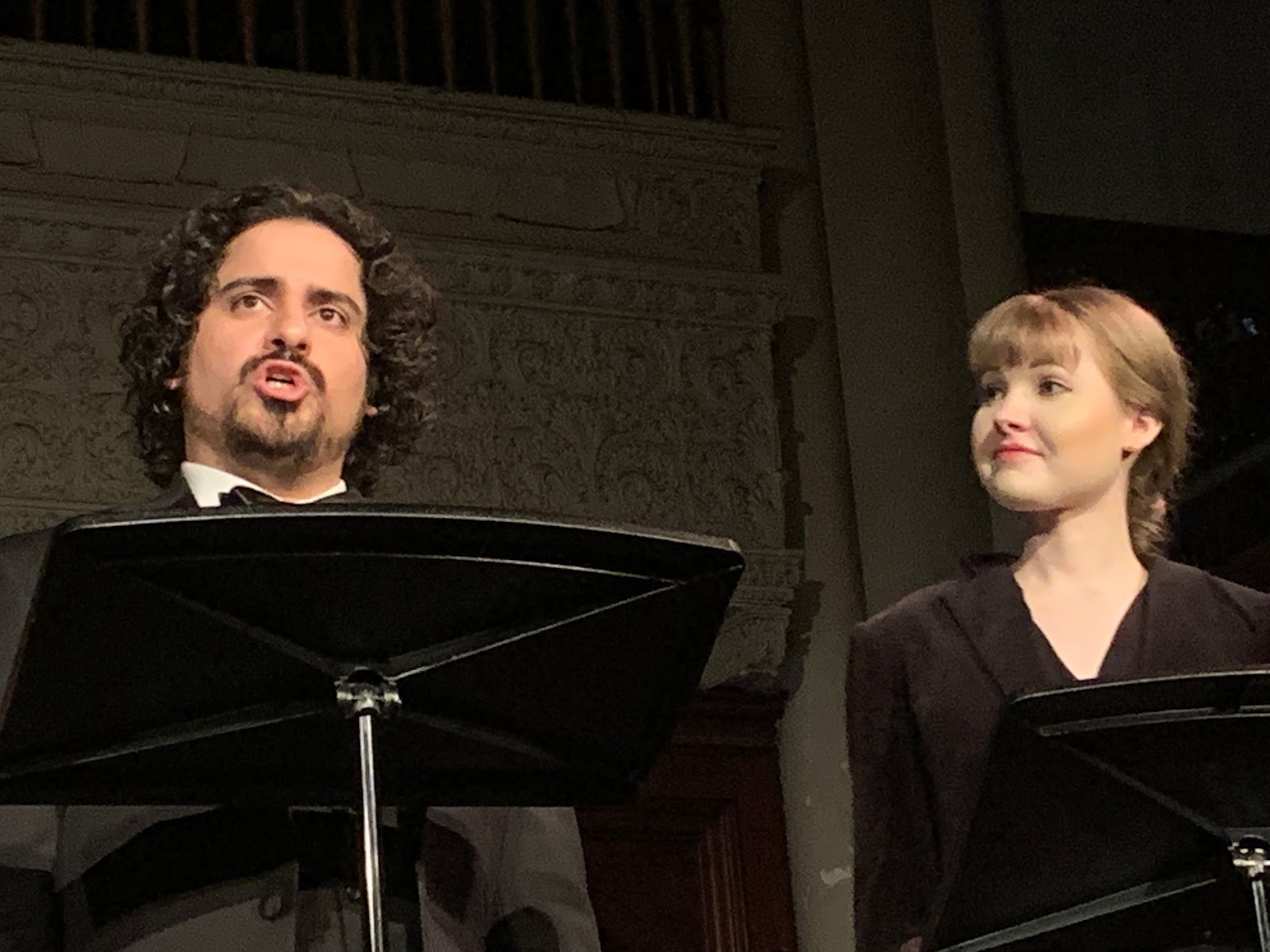
As Gennaro, her illegitimate son who had been raised apart from his ill-reputed mother, we heard tenor Eric Botto who filled out his role nicely. Unaware of  Lucrezia's identity and having been warned of her dangerous nature, his approach to her was wary.  But when singing with his friend Maffio Orsini. his voice wa colored with warmth. When there are no sets and costumes to help the story along, and when audience members do not wish to distract themselves from the singing to look at titles on their cell phones, these vocal colorations assume an outsize importance. We particularly enjoyed his duets with Orsini.

Which brings us to the remarkable performance of mezzo-soprano Madison Marie McIntosh as Maffio Orsini. She excelled at creating a character, an important character by virtue of his closeness to Gennaro. The vocal colors that we so appreciated were augmented by meaningful facial expressions and gestures that defied the limiting aspects of the concert style production and the presence of the music stand. We couldn't help wanting to know more about Orsini's friendship with Gennaro. But that could be another opera! This artist has an enormous range and can dazzle with her upper extension and then wow us with husky low notes. We loved the accuracy of the embellishments and skips.

As the jealous husband, Don Alfonso, Duca di Ferrara, bass Eric Lindsey made a fine showing with growling low notes and an effective pianissimo As his confidant Rustighella, tenor James Danner made the most of a small but vital role.

The group of hotheaded young nobles who set the story in motion (by deleting the letter "B" in the Borgia family crest) was played by  four fine singers who held their own individually as well as in the ensembles. Tenors Scott Rubén La Marca and Pedro Barrera took the roles of Jeppo Liverotto and Oloferno Vitellozzo, respectively. Baritone Wilbert Kellerman sang the role of Ascanio Petrucci and bass-baritone Nate Mattingly took the role of Don Apostolo Gazella. Although it may not have been appropriate in this concert version, we longed for some differentiation of character. Nonetheless, the harmonies were deftly handled.

We enjoyed the lively chorus as well as they contributed to the musical texture. The score and orchestral parts were supplied by Maestro Eve Queler who must have conducted the work with her Opera Orchestra of New York at Carnegie Hall but that was probably before our time. It is indeed a pity that this opera has been so overlooked. The music is melodic and memorable.  And yet, the only piece that we heard before was the Brindisi "Il segreto per esser felice" and it is this piece that is running through our head!

© meche kroop

Sunday, May 29, 2022

THE SCOTTISH OPERA


 Nate Mattingly, Kofi Hayford, Arnold Livingston Geis, Katy Lindhart, Maestro Keith Chambers, Kathleen Norchi, Joe Lodato, and Laura Zahn

We have no idea what initiated Europe's fascination with Scotland in the early 19th c. but the stories of Sir Walter Scott were adapted by Eugene Scribe as the libretto for François-Adrien Boieldieu's opéra comique La Dame Blanche a full decade before another of Scott's gothic tales became the plot of Bellini's tragic opera Lucia de Lammermoor. Other operas with elements of the fantastic were to follow--Meyerbeer's Robert le Diable and Gounod's Faust.

Here we have the requisite castle in an exotic locale, a lost heir, a hidden fortune, and a ghost, a benevolent one. By virtue of the good graces of Maestro Keith Chambers' New Amsterdam Opera, utilizing the score donated by Maestro Eve Queler, who presented the work about 30 years ago with her Opera Orchestra of New York, opera lovers had an opportunity to thrill to Boieldieu's gorgeous melodies and some very fine singing.

A capacity crowd greeted the work with uncommon enthusiasm and gave the superlative cast the accolades they deserve. Maestro Chambers was in complete command of his orchestra, of which Stephan Fillare was concertmaster. Harpist Kate Sloat stood out by providing the soothing arpeggi running through the score at just the right moments.

The story concerns the fate of a castle in a Scottish town and whether it would wind up in the hands of the greedy steward Gaveston (sung by bass Kofi Hayford) or those of the tenant farmer Dickson (baritone Joe Lodato). The climatic auction scene resolves the bidding war and the castle winds up in the hands of the legitimate heir Julien (tenor Arnold Livingston Geis)  who had gone missing under strange circumstances and reappeared as the soldier Georges. Julien will marry the clever Anna (soprano Katy Lindhart) who was Julien' childhood sweetheart. Of course they will live happy ever after!

The work begins with a spirited overture involving sweet melodies alternating with a martial theme, and a frisky staccato one. One could be excused for thinking a ballet was about to follow since the overture was written by Adolph Adam, a pupil of Boieldieu who went on to compose the music for Giselle and Le Corsaire.

There is a celebratory chorus followed by Georges' entrance aria which announces his military profession. Mr. Geis evinced a full throated and well supported tenor which was given many more opportunities to shine. There was a lovely trio with Dickson and his wife Jenny ( soprano Kathleen Norchi) as the couple offer him hospitality and learn about the vagaries of his life.  Jenny's ballad about La Dame Blanche, the spirit guardian of the estate, was delivered with both wonder and soul. Ms. Norchi has a most appealing stage presence with a delightful feel for her character illuminated by a bright clear tone which soared over the orchestra. Mr. Lodato sang with geniality and firmness coloring his substantial baritonal resonance. 

In Act II, we finally get to meet the heroine, the lovely and clever Anna who has also had a strange and varied history. Ms. Lindhart is blessed with a superb instrument that she knows how to play. We appreciated her very fine vibrato and an abundance of overtones in the resonance. In duet with the old housekeeper Marguerite (mezzo-soprano Laura Zahn) the blended voices of the two women gave Boieldieu's harmonies a splendid execution.  Moreover, their exaggerated facial expressions amplified the storytelling of Steven Herring as he narrated the plot points.  His text was originally written by Nico Castle and he added quite a bit. In a concert production we have never seen the singers use facial expression so successfully and we enjoyed every grimace and grin.

Mr. Geis got another opportunity to show off his sweet tenor in the cavatina "Viens, gentille dame" with horn accompaniment. There was a change in force and tempo and a return to sweet melody.  What a fine messa di voce we heard! The act ended with a brilliantly composed and well knit septet which one might say owes a debt to Mozart. Ms. Lindhart got to show off an enchanting glissando.

The final act gave her yet another gorgeous melodic aria with more glissandi and some descending scale passages offering all manner of challenges which she met effortlessly. We don't know the French word for fioritura but we loved it just the same.

Mr. Geis got yet another chance to shine in his final aria in which Georges recognizes the castle he grew up in.  What a wealth of vocal effect!  Descending arpeggi and upward skips, all joined by that glorious harp.

There is much to be done to resolve the plot involving a disappointed Gaveston, so well portrayed by Mr. Hayford's deeply resonant bass and mobile expressions, and a Justice of the Peace named MacIrton, successfully sung by bass-baritone Nate Mattingly with requisite attention to the officious attitude of his character. Fortune is found, truths are revealed, and the estate is settled.

What a coincidence that we reviewed both of these fine singers already this month, Mr. Hayford in a vocal concert at the National Arts Club and Mr. Mattingly in Garden of Alice produced by City Lyric Opera. Both reviews can be found by using the search function on this page.

Photos of the singers can be found on both our Facebook pages--Meche Kroop and Voce di Meche.

© meche kroop

Sunday, October 27, 2019

FOR HAITI CHILDREN

Madison Marie McIntosh, Kofi Hayford, Damian Wayne Faul, Susie Scott Krabacher, Wil Kellerman, Reyna Carguill
Kelly Griffin, Amanda Tarver, Steven LaBrie, Raymon Geis, and Maestro Keith Chambers
The beautiful Madison Avenue Presbyterian Church played host for yesterday's benefit performance, organized by composer Theodore Christman who is writing a music theater piece (a word less "scary" than opera to those who think they are two different forms of entertainment) based on the inspiring career of Susie Scott Krabacher.

Ms. Krabacher has written a book describing her 25 years spent facing the many challenges of helping the children of Haiti. She has taken unwanted children from orphanages, many of whom are handicapped, and provided food, shelter, education, and medical care. She hopes to educate future leaders for this unfortunate island nation, people who will pull Haiti out of its present hopeless-appearing situation. She is one of those people who create hope.

This does not sound, at first hearing, like material for "musical theater". However we got a preview of three songs from the work and were delighted by the clever and punchy lyrics of Donna Gay Anderson which matched perfectly with Mr. Christman's tuneful music. You heard right, dear reader! Mr. Christman's music is melodic, as we have written on several prior occasions. It was just waiting for the right story and the right librettist. We do believe he's got it and are looking forward to Unfolded, as it is called.

In "Babies for Sale", Amanda Tarver played Madam Marcellus, an unscrupulous woman trying to wrest money from a young couple. In "Wash the Dirt", mezzo-soprano Madison Marie McIntosh, portraying Ms. Krabacher, was given a strong melody to sing as she confronts her younger self, portrayed by soprano Michelle Guillot. "The Standoff" portrays a fictionalized version of Ms. Krabacher meeting her husband (baritone Wil Kellerman) for the first time. The acting and singing were similarly on point. Truth to tell, we hope Ms. McIntosh will be chosen to play the role.

The rest of the program comprised opera standards, ones we always love hearing. Ms. McIntosh is a young singer we have been writing about for several years. Possessor of a creamy mezzo with a dazzling upper extension, she is particularly perfect as a Rossini heroine. The flexibility of her instrument makes all kinds of embellishments seem natural and organic with respect to the character's feelings.

She opened the program with a tender performance of Mr. Christman's setting of "Ave Maria". There was a delicate diminuendo requiring exquisite breath control that had us holding our breath. His skill with writing melody made this a valuable entry among the many settings of this prayer. 

Her aforementioned artistry with Rossini could be appreciated in "Una voce poco fa" from Il barbiere di Siviglia. She evinced Rosina's spunky personality with a precision of fioritura and tickled us with a rolled "r" in "trappole"; it's the tiny details that set a singer apart from the others.

She also "plays well with others" as we observed in the famous duet "Mira, o Norma" from the Bellini opera in which her Aldagisa was matched with the Norma of Reyna Carguill who was previously unknown to us. Her sizable soprano was heard later in "Ebben? Ne andrò  lontana" from Catalani's La Wally. She impressed us with her breadth and depth of tone, just right for verismo roles.

Kelly Griffin is another soprano with a sizable instrument, making her perfect for dramatic Verdi heroines. We have heard her sing "Pace, pace" from La forza del destino more than once and might have been disappointed not to find it on yesterday's program; however, she was equally effective in "Tacea la notte placida" from Il trovatore.

Her duet from Verdi's Un ballo in maschera--"Teco io sto" was sung with tenor Raymon Geis as Riccardo. Both singers did justice to Verdi's magnificent melodies.

Mr. Geis had a fine solo in "Dein ist mein ganzes Herz" from Franz Lehár's Das Land des Lächelns. He paid exquisite attention to the meaning of the text and carressed each word in the pianissimo sections, then drew the piece to a thrilling climax.

His duet from Bizet's Les pêcheurs de perles-- "Au fond du temple saint", sung with baritone Steven LaBrie, involves two men both bedazzled by the same presumably unavailable temple priestess. We picked up some teetering on the edge between trust and mistrust. 

Mr. LaBrie's solo was María Grever's popular "Júrame" which, in his golden throat, took on the quality of an art song, sung with sincerity of feeling instead of the customary grandstanding. We have been writing about Mr. LaBrie since we began writing and have always found his performances to be artistically and emotionally genuine.

There were a couple selections on the program that are not exactly opera. Amanda Tarver, previously unknown to us, performed a song by Jake Heggie with very funny divinely irreverent lyrics by Gavin Geoffrey Dillard. "In the Beginning" is a spoof of the first verse of the bible and is part of a cycle we've never heard called Of Gods and Cats. If we ever get to hear the entire cycle it just might change our mind about Mr. Heggie. Ms. Tarver's delivery was delicious.

Bass Kofi Hayford has pleased us with his resonant bass on prior occasions. Yesterday he sang "Old Man River" from Kern and Hammerstein's Showboat, which we consider an American opera, especially when sung unamplified by such a well trained voice . The feeling ran deep as the river itself and the low tessitura presented no challenge for Mr. Hayford.

And finally, we heard Damian Wayne Faul perform "If I Loved You" from Rodgers and Hammerstein's Carousel, another work we consider an American opera. Mr. Faul also eschewed grandstanding for the sake of character, strangely giving  Billy Bigelow an accent that was more Southern than New England. Oh well, as a carnival barker perhaps he was itinerant!

Accompanist for the concert was the always wonderful Maestro Keith Chambers.

It was a fine afternoon of music, not to mention the lovely reception at which we got to speak with Ms. Anderson and Ms. Krabacher who has written an inspiring book about her life and experience in Haiti--ANGELS OF A LOWER FLIGHT: One Woman's Mission To Save A Country One Child At A Time. We hope that Mr. Christman's opera will serve to call attention to her work as founder and president of the Mercy and Sharing Foundation (www.haitichildren.org).

© meche kroop


Sunday, March 31, 2019

NEW AMSTERDAM OPERA SALON GALA

Kofi Hayford, Kevin Johnson, Maestro Keith Chambers, Jonathan Green, Rachelle Pike, Sara Beth Pearson, Raymon Geis, and Eugenia Forteza

What a special Saturday night!  We enjoyed a surfeit of aural, culinary, and intellectual nourishment provided by New Amsterdam Opera. The legendary culinary creations of Leslie Ritch were accompanied by appropriate libations; renowned artist manager Ken Benson was on hand to instruct us about Massenet's rarely heard opera Hérodiade and how it differs from Richard Strauss' Salome; the cover cast of the upcoming May 10th (SAVE THE DATE) production by New Amsterdam Opera provided the entertainment, teasing us with a selection of arias, duets and an ensemble from the opera.

As much as we enjoyed eating, drinking, and socializing with the luminaries of the opera world who attended (including Eve Queler and Jane Shaulis) let us get right to the music which was outstanding. We were wondering "If the cover cast is this stellar, what must the first cast be like?" Maestro Keith Chambers was at the piano and the works were performed concert style, mainly "on the book".

There were only two selections that are well known. "Il est doux, il est bon", which we just heard at the Manhattan School of Music Ades Competition, is a tender aria upon which Massenet lavished abundant melody. Soprano Sara Beth Pearson as Salomé gave it a beautiful reading with bright tone in the upper register. As Mr. Benson pointed out in the introductory lecture, she is not the lascivious heroine of the Strauss opera, but an innocent young woman in love with the prophet Jean (John the Baptist).

There is an impressive duet between Hérode (sung by the fine baritone Jonathan Green) and his wife Hérodiade (given intense life by the excellent mezzo-soprano Rachelle Pike). Here the music was strange to our ear. "Venge-moi...Ne me refuse pas" is a wife's attempt to get her husband to soothe her injured feelings in a kind of "Let's you and him fight!". Ms. Pike sang with appealing resonance and fiery drama. 

In "Calmez donc vos fureurs", the lovesick Salomé tries to win over the resistant Jean, sung by the terrific tenor Raymon Geis.

The duet "Que ce philtre...Vision fugitive" is the other selection from the opera that one gets to hear rather often. Here, Hérode acquires some kind of sleeping potion from a Babylonian woman, portrayed by soprano Eugenia Forteza, whom we are always happy to hear. Here, we got a clearer picture of Mr. Green's pleasingly textured vibrato.

Just like at the Metropolitan Opera, we had an intermission special--an opera quiz which was way too challenging for us but not for the contestants--critic John Yohalem, pianist William Hicks, and OperaWire co-founder and editor-in-chief David Salazar.

Bass Kofi Hayford lent his interestingly textured voice to "Dors, o cité perverse!...Astres étincelants" in the role of Phanuel, an astrologer. We look at the stars and see STARdom!

Awaiting execution, Jean sings "Ne pouvent réprimer" and here we got to appreciate Mr. Geis' delicate vibrato and emotional connection, as well as some lovely arpeggi in the piano accompaniment, so beautifully played by Maestro Chambers.

The Act III ensemble "Peuple juif" brought all the singers together, along with Vitellius, the Roman Consul, sung by Kevin Johnson in warmly resonant low tones.

All of the singers exhibited fine French and were easily understood. We don't know who has been cast for the May 10th performance at The Center at West Park on West 86th St. but we would not have a moment's disappointment to hear any of the singers we heard tonight.

We hope you will be tempted to share this performance with us. We don't believe New York City has heard this opera in twenty years when Maestro Eve Queler conducted it with Opera Orchestra of New York at Carnegie Hall. It's about time to revive it!

We cannot close without lauding the encore which was from Richard Strauss' comic opera Die ägyptische Helena. Soprano Kirsten Chambers has a voice made for Strauss and we loved her aria "Zweite Brautnacht". Perhaps New Amsterdam Opera might consider giving us the whole enchilada!

If you like the sound of this gala evening, you too can become a member of the New Amsterdam Opera family. The post-salon reception lasted way longer than planned because the "family" remained in lively and rewarding conversation long after the food and drink were stowed.  Now that's a memorable evening!

(c) meche kroop