MISSION

We are here to encourage the development of gifted young singers and to stimulate the growth of New York City's invaluable chamber opera companies. But we will not neglect the Metropolitan Opera either. Get ready for bouquets and brickbats.
Showing posts with label Maestro Ryan Brown. Show all posts

Tuesday, May 16, 2023

EDUCATION, ENLIGHTENMENT, AND ENTERTAINMENT


 Patrick Kilbride, Hannah De Priest, and Jonathan Woody 
Pergolesi's La servante maïtresse

Opera Lafayette's annual visit from Washington D.C. is always cause for celebration and the thunderous applause at the end of this week's visit manifested the high esteem in which they are held by their New York audience. This year's theme focused on Madame Pompadour, mistress of King Louis XV, radical, and patroness of the arts. Three events explored her influence upon and appreciation of mid-18th c. music. Sadly, prior commitments prevented us from attending the first two evenings but we made up for it in our own appreciation of the final evening.

We know of no other company that puts such a premium on scholarship, presenting artistic works in a socio-political context. The 120-page program book, fronted by a beautiful portrait of Mme. Pompadour, was thoroughly researched and highly educational. The pre-opera lecture, given by Dr. Julia Doe from Columbia University's Department of Music, was as engaging as it was instructive. The composer of the evening, Giovanni Battista Pergolesi, lived only a quarter of a century but his contributions altered the course of musical evolution. A precocious musical genius, he studied in Naples and brought his fresh direct simplicity to Paris. He died of tuberculosis but achieved posthumous fame. Many compositions claimed to be of his authorship but in fact he composed only thirty.

One of these was a one-act comic opera called La Serva Padrona, meant to be a "palate cleanser" in between the acts of an opera seria. However, it achieved fame outside of Europe and was translated into French and known as La servante maîtresse. This is what we saw and heard last night as a stand alone work followed by a tragedy-- about which more later.

In this comedic bonbon, the wealthy bourgeois Pandolfe (bass-baritone Jonathan Woody) is manipulated by his servant Zerbine (Hannah De Priest) into marrying her. The backstory is that he had procured her from her family and raised her to serve him; she was strong-willed and bossy toward his manservant Scapin (Patrick Kilbride) and resistant to serving Pandolfe. She finally succeeds in getting his "proposal" by enlisting the services of Scapin who impersonated a most unsuitable suitor, making Pandolfe feel jealous but also protective of her. It is a silly trifle with echoes of commedia dell'arte but the music is gorgeous. Maestro Ryan Brown, the Artistic Director of Opera Lafayette, conducted with fine attention to detail and the balance of instrumentation among the strings, a pair of French horns, a bassoon, and a harpsichord.

Much credit goes to Director Nick Olcott who kept the action moving and who provided translation of the text with spoken dialect in clever rhyming couplets. This struck us as a genius move which contributed to the fine French singing and on point acting. Marsha LeBoeuf's costume design was perfectly a propos and inventive to the point that when Zerbine gets "promoted" from servant to wife, she removes her serving apron to reveal an elegant dress. There are more photos of the production to be found on our Facebook page Voce di Meche. Lest you think that simplicity eliminated vocal decoration, let us reassure you that we relished every bit of fioritura.  It was thoroughly enjoyable.
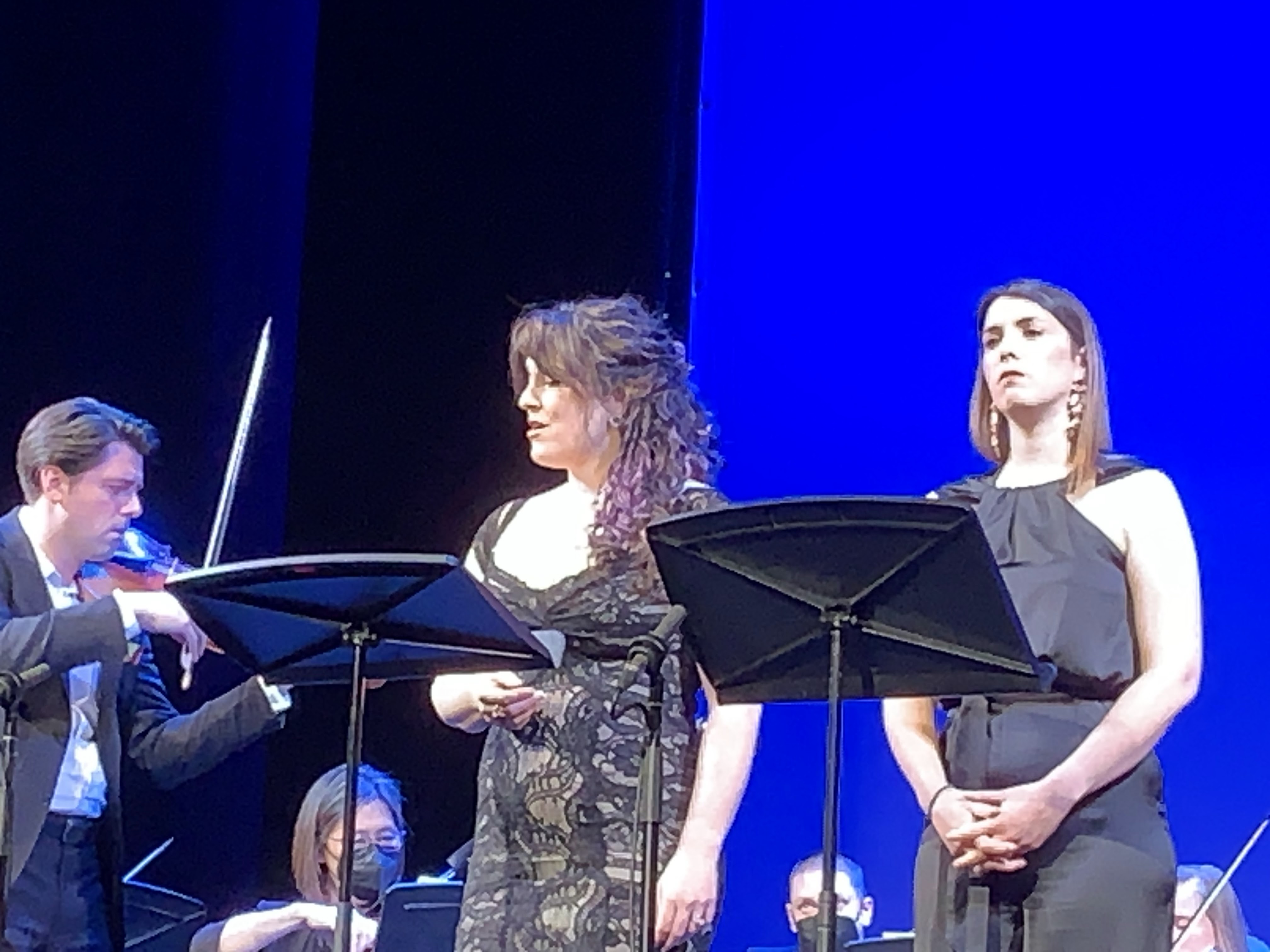

Jacob Ashworth, Sarah Mesko, and Gwendoline Blondeel

Tragedy followed comedy after intermision. Pergolesi's  Stabat Mater comprises a dozen sections dealing with the effects of the crucifixion on Jesus' mother Mary. That Pergolesi managed to give each section a different mood and color is testament to his genius. The work was sensitively sung by soprano Gwendoline Blondeel and mezzo-soprano Sarah Mesko. Ms. Mesko, unlike so many mezzo-sopranos who are barely distinguishable from sopranos, has a richly textured mezzo sound that had us mentally casting her as Carmen and Dalilah. We were not at all surprised, when we got around to reading the program notes, to learn that Carmen is one of her signature roles. The gorgous voices of these two women were blended together in a few duet sections adding even more interest. The work was successfully conducted by Concertmaster Jacob Ashworth, known to us from his work with Heartbeat Opera. 

It was a very special evening in both conceptionn and execution. Were we to have a flute of champagne at hand, we would raise it to toast Opera Lafayette!

© meche kroop

Wednesday, November 2, 2022

A VISIT FROM OPERA LAFAYETTE


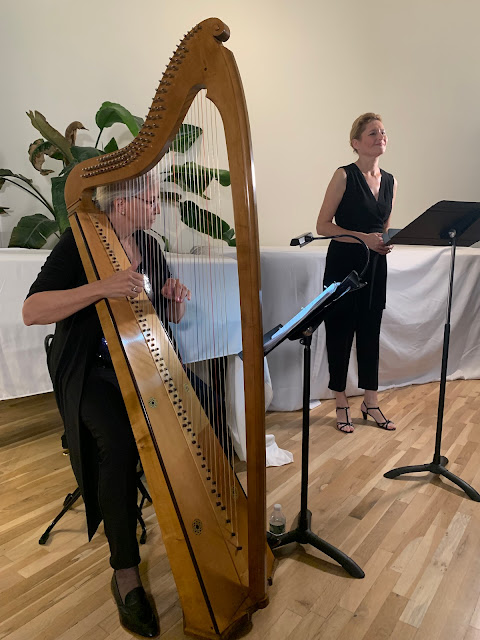
 Christa Patton and Markéta Cukrová

It is always a special event when Opera Lafayette comes to New York City from their home in Washington D.C.  The company makes an annual visit in the Spring, bringing neglected masterpieces, mostly from the 18th c. Opera Lafayette can be counted on to provide not only entertainment but education, by means of lectures which illuminate the operas that are presented.

Artistic Director Ryan Brown came to town for a short visit to pique our curiosity about this season's works and we will only give you a hint--they relate to Madame Pompadour--and we urge you to watch our FB page for advance notice. And if you cannot wait, go directly to their website (operalafayette.org).

Guests at this private event were treated to a delightful performance of Baroque music at a lovely space in Chelsea, not to mention a generously provided spread of delicacies and wine. But we are not here to talk about food (our other passion) but to tell you a bit about the music.  

Czechoslovakian mezzo-soprano Markéta Cukrová was accompanied by Christa Patton on a Baroque harp. True to Opera Lafayette form, we were not only entertained but also enlightened by Ms. Patton who demonstrated the unusual features of her harp.  Not only does it lack pedals but it has a third row of strings. Something that was entirely new to us is that the flats and sharps are played on different strings.  As an amateur pianist, we know that G# for example is played on the same key as A-flat. Not on this harp! We had to listen very closely to discern the difference in color and tonality.

Ms. Patton also introduced the gorgeous songs to which Ms. Cukrová lent her magnificent instrument. We had never enjoyed Baroque singing until our friend soprano Jessica Gould introduced us to her opinion that Baroque songs should not be sung dry, without overtones. And so we grew to love the early Italian canon when so performed.

Ms. Patton told us some interesting facts about the Caccini family. Father Giulio is the composer of "Amarilli", a song that has enchanted us since our first hearing. However we were a bit disappointed to hear that it might have been meant to be ironic. We have always taken it seriously when the poet says "Open my chest and see my love written on my heart".

We heard a number of songs and learned about his daughters and why women chose to be courtesans.

We were completely enraptured by the superlative artistry of both women. The singing was beautifully phrased and the dynamics astonishing. There were some delicate diminuendi that tapered off to a thin thread of sound hanging in the air. The fioritura was cleanly rendered. Although one song was of a religious nature, most were about love.  All were sung with consummate expressivity. We so enjoyed this trip back in time.

© meche kroop

Wednesday, June 8, 2022

AGRARIAN REFORM


 Maestro Ryan Brown conducting Grétry's Silvain

We have missed Opera Lafayette's annual visit to New York and were delighted to welcome them back. It's always an event to see operas from a neglected period of operatic history that we may never have an opportunity to see again. This year's visit was the first of a three-season exploration of French music of the 18th c.  Each season's festival explores music centering around a famous woman in French history.  This year's festival centers around Marie-Antoinette, and so we are given an opera that she enjoyed during France's period of admiration for the pastorale.

The scholarship involved in this festival seems thorough with examination of history, politics, social movements, and culture of that epoch. Probably, those who were able to attend the pre-performance lecture or to read the program book's 100 pages, had a very different experience than we did.

We are the type of person who learns by reading. For us, opera is entertainment. We entered the lovely theater of the Museo del Barrio completely unprepared and naive. It is our opinion that a work of art should stand on its own merits and not require explanation. It was only upon returning home and reading some of those 100 pages that we realized what director Tania Hernández Velasco was going for and what point she was trying to make.  We will discuss that after we discuss the music, which is why we go to the opera instead of reading a book.

The young Belgian composer André-Ernest-Modeste Grétry who had studied in Rome, composed Silvain in 1770 and it premiered at the Comédie-Italienne. It was the first opera performed in New Orleans in 1796. The music is lush and Maestro Ryan Brown (who is also Artistic Director of Lafayette Opera) elicited every nuance from the score. The cast was uniformly excellent with three notable sopranos lighting up the stage. Camille Ortiz, looking way to young to be the mother of a marriageable daughter, used excellent acting skills to overcome her youthful appearance. One of the highlights of the performance was her scena in which she expresses self doubts and ultimately courageous resolve. 

Paulina, the daughter about to get married was convincingly portrayed by Samantha Louis-Jean and the role of the enchanting little sister was excellently performed by Teresa Castillo. That the three women with the same vocal range were able to achieve musical harmony as well as familial harmony was impressive. 

The male singers were no less excellent. Tenor Jehú Otero has a lovely warm tone and was convincing as the prospective husband of Paulina and baritone Victor Sicard did well with the role of the paterfamilias who was threatened by a new landowner with the loss of his hunting privileges. In the role of the father from whom he is estranged we heard bass Nathan Berg who employed his resonant instrument in the final scene to restore order and harmony to a distressed family. His trio with his two newly discovered granddaughters was emotionally touching. 

But perhaps the most compelling moment of the opera was the intricately composed septet  pitting the family against a trio of thugs threatening with pitchforks (a pitched battle?). Here Mo. Brown distinguished himself by making each line distinct with all woven expertly together.

Musically, it was a most worthwhile 90 minutes in spite of a rather prosaic libretto by Jean-François Marmontel. The spoken dialogue was delivered in English and Spanish which puzzled us, since we were ignorant that the directorial decision had been made to change the century and the location! We were also puzzled by the colorful costumes (Patricia Michaels) which didn't look at all the way we imagined pre-Revolution France to look like.

Apparently we weren't the only puzzled audience members. The lively post performance conversations in the Ladies Room speculated without resolution. It was only after reading a lot of information in the program book that we found the solution to the puzzle. The director was drawing a parallel between the pre-revolutionary feudal agrarian system in France with the situation in 19th c. Colorado in the United States where the director's family had lost land. We consider ourselves newly educated since we never knew that French aristocrats owned land in the American Southwest. We do know that the Mexican people threw out the French in the 1860's.  (Think Cinco de Mayo and the battle of Puebla.)

We have been reviewing Santa Fe Opera for many years and have been aware of the strong Hispanic presence from Santa Fe north to Taos (where, incidentally, or maybe not, is located the Helene Wurlitzer Foundation at which Opera Lafayette was in residence to create this festival)! Perhaps the Hispanic natives of that region also had problems with land use. Perhaps there were similar issues with aristocratic sons falling in love with Hispanic peasant women and getting disowned by their fathers, which was the backstory of Silvain. Well, there is reconciliation at the end with acknowledgement that rustic virtue is more important than noble birth. A happy ending.

Even with this new understanding of the resonance between the need for land reform in pre-revolutionary France and the American Southwest, we still would have preferred seeing the piece the way it was written. To us it appeared that the work was forced into a Procrustean Bed.

A further quibble would be the overuse of video projections. They seemed fine during the overture, to set the stage as a rural environment, but later they became annoying as they distracted from the music. At one point we saw confusing loops of strings and fingers, only to learn it was a woman's hands doing embroidery. Like food fads (kiwis, sun-dried tomatoes, and avocado toast) we hope this trend will pass.

© meche kroop

Tuesday, March 3, 2020

RESCUED!

Opera Lafayette's production of Beethoven's Leonore (photo by Louis Forget)

Boy loves Girl, Girl loves Another Boy (sounds familiar?).  Wait, the Boy she loves is actually a Girl disguised as a Boy.  Of course, by now you've figured out that we're speaking of Beethoven's Fidelio. But we are not! We are speaking of the precursor to Fidelio which Beethoven wrote in 1804. How come we didn't know about this?

Opera Lafayette, on their too infrequent visits to New York City, is famed for unearthing treasures; but this treasure was missing something important. What's an opera without a tenor aria? Not that Beethoven didn't write one but in the process of revising an opera that didn't go over well with the French soldiers occupying Vienna at the time, much was lost.

Leave it to Artistic Director and Maestro Ryan Brown to engage the services of the renowned Will Crutchfield to work with Beethoven's sketches and recreate the aria. The scholarship involved in this project made for interesting reading in the program book; rather than reveal it, we prefer to urge you to attend the final performance Wednesday night at the Kaye Playhouse of Hunter College. You will be lucky, dear Reader, to snag a ticket and you will thank me.  (You are welcome!)
If you were reading my blog three years ago, you may have read about Opera Lafayette's production of Pierre Gavreaux's Leonore. If you have not, you can enter "Opera Lafayette" in the search bar and read about what might have been the inspiration for this telling of the same tale. If so it was a genius idea to utilize the same set and costumes and much of the same cast. We spoke with some of the singers and got the picture that learning the same role in German for these Francophiles was a challenge, one that they met successfully. The acting remained at the same fine quality.

There is plenty of spoken dialogue which often reminded us of a graphic novel like Maus by Art Spiegelman. The simplicity allowed us to focus on the themes and the music. 

As you probably know, the themes are those of overcoming oppression and the role of woman as rescuer. The titular character portrayed by the splendid soprano Nathalie Paulin has disguised herself (not very convincingly to our eye) as a man and secured a position as assistant to the jailer Rocco  (the fine bass-baritone Stephen Hegedus) who runs the prison where she believes her husband to be incarcerated.

Rocco's lively pixieish teenage daughter, portrayed by delightful soprano Pascale Beaudin, rejects her ardent suitor Jaquino (Keven Geddes) in the delightful opening scene and convinces her father that Leonore is the "man" for her. He consents.

Leonore wins the trust of Rocco, gets into the dungeon, and rescues her husband Florestan (tennorific Jean-Michel Richer) from the evil machinations of Don Pizarro, who wanted vengeance for Florestan's criticism of his evil ways. Let us say at this point that Matthew Scollin, who sang the role of Pizarro, created the most evil villain in our memory.

A deus ex machina concludes the opera with the arrival of the King's Minister Don Fernando (booming bass Alexandre Sylvestre) and the prisoners rejoice and celebrate Leonore's heroism.

The music captivated us from the moment Maestro Brown raised his baton. Please don't ask which of the four overtures we heard. It's like trying to sort out Puccini's four iterations of Madama Butterfly. Whichever it was we enjoyed the descending motif and the portentous theme. There were ascending flute arpeggi to lighten the mood. When the orchestra got into the melody that all Beethoven lovers will recognize, Maestro Brown carefully elicited the modulations from major to minor that make this overture so memorable and affecting.

The singing was superb all around and hearing the restored tenor aria was a special treat. Mr. Richer has grown in the role dramatically, in spite of having to sing in a different language. Actually we were quite satisfied with everyone's German diction and barely noticed the missing subtitles at the beginning which were quickly restored.

The score has some fine arias but we were most impressed by the duets and ensembles. The opera was written just five years after Mozart's death but we heard many echoes of him both musically and philosophically. Both composers created characters imbued with humanity and higher values.

Oriol Tomas directed with finesse until the final scene. We didn't care for the way it was staged; the words sung by Leonore and Florestan did not match up with the action. He was chained in place but Leonore, who should have been rushing to him, was lying at the other end of the stage. We just didn't buy it as a reunion scene. Actually there was more chemistry between Marzelline and Jaquino in the first scene who were charmingly directed, interacting quite believably whilst folding laundry.

Laurence Mongeau's set comprised simple interlocking rectangular forms embellished with parallel cables stretched to connect. It was Rob Siler's lighting design that created the appropriate atmosphere for each scene.

The theme of "rescue" has stayed with us all night. Leonore rescued Florestan and Opera Lafayette rescued Beethoven's early attempt at creating the Fidelio that occupies a major place in the canon.

© meche kroop