MISSION

We are here to encourage the development of gifted young singers and to stimulate the growth of New York City's invaluable chamber opera companies. But we will not neglect the Metropolitan Opera either. Get ready for bouquets and brickbats.
Showing posts with label Alice Chung. Show all posts

Thursday, November 9, 2023

OPERA INDEX 2022 AWARDS RECITAL


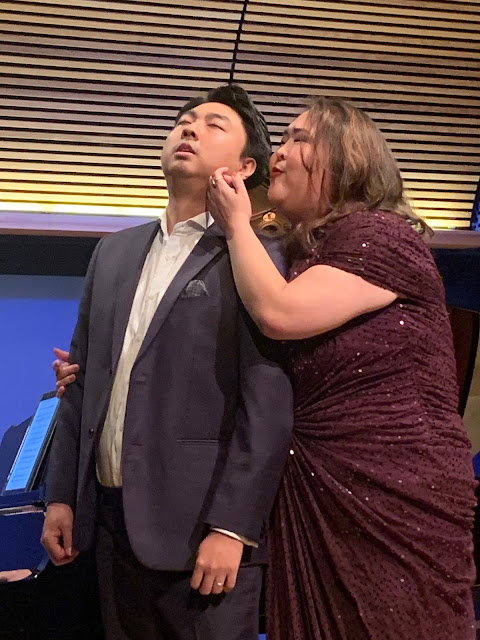
Woo Young Yoon and Alice Chung

Competition is fierce in the opera world.  Too little money, too many talented singers, too few positions. Opera Index is well known for a fair competition, a devoted membership, and generous awards. The selection of winners is highly anticipated and the 2023 winners have just been announced. However, last night's recital celebrated the artistry and versatility of  mezzo-soprano Alice Chung and tenor Woo Young Yoon, winners from last year. Both artists are well known by us and much admired. Watching their respective careers flourishing brings us joy. 

Ms. Chung is a powerhouse performer and has a very special gift for drawing us into her vision no matter what character she is inhabiting; it is far more than a portrayal. One lives through the scene with her and you experience the character just as she does. All of her exemplary technique is used in the service of the character and the scene. Of course, one cannot miss the consistency from one end of the register to the other, nor the scintillating vibrato, the impeccable phrasing, the effective dynamic variation, and the linguistic accuracy.  

We have written before about her performance of a Korean song by Choi Young-Sup entitled "Longing for GeumGang Mountain" and the reason why South Korea's art song tradition is so recent. Rather than repeat it, we urge you Dear Reader to enter Ms. Chung's name in the search bar. Last night the song was performed as a duet with tenor Woo Young Yoon with verses performed alternatively and then in harmony, to lovely effect.

Ms. Chung's songs in Russian were impeccably sung, as noted by our Russian-speaking companion. Rimsky-Korsakov was the first classical composer we were exposed to as a child and we still find his compositions magically colorful. We heard "When golden cornfields sway" and "Elegy" each given heartfelt involvement. An aria from Tchaikosky's Maid of Orleans went directly to the heart.

The artist's facility in French we could judge for ourself. By a strange coincidence, an aria we hadn't heard in years until last night was also on Ms. Chung's program. "Connais-tu le pays" from Ambroise Thomas' Mignon was performed with full attention to the mixed feelings of longing, nostalgia, regret, and hopefulness.

We knew vaguely about an opera written by Leoncavallo derived from the same Henri Murger stories that Puccini spun into the gold of La Bohême. Leoncavallo's version was rapidly eclipsed by Puccini's. Hearing Ms. Chung sing an aria from the Leoncavallo opera gave us the idea that Leoncavalllo's music was not the reason for the opera's disappearance. Reading the libretto written by the composer himself suggests that his storytelling lacked the emotional weight and continuity of the Illica/Giacosa adaptation. Nonetheless, we enjoyed the music and the performance.

What we enjoyed even more was an American song that we have always found trite and saccharine.  Leave it to Ms. Chung to transform "Somewhere  Over the Rainbow" from Harold Arlen's Wizard of Oz into a meaningful and highly personal meditation on wistful hopefulness. We will never hear it the same way again! 

Our very favorite part of the evening was the "Seguidilla" from Bizet's Carmen which we are sure was directed (and very effectively directed) by the artists themselves. It was unusually exciting to watch Carmen work her wiles on the hapless Don Jose, using every trick in the Book of Seduction. Mr.Yoon was equally effective as her victim, resistant at first and eventually succumbing to Carmen's spell.

Mr. Yoon is a fine tenor with an appealing voice and impressive versatility. As a fan of bel canto, we particularly enjoyed his  "A te, o cara", a song about love from Bellini's I Puritani. He was as ardent as a tenor should be, and quite different in performance style from the other characters he portrayed. 

His Rodolfo from Puccini's La Bohême was both shy and expansive as he courts his neighbor Mimi in the opening scene. Mr. Yoon conveyed youthful passion in a manner that older singers cannot. Ask any young man who is trying to impress a desirable young woman with bravado whilst also dealing with fear of rejection!

However, his creation of the character of Alfredo in Act II of Verdi's La Traviata was completely different. Here was a young man who has snatched his prize away from the glamorous life in Paris and has her all to himself out in the country where they are experiencing their newfound love with "new relationship energy". He is deluded into believing that their love will last forever, that she will regain her health, and that his bourgeois father will be won over. That's quite a task for a tenor but was successfully conveyed by Mr. Yoon in "Lungi da lei...de miei bollenti spiriti"

We further enjoyed the passionate "Be My Love" from Brodszky's The Toast of New Orleans and were reminded how much clearer English diction is when sung by people whose first language is not English. There was not a moment during the entire evening when we wished for projected titles.

We noticed some lovely spun-out decrescendi in several pieces which gave us a better picture of Mr. Yoon's artistry than his fortissimi in the upper register which seems to be a thing among young tenors. Perhaps it is the enthusiastic applause from the audience that eggs them on, but we personally prefer the planissimi sections that draw us closer rather than blasting us away.

The excellent accompanist for the evening was Yeontaek Oh, whose gifts were most noticeable to us during a contemporary piece by Jake Heggie, in which the vocal line did not engage us as much as his playing. Had the singing not been so arresting we might have paid him more attention during the remainder of the concert.

© meche kroop


Friday, March 3, 2023

A GIFT FROM GERDA LISSNER


 Danielle Orlando, Latonia Moore, Alice Chung, Titus Muzi, and Ethel Trujillo

One could not have asked for a more satisfying experience than that provided last night at The Greene Space by The Gerda Lissner Foundation, starring singers of the Academy of Vocal Arts, eleven alumni of which are performing this season at the Metropolitan Opera, including some of our very own favorites such as James Morris, Ailyn Perez, and Latonia Moore. There was a warm welcome from Scott Guzielek, Vice President and General Manager of AVA and the ever-delightful Midge Woolsey of WQXR.

As familiar as we are with students at New York City's three conservatories, we have only been introduced to the students of AVA on occasions when they have appeared in competitions. We were happy to have made up somewhat for the lack and quite interested to learn that students at AVA pay no tuition! They must be doing something very special down there in Philadelphia, judging by what we heard tonight.

Soprano Latonia Moore headlined the evening with "Il est doux, il est bon" from Massenet's Herodiade, adding gentle coloring to her sizable voice. What we liked best, aside from the magnificent instrument she possesses, was her total immersion in the character. The vibrato was one of innocent rapture and her gestures limned the character of a young Salome.

We heard her later in the program as Cio-Cio San in Puccini's Madama Butterfly--first (accompanied  by mezzo-soprano Alice Chung as Suzuki, about whom more later) in "Scuoti quella fronda di cilegio" in which her voice was colored with joyful anticipation, and later in "Tu, tu piccolo iddio" in which she bids farewell to her beloved son, with sorrow and despair. Having both scenes on the same program gave us a picture of the evolution of character, so necessary to the believability of the story. When singing is so perfect, it is this characterization that makes the difference between talent and artistry.

This quality seems to be a feature of AVA singers. Take, for example, the scenes from Don Pasquale, Donizetti's comic masterpiece. The widow Norina is ambitious and wily and makes a fine team with the shrewd and calculating Dr. Malatesta as they forge a plan to deceive the stingy Don Pasquale. The singers must work hard to get us to like these characters or the opera falls flat. And all this must reflect the commedia del'arte underpinnings of the story.

Soprano Ethel Trujillo and baritone Titus Muzi succeeded admirably at this. In "Quel guardo il cavaliere", Ms. Trujillo reveals Norina's romantic side, using her facility with fioritura and a warm coloration of the voice to put us squarely in her corner. There was an exceptionally clean descending scale and a notably fine trill none of which distracted us from the character she created.

But just watch how she reacted to the plot hatched by Mr. Muzi's Malatesta. His warm baritone was perfect for the role and he created a likeable character whom we could accept as one helping Norina to achieve her dreams, rather than as a wicked manipulator taking advantage of Don Pasquale.  The two artists worked very well together as he instructed her in how to play her part in the deception. They are marvelous comic actors as well as singers.

Mr. Muzi created a quite different character, playing Valentin in Gounod's Faust as a sincerely devoted and responsible brother. In the mid-section he revealed the stalwart soldier. It was great to see this other serious side of his artistry.

Ms. Trujillo also had another opportunity to dazzle us. Regular readers know about our passion for zarzuela and the soprano's choice of "Me llaman la primorosa" from Giménez and Nieto's El barbero de Sevilla suited her perfectly. We haven't heard it since New Camerata Opera presented it way back in B.C. (before Covid). The aria gave her a chance to show all kinds of vocal flair and personality. Again we noted the very fine trill and facility with even scale passages. At one point she exchanged phrases with the piano in a most charming fashion.

Mezzo-soprano Alice Chung, whose voice blended so beautifully with Ms. Moore's in the Butterfly duet, had some riveting solos which we found incredibly moving.  Perhaps "Voce di donna" is the only aria from Ponchielli's La Gioconda that we remember but Ms. Chung's performance brought the entire opera back to mind and we could just see La Cieca blessing Laura.

Even more remarkable was a Korean art song "Longing for GeunGang Mountain" by Choi Young-Sup, apparently written after the Japanese occupation ended, an historical turn of events which permitted Korea to develop its own art song tradition. In spite of being written in the 20th c. the song is melodic and the confluence of the melody in the music and the melody in the words brought tears to our eyes. It was obvious how deeply the artist related to the song.

Toward the end of this drama-filled evening, Ms. Chung performed a work of brevity and utter simplicity--William Bolcom's "Waitin'",  another triumph for this gorgeous voice.

Piano accompaniment was provided by the very gifted Danielle Orlando, whose playing captured our attention during some American folk songs arranged by Clifford Shaw, a most different experience than a piano attempting to replace an entire orchestra. We could really appreciate the writing and the performance.

If you didn't make it into the small Greene Space, perhaps you heard the live stream.  In which case, you are welcome to provide your comments below. Please note that the Gerda Lissner Foundation will have a competition at Zankel Hall on May 1st. We advise you to get your tickets now.

© meche kroop