MISSION

We are here to encourage the development of gifted young singers and to stimulate the growth of New York City's invaluable chamber opera companies. But we will not neglect the Metropolitan Opera either. Get ready for bouquets and brickbats.
Showing posts with label Santa Fe Opera. Show all posts

Tuesday, October 28, 2025

LILI ELBE


Melanie Bacaling, Tobias Picker, and Aryeh Lev Stollman


Sylvia D'Eramo and Lucia Lucas


The spacious and comfortable theater at The Guggenheim Museum is the perfect home for Works & Process. The format is one of panel discussion alternating with performance. It allows audience members to get a preview of upcoming artistic events as described by their creators and illustrated by performances. One gets a glimpse behind the scenes, as it were.

Last night's event provided a panel discussion by the creators of a new opera Lili Elbe--composer Tobias Picker and librettist Aryeh Lev Stollman--moderated by Melanie Bacaling. Scenes from the opera were presented concert style by Lucia Lucas and Sylvia D'Eramo who are cast in the American premiere of the opera taking place on August 1st at the Santa Fe Opera. Although the scenes belonged to the two women, we had the opportunity to hear the terrific tenor Aaron Blake as well.

The subject of the opera is a German painter named Einar who transitioned to a female, a real "first" a century ago. What a courageous act that must have been! Increasingly common today and no longer called "sex reassignment surgery", it is now, to be politically correct, called  "gender affirming surgery".  Upon this topic we will not comment.

Now called Lili, the painter stopped painting but remained friends with his/her wife, underwent several surgeries and eventually died from complications of one of the surgeries, the details of which, Dear Reader, we will spare you. The story is a fascinating one and was made into a film which we plan to see in the near future. The fact that the role of Einar/Lili was played by a man provoked a wave of criticism.

No such criticism can be leveled at the opera because the role of Lili is played by a trans woman baritone named Lucia Lucas who also served as dramaturg, apparently making good use of her own experience. And what a strong voice she has. It had the same electrifying effect on us as hearing a man singing soprano or counter-tenor. The role of Gerda, the wife of Einar/Lili, was sung by Sylvia D'Eramo, a Santa Fe Opera favorite whom we have previously reviewed and much admired. The two voices sounded beautifully balanced and interesting in the duets.

The presentation last night aroused our curiosity and we have spent some time reading about this unusual individual's life experience. We can see that it is fine fodder for the theater and film. But what about its relevance to opera? Its European premiere took place last year in St. Gallen, Switzerland and was very well received and honored with prizes. The staging we saw in a You Tube clip from this production looked far more interesting than we might have imagined given what was offered last night. When there is no staging, no costumes and no drama, one must rely on the music.

And there's the rub! Like most contemporary composers, vocal lines are given short shrift and our ears leaned into the piano score, replete with jazzy riffs and rhythmic variation. The conversational libretto was set to vocal lines of minimal melodic nature. If Lili's story needed music to be told, we would imagine something far different, although we do note that the music reflects the time period of the 1920's and 30's. But the story is not a jazzy one. It is a tragedy!

Consequently, we are curious to know what Santa Fe Opera will do with this work....but not curious enough to make the trip.

© meche kroop


Sunday, August 28, 2022

MUSIC 10 --LOOKS 2


 Isabel Leonard and Michael Fabiano (photo by Curtis Brown for Santa Fe Opera)


Where are we? We are sitting in the Santa Fe Opera's lovely theater, wishing we were being transported to Seville in the 19th c., the world created by Georges Bizet and librettists Henri Meilhac and Ludovic Halévy (originally created by novelist Prosper Mérimée)--a world of gypsies, smugglers, and bull fights. But no, that is not going to happen. We can't tell where we are from a confusing set and ugly costumes. We are in the world of a misguided director who wants to tell a different story.  Of our beloved Carmen, only the "romantic" obsession remains and the good girl/bad girl dichotomy.

We were inspired to do a search of our reviews of every Carmen we have ever written about.  And there are dozens. Significantly, the last Carmen done by Santa Fe Opera was similarly egregious. The most affecting one we ever saw was performed by a small (now defunct) company in New York City. The most original one was presented by a psychoanalytic colleague whose concept it was to be interviewing Don Jose in prison, after the stabbing. His character was explored by means of flashbacks to various scenes of the opera.  It was original and illuminating. If you are going to have a concept, it better be cohesive and show us something new about the characters. This production was about as interesting and as believable as Lucia in overalls in the rustbelt of the United States, as presented by the Metropolitan Opera.

If one closed ones eyes, which we frequently needed to do, one was treated to some superb singing and a glorious reading of the score by Maestro Harry Bicket. The music moved right along with big dramatic orchestrations, as in the overture, alternating with gentle pianissimo lyricism, as in the introduction to Act III.

Poor mezzo-soprano Isabel Leonard, drably dressed in jeans and dun colored top gave her all to make sense of the character. She possesses a magnificent instrument which she uses skillfully throughout the entire range. She clearly worked hard to fulfill the director's requirements and to tell us something new about the eponymous heroine. In the 19th c. there was something shocking and fascinating about a woman who marched to her own tune. Set in contemporary times, it's just old hat.

Tenor Michael Fabiano sounded just fine as Don Jose but was perhaps directed to be particularly awkward with his body movements, leading us to speculate that Don Jose had some rare ailment that contributed to his unbalanced mental state.  His violence did not evolve gradually but was present right from his ungracious shoving of Micaëla as she tried to give him a kiss from his mother. 

Soprano Sylvia D'Eramo scored vocally with her Act III aria. Dressed in overalls, backpack, and Keds, she looked nothing like an innocent country girl although she did her best to act the part, contrasting with Ms. Leonard's worldly wise mien.

Four apprentices delighted us with their performances, seemingly removed from the intensity of the main story. Soprano Magdalena Kużma's Frasquita and mezzo-soprano Kathleen Felty's Mercédès made a fine pair and we enjoyed their card reading duet. Tenor Anthony Léon's Remendado  and baritone Luke Sutliff's Dancaire brought Act II to vivid life. The quintet with Ms. Leonard resisting their blandishments was one of the vocal highlights of the evening.

Bass-baritone Michael Sumuel was put in the ambiguous position of portraying Escamillo as a bullfighter in authentic dress, and also some kind of entertainer in a saloon pretending to be a bullfighter. Nonetheless, we enjoyed his singing of the Toreador Song.

Bass-baritone David Crawford was effective as Zuniga; Apprentice David Lekeith Drone sang the role of Morales; Omen Thomas Sade took the non-singing role of the famed Lilias Pastia.

A terpsichoreally challenged female child was onstage so much, for no apparent reason, that we were not surprised at the muttering of the woman sitting next to me, muttering we choose not to repeat. These constant appearances were most resented when they occurred during the big arias. How unforgivably distracting! Perhaps she is the offspring of a big donor. Why was she holding her ears during the overture? Why was she prancing around stage making odd faux flamenco moves with her arms and swishing her skirt? Whatever the director had in mind was lost on every audience member we spoke with or overheard in the ladies room during intermission.

French director Mariame Clément obviously comes from the European régie theatre school.  Silly us to think that opera is about singing that enhances logical story telling! Whatever happened to authenticity and honoring the intentions of the composer and librettist? We would beg directors to stop trashing the classics. Modern touches added to comedies are just misdemeanors but to ruin a tragedy is a felony.

Julia Hansen's set and costumes for Act I were not awful.  Just a bunch of soldiers on one side and a fenced in area on the other side, enclosing a yard for the cigarette factory workers to take their breaks. But things got progressively worse.  In Act II, there was something like a nightclub with what appeared to be a drag show onstage; but then appeared to be Frasquita and Mercedes in hideous garish costumes. And another smaller stage was wheeled on with Escamillo in full toreador costume singing his big aria.

Act IV was completely incomprehensible.  At first, the chorus of onlookers were waving flags behind a wooden barrier. So, it's a bullfight and we had no problem using our imagination to recreate the parade of chulos, picadors, and toreros that were being sung about.  But then the set became a garish amusement park with a ticket office with a sign reading "CAJA"--Spanish for cashier or box office--and the only sign that the action is supposed to be taking place in Spain. A lone merry-go-round horse witnessed the violence perpetrated by Don Jose on the complacent but defiant Carmen.

Not only were the characterizations impossible to fathom but the stage business frequently belied the text. Please don't sing about a rope and then produce handcuffs to restrain Carmen.

We could go on and on about the directorial  misjudgment but we would prefer to use the space to once again applaud the excellent chorus of apprentices, directed by Susanne Sheston.  The chorus has been a winning element throughout the season.

© meche kroop

Saturday, August 13, 2022

BUTTERFLY DREAM


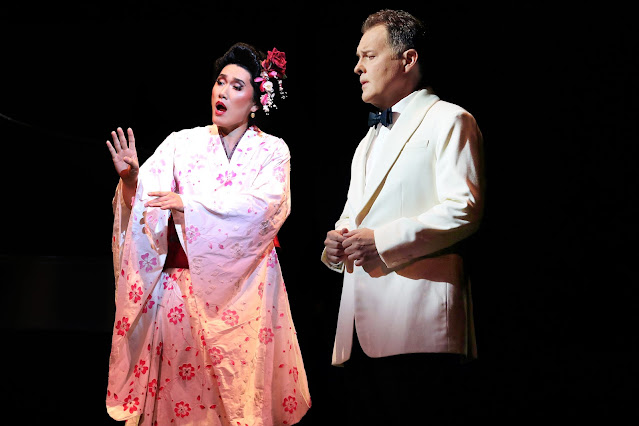
Kangmin Justin Kim and Mark Stone
(photo by Curtis Brown)


With our eyes closed, we might have thought the scintillating voice was that of a soprano; but no, it was the scintillating voice of counter-tenor Kangmin Justin Kim whose expressive instrument and superb control of the upper register was absolutely perfect for the role of Chinese opera star Song Liling. The opera M. Butterfly, commisioned by the Santa Fe Opera, is about deception, among other things. We humans are inclined to deceive ourselves based upon our wishes, our experience, and our preconceived notions. M. Butterfly tells the story of a minor French diplomat who falls in love with a male Chinese opera star who portrays female roles. Until confronted with the "naked evidence" the diplomat never accepts the fact that he has fallen in love with a man--not even after a years-long relationship.

The story originated as a play by David Henry Hwang whose tales of China have entertained us going back to his play The Dance and the Railroad. The play M. Butterfly upon which the opera is based, was a huge success at its Broadway premiere and once again at its revival and then again as a film. We have enjoyed every iteration and was looking forward to the opera ever since it was announced.

So, we are wondering why, in spite of some dazzling performances, we were somewhat disappointed in the opera. To cut to the chase, the story worked just fine as a play.  The play did not yearn for music, not even the fine music of Huang Ruo. The references to Puccini's Madama Butterfly, scattered throughout the score, only served to point out the superiority of Puccini's vocal lines. Mr. Ruo's instrumental writing is eclectic and interesting, but the vocal lines were not. This complaint of ours is not unique to Mr. Ruo. Most contemporary operas seem to have the same deficiency.

Although Mr. Hwang and Mr. Ruo have worked together before, we did not feel the union of libretto and music that we hoped for. The "recitative" (95% of the opera) was declamatory, prosy, and repetitive. The nail was hammered so hard it went right through the wood! Is it not taught to dramatists to "show, don't tell"? There were a couple arias in Act III that allowed the artists to show their stuff but were not at all melodic.

Perhaps we were alone in our assessment because there was a standing ovation at the conclusion; however we believe the thunderous applause was meant for the performances. Baritone Mark Stone sang the role of the duped accountant/diplomat René Gallimard with fine rich tone whilst creating a sympathetic and believable portrayal.

Mr. Kim's lustrous counter-tenor added to his consummate acting skills. We can see how Mr. Gallimard was fooled! All of the gestures and movements were as feminine as one could imagine and, at the end, when he appeared as a man (in full frontal glory) it came as a shock, even though we knew the artist was male.

This kind of gender fluidity is far less shocking than it was some decades ago and we do admire Mr. Hwang and Mr. Ruo for tackling issues of racial, cultural, and gender stereotypes, along with the issue of cultural misunderstanding.  The references to Puccini's opera serve to remind us how many changes have occurred in the past century.

Let us return to the quality of the performances and the production. We particularly enjoyed hearing mezzo-soprano Hongni Wu as Song Liling's communist "handler" who set the espionage in motion. We always feel great to see Asian artists cast in Asian roles, although there are other opera lovers who think it doesn't matter.

Tenor Joshua Dennis (a former apprentice) livened things up as Mr. Gallimard's tennis-playing childhood friend, appearing as a memory. Bass Kevin Burdette was fine as the somewhat arrogant French ambassador to China who promotes Mr. Gallimard, seems to admire his acquisition of a Chinese mistress, and then sends him back to France.

Adding greatly to the production was the choreography of Seán Curran who managed to combine communist tropes with the movements we have seen in Chinese opera, an art form we particularly enjoy.

Maestro Carolyn Kuan led the orchestra with a firm hand; our only regret was that more Chinese instruments were not employed. We liked the way she brought out the references to Puccini's Madama Butterfly.

Once more, we admired Chorus Master Susanne Sheston for creating a behind the scenes choral rendition of Mr Ruo's very own "Humming Chorus". The apprentices sounded great there and also as they portrayed members of French society in several scenes--as bored expats living in China, and as French citizens laughing at Mr. Gallimard's benightedness.

Director James Robinson kept the action moving along and Allen Moyer's set design was superb, especially Ms. Liling's sexy red boudoir. Christopher Akerlind's lighting made an impressive addition. James Schuette's costumes were right on point. Even the projections of Greg Emetaz were fine since they contributed location information instead of the distractions produced by other projection designers that we have found annoying.

In sum, Santa Fe Opera can be commended for commissioning a provocative and original work and for giving it a first-rate production. It is just our personal taste that wanted a more memorable vocal line and a more poetic libretto. Still, it was an interesting evening in term of getting us to think about the issues mentioned earlier. But for sheer auditory pleasure and a climax that leaves us shaken, we will choose Puccini.

© meche kroop

Friday, August 16, 2019

BLEAK HOUSE

Laura Wilde (Jenůfa), Gina Perregrino (Herdswoman), Katherine Beck (Karolka), Kathleen Reveille (Mayor’s Wife), and Richard Trey Smagur (Števa Buryja) (Photo by Ken Howard for Santa Fe Opera)


Contemporaneous with Puccini, Leoš Janáček wrote a very sad opera about sin and redemption in a small Moravian village; Jenüfa premiered in1904 after six years of compositional labor; it would not be heard in the composer's original version for seventy years. This is one of the first "prose" operas.

The grim story deals with issues of unrequited love, out-of-wedlock pregnancy, fraternal envy, violence, and infanticide. The eponymous heroine (soprano Laura Wilde) is in love with the fickle Števa (tenor Richard Trey Smagur) and is carrying his child. His half-brother Laca (tenor Alexander Lewis) is envious of Števa's favored position in the family and is jealous of Števa's relatioship with Jenufa. How this all works out is a gripping story.

Two elements pleased us even before attending the performance. Firstly, the opera is sung in Czech; this is a difficult language but every time we hear it sung we are impressed by how wedded are word and vocal line. Janácek wrote the libretto himself so this element is particularly important.

Secondly, the opera has been cast with singers we know and love, some of whom we heard last year as Santa Fe Apprentices, others we know from conservatories in New York or from competitions.

One of the hallmarks of a great production is that one can identify with the characters and care about them. The fact that the piece was updated to the mid-20th c. did not detract from its impact. This story might even take place today in a small town gripped by religious fundamentalism.

The eponymous Jenufa has been captivated by a man of poor character who seduces her and abandons her when her face has been disfigured. Who could not identify with an innocent young woman who falls for a narcissistic man! Soprano Laura Wilde (once an 
apprentice at Santa Fe Opera) used her generous instrument and agile body to create a Jenufa we could really care about. The dénouement of the drama finds her accepting her fate and possibly finding happiness with Laca. All of the emotions she experienced were revealed through vocal coloration and body language---anticipation, joy, anxiety, despair, grief, forgiveness, and reconciliation. What a stunning performance!

As Kostelnička, soprano Patricia Racette turned in a highly memorable performance. The intensity of her vocal expression and the measured use of vibrato made her a sympathetic monster. Under the stress of living in a religious community as the widow of the church warden, her experience of shame over her step-daughter's pregnancy and her efforts to find the best for Jenufa clashed with her religious beliefs; her desperate act left her feeling sick and guilty. Ms. Racette made her climactic realization --how she loved herself more than others -- convincing evidence of her emotional growth.

As the rascal Števa, tenor Richard Trey Smagur (well remembered from his Apprentice performances) created a character imbued with childish narcissism, caring only for his own desires--drinking and philandering. Whilst Jenufa was grieving he was busy courting the daughter of the Mayor. Mr. Smagur created a thoroughly detestable character but sang so well we were ready to forgive him anything. Additionally, he has a compelling stage presence that dominated the stage.

Tenor Alexander Lewis, whom we haven't heard in a few years, sounded terrific as Laca. Sulking around the stage as a grievance collector when the opera opens, he explodes with anger and slashes Jenufa's face. By the end of the opera he has matured emotionally; forgiven by Jenufa, he seems prepared to make a good husband for her. All of these emotions were made clear by Mr. Lewis, both in his vocal coloration and in his posture.

We enjoyed the performance of baritone Will Liverman, also a former Apprentice at Santa Fe Opera. His character was the foreman of the mill which Števa inherited and had the task of announcing the fact that Števa had not been drafted. His voice always lends a sense of import.

Renowned mezzo-soprano Susanne Mentzer, a Santa Fe resident, created the role of Grandmother Buryjovka, mother-in-law of Kostelnička, and a seemingly kind woman who can also swat her wayward grandson with her purse. She became increasingly frail during the three seasons in which the opera takes place

Several apprentices graced the stage with their presence in smaller roles. Alan Higgs gave a fine interpretation of the self-satisfied mayor with Kathleen Reveille creating the character of his wife---critical and all too ready to humiliate Jenufa. Their daughter Karolka was portrayed by Katherine Beck as the superficial flighty beauty that Števa was going to marry. The three of them just made sense as a family.

Making brief appearances but sounding great were Gina Perregrino, Sylvia D'Eramo, Jana McIntyre, Kaitlyn McMonigle, Danielle Beckvermit, and Benjamin Taylor.

The chorus of Apprentices appeared as townfolk and sounded sensational, as usual. We loved the folk dances choreographed by Maxine Braham.

Maestro Johannes Debus honored Janáček by revealing all the colors of his palette. Our esteem for this composer grows every time we hear his compositions. His writing underscores the action at every turn. We loved the duet between mother and step-daughter which seemed more tuneful than the writing for solo voice. When Kostelnička sends Jenufa to bed, the orchestral writing has the quality of a lullaby. Our favorite passages are almost always the most lyrical ones but last night we found much to love in the forceful and dramatic ones.

Director David Alden similarly honored the work. His direction put a lot of space between the characters which emphasized their loneliness and isolation. There wasn't much love in this family! Fortunately, there wasn't even a whiff of directorial arrogance. Alden wisely allowed the tale to speak for itself.

Charles Edwards' minimalist set design neither added nor detracted but it was stunningly lit by Duane Schuler, who created chiaroscuro effects with dramatic shadows on the walls. We liked the way the boarded up windows exploded when the boards were removed and a storm occurred, lending verisimilitude to the storm within the family.

Jon Morrell's costumes were a propos to a small European village in the mid-20th c.. The folk dancers were colorful and the family drab. The mayor's wife and daughter were more lavishly costumed as befit their lofty position in the local society.

Unfortunately, this was the last performance of the season so unless you have already attended you are out of luck. But there is plenty more artistry to look forward to. We are looking forward to tomorrow's La Bohême and the Sunday Apprentice recital.


(c) meche kroop


Wednesday, August 14, 2019

INFIDELITY AND BETRAYAL

Amanda Majeski, Jarrett Ott, Rod Gilfry, Ben Bliss, and Emily D'Angelo
(Photo by Ken Howard for Santa Fe Opera)

It was at the tail end of the Enlightenment when Mozart and Da Ponte created their puzzling masterpiece Cosi fan tutte, puzzling because it has one foot in comedy and the other in tragedy. It must have scandalized the opera-going public at that time. As late as the 20th c. audiences might have understood the shame experienced by cheating fiancées; but 21st century morality has changed and partner swapping no longer shocks or shames.

Given Mozart's marvelous music and an attractive young cast, we expected a captivating telling of the tale, especially since we have previously enjoyed the fresh takes on Händel's operas provided by Stage Director R.B. Schlather. To say we were disappointed would be a gross understatement; in fact we were appalled by this meretricious production.

We frequently closed our eyes during the "important" arias so we could focus on the glorious voices. It was indeed a casting coup to have engaged these artists who were excellent vocally and who worked well as an ensemble, apparently doing their best to give Mr. Schlather what he wanted.

Tenor Ben Bliss, possessor of a gorgeous instrument, could have melted anyone's heart with his "Un'aura amorosa". His voice has expanded in the past couple of years without losing any of its tonal luster. It was amazing that Fiordiligi could hold out for so long!

Baritone Jarrett Ott has a compelling stage presence and sings with baritonal beauty that was never lost in this low lying tessitura. Mozart did not give him a memorable aria but "Non siate ritrosi" was given a fine delivery. He was memorable in his seduction of Dorabella.

The role of Dorabella was performed by the excellent young mezzo-soprano Emily D'Angelo who possesses an instrument of distinctive texture. We particularly enjoyed her performance of "Smanie implacabili" for its gorgeous vocalism and over-the-top dramatics.

The soprano role of Fiordiligi was performed by Amanda Majeski who readily conquered the wide skips of the showpiece aria "Come scoglio".  However we were distressed by a hard edge in her voice that sounded shrill. In duets and ensembles this feature created an unpleasant imbalance in the harmonies. Also, her ornamentation could have been crisper in its articulation.

Baritone Rod Gilfry is always a welcome presence, even when he portrays un unlikeable character like Don Alfonso. How can one like an older man who treats his young friends as puppets to play with!  We call him guilty of entrapment.

Soprano Tracy Dahl got a lot of laughs as Despina and we loved the particular timbre of her high soprano. It was particularly funny that her height brought her barely to the shoulders of the other artists. "Una donna a quindici anni" was given plenty of sass.

We always enjoy Mozart's duets and ensembles, especially "Soave sia il vento". The esteemed conductor Maestro Harry Bicket led the Santa Fe Opera Orchestra in a lively reading of the score, also giving the lyrical moments plenty of space.

We also noticed that moments of comedy were enhanced by leaving an extra beat of silence right before a humorous line. We don't know whether Mo. Bicket or Mr. Shlather was responsible for this but it worked well.

Now, about the production--we found it illogical, incomprehensible, and just plain ugly. It would take forever to relate every single instance of directorial waywardness but let us name a few. In Act I, all four of the young lovers were directed to move jerkily around the stage, roll on the floor, fight, and bounce off the walls. 

Despina has a magic wand to "heal" the poisoned "Albanians" (who in this case were silver-clad cowboys) and appears to use it to advance Don Alfonso's machinations. If "magic" is involved, it undercuts the theme of human foibles and succumbing to the pull of romantic variety. In this production the women can't really take responsibility for their lapses although they do feel shame.

The final scene was particularly confusing. Don Alfonso makes all four young lovers kneel as if preparing for an ISIS beheading; then he pours water or some other liquid on their heads. 

Characters were often onstage when they were not supposed to be. Don Alfonso had no justification for announcing the return of the fiancés just when everyone was partially deshabillé.

Terese Waddens' costume design furthered the confusion. The young men first appear in what seems to be tennis whites, as do the young women. The men then appear dressed as cowboys, so that when they next appear as the "Albanians" the only apparent difference is that their moustaches are gone. This makes it even more preposterous that the ladies don't recognize their fiancés.

Despina is costumed in an unflattering housedress and later in a spangled evening gown that harmonizes with those of her employers robbing her of her special role in the plot. No attempt was made to convince anyone that she was a notary or a doctor.

Dorabella at first looks very feminine with long hair. Toward the end she appears wearing a man's suit and very short hair. Why?

Paul Tate De Poo III's minimalistic set design was similarly ill advised. Flat architectural elements had square spaces cut out of them through which characters emerged in somersaults or fell through. The floor had a similar square hole through which characters emerged or descended. None of these movements served the plot. There were no props except for Despina's magic wand.

Perhaps Mr. De Poo and Ms. Wadden were just giving Mr. Schlather what he wanted, just like the singers. But the overall effect added nothing to our understanding of the characters. We speculate that Mr. Schlather wanted his audience to focus on the psychology of the characters and the emotional effects of their interaction. This is not the way to do it!

When we see a production that honors the intent of the librettist and composer and is given a specific context of time and place, we in the audience do the work of finding parallels with our own time and place, as well as differences. It gives us a feeling of participation and a sense of understanding of our place in history.

On the other hand, a barren production like this one was devoid of context. Such abstraction leaves us feeling alienated and disconnected, when we should be identifying with the characters and caring about their destinies.

So...Mozart 10: Schlather 2!  It was the production which was guilty of infidelity and the audience which was betrayed!

(c) meche kroop


Friday, August 17, 2018

ENDING WITH A WHIMPER, NOT A BANG

The Santa Fe Opera Chorus in Doctor Atomic (photo by Ken Howard for Santa Fe Opera)

It would have been wonderful if the onstage nuclear scientists waiting for detonation of the atom bomb at Los Alamos had been accompanied by a real live storm but there was only a brief shower. We reflected upon the night at the Santa Fe Opera when the final scene of Verdi's Rigoletto was accompanied by real thunder and lightning, making for one exciting operatic experience.

Well, Doctor Atomic is no Rigoletto and John Adams is no Verdi; we doubt that audiences will be clamoring for this work in the 22nd c. However, if we accept the message of the evening, there may be no 22nd c. The part of the evening we enjoyed the most was the pre-opera lecture by Director Peter Sellars in which he made some very good points about the nuclear age and why he chose to present it as contemporary, with Gabriel Berry's costumes belonging to our present day. Although we strongly disagree we enjoyed hearing his rationale. 

We enjoyed even more the talks we heard from three of the Downwinders--an elderly woman, her daughter, and her niece--all suffering from crippling anxiety related to the decimation of their family by cancer, a consequence of the 1945 detonation of the world's first atomic bomb. Apparently, the government's fund to compensate the victims of fallout and radiation has not been extended to New Mexicans, a condition the Downwinders have been fighting for several years. The stories they shared were terribly tragic. The government did not evacuate them for fear the press would find out that "something was going on".

The production of Doctor Atomic, taking place just a stone's throw from Los Alamos, seemed to be a risk for the Santa Fe Opera but they put all their resources behind it and succeeded in selling out the entire run. Not only did we get to hear the voices of the afflicted but we got to watch members of nearby pueblos performing a corn dance onstage, a form of prayer for healing and for water to nourish their corn crop. The stage was filled with Downwinders who probably had as many tragic tales to tell as the three we heard in the lecture.

Our desire to learn about this tragedy created by the military/science complex was not matched by an appreciation for the opera itself, in spite of some stellar performances by artists we know and love. This lack of affection for the work is not due to the fact that it is political.  Verdi himself wrote several operas with political themes, both overt and covert.  But he did so with glorious music and singable melodies.

Although there were a few moments when Adams' orchestral colors pleased our ears, for the most part the music is harsh and dissonant. Peter Sellars' libretto is nothing if not "wordy". The text was derived from government documents, wire-tapped conversations, surveillance reports, first-person accounts, scientific data, and poetry loved by the Oppenheimers; none of it is singable, nor is the vocal line melodic in any way, shape, or form.

The fact that the voices were amplified, as Adams stipulated, did nothing to enhance the listening experience. NATO would describe the opera--No Action Talk Only.  There is only the conversation about the Manhattan Project, the waiting, and the concern with the weather. Emily Johnson's choreography involved some highly generic modern dance to give the illusion of movement--eye candy that was more sour than sweet. David Gropman's set was bare, save for a huge suspended reflecting ball.

Now that we got the negatives off our chest, let us relate the positives, which involve some pretty swell performances. Bass-baritone Ryan McKinny establishsed the complex character of Dr. J. Robert Oppenheimer whilst the exceptional soprano Julia Bullock excelled at limning the character of his neglected wife Kitty. Most of her singing involved texts of poet Muriel Rukeyser which was abstract to the point of incoherence. We have written that Ms. Bullock could sing the phone book.  This came close.

In the sympathetic role of the physicist Robert Wilson, tenor Ben Bliss' youthful timbre was just right for the part. His "aria" whilst climbing to the top of the tower was probably the most musical part of the opera.

Contralto Meredith Arwady lent her distinctive sound to the role of Pasqualita, Kitty's Tewa housekeeper. Her singing of a Tewa native song was rather more listener-friendly. 

General Leslie Groves was the U.S. Army Commander of the Manhattan Project, a demanding, aggressive, and overweight man; bass-baritone Daniel Okulitch got the first two qualities just right but the banter about his weight and his diet didn't make sense since Mr. Okulitch is admirably fit. 

Bass Andrew Harris portrayed the physicist Edward Teller and baritone Tim Mix took the part of the chief meteorologist for the Trinity test site. General Groves was casting shade on him for not producing better weather!  

Apprentice Mackenzie Gotcher lent his tenor to the voice of Capt. James Nolan who, as chief of the post hospital at Los Alamos, expressed concern for the well-being of the scientists working on the Manhattan Project. Most enjoyable for us was the chorus composed of Apprentice Singers. They blended onstage with the Downwinders and provided some visual as well as aural interest. 

The evening ended with a standing ovation, dear readers, so our comments are not meant as a value judgment, rather as the opinion of one opera lover who wants to be entertained. Mr. Sellars' libretto might have made good reading but those words we heard never begged to be set to music. Nor was any provided.

(c) meche kroop

Thursday, August 16, 2018

THE SUBLIME AND THE RIDICULOUS

Anthony Robin Schneider, Jarrett Ott, Matthew DiBattista, Liv Redpath, and Terrence Chin-Loy (photo by Ken Howard for Santa Fe Opera)


Liv Redpath and Amanda Majeski
(Photo by Ken Howard for Santa Fe Opera)

Richard Strauss' 1916 opera Ariadne auf Naxos offers countless delights as well as a wonderful message--comedy can overcome tragedy and love can eliminate grief and stress. The richest man in Vienna is throwing a dinner party and has commissioned an opera to entertain his guests.  Unbeknownst to the unwary young composer, he has also engaged a comedy troupe starring the flirtatious and fickle Zerbinetta. This is enough to throw the arrogant and temperamental stars of this opera seria into a frenzy of disdain and scorn.

When the Major Domo announces in the plummiest of British accents (spoken dialogue was in English) that both troupes will perform simultaneously in order to finish in time for the fireworks, the composer and singers go ballistic. It is time for the young composer to face the reality of the music business! On a happier note, he and Zerbinetta fall for one another.

The show must go on with poor Ariadne singing in Act II (now in German) about her wish to die.  Theseus has loved her and left her, abandoned on a lonely island. She longs for Mercury to come and take her to the "other side". Zerbinetta and her troupe dance and sing and try to cheer her up, to no avail. Zerbinetta even tries to talk to her woman to woman about taking new lovers. Eventually, the young god Bacchus arrives on Naxos and becomes smitten with her. In a lovely directorial touch (Tim Albery) the Composer arrives at the side of the set and appears delighted at the apparent success of his opera. He is joined by Zerbinetta and the two couples are seen embracing in tandem.

As Zerbinetta, 2017 Apprentice Singer Liv Redpath simply stunned us with her glorious coloratura and engaging stage presence. Every note and every gesture served to illuminate her delightful character. She was far more appealing than the dour Ariadne, sung by South African soprano Amanda Echalaz. Ms. Echalaz was effective in Act I as the imperious prima donna but in Act II, her performance as Ariadne lacked the beauty and color we have come to expect in this role. Tenor Bruce Sledge distinguished himself by getting through this challenging role with beauty of tone and lovely phrasing.

The other Amanda in this tale of two Amandas surprised us. We have never been a great fan of Amanda Majeski, but in the travesti role of The Composer, usually sung by a mezzo-soprano, she absolutely shone and was totally convincing in her artistic despair and in her budding romance with Zerbinetta.

Zerbinetta's troupe of commedia dell'arte players was performed with great lively style by Apprentice Artists--Jarrett Ott, Anthony Robin Schneider, Matthew DiBattista, and Terrence Chin-Loy, whose singing and dancing (!) added so much to the evening's delight.

Sarah Tucker, Samantha Gossard, and Meryl Dominguez (photo by Ken Howard for Santa Fe Opera.
Accompanying Ariadne on the isle of Naxos were three lovely ladies portraying the nymphs Echo (soprano Sarah Tucker), Najade (soprano Meryl Dominguez), and Dryade (mezzo-soprano Samantha Gossard). Strauss gave them some beautiful harmonies and they gave some beautiful singing to the audience. We got to thinking about Mozart's three ladies and then about Wagner's Rheinmadchen. We can think of no greater treat than three female voices in harmony. And those gals can really sing!

Smaller roles were all well handled. Kevin Burdette's Major Domo was a study in pomposity and self-importance. Rod Gilfrey portrayed the Music Master in a piece of luxury casting. Jarrett Logan Porter played the wigmaker, so badly abused by the temperamental tenor. Brent Michael Smith was the scurrying footman and Jesse Darden played an Officer. Brenton Ryan made a fine dancing master.

Maestro James Gaffigan did a swell job with Strauss' lavish orchestration and Tim Albery directed with a sure hand. Jodi Melnick's choreography for Zerbinetta's troupe was delightfully different and done in vaudeville style with the men sporting walking sticks. Who knew those guys could dance!!!!

Set and Costume Design by Tobias Hoheisel was highly unusual. The set for Act I was realistic and accurate to the period. We were shown a corridor in the rich man's home with a series of doors to dressing rooms.  Except, in a droll turn, one of them turned out to be a broom closet. During the overture, we could see the arrival of all the artists and get a good idea of their personalities.

The set for Act II was abstract with a pair of curved architectural elements enclosing Ariadne's "cave" which was shaped like a shallow bowl colored red. Thomas C. Hase's lighting design worked its magic.

Ariadne wore a long black dress, suited to her grief.  Zerbinetta and her troupe were not costumed in traditional commedia dell'arte garb but sported garments suited to the early 20th c. Zerbinetta herself looked like a model for Poiret.

We cannot close without mentioning our thought that Strauss often worked through his personal issues through his operas. In this case, he and his librettist Hugo von Hofmannsthal almost came to blows as they worked out the necessary compromises to get this opera on the page and on the stage. Could we not notice similar attempts at working through issues in his Capriccio and in his Intermezzo?  In these cases, art surely imitates life!

(c) meche kroop


Sunday, August 13, 2017

MAD FOR THE MAD SCENE

Soprano Brenda Rae as Lucia and Santa Fe Apprentices in Donizetti's Lucia de Lamermoor (photo by Ken Howard)

Another brilliant evening at the Santa Fe Opera brought to us another compelling heroine--the fragile and vulnerable Lucia portrayed by the brilliant soprano Brenda Rae who impressed us four years ago as Violetta. What a stunning contrast with last night's Alcina, a heroine who is manipulative and deceitful! Lucia is a an unfortunate young woman who wants nothing more than to wed her beloved Edgardo, sung by terrific tenor Mario Chang who has also impressed us in the past five years since we began writing  www.vocedimeche.reviews. Mr. Chang made an exceptional Edgardo, gathering impact as the evening progressed. His final scene was heartbreaking.

In Salvadore Cammarano's libretto, based on a work by Sir Walter Scott, poor Lucia is thwarted by her desperate brother Enrico, whose political future, and perhaps his life, hang upon his establishing a relationship with Lord Arturo Bucklaw; Baritone Zachary Nelson (about whom we have also been writing for about five years) lent his forceful stage presence and rich voice to the role. Lucia becomes a pawn in this political intrigue and is manipulated into signing a contract of marriage with Lord Bucklaw, here portrayed by a promising member of the Apprentice Program--Carlos Santelli, who has a pleasing, if somewhat covered sound. 

Obviously, this cannot end well! Indeed, by the end of the opera, Lucia has died of a broken heart, Arturo has been murdered on his wedding night, Edgardo commits suicide by grabbing Enrico's dagger, and Enrico will probably suffer the ignominious defeat of one who falls out of favor with the court.

What makes Gaetano Donizetti's opera such a favorite is the theme of a woman's suffering at the hands of men, the torrent of tunes that fell from Donizetti's pen, and the opportunity to hear a favorite soprano unravel to the accompaniment of the eerie sound of a glass harmonica, here played by international expert Friedrich Heinrich Kern. (Thanks Benjamin Franklin for this amazing invention!) The lengthy mad scene requires the casting of a soprano of prodigious coloratura skills-- but the rest of the opera requires her to arouse our sympathy. To this end, Ms. Rae succeeded admirably on both counts. It was a riveting performance that completely deserved the standing ovation at the end of the performance.

Also notable was bass-baritone Christian Van Horn as Raimondo the Chaplain and apprentice Stephen Martin as Normanno, Captain of the Guard, who takes the rap for Lucia's death by virtue of having exposed her illicit romance with Edgardo of Ravenswood, her brother's arch enemy.

One of the great pleasures of the Santa Fe Opera is witnessing the rise of the apprentice singers. Mezzo-soprano Sarah Coit captured our notice when she sang the role of Laurene Jobs in a preview of The (R)Evolution of Steve Jobs which we attended in NYC at Works and Process at the Guggenheim Museum.  Last night she sang the role of Lucia's companion Alisa and she sang it with superb vocal resources and appropriate deference to Ms. Rae.

Maestro Corrado Rovaris, a notable bel canto expert, led the Santa Fe Opera Orchestra which sounded superb, as always. We thought that his somewhat accelerated tempi for the first act was a double-edged sword: on the one hand, it increased the sense of urgency in the plot; on the other hand, we missed the sense of spaciousness he provided for the singers in the second act.

All of the singers impressed us with their musicality of phrasing; the variations of dynamics and tempi as well as vocal coloration indicated the presence of true artistry. The vocal blending in the sextet (when Edgardo crashes the wedding celebration) could not have been better and was second only to the mad scene in its ability to astonish us with the writing of Donizetti and the performances of the singers.

Also noteworthy were the confrontational duets between Mr. Nelson and Mr. Chang--two powerful artists matching artistry with equivalent artistry.

Director Ron Daniels went for a minimalist approach, such a contrast with last night's overcooked Alcina. He set the opera at the time Donizetti composed it--thankfully not in contemporary times. The principals seemed well directed toward sustaining dramatic verisimilitude but the chorus seemed static, standing in rows and moving rather mechanically and in unison. We take issue with Lucia visiting her brother in his bedroom; it just seemed inappropriately informal. And it bothered us that Lucia's hallucinations were invisible to the audience whilst Edgardo's dying hallucination was presented onstage.  However, it was indeed a gorgeous image of Ms. Rae looking pure and heavenly!

The chorus, comprising the Santa Fe Apprentices and under the fine direction of Susanne Sheston, sang with similar superb musicianship and well-defined diction. We expect no less!

Riccardo Hernandez' set design was also minimalistic. The walls and ceiling comprised square panels done in skewed perspective that emphasized the feeling of claustrophobia that Lucia must have felt. The fateful fountain at which Lucia hallucinates a ghost was a fluorescent plastic tub of water. There was nothing great about the great hall in which the wedding ceremony took place. Edgardo's room was nothing but a chair and tiny table with a lamp. This simplicity is not a bad thing but another double-edged sword in that it allowed us to focus more on the performances than on the background.

Peter Negrini's projections overlay the walls with images of forests. Effective lighting was by Christopher Akerlind.

Emily Rebholz' costume design worked very well for the women who wore muted ball gowns to the wedding, as one would expect among the Scottish aristocracy. But the men at the ball were dressed in white tie and tails and not sporting kilts or the colors of their clan, which we have come to expect. The men looked more authentic in the first act, wearing dark clothes trimmed in fur.

The ball scene also included some dancing, choreographed by Zack Winokur, which was vaguely "folk" but markedly un-Scottish.

We left at the end of the opera feeling fulfilled on all counts, but especially that of witnessing the success of former apprentices.  We hope to find Ms. Coit, Mr. Santelli, and Mr. Martin following in their footsteps within the next five years!

(c) meche kroop


Tuesday, April 11, 2017

STEVE JOBS PREVIEW

Kevin Newbury, Mark Campbell, and Mason Bates

This summer, Santa Fe Opera will present the premiere of a new opera--The (R)evolution of Steve Jobs.  We have already lined up tickets. This is surprising given our disappointment in contemporary opera. But this one seems quite different and we are bursting with enthusiasm. The work appears to be taking opera to an entirely new level, suited to the 21st c.

Last night at the Guggenheim Museum we attended a Works and Process in which we heard about the opera from Director Kevin Newbury, librettist Mark Campbell, and composer Mason Bates. We completely grasped their objectives. So many operas are about revolutions.  So many operas are about seminal figures. In this case we have a seminal figure who created a revolution--a cultural revolution that has altered our society and the way we interact.

We have been reflecting upon the changes he wrought upon our culture--the way we get information, the way we shop, the way we interact with other people, even the way we find mates; nothing will ever be the same. We may or may not like these changes but if we do not adjust to them, we are left out of society.

What a stimulating topic for an opera! Mr. Jobs was a complex figure, starting out as a counter-culture hippie wanting to bring down big business--and ended up as a mogul. He was said to be a difficult man and a perfectionist. The opera will humanize this iconic figure. It focuses on five main characters--Mr. Jobs, his creative partner Steve "Woz" Wozniak, his wife Laurene, his spiritual advisor Kobun Chino Otagawa, and his girlfriend Chrisann. Composer Mason Bates has given each a leitmotiv.

Mr. Bates is a highly regarded and celebrated composer and this is his first "produced" opera. The music is playful and incorporates electronics, guitar, and other unusual elements to tell an emotional story. Mark Campbell's libretto is theatrical and tells the story in a non-linear way, humanizing this larger-than-life figure who thought of the computer as "an instrument to be played".  Most of us forget or never knew how inaccessible computers were before Jobs. We recall our first Apple product--a Blackberry which we still have! We would never have gotten a computer, but the Blackberry was so--friendly!

We got a pretty good glimpse of what the opera will look and sound like. Several scenes were presented for our enjoyment. The casting was flawless. Baritone Edward Parks, an artist we have long admired, was chosen for the lead because of his fine dramatic instincts and because of his mellow voice which one can listen to all night long (although the opera is not all that long and will be performed without intermission).

We especially loved the scenes in which Otogawa confronts Jobs. The role is brilliantly performed by Gerda Lissner Award winning bass Wei Wu from the Washington National Opera Young Artists Program. Both Mr. Parks and Mr. Wu will perform these roles in Santa Fe. The music for these scenes was otherworldly, employing the guitar (played by James Moore) and electronic music produced by Mr. Bates himself. There were some portentous chords on the piano, produced by Maestro Robert Tweten, who conducted.

There was also a wonderful scene in the garage of Jobs' home in Los Altos when Jobs and "Woz" were figuring out how to make the computer accessible and another one three years earlier when they figured out how to scam the telephone company and "Woz" pretended to be Kissinger calling the Vatican to cancel a meeting with the Pope. Tenor Garrett Sorenson made a marvelously funny "Woz" and sang the role with great gusto and sound.

In the role of Laurene, Jobs' wife, we heard Sarah Coit, one of the Santa Fe Apprentices, who floated and held a high note with a dazzling diminuendo. This summer the role will be taken by the splendid Sasha Cooke.

SFO apprentice Jessica Jones sang the role of the girlfriend with whom he dropped acid in the 70's. We enjoyed her performance and we don't know who will be singing that role in Santa Fe. 

Slides were projected illustrating the high-tech sets and their Japanese influence. There will be complex video projections that will move with the scenery.

With such a gifted production team and such superb artists onstage, this should be a special night in Santa Fe. The work will have its world premiere on Juy 22nd and there will be only six performances.

We strongly recommend that you get your tickets ASAP. The topicality, the production, and the music should make it a sell-out.  And Santa Fe is fantastic in the summer.

(c) meche kroop


Saturday, August 20, 2016

RICHARD STRAUSS' CAPRICCIO AT SANTA FE OPERA

Amanda Majeski and Ben Bliss (photo by Ken Howard)


Richard Strauss' last opera Capriccio premiered in 1942 in Munich and received its professional debut right here at the Santa Fe Opera in 1958 (although the Juilliard School had presented it four years earlier).  Strauss has always been important at the Santa Fe Opera and last night's performance yielded numerous delights, although it will never be our favorite Strauss opera. That place belongs to Der Rosenkavalier!

Capriccio has been called "A Conversation Piece for Music" and it does indeed involve a great deal of conversation.  One might call it "talky". The libretto was written predominantly by Clemens Krauss with likely a great deal of input from Strauss himself. It comprises an exploration of the relative importance of literature and music.  After hearing the opera, we have decided for ourselves--Music 10, words 2!

We personally do not care for operas about ideas, politics, or philosophy.  We prefer operas about human relationships.  In this case, it is the relationship between the characters that held our interest. The philosophical argument has been dramatized as a decision to be made by the Countess Madeleine regarding her two suitors--the composer Flamand and the poet Olivier.

Soprano Amanda Majeski portrayed the countess elegantly and had her finest moment at the end of the opera when, alone onstage, she sings the same aria that Flamand had composed for her and sung in the first act. The exceptional young tenor Ben Bliss, whose singing has blissed us out for a few years now, perfectly personified an ardent young composer, confident in his talent.  The character likely represents Strauss himself; the string sextet which opens the opera, played by onstage musicians, amounts to a statement of the beauty of music without words.

But Flamand's song, which we heard sung first by tenor and later by soprano, is the most gorgeous piece in the opera and is a  setting of a love sonnet written by Olivier to woo the Countess. The role of Olivier was excellently handled by baritone Joshua Hopkins. Olivier accuses Flamand of ruining his text but we, and the audience, know better. The music has animated the text and brought it closer to our hearts.

Bass-baritone David Govertsen gave a marvelous performance as La Roche, the theater director, who gets to hold the stage for a considerable period of time in a rant about the performing arts. He is a guest at the home of the Countess along with Flamand and Olivier. Also present is Clairon, a famous actress, stylishly enacted by mezzo-soprano Susan Graham. 

It is the tiny touches that create a believable character and Ms. Graham's finest dramatic moment occurred when she opened the script for a reading, stretched out her arms to hold the book as far away as possible, and finally dived into her bag for her glasses. The gesture is common in those over 40, but the expression on her face was uniquely hers.  It was a moment! Obviously she was hiding her presbyopia from the Count, Madeleine's brother, with whom she was having a flirtation. 

The Count was enamored of her and had theatrical aspirations as her "scene partner". Baritone Craig Verm also succeeded in creating a believable character, one who was not particularly musically inclined. There was some gentle humor in the way he and his sister teased one another about their romantic interests.

Tenor Galeano Salas and soprano Shelley Jackson, both apprentices, made a fine appearance as the Italian Singers and drew laughs from the audience. While the artists were debating the worth of the various arts, this couple was off to the side devouring the cake and port.

Further humor was provided by the servants who had a great scene at the end in which they gave their opinions on the arts and on the behavior of the now-departed artists.  All were sung by apprentices: Thaddeus Ennen, Andrew Maughan, Andrew Paulson, Benjamin Werley, James Harrington, Nicholas Davis, John Matthew Myers, and Peter Scott Drackley.

Tenor Allan Glassman was quite funny as Monsieur Taupe the prompter who told the Major Domo (Apprentice bass-baritone Adrian Smith) that he was the most important individual at the opera.  Without him the show would not go on!

There were also giggles to be had when the artists discussed their opinions about opera, several of which corresponded to our opinions of the opera we were hearing in real time.

Conductor Leo Hussain seemed to have a special feeling for Strauss and brought out the textural subtleties. The vocal ensembles were particularly fine.

Director Tim Albery prevented this wordy opera from being static. However, we did not understand why the story, which was supposed to take place in the latter part of the 18th c., was updated to Strauss' own time of 1942. There was much discussion among the characters of Gluck's modernization of opera which seemed to make no sense.  

We are puzzled by all the recent updatings of operas to the 1940's and 50's--a period when costumes and hairstyles were particularly unflattering. We don't think Capriccio was horribly damaged by the updating; it just seemed pointless.

Costume and Set Design were by Tobias Hoheisel. Strangely, the Countess' drawing room, where all the action takes place, was in fine 18th c. design as would have been appropriate if the opera were staged as it was meant to be.  But the side rooms were furnished in unattractive mid 20th c. style.  In one moment, which delighted us, the Countess has a servant remove a boring piece of modern art from the wall and replace it with a classical oil painting.  

(c) meche kroop